Issue #88 (August 1984) included the following advertisement:
Empire of the Petal Throne and Tékumel were things I'd long heard about from other, usually older, gamers, but I'd never actually seen anything relating to them by the time this ad came out. So, I was greatly interested in getting hold of a copy of The Man of Gold and reading it. Oddly, I never found a copy in any bookstore I visited, but I did find a copy at one my local public libraries about a year later and happily devoured, hoping to learn at last what all the fuss was about.
I wish I could say that that first reading of The Man of Gold turned me into a Tékumel fan, but it didn't. It would take many more years before it finally started to click for me.
Thursday, August 18, 2011
The Ads of Dragon: The Man of Gold
Labels:
ads of dragon,
barker,
dragon magazine,
tekumel
Wednesday, August 17, 2011
The Beast That Hath No Name
At the risk of horning in on Jeff's territory, let me share with you a recent discovery of mine. You see, one of the many, many benefits of having children is that, no matter how curmudgeonly and set in your ways you are, you're inevitably going to be introduced to new things, at least some of which might not be bad. One such thing is Scooby-Doo! Mystery Incorporated, a reboot of the classic Hanna-Barbera cartoon series that began in 1969.
Now, in general, I'm not a big fan of reboots. They're typically tasked with changing characters and concepts enough so that they're very different in both tone and content from the originals. In the case of Scooby-Doo! Mystery Incorporated, there is a change in tone. The show is much more serious than its predecessors, though not self-serious, if you understand the distinction. There's still plenty of humor and many of the plots are the kinds of things that could only happen in a cartoon. Yet, the stories are presented straight and without irony. In this respect, I'm reminded a bit of Batman: The Brave and the Bold, another excellent cartoon I learned about because of my children.
I bring this all up because, in addition to its other fine qualities, many episodes of Scooby-Doo! Mystery Incorporated are loving homages to horror films or books, which makes them great fun to watch if you catch the references, as I do. A thoroughly delightful example of this was the episode entitled "The Shrieking Madness," which concerns an octopus-headed creature known as Char Gar Gothakon, seen below.
Char Gar Gothakon is the creation of a professor at Darrow University by the name of H.P. Hatecraft, voiced by Jeffrey Combs.
Hatecraft claims that Char Gar Gothakon and his ilk are real entities that contact him in dreams and that he then spins into horror stories.
Some people scoff at this notion, including visiting lecturer Harlan Ellison (voiced by the author himself), deriding Hatecraft as a fraud.
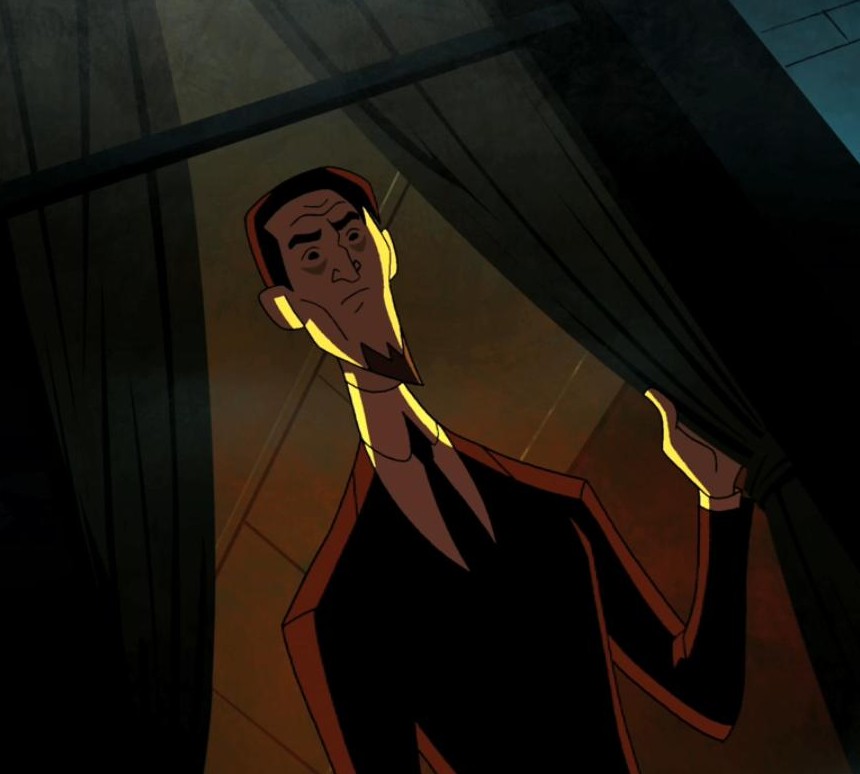
This stance doesn't find favor with one of Hatecraft's biggest fans, a young man named Howard E. Roberts, whom Ellison humiliates at his appearance at Darrow University. Here's Roberts, who looks nothing like any real world person, living or dead.
Char Gar Gothakon attacks the university several times, leading Hatecraft to eventually admit that Ellison is right and that he invented the monster with his own imagination rather than having been contacted by him. Unfortunately, that doesn't stop the beast from attacking Ellison in a parking lot and nearly carrying him off.
I won't say any more about the plot of the episode, since I don't want to spoil it for anyone, though I suspect anyone who's watched even a single Scooby-Doo episode should have no trouble unraveling the mystery. For me, though, the real joy of this was seeing all the references and allusions to some of my favorite pulp fantasists and their creations. It was also amusing seeing Harlan Ellison making light of himself, his writings, and his acerbic style. If you get the chance to see this episode, please do so. There's nothing deep or meaningful in it, but it is great fun.
Now, in general, I'm not a big fan of reboots. They're typically tasked with changing characters and concepts enough so that they're very different in both tone and content from the originals. In the case of Scooby-Doo! Mystery Incorporated, there is a change in tone. The show is much more serious than its predecessors, though not self-serious, if you understand the distinction. There's still plenty of humor and many of the plots are the kinds of things that could only happen in a cartoon. Yet, the stories are presented straight and without irony. In this respect, I'm reminded a bit of Batman: The Brave and the Bold, another excellent cartoon I learned about because of my children.
I bring this all up because, in addition to its other fine qualities, many episodes of Scooby-Doo! Mystery Incorporated are loving homages to horror films or books, which makes them great fun to watch if you catch the references, as I do. A thoroughly delightful example of this was the episode entitled "The Shrieking Madness," which concerns an octopus-headed creature known as Char Gar Gothakon, seen below.
Char Gar Gothakon is the creation of a professor at Darrow University by the name of H.P. Hatecraft, voiced by Jeffrey Combs.
Hatecraft claims that Char Gar Gothakon and his ilk are real entities that contact him in dreams and that he then spins into horror stories.
Some people scoff at this notion, including visiting lecturer Harlan Ellison (voiced by the author himself), deriding Hatecraft as a fraud.
This stance doesn't find favor with one of Hatecraft's biggest fans, a young man named Howard E. Roberts, whom Ellison humiliates at his appearance at Darrow University. Here's Roberts, who looks nothing like any real world person, living or dead.
Char Gar Gothakon attacks the university several times, leading Hatecraft to eventually admit that Ellison is right and that he invented the monster with his own imagination rather than having been contacted by him. Unfortunately, that doesn't stop the beast from attacking Ellison in a parking lot and nearly carrying him off.
I won't say any more about the plot of the episode, since I don't want to spoil it for anyone, though I suspect anyone who's watched even a single Scooby-Doo episode should have no trouble unraveling the mystery. For me, though, the real joy of this was seeing all the references and allusions to some of my favorite pulp fantasists and their creations. It was also amusing seeing Harlan Ellison making light of himself, his writings, and his acerbic style. If you get the chance to see this episode, please do so. There's nothing deep or meaningful in it, but it is great fun.
OSRCon Thoughts (Part III)
After I completed my second session of refereeing Dwimmermount, there was a short break, followed by an hour-long Q&A session, featuring myself, Ed Greenwood, Alex Von Thorn, and Glenn Pearce. Discussion was open-ended, though vaguely focused on the question of "How has the hobby changed since the 1970s and 1980s?"
I don't think it's a secret to say that Ed Greenwood loves an audience. So, while there were four of us on the panel, it was really Ed's show and I was fine with that, because I absolutely love listening to Ed tell stories and generally ham it up for the crowd. I should say, though, that Ed made every effort to include the rest of us in the discussion, often specifically directing questions or comments toward us, so that we could respond. He acted as an impromptu moderator of the panel, albeit one who participated fully in the discussion.
And, as I said, I didn't mind at all, since, frankly, Ed's extremely entertaining to listen to. He had a lot of great stories to share, including tales of his introduction to the hobby and his entry into professional writing ("TSR was clearly desperate"). He also ventured his opinion about the current edition of D&D ("It's a different game entirely") and how TSR drew the wrong lessons from the popularity of the Forgotten Realms, to the detriment of both the company and the setting. Glenn Pearce of the Napoleonic Miniatures Wargames Society of Toronto also had a lot of interesting things to say. What I found most fascinating was how the rise, success, and decline of miniatures wargaming so closely mirrors what has happened in our own hobby. For example, Mr Pearce mentioned that 15mm Napoleonics minis were easily obtainable through department stores in the 1960s and '70s, something I never knew. I was reminded of a similar situation with regards to RPGs in my own youth.
The panel lasted only an hour, so there wasn't a vast scope for discussion, but it was worthwhile nonetheless. What strikes me now, in looking back on it, is that everyone on the panel felt that good games have no expiry date. They are -- or at least can be -- every bit as fun to play at age 40 as they were at age 10. That's certainly my feeling on the matter. The notion that you "can't go home again" is only true in a very limited sense. Certainly I can never again be the naive and wide-eyed kid I was in 1979, but that doesn't mean I still can't enjoy the same things I did back then. I may enjoy them somewhat differently than I did back then -- but I still enjoy them and see no reason why that has to change.
I don't think it's a secret to say that Ed Greenwood loves an audience. So, while there were four of us on the panel, it was really Ed's show and I was fine with that, because I absolutely love listening to Ed tell stories and generally ham it up for the crowd. I should say, though, that Ed made every effort to include the rest of us in the discussion, often specifically directing questions or comments toward us, so that we could respond. He acted as an impromptu moderator of the panel, albeit one who participated fully in the discussion.
And, as I said, I didn't mind at all, since, frankly, Ed's extremely entertaining to listen to. He had a lot of great stories to share, including tales of his introduction to the hobby and his entry into professional writing ("TSR was clearly desperate"). He also ventured his opinion about the current edition of D&D ("It's a different game entirely") and how TSR drew the wrong lessons from the popularity of the Forgotten Realms, to the detriment of both the company and the setting. Glenn Pearce of the Napoleonic Miniatures Wargames Society of Toronto also had a lot of interesting things to say. What I found most fascinating was how the rise, success, and decline of miniatures wargaming so closely mirrors what has happened in our own hobby. For example, Mr Pearce mentioned that 15mm Napoleonics minis were easily obtainable through department stores in the 1960s and '70s, something I never knew. I was reminded of a similar situation with regards to RPGs in my own youth.
The panel lasted only an hour, so there wasn't a vast scope for discussion, but it was worthwhile nonetheless. What strikes me now, in looking back on it, is that everyone on the panel felt that good games have no expiry date. They are -- or at least can be -- every bit as fun to play at age 40 as they were at age 10. That's certainly my feeling on the matter. The notion that you "can't go home again" is only true in a very limited sense. Certainly I can never again be the naive and wide-eyed kid I was in 1979, but that doesn't mean I still can't enjoy the same things I did back then. I may enjoy them somewhat differently than I did back then -- but I still enjoy them and see no reason why that has to change.
Labels:
conventions,
history,
memories,
musings,
old school,
osrcon
Retrospective: Shrine of the Kuo-Toa
I've always been fond of the kuo-toa, the titular antagonists of 1978's Shrine of the Kuo-Toa by Gary Gygax. I suspect my affection for them comes from the fact that H.P. Lovecraft's "The Shadow Over Innsmouth" made a strong impression on me and I read it not long before first encountering this module. Thus, for me, the kuo-toa are inextricably bound up with HPL's deep ones. But, as is so often the case with Gygax's pastiches, he alters the original in ways that make it accessible and satisfying outside its original context. In short, with the kuo-toa, Gygax transformed the deep ones into more -- or, less, depending on one's point of view -- than avatars of Lovecraft's fear of miscegenation. Call the kuo-toa "deep ones lite," if you will, though I would argue that it is that lightness that makes them more suitable as opponents in your average D&D campaign than deep ones.
In some respects, module D2 is very similar to its predecessor, lacking in an explicit plot and filled with a lot of random tables for generating encounters with the denizens of the subterranean world as the PCs continue their quest to find the city of the drow. Where it differs is that Shrine of the Kuo-Toa describes in detail a single eponymous locale, which is intended to be the focus of play. Module D1 had the Caverns and Warrens of the Troglodytes, of course, and they certainly qualify as adventuring locales, but they lack the coherence of the Shrine in my opinion. Players remember the Caverns and Warrens as "just a bunch of caves" populated by a wide variety of monsters, whereas the Shrine is not only held by a single type of monster -- the kuo-toa -- but is clearly important to them, so important that they will mount an organized and determined defense of it against the PCs and their allies.
These allies are another important part of what differentiates modules D1 and D2. The deep gnomes (or svirfneblin) of D2 are presented as determined foes of the kuo-toa and thus potential aids to the player characters in their own efforts. Their motivation is primarily greed, as they've played out all the veins of gems that can be obtained easily and wish to gain more from the area of the Shrine, either by prospecting or, if possible, theft. The deep gnomes are potent enemies, some of whom can summon earth elementals to do their bidding, but they're also suspicious of outsiders. Convincing them to help the PCs is thus an important means of achieving success in this adventure, though it's worth noting that Gygax devotes very little verbiage to it.
The Shrine itself is terrific: a ziggurat-like structure filled with kuo-toa, including many clerical spellcasters (which only makes sense, as it's a religious location). It's here that we first catch glimpses of the awesomely-named Blibdoolpoolp, the Sea Mother of the kuo-toa. Again, Gygax displays his appreciation of the power of names. Blibdoolpoolp is not just a memorably absurd name; it's also one that sounds like it could be uttered by alien lips immersed in water. And the appearance of a nude statuesque woman with the head and claws of a lobster is an inspired way to portray this deity -- alluring and repellant at the same time. I'm not ashamed to admit that, as a kid, I found Blibdoolpoolp quite disturbing and, on some level, I still do.
Shrine of the Kuo-Toa isn't as good as Vault of the Drow, but it's still very good. It presents a well-realized locale that inspires as much as it describes. There can be little question why, like the drow, the kuo-toa are remembered as among the most interesting antagonists AD&D ever placed in the path of adventurers. I am frankly grateful that, more than three decades later, this module remains one of the only places where the kuo-toa are discussed at any length. Unlike the drow, there's still mystery associated with them and I'm sure that contributes greatly to my liking of D2, one of Gary Gygax's finest creations.
In some respects, module D2 is very similar to its predecessor, lacking in an explicit plot and filled with a lot of random tables for generating encounters with the denizens of the subterranean world as the PCs continue their quest to find the city of the drow. Where it differs is that Shrine of the Kuo-Toa describes in detail a single eponymous locale, which is intended to be the focus of play. Module D1 had the Caverns and Warrens of the Troglodytes, of course, and they certainly qualify as adventuring locales, but they lack the coherence of the Shrine in my opinion. Players remember the Caverns and Warrens as "just a bunch of caves" populated by a wide variety of monsters, whereas the Shrine is not only held by a single type of monster -- the kuo-toa -- but is clearly important to them, so important that they will mount an organized and determined defense of it against the PCs and their allies.
These allies are another important part of what differentiates modules D1 and D2. The deep gnomes (or svirfneblin) of D2 are presented as determined foes of the kuo-toa and thus potential aids to the player characters in their own efforts. Their motivation is primarily greed, as they've played out all the veins of gems that can be obtained easily and wish to gain more from the area of the Shrine, either by prospecting or, if possible, theft. The deep gnomes are potent enemies, some of whom can summon earth elementals to do their bidding, but they're also suspicious of outsiders. Convincing them to help the PCs is thus an important means of achieving success in this adventure, though it's worth noting that Gygax devotes very little verbiage to it.
The Shrine itself is terrific: a ziggurat-like structure filled with kuo-toa, including many clerical spellcasters (which only makes sense, as it's a religious location). It's here that we first catch glimpses of the awesomely-named Blibdoolpoolp, the Sea Mother of the kuo-toa. Again, Gygax displays his appreciation of the power of names. Blibdoolpoolp is not just a memorably absurd name; it's also one that sounds like it could be uttered by alien lips immersed in water. And the appearance of a nude statuesque woman with the head and claws of a lobster is an inspired way to portray this deity -- alluring and repellant at the same time. I'm not ashamed to admit that, as a kid, I found Blibdoolpoolp quite disturbing and, on some level, I still do.
Shrine of the Kuo-Toa isn't as good as Vault of the Drow, but it's still very good. It presents a well-realized locale that inspires as much as it describes. There can be little question why, like the drow, the kuo-toa are remembered as among the most interesting antagonists AD&D ever placed in the path of adventurers. I am frankly grateful that, more than three decades later, this module remains one of the only places where the kuo-toa are discussed at any length. Unlike the drow, there's still mystery associated with them and I'm sure that contributes greatly to my liking of D2, one of Gary Gygax's finest creations.
Tuesday, August 16, 2011
OSRCon Thoughts (Part II)
The second day of OSRCon was a long one for me, beginning at 9:30 am and finishing at 7:30 pm, with scarcely a break. That probably explains why, by the end of the day, I had a terrible headache that prevented me from fully enjoying the AD&D game I played with Ed Greenwood as DM in the afternoon/evening (about which I'll say more later).
My second session refereeing was also devoted to exploring Dwimmermount using the OD&D rules. This time, it was the infamous third level -- The House of Portals -- to which the PCs were dispatched by a sage named Fandel who was looking for evidence that three of its otherworldly gates were still operable after so many centuries of disuse. Again, the PCs were pre-generated, though of more experience than those used in the previous day's session (5001 XP each, so generally 3rd or 4th level, depending on class). A couple of my players were repeats from the day before, but most were new. Of those that returned, one decided to play the "same" character -- a dwarf fighter -- explaining away the difference in ability scores between the 1st-level and 3rd-level versions as the result of age and misadventure. I have to admit that I rather liked that explanation.
The House of Portals is a big level and one that's been extensively -- though not completely -- explored by the players in my face-to-face Dwimmermount campaign. Consequently, when the players at OSRCon came to various rooms, they saw evidence of my regular players' actions in the way that certain traps had already been sprung or items were missing from where they expected them to be. To me, Dwimmermount is a "living" place, constantly changing in response to what happens in any sessions I run using it. Until now, though, I'd never run a second group through the dungeon, so there was never an opportunity to highlight this fact in quite this way. The OSRCon players found it intriguing and noteworthy enough to comment on it a couple of times. For a moment, I got a flash of what it might have been like to have played in one of those early campaigns of old, where there were 20+ players who all explored the same megadungeon at different times.
The session itself went well and the players were, again, excellent. What impressed me most was how thorough and focused they were in their exploration of the dungeon. They took note of everything and made their decisions about which way to proceed based on the information they received and how well it jibed with what they were looking for. From my perspective, it was a thing of beauty, as was the way that the players spent time speaking, in character, with one another, as they debated the best course of action. As the referee, this made the session run really smoothly. Plus, it was just plain fun to watch.
At the end of the session, several of the players expressed interest in continuing their explorations later. They'd just found the portal to the Red Planet of Areon -- two of them even went through to see that the portal still worked -- and were really keen on spending more time there, but we ran out of time. That's why I'm thinking ever more of starting up regular open-ended Dwimmermount sessions on Google+ in the near future with a rotating cast of characters (and players). More on that as details become clearer.
My second session refereeing was also devoted to exploring Dwimmermount using the OD&D rules. This time, it was the infamous third level -- The House of Portals -- to which the PCs were dispatched by a sage named Fandel who was looking for evidence that three of its otherworldly gates were still operable after so many centuries of disuse. Again, the PCs were pre-generated, though of more experience than those used in the previous day's session (5001 XP each, so generally 3rd or 4th level, depending on class). A couple of my players were repeats from the day before, but most were new. Of those that returned, one decided to play the "same" character -- a dwarf fighter -- explaining away the difference in ability scores between the 1st-level and 3rd-level versions as the result of age and misadventure. I have to admit that I rather liked that explanation.
The House of Portals is a big level and one that's been extensively -- though not completely -- explored by the players in my face-to-face Dwimmermount campaign. Consequently, when the players at OSRCon came to various rooms, they saw evidence of my regular players' actions in the way that certain traps had already been sprung or items were missing from where they expected them to be. To me, Dwimmermount is a "living" place, constantly changing in response to what happens in any sessions I run using it. Until now, though, I'd never run a second group through the dungeon, so there was never an opportunity to highlight this fact in quite this way. The OSRCon players found it intriguing and noteworthy enough to comment on it a couple of times. For a moment, I got a flash of what it might have been like to have played in one of those early campaigns of old, where there were 20+ players who all explored the same megadungeon at different times.
The session itself went well and the players were, again, excellent. What impressed me most was how thorough and focused they were in their exploration of the dungeon. They took note of everything and made their decisions about which way to proceed based on the information they received and how well it jibed with what they were looking for. From my perspective, it was a thing of beauty, as was the way that the players spent time speaking, in character, with one another, as they debated the best course of action. As the referee, this made the session run really smoothly. Plus, it was just plain fun to watch.
At the end of the session, several of the players expressed interest in continuing their explorations later. They'd just found the portal to the Red Planet of Areon -- two of them even went through to see that the portal still worked -- and were really keen on spending more time there, but we ran out of time. That's why I'm thinking ever more of starting up regular open-ended Dwimmermount sessions on Google+ in the near future with a rotating cast of characters (and players). More on that as details become clearer.
Labels:
conventions,
dwimmermount,
memories,
musings,
old school,
osrcon
OSRCon Thoughts (Part I)
Originally, I'd planned to write a single post summing up my thoughts and feelings about everything I did and saw while at OSRCon this past weekend, but I've now become convinced that there's enough of interest to justify several posts. Let me start by praising both the convention's organizer, Chris Cunnington, and its sponsor, the Merrill Collection of Science Fiction, Speculation & Fantasy for making this happen. The con went off without any hitch that I could detect and the facilities at the Lillian H. Smith library were fantastic. So, kudos to everyone who helped inaugurate what I hope will be a long-lasting tradition here in Toronto.
As I'm certain I've stated innumerable times before, I am not a con-goer. I've been to GenCon and Origins once each and am frankly not in a huge hurry to attend either again anytime soon. I find such gatherings simply too overwhelming to enjoy properly. Likewise, I haven't run an adventure for a group of total strangers since I did so at "RPG days" at local libraries back in Baltimore County in the early 1980s. I've got a long-established group of players with whom I've been playing since the early 1990s and the last new player added to that group joined us over a decade ago. Consequently, it's no exaggeration to say that I felt some trepidation at the thought of attending OSRCon.
As it turned out, I had no reason whatsoever to be concerned. I very quickly felt quite comfortable, due in no small part to Chris Cunnington's excellent organization and discussions with me beforehand. But, much as I wish to praise Chris, even more do I wish to praise the con's attendees, who were, to a man, some of the friendliest and most pleasant gamers I've had the occasion to meet. As I noted in a comment to an earlier post, gamers have a reputation for being socially awkward misfits who are in large part responsible for the bad impressions outsiders have of our shared hobby. I came away from OSRCon with the feeling that, while that description may be true of some gamers, it certainly isn't true of most of them, certainly not any of those with whom I interacted over the course of two days. I won't go so far as to claim that "the ugly gamer" is wholly a myth, even if I am sure that he's not as common a creature as conventional wisdom would have us believe.
On Friday, I ran a single four-hour session of my Dwimmermount megadungeon. This session had six players -- the maximum allowed to register -- and involved the exploration of Level 1 of the mountain fortress. All the players used pre-generated characters, resulting in a party that consisted of two dwarves, a fighting man, a cleric of Typhon, a magic-user, and a thief. I was (mostly) using LBB + Greyhawk OD&D, supplemented with a few minor house rules. I allowed spellcasters to choose their own spells and used Jeff's "deck of stuff" to give each character something unusual to play with. I also provided a frame for the session: the PCs were sent by some dwarves to seek out the whereabouts of a dwarven cemetery reputed to be on the first level, as well as to determine what had become of a previous scouting party, consisting of three dwarves and a gnome, that never returned from their mission. This latter bit proved very useful, since it kept the players focused. Otherwise, four hours could easily have elapsed without any sense of "conclusion," if you catch my meaning.
There are many things that stick with me after Friday's session. The first was just how fresh Dwimmermount became when seen through the eyes of players who'd never walked its corridors before. I've been running that megadungeon for 2+ years now with the same crew of players and, while it's still fun for us, familiarity can sometimes breed contempt. Playing it with new people made it all seem new, even to me, and that's a terrific feeling. Also, I felt very much at ease refereeing, since I knew the dungeon inside and out already, having run it many times previously. This afforded me the opportunity to present everything I already knew in an entertaining and intriguing way. Whatever "stage fright" I had when I first sat down at the table quickly evaporated.
What was also neat to watch was how quickly this group, consisting of people who didn't know each other before the con, cohered into a unified party. They acted as a group and did so well. Furthermore, their characters, who began as little more than a jumble of stats I handed them, were true characters by the end of the session, so much so in fact that I found myself wishing I could continue to play with this same group again in the future. It was amazing to watch them them develop tactics and procedures as they dealt with the tricks, traps, and monsters they encountered. There were times when I felt myself transported back to those heady days when my friends I did the same and it confirmed for me that it is possible to go home again. Good games never get old and D&D is a very good game.
There are too many moments from the session to recount and this entry has already gone on longer than I anticipated, so I won't share most of them here. However, the one that really stayed with me is one where, having fought innumerable small skirmishes with kobolds in the caves leading to where the PCs felt the dwarven cemetery was located, they corned a large band of them and attempted to parley with them. One of the dwarves, believing that negotiation might work, offered to help the kobolds against the orcs inhabiting another part of the dungeon in exchange for the kobolds' leaving the dwarven cemetery alone. The kobolds were unwilling to accept this offer, since, as they explained, "We need the dead dwarves to replenish our numbers." Yes, that's right: kobolds are made from dead dwarves in the Dwimmermount setting. Upon learning this, the formerly pacific dwarf raised his warhammer (which he dubbed "Grool") and ran right into the kobolds' midst to slay them. As he explained later to his companions, "I pitied them at first, but, now that I know what they're doing, they must all die!" It was a great moment in a session filled with them.
As I'm certain I've stated innumerable times before, I am not a con-goer. I've been to GenCon and Origins once each and am frankly not in a huge hurry to attend either again anytime soon. I find such gatherings simply too overwhelming to enjoy properly. Likewise, I haven't run an adventure for a group of total strangers since I did so at "RPG days" at local libraries back in Baltimore County in the early 1980s. I've got a long-established group of players with whom I've been playing since the early 1990s and the last new player added to that group joined us over a decade ago. Consequently, it's no exaggeration to say that I felt some trepidation at the thought of attending OSRCon.
As it turned out, I had no reason whatsoever to be concerned. I very quickly felt quite comfortable, due in no small part to Chris Cunnington's excellent organization and discussions with me beforehand. But, much as I wish to praise Chris, even more do I wish to praise the con's attendees, who were, to a man, some of the friendliest and most pleasant gamers I've had the occasion to meet. As I noted in a comment to an earlier post, gamers have a reputation for being socially awkward misfits who are in large part responsible for the bad impressions outsiders have of our shared hobby. I came away from OSRCon with the feeling that, while that description may be true of some gamers, it certainly isn't true of most of them, certainly not any of those with whom I interacted over the course of two days. I won't go so far as to claim that "the ugly gamer" is wholly a myth, even if I am sure that he's not as common a creature as conventional wisdom would have us believe.
On Friday, I ran a single four-hour session of my Dwimmermount megadungeon. This session had six players -- the maximum allowed to register -- and involved the exploration of Level 1 of the mountain fortress. All the players used pre-generated characters, resulting in a party that consisted of two dwarves, a fighting man, a cleric of Typhon, a magic-user, and a thief. I was (mostly) using LBB + Greyhawk OD&D, supplemented with a few minor house rules. I allowed spellcasters to choose their own spells and used Jeff's "deck of stuff" to give each character something unusual to play with. I also provided a frame for the session: the PCs were sent by some dwarves to seek out the whereabouts of a dwarven cemetery reputed to be on the first level, as well as to determine what had become of a previous scouting party, consisting of three dwarves and a gnome, that never returned from their mission. This latter bit proved very useful, since it kept the players focused. Otherwise, four hours could easily have elapsed without any sense of "conclusion," if you catch my meaning.
There are many things that stick with me after Friday's session. The first was just how fresh Dwimmermount became when seen through the eyes of players who'd never walked its corridors before. I've been running that megadungeon for 2+ years now with the same crew of players and, while it's still fun for us, familiarity can sometimes breed contempt. Playing it with new people made it all seem new, even to me, and that's a terrific feeling. Also, I felt very much at ease refereeing, since I knew the dungeon inside and out already, having run it many times previously. This afforded me the opportunity to present everything I already knew in an entertaining and intriguing way. Whatever "stage fright" I had when I first sat down at the table quickly evaporated.
What was also neat to watch was how quickly this group, consisting of people who didn't know each other before the con, cohered into a unified party. They acted as a group and did so well. Furthermore, their characters, who began as little more than a jumble of stats I handed them, were true characters by the end of the session, so much so in fact that I found myself wishing I could continue to play with this same group again in the future. It was amazing to watch them them develop tactics and procedures as they dealt with the tricks, traps, and monsters they encountered. There were times when I felt myself transported back to those heady days when my friends I did the same and it confirmed for me that it is possible to go home again. Good games never get old and D&D is a very good game.
There are too many moments from the session to recount and this entry has already gone on longer than I anticipated, so I won't share most of them here. However, the one that really stayed with me is one where, having fought innumerable small skirmishes with kobolds in the caves leading to where the PCs felt the dwarven cemetery was located, they corned a large band of them and attempted to parley with them. One of the dwarves, believing that negotiation might work, offered to help the kobolds against the orcs inhabiting another part of the dungeon in exchange for the kobolds' leaving the dwarven cemetery alone. The kobolds were unwilling to accept this offer, since, as they explained, "We need the dead dwarves to replenish our numbers." Yes, that's right: kobolds are made from dead dwarves in the Dwimmermount setting. Upon learning this, the formerly pacific dwarf raised his warhammer (which he dubbed "Grool") and ran right into the kobolds' midst to slay them. As he explained later to his companions, "I pitied them at first, but, now that I know what they're doing, they must all die!" It was a great moment in a session filled with them.
Labels:
conventions,
dwimmermount,
memories,
musings,
old school,
osrcon
The Ads of Dragon: Jorune
Issue #87 (July 1984) had the following ad in its pages:
While not nearly as evocative as later advertisements for Jorune, this one was nevertheless quite effective in getting me to wonder, "What the heck is Jorune?" Of course, since I didn't attend GenCon 17, I never got the chance to see a copy of the game itself, a situation I wasn't able to rectify until quite some years after it was published, by which point my initial fascination with it had subsided. Having finally read Jorune (or Skyrealms of Jorune, as it's actually titled), I'm not sure I'd have ever played the game back in the day even if I had been able to obtain a copy in 1984, but I'd have enjoyed reading it back then, too. It's a unique and fascinating setting for a "fantasy" RPG -- indeed one of the best.
Labels:
ads of dragon,
dragon magazine,
jorune,
memories
Monday, August 15, 2011
Getting Old
My apologies for the lack of posts today. I've been busy doing real world things, including a visit to the eye doctor. As expected, I needed to get a new prescription for my glasses, which included a need for bifocals. I am now officially an old man!
In any case, I'll try to catch up on my missed posts tomorrow, including a fuller report on OSRCon.
Saturday, August 13, 2011
OSRCon, Day 2
The second and final day of OSRCon was today and it was just as enjoyable as yesterday. I'll give a fuller report of events either tomorrow or Monday, but I will share a couple of photos from today's question and answer session with its guests.
Here's one of many of the attendees of the conventions. I was pleased by the wide range of ages represented.
This is a long shot of one of the halls in which the convention was held. You can see the four panelists for the Q&A session (I'm the short guy on the far left).
Here's a group shot of the four of us on the panel discussing the past and present of RPGs and wargaming. That's me on the left. Ed Greenwood is sitting next to me. Next to him in the hat is Alex Von Thorn, who owned and operated a game store here in Toronto for over 20 years. He's also the author of "The Politics of Hell," from issue #28 of Dragon, among several other works. On the far right is Glenn Pearce, who's a member of the Napoleonic Miniatures Wargame Society of Toronto.
This is a close-up of the four panelists.
I'm tired and a little under the weather after the last couple of days' activities, so I'll save in-depth commentary for later. Once again, I'll just say that the con was good fun for all involved and I'm already looking forward to attending again next year.
Here's one of many of the attendees of the conventions. I was pleased by the wide range of ages represented.
This is a long shot of one of the halls in which the convention was held. You can see the four panelists for the Q&A session (I'm the short guy on the far left).
Here's a group shot of the four of us on the panel discussing the past and present of RPGs and wargaming. That's me on the left. Ed Greenwood is sitting next to me. Next to him in the hat is Alex Von Thorn, who owned and operated a game store here in Toronto for over 20 years. He's also the author of "The Politics of Hell," from issue #28 of Dragon, among several other works. On the far right is Glenn Pearce, who's a member of the Napoleonic Miniatures Wargame Society of Toronto.
This is a close-up of the four panelists.
I'm tired and a little under the weather after the last couple of days' activities, so I'll save in-depth commentary for later. Once again, I'll just say that the con was good fun for all involved and I'm already looking forward to attending again next year.
Friday, August 12, 2011
OSRCon, Day 1
I'm back from Day 1 of OSRCon and had a blast. I ran six players through Dwimmermount on a quest to find the location of a dwarven cemetery reputed to be hidden somewhere on the first level. I'll have more to say in depth about the session and its events, but, for now, let me say what a joy it was to play D&D with people I'd never met before. I'm really looking forward to doing it again tomorrow, as well as at future conventions.
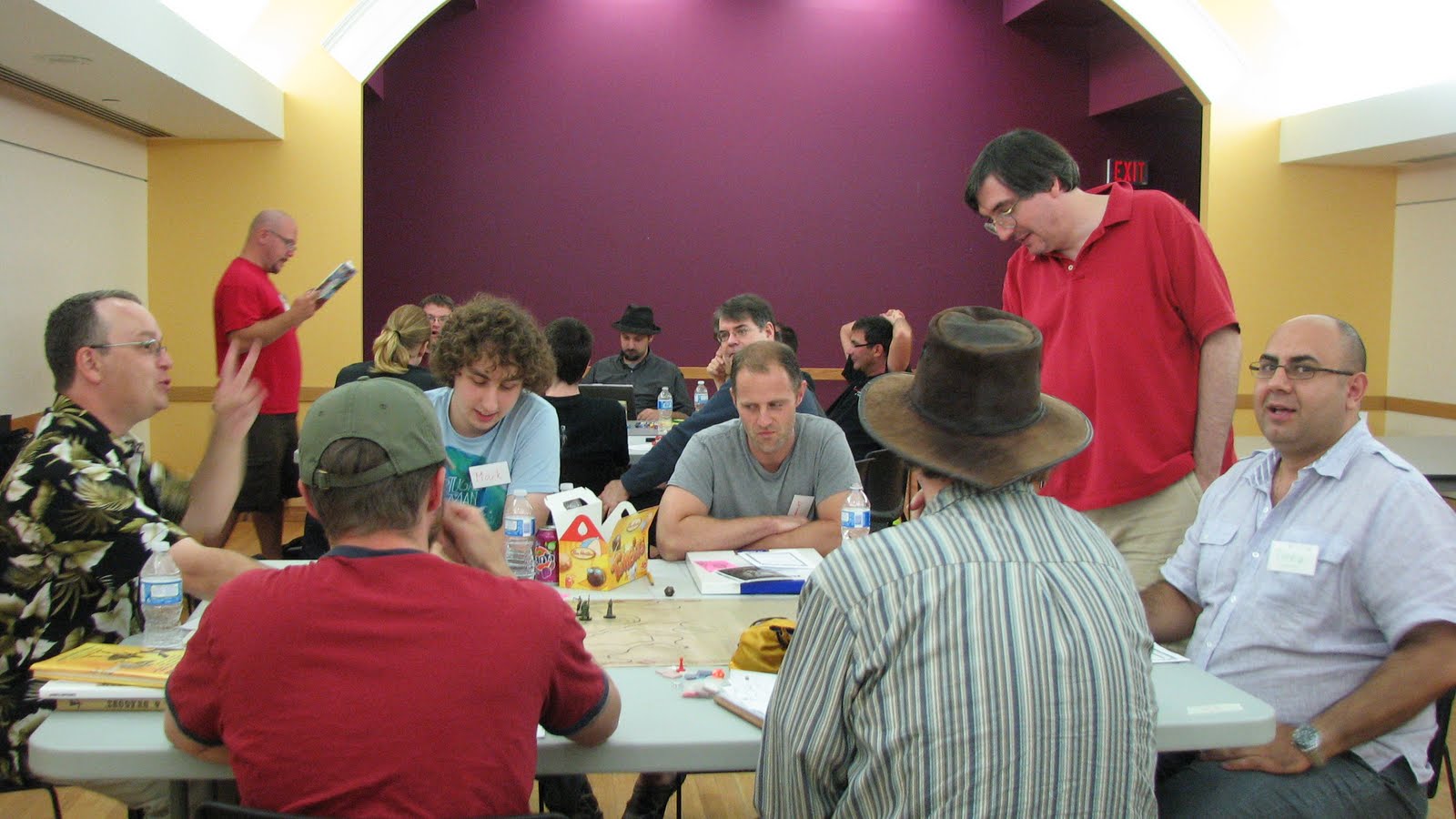
Here's a shot of our table, while the players are in the midst of a desperate fight against kobolds. The guys at the table behind us were playing AD&D and seemed to be having a great time, too.
Subscribe to:
Posts (Atom)