
Sunday, December 4, 2011
The Underdark Gazette is Moving
In case you haven't already heard, James of the Underdark Gazette is going to be shutting down his current blog at the start of 2012 and devoting himself instead to a new one, entitled Dreams of Mythic Fantasy. While I fully understand the reasons behind the shift and largely agree with them, I'm still sorry to see the Underdark Gazette go. It's been a pillar of the old school community for several years now and it's long been my one-stop shop for the latest news and information from our little echo chamber, so it's nice to know that James will continue doing what he's been doing so well, even if it's under a new name.


The Whisperer in Darkness Available for Pre-Order

Whisperer is a much more ambitious project by the HPLHS, being more than twice as long as its predecessor and being a talkie rather than a silent film. Reviews at the time of its limited release during this year's convention season were mixed. There was a lot of praise for the film's period production values, but some reviewers weren't happy with the pacing (or the CGI mi-go). If you think the pacing issues owe to its being too faithful to HPL, then you'd be wrong, as some reviews have also noted that this movie deviates considerably from the text, particularly in its final act.
This disappoints me a little bit. A big part of the appeal of these fan films is that they hew fairly closely to their source material, but, not having seen the movie, it's hard to know whether or not the deviations are nevertheless in the spirit of Lovecraft. Even if they aren't, I have a hard time imagining that they'll be as deviant as most Hollywood efforts to bring HPL to the silver screen to date. Once my copy arrives -- and I have no idea when that'll be -- I'll post my own review here.
Saturday, December 3, 2011
The Inirot
I'm not a big fan of humanoid alien races, or at least I prefer that, when possible, extraterrestrial beings not share many physical characteristics with human beings. That's why, in Thousand Suns, all the sample alien races look pretty weird, like these guys, the Inirot.
 |
| ©2011 Alfredo Lopez Jr. |
The Game You Think You Know
It's funny how often you can read a book and still overlook something that's stated very clearly and unambiguously. For example, a lot of players of OD&D fail to notice that the Dexterity bonus to Armor Class applies only to fighting men and to no other class. Of course, the same is true of the bonuses to hit and damage for high Strength. That's something I didn't realize until earlier today when I was re-reading my copy of Greyhawk and saw the following on page 7:
Strength also aids the fighting man in his ability to both score a hit upon an adversary and damage it. This strength must be raw. i.e. not altered by intelligence scores. On the other hand low strength will effect [sic] any character's fighting ability.If I'd ever read those words before, I don't recall them. It's a perfect example of why it's so important to read OD&D with fresh eyes and to try to forget, to the extent that it's possible, what you think you know about the game based on what was done in later editions.
A Kindred Spirit
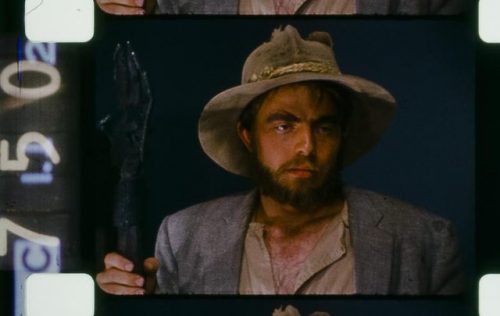
A common refrain I’ve heard is that without Joel and the Bots, the movie is “unwatchable”, but I suspect a big part of that is the bad visual presentation that the movie has always had. When you divest Manos of its grimy, unpleasant patina, you are still left with a weirdly dubbed, strangely edited, small town, outsider horror film. But with a clearer view of the production design (paintings, metalwork, and stone sculptures by Tom Neyman, a local artist who played The Master), the off kilter handmade world the film presents, and the shaggy but poppy Ektachrome photography by Robert Guidry, 45 years later Manos assumes a different identity as a fascinating bit of 1966 ephemera.This is a big part of why Solovey wants to restore the film, but it's not the only one.
Here is a truly independent horror film from the 60′s, a contemporary of 1962′s Carnival of Souls and 1968′s Night of the Living Dead. The main difference being, of course, that those movies came from career filmmakers Herk Harvey and George Romero, who had already made commercials and industrials and knew how a set should be run. Hal Warren, director of Manos, did not have that sort of experience and the deck was truly stacked against him. Although he had not yet infamously sold fertilizer- that would come later- he was a good salesman and was able to rustle up a reported budget of $19,000 (over $132,000 in today’s money) to get his script made.I don't know about you, but I can't help but applaud Solovey's efforts, perhaps because I detect in him a kindred spirit to a lot of us in the old school community, someone who's willing to ignore conventional wisdom about the quality of a work and try to appreciate it for the virtues it might possess beneath the patina it's accumulated over the years. That's an attitude worthy of respect and so I'll be paying close attention to this project in the weeks and months to come.
If you yourself have ever been involved in an independent movie, Manos becomes somewhat poignant as you see evidence of the problems that have arisen and have been worked around or willfully ignored. Actors dropping in and out of the production, a broken leg that stranded two in a car for their entire screen time…
A lack of reliable electricity, which creates a murky, crudely lit effect at night…
Animals that were unwisely written into the movie and refuse to cooperate…
It’s all very relatable stuff. And because this is a movie where the artifices of filmmaking are constantly crumbling and being rebuilt, a little shakier every time, it holds a certain fascination to film buffs that places it above worse and more boring films (which there are no shortage of, then or now). Simply put, it’s memorable. If you’ve seen it you’ll remember Torgo and the Master. You’ll remember the interminable driving that opens the movie, the weird squabbling of the Wives, the loungey soundtrack, the unconvincing dubbing, the Scorpio Rising-esque invocation of Manos, God Of Primal Darkness. All this in a film that’s only 70 minutes and change.
So rather than have Manos fade away as a footnote with only a cruddy video transfer to remember it by, I’ve resolved to make it a personal project to restore it.
Memories of Gary Gygax
Quite a number of people emailed me yesterday to point out a post on Jim Shooter's blog about his meeting with Gary Gygax and some "executives" from TSR back in the Fall of 1981. Of particular interest were these paragraphs:
Thanks to everyone who pointed me toward this story.
After reading that, I have to wonder who these "executives" at TSR were. While I don't doubt Shooter's recollection that they, like Gygax, "clearly loved D&D," it does fly in the face of the received view of TSR's history that, by the time the Blume brothers were fully in control (and they were in 1981, as I understand it), the company came increasingly to be run by people who didn't know or care about gaming. Now, maybe at this early stage, the culture of TSR hadn't yet changed, I don't know, but it's nevertheless fascinating to read an outsider's perspective on Gygax and the other TSR-ites he met back in 1981.Gary and his troops talked about what they did. Gary struck me as a brilliant, clever and creative guy.
I was also impressed that his top executives, suit-and-tie business people types who wouldn’t look out of place at MetLife, all knew the game and played the game. They clearly loved D&D.
Then it was our turn to talk about what we did. Galton and the licensing people made it clear that they were far too dignified and sophisticated as human beings to ever read a comic book. They joked about not knowing anything about the comics.
I have to believe the TSR people had to be a little insulted. If Marvel’s execs thought that proper adult business people worried only about dollars and deals, that actually reading the books would be somehow embarrassing, then what might they be thinking of TSR’s game-playing execs?
Thanks to everyone who pointed me toward this story.
Friday, December 2, 2011
Open Friday: Good Gaming Art
One of the truly frustrating aspects of discussing old school games, both the originals and those inspired by them, is the moving target of what constitutes "good" gaming art. For some, nothing less than homages to art from three decades ago can ever be good; for others, anything that demonstrates even the slightest connection to what has come before will never suffice. I suppose I shouldn't be surprised by this diversity of opinions, since there's never been a consensus on such matters. I mean, even back in the early '80s there were people who didn't like Erol Otus (and still don't).
So, rather than trying to come to any conclusions regarding what makes good gaming art in any universal sense, what I want to know is: what piece of art, produced in the last five years, do you consider a particularly effective piece of gaming art and why? Just stick to that question and nothing else, least of all criticizing someone else's choice of what they consider good. The point of this question is simply to learn what my readership likes and why.
So, rather than trying to come to any conclusions regarding what makes good gaming art in any universal sense, what I want to know is: what piece of art, produced in the last five years, do you consider a particularly effective piece of gaming art and why? Just stick to that question and nothing else, least of all criticizing someone else's choice of what they consider good. The point of this question is simply to learn what my readership likes and why.
Thursday, December 1, 2011
Oubliette #7 Released

Here's the Full Contents:
- Editorial
- Tales from Hell Cartoon
- Monster Club #11: The Naughty Step
- Miniatures Special: An Interview with Richard Scott of Otherworld Miniatures
- Monster Club #12: Dungeon Random Encounter Tables: Levels 4-6
- Newland Campaign Setting Part II: Raiders
- Monster Club #13: Newland Bestiary Part I
- Tomb of the Snake King: A Labyrinth Lord Adventure for 3rd to 5th Level Characters
- The 10-Foot Pole
- Found Familiar: The Toad
- Goblin Quest Cartoon
- What's in the Oubliette? Reviews
- Mouse Watch Cartoon
- The Song of Sithakk Part 7: A Dream of Blossoms
John Carter Trailer
For the few of you who haven't yet seen it, here it is:
Naturally, I have some fan boy complaints, chief among them being that Dejah Thoris is neither red nor incomparable, but, based on what this trailer shows us, the movie looks like a seriously good faith effort to bring A Princess of Mars to the silver screen, which I cannot help but applaud.
Naturally, I have some fan boy complaints, chief among them being that Dejah Thoris is neither red nor incomparable, but, based on what this trailer shows us, the movie looks like a seriously good faith effort to bring A Princess of Mars to the silver screen, which I cannot help but applaud.
The Articles of Dragon: "Relief for Traveller Nobility"

For those not familiar with the game, Traveller characters have six randomly determined ability scores, one of which is Social Standing. Scores are generated by rolling 2D6 and results of 11 or 12 for Social Standing indicate the character is of noble birth. Scores can reach as high as 15 a result of events in character generation, with each number above 10 reflective of a different level of nobility (from Knight to Duke). This is all well and good and comports with much of the sci-fi that inspired Traveller, but, other than a title, there is absolutely no difference between a noble character and a non-noble one. One could reasonably argue that it's up to the referee to decide what benefits (and drawbacks) go along with patents of nobility in his campaign, especially given that Traveller presents itself as a generic game without a default setting of its own. However, not a few gamers wanted something more than "make it up yourself" and that's where Crabaugh's article comes in.
"Relief for Traveller Nobility" firstly provides rules for determining what sort of family estate (if any) a noble character possesses, as well as the revenue generated by it. Of course, estates require management and, if a noble does not spend much time on his estate, preferring instead to go traipsing across the galaxy with his old military buddies, there's an ever-increasing chance of a coup or revolt. Of course, estates have expenses, too, and Crabaugh spends some time discussing that aspect of noble life in the article. He also discusses the sorts of personal starships to which a noble might have access, something suggested in various parts of the rules but insufficiently fleshed out to Crabaugh's satisfaction.
In the end, it's actually a very short and sketchy article, but it provides more ideas for dealing with noble characters in Traveller than were ever provided in the rules themselves. One of the things that Crabaugh stresses is that the presence of a noble character who takes running his estate seriously will necessarily change the content and scope of the campaign. Instead of speculative trading and breaking and entering on behalf of shady patrons met in startown bars, the campaign will focus more on power politics and all that that entails. That's certainly my own experience in playing a noble-centric campaign and doing it successfully definitely requires a shift in one's perspective and expectations. On the other hand, it can be a lot of fun, particularly if, like me, you enjoy the ups and downs of political machinations and jockeying for influence.
Subscribe to:
Posts (Atom)