6. You were in charge of design and development on the original Forgotten Realms boxed set. What was it like to pore over Ed Greenwood's pages of notes and turn them into a publishable product?
Friday, August 21, 2020
Interview: Jeff Grubb (Part II)
Thursday, August 20, 2020
Sage Words
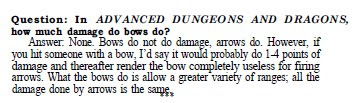
I hope to answer many questions that people may have on their minds about D&D or AD&D. Part of my job at TSR is answering questions about the game, and sometimes refereeing a dispute between players and their DMs.While this might seem like a exercise in tedium, particularly in light of statements by Gary Gygax and others that implied Advanced Dungeons & Dragons would possess clear and unambiguous rules (lest it become a "non-game" like its predecessor), it was not, thanks in large part to Wells's humor. Take, for example, her answer to the second question ever asked in the column.
Here's another amusing entry in that very first column. Taken together, I think they set the tone for her tenure as the Sage.
I adopted this approach because this is who I am. I tend to look at humor in life. I believe in laughter especially when things are taken out of context and way over done. I chose the strangest most far fetched questions for two reasons. One, they were funny, and two they were also a sad statement on the depths that some people played this "game."I felt the youngsters under the age of sixteen were spending far too much time being far too serious about a game when they needed to focus some of that attention back on their families and schools. I'd hoped the kids would see the humor in the situation and not take the game so seriously that every breath they took, every word they said was about D&D.
Sword of Sorcery
During its brief run, O'Neil adapted four of Leiber's short stories ("The Price of Pain Ease," "Thieves' House," "The Cloud of Hate," and "The Sunken Land") and wrote one original tale of the Twain, which appears in issue #3. Interestingly, Chaykin would himself adapt several Nehwon stories for Dark Horse Comics in 2007, this time with Mike Mignola and Al Williamson providing the artwork.
I'd never seen any of these until fairly recently, since I was quite young when they originally appeared. Overall, they're not bad, roughly comparable to the adaptations you'd see in Marvel's Conan the Barbarian, which predated it by a three years. Indeed, it's quite likely that Sword of Sorcery was part of an attempt by DC to take advantage of the growing popularity of not just Conan, but fantasy stories in general.
The more one delves into the popular culture of the late 1960s and early 1970s, the more sense the appearance of Dungeons & Dragons at that precise time makes. There was definitely something in the air at the time.
Interview: Jeff Grubb (Part I)
Jeff Grubb worked at TSR Hobbies from 1982 to 1994. During that time he served as the design consultant on Gary Gygax's Monster Manual II and Unearthed Arcana, joined the team behind Dragonlance, developed the Forgotten Realms, and designed the Marvel Super Heroes roleplaying game, among many other projects. He very kindly agreed to answer a few questions about his time at TSR as well as his current projects. The second part of this interview will appear tomorrow.
1. How did you first become involved in the hobby of roleplaying?
Wednesday, August 19, 2020
A Momentous Summer
Have Space Suit – Will Travel
When I was a child, I owned a copy of the Marvel Treasury Special adaptation of 2001 by Jack Kirby. I can't recall how I acquired it, though I suspect it was a gift by a well-meaning relative who knew that I liked science fiction. I am certain that I read the comic before I ever saw the movie (which wasn't released on home video until 1980). The combination of Clarke's story, Kubrick's visuals, and Kirby's art was a heady mix and I was equally enthralled and frightened by what I saw in those large newsprint pages.
Perhaps unsurprisingly, I became a fan of 2001: A Space Odyssey when I finally did see the film and it remains one of my favorite movies. I recently re-watched it; my feelings toward it are unchanged: I consider it not only one of the greatest science fiction films of all time, but one of the greatest films regardless of genre.Even if you disagree with that assessment, it's hard to deny how influential the movie is. Without even paying close attention, you can recognize imagery, set designs, costuming, even plot details that have clear echoes in subsequent motion pictures. Ash from Alien owes a lot to HAL 9000, for example, particularly in his having been given a hidden agenda at odds with those of the human characters. Likewise, the Enterprise's encounter with V'ger in Star Trek: The Motion Picture would have been impossible without the final act of 2001, "Jupiter and Beyond the Infinite."
Growing up in the immediate aftermath of the Apollo lunar lanading, astronauts and space suits were everywhere. 2001 has particularly stylish and iconic space suits – so much so that I am convinced the multi-colored thruster suits from the aforementioned Star Trek film are a tribute to those in Kubrick's masterpiece. Come to think of it, Alien also had remarkable space suits, but those are the work of French artist Jean Giraud, better known by his nom de plume, Moebius.
On the other hand, science fiction like Star Wars or Battlestar Galactica didn't have a place for space suits – flight helmets, yes, but not full suits of the sort seen elsewhere. It's probably for this reason that I've subconsciously come to divide space-oriented sci-fi into space suit and non-space categories, with the former being more "serious" than the latter. The lack of space suits is something I associate with action-oriented space opera rather than idea-based science fiction. Obviously, this is a completely unfair distinction, one largely based, I imagine, on the prominence that space suits had in 2001: A Space Odyssey.
Nevertheless, it's a distinction that's been lurking at the back of my mind since childhood, affecting even my feelings about science fiction roleplaying games. One of the most basic and ubiquitous skills in GDW's Traveller is Vacc Suit (though I've never discovered the origin of the second "c" in the word). Consequently, I've always seen the game as a sober, serious, and indeed thoughtful game, compared to, say, TSR's Star Frontiers, which, while I have a great fondness for it, didn't even mention space suits or their equivalent until the release of the Knights Hawks expansion a year later. Ironically, it was Star Frontiers that saw an adventure module based on 2001: A Space Odyssey, not Traveller, which only goes to show how arbitrary distinctions like this can be.
Retrospective: Dwarven Glory
Also like its predecessor, Dwarven Glory calls itself a "dungeon kit." As you will see, this is an apt description. The product consists of eight hex map sections, each of which can be connected to the others in a variety of different ways (more than sixty, according to the text). This allows the referee to configure the dungeon according to his own wishes (or re-use it). Thus, Dwarven Glory is as much a set of geomorphic maps as it is an "adventure module," as the term is generally understood.
These maps detail a semi-abandoned dwarven community that is now overrun by the Ten Orc Tribes. Their keys are comparatively brief, but not minimalist. Here's a typical example:
This room contains 4 locked cabinets (each with 6 bottles of Dwarven Ripple Wine), 18 empty bottles (on the floor), and a long table with 8 plain cups (in the corner).
Many entries contain even less detail. However, a few are more elaborate, containing not only specific information but the germs of side adventures.
The door is trapped with a bank of crossbows set to fire 5 hexes across towards Room #4. A Minotaur (HP 21; AC 6) carries a +2 hand axe and 4,000 SP. The room contains a roasting rack with several Human skeletons and 2 bedding areas. There are 4 gems: one is worth 1,000 GP, one is broken with no value, one is a Gem of Giant Strength, and one is a Gem of Sexual Change. The Minotaur puts the party under a geas to find and return his son unharmed. Failure to perform this task invokes a curse upon the party members (loss of 1 intelligence pt per day, unless the geas is resumed; the effects are not reversible). If the geas is fulfilled, the Minotaur will obtain Gauntlets of Ogre Power for each party member.
Judged by the standards of later times, Dwarven Glory seems quite primitive, being little more than a collection of simple maps and sparse keys. That's undeniably true but it's also reductive. To explain what I mean, allow me a lengthy digression.
By the time I had entered the hobby in earnest, in early 1980, Wee Warriors was no longer producing support materials for Dungeons & Dragons. I had never even heard of the company or its products, let alone seen them. That changed one summer – I wish I could nail it down to a specific date, but it was certainly before 1984 – when I attended a "games day" at a local library.These were regular events where the library opened up its meeting rooms for six or eight hours to players of RPGs. Referees would claim a table and set up, while players milled about, inquiring as to what games the referees were planning to run. Once enough players joined a table, the referee would begin.
One of the great things about these events was that they introduced me to games I otherwise wouldn't have known about or had the opportunity to play. This is where I became better acquainted with RuneQuest and The Morrow Project, for example, and it was also where I first set eyes on Dwarven Glory. A referee had set up in the boardroom, a room adjoining the main play area, in which there was a long table and lots of chairs. Somewhere between ten and fifteen players grabbed chairs on the assumption that, given the magnificence of the venue, the adventure scenario would must be just as grand. We weren't mistaken.
Even after four decades, I remember the scenario quite vividly. We had a lot of fun and Dwarven Glory most certainly played a large part in that – not the only part, of course, since, like so many good times I've had while roleplaying, the fun was the result of the inexplicable alchemy of referee, players, source material, and randomness. Nevertheless, the experience left me with fond memories of the little yellow booklet the referee kept hidden behind his screen. I assumed that it had to be one heck of an adventure, because we all enjoyed ourselves so much, which is just about the highest praise I can offer an RPG product of any kind.
Over the years, I would occasionally try to find a copy of Dwarven Glory, but to no avail. Like Metamorphosis Alpha, this booklet became a white whale for me, albeit a minor one. Indeed, I'd pretty much forgotten about until very recently, when I discovered that Precis Intermedia had acquired the rights to the entire Wee Warriors catalog, including Dwarven Glory. Having now had the chance to read the dungeon kit for myself, I was transported back to my youth, remembering weird little details from it, like the underground tavern run by a half-orc and the dwarven police station (yes, really!). I cannot claim that Dwarven Glory is, in itself, a forgotten classic, but it's both an important artifact of the early days of our hobby and a source of personal satisfaction. That's reason enough to celebrate it.
Tuesday, August 18, 2020
The Other Howling Tower
Monday, August 17, 2020
Pulp Fantasy Library: The Howling Tower
There are many reasons for why I believe this, but chief among them is that the tales of the Twain possess the right mix of elements. Fafhrd and the Gray Mouser are an unlikely duo: one a burly northern barbarian, the other a small, witty urbanite. Further, their primary goal is self-enrichment. In these two respects, they are not unlike most D&D player characters in my experience. Notable too, I think, is the way that Leiber writes the stories of the pair's adventures. They are equal parts dramatic and comedic. They neither take themselves too seriously nor devolve into farce. Instead, there is a balance that, again in my experience, comes closest to what it's like to play in a fantasy RPG campaign.
"The Howling Tower" is an early entry in the saga of these two brothers in arms, first appearing in the June 1941 issue of Unknown, edited by John W. Campbell. Unknown was the fantasy sister publication to the more well-known Astounding, for which Campbell also acted as editor. Looking at the cover, I am struck by two things. First, compared to the covers of, say, Astounding or Weird Tales, Unknown looks rather dull. There is no art to speak of, certainly not of the gory or titillating sort that was commonplace for the pulps of the era. Second, the featured authors are, with the exception of Theodore Sturgeon, largely forgotten today. That shouldn't be a surprise, given that, at the time, Leiber was still comparatively unknown (his first piece of published fiction having only appeared two years previously), but I think it's remarkable all the same.
In the best tradition of pulp fantasy, "The Howling Tower" begins abruptly.
The sound was not loud, yet it seemed to fill the whole vast, darkening plain, and the palely luminous, hollow sky: a wailing and howling, so faint and monotonous that it might have been inaudible save for the pulsing rise and fall––an ancient, ominous sound that was somehow in harmony with the wild, sparsely vegetated landscape and the barbaric garb of the three men who sheltered in a little dip in the ground, lying close to a dying fire.
The three men are Fafhrd, the Gray Mouser, and a local guide whom they have employed to help them traverse the wilderness. Fafhrd is convinced that the sound comes from wolves, whom he is eager to engage in combat, but the guide demurs,
"I have never seen a wolf in these parts, nor spoke with a man who killed one." He paused, then rambled off abstractedly. "They tell of an older tower somewhere out on the plain. They say the sound is strongest there."
The next morning, the guide has disappeared and Fafhrd surmises that he was a superstitious coward who fled rather than face the howling wolves. The Mouser is not so sure and counsels caution. His companion will have none of it and seems obsessed with the idea of taking on the "little wolves" that he remains convinced lurk nearby. Scanning the terrain, the Mouser spies "an irregularity in the horizon toward which they were tending." Squinting, he concludes that it "a tower of some sort."
The next morning, like the morning before, someone goes missing, in this case Fafhrd. The Gray Mouser awakens to find that his friend has seemingly wandered off during the night. He follows Fafhrd's footprints, which are "wide-spaced, made by a man running," across the countryside, They lead the Mouser, inevitably, toward the tower he'd spied on the horizon. The closer he gets to the tower, the louder the howling becomes. After carefully surveying the area near the tower, out of concern that perhaps Fafhrd was right after all about the presence of wolves, he concludes that the big swordsman must have somehow entered the tower, which
was not as high as he had thought; five stories or perhaps six. The narrow windows were irregularly placed, and did not give any clear idea of inner configuration. The stones were rudely hewn; seemed firmly set, save for those of the battlement, which had shifted somewhat. Almost facing him was that dark, uninformative rectangle of a doorway.
Naturally, the Mouser enters the doorway in search of his friend. What follows is a well executed ghost story, filled with mounting dread and barreling toward a terrific climax in the best tradition of sword and sorcery literature. Leiber's command of mood and emotion is put to very good effect in this story. "The Howling Tower" is very short in length and I think its brevity contributes greatly to its power. Leiber is concise and to the point, which lends an urgency to the Mouser's quest to locate Fafhrd and save him from whatever – or whoever – it is that dwells within the eponymous tower. It's great stuff, maybe not Leiber's best, but certainly memorable and well worth a read.
"The Howling Tower" was later collected, along with nine other short stories (most notably "Bazaar of the Bizarre"), in Swords Against Death in 1970.
Tuesday, August 11, 2020
REVIEW: Mörk Borg
That was my immediate thought after attempting – and failing – to read Free League’s apocalyptic fantasy roleplaying game, Mörk Borg. As you can probably gather from its title, Mörk Borg (meaning “Dark Fort”) originates in Scandinavia, specifically Sweden, and is the brainchild of writer Pelle Nilsson and graphic designer and artist Johan Nohr. Together, they have produced, in their own words, “A doom metal album of a game. A spiked flail to the face. Rules light, heavy on everything else.”
I bought Mörk Borg solely because of its physical characteristics. A local friend of mine raved about it months ago and then, while perusing Free League’s website recently, I caught a glimpse of it in all its lurid glory. I was so intrigued by its bright yellow cover and black, white, and red artwork that I ordered a copy and anxiously awaited its arrival. I was not disappointed when it appeared at last: the 96-page A5 book is sturdy and well-made, like so many European RPG books these days. Most of the paper in the book has a satin finish, but its last section, presenting an introductory adventure, has a rough, natural feel to it.
The graphic design is remarkable. Scarcely a single page looks like any other, both in terms of layout or the headers, fonts, and other elements used. This gives the whole book a jumbled, chaotic feel to it, which no doubt contributed to my initial inability to make heads or tails of it. Nohr’s illustrations, whose execution runs the gamut from primitive to florid, are accentuated by a riot of bold colors – red, yellow, and pink – that contrast with the black and white pages, with occasional silver highlights, that make up the bulk of the book. The overall effect is disorienting and I expect that was intentional. Unlike most RPG rulebooks, particularly those “in the OSR genre” (as the game describes itself), Mörk Borg can’t be easily digested in a single reading. That was my mistake.
Mörk Borg is laconic, even elliptical, in its prose. Much is left to the reader to infer from its short, suggestive paragraphs. This is particularly true in the early sections of the book, which introduce the game’s setting. Brief sketches are given of the major locations of the world, such as Galgenbeck, “the greatest city that ever was,” the vast cemetery of Graven-Tosk, Kergüs, ruled by Blood-Countess Anthelia, and the Valley of the Unfortunate Undead, among others. There’s a map of sorts included, but there are few details and no scale. Instead, it’s largely impressionistic, depicting relations between the named locales rather than showing how many miles Wästland is from the city-state of Grift.
This should come as no surprise, as Patrick Stuart is credited with both “English writing and creative consultation.” Stuart is well known for his gnomic writing, most famously in Deep Carbon Observatory and Veins of the Earth. I must confess that the appeal of Deep Carbon Observatory eludes me, which likely speaks to my own mental dullness, but here the prose strikes the just right balance between cryptic and opaque. Rather than feeling thwarted, I felt transported and I have little doubt that Stuart played a significant role in shaping Pelle Nilsson’s words to achieve this effect.
The prophecies of the recently discovered Nameless Scriptures accurately predict the coming death of this world. As events unravel, “reality decays, truth becomes dream and dream, truth. Cracks grow in the once-stable structures of the past, allowing things misshapen and vile to worm through, emerging into day’s wan light.” This is the backdrop against which Mörk Borg is set – a dark, depressing, and cruel place burdened with miseries aplenty (there are even random tables for determining which misery befalls the world each dawn, in accordance with the texts of the Nameless Scriptures). In this respect, it’s kin to games like the venerable Warhammer Fantasy Roleplay or the more recent Shadow of the Demon Lord in being more a “pre-apocalyptic” fantasy, albeit steeped in an extra layer of Nordic gloom.
The rules of Mörk Borg are where OSR influences are the most apparent. Character generation is completely random; everything from ability scores to equipment is determined by dice rolls. There are four abilities – Agility, Presence, Strength, and Toughness – whose scores range from –3 to +3. Character action (or tests) are made by rolling against a difficulty rating (DR) on a d20 and adding the appropriate ability score. The book provides numerous options for character generation, most of which are not additional or expanded rules as such but rather flavorful random tables. A notable exception are six optional character classes, each of which grants one of several random abilities and a bit of background. Even then, these abilities are more inspirational than mechanically significant. I would say that Mörk Borg is in the vicinity of Moldvay/Cook D&D in terms of its overall rules complexity, with slightly more options.
Combat is handled similarly to other tests, though it is worth mentioning that players roll for both their characters’ attacks and their defense against enemies’ attacks. Armor is ablative and there are critical hits and fumbles. Hit point totals are low and, while healing through rest is available, magical curatives are uncommon. Indeed, magic of any kind (called “powers” in the game) are both unusual and comparatively weak, particularly when measured against RPGs like D&D or RuneQuest. Consequently, lethality is high, a fact the text brings up repeatedly, most memorably in the character generation section, whose fifth step reads: “Name your character if you wish. It will not save you.”
Flavor and randomness are the hallmarks of Mörk Borg. The book is littered with random tables (including the front endpapers) that either aid the GM (e.g. corpse plundering or the traits of followers) or convey the feel of the setting (e.g. weather or NPC names). Table results are generally allusive and free of game mechanics, in keeping with the tenor of the game. Intriguing hints and redolent intimation are Nilsson’s idiom. In this way, he offers the GM and players free rein in deciding what it all means in their own campaigns. Readers used to more traditional RPG rulebooks might therefore find Mörk Borg frustrating at first due to its seeming disinterest in straightforward and unambiguous prose, whether in describing its setting or presenting its rules. That’s certainly how I felt initially, but it’s also why I kept picking the book up and trying again: there’s more to this game than its terse text would suggest.
Mörk Borg includes twelve creatures, such as berserks, blood-drenched skeletons, undead dolls, and wyverns. Like everything else in the game, their game statistics are simple and their descriptions pregnant with inspiration. For example, each entry includes the creature’s value in silver pieces if sold, whether alive, dead, or in pieces. An adventure, entitled “Rotblack Sludge, or The Shadow King’s Lost Heir,” rounds out the book. Described as a dungeon crawl, the adventure is nicely presented, employing a series of bullet points, bold and underlined words, and boxed text to draw the GM’s attention to important details and thereby make it easier to use in play. The adventure also provides additional examples of creatures, as if to reassure the GM about the ease with which new opponents can be created.
If I have any criticism of the book, it’s that, for all its mechanical simplicity, Mörk Borg is probably not a good choice for a newcomer to the hobby. The text assumes, I think, that you’re already familiar with RPGs generally and with old school Dungeons & Dragons and its derivatives in particular. Given the popular resurgence of D&D in both its contemporary and “classic” varieties, I don’t think this a damning criticism. I’m on record as doubting the efficacy of “what is a roleplaying game?” sections in RPGs anyway and believe that the best way to learn to play is to be inducted into the hobby by an existing player. As a game, Mörk Borg is no more difficult to learn than most other old school RPGs; as a rulebook, however, it’s neither an ideal introduction nor a handy reference.
I struggled when writing this review, in large part because so much of what defines Mörk Borg is conveyed via art, layout, and graphical elements whose effects are hard to translate into words. Reading – and understanding – Mörk Borg is almost as much a sensory experience as it is a textual one. I’m not certain it’s possible to grasp what the game is and what it’s about without actually holding the book in your hands and reading it. Even then, I personally found it hard going; it took multiple attempts before I appreciated Mörk Borg and its unique take on fantasy roleplaying.
I might have had an easier time if I had been an aficionado of metal bands. As noted earlier in this review, Mörk Borg is self-avowedly a “doom metal album of a game” and includes a list of “music that helped,” which serves as the its Appendix N. I’ve written in the past about the role played by metal and metal fans in shaping the modern conception of fantasy, but, as I said then, my direct familiarity is limited. This lacuna in my cultural education no doubt contributed to my initial confusion with Mörk Borg. Viewed through the lens of metal music and its accompanying imagery, Mörk Borg makes so much more sense. Approach it with that in mind and you’ll likely have an easier time than I did in appreciating its unique vision.
Mörk Borg is not a game I would have expected to like as much as I do. So much about it, from its garish colors and “artpunk” esthetics to its gloomy, edgy tone would seem to run counter to my own personal preferences. Yet, somehow, Mörk Borg not only works on its own terms but also managed to capture my imagination. I’ve re-read it several times now, gaining new impressions each time I’ve done so, aided in part by some of the wonderful (and attractively presented) free support material available on the game’s website. This is a fantasy roleplaying game that has lodged itself in my imagination, which is a remarkable thing, after having read so many others over the course of my life.
If anything I have written here intrigues you, I recommend you take a chance on Mörk Borg. Even if you never play it, the game can serve as a source of inspiration and a reminder that the old school scene is still a source of boundless creativity.