Thursday, August 27, 2020

Orcish ODDities

!
Volume II of original Dungeons & Dragons states that orcs make their lairs either in cave complexes or above ground villages. If they dwell in a village, there's a 25% chance per 100 orcs of a 7th-9th level fighting man being among them, as well as a 10% chance per 100 orcs of an 11th level magic-user. If they dwell in caves, there's a 10% chance per 100 orcs of there being a dragon present, as well as 10% chance per 100 orcs of 1-4 trolls. Both types of settlements have a chance of 1-6 ogres being among them. These powerful creatures are called "leader/protector types" in the text of Monsters & Treasures, which is a delightfully vague yet suggestive. 

Meanwhile, AD&D's Monster Manual makes a passing reference to orcs needing "a strong leader (such as a wizard, evil priest, evil lord) with sufficient force behind him" to control them, but that's it. Gone are the references to non-orcish "leader/protector types," with more verbiage expended on telling us what percentage of orcs wield polearms (20%, in case you're wondering). There are also references to females and young living in orcish settlements as well, something completely absent and not even hinted at in OD&D.

Now, it may seem to some that I'm bashing AD&D here. If I am, it's not because Gygax's description of orcs in the Monster Manual is many times longer and more specific than the one in OD&D. Rather, it's because, in OD&D, orcs are clearly monsters, while in AD&D they've graduated to being "humanoids." OD&D orcs are the kinds of nasty brutes you'd find cowed into service by an evil magician or dark knight or even a dragon, while AD&D orcs are a parallel human race, albeit an irredeemably evil one. That is, AD&D orcs have an existence apart from whom they serve, which makes it far easier to believe they have a unique society and culture of their own. OD&D, it seems to me, suggests that a race of ready-made minions akin to Maleficent's twisted goons from Disney's Sleeping Beauty. 
These days, I find myself preferring monstrous monsters over more nuanced and naturalistic humanoids, so OD&D rings my bell far better than does AD&D. That's purely a matter of preference, mind you, and, of course, one can easily ignore the Monster Manual's description of orcs in favor of one's own. I'm increasingly of the opinion, though, that AD&D has its own distinctive feel, one derived from actual play in the Lake Geneva campaign, whereas OD&D, in the LBBs anyway, has a much more nebulous feel. AD&D is Gary Gygax's D&D and it's that's awesome. But I want to play my D&D and I find it much, much easier to do so with OD&D, whose monster descriptions are so sparse as to demand that each referee fill in the blanks for his own campaign. That's as it should be.

Wednesday, August 26, 2020

Warlocks of the Dark Star


Here's an advertisement from the back of Book of the Dragons, written by D.H. Casciano and M. Fisher and appearing in 1977. Warlocks of the Dark Star did eventually appear in 1979 and was apparently a hex and chit style wargame in which one player takes the role of the magic-using Warlocks and the other takes the role of the scientific Technoids. The theme of science/technology vs magic remains a staple of fantasy even today, but it seems to have been enjoyed a high point during the 1970s, with Ralph Bakshi's Wizards being a noteworthy example of it. 

Regardless, this advertisement – and the book from which it came – is a reminder that the history of the hobby is replete with dark alleyways and forgotten lore of the sort that Jon Peterson has been busy chronicling for some time now. How many of us have ever heard of the Attack International Wargaming Association, for example? There are many more companies like it, producing original RPG material with very limited budgets and small print runs. Their products, though perhaps not as well known or influential as, say, Dave Hargrave's Arduin books, are another reminder of the reckless ferment that characterized the first five years of the hobby

Weird Maps


I've always been a sucker for maps. Along with non-Roman alphabets, maps occupied an important place in my pre-D&D personal education. My favorites were historical maps and maps of imaginary places. I still recall the first time I laid eyes on the map to L. Frank Baum's Land of Oz, consisting of four triangular countries – Gillikin, Munchkin, Quadling, and Winkie – surrounded by four impassable expanses of sand (Baum later added other realms beyond the deserts but I don't believe I saw maps including them until some time later). The map isn't all that impressive in and of itself, as you can see, but it enthralled me nonetheless and I was forever after a devotee of unusual maps.

I bring this up because, recently, I've been reading old fantasy comics produced by Marvel and DC as part of an effort to look into their origins and influence in the vast cultural stew pot out of which Dungeons & Dragons and other RPGs sprang (Ken St. Andre, for example, has long called Tinnels & Trolls as "The Lord of the Rings as it would have been done by Marvel Comics in 1974"). There's a lot of good stuff there and I plan to post about many of them in the weeks to come. One of the most immediately interesting of these comics is Matvel's Weirdworld, which premiered as a one-off in 1976 before returning, first in 1977 and then in 1979 (and a couple more times in the '80s). The map (or "chart") below depicts the landmasses and points of interest of Weirdworld.


Looking at the Weirdworld map, I see a lot more in common with the map of Oz than I do with the map of, say, Middle-earth, which is, along with Howard's map of the Hyborian Age, the locus classicus of fantasy maps. The Weirdworld map is utterly fantastical, with few concessions to reality. The large continent to the right looks like a dragon's head, complete with an eye in the form of the floating island of Klarn, while the Land of the Dead literally looks like a skull. The map makes it clear that this is a realm of pure fantasy rather than naturalism, let alone realism.

This is one of the reasons why I find the 1970s such a fascinating time when it comes to the development of fantasy as an artistic genre. At this point, fantasy had not yet been fully solidified (or brandified) into a consistent set of elements immediately understood by everyone who viewed them. Each fantasy setting was unique, springing from the imagination of its creator(s) rather than drawing on stock components. At this point, The Lord of the Rings, though popular, was still just one example of a fantasy, rather than being the template all subsequent fantasies would imitate (or react against). Looking at "A Chart of Weirdworld" thus opens a window on this wild, chaotic time.

Retrospective: Against the Cult of the Reptile God

Despite the fact that I rarely get to use them, I have a great fondness for low-level adventures. Even moreso, I have a great fondness for "sleepy little village is menaced by something bad" adventures. The paradigmatic example of this is Gary Gygax's The Village of Hommlet, which I praise at every opportunity, but there are many other examples of this well-worn genre of RPG scenario – too many, in the opinions of some.

I politely disagree, which is why I think kindly about Advanced Dungeons & Dragons module N1, Against the Cult of the Reptile God. Written by Douglas Niles and first published in 1982, this is, I believe, the last AD&D module to use this specific iteration of TSR's trade dress (a new one being introduced with Pharaoh later this same year). It's also a late entry in the period I've termed D&D's Golden Age and, as such, is more of a location based scenario than those of the nascent Silver Age (though not wholly, as we shall see). 

The adventure is set in the village of Orlane in the Gran March of the World of Greyhawk setting. Orlane was already a community in decline when an evil cult led by a spirit naga infiltrated it. The naga installed himself as "the Reptile God" in a dungeon in the local wilderness and set his cultists on the village. They then set about kidnapping villagers, taking them to their god, who uses his charm person ability to add them to his throng of brainwashed minions.Those who resist are slain and animated as zombies to serve as guardians of the naga's lair. 

The module largely consists of a series of location maps and keys, starting with the village of Orlane itself. Within the village, there are details of two different inns and a temple. Outside it, there are the two levels of the dungeon occupied by the cult. As written, the characters come to Orlane by rumors that something is not right in the town. Once there, they can gain additional rumors and clues by poking around and speaking with the villagers. With some work (and maybe a little luck), the characters should learn enough to make their way toward the lair of the spirit naga and put an end to his depredations.

Against the Cult of the Reptile God provides no "scenes" or set pieces or much of anything in the way of a plot beyond the one the characters create by interfering with the activities of the Reptile Cult. The closest the modules comes to that is a section detailing the activities of the cult independent of their own. Orlane is not a static environment and the cult does not simply stand in place waiting for the characters to come looking for them. One activity in which they might engage is kidnapping the characters, should they stay at a certain inn within the village, in which case one or more of them might wind up imprisoned or enthralled by the naga. Even so, this is a far cry from the heavy-handed story-driven approach seen in later AD&D modules.

The approach Niles adopts throughout is one I've come to appreciate more as the years have worn on. He trusts the players to figure out what's happening in Orlane and to act accordingly, just as he trusts the DM to be able to handle the various moving parts of the local situation without the need for explicit instructions on how to do so. N1 may be a beginning level module but it nevertheless doesn't treat its readers like children. It's little wonder why it earned an entry on the list of the 30 Greatest D&D Adventures of All Time.

Tuesday, August 25, 2020

REVIEW: Folk Magic of the Haven Lands

Since 2017, Monkeyblood Design has been detailing the Midderlands, "a twisted version of central England" as viewed "through grime-smeared spectacles." Though ostensibly written for use with Swords & Wizardry, all Midderlands products are easily adapted to your favorite OSR rules system. The latest release for the Midderlands is no different. 

Folk Magic of the Haven Isles (available in hardcover, softcover, and PDF) is a concise 60-page volume offering a collection of new options for magic-users, inspired by the folklore of the actual British Isles (called the Haven Isles in the Midderlands setting). Written by Richard Marpole and with full color illustrations by Glynn Seal, Folk Magic is delightful, filled with not only intriguing takes on magic but the same quirky charm found in all the Midderlands books – a twisted (semi)historical fantasy with bits of absurd, Pythonesque humor.

More importantly, this is a book suffused with a refreshing specificity. Nearly everything in Folk Magic is inspired by real world myths and legends while still being accessible to those unfamiliar with them. In this way, the book avoids being generic and deracinated like so much fantasy these days. There's a groundedness to it all that, for me anyway, is a huge part of its appeal.

The meat of Folk Magic is the eleven new magical sub-classes it introduces. Each one is tied to the traditions of the Haven Isles, providing unique abilities and drawbacks, including spell options and casting styles. Fortunately, each sub-class generally takes up only one or two pages of text, ensuring that any new rules associated with them are straightforward and simple to employ. In most cases, the descriptions focus as much on flavor as on rules, which I think offers a great model to referees looking for ways to customize the magic-users of their own settings. 

The new sub-classes are:

  • Appel Queen or King: Supernaturally inspired brewers (an option for beer making is provided)
  • Bog Chanter: Knowers of the secrets of bogs and marshes.
  • Braag: Magical tricksters who can change into donkeys
  • Demon Slaves: Sorcerers who have aligned themselves with devilry in exchange for great power
  • Faerie Bride or Bridegroom: Individuals who spent time in the realm of the Faeries
  • Green Child: Children raised in the subterranean Middergloom and make their way to the surface
  • Hermetic Magician: Learned scholars of the occult
  • Masked Dancer: Magicians who draw power from the masks and costumes they don
  • Peller: Cunning-folk steeped in the lore of their rural homes
  • Sin Eater: Religious folk who acquire magical abilities by atoning for the sins of magicians
  • Spae Wife: Prophets and weather diviners
  • Stitch Witch: Magicians who demonstrate their powers through magical attire
  • Toadman: Poisoners, gamblers, and con men with batrachian powers
  • Wizard of the Cage: Sorcerers who tend to the sleeping knights fated to help the Haven Isles in its hour of greatest need
As you can see, there is a great deal of variety in the sub-classes. The one thing that unites them is their connection to the folklore of the Midderlands setting. For example, the Braag is more common among the playable goblin race and is reflective of their ways, while the Green Child maintains a connection to the weird green radiation that manifests in physical deformities that can be passed on to others. In every case, there are small tweaks or additions to the basic magic-user class, such as the demon slave's demonic familiar or the spae wife's divinations, that set them apart. It's all so simple and yet evocative, demonstrating that you don't need to deviate too much from the core classes of the D&D tradition in order to create a PC or NPC who is genuinely distinctive.

Folk Magic of the Haven Isles also includes new backgrounds (non-mechanical bits of inspiration), magical tomes (spellbooks with histories of their own), new spells (some limited to specific sub-classes), and oddities, like the mandrake and robin jade-breast. Taken together, it's a neat little package of ideas to inspire referees and players alike, whether they're using the Midderlands setting or not. If nothing else, I hope that we'll see more books like this, not just from Monkeyblood Design, but from other publishers too: charming and idiosyncratic takes on the well worn elements of old school fantasy. There's a surprising amount of life left in these hoary standards. Folk Magic of the Haven Isles brilliantly demonstrates shows this to be the case; others should take note and emulate it.

Imagine Magazine: Issue #7

Issue #7 of Imagine appeared in October 1983 and its cover proclaims that it is "A DRAGONQUEST game special edition." That alone is quite intriguing to me, since DragonQuest is a game for which I still have a strange attraction, even though I never really got the chance to play back in the day. Furthermore, it's rare to see a gaming magazine outside of SPI's own Ares devote much space to supporting it. Of course, not long before this issue was published TSR had picked up DragonQuest, along with all of SPI's intellectual property, through a self-serving financial arrangement that ultimately resulted in SPI's shutting down for good. This issue was likely an effort – I believe there was a similar one in the pages of Dragon – to drum up support for TSR's latest RPG acquisition.

We'll get to the DQ content shortly. First, there's another installment of Jim Bambra's "The Beginners' Guide to Roleplaying Games," accompanied, as were previous ones, by a comic, "The Adventures of Nic the Novice," drawn by Geoff Wingate, under the pen name of Paul Ruiz. This issue's chapter shows what it's like to assume a role in a game. Looking back on this from the hindsight of 2020, when the idea of RPGs is so well established, it's difficult to understand why an article like this was necessary. Yet, it clearly was and it's an important reminder of just how strange and indeed revolutionary this hobby was even in the early 1980s.

Roger Musson's "Stirge Corner" also returns. This time, he discusses the importance of planning to the success of a D&D adventure. It's a fascinating little piece, because so much of Musson's advice seems rooted in an understanding of D&D where dungeon exploration is a foundational activity. For example, his advice concerns matters such as healing, avoiding combats, and treasure seeking, among others. Nearly a decade after the release of Dungeons & Dragons, these were still important considerations to players of the game.

"The Quest for the Perfect Game" is a lengthy, four-page article by Robert Kern, discussing the strengths of the DragonQuest game, both in general terms and in comparison to D&D. Now, it's worth noting that Kern wrote an introductory adventure for DQ, which was included in the second edition of the game. Nevertheless, he states early on that he "was asked to write an article introducing the DRAGONQUEST game to people perhaps more familiar with the DUNGEONS & DRAGONS game." Asked by whom he does not say, but, as I noted above, my guess is that it was TSR who did so in order to promote their newly acquired RPG. Kern provides some support for this interpretation at the end of his article when he says:
The good news is that TSR now own the DRAGONQUEST game so that it no longer directly competes with the D&D game in the marketplace, and therefore can be given the full marketing and creative force that TSR can muster. 

Sadly, that never happened and DragonQuest effectively died after TSR took over its publication. Even so, this issue offers a mini-adventure by Michael Brunton for DQ that, unlike the one that appeared in issue #6, is not dual-statted for AD&D.

"The Philosopher's Stone" is an ongoing competition, with a monetary prize of £40 to whoever can correctly answer six questions based on a two-page illustration filled with strange symbols and imagery. "Illuminations" provides news from around the world regarding to the latest happenings in roleplaying games, especially releases. Graeme Davis offers a short story, while Don Turnbull talks about trademarks. The "Dispel Confusion" column answers reader questions about D&D, AD&D, and RuneQuest. There's another entry in the comic saga of "Rubic of Moggedon and "The Imagination Machine" discusses the possibilities to be achieved with more advanced home computers (such as those with 256K of RAM!). 

As with previous issues, there's a page devoted to the latest fanzine releases. I continue to find this remarkable, particularly now that I have produced fanzines of my own. I don't believe Dragon ever took note of these kinds of grassroots publications and it suggests a significant way that the hobby in the UK might have been different than in North America. This issue also includes reviews of Frank Mentzer's D&D Basic Rules, Dave Trampier's Titan, and the second edition of Gamma World. Peter Tamlyn criticizes "rule playing" in a two-page piece that reminds me very much of discussions found in numerous periodicals around the same time. This is another fascinating snapshot of where the hobby was in the early 1980s.

I never read Imagine at the time of its release, White Dwarf being my main window on what was happening in gaming on the other side of the Atlantic. Consequently, reading through these issues continues to be educational, filling in gaps in my knowledge and providing insights I otherwise would not have had.

Monday, August 24, 2020

Out of My Hands

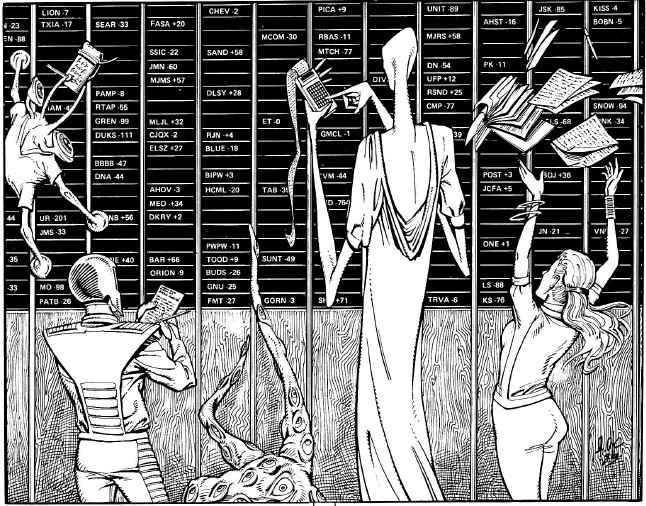
Growing up, Star Trek was my first love when it came to science fiction. I can't recall how young I was when I was introduced to Kirk, Spock, McCoy, and the crew of the USS Enterprise, but it was certainly several years before 1977, when Star Wars appeared and momentarily won my cheating heart. In any case, the release of FASA's Star Trek the Roleplaying Game in 1982 was an important moment in my gaming history. I still remember the anticipation occasioned by the ads in the pages of Dragon that heralded the game's imminent arrival. 

This post isn't actually about Star Trek or Star Trek the Roleplaying Game, though the latter serves as an important example. You see, an early supplement for the RPG was Trader Captains and Merchant Princes by Guy W. McLimore which detailed, as its name suggests, what it is like to be an independent trader à la Cyrano Jones in the Star Trek universe. I really liked the book for many reasons – perhaps I'll do a Retrospective on it some day – but a reason that sticks out is its inclusion of rules for playing the Federation stock market.

The rules are fairly simple, even simplistic if you know anything about real world financial markets. Arguably, they don't even make much sense in the post-scarcity economy of Roddenberry's United Federation of Planets. None of that mattered to me, who enjoyed the rules because they mechanized an aspect of the background setting, enabling me to see the rise and fall of the relative values of Federation companies. This might not seem like much, but it meant a lot in merchant campaigns where the the fortunes of Multiplanet Metals or Shuvinaaljis Warp Technologies played an important role. I appreciated that, with a few rolls of the dice, a part of the game setting was taken out of my hands and I could be as surprised at how things unfolded as the players.

This is also why I continue to esteem Frank Mentzer's D&D Companion Rules, despite their many shortcomings. Mentzer included a couple of lists of natural and unnatural events, along with percentages assigned to each, that might occur in a player character-run domain each year. To call it a "system" is ridiculous, but it nevertheless gives the referee some creative pushes in terms of how the campaign world might unfold independent of his own ideas. A more developed version of these lists can be found in 1985's Oriental Adventures by Gary Gygax, David Cook, and François Marcela-Froideval.

After refereeing my Empire of the Petal Throne campaign for the last five and a half years, I've often found myself looking for ways to mechanize background events, both to alleviate some of the prep work I must do and to ensure that setting events don't fall into ruts. I find that certain ideas recur in my imagination and, left solely to my own devices, things might get repetitive. Having access to a system that determined, for example, the start of a war or a political alliance or a magical discovery would be extremely useful to me. The only old school RPG I can think that includes such a system is Stars Without Numbers and even that isn't exactly what I'm looking for. I suppose the answer, as with so many things, is to make one for myself.

The DragonDex

While I'm sure most readers are already familiar with this site, there may be some newcomers who are not. The DragonDex is probably one of the most useful sites I've come across. It's a complete index of all 359 print issues of Dragon magazine, covering material from June 1976 to September 2007. Helpfully, there are several different ways to use the index, starting with the straightforward Master Index, which simply lists all the articles alphabetically. Each article listing provides its title, author, game system, and the issue in which it appeared, along with the page numbers. 

It's simply a site and I can't tell you how often I've used it to locate an article I only dimly remember from my youth. Whether you're trying to do the same or you're simply interested in the history of the hobby, the DragonDex is an amazing resource.  

Pulp Fantasy Library: Burn, Witch, Burn!


Abraham Grace Merritt (1884–1943) is one of the forgotten fathers of fantasy and science fiction and, by extension, the other genres and entertainments that they inspired. Gary Gygax was quite clear about the influence Merritt exercised over his own imagination. In Appendix N of the Dungeon Masters Guide, he lists Merritt alongside such luminaries as Howard, Leiber, Vance, and Lovecraft, most of whom, I'd wager, are much more well known and widely read today. 

That's a shame, in my opinion, because Merritt was an imaginative writer with a unique voice who, in his day, was both successful and well regarded by his peers. He worked most of his adult life as a reporter and editor for a variety of American periodicals. Over the course of his career, he traveled extensively and, in so doing, acquired many mementos of remote locales, including books on esoteric subjects, most of which we'd group under the heading of the occult today.

This should come as no surprise to anyone who has read his works. Black magic and diabolism figure prominently in Merritt's pulp yarns, none more clearly than in his novel Burn, Witch, Burn! Originally serialized in the pages of Argosy over the course of six issues between October 22, 1932 and November 26, 1932, Burn, Witch, Burn! presents itself as a fictionalized account of real events that took place in New York City. The narrator is a medical doctor "specializing in neurology and diseases of the brain" who uses the pseudonym Lowell, in order to avoid identifying his true identity. He adds that all the characters in his tale are real people whose names he has changed for similar reasons.

In the foreword, Dr Lowell states the following:

But now, orthodox man of medicine that I am, I ask myself whether there may not be causes other than those we admit. Forces and energies which we stubbornly disavow because we can find no explanation for them within the narrow confines of our present knowledge. Energies whose reality is recognized in folklore, the ancient traditions, of all peoples, and which, to justify our ignorance, we label myth and superstition.

A wisdom, a science, immeasurably old. Born before history, but never dying nor ever wholly lost. A secret wisdom, but always with its priests and priestesses guarding its dark flame, passing it on from century to century. Dark flame of forbidden knowledge... burning in Egypt before even the Pyramids were raised; and in temples crumbling now beneath the Gobi's sands; known to the sons of Ad whom Allah, so say the Arabs, turned to stone for their sorceries ten thousand years before Abraham trod the streets of Ur of the Chaldees; known in China—and known to the Tibetan lama, the Buryat shaman of the steppes and to the warlock of the South Seas alike.

Dark flame of evil wisdom... deepening the shadows of Stonehenge's brooding menhirs; fed later by hands of Roman legionaries; gathering strength, none knows why, in medieval Europe... and still burning, still alive, still strong.

With the stage now set, Lowell regales the reader with the story of his encounter with Julian Ricori, "a notorious underworld chieftain, one of the finished products of the Prohibition Law." Ricori has a problem that he believes only Lowell can solve: his partner in crime, Peters, has been afflicted with a mysterious ailment, one that leaves him catatonic and completely non-responsive. Ricori offers Dr Lowell a large sum of money, if he can not only discover the cause of the man's affliction but also save his life. 

Lowell agrees to help, out of scientific curiosity and concern for the man's health rather than any desire for money. He takes a blood sample, which he examines under a microscope, revealing a single strange, phosphorescent globule inside a leukocyte. Not long thereafter, Peters dies but not before "the chattering laughter of a devil" erupts from him. An autopsy reveals little more about Peters' death. Frustrated, Lowell sets out to see if anyone else in the city has recently died under similar circumstances. He not only finds that there are in fact seven others but they all have something in common: visiting a toy shop run by an old woman named Madame Mandilip.

It's at this point that Burn, Witch, Burn! really takes off. Dr Lowell finds his scientific skepticism challenged again and again, as he is forced to consider the increasingly likely possibility that Madame Mandilip is in fact a witch and that the dolls she sells in her toy shop are enchanted to come alive and kill! If this sounds ridiculous, on some level it is, but Merritt makes it work, largely due to his skill at evoking mood. Burn, Witch, Burn! is a terrific yarn in the pulp tradition.

So successful was Burn, Witch, Burn! that it was – loosely – adapted into a movie by Tod Browning (of Dracula fame) in 1936 under the title The Devil-Doll. This was the second Merritt tale turned into a film, the first being the 1929 silent movie, Seven Footprints to Satan, and is generally better regarded, despite the many liberties it takes with the source material. The Devil-Doll is best known for its special effects and its star, Lionel Barrymore, whose character, wholly original to the motion picture, evades capture by his enemies by disguising himself as an old woman named Madame Mandilip. The movie is worth watching primarily as an artifact of its time and as a reminder of how poorly Merritt, like most pulp writers, has been served by Hollywood's attempts to adapt them.

Friday, August 21, 2020

Asymmetric Warfare

I'm not sheepish about admitting that I've never been a wargamer. Growing up, I knew a lot of wargamers, like the father and older brother of a childhood friend, but I wasn't one myself. Of course, all the hobby stores I frequented – including chain stores like Toys "R" Us – sold Avalon Hill and SPI bookcase games, but, until I was in high school, I never had much opportunity to play any of them (and, even then, my experiences were quite limited). 

I consider this a serious lacuna in my gaming education. That's why I've long been looking for ways to correct this – and in recent months I have. Last summer, I got back in touch with a couple of friends of mine whom I hadn't seen in years. One of them is fairly experienced wargamer, with a sizable collection of games, both classics of the genre and more recent designs. Recent events in the world have given us all a surprisingly amount of free time and we decided to use some of it wargaming each week.

Naturally, we're not playing these games face-to-face. Instead, we're making use of VASSAL, a virtual tabletop created for wargamers (specifically Advanced Squad Leader). VASSAL has proven surprisingly easy to use, not to mention fun. Based on my friend's recommendation, we began my education with GMT's Falling Sky: The Gallic Revolt Against Caesar. Partly this was done because it's a period of history I know a bit about and partly because Falling Sky is an entry in GMT's COIN series, which my friend thought would appeal to me.

COIN is a contraction of counter insurgency and the games in the series are notable for having three or more dissimilar factions in contention with one another. A very good article at another site described them very well: 

COIN can be described as multi-factional guerrilla wargames with a simple area control system that is driven by actions and objectives that are often unique for each faction. Bolted on to this is a card-driven historical event system; the result is simplistic, asymmetrical progression with a historical narrative. With four players the military environment has a political layer of oversight that drives player interaction, sub-optimal decisions, and tense tactical trade-offs. Even your so-called friends can pose a direct threat to your efforts through corruption, cultural patronage, or shady business practices.

I greatly enjoyed both the design of Falling Sky and my experience playing it. As an introduction to the world of contemporary wargame design, it could not have been better (well, maybe if I'd have won!). We'll soon be continuing my education with another COIN game, Liberty or Death: The American Insurrection before, I hope, playing some older games. I have decades' worth of catching up to do.