Friday, June 10, 2022
High Lethality
Thursday, June 9, 2022
The Tékumel Interview
Last week, Sean McCoy, designer of Mothership, asked me if I'd be willing to be interviewed about my experiences refereeing my ongoing House of Worms Empire of the Petal Throne campaign. Sean was particularly interested in what I'd done to keep the campaign running for the last seven years and I hope I provided some answers useful to others. Since I return to blogging almost two years ago, I've been beating the drum for long campaigns, but I recognize that this is outside many people's experiences, which is why I keep talking about it. Odds are it'll remain a significant theme on Grognardia for quite some time to come.
In any case, the interview has been posted here, if you're interested. (Apologies in advance: the interview long and the font size on Sean's blog is quite small.)
Gold as Experience
As characters meet monsters in mortal combat and defeat them, and when they obtain various forms of treasure (money, gems, jewelry, magical items, etc.), they gain "experience". This adds to their experience point total, gradually moving them upwards through the levels.–Dungeons & Dragons, Volume 1, p. 18 (1974)
The importance of finding treasure to a character's level advancement is a foundational feature of the Gygaxian presentation of D&D. In fact, after the publication of Greyhawk in 1975, which introduced a new – and less rewarding – method for calculating the XP of defeating monsters, finding treasure only rose became more importance. In AD&D, which uses a roughly similar system, Gygax explains that the system is intended to be an abstraction rather than reflective the in-game activities by which a character might "actually" advance in the skills and abilities of his chosen class.
I have never had any significant problems with this set-up. I accepted it without question when I was first introduced to D&D more than forty years ago and have made good use of it in multiple campaigns in the years since (including in my D&D-derived Empire of the Petal Throne campaign). I largely agree with Gygax that it's a perfectly workable compromise for a game whose rules don't (generally) possess a high degree of detail (see the one-minute combat round as another example of this in action).
However – you knew there'd be a "however" – I've been thinking lately about the need for experience and advancement systems for roleplaying games. In doing so, I began to think about the idea of using gold and other monetary treasure in a slightly different way. In Chaosium's RuneQuest, characters can improve both characteristics and skills through training. This training takes two things: time and money. A character who lacks either cannot make use of this method of improvement and must instead rely on the much more unpredictable method of experience rolls after the successful use of a skill in an adventure. It's worth noting, too, that even spells are acquired by "buying" them, usually from a cult.
Beginning characters often lack sufficient funds to buy all the training and spells they desire. That's why the cults and guilds of RuneQuest sometimes extend credit to neophytes, enabling them to take on a debt in exchange for training. This not only makes beginning characters a little more prepared for the adventuring life than they would otherwise be, but it establishes a connection between the character and the cult. In this way, beginning characters are immediately connected to the setting, one the referee can then use in the course of the campaign. It's an inspired idea to my mind and one I think more games should look to for inspiration.
This brings me back to the use of gold as a measure of experience in Dungeons & Dragons. As I've been thinking about this matter, I find myself wanting something akin to RuneQuest. Instead of a character simply improving all of his class-based abilities as soon as his experience total reaches a certain threshold, wouldn't it be more interesting – I won't say "realistic" – if instead he could use his gold to buy training that improved his abilities piecemeal. For example, he could employ a weapons master to increase his combat skills or acquire access to new spells at the sorcerer's guild and so on. Even mechanics like hit points and saving throws could be acquired through training of some sort or another.
Now, I realize that AD&D at least already possesses training rules and that, to some extent, they exist to explain the purpose of the large sums of money needed to gain new levels. However, like so much in D&D and its descendants, they're very abstract, more abstract, I would argue, than many similar systems in the game. Mind you, I speak from some degree of ignorance, since I cannot recall ever having made use of these rules, nor did I ever know anyone who had, until relatively recently. It's quite possible that AD&D's rules work very well and achieve the kind of in-setting connection I increasingly see as vital to a campaign's long term success.
One thing the AD&D training rules do seem to do is take time. Much like those in RuneQuest, a character will spend weeks of in-game time training the new abilities he's acquired upon gaining a level. That's something I very much appreciate. Between my House of Worms campaign and the Pendragon campaign in which I'm currently playing, I am more convinced than ever that a long campaign should encompass years or in-game time, with characters and events growing and changing in the process. This is an area where RPGs excel and it ought to be embraced.
Wednesday, June 8, 2022
Retrospective: Tarsus
A common knock against the official Third Imperium setting for GDW's Traveller is that it's simply too big. Encompassing 11,000 worlds spread over nearly 300 subsectors, there's simply no way a referee can make use of it all except in a cursory way. Even a single sector, like the Spinward Marches or Solomani Rim, still contains close to 500 planets. The end result is that, for all its breadth and diversity, the Third Imperium will be little than an abstraction in most campaigns that make use of it.
There's more than a little truth to this criticism, though, at the same time, I also feel that using the Third Imperium as a loose backdrop is exactly what the referee should be doing. Focusing too much on large scale sector-wide events, like the Fifth Frontier War, is precisely where GDW went wrong in its later development of Traveller. In my opinion, the company – and the game – would have been much better served by focusing instead on smaller scale details, such as individual subsectors or even worlds.
While the much celebrated The Traveller Adventure did the former, 1983's Tarsus: World Beyond the Frontier did the latter and did it very well indeed. Located in the unaligned District 268 subsector of the Spinward Marches, Tarsus is a non-industrial, agricultural world that's home to some 2.2 million human beings. Consequently, it's something of a backwater planet, though it maintains economic ties to both the Imperium, which it hopes to join one day, and other nearby interstellar powers, like the Sword Worlds.
Tarsus was released as a boxed set and included a 24-page World Data book (written by Marc Miller and Loren Wiseman) that detailed the planet, its history, local government, ecology, and more; a color map of the planet; a color map of an important region of the planet (Tangle Wald); a map of District 268 subsector; five 4-page adventure pamphlets; and a dozen pre-generated character cards. It's an excellent collection of material, attractively presented. Taken together, the referee has more than enough information to provide many months' worth of adventure on Tarsus itself, even longer if the characters eventually expand their scope beyond the planet itself to its neighbors in the subsector.
With its focus on agriculture and ranching nobbles (a large, horned, grazing animal), Tarsus has a vaguely Western feel to it. The whole planet reminded me of an unincorporated territory of the 19th century United States, on the verge of consideration for statehood, with various interests lobbying one way or the other. Indeed, there's much discussion of the voting system employed on Tarsus, which not only allows the open buying and selling of votes but also the buying and selling of them by newcomers to Tarsus. By law, only individuals can hold votes, though they may hold multiple votes, and may freely vote on behalf of others, like offworld corporations, that cannot themselves legally vote. It's a situation ripe for political machinations and corruption – not to mention adventure.
Of course, there's more to Tarsus than political maneuvering. The planet is a giant sandbox, with plenty of scope for a variety of approaches to its content. Player characters could, for example, become involved in nobble ranching, working for or against a megacorporation, exploring the Tangle Wald, cataloging the planet's native life, and more. There are also several flashpoints for armed conflict, as well as mercenary company in need of new recruits. This is in addition to the presence of many local patrons, a staple of Traveller adventures and a good way to kick off a campaign or extended adventure on this frontier world.
If one were to complain about Tarsus, it's that the information it presents about the planet and its conflicts is diffuse. The referee needs to read through all the included material several times to get a good handle on it, but, to my mind, that's the job of any good referee. Having done so, the referee should have little trouble keeping things the players and their characters engaged for a long time. With so many worlds in the Third Imperium, Tarsus is thus a good example of the kind of thing I wish GDW had done more often: fleshing out a single world in sufficient detail to demonstrate how much fun could be had be spending an extended period of time there. The game is called Traveller for a reason, to be sure; that doesn't mean the characters should always be on the move, Tarsus is a world worth visiting.
Tuesday, June 7, 2022
You Want the Treasure
White Dwarf: Issue #37
When I say "brief," I mean it. None of the ideas is fully fleshed out and most are only a paragraph or two long. Like the "Introduction to Traveller" piece earlier, it's hard to judge articles like this in retrospect. I can only say that I wasn't inspired, let alone blown away, by any of the ideas presented here. How much of that reflects my current vantage point is hard to say. Much more compelling was this month's installment of the "Fiend Factory," which presents four new monster species, the standout being the weed-delvers, a race of ancient cephalopods that ruled the seas eons ago. Also called the Wet Ones, the weed-delvers come in three varieties and are Chaotic Neutral in alignment, meaning the referee can use them in a multitude of ways, not simply as straight up antagonists.
Monday, June 6, 2022
Create Exciting Color Pictures with Light!
I'm a well-known meanie when it comes to the brandification (and kiddie-fication) of Dungeons & Dragons by TSR in the mid-1980s. For that reason, I apologize in advance for my instinctive disdain of products like the Dungeons & Dragons Lite-Brite Picture Refill. Bear in mind that, in 1984, when this was released, I was almost 15 years old and at the height of my adolescent snobbery. That 15 year-old still slumbers within my middle-aged shell. When I look at images like this one, it's hard to keep him in check.
On first glance, I wondered why Bozo the Clown was pictured on the front of this thing. As I looked closer, I realized that the kids were in fact creating an image of Strongheart the Paladin, but I can't be the only one who had to squint to recognize him, can I?Are Character Advancement Rules Necessary?
I mention this because twice in recent weeks I've been asked about how I handle character advancement in my ongoing House of Worms Empire of the Petal Throne campaign. Though obviously derived from OD&D, EPT includes a number of unique mechanical features, including reduced experience points as characters rise in level. The practical effect of these reductions is that, unless one's campaign is focused very heavily on underworld exploration and the acquisition of huge amounts of treasure, character progression stalls out at about level 6 or 7. That's what has happened in House of Worms.
In Traveller, once you've generated your character, his characteristics or skill levels will probably never improve (though characteristics can decrease, due to the effects of aging). As the game explains,
Characters already know their basic physical and mental parameters; their basic educational and physical development have already occurred, and further improvement can only take place through dedicated endeavor. Experience gained as the character travels and adventures is, in a very real sense, an increased ability to play the role which he or she has assumed.
This is a dramatic counterpoint to the approach of D&D or indeed almost any other roleplaying game, where regular mechanical improvement is, if not the entire point of the game, a major feature of it. Traveller, by contrast, largely eschews this; the "reward" of playing Traveller over time is "increased ability to play the role" the player has adopted. In other words, the player becomes more experienced rather than his character.
Note the distinction I made: regular mechanical improvement, by which I meant things like increased hit points, combat ability, saving throws, etc. Traveller provides little scope for that after character generation and yet, despite their absence, I can't recall a single complaint from anyone with whom I've played the game over the years. Certainly no one in my Riphaeus Sector campaign was aggrieved by this state of affairs. Of course, a lack of regular mechanical improvements is not the same thing as a lack of all improvements. Whenever I've played Traveller, the characters have improved, through the acquisition of better gear, greater knowledge, and more far-reaching influence. None of this is insignificant and, in fact, I would argue that most of these non-mechanical improvements ultimately have longer-lasting consequences (particularly in long campaigns).
This is certainly what I have observed in the House of Worms campaign. Though no player character has acquired any new hit points or spells in a very long time, I don't think anyone involved in the campaign would attempt to make the claim that his character hasn't improved with time. For example, the characters began, seven years ago, as minor scions of the mid-ranked House of Worms clan in the city of Sokátis. Through a combination of skill, cleverness, and dumb luck, they're now in positions of some power and influence within Tsolyánu. In addition, they've learned more about the world of Tékumel, knowledge that has served them well as they attempt to unravel the mysteries of Achgé Peninsula. As in my Traveller campaigns of old, not a single player has ever complained about his character's "lack of improvement."
Perhaps unsurprisingly, as I continue to work – albeit more slowly than I'd hoped – on The Secrets of sha-Arthan, the question of the mechanical improvement of characters is something I'm pondering. Are character advancement rules even necessary? Do we simply include them in nearly every RPG simply because D&D did so in 1974? I haven't made up my mind on this matter, but, between a lifetime of playing Traveller and the last seven years of my House of Worms campaign, I'm seriously beginning to wonder about their presumed necessity. At the very least, I'm looking more closely at experience and advancement than I have until now, with an eye toward understanding their purpose and effect on gameplay. What can we learn from Traveller and might its approach not be a better one than the never-ending mechanical escalation of Dungeons & Dragons?
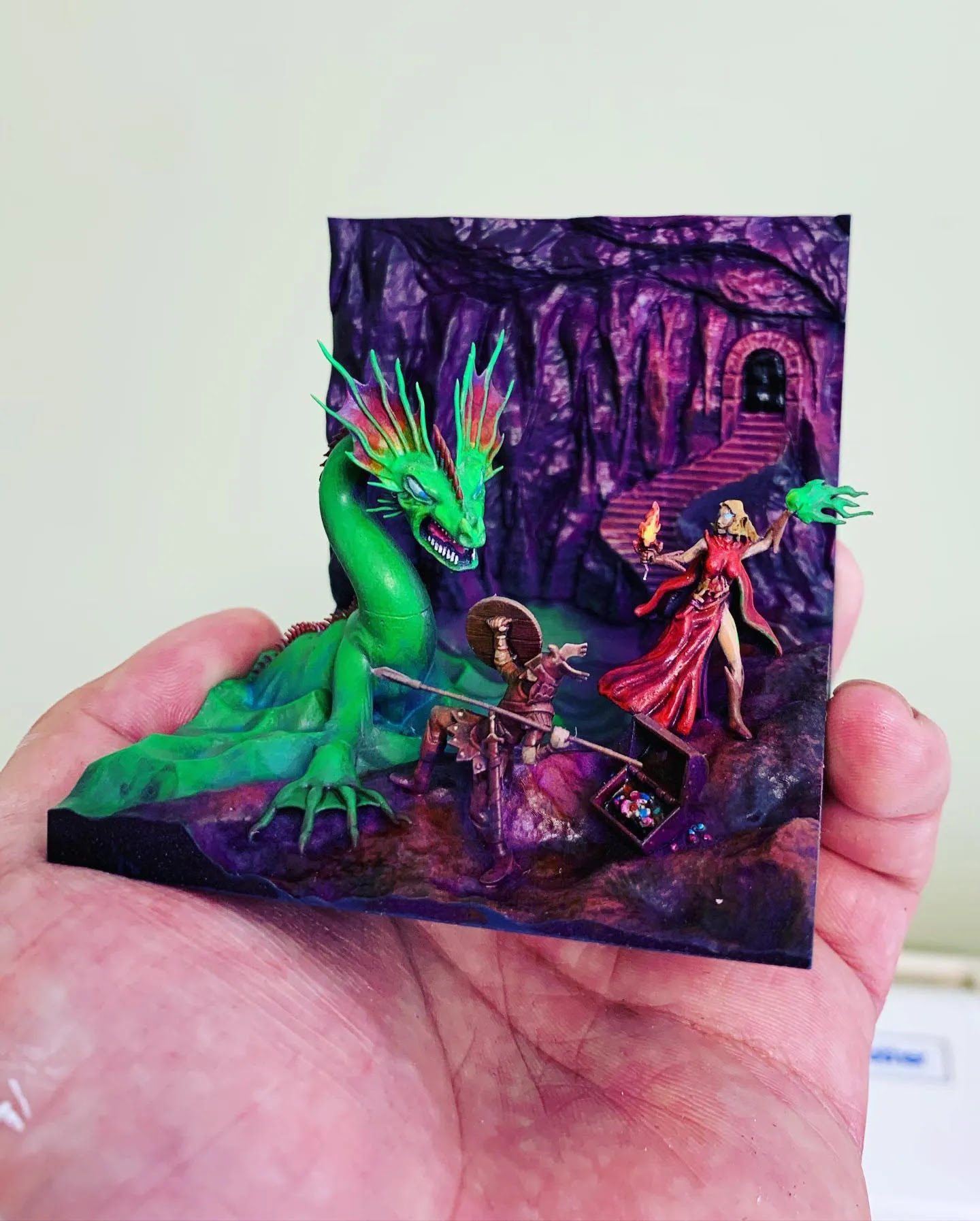
Dungeon Dragon Battle
For those of you into 3D printing, you might find this reproduction of the iconic Erol Otus cover to the 1981 Dungeons & Dragons Basic Set interesting. I know next to nothing about 3D printing – or painting for that matter – but it's hard not to be impressed by this!
Pulp Fantasy Library: Enchantress of Venus
The surface of the Red Sea closed without a ripple over Stark. There was a burst of crimson sparks, a momentary trail of flame going down like a drowned comet, and then—nothing.Stark dropped slowly downward through a strange world. There was no difficulty about breathing, as in a sea of water. The gases of the Red Sea support life quite well, and the creatures that dwell in it have almost normal lungs.Stark did not pay much attention at first, except to keep his balance automatically. He was still dazed from the blow, and he was raging with anger and pain.
Properly scientific or not, this is evocative stuff and a reminder of why Brackett made such a splash (no pun intended) in the world of pulp fantasy during the 1940s and '50s.
Emerging from the sea, Stark makes his way to Shuruun in search of Helvi. He is almost immediately recognized as a stranger by the locals, who confront him and appear ready to attack. Before this can occur, a white-haired Earthman named Larrabee calls out and invites him to drink with him. Larrabee, we soon learn, is a notorious thief who "got half a million credits out of the strong room of the Royal Venus." In the nine years since, he has holed up in Shuruun to avoid being found by the authorities. When Stark introduces himself, Larrabee mentions that he knows his name from a wanted poster as "some idiot that had led a native revolt somewhere in the Jovian Colonies—a big cold-eyed brute they referred to colorfully as the wild man from Mercury."
Stark is amused by this description of himself but soon shifts the conversation to local matters, in particular the whereabouts of Helvi. Larrabee claims not to have seen him and instead speaks of the Lhari, "the Lords of Shuruun," who are "always glad to meet strangers." Hearing this, Stark decides he to call on the Lhari to see if they might know something about Helvi. Along the way, he meets Zareth, the teenage daughter of Malthor, who'd been sent into Shuruun to find him and then lure him into an ambush outside the city. Then, he'd be handed over to "the Lost Ones," who dwell in the interior of the swamp and have an interest in strangers like Stark. Zareth doesn't follow through on her father's plans, though, because he beats her and she hates him. However, she has no interest in joining Stark in visiting the Lhari, who frighten her as much as her father.
If you're having difficulty keeping all these narrative threads – Malthor, the Lhari, the Lost Ones – straight in your head, that's understandable. Brackett throws a lot at her readers at the beginning of "The Enchantress of Venus" and its can be confusing at times. Fortunately, she's a very skilled writer and repays the patience and forbearance shown to her. By the time Stark enters the castle of the Lhari and meets them, in all their decadent glory, for the first time, that things begin to make a great deal more sense. In some ways, that's the real beginning of the novella and the action barrels along from that point until it reaches its ultimate, satisfying conclusion. It's a lot of fun to read and reminds me, in some ways, like many of Robert E. Howard's tales of Conan the Cimmerian: a "wild" outsider finds himself caught up in the machinations of several sinister factions and must find a way to extricate himself from their clutches. What's not to love?