Escape from New York, while quite tame by today's standards, the film was rated R, which means that, in principle, no one under the age of 17 should have seen it (and it wouldn't be released on VHS until 1984, three years after the game was published). Granted, there's no reason you need to see the movie to enjoy the game, but would anyone who hadn't seen it take much interest in it? Then again, TSR was just coming into the height of its power and influence, so a movie or TV tie-in was probably inevitable. Compared to the alternatives, Escape from New York doesn't look so bad.
Monday, August 31, 2020
An Exciting New Family Boardgame!
The Coming of Red Sonja
Horses of Different Colors
Pulp Fantasy Library: The Shadow of the Vulture
No doubt you've heard of Red Sonja, the chainmail bikini-clad heroine created by Roy Thomas and Barry Windsor-Smith for Marvel Comics in 1973. For nearly a half-century, she's been an icon of sword-and-sorcery literature and the world's most prominent poster girl for unreasonable armor. She first appeared in issue #23 of Conan the Barbarian (February 1973), which adapted a story by Robert E, Howard entitled "The Shadow of the Vulture." But did you know that the original story neither featured Conan nor took place in the Hyborian Age but was rather a historical yarn set in Austria in the 16th century?
The short story appeared in the January 1934 issue of The Magic Carpet Magazine. The Magic Carpet was the very short-lived successor to Oriental Stories, a companion magazine to the much more well known and successful Weird Tales. Farnsworth Wright was editor of both magazines, which no doubt explains the presence of so many Weird Tales stalwarts in its pages (e.g. Robert E. Howard, Otis Adelbert Kline, Clark Ashton Smith). The January 1934, as it turns out, was the final issue of the pulp and it is now largely forgotten but for the handful of memorable stories published in its pages.
By my lights, "The Shadow of the Vulture" is among those memorable stories. The story starts sometime after the Battle of Mohács (which Howard spells Mohacz), as the Ottoman sultan, Suleyman, is preparing to release a collection of Austrian envoys "pallid from months of imprisonment." As he is doing so, he recognizes one of the envoys, but does not immediately remember where, and so lets him return to his homeland. Later, as he is talking with his grand vizier, Ibrahim, he recalls that the Austrian, named Gottfried von Kalmbach, had wounded him at the aforementioned battle. "I could not mistake those blue eyes," he explains. For the crime of having "with impunity spill[ed] [Suleyman's blood] on the ground for the dogs to lap up," the sultan demands Gottfried's head.
Eager to gain Suleyman's favor, Ibrahim enlists the aid of a Tatar named Yaruk Khan to stop Gottfried from leaving Turkey; when that fails, he turns to his agent Mikhal Oglu.
The Grand Vizier brooded on his silken cushions until the shadow of a pair of vulture wings fell across the marble-tiled floor, and the lean figure he had summoned bowed before him. The man whose very name was a shuddering watchword of horror to all western Asia was soft-spoken and moved with the mincing ease of a cat, but the stark evil of his soul showed in his dark countenance, gleamed in his narrow slit eyes. He was the chief of the Akinji, those wild riders whose raids spread fear and desolation throughout all lands beyond the Grand Turk's borders He stood in full armor, a jeweled helmet on his narrow head, the wide vulture wings made fast to the shoulders of his gilded chain-mail hauberk. Those wings spread wide in the wind when he rode, and under their pinions lay the shadows of death and destruction. It was Suleyman's scimitar-tip, the most noted slayer of a nation of slayers, who stood before the Grand Vizier.
I suspect that Oglu's unique armor is inspired by that of the famed Polish winged hussars, which are contemporary with the time period of the story.
Oglu and his men, after some time, track Gottfried von Kalmbach to a village along the Danube but he manages to escape their clutches, riding to Vienna. When he arrives there, the city is already preparing for a siege by Ottoman forces led by Suleyman himself. Gottfried joins the Viennese in fighting the Turks and, while doing so, finds himself under the guns of advancing Janissaries. Deciding to make a break for a nearby cannon, he turns, only to be greeted by a strange sight.
It was a woman, dressed as von Kalmbacj had not seen even the dandies of France dressed. She was tall, splendidly shaped, but lithe. From under a steel cap escaped rebellious tresses that rippled red gold in the sun over her compact shoulders. High boots of Cordovan leather came to her mid-thighs, which were cased in baggy breeches. She wore a shirt of fine Turkish mesh-mail tucked into her breeches. Her supple waist was confined by a flowing sash of green silk, into which were thrust a brace of pistols and a dagger, and from which depended a long Hungarian saber. Over all was a carelessly thrown scarlet cloak.
This surprising figure was bending over the cannon, sighting it, in a manner betokening more than a passing familiarity, at a group of Tirks who were wheeling a carriage-gun just within range.
"Eh, Red Sonya!" shouted a man-at-arms, waving his pike. "Give 'em hell, my lass!"
This woman, who hails from Ruthenia, saves Gottfried's life for the first time (the second will occur later in the story). We learn that she bears a grudge against not just the Turks generally but against her sister, Roxelana, who has become Suleyman's chief consort. Over the course of the story, we learn more about Sonya and watch her prowess in battle on numerous occasions. Though Gottfried von Kalmbach is ostensibly the main character of this tale, it is Red Sonya of Rogatino who is by far its most memorable character.
"The Shadow of the Vulture" is, I think, a good example of Howard's historical fiction. He tells an engaging story that takes place against real historical events, in this case the 1529 Siege of Vienna, populated by a mix of fictional (Gottfried and Sonya) and real characters (such as Suleyman and Roxelana). It's told in a fast moving "blood and thunder" style that I found delightful, but it is likely not to everyone's taste. If nothing else, as the literary origin of one of the most enduring female characters of sword-and-sorcery literature, it's well worth looking at.
Saturday, August 29, 2020
All Hail the Emperor!
Friday, August 28, 2020
Interview: Steve Crompton
For long-time fans of Flying Buffalo gaming products, such as Tunnels & Trolls and Grimtooth's Traps, Steve Crompton needs no introduction. For the benefit of them and others not yet familiar with his decades of work in the RPG world, I present the following interview, to which Mr Crompton very kindly agreed.
![]() |
| Steve Crompton at the GAMA Expo, March 2020 |
1. How did you first become involved in the hobby of roleplaying?
I ran into Rick [Loomis] though church while I was still a teenager and he gave me and my sister a couple of solo adventures to play. So I learned to RPG via the solo adventures back in 1979. Before that, I’m not sure I’d really even heard of D&D, let alone T&T.
2. After being given those solo adventures, did you then start to participate in a group? What games did you play?
I think the very first time I ever played an RPG, it was with Rick Loomis and he ran Buffalo Castle as a solo. I don’t think I had gotten though Buffalo Castle without dying, so it was fun to have it run by its creator. It was probably in 1979 or '80. Once I was I working in the store, I would often join in a game if things were slow. The first time I played with Ken St. Andre, it was in Gristlegrim Dungeon and I died in about 15 minutes. I also played in adventures run by Bear Peters, Mike Stackpole and Larry DiTillio, so I’ve been very lucky to have been able to be in adventures run by some of the greats of T&T history! I think most of them killed me at some point! I did have a regular RPG group when we were running our Lejentia Campaign back in the late 80’s and early 90’s
3. How did you come to be employed by Flying Buffalo?
Rick knew I wanted to be a graphic artist and was taking commercial art courses via a high school “working trades” program. (So I think that was a factor for him picking me) He needed someone to work the Flying Buffalo store and I was polite and a good talker, so he offered me the job as a store clerk which I accepted. Back then, eventually best selling author Michael Stackpole was my store manager!
4. While at Flying Buffalo, you worked on a wide variety of projects, but I suspect you're best known for the illustrations in Grimtooth's Traps, which have a very distinctive style. Did you receive a lot of direction on how to illustrate these books or were they largely of your own invention? What about Grimtooth himself: did you create his appearance or were you given instructions beforehand?
I was working in the store in late 1980 when Liz Danforth (who was Flying Buffalo’s art director at the time) came to me and said that they were developing this book of traps they were going to publish. She knew I had taken drafting classes, so she thought I would be a good match for drawing out the traps they came up with.
At the time, Grimtooth wasn’t really in the picture, but at some point, either Liz, or perhaps it was Paul O’Connor (Grimtooth's Traps editor) came up with the idea to use Grimtooth as the narrator. Grimtooth was a character that Liz created as a sort of sardonic “mascot” for our Sorcerer’s Apprentice magazine. So, she had already drawn him, and that was my guide for any Grimtooth illustrations I did going forward. My take was more influenced by the thousands of comic books I had read. In the original first edition of Grimtooth’s Traps, I think there are maybe two or three illustrations of him in the whole book, but he was its voice. In later re-printings (once we realized how popular he was with the fans), I added him in to more illustrations and elsewhere in the book.
For the trap illustrations, I wasn’t really given any specific instructions other than to make the trap match is description. As we went along, though, the text was sometimes changed to match what I had drawn, as I would sometimes add a “twist” to the trap or its location.
5. Are there any illustrations you did for Flying Buffalo that you're particularly proud of, even after all these years?
My personal favorite is of Grimtooth’s Airship flying through a storm – that’s a great one. I have a cute illo of Grimtina on a BMX bicycle, but she also has a big gun and an attitude. I also had a lot of fun drawing the Grimtooth comic pages in the Traps Too reprint and Traps Lite!
6. Aside from Flying Buffalo, you also did work for GDW and FGU, in each case for science fiction roleplaying games. Do you enjoy sci-fi illustration as much as fantasy?
Certainly I liked the variety of doing different things and trying to take on different styles and approaches to my work to match the genre and tone of a given project. I tended to make those illustrations far less cartoony and more technical in their look. I used a lot of Zipatone screens in the sci-fi art that I rarely used in the fantasy pieces, for example. I tried to give the sci-fi art a sort of futuristic “noir” look.
7. You've produced a lot of artwork outside the RPG industry, primarily in the field of comics. How did you become involved in comics illustration/writing?
Really I was a comic book fan long before role-playing games even existed, so doing comics was in my blood from about the age of 5. I think a lot of my art for Nuclear War and Grimtooth’s Traps really reflect my comic book upbringing. I regularly went to San Diego Comic Con starting in 1988, and it was there I met the publisher of Revolutionary Comics, Todd Loren. He gave me my first break into the comics field and I ended up doing numerous comics for him, Rip Off Press, Kitchen Sink, Mu Press, and many others. My main claim to comic fame is Demi the Demoness. She’s appeared in over 40 comics and I wrote her into my City of the Gods novel and some game books I’ve done. Ken St. Andre is actually working on a City of the Gods T&T solo adventure and I’m sure Demi will have an appearance there as well.
8. Do you still have the chance to play RPGs?
Not as often as I like. Sometimes Bear Peters or Ken St. Andre will run something and I’ll join in. Mostly I play the T&T Phone app, which has 30 solos in it on my phone. I read a lot of gaming books all the time as I am usually editing or even writing parts of them. So my main RPG exposure nowadays is “on-the-job” so to speak.
9. You're now the managing director of Flying Buffalo. What does that job entail?
When I first took on that role, we had to do a complete inventory of all our products that we had in stock. This was not something that has been done in many years so it was a big task. My next big task was completing several Kickstarters that had been started while Rick Loomis was alive. That included part of the Nuclear War Kickstarter, the Mercenaries, Spies & Private Eyes Kickstarter and the Elven Lords Kickstarter. We’ve completed two of those and will soon be mailing out the full-color version of Elven Lords to the backer and that will end that one as well.
My ongoing mission is to promote Flying Buffalo however I can and help let the world and our fans know that the Buffalo is still flying and will continue to do so. In fact, since December we have either printed or released on DriveThruRPG 14 new or reprinted RPG solos, GM adventures, and other books. Seven of them are brand new, and seven of them are enhanced reprints of items that were previously out of print and unavailable on DriveThru. I also do customer service to take care of problems that distributors or customers have with orders or with trying to order things from us. I also have duties related to helping with Rick’s estate settlement and dealing with the Loomis family, various rights holders and other RPG industry friends of Rick who are helping and advising us in various ways. And I work with freelancing and licensees who want to print T&T books in Spanish, Japanese or German for example. So that’s my job in a nutshell. Its challenging and I love every minute of it. I consider it to be a great honor to be able to help keep Rick’s dream alive and continue to help bring in orders and new products to keep Flying Buffalo a going concern!
Mörk Borg and I
Thursday, August 27, 2020
Weird Maps II
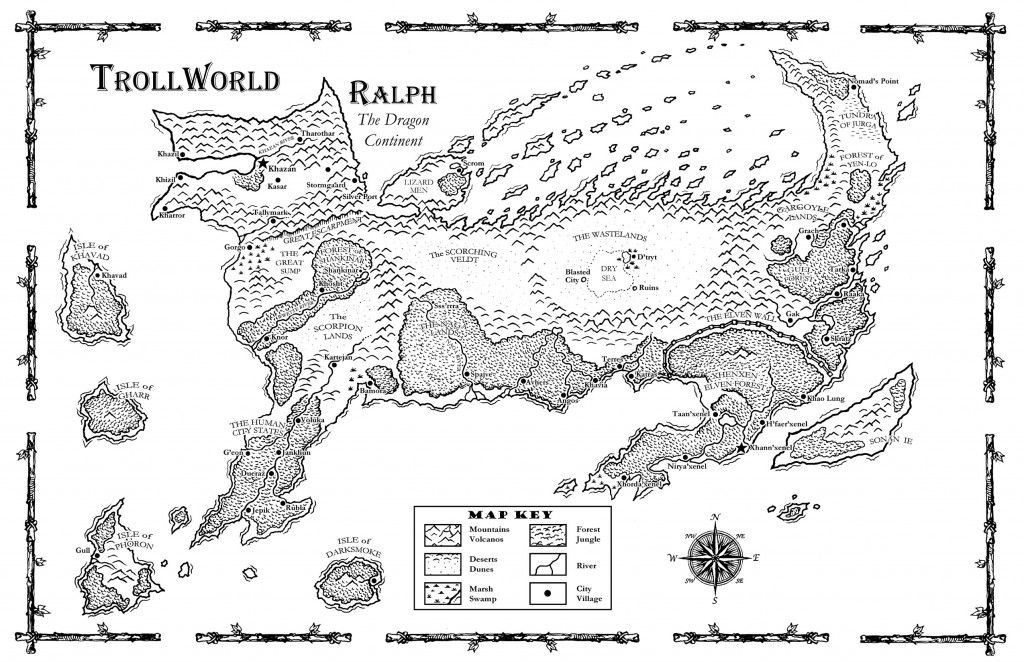
I talked the other day about weird maps, focusing primarily on literary examples of them. Today, I want to draw attention to the maps of Trollworld, the setting of Ken St. Andre's Tunnels & Trolls.
This is the continent of Ralph (or Rrr'lff, as it is known in some later sources). As you can see, it's shaped like a dragon, just like the one depicted in the Chart of Weirdworld. If anything, though Ralph is even more fantastical, since it looks like the entire body of a dragon rather than just its head. Ralph is home to Khazan, perhaps the best known city of Trollworld.Zorr is the eagle-shaped continent of Trollworld. It's also the land of the letter "z," as nearly all of its locations include that letter somewhere in their names. If I recall correctly – and my knowledge of T&T lore is limited – Trollish names tend to include lots of z's in them. Of course, that's a minor detail in my estimation compared to the appearance of the continent itself. Trollworld isn't a natural place; there is nary a concern for plate tectonics, geology, or anything remotely scientific. Instead, I suspect that Zorr, like Ralph, looks that way, because someone thought it was cool – and that's a perfectly valid reason in a fantasy roleplaying game setting!Allow me to lay my cards on the table: in my own efforts to create fantasy settings, I have tended toward the Middle-earth/Hyboria model when it comes to map making. I don't outright eschew magical weirdness and whimsy but neither do I embrace it the way that Trollworld clearly does. Is that a mistake? No, I don't think it is – not all fantasy settings are the same and there is room for a variety of different approaches. At the same time, I can't help but look at maps like that of Weirdworld or Trollworld and wonder. Isn't that what maps of fantasy worlds should make us do?
House of Worms
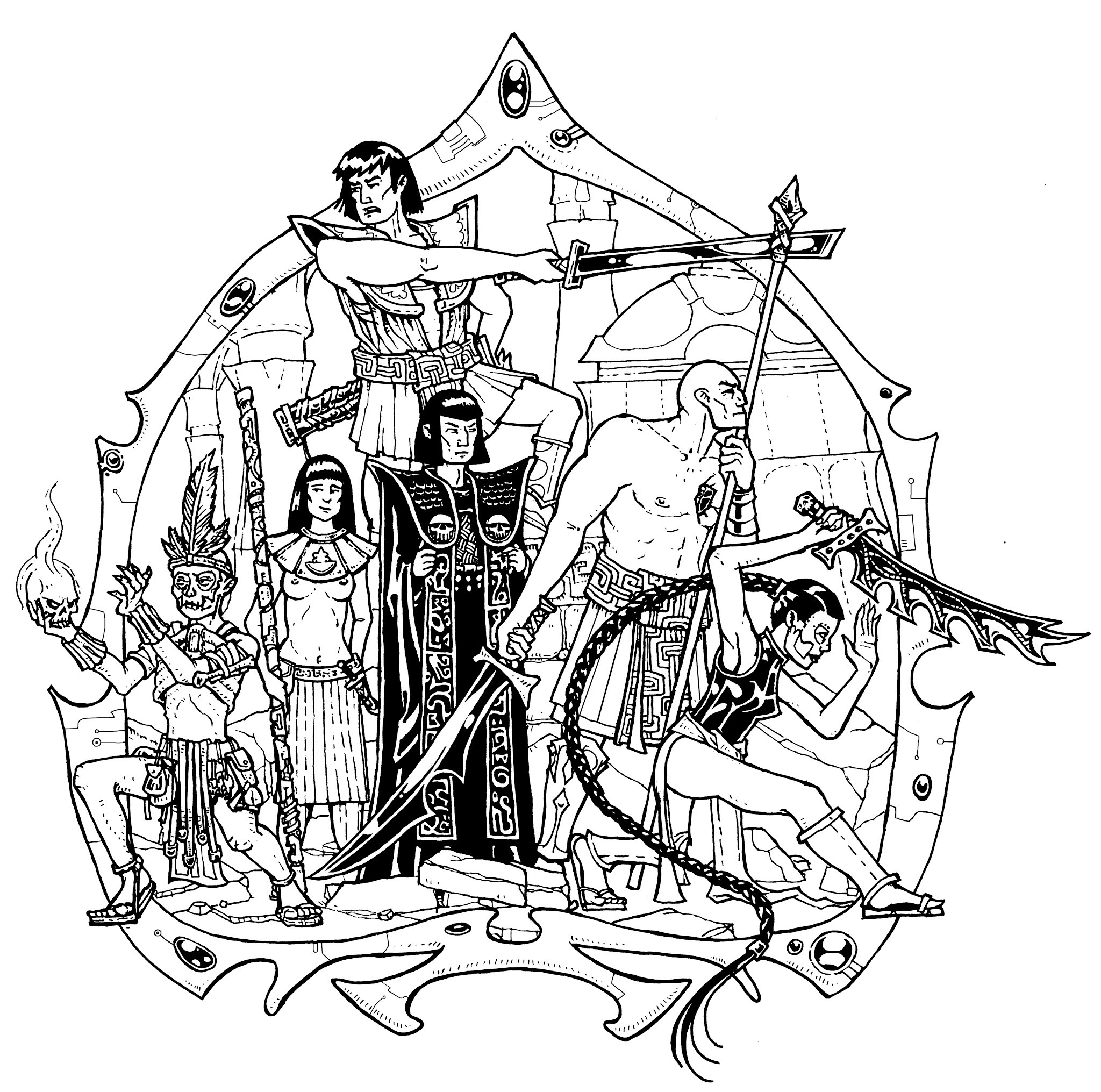
- Aíthfo hiZnáyu (top middle): An adventurer who's the lone member of the group not to worship Sárku or Durritlámish, instead being devoted to Ksárul. Aíthfo is the group's tactician, commanding a group of Pecháni mercenaries with great skill. He has dreams of being a sea captain and travelling the length and breadth of Tékumel in search of “cash and prizes,” in the memorable words of his player.
- Znayáshu hiNokór (bottom left): A lay priest of Durritlámish with an interest in astrology. He makes a living creating horoscopes when not involved in some scheme of his clan-mates. His fiancée, Tu'ásha hiNarkóda, of the Mourning Rock clan of Thráya, died before the two could wed – but that hasn't stopped Znayáshu, who had her corpse carefully preserved and now plans to have her reanimated as a Shédra, so that she can serve the Lord of Worms forever.
- Ssúri hiNokór (second from the bottom left): A ritual priestess of Durritlámish with a keen knowledge of dance and acrobatics, some of which she uses to her advantage even outside the temple. Sharp-tongued and no-nonsense, Ssúri often acts as the public face of this group of characters.
- Keléno hiNokór (bottom middle): A 5th Circle scholar priest of Sárku who prefers to keep his nose in books when he is able (which, sadly, isn't as often as he'd like). He recently developed an interest in demonology, after successfully – and unintentionally – summoning dread Srükárum to fight against an army of Ssú in the Dry Bay of Ssu'úm. Keléno is married to Hmásu hiTéshku, a priestess of Belkhánu, with whom he shares many interests.
- Grujúng hiZnáyu (second from bottom right): An older, ex-legionnaire (formerly of the 6th Imperial Medium Infantry) who finds life in Sokátis dull and so travels around with his clan-mates in search of excitement. He dreams of gaining a commission in the famous First Legion, which is currently posted to Sokátis as a result of the machinations of Imperial politics.
- Jangáiva hiTlélsu (bottom right): A temple guard of Sárku, Jangáiva has lately fallen under the patronage of an officer of the Omnipotent Azure Legion, who is testing her for possible formal induction into that august force. While in Yán Kór, she obtained a demonic hammer that calls itself “Little Sister” and revels in destruction. Jangáiva does her best to keep the weapon under control.
![]() |
| The Achgé Peninsula in all its hexcrawl glory! |
Orcish ODDities
![]() |
| ! |
Now, it may seem to some that I'm bashing AD&D here. If I am, it's not because Gygax's description of orcs in the Monster Manual is many times longer and more specific than the one in OD&D. Rather, it's because, in OD&D, orcs are clearly monsters, while in AD&D they've graduated to being "humanoids." OD&D orcs are the kinds of nasty brutes you'd find cowed into service by an evil magician or dark knight or even a dragon, while AD&D orcs are a parallel human race, albeit an irredeemably evil one. That is, AD&D orcs have an existence apart from whom they serve, which makes it far easier to believe they have a unique society and culture of their own. OD&D, it seems to me, suggests that a race of ready-made minions akin to Maleficent's twisted goons from Disney's Sleeping Beauty.