Monday, November 13, 2023

No Longer a Challenge

Here's another interesting passage from the September 1980 issue of Fantastic Films, where its author, Neesa Sweet, talks to Jeff Urquhart, owner of Sutler's Wagon Hobby Shop in Chicago (any readers remember this place?). 

What I find most remarkable about Urquhart's comments is that, even in 1980, it was already apparent that, as a hobby, RPGs don't actually require players to buy all that much to enjoy them. As he says above, you can "get away with spending $15 ($55 in today's devalued currency) and have enough material to play with the rest of your life." Equally remarkable is that Urquhart doesn't think much of "the newer, complete scenarios," believing that they "rob people of the freedom, energy, and imagination that the game had in the beginning."

The more things change, the more they stay the same!

Death by Misadventure

Barrett's Raiders, the Twilight: 2000 campaign I am currently refereeing, is just a little shy of two years old, our first session having been December 6, 2021. Like my House of Worms Empire of the Petal Throne campaign, now in the middle of its ninth year, we play more or less weekly. That's possible in part because there are seven (down from eight originally) regular players, which means that, even accounting for real life interruptions, it's rare that we don't have enough people to play each week. 

Sometime toward the end of summer, one of the campaign's stalwarts undertook some new responsibilities that prevented his playing for an extended period of time. Fortunately, there were six other players to pick up the slack and we've soldiered on – pun intended – without him. Nevertheless, his presence is very much missed, both because we enjoy the company of the player and because the character he plays (Sgt. Tom Cody) is an important part of the unit under the command of Lt. Col. J.D. Orlowski. 

Indeed, Sgt. Cody is so important to the unit that, even in the absence of his player, he's continued to participate in – and lead – military operations in eastern Poland. Recently, for example, the characters received intelligence suggesting that one or more NATO soldiers were being held captive in Kraśnik, a town not far from their current position. Orlowski tasked a small number of his men, under the command of Cody, to engage in reconnaissance near Kraśnik to determine if the intelligence was accurate and, if so, to assess the difficulty in liberating the NATO captives.

Since Cody's player was still unavailable, one of the other players, whose character was not assigned to the mission, took over playing him for the next few sessions. That's when I joked, "It'll be a shame when [Cody's player] returns and you'll have to tell him that Cody died bravely defending his comrades." We all laughed, because I clearly meant it as a joke. At the same time, combat is Twilight: 2000 can be unpredictable and there was no guarantee that Cody wouldn't die, even if the likelihood was small. Likewise, the player who took him over for those sessions is thoughtful and clearheaded, so he wasn't the sort to do anything too foolish.

The funny thing is that, in my youth, it was not at all an infrequent occurrence for someone's character to die while they weren't present – and it was rarely funny. In those days, we played RPGs a lot and there was an unspoken pact that we'd always be in attendance for every session of every game. To not be there, even for a perfectly legitimate reason, was seen as a rejection of the game or campaign being played, an acknowledgement that it just didn't matter all that much. What can I say? We were young and, as adolescent boys often are, prone to finding any excuse to haze one another.

One of the forms such hazing would take is killing off someone's character when they didn't show up for a game. "Sorry, dude, your fighter died last night, but, don't worry: he died covering our escape from a horde of ghouls." That sort of thing. Of course, as we played D&D in those days, there were innumerable ways to return a dead character to life and we rarely hesitated to make use of them. I think that was a big part of why no one ever hesitated to kill the characters of absent players – we all understood that death wasn't permanent. Thus, the proper response to learning that your character died while you were visiting your grandparents or on vacation at Disney World was not whine and moan, but rather "Oh yeah? That's cool. Have you raised him yet or is that our next adventure?"

While I don't advocate for the killing off of absent players' characters, let alone allow it in games I referee, I still make jokes about it. I wonder why that is? I suppose it's that, as puerile as it was, it was part of my earliest memories of roleplaying games. Those were days of wild-eyed, reckless adventure, when we first began to understand that RPGs gave us the ability to "do" anything we wanted – and a lot of what we wanted was foolish and occasionally cruel. We grew out of that initial childishness in time, but I almost feel as if it were a necessary stage in our development as roleplayers. To become more "serious" as gamers, we first had to indulge our unbridled ids a bit.

Maybe I'm wrong and this isn't a phase that everyone goes through when they're first introduced to this amazing hobby. All I know is that my friends and I did more than four decades ago and, try as I might, I can't say it wasn't fun, after a fashion. Good thing I outgrew it, eh?

Thursday, November 9, 2023

Inimical and Beneficial and the Worst and the Best

Some fascinating thoughts from Gary Gygax about the role of the Dungeon Master in Dungeons & Dragons (from the September 1980 issue of Fantastic Films). What he has to say reminds me a bit of my defense of the "killer DM" last year.

The Eshkom District

Though progress continues to be quite a bit slower than I'd like – due, in large part, to my constant tinkering – Secrets of sha-Arthan continues to chug along. I've taken a break from working on its rules to working on its setting. In particular, I've been developing a border region of the Empire of Inba Iro that can serve as a starting area for a new campaign. The first step in doing so was producing a map. Here's a scan of a portion of my original, hand-drawn map.

The region is called the Eshkom District, after its largest settlement, the city-state of Eshkom, one of the so-called Twenty Cities of Inba Iro, whose kings swear fealty to the King-Emperor of da-Imer. Eshkom has a history of unrest and periodic rebellion against the Solar Throne, all the more so since Chomachto invaders from the north seized it and declared themselves the new ruling elite of the Empire. I think a troubled border region like the Eshkom District had a lot of potential for adventure.

Fond as I am of hand-drawn maps, I nevertheless wanted something a bit more polished for eventual inclusion in Secrets of sha-Arthan, whatever form it eventually takes (that's a topic for another day). To that end, I turned to the cartographic skills of Glynn Seal of Monkeyblood Design to create a more attractive map. Here's the same portion pictured above in more professional form:
I'm quite pleased with the results. Glynn did a superb job of translating my rough original into something that's both usable and appealing. What I particularly like about Glynn's map is the way that the various settlements and ruins stand out against the background. That's important to me, because I made an effort to include lots of places for the referee to develop into adventure locales and I want their locations to be visually apparent.

Wednesday, November 8, 2023

"No, real life is quite horrible."

Several people sent me pointers to this while I was busy elsewhere last month – thanks to everyone who did so – but it's fascinating enough that I wanted to spread the love. It's a video segment from the BBC regional magazine, South East at Six, devoted to roleplaying games. Originally airing on October 6, 1983, the segment is notable for including interviews with Games Workshop founders Steve Jackson and Ian Livingstone, as well as Gary Chalk and Joe Dever. The segment is short, only a little over four minutes, but it's well worth your time. Take a look!

Retrospective: Bugs in the System

With all the talk of Star Frontiers in issue #9 of Polyhedron, I thought it might be worthwhile to look more closely at what might well be the best adventure ever published for that roleplaying game, Bugs in the System. Some of you may recall that, almost two years ago, I included Graeme Morris's 1985 effort in the list of My Top 9 non-D&D Adventures of All Time. While I still very much stand by that assessment, the module is not perfect – few things are – and I feel that a fuller examination of it lends itself to some interesting topics, both about the history of the hobby and the design of published adventure scenarios.

Bugs in the System is a product of TSR UK, the British division of TSR Hobbies, which closed its doors in 1986. During its brief existence, TSR UK distinguished itself by producing a number of well-regarded and highly imaginative game materials, some of which have long been among my favorites. Though I'm not quite certain I can put my finger on precisely what sets them apart from their American counterparts, there's no denying that there's something unique about even the worst of them. 

That's certainly true of Bugs in the System. Whereas the American Star Frontiers adventures, like the Volturnus Trilogy, draw their inspiration from the pulp sci-fi of the genre's Golden Age, Bugs in the System is a fair bit harder edged and "serious" in its approach to science fiction. By "serious," I mean only that Morris takes seriously Isaac Asimov's belief that science fiction isn't really science fiction if it lacks science. Most of what we reflexively call science fiction, especially in the realm of roleplaying games, doesn't include much in the way of genuine scientific speculation. It's mostly fantasy in space, which is absolutely fine in my opinion, but I still appreciate it when an author puts serious effort into incorporating science and scientific ideas into his story.  

Bugs in the System does just that and in a way that puts the lie to the notion that "real" science fiction can't still be adventuresome. The premise of the adventure is quite simple: the characters are tasked with the job of traveling to a biochemical extraction platform located in the upper atmosphere of a gas giant to determine the nature a disaster that cut it off from contact and, if possible, effect repairs and rescue any surviving members of its crew. It's a classic set-up for an adventure, since it provides the characters with just enough information to understand their ostensible mission and leaves just enough unknown that there's no doubt in the players' minds about the fact that unraveling a mystery is why their characters are truly traveling to the extraction platform.

As I noted, Morris is very committed to the adventure's scientific speculation. The nature of the disaster that struck the extraction platform is an unintelligent, microscopic organism that consists of patterns of electrical impulses. These patterns gather together simple compounds from the atmosphere of the gas giant to build up large biochemical molecules in which they "live." A mutated form of this lifeform has infected the extraction platform's circuitry, causing malfunctions and other anomalies – in short, a living computer virus. That may not seem like an original idea in 2023, but, nearly four decades ago, it was and I remember thinking how clever Morris was to have come up with it.

Of course, the fun of the adventure isn't simply in the high concept of its backstory. The fun comes from the characters wandering around the extraction platform, which is supported by bags of gas heated by nuclear reactors, looking for clues to what might have happened, as well as dealing with the malfunctions caused by the lifeform. Characters with technological skills, particularly computers and robotics, will have a lot to do. Morris put a lot of thought into how the lifeform operates within the computer systems and how the characters can combat it. There are even charts and diagrams, depicting the architecture of the platform's mainframe, programs, and terminals, intended both to visually represent the overall system but also to aid the characters as they attempt to track down and isolate the lifeform.

Overall, Bugs in the System is a thoughtful and challenging scenario, one that rewards characters who pay attention and carefully consider evidence. Even so, that strength is also something of a weakness, in that characters – and players – who are not as scientifically/technologically inclined might become a bit bored. Morris seems to recognize this, hence the inclusion of malfunctioning robots to fight, including one whose outward appearance hides its true nature (shades of Ash in Alien). I can't really fault him for this, since he needs to ensure the module holds appeal for a wider audience, but I found these obligatory combat-oriented threats somewhat jarring even at the time. They only appear more so today.

As I stated at the beginning of this post, I stand by my judgment that Bugs in the System is one of my favorite RPG adventures of all time. Its underlying idea is very solid and its implementation excellent. Graeme Morris put a lot of thought into it and it shows. The maps and diagrams (by Paul Ruiz) are clear and well-done, too, which only adds to the module's overall quality. It's just a pity that, likely as a concession to those who prefer their "science fiction" to be Star Wars rather than 2001, there are all these unnecessary shoot 'em ups sprinkled throughout. Them's the breaks, I guess.

Tuesday, November 7, 2023

A World of Swords & Sorcery Awaits You

From issue #81 (September/October 1977) of Don Greenwood's Campaign magazine (formerly Panzerfaust):

Polyhedron: Issue #9

Issue #9 of Polyhedron (December 1982) features a piece of Star Frontiers-inspired cover art by Jeff Easley. That makes sense, since this issue features a pair of Star Frontiers articles, no doubt intended to introduce the 'zine's readers to TSR's then-new science fiction RPG. Issue #9 is also notable for being 32 pages in length, twice that of issue #8. While that sounds good in principle, the amount of gaming material is not noticeably greater in my opinion. Much of the additional page count is given over to advertising for the RPGA and its products. That make sense, I suppose, given the actual purpose of Polyhedron, but I always looked on the fanzine as a "Dragon Jr" and so was disappointed by how much of it was devoted to strictly RPGA matters.

Editor Mary Kirchoff's "ESP" column not only crows about the increased bulk of Polyhedron, but also suggests in passing that, by this point, the RPGA had about 5000 dues-paying members. She then introduces Gary Gygax's "Holiday Greetings!" column, which is accompanied by this somewhat frightful image, drawn by Jim Holloway:
Though I know it's meant in fun, I nevertheless can't help but wince a little bit. As I've mentioned many times on this blog before, TSR spent many years promoting Gary Gygax as the company's version of Stan Lee – an avuncular, slightly cranky authority figure to serve as its public face. No doubt it worked well for TSR fanboys like myself, but I cannot help but wonder if led to problems elsewhere (not the least of which being the feeding of Gygax's ego). In any case, Gygax's column doesn't hold much of lasting interest; it's mostly a rundown on the growth and future of the RPGA.

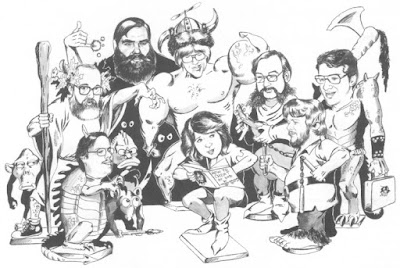
More interesting is Mary Kirchoff's second article, "Confessions of a Greenhorn Gamer." In it, she admits to a "deep, dark secret" about herself, namely that she is "not yet a 'gamer.'" She further admits that, when she was hired for her position as editor, she hadn't played any roleplaying games. Though she's rectified this during her time at TSR, she is "still not among the masses who can quote the DMG." With that confession out of the way, she shares her initial impressions of roleplaying, focusing on her time playing a fighter/cleric named Derrick in a confusing session that resulted in Derrick's death at the hands of another party member. From Kirchoff's brief description, it doesn't seem as if the established players made much of an effort to ease her into the game – not surprising: that was the style at the time – but she somehow came to enjoy the experience anyway. Truth be told, this is one of the more interesting articles in the issue and probably worth examining at greater length, if only for the Jim Holloway illustration that accompanies it:
Next up, Steve Winter "reviews" Star Frontiers. I put reviews in scare quotes, because it's not really a critical look at TSR's new SF RPG so much as an advertisement for it. The most interesting part of the piece is that, since its release in August, Star Frontiers had sold 49,500 copies. Winter compares this favorably to FGU's Space Opera, released in 1980, which had sold only 20,000 copies. On the other hand, GDW's Traveller, released in 1977, had sold over 250,000 copies. I can't speak to the veracity of these numbers, but, if correct, they're very instructive about the relative popularity of the three big science fiction RPGs of my youth.

There's a "Christmas Crossword" reprinted from the first issue of the Grenadier Bulletin, along with reprints (also from the Bulletin) of two pun-filled Reiga Nerd tales by Kim Eastland. This month's "Encounters" article is written by David Cook and features a meeting between a human "xenopologist" and a member of the octopus-like Ul-Mor species from Star Frontiers. It's a bit underwhelming, to be honest, and I'm honestly not sure how useful it'd be to anyone actually playing the game. Potentially greater value is to be found in "Dispel Confusion," which offers answers to AD&D, Top Secret, and Gamma World questions sent in by readers. 

The winners of the Top Secret gadget contest announced in issue #3 appear in this issue. There are nine winning gadgets, none of which struck me as being anything we've haven't all seen before in one form or another in spy novels and movies. To my mind, the most noteworthy thing about the winners is that one of them, Matt Forbeck, would later go on to become a professional game designer, working on Dungeons & Dragons, among many other games. The winners of the Gamma World art contest, also announced in issue #3, are mentioned too, but the artwork does not appear. I wonder why.

Mike Carr pens a very airy – no pun intended – reflection on Dawn Patrol, which is even less substantial than Steve Winter's review of Star Frontiers. As I said at the beginning of this post, Polyhedron may have expanded its page count, but very little of it was devoted to "game-y" content. That said, Frank Mentzer's "Spelling Bee" looks at the similarities and differences between the polymorph self, polymorph other, and shape change spells in AD&D. This is helpful to both players and referees, though it seems clear Mentzer's intended audience is primarily the latter, since he devotes much of his commentary on the ways to "control" use of the spell, which is to say, rein it in against abuse.

Continuing with the issue's Christmas theme, there are six RPG-themed carols presented here: The Great Druid's Coming to Town, Silver Shells (for Gamma World), O Purple Worm, Jingle Bells, White Dragons, and The Twelve Days of Christmas Gaming. There's also a Christmas-flavored installment of Ron Shirtz's "The Knight-Error" comic. "Gen Con XV: Megacon" is a report on the major events of that convention, complete with photographs. Frank Mentzer's "Notes for the Dungeon Master" is the usual grab bag of ideas and advice. However, it also states that "Gary doesn't run a straight AD&D campaign; he's too creative to feel comfortable in that rigid system." He quickly follows this up with, "You say you are, too? How many games, modules, and articles have you written lately?" It's a very odd response in my opinion, suggesting that only the most imaginative, creative, and lofty of people should be free from using the game as written. This kind of attitude is precisely why many gamers were becoming turned off by AD&D at the time.

Aside from the letters page and "Notes from HQ," dealing with RPGA ephemera, all that remains of the issue is the aforementioned catalog of products for sale. All in all, issue #9, despite its size, doesn't really show off Polyhedron to its fullest. Certainly, it's not one of the issue I most remember from my youth. Fortunately, there are – eventually – better ones on the horizon.

Monday, November 6, 2023

The Giant Kingdom

One of the more underappreciated aspects of the 1977 Dungeons & Dragons Basic Set is the degree to which its rulebook, prepared by J. Eric Holmes, is a very faithful editing and restatement of the original 1974 OD&D rules. Consider, for example, that both the Holmes rulebook and Volume 1 of OD&D begin with the same foreword, penned by Gary Gygax just a little over half a century ago (November 1, 1973). Here's the version found in OD&D:

Here's the version found in Holmes:
Aside from differences in typography, the two paragraphs are the same, right down to the idiosyncratic use of quotation marks and capitalization of titles. At least, that's what I had long thought, until Stephen Wendell, longtime player in my ongoing House of Worms Empire of the Petal Throne campaign, pointed something out on his own blog. 

In the Holmes version of the foreword, the second time the phrase "Great Kingdom" should appear, it's been replaced with the phrase "Giant Kingdom." This is clearly a transcription error, resulting no doubt from the process of re-typing the original foreword for use in the new rulebook, rather than a deliberate change. I've read that foreword in its Holmes version countless times over the decades, but it wasn't until Stephen mentioned it to me before our last EPT session that I ever took notice of it. I suppose my brain simply saw what was intended – "Great Kingdom" – rather than what's actually present in the text. The workings of the human mind can be very strange!

Though small in import, this revelation nevertheless got me wondering about how often we think we've read the words of a text when, in fact, we've unconsciously substituted our own. I suspect this happens a great deal in reading roleplaying game rules, especially when we come to the rules confident that they already know them. I'd further theorize that this is most common when it comes to Dungeons & Dragons, a game whose rules everyone thinks they "know" based on years of playing it and yet whose actual rules are often neither read nor understood correctly. 

Goodness knows I've been guilty of that many times and probably continue to do so. I'd be interested to know if readers can recall any notable examples of this in their own reading of RPGs. What sections of the rules have you misread for years, only realizing the truth later? 

Be a Creator, Not a Consumer

To say that I was a Star Wars fan during my childhood is something of an understatement. Children are, by nature, given to intense enthusiasms of all sorts, whether for dinosaurs or the planets or ancient Egypt – all of which I was, at various times, as utterly devoted as I was to George Lucas's 1977 space fantasy. During the period between 1977 and the release of The Empire Strikes Back in 1980, I lived and breathed Star Wars. I saw both movies in the theater multiple times, read every newspaper and magazine article about them that I could find, and (of course!) owned a disturbingly large amount of Star Wars-related merchandise. If I hadn't discovered Dungeons & Dragons, I daresay my zeal for the galaxy far, far away would likely have continued unabated well into the next decade.

Looking back on my youthful ardor from the vantage point of jaded middle age, I can't help but feel mildly embarrassed, though, as I already noted, such devotion is in the nature of children. And, to be fair, Star Wars enjoyed a cultural moment of the sort that doesn't happen everyday, so I hope I can be forgiven for being caught up in it. Furthermore, Star Wars was a genuinely good movie, one that simultaneously had a strong connection to earlier storytelling and did things that had never been done before, especially in the field of visual effects. In retrospect, I think it would been more remarkable if I hadn't become a fan of it.

I'm no longer much of a Star Wars fan. Aside from DVDs of the original movies, which I don't think I've actually watched in more than a decade, I don't think there's a single piece of Star Wars merchandise or memorabilia in my home. That's not out of dislike so much as disinterest. I still retain a residual affection for the 1977–1983 films, as I do for many other things I adored as a child, but I no longer devote much mental space – let alone closet space – to Star Wars. Were I to gain the ability to travel back in time and reveal this state of affairs to my younger self, I doubt he would believe me, so important was Star Wars to me as a child.
Even during those three or four years of my childhood, Star Wars wasn't my only interest, but it certainly occupied a pride of place that was immediately evident to anyone who spent more than a few minutes talking to me. Dungeons & Dragons – and roleplaying games more generally – eventually displaced it and indeed surpassed it in staying power. More than four decades after I first cracked open my beloved Holmes Basic Set, I'm still playing RPGs, whereas Star Wars (and lots of other childhood enthusiasms) are now very much in the rearview mirror. 

Allow me to reiterate: this isn't because of dislike on my part, let alone hatred, but largely because of disinterest. I simply don't find Star Wars all that compelling anymore and I suspect it has to do with the way that it's become little more than a brand rather than a vehicle for telling rollicking space fantasy adventures. Arguably, that's always been the case, as evidenced by the large number of Star Wars-branded products available for purchase as soon as the movie was released – a great many of which I proudly owned and displayed. Like a lot of children in the late 1970s, I demonstrated that I was a fan of Star Wars by owning a lot of Star Wars products.

I recall that, at the time, there were critics who complained that George Lucas had "ruined" cinema with the blockbuster success of Star Wars. In their opinion, movie studios would now prioritize crowd-pleasing spectacle over the more serious films that had characterized the early part of the decade. It's an old – and recurring – line of attack that isn't completely without merit. Nowadays, though, I tend to think that the true "sin" of Star Wars is not that it ushered in an era of "dumb" movies, but that it demonstrated just how lucrative merchandising it could be. 
One of the best things about roleplaying games is that, at base, they are vehicles for creating your own rollicking adventures with your friends. I sometimes think we don't recognize just how powerful a thing Gygax and Arneson unleashed upon the world almost half a century ago. There's a reason Greg Stafford likened RPGs to Pandora's Box in the dedication of RuneQuest. After the appearance of D&D, the world was forever changed, in ways both big and small. 

Roleplaying games gave their players the tools to make their own imaginary worlds. Once you had learned their rules, you had everything you could ever need to keep on creating for the rest of your life. This fact has long vexed RPG publishers who, understandably, want to keep selling products, but the truth is that there's absolutely no need to ever purchase anything else. That hasn't stopped game companies from trying to convince you otherwise, of course. If they couldn't get you to buy an adventure or a supplement or a rules expansion, then how about this T-shirt, maquette, or beach towel? Let's equate your hobby with your personal identity to make money!

It's a predictable script, one very similar to that employed by Star Wars merchandising over the years. While there's nothing inherently wrong with this – everyone needs to make a living somehow – it doesn't hold much attraction for me. Been there, done that, literally bought the T-shirt. From my perspective, this hobby is at its best when it's about creating, not simply consuming. If you're a roleplayer, then play – imagine a new setting, generate a character, write up an adventure. That's what makes this pastime so uniquely compelling, especially in a world that seems increasingly hostile to the liberation of the human spirit. Give free rein to your imagination and fight on.