Showing posts with label naturalism. Show all posts

Friday, September 23, 2022

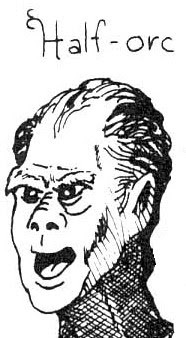
Half-Orcs Were a Mistake

Wanted: For the Crime of
Gygaxian Naturalism

Despite Gary Gygax's repeated assertion that his conception of Dungeons & Dragons owes little to the works of J.R.R. Tolkien's The Lord of the Rings (which he nevertheless included in Appendix N), he sure did borrow a lot of individual elements from the novel! Orcs are regularly cited as the prime example of this peculiar phenomenon and rightly so, I think, because, as a distinct type of enemy, they are largely without any significant mythological precedent prior to the publication of Tolkien's tales. At the same time, orcs are, at base, little more than man-shaped monsters in service to Evil, not unlike similar creatures found in northern European folklore and in the pulp fantasy stories that proliferated in the first half of last century. 

The same, however, cannot be said for the half-orc, references to which can also be found in The Lord of the Rings. The precise nature of half-orcs in Middle-earth is unclear, partly because I don't believe Tolkien ever settled the question of the nature of orcs, having changed his mind several times on the subject. What we can say for certain is that Tolkien's half-orcs – or "goblin-men," as he sometimes called them – were creatures that, while generally orcish, looked enough like Men that they move among them without attracting much comment. Half-orcs were thus useful as spies by the forces of Evil.

Half-orcs don't exist in Dungeons & Dragons prior to the publication of the AD&D Monster Manual in 1977, where there's a brief discussion of them at the end of the book's entry for "orc." There, Gygax states that

As orcs will breed with anything, there are any number of unsavory mongrels with orcish blood, particularly orc-goblins, orc-hobgoblins, and orc-humans. Orcs cannot cross-breed with elves. Half-orcs tend to favor the orcish strain heavily, so such sorts are basically orcs although they can sometimes (10%) pass themselves off as true creatures of their other stock (goblins, hobgoblins, humans, etc.).

This sounds a lot like the broos of Glorantha, does it not? In any case, the Players Handbook a year later gives us a a bit more information about them. Here, Gygax reiterates that

Orcs are fecund and create many cross-breeds, most of the offspring of such being typically orcish. However, some one-tenth of orc-human mongrels are sufficiently non-orcish to pass for human. 

The remainder of the PHB's description is given over to game mechanics, with little else stated about the nature of half-orcs or the place within the implied setting of AD&D. We do learn that, with the exception of humans and halflings (!), all other playable races hate or have antipathy for half-orcs. This makes sense, given half-orcs' preference for classes like thief and assassin, marking them as having criminal and antisocial tendencies of a most unsavory sort. I have no idea why Gygax felt the need to include orc-human hybrids as a playable race in AD&D, though I suspect that, like half-elves, which first appeared in Supplement I to OD&D, he did so to appeal to the fans of The Lord of the Rings among early gamers. I think this was a profound mistake, one that has haunted D&D ever since. 

I say this because orcs are monsters. According to the Monster Manual, they "are cruel and hate living things in general." Likewise, "they take slaves for work, food, and entertainment (torture, etc.)." They're not people in the same sense that, say, humans, dwarves, or elves are – or at least that's how I think they were initially conceived. Unfortunately, Gygaxian naturalism upended that particular apple cart and we discovered that orc lairs contain noncombatant females and young. No longer is an expedition into the Caves of Chaos a simple matter of defending the Realm against Evil; now it's an exercise in the mass murder of the defenseless.

The existence of playable half-orcs only complicates the matter further. It might just be possible to squint one's eyes and imagine that even baby orcs are an existential threat to the Realm of Law and Goodness and therefore fit only for extermination. Once you allow playable orc-human hybrid characters who are not required by the rules to be evil, let alone restricted from being good, you open the door to viewing orcs (and, by extension, all humanoid monsters) as people on par with the more traditional player character races. From there, you're well on the road out of the adventuresome pulp fantasy world D&D has long evoked and heading toward … something else entirely.

Far be it for me to suggest that there's anything inherently wrong with this approach to fantasy. Indeed, there might well be something genuinely fun and compelling about treating humanoid races as one might treat alien species in an episode of Star Trek rather than as ravening Chaos-spawn that bubble up from the black blood of the Earth to wreak havoc across the Realm of Man. However, for those of us who like fighting orcs (and goblins and gnolls and …) without pangs of conscience, I think it's important we keep them genuinely monstrous and inhuman. Doing this necessitates, among other things, abandoning the idea of playable half-orcs. They were a grave mistake back in 1978 and they've only become more so in the more than four decades since.

Tuesday, March 3, 2009

Gygaxian Unnaturalism

Like the term "old school," trying to define the precise mix of ingredients that makes Dungeons & Dragons Dungeons & Dragons is a slippery business, so slippery in fact that many have long been quick to dismiss it as a pointless exercise. This quickness has been all the more pronounced in the last year. Between the death of Gary Gygax and the advent of a new game laying claim to his legacy, there's been much discussion of these and related topics, much of it sadly ill-informed either by history or by logic. There's a natural tendency in human beings -- gamers in particular -- to want to put ideas and concepts into nice, neat mental "boxes." I'm as guilty of this as anyone, as regular readers of this blog can attest. It's the same tendency that reduces complex discussions into simple formulae or sees lists as exhaustive rather than as mere aids to understanding.

Something like this has happened in the months since I wrote the well-regarded entry entitled "Gygaxian Naturalism." I don't think I'm flattering myself to say that it's one of the more influential posts to have arisen out of the old school blogging community. Lots of people seem to have latched on to the idea I put forward in that post, including people whose interests and agendas are very different than my own. Unfortunately, some have reduced my original post to a mantra or formula, seeing in it an exhaustiveness I never intended. In and of itself, that's not necessarily a bad thing, since I'd much rather see the adoption of a literal-minded interpretation of Gygaxian Naturalism than the wholesale rejection of it. The problem is that such literal-mindedness makes it far too easy for some to reject the principle or to argue that it's incoherent, much in the way that a child who'd been taught "all swans are white" would be at a loss to explain the black swans of Australia.

Naturalist though he was, Gary Gygax was also -- perhaps even pre-eminently -- a fantasist: "These rules are strictly fantasy ... those whose imaginations know no bounds will find that these rules are the answer to their prayers. With this last bit of advice we invite you to read on and enjoy a 'world' where the fantastic is fact and magic really works!" It doesn't take a sharp-eyed scholar to find innumerable examples of where Gygax's love of the fantastic trumps his love for the natural. For every creature whose behavior obeys an approximation of natural laws, there is another that exists wholly outside of Nature. For every place where the implied world of D&D works according to recognizable axioms, there is another place where they flout them.

The many exceptions to naturalism found in the Gygaxian canon are only a threat to a naive understanding of it -- an understanding founded primarily on tallying examples of one approach and weighing against examples of another. I suspect that, if this is the approach one takes, explicit examples of naturalism would prove far less numerous than one might imagine. That's partly because the underlying assumptions of D&D -- the things it doesn't say -- are those of the real, natural world. Gygax didn't bother to talk about such things, because he simply assumed their veracity, whereas unnatural events and effects needed specific explication. Gygaxian fantasy takes place not in a wholly magical world, but instead in a natural world to which magic has been added, which is why magic often gets a great deal more attention in his writings.

All that aside, Gygaxian unnaturalism is nevertheless an equally important principle of the game. Flip through the Monster Manual and take a look at the creatures you find there. You'll almost certainly find monsters, like demons and devils, that exist completely outside anything resembling an earthly ecology and whose existence and behavior cannot be accounted for according to "scientific" principles. More than that, though, look carefully even at many of the "natural" creatures described in that volume: dinosaurs, Irish deer, giant lynx with the power of speech, to name but three. None of these beasts is "monstrous" in the usual sense of the term, but all are largely outside our experience of the natural world, being either throwbacks to earlier prehuman eras or unnatural modifications of real world animals. Indeed, a goodly percentage of the Monster Manual's entries are made up of giant animals of many sorts -- hardly sterling examples of Gary's commitment to naturalism.

But why does it have to be either/or? Part of the appeal of Gygax's vision of Dungeons & Dragons is that he rejected both the whimsy of a completely magical world even as he avoided the banality of "realistic" fantasy. His unique genius was in being able to steer the game between these twin extremes and into the heady waters where the two approaches exist in relative harmony, the one serving the other. It would be a mistake, I think, to deny that naturalism was the foundation on which Gary built his game, but, by the same token, that never stopped him from building glorious edifices of purest fantasy -- the "dark fairyland" of the Drow, the terrifying tomb of the demi-lich, the whimsy of Dungeonland -- upon that foundation. This marvelous coincidence of opposites is perhaps the greatest of many gifts Gary bequeathed to the game he co-created and tirelessly promoted during his life. It is his truest legacy and one I have tried very hard to honor.

Thursday, January 8, 2009

Retrospective: Tegel Manor

Tegel Manor vexes me.

First published in 1977 and revised in 1980 (and expanded in 1989) by Judges Guild, Tegel Manor is without a doubt one of Bob Bledsaw's masterpieces. Describing a sprawling 240-room haunted castle, the module is a textbook example of a funhouse dungeon, utterly lacking in anything resembling an ecology and filled with many encounters for which the adjective "whimsical" is charitable at best. The contents and/or inhabitants of each room are random -- in some cases literally -- meaning that, here you might find nothing more threatening than some giant beetles but next door you might find a Type III demon polymorphed as a kindly old beggar.

Now, I've come clean on the fact that I'm not a huge fan of funhouse dungeons, with a few exceptions. At the same time, I recognize their importance in the history of D&D and see them as an important antidote to post-Hickman tendency to treat adventure modules primarily as a vehicle for "story." But, even within that context, Tegel Manor irks me. I'm not entirely sure how to take it. Is it intended as a joke, a Castle Greyhawk before its time? With its random encounter charts containing 100 members of the cursed and unfortunately named Rump family (all of whose names start with the letter R) and its goofy encounters ("Four Zombies ... bowing to a Giant White Rat ... in a pink cape and red plumed hat"), it certainly seems that way. It's one thing to sidestep naturalism, but Tegel Manor goes above and beyond the call of duty when it comes to "gonzo."

But the map is a think of beauty. Nothing -- and I mean nothing -- has ever beaten it. You can see a bit of it in the image above, but it doesn't do justice to the thing. It's filled with winding passages, secret doors, mazes, empty rooms, weird features, and more. Best of it, the map is completely legible and usable in play, despite its complexity. I think the quality of Judges Guild's maps is often overlooked. Compared to what others produced at the time, JG's output is often unparalleled. Bill Owen, in his reminsicences about the Guild, commented on the difficulties Bob Bledsaw encountered in fnding printers capable of producing maps of the quality he wanted to include in his modules and I can believe it. Even now, with so many advances in technology, very few gaming maps are as multifaceted yet usable as Judges Guild's best work. It's really a testament to the company that they did so much first and best.

Tegel Manor isn't a module I'd ever run as written. There's too much about it that rankles me and, if it rankles me, you can be sure that it'd get even less warm a reception by today's gamers. Yet, despite that, there's something very compelling about it. Perhaps it is because it's so different from my own tastes that it elicits a frisson in me whenever I read it. Perhaps I can't shake the feeling that I've yet to reach the zen state where, suddenly, the whole thing will make sense to me. Or perhaps it's simply that the maps are so damned cool. Whatever it is, I find it hard to dismiss Tegel Manor outright, even though I want to. It's simply not the kind of module I'd ever run, let alone write, but that may be the point. One of the joys of my exploration into the history of the hobby is encountering stuff that is so different from my own preferences. Even when I don't change my mind, I still come away enriched by the encounter.

Friday, January 2, 2009

Silver Age Obsessions

Issue 88 of Dragon was released in August 1984, which puts it outside what I generally consider the Golden Age. The cover art, as you can see, is by Jim Holloway. I'll admit to having an inexplicable soft spot for his work -- probably having to do with fond memories of Paranoia -- but I think it's fair to say that that the presence of his artwork is a pretty good indicator that you're looking at an artifact from a period outside the period I regard as the hobby's apex, but perhaps only barely. Call it the Silver Age.

One of the fascinating things about the Silver Age -- indeed of many Silver Ages -- is that it was heavily focused on commenting upon and embellishing the works of the Golden Age. This is very evident in the pages of Dragon from the period, which, if looked at today, would no doubt seem unduly obsessed with minutiae, such as a "realistic" method of calculating a character's height and weight based on his ability scores or determining how far a character could jump up or across based on the same. "Realism" was a watchword of the Silver Age. Indeed, I recall an exhaustive review of the then-new Rolemaster series which reviewed the game primarily on the basis of how realistic it was.

This concern about realism is why issue 88 could, for example, boast not one but two different articles on the physics of falling damage (and a further article on the subject by Gygax himself a few issues later). To some, arguing over whether falling 40 feet causes 4d6 damage or 10d6 damage might seem like needless nitpicking and, on some level, it is. What it really is, in my opinion, is two things. First, it's a consequence of the maturity of D&D. The game had been out for 10 years by this point and was so firmly established in its essentials that all that was left to do was gild the lily, so to speak. In short, there's a hint of decadence even amidst the enormous creativity of the Silver Age (and there was a lot of creativity, as I'll discuss in a future post).

The second thing that the obsession with realism indicates is how unquestioned Gygaxian naturalism had become in the game. Most gamers at the time simply accepted that the rules of the game were intended to simulate a reality, albeit a fantastic one. Consequently, the more closely the rules modeled that reality, the "better" they were, which is why you see lots of arguing back and forth over the best way to do so. There were, to my recollection anyway, comparatively few voices arguing that D&D shouldn't be as realistic as possible within the constraints of the magical world it portrays. This is something even the Hickman Revolution didn't seek to overthrow, as it was a largely unquestioned pillar of what D&D -- what a roleplaying game -- was supposed to be (superhero games are something of an exception and, I think, one of the primary gateways through which non-simulationist approaches gained greater popularity).

Naturalism thus reached its height during the Silver Age and, on reflection, I realize that, coming to the hobby as I did during the late Golden Age, I didn't see the transition between the two ages as clearly as I do now. Moreover, the dominance of naturalism was not a foregone conclusion during the Golden Age. One need only look at things like Arduin or even Blackmoor to find plenty of examples of non-naturalistic approaches to gaming during the early days. But naturalism is what Gygax, through TSR, raised to the level of dogma and it's what informed my own contnued conception of what D&D is and how it ought to be played. It's clearer to me now that this approach wasn't the only one, even within D&D, prior to the end of the Silver Age. However, it was the favored one and, for good or for ill, it's (until recently anyway) been a core part of the way the game has been played and published. It's certainly my preferred style, which probably explains my general dislike for more "wahoo" approaches.

I'll be returning to this and related topics in future posts. There's a lot of history to mine here and I would like more time to do so.

Friday, October 10, 2008

Yet More Buzzwords

I'm always pleased when I see that people have taken something I wrote and run with it. That's what's happened over at the Paizo forums, where there's a long thread that spun off from my post about Gygaxian Naturalism. Aside from the generally thoughtful tone of the thread, I was particularly impressed with its introduction of two more terms that I plan to add to my vocabulary: Gygaxian Methodology and Gygaxian Canon.

As defined by poster Jeremy MacDonald, Gygaxian Methodology consists of:
the use of tables to enhance authenticity. Rules and rulings that don't have anything to do with the players but are simply aspects of the world at large. The creation of adventures that are internally consistent and not modified one way or another simply because your players party does or does not have a Paladin. Adventures that have secrets that might or might not be discovered by the players.

Authenticity is the key here even if it trumps story.

Gygaxian Canon on the other hand:
This is adherence to Gygax's original view of the monsters and their themes and of the Great Wheel Cosmology. Kobolds are fecund little dogmen, Mind Flayers plot to extinguish the sun and there are hints that that they are either from the future or the past but they are deffinitly not from this time line. Drow are led by powerful woman and they are always evil. They worship the Goddess Lolth.
In both cases, I have quibbles and qualifications I'd make, but I agree with the general thrust of both definitions. I find these new terms useful because they help to highlight where some of the fault lines lie in "old school" vs. "new school" debates, particularly as it relates to the WotC editions of Dungeons & Dragons. In my case, it's the deviation from the Gygaxian Methodology (of which Naturalism is a sub-set) that bothers me more about the WotC editions than it is the deviations from the Gygaxian Canon.

Now, obviously, I like many aspects of the Canon and have indulged in my fair share of potshots at the re-evaluations of the Canon, but I'm actually much more open to doing so than I am to changes to the Methodology. For me, the Gygaxian Methodology is where D&D "lives," so to speak, and it's what has long distinguished it from other RPGs, both in the past and now. I have a lot of sympathy for folks who want to "save the Great Wheel" and all that, but I think it's a mistake to conflate D&D with the Gygaxian Canon, even if the Canon has such a long history with the game that it's practically synonymous with it. On this point, I don't think 4e necessarily made any mistakes by changing the Canon (even if I think many of the specific changes are just plain idiotic).

The Gygaxian Methodology, however, not only undergirds the game's mechanics (at least from late OD&D onward), but it's central to the way the game was played and experienced by most gamers before 1983 or thereabouts. That's where the "soul" of old school D&D resides, like it or not. Indeed, I suspect, far moreso than the Gygaxian Canon, it's the Methodology that's at the root of whether one has sympathy for the old school or not. That's not to say there aren't other parallel, equally valid Methodologies -- Dave Arneson assuredly has his own -- but I imagine these parallels share much with the Gygaxian one, so much so that you could easily create a superset to describe their characteristics.

With all that aside, I think it's a mistake to fixate too much on the Gygaxian Canon, love it though I do. Over the years, I've deviated from it in various ways and I plan to do so again in my next campaign. At the same time, I plan to hew very closely to the Gygaxian Methodology. One of the reasons I object to equating old school play with "a feel" is that this position tends to downplay the close connection between the Methodology and the mechanics. If you look back at the history of 2e, though, what you'll see is that each of TSR's many campaign settings either replaced large swaths of the core rules in order to accommodate a different Methodology or, if they didn't, gamers complained that the D&D rules weren't "right" for the setting in question. This is an important lesson to those who would argue that "old school" is a flavor that can be easily added to any rules set.

Thursday, September 4, 2008

Gygaxian "Naturalism"

I refer, from time to time, to a concept called "Gygaxian Naturalism." I realize that I've never actually explained what I mean by this phrase. As I use it, it refers to a tendency, present in the OD&D rules and reaching its fullest flower in AD&D, to go beyond describing monsters purely as opponents/obstacles for the player characters by giving game mechanics that serve little purpose other than to ground those monsters in the campaign world.

This naturalism can take many forms. For example, OD&D often tells us that for every X number of monster Y, there's a chance that monster Z might also be found in their lair. In the case of the djinn and efreet, as another example, we find that they both can create nourishing food and potable beverages, as well as many other kinds of materials through the use of their innate powers. In AD&D, these sorts of things get expanded upon greatly, with the Monster Manual telling us how many females and children can be found in a monster lair and giving many creatures powers and abilities that don't serve a specifically combat-oriented purpose, such as a pixie's ability to know alignment, for instance.

The intention behind Gygaxian Naturalism is to paint a picture of a "real" world, which is to say, a world that exists for reasons other than purely gaming ones. The implication is that monsters have lives of their own and thus go about their business doing various things until they encounter the player characters. Exactly what they do is described by reference to game mechanics, whether it be the numbers of non-combatants in a lair or spell-like abilities that help the monster do whatever it naturally does when it's not facing off against an adventuring party.

A consequence of Gygaxian Naturalism is that it grounds D&D a bit more in a pseudo-reality. I don't mean to imply that it's realistic in any meaningful sense, only that its fantasy follows "natural" laws of a sort, much in the way that, for example, I know that there are squirrels and raccoons and rabbits in my neighborhood who go about their business when I'm not seeing them in my yard or chasing them away from my recycling bins. That's one reason why AD&D has stats for so many kinds of "ordinary" animals: you can't build a "real" world without stats for sheep and cows and horses and such, because you never know when the PCs might need to kill one.

The end result of this is that Gygaxian fantasy is a simulation -- a fantastical one, to be sure, but a simulation nonetheless. The downside is that it's a very specific kind of simulation and it carries with it a lot of assumptions and expectations that not everyone shares. I know many OD&Ders, for example, who don't like "naturalistic" orcs, preferring them instead to be spawned from black ooze that bubbles up from the mythic underworld that is the dungeon. Likewise, the tendency to provide stats for everything is a self-perpetuating one, reaching its zenith in 3e, in which the game almost literally did stat out every conceivable thing with which your character might interact. Needless to say, some find this to be too much, myself included.

Gygaxian Naturalism survived Gygax's involvement in the development of Dungeons & Dragons and formed one the most important, if often only sub-consciously, creative foundations of the game through its second and third editions. My read of the latest edition is that it largely rejects Gygaxian Naturalism without embracing the alternative offered by some interpretations of OD&D, instead opting for a different model altogether. I myself have drunk deeply from the wells of Gygaxian Naturalism, so it's second nature to me now. I won't go so far as to say that Gary's approach is inseparable from D&D, because that's certainly not the case, but I will say that it's so deeply ingrained -- even in OD&D, particularly if you add the supplements -- that, to remove it, is very likely to have the effect of creating a different game entirely -- certainly a different one that what has been called D&D for most of the game's existence.