Showing posts with label silver john. Show all posts

Monday, August 15, 2022

Pulp Fantasy Library: Vandy, Vandy

In the years since I first started writing this series, I've developed a great deal of affection for certain writers, some of whom are not very well known today. Among their number is Manly Wade Wellman. Though included in Appendix N, Gary Gygax didn't specify which of Wellman's stories, books, or series he felt had had the most "immediate influence" upon him. That's too bad, because it makes it much more difficult, I think, for those interested in tracing the creative genealogy of Dungeons & Dragons to home in on writers and tales of particular significance. 

Though Wellman had a very long and prolific career as a writer – primarily of short fiction – if I had to hazard a guess as to which of his many creations might have had a strong influence over Gary Gygax's imagination, I'd certainly select John the Balladeer, sometimes called Silver John, after the silver strings of the guitar he carries with him everywhere. John is a traveling singer, who wanders the Appalachian Mountains, where he encounters all manner of supernatural beings and witchcraft drawn from the legends of the region. Wellman's stories of John are generally short in length but long in staying power. They read like genuine folktales of rural America and they never disappoint.

"Vandy, Vandy" is a perfect example of what I mean. First appearing in the March 1953 issue of The Magazine of Fantasy and Science Fiction (where much of Wellman's work appeared during the '50s), the story concerns John's visit to "that valley [that] hadn't any name" where "no lumberman had ever cut the thick, big old trees." Near sunset, John comes a family playing music and dancing outside their secluded cabin. Naturally, their somewhat suspicious of the unexpected arrival of a stranger, even one as seemingly friendly as John. He asks for a place to sleep and the eldest of them, "a long-bearded old man with one suspender and no shoes" suggests that he go elsewhere to find a place "to stretch out."

John tries another approach.

"I heard you all playing first part of Fire in the Mountains."

"Is they two parts?" That was the boy, before anyone could silence him.

"Sure enough, son," I said, "Let me show you the second part."

The old man opened his beard, likely to say wait till I was asked, but I strummed my own guitar into second part, best I knew how. Then I played the first part through, and, "You sure God can pick that," said the short-bearded one. "Do it again."

This wins the family over and the old man, who identifies himself as Tewk Millen, invites John to have a dinner of "smoke meat and beans" with his family, which consists of his son, his daughter-in-law, and their son, along with his own wife and daughter. The daughter, who had "her hair like yellow corn silk and … eyes like purple violets" is named Vandy. Her name attracts John's attention.

"Vandy?" I said after her father.

Shy, she dimpled at me. "I know it's a scarce name, Mr. John, I never heard it anywhere but among my kinfolks."

"I have," I said, "and it's what brought me here."

Mr. Tewk Millen looked funny above his whiskers. "Thought you said you was a young stranger man."

"I heard the name outside in a song, sir. Somebody allowed the song's known here. I'm a singer. I go after a good song."

The song tells the story of a rich man who comes to court a young woman named Vandy. He promises her "gold and silver," "a house and land," and "a world of pleasure," but she nevertheless rejects him, saying she already has a sweetheart, "a man who's in the army" and has been away for "seven long year." The Millens claim the song is a very old one, passed down in their family from generation to generation. They perform it for John, who observes that 

the notes were put together strangely, in what schooled folks call minors. But other folks, better schooled yet, say such tunes sound strange and lonesome because in old times folks had another note scale from out do-re-mi-fa today.

The performance is interrupted by the sudden appearance of another man, one who bears a gold-headed black cane. 

He was built spry and slim, with a long coat buttoned to his pointed chin, and brown pants tucked into elastic-sided boots, like what your grandsire had. His hands on the cane looked slim and strong. His face, bar its crooked smile, might be handsome. His dark brown hair curled like buffalo wool, and his eyes were the shiny pale gray of a new knife. Their gaze crawled all over the Millens and he laughed a slow, soft laugh.

The family treats the man, whom we learn is called Mr. Loden, with respect born out of fear and offer him a place to sit, as well as an offer to stay for dinner. Mr. Loden plays the part of a gracious guest, but it's clear the family is uncomfortable around him, "nervous as a boy stealing apples." He brings gifts for everyone present – except John, whom he is surprised to see – including a necklace for Vandy, whom he begs to "let it rest on your heart, that I may envy it."

Mr. Loden doesn't like John, though he behaves politely toward him. For his part, John is skeptical of Mr. Loden and his interest in Vandy. He also sees the effect his presence has had on the Millens.

The menfolks sat outside and said nothing. They might have been nailed down, with stones in their mouths. I studied about what could make a proud, honorable mountain family so scared of a guest I knew it was only the one thing. And that one thing wouldn't just be a natural thing. It would be a thing beyond nature or the world. 

John is right, of course, as he usually is and the remainder of the short story deals with the revelation of Mr. Loden's true identity and intentions. Fortunately for the Millens, John has learned a thing or two about dealing with things "beyond nature or the world" in his travels. He's a great example of how a bard might work in Dungeons & Dragons – a wandering entertainer who recognizes how much wisdom and knowledge are hidden in ancient traditions and folklore and uses them to good ends. John the Balladeer is a terrific character and all of his adventures are worth a read, but "Vandy. Vandy" is an especially good one in my opinion. Seek it out, if you can.

Monday, October 25, 2021

Pulp Fantasy Library: Can These Bones Live?

With Halloween less than a week away, I found my thoughts drifting toward "spooky" stories I could discuss in this week's installment of Pulp Fantasy Library. There were a lot of good candidates – some of which might appear in the coming weeks – but the one that most excited me was Manly Wade Wellman's "Can These Bones Live?," a short story featuring the Appalachian balladeer, Silver John. 

Now, I'm a huge fan of Wellman's fiction in general and the stories of John in particular, but what was the deciding factor in my decision was the publication where it first appeared: Sorcerer's Apprentice (issue #11/summer 1981, to be precise). For those unfamiliar with this periodical, Sorcerer's Apprentice was published by Flying Buffalo in support of its fantasy roleplaying game, Tunnels & Trolls. Original fiction by established fantasy and science fiction authors was a common feature of many gaming magazines in the 1970s and '80s and Sorcerer's Apprentice was no different. 

While traveling, John encounters "eight men in rough country clothes" carrying "a big chest of new-sawed planks" that measured "nine feet long and three feet wide and another three high." One of the men, Embro Hallcott by name, approaches John and asks him his name and business.

"Well, mostly I study things. This morning, back yonder at that settlement, I heard tell about a big skeleton that turned up on a Chaw Hollow farm."

"You a government man?" the grizzled one inquired of me.

"You mean, look for blockade stills?" I shook my head. "Not me. Call me a truth seeker, somebody who wonders himself about riddles in this life."

John's a character about which Wellman tells us little. Like most good pulp fantasy protagonists, his origins and history are largely unimportant. All that matters is that he's here, where something interesting is about to occur. In this case, that something interesting is the burial of the aforementioned big skeleton. John helps the eight men carry the chest holding it half a mile to Stumber Creek Church. 

The preacher, Travis Melick, is a gaunt man "in a jimswinger coat, a-carrying a book covered with black leather." Though he's never met John, he knows him by reputation, having "heard of good things [he'd] done." The approbation of the preacher reassures Hallcott and his fellows, he were still somewhat suspicious of the guitar-toting stranger. 

The men heave the chest – a massive coffin really – toward the graveyard, where a fresh grave has already been made for it. Before burying it, one of the men, called Oat, asks that it be opened first, since that is "the true old way." John then peers inside.

The bones inside were loose from one another and half-wrapped in a Turkey Track quilt, but I saw they were laid out in order. They were big, the way Hallcott had said, big enough for an almighty big bear. I had a notion that the arms were right long; maybe all the bones were long. Thick, too. The skull at the head of the coffin was like a big gourd, with caves of eyeholes and two rows of big, lean teeth, Hallcott banged the lid shut and hooked it again.

With that out of the way, Melick begins the burial rite for "the remains of a poor lost creature," a rite that involves quoting from the Book of Ezekiel (from which the title of the short story comes). Afterwards, the men lower the coffin into the grave and they depart. Melick asks John if he'll be his guest for the night, but he puts him off, saying he wants to "wait here a spell." 

Hallcott takes notice of this fact and asks John why he wishes to stay at the gravesite rather than leave like everyone else. John doesn't offer a solid explanation. Instead, he talks about the Book of Ezekiel and the many oddities in it – living bones, flying wheels, and the like. Hallcott agrees there are "strange doings in Ezekiel" and the two men settle down for a nighttime vigil together. They pass the time eating sandwiches and pondering the big skeleton they buried.

"I reckon you'll agree with me, them bones we buried were right curious. Great big ones, and long arms, like on an ape."

"Or maybe on Sasquatch," I said. "Or Bigfoot."

"You believe in them tales?"

"I always wonder myself if there's not truth in air tale. And as for bones – I recollect something the Indians called Kalu, off in a place named Hosea's Hollow. Bones a-rattling 'round, and sure death to a natural man."

"You believe that, too?"

"Believe it? I saw it happen one time. Only Kalu got somebody else, not me."

"Can these bones live?" Hallcott repeated the text.

I trust it won't come as a surprise to anyone to reveal that, yes, these bones can live and the remainder of the yarn is spent the consequences of that. Like most of Wellman's Silver John stories, this one is charmingly told in a folksy, understated way that evokes the tension of a good ghost story. The reader won't be frightened down to his bones, but he might well be transported to the woods, hunkered down around the campfire to hold off the chilly night air, while shadows dance and strange sounds echo. "Can These Bones Live?" is thus a genuinely effective short story and a reminder of why Wellman is rightly considered one of the masters of pulp fantasy.

Monday, June 14, 2021

Pulp Fantasy Library: One Other

Manly Wade Wellman is one of those authors whose name appears in Appendix N without any specific titles attached to it. One can interpret this fact in several different ways, but I simply assume it's because Gary Gygax thought so highly of all of Wellman's output that he found it difficult to choose just a few of them as representative. No less a luminary than Karl Edward Wagner called Wellman "the dean of fantasy writers," which suggests that Gygax was not alone in his esteem for him.

At the same time, I also assume that Wellman's stories of the Appalachian balladeer Silver John are among those most immediately influential on Dungeons & Dragons. When I say this, some assume, reasonably but mistakenly, that it's because the aforementioned John is a possible literary antecedent for the bard class. I don't discount the possibility, even likelihood, that Silver John played a role in the conception of the bard class, only that this is why the stories might have been in the back of Gygax's mind when he included Wellman in Appendix N. After all, it was Doug Schwegman, not Gygax, who first presented a version of the bard class in the pages of Strategic Review and, in any event, I'm not at all certain Gygax had any special affection for the class (which he relegated to an appendix in the AD&D Players Handbook).

What the Silver John stories all have in common is the deft re-purposing of folklore and local legends. Wellman, like Gygax, never missed an opportunity to put a new spin on an old idea; his Appalachian yarns are rooted in regional myth but many, if not most, go way beyond their origins, presenting the ancient fears of American mountain folk in a new light. Another point of connection with Gygax is the way that Wellman, who had written many science fiction stories, would often work science and scientific speculation, into his tales of fantasy. This is evident in the subject of today's post, "One Other," which first appeared in the August 1953 issue of The Magazine of Fantasy and Science Fiction. 

The story begins evocatively, with John climbing a mountain on his own.

Up on Hark Mountain, I climbed all alone, by a trail like a ladder. Under my old brogans was sometimes mud, sometimes rock, sometimes rolling gravel. I laid hold on laurel and oak scrub and sourwood and dogwood to help me up the steepest places. Sweat soaked the back of my hickory shirt and under the band of my old hat. Even my silver-strung guitar, bouncing behind me, felt weighty as an anvil. Hark Mountain's not the highest in the South, but it's one of the steepest.

I reckoned I was close to the top, for I heard a murmuring voice up there, a young-sounding woman's voice. All at once she like to yelled out a name, and it was my name.

Surprised by this, John makes an effort to reach the top of the mountain quickly. Doing so, he found a pool "where no pool could by nature be expected." It was "a clear blue pool, bright but not exactly sweet-looking." Near the pool was a young woman who, by her dress, John took to be a "town girl." She was seated near a fire, where she was engaged in some sort of incantation – burning leaves, melting wax, pouring libations, all the while invoking the names of both John and One Other. 

John speaks to the girl, asking her "Why were you witch-spelling me? What did I ever do to you?" She reveals that, a month before, John had ignored her at a party hosted by Old Major Enderby. John is astounded. "Ignored? I never notice such a thing," he says, to which the girl replies, "I do. I don't often look at a man twice, and usually they look at me at least once. I don't forgive being ignored." She then explains that she had hoped, by means of a charm said three times "beside Bottomless Pool on Hark Mountain," she could cause John to fall in love with her. 

John denies that the charm has worked, but she, whose name we learn is Annalinda, doubts him, pointing out that he climbed Hark Mountain. Why else would he do it, unless it was to find her? Not long thereafter a third person appears, Mr Howsen, from whom Annalinda claims to have learned the spell that brought John to her. She wishes to repay him for his aid, but Howsen corrects her, "No, you pay One Other." John, of course, has no idea who – or what – One Other is, but he has no interest in finding out. He begs Annalinda to leave Hark Mountain with him. Unfortunately, she's too frightened by Mr Howsen's claim that, if either of them leave before One Other appears, "it would be worse for you than if fire burned you behind and before, inside and out."

The meat of "One Other" lies in what happens next, as Silver John and Annalinda await the One Other. As they prepare for that fateful encounter – which is quite memorable in itself – they two converse about themselves, their lives, and their outlooks. In the course of this conversation, John speaks of a "science man" he once heard, who compared existence to a soap bubble and had

said our whole life, what he called our universe, was swelling and stretching out, so that suns and moons and stars pull farther apart all the time. He said our world and all other worlds are inside that stretching skin of suds that makes the bubble. We can't study out what's outside the bubble, or either inside, just the suds part. It sounds crazyish, but when he talked it sounded true."

"It's not a new idea, John. James Jeans wrote a book, The Expanding Universe. But where does the soap bubble come from?"

"I reckon Whoever made things must have blown it from a bubble pipe too big for us to figure about."

She snickered … "You believe in a God Who blew only one lone soap bubble."

This metaphor of the soap bubble recurs throughout "One Other" and it's put to good, even chilling, effect. I think it helps set the story apart from others in the Silver John series and even brings it closer to some of Gygax's more outré speculations about the planes of existence in D&D. Even if you disagree with that last point, it's well worth reading.

Monday, December 7, 2020

Pulp Fantasy Library: The Desrick on Yandro

The bard class first appeared in the June 1976 issue of The Strategic Review. Its creator, Doug Schwegman, explained that the class was intended as a "hodgepodge" of the Norse skald, the Celtic bard, and the southern European minstrel. I've never made a secret of the fact that I'm generally not a fan of the class, which, at least as its usually presented (and played), is a bit too twee for my tastes. That said, the one aspect of the class that I do like is its "lore" ability, which Schwegman explains "reflects the Bard's knowledge of legends, magic, etc." Being an inveterate creator of lore for my adventures and campaigns, an ability like that is my natural ally. The lack of something like it in other D&D classes almost makes me wish to set aside my reservations about the class – almost.

Another thing that give my reticence pause is whenever I read one of Manly Wade Wellman's Silver John stories, such as "The Desrick on Yandro," which first appeared in the June 1952 issue of The Magazine of Fantasy & Science Fiction. Silver John, who first ambled into the world of pulp fantasy a year earlier, is a wandering Appalachian balladeer, who gets his name from the pure silver strings on his guitar. Like the bard class, John has knowledge of the history, legends, and folk ways of the people of Appalachia, knowledge that serves, at various times, as the catalyst and/or resolution of the strange things he encounters in the mountains of the eastern United States.

Indeed, "The Desrick on Yandro" begins with a demonstration of John's knowledge, as he sings "that song," an ominous turn of phrase that rather nicely situates all that follows. In exchange for lodging – he is, as I said, a man of no fixed address – John entertains the guests of a party, culminating in the singing of "the Yandro song."

I'll build me a desrick on Yandro's high hill,

Where the wild beasts can't reach me or hear my sad cry,

For he's gone, he's gone away, so stay a little while,

But he'll come back if he comes ten thousand miles.

A desrick, if, like me, you are unaware, is the Appalachian dialectical term for a roughly built but sturdy cabin. This particular desrick is found atop the peak of a mountain called Yandro, which John admits in conversation with the party guests is "not a usual name." One of the guests takes a special interest in "that song," as Yandro is his surname.

"I've never heard of that peak or valley, nor, I imagine, did my father before me. But my grandfather – Joris Yandro – came from the Southern mountains. He was young, with small education, but lots of energy and ambition." Mr. Yandro swelled up inside his fancy clothes. "He went to New York, then Chicago. His fortunes prospered. His son – my father – and then I, we contrived to make them prosper still more."

Though John is not one to suffer fools – or the pompous – gladly, he nevertheless acquiesces to Mr Yandro's request that he show him where "[his] grandfather might have come from." Yandro charters a plane and the two of them fly to a small airport near to where mountain is located. Unimpressed with the region, which he calls "a stinking country," much to John's dismay, Yandro is even more put out when he discovers that the road leading up the peak is too treacherous for travel by car. He and John have no choice but to set out on foot. 

Eventually, the pair come across the home of an aged woman named Miss Tully. She remembers John, whom she'd met before; he then introduces Yandro and she immediately becomes interested, muttering cryptically, "Funny … you coming along as the seventy-five years are up." When pressed, Miss Tully discloses that she remembers Joris Yandro from her childhood. Joris, she says, "courted Polly Wiltse, the witch girl." John reflects on her words.

Even the second time hearing it, I listened hard. It was like a many such tale at the start. Polly Wiltse was sure enough a witch, not just a study-witch like Miss Tully, and Polly Wiltse's beauty would melt the heart of nature and make a dumb man cry out, "Praise God Who made her!" But none dared court her save only Joris Yandro, who was handsome for a man like she was lovely for a girl. For it was his wish to get her to show him the gold on top of the mountain named for his folks, that only Polly Wiltse and her witching could find.

"Certain sure there's gold in these mountains," I answered Mr. Yandro's interrupting question. "Before ever the California rush started, folks mined and minted gold in these parts, the history-men say."

"Gold," he repeated, both respectful and greedy. "I was right to come." 

Miss Tully adds that Joris Yandro succeeded in coaxing Polly Wiltse to "bring down gold to him, and he carried it away and never came back." Abandoned by her feigned suitor, she "pined and mourned like a sick bird, and on Yandro's top she build her desrick." The song that John had sung at the party, it seems, was one Polly Wiltse had made and "it was part of a long spell and charm" intended to bring her lover back to her. Yandro is now convinced that Polly is still alive and waiting for him in her desrick atop the mountain named for his kin. He asks John to accompany him on his ascent, which he agrees to do, despite the warnings from Miss Tully about the many cursed creatures that haunt the mountain, like the Bammat, the Culverin, and the Behinder. Needless to say, the journey is eventful and what they find when they reach the desrick is memorable.

"The Desrick on Yandro" is an enjoyable story well told, a darkly humorous tale not dissimilar in many ways to those found in contemporary horror comics. What sets it apart, though, is Wellman's prose, which are those of a master folktale teller able to hold the attention of his audience as they huddle around the campfire on a shivery night. His ability to blend genuine Appalachian legends and lore with his own creations (and sly social commentary) elevate all the Silver John stories above much of what was written in the pages of the pulps. It's fun, powerful stuff – it would have to be to make me reconsider my stance on the bard!

Monday, March 14, 2011

Pulp Fantasy Library: Frogfather

No, I never liked frogs' legs very much, not even before what happened. And I wouldn't eat them now if I was starving. This is why.
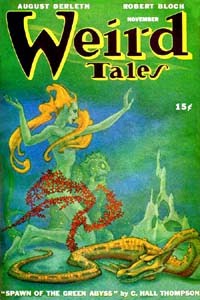
So begins Manly Wade Wellman's "Frogfather," which first appeared in the November 1946 issue of Weird Tales. Like all the tales in his Appalachian cycle, "Frogfather" is told in the first person, from the perspective of the wandering minstrel known only as Silver John, and draws on American folklore for its plot. In this case, Silver John is remembering an event from his childhood, when his maiden aunt, who raised him, turned him over to an unpleasant man named Ranson Cuff to settle a debt she owed. Cuff, is described in very unflattering terms.
His face was as round as a lemon, and as yellow and sour, and his eyes couldn't have been closer together without mixing into each other, and his little nose was the only bony thing about him.
Furthermore,
Ranson Cuff was the sort of man who shoved himself into your mind, like a snake crawling into a gopher hole. I defy anyone to find anyone else who liked Ranson Cuff -- maybe his wife liked him, but she didn't live with him for more than three weeks. Nobody around the Swamps liked him, though he was the best off in money. He ran a string of hunting camps for strangers from up north, who came to hunt deer or fish for bass, once in a while to chase bear with dogs. He did his end of that job well, and if he was rude the strangers figured for a picturesque character. I've heard them call him that. The Swamps people called him other things to his face, if he didn't have mortgages on their houseboats, cabins, and trapping outfits.
John tells us that Cuff loves frogs' legs, especially those he'd gotten for himself by hunting frogs in the Swamps. So it was that, on one night, John accompanies Cuff and "an old, old Indian whose name I never knew" on a frog hunting expedition "in a really beautiful boat [Cuff had] taken from a bad debt." Unfortunately for Cuff, there seem to be no frogs to be found -- that is, until he hears the sound of frogs singing along a bank to the northeast, a move the old Indian urges him against.
"I'm speaking for your good, Mr. Cuff," said the old Indian. "That's no place to stick frogs."

"I can hear them singing!" Cuff said. "Listen, there must be a whole nation of them."

"They're there because they're safe," said the old Indian.

"Khaa!" Cuff spit into the water, "Safe! That's what they think. We're going in there to stick a double mess."
Aficionados of weird tales don't need to be told how the story will unfold after this point, once Cuff ignores the old Indian's warning and orders the young Silver John to paddle up the river to where he hears those frogs singing. Despite the relative lack of suspense, Wellman nevertheless manages to hold one's attention. His gifts as a storyteller and his love of the legends of Appalachia both come through powerfully and, together, they carry the reader along to the inevitable conclusion.

That's probably what I found most remarkable about this story: despite the telegraphing of its end, I still wanted to read it. Wellman is simply a joy to read. Silver John's voice rings true. Though his words initially come across as simple and "folksy," there's unexpected insight and sophistication in them. There's also a rhythm to them, a poetry that becomes more apparent when you read the story aloud. Wellman is one of those rare authors whose work demands to be spoken; mere reading doesn't do it justice. I wonder if there are any audio recordings of the Silver John stories, because I'd love to hear them read by someone, preferably someone with a Southern Appalachian accent.

Regardless, "Frogfather" is an enjoyable short story that nicely showcases Manly Wade Wellman's talents as a writer. It's a pity he's not more widely known, even within pulp fantasy circles; he certainly deserves more accolades than he's received.

Monday, May 31, 2010

Pulp Fantasy Library: O Ugly Bird!

I wrote about Manly Wade Wellman's character of Silver John -- known simply as John in the stories in which he appears -- a year and a half ago. At that time, I hadn't read a Silver John story in a very long time, probably two decades and was going on my memories of reading from the old Arkham House anthology I found at a local library when I was a teenager. Back then, I liked the stories well enough, but I can't say that they really "spoke" to me, in the way that many other stories did. Thanks to Paizo's recent re-release of all the short stories under a single cover, I've had the chance to re-acquaint myself with Wellman and Silver John and I'm glad I did. These are some of the most excellent fantasy tales I've read in a long time. I have little doubt that I'll be talking more about them in the weeks to come.

First appearing in the December 1951 issue of The Magazine of Fantasy & Science Fiction, "O Ugly Bird!" marks the introduction of the wandering Appalachian balladeer known as John. It's also got one of the best opening paragraphs of any work of fantasy I've ever read:
I swear I'm licked before I start, trying to tell you all what Mr. Onselm looked like. Words give out -- for instance, you're frozen to death for fit words to tell the favor of the girl you love. And Mr. Onselm and I pure poison hated each other. That's how love and hate are alike.
The story just gets better from there.

While wandering "up these heights and down these hollows," John finds himself in a secluded town whose inhabitants are terrorized by one of the townsfolk, the aforementioned Mr. Onselm. Everyone in town is afraid of him and does what he says or else.
"One Old Jim Desbro refused him a chicken. Mr. Onselm pointed his finger at Old Jim's mules, they was plowing. Them mules couldn't move ary foot, not till Mr. Onselm had the chicken. Another time, Miss Tilly Parmer hid a cake when she seen him come. He pointed a finger and dumbed her. She never spoke one mumbling word from that day to when she died. Could hear and understand, but when she tried to talk she could just wheeze."
John, well-versed in the lore of the mountains (and much else, it's implied), recognizes that Mr. Onselm is "a hoodoo man ... which means the law can't do anything." He then resolves to look into his activities and deal with him, if possible. The problem is that Mr. Onselm has an accomplice, the Ugly Bird of the story's title.
It must have hung over us, high and quiet, and now it dropped into the yard like a fish hawk into a pond. First out I saw it was dark, heavy-winged, bigger than a buzzard. Then I saw the shiny gray-black of the body, like wet slate, and how it seemed to have feathers only on its wide wings. Then I made out the thing snaky neck, the bulgy head and long stork beak, the eyes set in front of its head -- man-fashion in front, not to each other.
None of the townsfolk are willing to stand up to Mr. Onselm and his Ugly Bird and so it takes the outsider John to do what they cannot, resulting in a terrific tale very well told.

Silver John is no mere bumpkin despite his rustic ways. As I noted above, he knows the lore of the mountains, as well as that of other parts of the world. It's hinted that, in his travels, he's learned much occult knowledge and it's his knowledge, along with his purity of heart, that enables him to face down many a supernatural threat. John's a very compelling character, simultaneously mysterious and familiar, the archetypal Cunning Wanderer come to life. He makes a great model for a re-imagined bard class, something I might attempt in the future.

Many pulp fantasies, being written in the past, can be difficult to get into. Their style and presentation can be off-putting to readers more accustomed to contemporary fiction. But "O Ugly Bird!" (or any of the Silver John stories) isn't like that at all. The first person narration is very effective and, while John and his interlocutors, use Appalachian, it comes across naturally and is surprisingly easy to understand -- certainly easier than, say, Lovecraft's attempts to convey backwoodsy speech in his own stories. That's because Wellman clearly loved and respected the people and traditions of Appalachia, whereas HPL likely didn't think much of the rural New Englanders he often portrays in his stories. Wellman has a great affinity for his characters and it results in superb fiction that everyone ought to sample, if not drink deeply from.