Monday, August 1, 2022

Speaking of Burn, Witch, Burn!

As some of you may recall, I was asked by Centipede Press to write the introduction to a new edition of Abraham Merritt's Burn, Witch, Burn! The book was recently released in a limited print run and almost immediately sold out, which is unfortunate, because it's a lovely piece of work that I'd have been proud to have on my bookshelf, even if I hadn't been involved in its creation.

Here's the cover and spine of the book. Not visible is the silk bookmark.

This is the table of contents, featuring some of the terrific, original artwork by Dan Rempel.
Of course, no edition of a work by Merritt would be complete without illustrations by Virgil Finlay, an artist from whom Merritt commissioned more than a thousand pieces during his lifetime.
Though the limited edition of the book is sold out, Centipede Press is planning to produce a reprint in the future. When it's available for sale, I'll make an announcement here, since I think it would definitely be of interest to many readers.

Marvel and HPL

A largely faithful adaptation of Lovecraft's "Pickman's Model" was found in the pages of issue #9 (January 1971) of Marvel's Tower of Shadows comic. Tower of Shadows was a horror anthology book that Marvel published between 1969 and 1971, after which it was revamped and its title changed to Creatures on the Loose! (which lasted until 1975). Each issue of the comic typically featured three or four stories, some original and some adapted from the works of other authors.

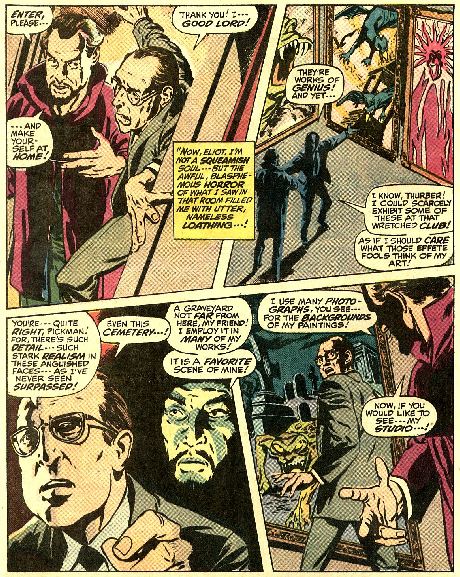
Roy Thomas of Conan the Barbarian fame adapted "Pickman's Model," with Tim Palmer (of Tomb of Dracula) providing the artwork. As I said, it's quite faithful to Lovecraft's original tale. The same characters are present (with the same names) and the plot proceeds more or less identically to the short story on which it's based. There are only two differences that I can detect.

The first difference is the least consequential. Rather than being set in the 1920s, it's set in the early 1970s – the present day of the comic. That has few, if any, repercussions for the story itself beyond esthetic ones. The second is the appearance of the creature that Pickman paints. You can see what it looks like on the cover illustration above. Lovecraft had described the creature as vaguely "canine" in appearance; the creature in the comic is nothing like that. Whether that matters greatly is a matter of taste, I suppose, though I personally prefer the traditional appearance of Pickman's model, particularly in light of Pickman's subequent reappearance in The Dream-Quest of Unknown Kadath.

For those interested in such things, here are a couple of representative pages from the adaptation. 
As you can see, Pickman looks like he might have been modeled on Vincent Price (or perhaps Doctor Strange). Here's the concluding panel to the comic, in which the photograph of the model is shown:
I'm still not sure why Thomas and Palmer chose to depict the model in this fashion. It's certainly a memorable monster, but it's not a particularly Lovecraftian one. All in all, this is mostly a purist quibble about an otherwise close adaptation of a classic HPL tale. 

Rod Serling and HPL

Last month, I mentioned that Clark Ashton Smith's "The Return of the Sorcerer" had been adapted for Rod Serling's Night Gallery television series in 1972. As some of you likely already know, that wasn't the only time that a story by one the greats of Weird Tales appeared on the program. At the end of the previous year – December 1, 1971, to be exact – there was an adaptation of H.P. Lovecraft's "Pickman's Model."

Like the adaptation of "The Return of the Sorcerer," this one isn't a particularly faithful to its literary forebear. For one, the episode introduces the framing device of a man in the 1970s who's bought an old home in Boston that was once owned by the 19th century artist, Richard Upton Pickman. Pickman, we're told, disappeared mysteriously seventy-five years prior and most of his macabre artwork was lost along with him. The new owner of the place discovers some canvases hidden in the building that he assumes must have belonged to Pickman, including the one featured above. His friend is the owner of an art gallery and assures him that, were these paintings to truly be those of Pickman, they'd be worth hundreds of thousands of dollars. 

We then flashback to the end of the previous century, where Pickman is giving art lessons to young women of well to do families, one of whom takes a romantic interest in him. Though he begs her to leave him be and not try to get too close to him, she persists, eventually following him to his home in the North End of the city.
Once there, Pickman again tries to convince her to leave, but she will not, eventually encountering the model he'd been using for some of his most horrific paintings. 
The episode isn't awful and, much like the adaptation of "The Return of the Sorcerer," it doesn't lack charm in certain respects. The tale as presented on screen is a lot more melodramatic than Lovecraft's own take on it and the framing device is a bit silly, especially at the end, when it's shown that the monster – it's never called a ghoul or indeed anything – still exists in the tunnels beneath Pickman's old home and lies waiting for the chance to be loosed upon the world once more.

If you're interested in watching the episode, it can be found on the Internet Archive site, at least for the moment. It's short and, despite its flaws, worth the twenty-two minutes or so it'd take to see it in its entirety.

Pulp Fantasy Library: Creep, Shadow!

Of the authors listed in Gary Gygax's Appendix N, one of the most obscure to contemporary readers is no doubt Abraham Grace Merritt (or A. Merritt, as he was known during his lifetime). That's why, more than a decade ago, I dubbed him a "forgotten father" of fantasy, science fiction, and horror. Much like his contemporary, Edgar Rice Burroughs, Merritt has exerted a huge, though frequently unacknowledged, influence on much of the popular fiction that came after him (and the popular culture that it, in turn, inspired). 

Gary Gygax was quite consistent in his praise for Merritt's works, placing them on par with those of other more well known authors. In the Dungeon Masters Guide, for instance, he states that Merritt is one of "the most immediate influences upon AD&D," alongside such greats as Robert E. Howard, Fritz Leiber, Jack Vance, and H.P. Lovecraft, all of whom, I'd wager, enjoy much higher profiles in the 21st century. In Appendix N, Gygax singles out three of Merritt's stories for particular mention: The Moon Pool, Dwellers in the Mirage, and Creep, Shadow, Creep. Though I've listed Creep Shadow! last (and under its later title, as Gygax did), it is, in fact, the first of Merritt's titles in Appendix N and for good reason, as I hope to explain.

Like many of Merritt's tales, Creep, Shadow! was serialized in the pages of a weekly periodical, in this case The Argosy, the premier pulp magazine of the early 20th century. Creep, Shadow! appeared in seven consecutive issues between September 8, 1934 and October 20, 1934. The following year, the serial was collected into a single volume and released as a stand-alone novel, under the title of Creep, Shadow, Creep!, which is how many later readers, including Gary Gygax, would come to know it. So far as I know, there are no significant differences between the two versions of the story, other than their titles. In the decades since its original publication, the story has appeared under both titles.

Creep, Shadow! is a sequel of sorts to Merritt's earlier tale, Burn, Witch, Burn! (which might explain why the title was later changed). I say "of sorts" because, while Dr. Lowell reappears, he is a supporting character rather than the protagonist. Instead, the story focuses on a different man of science, in this case Dr. Alan Caranac, an ethnologist, who, like Dr. Lowell, is interested in "those fields which [his] medical and allied scientific brethren call superstition—native sorceries, witchcraft, voodoo, and the like." Caranac travels widely across the globe in the course of his work, so much so that he tells the reader that his colleagues attribute

my wanderings to an itching foot inherited from one of my old Breton forebears, a pirate who had sailed out of St. Malo and carved himself a gory reputation in the New World. And ultimately was hanged for it. The peculiar bent of my mind he likewise attributed to the fact that two of my ancestors had been burned as witches in Brittany.

Regular readers of Merritt will almost certainly know that comments like this are included not just for color, but because they have relevance to the story. 

All that aside, the action of the novel begins with an investigation into a series of mysterious deaths. In this case, the deaths are in fact suicides and the suicides of wealthy and influential men at that. One of these men is Richard "Dick" Ralston, a friend of Caranac, who had inherited $5,000,000 two years prior, following the death of his own father, a copper magnate. More ominously, Ralston's suicide note mentions Caranac: "If only Alan were here. He knows more–" 

The suicide note is addressed to Dr. Bill Bennett, a brain surgeon and mutual friend of both Ralston and Caranac (and Dr. Lowell of Burn, Witch, Burn! we also learn). Unsurprisingly, Bennett comes to see Caranac. He implies that, as Caranac himself suspects, there's more to this story than the police realize.

"What do you know that the police don't know, Bill?"

He said: "That Dick was murdered!"

I looked at him, bewildered. "But if he put the bullet through his own brain—"

He said: "I don't blame you for being puzzled. Nevertheless—I know Dick Ralston killed himself, and yet I know just as certainly that he was murdered."

Later, detectives call upon Caranac, along with reporters, all of whom are eager to discover what he might know about Bennett's suicide or why his name was mentioned in his suicide note. During the course of his interview with a reporter, Caranac talked about his travels and the superstitions of the various places he'd visited. One of them concerned the belief that measuring a man's shadow with a string and then burying the string in a box would result in his death. The reporter liked this superstition enough to mention it in his article about Caranac, much to the consternation of Bennett.

"What put it in your head to talk to that reporter about shadows?"

He sounded jumpy. I said, surprised:

"Nothing. Why shouldn't I have talked to him about shadows?"

He didn't answer for a moment. Then he asked:

"Nothing happened to direct your mind to that subject? Nobody suggested it?"

"You're getting curiouser and curiouser, as Alice puts it. But no, Bill, I brought the matter up all by myself. And no shadow fell upon me whispering in my ear—"

He interrupted, harshly: "Don't talk like that!"

Bennett asks Caranac to join him at the home of Dr. Lowell for a party. There he hopes to discuss his latest thoughts about Ralston's suicide – or murder. One of Lowell's guests is a famed French psychiatrist named De Keradel and his daughter, Dahut. De Keradel is an expert in hypnosis and holds some unusual notions regarding the transmigration of souls. About De Keradel, Caranac says:

I began to feel a strong interest in this Dr. de Keradel. The name was Breton, like my own, and as unusual. Another recollection flitted through my mind. There was a reference to the de Keradels in the chronicles of the de Carnacs, as we were once named. I looked it up. There had been no love lost between the two families, to put it mildly. Altogether, what I read blew my desire to meet Dr. de Keradel up to fever point.

Even those who have not read any of Merritt's other works will discern where the story is going, especially in light of Caranac's earlier comments about his ancestry. Past lives and ancestral memory play major roles in several of Merritt's works and Creep, Shadow! is no exception. De Keradel repeatedly suggests that, through the medium of ancestral memory, passed down from generation to generation, one might gain access to ancient wisdom that would otherwise have been lost. Indeed, he implies, as does his daughter, that this wisdom might grant one mastery over powers no man has seen in centuries.

It's a given that all these various threads – Ralston's death, shadows, atavisms, ancient wisdom – eventually come together. It's similarly a given that Merritt weaves them all into a single tale with remarkable verve. Though written nearly a century ago, Creep, Shadow! nevertheless manages to capture the imagination and hold one's attention. In particular, the elements of past lives, ancestral memory, and the transmigration of souls are used compellingly. Also noteworthy are the titular shadows, which so left an impression on Gary Gygax that he not only included a monster inspired by it in OD&D but wished to explore the concept of Shadowland itself. If you've ever wondered why the original presentation of the shadow in Dungeons & Dragons was not an undead being, look no further than this novel.

There's a great deal going on in Creep, Shadow! and I don't feel I've done it sufficient justice in even this somewhat long post. This is Merritt at the height of his powers, elaborating on the themes that have filled his stories since the start of his fiction writing career. His characters are compelling and his descriptions vivid. Most importantly, he presents an engaging mystery filled with terrific twists and turns (and not a few genuine frights). To call Creep, Shadow! Merritt's masterpiece might be a slight exaggeration, but it is nevertheless one of his greatest works and well worth one's time.

Tuesday, July 26, 2022

White Dwarf: Issue #43

With issue #43 of White Dwarf (July 1983), we are well within the range of issues I remember strongly from my youth. This is the period before I'd actually subscribed to the magazine – that would come a little while later – but after I'd made it a point to pick up a new issue each month. Consequently, I still have a vivid recollection of this Jim Burns cover. Strangely, I also recall Ian Livingstone's editorial in which he suggests that computer games can never replace tabletop RPGs (or even boardgames) for the satisfaction they provide in playing them with (or against) human beings. Nearly forty years later, I find it hard to disagree.

Part 2 of Marcus L. Rowland's "Cthulhu Now!" presents two mini-scenarios and one campaign outline for use in a Call of Cthulhu campaign set in the 1980s. One of these, entitled "Trail of the Loathsome Slime," would become the basis for a licensed CoC adventure published by Games Workshop at a later date. Since I never owned that particular book, I can't say how closely it hews to Rowland's original idea. I really enjoyed this article back in 1983 and it encouraged me to try my hand at modern day Call of Cthulhu.

"Open Box" reviews Warhammer in its initial release, earning 8 out of 10. I've mentioned before that I've never had the chance to look at this version of the game and now I wish I had. It's a pity that it's nigh impossible to find a copy at a reasonable price. Oliver Dickinson gives Questworld, Chaosium's alternate setting for RuneQuest, a mere 6 out of 10, which surprises me, as my (admittedly hazy) recollection is that it was more interesting than that. I shall have to re-read it sometime soon to see if I agree with Dickinson's assessment. Finally, there's a review of the play-by-mail game, The Tribes of Crane, which garners a 9 out of 10 – high praise indeed! I never got into play-by-mail games, but I'm fascinated by them, so such a positive review only piques my interest further.

Dave Langford's "Critical Mass" looks at a number of books, starting with a couple casting skeptical eyes on psychic and related phenomena. He follows it up with reviews of Alfred Bester's The Deceivers and The Insider by Christopher Evan. I've read the former, but I've never even heard of the latter. Go figure. "Hanufa's Little Sister" is Oliver Dickinson's final short story of Griselda. The tale includes a note that information on her further exploits can be found in Chaosium's Pavis. This is true: the boxed set released the same year as this issue includes another short story of Griselda, also written by Dickinson (though her game stats appear in Big Rubble, along with those of her associates).

"Magimart" by Lewis Pulsipher briefly discusses the ups and downs allowing the buying and selling of magic items in a D&D campaign. As with so many of Pulsipher's articles, he offers sound advice, though it's difficult, from the vantage point of the present, to appreciate it fully, since so much of what he has to say has since passed into the collective wisdom of the hobby. "Vehicle Combat" by Andy Slack, meanwhile, remains of lasting interest. It's a nice, simple system for adjudicating vehicle combat in Traveller without recourse to Striker (though it does make use of Mercenary). I had a lot of fun, thanks to this article, so it remains a favorite of mine to this day.

The centerpiece of the issue is Part 2 of Daniel Collerton's "Irilian." As with last issue, Collerton describes a single section of the city, along with an adventure set in that part of Irilian. This part focuses attention on an abbey and an inn, both of which are given complete maps and both of which figure prominently in the scenario. The remainder of the article describes on living in Irilian, with an emphasis placed on what houses look like, family arrangements, coinage, and similarly mundane but nevertheless useful features. It's another great installment in a terrific series; it remains one of the highlights of White Dwarf during the period when I was reading it.

"Happy Landings!" by Thomas M. Price is a very good three-page article for Traveller. Price looks at starport design, an overlooked aspect of Traveller in my opinion (and not just because I worked on a book concerning this topic). What makes the article especially good are the half dozen or so sample maps included with it. Traveller characters spend an awful lot of time in starports; having more examples of possible layouts is this extremely helpful to the harried referee. This was another favorite of mine. "Arms Talk" by Oliver Dickinson is a discussion of damage absorption in RuneQuest. It's a fairly dense little essay, filled with plenty of musings about RQ's combat system. At the time, I wasn't playing the game, so I paid little heed to it. Nowadays, I wouldn't give it much attention either, since the complexities of the combat system are my least favorite aspects of RuneQuest.

"And Some Came Riding" is a fun installment of "Fiend Factory," describing several new D&D monsters that make use of mounts of one type or another. I especially like the Bug Riders, insect men who make use of a variety of arthropods as riding beasts. "Bujutsu" by Graeme Davis details Japanese weapons for use by AD&D monks, which was a well worn genre of article in the gaming magazines of the '80s. Finally, there's the first appearance of the comic Gobbledigook by Bil (who, I believe, is Bill Sedgwick, who did art for Games Workshop). I loved many of White Dwarf's comics, including Gobbledigook, so it was great seeing his debut in this issue.

Issue #42 of White Dwarf is an excellent one, perhaps one of the best I ever owned. The mix of D&D, Call of Cthulhu, and Traveller material was welcome, since they were my three main RPGs back in the days of my youth. Even now, they remain among my favorites. It's a real pleasure to revisit issues like this one and I look forward to those that follow it, as I recall that many of them are just as superb as this one.

Monday, July 25, 2022

"Robot Role-Playing Game"

The "Coming Attractions" column in issue #99 of Dragon (July 1985) included an entry for a new science fiction roleplaying game entitled Proton Fire.

The entry does not specify a release date, which only makes sense, because the game was never released. Steve Winter, who worked at TSR at the time, explained that Proton Fire was in fact completed (and even playested) but that it was canceled due to a lack of enthusiasm on the part of both TSR and its distributors. Nevertheless, I still sometimes think about Proton Fire and what it might have been like, but then I am also a connoisseur of vaporware RPGs, so that should come as little surprise.

Pulp Fantasy Library: Pickman's Model

Though I'd read some of the stories of H.P. Lovecraft before the release of Call of Cthulhu in 1981, it was the publication of that roleplaying game that greatly accelerated my knowledge and appreciation for the works of HPL, as I suspect it was for others as well. Unless my memory is playing tricks on me, I believe the first edition of CoC includes an introduction or an essay by Sandy Petersen, in which he talks about his first encounter with Lovecraft at a tender age. As I recall it, Petersen states that the first Lovecraft tale he read was "Pickman's Model" and that it left a lasting impression on him (just as my first HPL story, "The Tomb," did for me). 

Seeing that in the pages of the Call of Cthulhu rulebook was recommendation enough for me and I quickly sought out the story. I found it in a paperback collection called The Dunwich Horror and Others. The story was every bit as memorable as Petersen had implied it would be. Like "The Tomb," it remains a favorite of mine, despite the fact that, by many measures, it's not one of Lovecraft's most well crafted stories. On the other hand, its central ideas are powerful ones and there are passages in the tale that I continue to find moving.

"Pickman's Model" first appeared in the October 1927 issue of Weird Tales. Like so many Lovecraft stories, it's told in the first person, in this case from the perspective of a man named Thurber, who tells his tale to yet another man, Eliot. Thurber begins by saying, "You needn't think I'm crazy, Eliot," which is rarely an auspicious beginning, particularly in a H.P. Lovecraft story. Thurber goes on to say that he had recently "begun to cut the Art Club" in order to "keep away from Pickman."

"Boston had never had a greater artist than Richard Upton Pickman," Thurber declares. 
 Any magazine-cover hack can splash paint around wildly and call it a nightmare or a Witches’ Sabbath or a portrait of the devil, but only a great painter can make such a thing really scare or ring true. That’s because only a real artist knows the actual anatomy of the terrible or the physiology of fear—the exact sort of lines and proportions that connect up with latent instincts or hereditary memories of fright, and the proper colour contrasts and lighting effects to stir the dormant sense of strangeness.

If that sounds a bit like Lovecraft himself speaking, you're probably correct in your assessment. Much of what Thurber says about art in "Pickman's Model" echoes Lovecraft's own sentiments at the time. These passages are fascinating if you're interested in the evolution of HPL's own thought, but they sometimes get in the way of the narrative. 

Pickman, we learn, is an artist of the "morbid" and the "weird," whose works had "repelled" the upstanding members of the Boston arts scene. Thurber, at least initially, was more open-minded in his assessment. Indeed, he begins to spend a great deal of time with Pickman.

Before long I was pretty nearly a devotee, and would listen for hours like a schoolboy to art theories and philosophic speculations wild enough to qualify him for the Danvers asylum. My hero-worship, coupled with the fact that people generally were commencing to have less and less to do with him, made him get very confidential with me; and one evening he hinted that if I were fairly close-mouthed and none too squeamish, he might shew me something rather unusual—something a bit stronger than anything he had in the house.

Remember that, at the beginning of the story, Thurber confessed to Eliot that he had started to "keep away from Pickman." At this point in his tale, though, he was instead the painter's friend and confidante. What, then, could have effected this change in his attitudes?

Pickman lives in the dilapidated North End of Boston, since any "sincere" artist would "put up with the slums for the sake of the massed traditions." 

God, man! Don’t you realise that places like that weren’t merely made, but actually grew? Generation after generation lived and felt and died there, and in days when people weren’t afraid to live and feel and die.

Again, this is clearly Lovecraft speaking through the mouth of Thurber, but I've long had sympathy for his preference for organic growth over rational planning when it comes to many human endeavors, so I'll let it pass. Regardless, Pickman eventually reveals to Thurber that he has "another studio" elsewhere "where I can catch the night-spirit of antique horror and paint things that I couldn't even think of in Newbury Street." This studio is located in a cellar near Copp's Hill Burying-Ground and it's here that he keeps his most shocking paintings, which Thurber sees for the first time.

There’s no use in my trying to tell you what they were like, because the awful, the blasphemous horror, and the unbelievable loathsomeness and moral foetor came from simple touches quite beyond the power of words to classify. There was none of the exotic technique you see in Sidney Sime, none of the trans-Saturnian landscapes and lunar fungi that Clark Ashton Smith uses to freeze the blood. The backgrounds were mostly old churchyards, deep woods, cliffs by the sea, brick tunnels, ancient panelled rooms, or simple vaults of masonry. Copp’s Hill Burying Ground, which could not be many blocks away from this very house, was a favourite scene.

The madness and monstrosity lay in the figures in the foreground—for Pickman’s morbid art was preëminently one of daemoniac portraiture. These figures were seldom completely human, but often approached humanity in varying degree. Most of the bodies, while roughly bipedal, had a forward slumping, and a vaguely canine cast. The texture of the majority was a kind of unpleasant rubberiness. Ugh! I can see them now! Their occupations—well, don’t ask me to be too precise. They were usually feeding—I won’t say on what. They were sometimes shewn in groups in cemeteries or underground passages, and often appeared to be in battle over their prey—or rather, their treasure-trove. And what damnable expressiveness Pickman sometimes gave the sightless faces of this charnel booty! Occasionally the things were shewn leaping through open windows at night, or squatting on the chests of sleepers, worrying at their throats. One canvas shewed a ring of them baying about a hanged witch on Gallows Hill, whose dead face held a close kinship to theirs.

Thurber is most impressed by how realistic these paintings are, as if Pickman had not conjured them from his imagination but rather had painted them from life. That is, of course, the "surprise" twist of "Pickman's Model" and I hope no one will be aggrieved at my having revealed it here. The story is nearly a century old at this point and, besides, Lovecraft telegraphs the tale's ultimate revelation several times before explicitly presenting it. 

At any rate, it's not the conclusion of the story that matters so much as the ideas it presents and the manner in which Lovecraft does so. Lovecraft is deeply concerned with realism in art, which he considers to be essential to its power. This is why he spends so much time in his stories set the scene, enumerating seemingly insignificant details, and grounding his whole narrative in elaborate histories. One might justifiably quibble with his execution of this approach in some instance, but his reasons for doing so are quite sound, given his interest in literary realism. "Pickman's Model" is by no means a flawless masterpiece, yet it points the way forward for Lovecraft's later career and, for that reason alone, deserves one's attention.

Thursday, July 21, 2022

Frodo Was a 2nd-Level Fighter

As I noted in my examination of issue #38 of White Dwarf (January 1983), Lewis Pulsipher provided AD&D game statistics for the members of the Fellowship of the Ring. Here they are:

Let's take a brief look at these stats, starting with Gandalf, who is an 8th-level cleric with a slightly modified list of spells. I find that fascinating, especially in light of Gary Gygax's comment in Dragon – can anyone recall the specific issue? – that Gandalf was not a magic-user but a cleric (and a fairly low-level one at that). It's also noteworthy that Pulsipher lists him as a "Man" rather than a Maia. 

Aragorn is described as a "ranger-paladin." Whether that's meant to represent a multi/dual class is open to interpretation, since Pulsipher only indicates a single level (7th) for the character. It's an odd, though understandable, way to represent the character, since Aragorn does demonstrate a number of abilities that are akin to those of an AD&D paladin. On the other hand, the ranger class only exists as a way to represent Aragorn as a Dungeons & Dragons character. That Pulsipher didn't think the class adequate to the task is intriguing.

Boromir is just a straight-up fighter, which makes perfect sense. The same is true of Gimli and, aside from his relatively low level, I don't think anyone could find fault with this interpretation. Of course, Legalos (also a fighter) is similarly low level, so there's likely a method to Pulsipher's madness here.

The hobbits are interesting. Only Frodo is a fighter, while Sam, Pippin, and Merry are all thieves. I can see a logic to Sam's being a thief, given his skill at sneaking about. Likewise, Merry makes sense too; he did, after all, help defeat the Witch-King of Angmar with perhaps one of the greatest backstabs in all of fantasy literature. Pippin, though, seems like he ought to be a fighter. He showed considerable skill in battle, eventually defeating a troll. Likewise, he later became Thain of the Shire, a largely military office. 

Attempting to provide game statistics for literary characters, as Dragon did in its "Giants in the Earth" series, is always a fraught endeavor. While inspired by literature, D&D was never intended to emulate its specific. The game's character classes (and their abilities) generally have game-specific origins and purposes. Consequently, definitively pronouncing that any literary belongs to a particular class or is of a particular level is never going to be wholly satisfying. That said, I think Lewis Pulsipher did a fair job in this case, especially in light of his goal of using The Lord of the Rings as a way to introduce newcomers to Dungeons & Dragons. I can quibble about the fine details, but not the general direction of his adaptation.

Wednesday, July 20, 2022

Retrospective: Cthulhu Companion

I've written before about my fondness for the concept of companion volumes to roleplaying games. By "companion," I don't simply mean a rules supplement, though many RPG companions do include augmented, expanded, and/or new rules. Rather, a companion – or a good companion, at any rate – isn't focused solely on the mechanical aspects of a game; neither does it consist entirely of "fluff." Instead, it's a buffet of options, ideas, and inspiration for players and referees alike, particularly those who've been playing a game for some time. 

The first such companion I ever owned was 1983's Cthulhu Companion, subtitled "Ghastly Adventures & Erudite Lore." Released two years after the publication of the first edition of Call of Cthulhu. CoC was – and is – one of my favorite RPGs. After my initial purchase of it in 1981, I played the heck out of it with my friends. Consequently, I was more than ready for this companion when it was released. I was eager for additions and expansions to the original game, not to mention inspiration for my own adventures. I found all of that and more in this book.

Cthulhu Companion begins with a brief overview of the changes appearing in the upcoming second edition of the rulebook. The changes are quite minor, the most significant being that the characteristic Charisma is replaced by Appearance, for reasons that are never explained. At the time, I simply accepted this change, which was subsequently employed in several other Basic Role-Playing variants, like Pendragon. Nowadays, I find it a bit odd. If ever there were a game where a character's physical appearance should matter little, it's Call of Cthulhu. All the rules changes presented in Cthulhu Companion are small and that's one of the things I've long admired about CoC: until very recently, every edition of the game and its support materials were mechanically compatible without almost any effort.

Highlights of the companion are "The Cthulhu Mythos in Mesoamerican Religion" and "Further Notes on the Necronomicon." Both of these faux academic articles try to contextualize the entities of Lovecraft and his imitators within real world cultures and mythologies. The former takes a cue from Zealia Bishop's "The Mound" (ghostwritten by HPL) and focuses primarily on Aztec religion, while the latter casts a broader net, delving into Egyptian, Greek, Roman, and Arabic legendry. I love these sorts of articles, which provide excellent pointers for how to make the Cthulhu Mythos feel more "real" and grounded. I read and re-read both of these many, many times in my younger days.

Also included are lots more details about prisons in the 1920s, along with a large list of new insanities and Mythos beings. These might be called the "bread and butter" of companion volumes like this, since they're useful to any referee – I mean Keeper of Arcane Lore – regardless of the kind of campaign he is running. Of particular interest to me, both then and now, are the inclusion of deities from the works of Clark Ashton Smith. I've long felt that one of the strengths of Call of Cthulhu is that it's infinitely capable of expansion beyond the works of Lovecraft himself. Indeed, I think the game is improved by occasionally shifting its focus elsewhere, lest it become too monomaniacal in its devotion to the Lovecraftian canon (however defined).

Of course, no companion would be complete without adventures. Cthulhu Companion includes four, ranging from the brief to the lengthy. Each of them is unique and illustrates a different aspect of Call of Cthulhu. For example, "Paper Chase" is a short scenario that brings the investigators into contact with a a Mythos being that is not entirely antagonistic – an unusual occurrence! "The Mystery of Loch Feinn," meanwhile, is an example of couching an old legend in Mythos terms. "The Rescue" is a "mundane" horror scenario involving non-Mythos creatures (werewolves), while "The Secret of Castronegro" imagines what a Mythos tale might be like if set in the American Southwest rather than Lovecraft's New England. Even if not used as-is, all the adventures contain plenty of ideas and inspiration the Keeper can use in crafting his own.

Cthulhu Companion is a classic Chaosium product, filled with plenty of imagination and inspiration. Aside from the original boxed set, this is probably the Call of Cthulhu product from which I got the most use back in the day. Even now, paging through, thoughts of a campaign centered around a subterranean expedition in search of blue-litten K’n-yan, red-litten Yoth, and black, lightless N'kai – all thanks to the little hints about each mentioned in the Mesoamerican Religion article. It's precisely for that reason that I'm such a big fan of companion books and takes such pleasure in them. Here's hoping we might see more books of this sort in the future!

Tuesday, July 19, 2022

White Dwarf: Issue #42

Issue #42 of White Dwarf (June 1983) is one of a handful of issues for which I have particularly strong memories, in large part because of the two articles that feature on the cover: "Irilian" and "Cthulhu Now!" The magnificent cover by John Blanche also likely played a role, as it nicely incorporates the historical, creepy, and goofy elements I so strongly associate with British fantasy in the '70s and '80s (and that Warhammer honed to perfection). Ian Livingstone's editorial notes that he'd received a certain amount of what he describes as "hate mail" concerning the changes to the magazine's appearance that began with issue #39. Long-time readers apparently preferred the "quaint" look of the earlier issues. As a proud hater of change, this does not surprise me to say the least.

The issue kicks off with the first part of "Cthulhu Now!" by Marcus L. Rowland. The purpose of the article (and the series it inaugurates) is to provide rules additions and expansions to make playing Call of Cthulhu in the 1980s possible. This issue's installment focuses on new skills, firearms, and careers (including rock musician). While I am no longer as enamored of the idea of playing Call of Cthulhu in the present day, I simply adored this article in my youth.

"... to Catch a Thief …" by Graham Staplehurst is an article devoted to crime prevention, detection, and perpetration in Traveller. It consists entirely of new technological items, such as alarms, locks, IDs, and personal gear of various sorts. The article is fine for what it is, though, even in 1983, I felt that the last thing Traveller – and, by extension, most SF RPGs – needed was yet more technological items. "Shamus Gets a Case" by Oliver Dickinson is another tale set in New Pavis featuring Griselda. Like its predecessors, this is a fun story that offers a unique spin on Glorantha's most famous city and its denizens.  

"Open Box" begins with a review of SoloQuest 3: The Snow King's Bride for RuneQuest. The reviewer, Oliver Dickinson, has some minor quibbles with the solo scenario but is otherwise quite pleased with it, giving it a score of 8 out of 10. Marcus Rowland is similarly pleased with two new Fighting Fantasy books, The Citadel of Chaos (9 out of 10) and The Forest of Doom (10 out of 10). I have a particular fondness for The Forest of Doom myself, so this pleases me. On the other hand, FASA's Grav Ball – a game I only know from old advertisements in Dragon and elsewhere – gets a mere 4 out of 10. Neither The Morrow Project nor its scenario, Liberation at Riverton, do much better, earning 5 and 6 out of 10 respectively.   

In his "Critical Mass" column, Dave Langford offers his opinions on the nominees and winners of various science fiction and fantasy awards, including the Hugos. I remember a time when I not only recognized but had read many of the books on such awards lists. Nowadays, like so much else, I have no knowledge of them. "Castles in the Air" by Lewis Pulsipher is a short but interesting article in which he muses about why dungeons might exist in a fantasy setting. In the process, he implicitly raises the equally relevant question of why so many fantasy worlds resemble copies of medieval Europe, despite the presence of magic and monsters that would, for example, obviate the utility of traditional castles. "Careers in Traveller" by Marcus Rowland presents the code for a computer program that will randomly generate Traveller characters – a staple of 1980s gaming magazines.

Daniel Collerton's "Irilian" is the first part of a six-part series describing the titular city of Irilian. Each part includes a scenario that introduces a new aspect or portion of the city, along with additional information about Irilian's society and culture. The first part, in this issue, is mostly an overview of the city, detailing its laws, calendar, diseases, religion, and so on. What stands out is that Collerton makes use of Old English words to name the people and places of Irilian, which gives it a unique flavor. I adored this article in my youth, along with its sequels. I read and re-read them many times and even placed Irilian into one of my old campaign settings.

Phil Masters continues his "Inhuman Gods" series, this time giving us information on the deities of norkers, svirfneblin, and trolls, among others. "Rune Rites" presents "Horses" by Graham Cobley, a collection of RuneQuest game statistics for different breeds of horses. In principle, I've long liked the idea of such details; in practice, though, it's rarely been the case that any player has cared as much as I did. "The Sorceror's [sic] Spell Book" by Gary and Terry Saul is a fairly typical collection of new spells for use with D&D. The only truly memorable one is Valin's Total Inversion, which kills its target by turning him inside out. The spell was quite infamous in many of the gaming circles in which I moved back in my youth and understandably so.

It's difficult for me to be objective about this particular issue, since it was one of my favorites of old. "Irilian" remains the issue's centerpiece and I think it holds up quite well, even after all these years. I look forward to re-reading the next five issues, which further develop the city and its inhabitants.