Showing posts with label roy thomas. Show all posts

Monday, August 1, 2022

Marvel and HPL

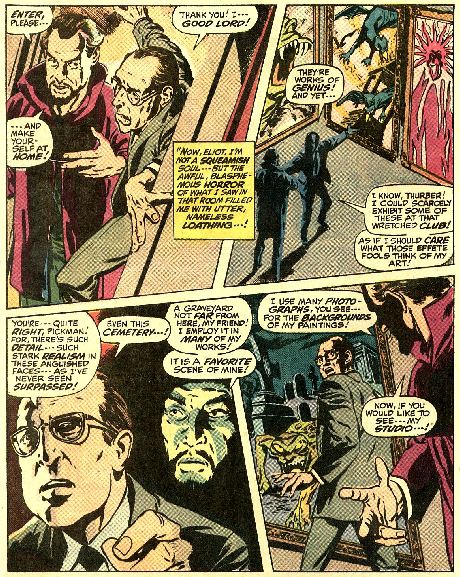
A largely faithful adaptation of Lovecraft's "Pickman's Model" was found in the pages of issue #9 (January 1971) of Marvel's Tower of Shadows comic. Tower of Shadows was a horror anthology book that Marvel published between 1969 and 1971, after which it was revamped and its title changed to Creatures on the Loose! (which lasted until 1975). Each issue of the comic typically featured three or four stories, some original and some adapted from the works of other authors.

Roy Thomas of Conan the Barbarian fame adapted "Pickman's Model," with Tim Palmer (of Tomb of Dracula) providing the artwork. As I said, it's quite faithful to Lovecraft's original tale. The same characters are present (with the same names) and the plot proceeds more or less identically to the short story on which it's based. There are only two differences that I can detect.

The first difference is the least consequential. Rather than being set in the 1920s, it's set in the early 1970s – the present day of the comic. That has few, if any, repercussions for the story itself beyond esthetic ones. The second is the appearance of the creature that Pickman paints. You can see what it looks like on the cover illustration above. Lovecraft had described the creature as vaguely "canine" in appearance; the creature in the comic is nothing like that. Whether that matters greatly is a matter of taste, I suppose, though I personally prefer the traditional appearance of Pickman's model, particularly in light of Pickman's subequent reappearance in The Dream-Quest of Unknown Kadath.

For those interested in such things, here are a couple of representative pages from the adaptation. 
As you can see, Pickman looks like he might have been modeled on Vincent Price (or perhaps Doctor Strange). Here's the concluding panel to the comic, in which the photograph of the model is shown:
I'm still not sure why Thomas and Palmer chose to depict the model in this fashion. It's certainly a memorable monster, but it's not a particularly Lovecraftian one. All in all, this is mostly a purist quibble about an otherwise close adaptation of a classic HPL tale. 

Monday, January 18, 2021

The Murderous Mirrors of Kharam-Akkad

I wrote in my earlier post on "The Mirrors of Tuzun Thune" that Roy Thomas "clearly disagrees with me" regarding adapting the story to feature Conan. I wrote this because I was thinking of Issue #25 of Conan the Barbarian (April 1973). That issue contains a story entitled "The Murderous Mirrors of Kharam-Akkad" that draws heavily on the Kull tale but isn't precisely an adaptation, as I had thought. In it, a Hyrkanian high priest named Kharam-Akkad possesses Tuzun Thune's mirrors and sees in them a vision of Conan standing over his dead body. 

Kharam-Akkad becomes so obsessed with this vision of his demise that he attempts to thwart it by ordering Conan captured and brought to him. You only need to have read Sophocles or Shakespeare to see where this story is going: the Cimmerian's capture brings about the very death that Kharam-Akkad had hoped to avoid. 

It's frankly not a very interesting story in its own right and only really serves to advance the story of Conan's life, pointing toward his eventual adoption of the pseudonym Amra. That said, the story does feature a couple of panels that recapitulate the plot of "The Mirrors of Tuzun Thune," marking the first ever appearance of Kull in the pages of a Marvel comic. 
Whatever else I could say about Thomas's Conan comics, one thing I will always praise is his willingness to use Howard's own words (or paraphrases of them) in his dialog and descriptions. That's evident in the panels above, which include snippets from "The Mirrors of Tuzun Thane" and this otherwise forgettable issue is the better for it.

Pulp Fantasy Library: The Mirrors of Tuzun Thune

Robert E. Howard's character Kull of Atlantis is not as well known as Conan, even among fans of fantasy, and understandably so. For one, Kull appeared in only three published stories between August 1929 and November 1930. For another, Kull is a much more "restrained" character than the Cimmerian, being much more conventionally chivalrous and, I'd wager, less compelling than the hotblooded barbarian to readers of the pulps. Consequently, the stories of Kull, both those published during Howard's lifetime and those published later (mostly in the 1960s and '70s), to the extent that they're remembered at all, are conflated with those of Conan. This situation is only made worse by the fact that REH himself re-purposed at least one Kull story as a tale of Conan, which established a precedent followed by others, such as Marvel's Roy Thomas. 

I think this is a shame, not just from a historical perspective, but also because I think that Kull is an intriguing protagonist in his own right, one whose differences from Conan demonstrate well Howard's range as a writer. This comes through clearly in the second published Kull story, "The Mirrors of Tuzun Thane," which appeared in the September 1929 issue of Weird Tales. The yarn begins with with one of my favorite passages in all of Howard, as Kull struggles with a dark mood.

There comes, even to kings, a the time of great weariness. Then the gold of the throne is brass, the silk of the palace becomes drab. The gems in the diadem and upon the fingers of women sparkle drearily like the ice of the white seas; the speech of men is as the empty rattle of a jester's bell and the feel comes of things unreal; even the sun is copper in the sky and the breath of the green ocean is no longer fresh.

Kull sat upon the throne of Valusia and the hour of weariness was upon him. They moved before him in an endless, meaningless panorama, men, women, priests, events and shadows of events; things seen and things to be attained. But like shadows they came and went, leaving no trace upon his consciousness, save that of a great mental fatigue. Yet Kull was not tired. There was a longing in him for things beyond himself and beyond the Valusian court. An unrest stirred in him and strange, luminous dreams roamed his soul.

Kull is so immersed in his thoughts that even his boon companion, the Pictish warrior, Brule, can rouse him from them. Then, "a girl of the court" with golden hair and violet eyes whispers to the king of the wizard Tuzun Thune, who, she says, possesses "the secrets of life and death." Kull asks the girl to tell him more of the wizard, which she does, explaining that he is

"A wizard of the Elder Race. He lives here, in Valusia, by the Lake of Visions in the House of a Thousand Mirrors. All things are known to him … he speaks with the dead and holds converse with the demons of the Lost Lands."

Intrigued, Kull sets off to meet Tuzun Thune alone, hoping that "this mummer" might be able to cure him of his melancholy. 

Upon meeting him, Kull interrogates the wizard, asking him, "Can you do wonders?" What follows is memorable and another example of the ways in which the tales of Kull differ from those of Conan.

The wizard stretched forth his hand; his fingers opened and closed like a bird's claws.

"Is that not a wonder – that this blind flesh obeys the thoughts of the mind? I walk, I breathe, I speak – are they not all wonders?

Kull meditated a while, then spoke. "Can you summon up demons?"

"Aye. I can summon up a demon more savage than any in ghostland – by smiting you in the face."

Kull started, then nodded. "But the dead, can you talk to the dead?"

"I talk with the dead always – as I am talking now. Death begins with birth and each man begins to die when he is born; even now you are dead, King Kull, because you were born.

Kull is unimpressed by these clever responses and declares the wizard to be "no more than an ordinary man." It's at this point that Tuzun Thune suggests that Kull "look into my mirrors" and reveals that the walls and ceiling of his home consisted almost entirely of perfectly jointed mirrors. The king does so and, in so doing, sees first scenes from the past and then the future before being directed into another mirror "of the deepest magic," in which Kull sees only himself – or does he? 

Fascinated by his reflection, the king begins to wonder "Am I the man or is he? Which of us is the ghost of the other?" This thought slowly overtakes him and, even after he leaves Tuzun Thune's home, he continues to ponder it, in the process becoming more and more unsure of whether the world he inhabits is the real one or whether the world beyond the mirror is. His advisors begin to worry about his state of mind, fearing that Valusia will come to a bad end because of it.

"The Mirrors of Tuzun Thune" is a unique story, marrying the conventions of pulp fantasy to a philosophical exploration of the nature of identity and indeed reality itself. No one's world is going to be shattered by this story: it's interesting but not especially profound. But I enjoy it nonetheless, in large part, I think, because of just how different it is from Howard's Conan stories. Though Conan is no blockhead, he prefers to leave questions such as these to teachers and priests. I can't imagine the Cimmerian starring in a story like this one (though Roy Thomas clearly disagrees with me) and that's more than enough to make it memorable. 

Monday, October 8, 2012

Pulp Fantasy Library: Arak, Son of Thunder

When I was in college, I knew a guy who was really into comics -- DC comics in particular -- and he decided to bring a significant portion of his collection with him to keep in his dorm room. While certainly an odd decision, I didn't complain, as it afforded me the opportunity to read a lot of comics I'd never seen when they were released. Partly this was because I hadn't been all that interested in comics as a kid (with a few rare exceptions, mostly Marvel) and partly this was because the comics that seemed to be readily available in my neck of the woods were pretty straight forward superhero ones. Although I knew of the existence of comics like Savage Sword of Conan, I didn't regularly see copies of it at any of the drugstores where the neighborhood children bought their comics.

On the other hand, I'd never even heard of Arak, Son of Thunder when it debuted in September 1981. Amusingly, the comic was created by Roy Thomas (along with Ernesto Colón), creator of the aforementioned Savage Sword of Conan and there's a superficial similarity between the two comics. Both feature clever, muscular wanderers who have adventures in an ancient/medieval world. The similarities largely end there, though. Whereas Savage Sword is set in the fictitious prehistorical world of the Hyborian Age, Arak takes place in the real world of the late 8th and early 9th centuries. Admittedly, this "real" world is a legendary one, replete with magic, monsters, and Charlemagne's paladins, but it wasn't wholly imaginary in nature, even if it did play fast and loose with history in the interests of a good story.

Arak's "gimmick" was that its titular character was an American Indian (from a fictitious East Coast tribe) cast adrift in a canoe as a child -- by his father, the thunder god, He-No -- and then picked up and raised by Vikings. Though his real name was Bright-Sky-After-Storm, the Vikings renamed him Erik, which he mispronounced as Arak, giving rise to his nom de guerre. As recounted in the first issue of his comic, Arak spends his early life raiding with his adoptive people, becoming a great warrior, especially skilled with the axe and the bow. During a raid on a monastery, the Vikings find themselves attacked by a monstrous serpent sent by the sorceress Angelica of Albracca (who becomes the comic's primary antagonist). Arak slays the serpent by means of a hammer-shaped cross, leading one of the surviving monks to opine that Arak has a divine mission. Arak himself wonders what god it was, if any, who aided his victory and sets off to find his destiny.

From then on, Arak wanders, for a time settling in one place, but eventually moving on as he continues his personal quest to discover the truth about himself and his dimly-remembered past a continent away. For most of the early issues, Arak is in Frankland, as part of the court of Charlemagne, fighting side by side with his famous paladins against a variety of magical and mundane foes. Among the paladins was the female warrior Bradamante, whose daughter, Valda, is a powerful fighter in her own right, as well as the eventual love interest of Arak. In time, Arak moves on from Frankland and has adventures all across the Old World, meeting both historical personages and mythological monsters. It is my understanding that he eventually returned to North America to be reunited with the tribe of his birth before the comic ended its run in 1985.

Arak, Son of Thunder appealed to me back in college for the same reasons it does now: it's a fun take on historical fantasy with a twist. Certainly it's not very plausible historically but then neither are the tales of Conan. Still, I think Roy Thomas did a terrific job with the comic, presenting both a world and a protagonist worth reading about. It's also a good model for historical fantasy gaming, something I find myself pondering quite regularly. I have no idea how hard it is to find copies of the comic nowadays (I last saw them in the early '90s), but, if you ever come across them, they're worth a read.