Showing posts with label sword-and-planet. Show all posts

Monday, December 12, 2022

Pulp Fantasy Library: The Outlaws of Mars

Otis Adelbert Kline, despite having a very memorable name, is one of those authors of the Golden Age of the Pulps that almost no one remembers today. To some extent, that's understandable, since his most successful stories are often erroneously described as being little more than rip-offs of the works of Edgar Rice Burroughs. The most well regarded of these – the two novels set on Mars – probably also suffer from not sharing a protagonist, unlike, say, the tales of John Carter to which they are unfavorably compared (or, for that matter, Kline's own Venus stories, all three of which feature the character of Robert Grandon). 

I've previously written about the first of Kline's Martian novels, The Swordsman of Mars, and declared it better than its sequel, The Outlaws of Mars. Having just re-read the latter in preparation for today's post, I now wonder if my earlier judgment might have been mistaken. While both novels are breezily written and full of heroic exploits, Outlaw is notable in that its lead character, Jerry Morgan, is notably more fallible (and, therefore, more relatable) than Swordsman's Harry Thorne. Indeed, the initial action of Outlaws rests heavily upon the negative consequences of Morgan's leaping before he looked, as we shall see.

Like its predecessor, The Outlaws of Mars was originally serialized before being collected together under a single cover decades later. Also like its predecessor, the serial appeared in the pages of Argosy Weekly, starting with the November 25, 1933 issue and running for the next six issues. Though Kline was an assistant editor at Weird Tales (and had been since its premiere in 1922), none of his longer serials appeared in the Unique Magazine. I would imagine this was to avoid any appearance of favoritism, though several of his yarns did appear in WT's sister periodical, Oriental Stories.

The novel begins as Jerry Morgan, described as "a tall, broad-shouldered young man with steel-gray eyes and sandy hair," steps off a train at "the diminutive Pineville station." Morgan is in Pineville to visit his uncle (and former guardian), Dr. Richard Morgan, whom readers may remember as the eccentric scientist who enabled Harry Thorne to travel to the Red Planet in The Swordsman of Mars. Jerry believes his visit will be a surprise, but his uncle seems to be expecting him.

Jerry stared in amazement as he took his uncle's proffered hand. "Expecting me? Why, I told no one, and fully intended to surprise you. It sounds like thought-transference, or something."

"Perhaps you are nearer the truth than you imagine," replied the doctor, seating himself.

Setting aside his uncle's cryptic remark, Jerry admits that "I've disgraced the family – dragged the name of Morgan in the dirt." Again, Dr. Morgan claims to know this already and again Jerry boggles at this. Morgan then proceeds to prove that he knows why his nephew has come by recounting, in precise detail, the unfortunate circumstances that led him to his doorstep. The long and short of it is that Jerry had been framed by a romantic rival so as to not only lose the affections of his fiancée but also to be cashiered from the army regiment in which he had served proudly up to now. 

Needless to say, Jerry is astounded by how much his uncle knows.

"You have said, half in jest, that I appear to read your mind. Without realizing it, you have hit upon the truth. I do and have always read your mind, since the death of your parents placed you under my guardianship. I have never needed your letters or telegrams to inform me of your doings, because since the day when I first established telepathic rapport with you, I have been able at all times to tap the contents of your subliminal consciousness, which contains a record of all you have thought and done."

Rather than dwell on the uncomfortable – to modern readers anyway – implications of this secret telepathic rapport, Dr. Morgan instead reveals that he has recently, thanks to his telepathic contact with "the people of Olba, a nation on the planet Venus," constructed a spaceship that will enable humans to travel to Mars "in the flesh," in contrast to the more mystical means employed in the previous novel, The Swordsman of Mars. While he would like to go to Mars himself, the urgency of his other work has prevented this. Naturally, Jerry offers to go in his stead, to which his uncle readily agrees.

Though Jerry's primary purpose in traveling to Mars is as "a valuable scientific experiment" that will "increase the sum total of terrestrial knowledge," it has the added benefit of giving him "new scenes, new adventures, and forgetfulness – these and a chance to begin life over again." This theme of "starting over," being given the chance to leave behind a shattered past, is a common one in sword-and-planet stories, starting with A Princess of Mars. I suspect it plays a big part in the lasting appeal of the genre and may have held particular resonance with readers during the depths of the Great Depression.

Jerry's transit to Mars is far less interesting than what happens upon his arrival. He finds himself not far from a Martian city, whose inhabitants "did not show any marked difference from terrestrial peoples" beyond "their strange apparel and the fact that their chests were, on average, larger than those of Earth-men," this latter feature being a consequence of the thinner atmosphere of the Red Planet. Jerry observes that many of the city's buildings feature roof gardens. In one of these gardens, he sees an extremely beautiful woman – of course! – with "an ethereal beauty of face and form such as he had never seen on Earth, or even dreamed existed." 

I could not blame anyone for assuming at this point that the criticisms of Kline as a mere Burroughs imitator are correct. Thus far, The Outlaws of Mars is little different from the sword-and-planet material cranked out by the ream after the publication of A Princess of Mars and its sequels. However, that assessment of the novel would, in my opinion, be mistaken. When Jerry introduces himself to the young Martian beauty, she is frightened and looks ready to flee. Confused, the Earthman looks around for an explanation and seemingly finds it in the form of a strange Martian beast leapt from behind the shrubbery of the garden with "a terrific roar" and "a yawning, tooth-filled mouth as large as that of an alligator." 

In an act of chivalry befitting John Carter himself, Jerry slays the alien creature, believing he had saved her from danger.

At the sound of the shot the girl had sprung erect. For a moment she peered down at the fallen beast. Then, her eyes flashing like those of an enraged tigress, she turned on Jerry with a volley of words that were unmistakably scornful and scathing, despite the fact that he was unable to understand them.

Suddenly her hand flashed to her belt and came up with a jewel-hilted dagger. Jerry noticed that the blade straight and double-edged, with tiny, razor-sharp teeth. For a moment, he did not realize what she intended doing. But when she raised her weapon aloft and lunged straight for his breast, he caught her wrists just in time.

We soon learn that the animal Jerry had slain was, in fact, the beloved pet of Junia Sovil, daughter of the emperor of Kalsivar, the greatest kingdom of Mars. Worse still, the slaying of the dalf (as the animal is called) is a capital crime – and the people of Kalsivar believe in swift justice. Thus, our hero has barely stepped foot on Mars and he has already made an enemy of an imperial princess and found himself condemned to death. Jerry Morgan works fast!

Naturally, Jerry does not die only a few chapters into The Outlaws of Mars and indeed soon finds himself entangled in the vicious court politics of Kalsivar, but I was nonetheless charmed by the way that Kline kicked off his adventures on Mars. Jerry's ignorance of Mars and its customs and language cause him no end of headaches early on. Likewise, his headstrong nature and gentlemanly ideals lead him astray almost as often as they aid him. It's almost as Kline were playing with and commenting upon the conventions of the sword-and-planet genre, though I have no evidence that he did so intentionally. 

Regardless, The Outlaws of Mars is a fun, fast read, filled with plenty of pulpy action and dastardly deeds. To call it a classic would be overstating its simple virtues, but virtues they are nonetheless. I was very glad to have had the opportunity to re-read this and I recommend it to anyone who enjoys sword-and-planet stories.

Monday, September 26, 2022

My Top 10 Favorite Imaginary Settings (Part I)

My recent retrospectives of both Dragonlance Adventures and Greyhawk Adventures got me thinking about my favorite settings for roleplaying games, which, in turn, got me to thinking about my favorite imaginary settings in general. Before long, I realized that I had the makings of a couple of posts in which I listed, in order, my favorite imaginary settings, along with some thoughts on how I first encountered them and why I still like them. Like all my previous lists of this sort, this one is intentionally personal. It's not intended to pass judgment on these or any other imaginary settings in any absolute sense. If your favorite isn't to be found here, that only means that you and I have different tastes, nothing. I doubt there will be many surprises here for long-time readers, except perhaps the order in which I rank the various settings I've chosen. 

10. Middle-earth

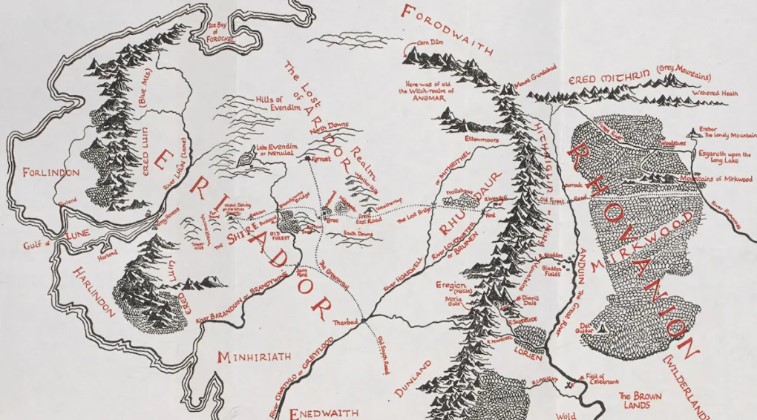
Growing up in the 1970s, J.R.R. Tolkien's Middle-earth was probably the most well-known example of literary fantasy in popular culture. The Rankin-Bass cartoon of The Hobbit was released in 1977, with Ralph Bakshi's The Lord of the Rings coming out the following year. This is also the decade of the Brothers Hildebrandt Tolkien calendars and the Ballantine paperbacks with covers featuring Tolkien's own artwork. Consequently, it would have been nigh impossible for me not to have been pulled into the orbit of one of greatest fantasy settings of all time. 

Tolkien invested Middle-earth with a richness of detail that has, I think, become a model for every creator who's followed in his wake, even those who explicitly reject his particular take on fantasy. I know that's true in my own case, which is why I include the setting in this list. However, my fondness for Middle-earth is a distant and somewhat cold one – respect might be a better word to describe it. There's much I admire about Tolkien's creation, but very little I've directly emulated in my own (admittedly paltry) efforts, hence why I rank it lower than every other setting I'll discuss.

9. Barsoom

Mars, as envisioned by Edgar Rice Burroughs, is one of the oldest science fiction – or fantasy; take your pick – settings of lasting significance, inspiring innumerable writers (and scientists) to consider what life might be like on planets other than our own. I can't quite recall when I was first exposed to Barsoom, but it's been a setting I've loved for almost as long as I can remember. In my younger days, I simply thrilled to the exploits of John Carter, as he struggled mightily against a wide variety of nefarious antagonists, none of whom possessed an ounce of his courage or honor. Nowadays, I'm much more interested in Burroughs's worldbuilding, which is surprisingly rich and deep.

Barsoom is a great example of an adventuresome setting, by which I mean one where almost every detail exists to provide fodder for tales of derring-do. That undoubtedly limits the scope of Barsoom somewhat, but I can't say that bothers me much. Sometimes, all you want out of an imaginary setting is a fun environment for exciting stories and Barsoom provides that in spades. Considering the importance of the Red Planet to the creation of the hobby, I'm not the only person who thinks so.

8. The Known Worlds of Fading Suns
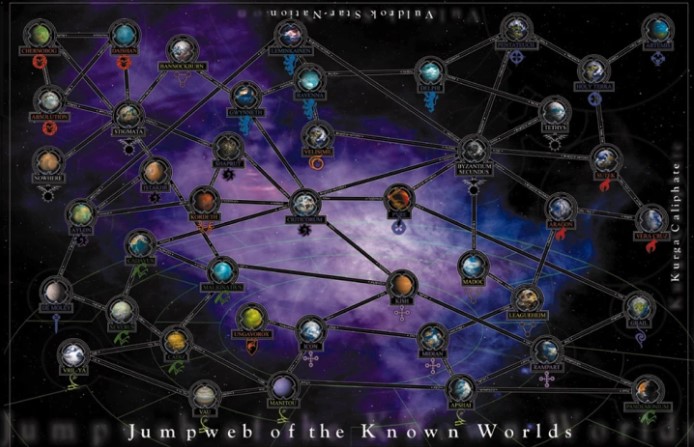
This is the first (but not the last) roleplaying game setting to appear on this list and with good reason. Since its appearance in 1996, I've enjoyed the 51st century of this "futuristic passion play," both as a referee and as a writer. Much like Barsoom, the Known Worlds are an adventuresome setting, perhaps even more explicitly so, since it was created for use in roleplaying game campaigns. This means that (also like Barsoom), the setting doesn't stand up to close scientific scrutiny, despite the fact that it's supposed to take place thousands of years from now in our world. It's closer to a fantasy setting in many ways and I have found that most objections to one or another aspect of it are best met by explaining that.

On the other hand, the Known Worlds are almost unique among futuristic settings in the pride of place they give to philosophy, religion, and spiritual matters. This is a setting, like Frank Herbert's Dune, that recognizes that mankind will bring religion with him as it travels the stars and, if anything, will only become more influential because of it. That's catnip for people like myself, who take great interest in questions of this kind, especially since the setting isn't interested in providing answers to those questions but rather occasions to ask more of them against a back of interstellar adventure.

7. The Hyborian Age

The 1970s was also the decade in which the works of Robert E. Howard managed to break into popular culture, thanks in no small part to Marvel's Conan the Barbarian comic book series. Though I of course read the comics, I was even more devoted to the short stories and novellas that I found on a spinner rack in my local library. Through them I became acquainted with the prehistoric Hyborian Age in which the Cimmerian lived. A heady mix of real world history and Howard's own flights of fancy, the Hyborian Age was simultaneously familiar and alien to me, which made it all the easier for my youthful self to fall in love with it. 

My appreciation for the setting only grew with age. I read REH's own essay about the Hyborian Age and his thoughts on its creation and immediately understood what I had only dimly grasped previously, namely, that real world history and cultures could be used to create something that nevertheless felt fresh and exciting. There is no need to create entire worlds from whole cloth, nor is there any shame in borrowing from the examples of the past. The trick is in using these raw materials imaginatively, as Howard had done, to present something that was a compelling back drop for adventure.

6. The Dying Earth
I've often said that science fiction is my natural medium. Despite that, I've spent more time roleplaying in fantasy worlds than in science fiction ones. Given that, I suppose it was inevitable that I'd fall in love with Jack Vance's Dying Earth. Set untold eons in the future, the Dying Earth is a setting in which science has become indistinguishable from magic and has changed the face of the planet – and its inhabitants – forever. In some ways, it's an ideal setting for someone with my conflicting interests and experiences, allowing me to have my cake and eat it too, so to speak. (I'm sure the fact that D&D's magic system is based on that of the setting endeared it to me as well.)

The other thing I adore about the Dying Earth is its overall feel: cynical, exhausted, and mysterious. You never know what you're going to find over the next hill or whether the traveler with an extra-broad smile you meet on the road is a friend or a foe. It's a place that keeps you guessing, sometimes until it's too late to extricate yourself from the trouble in which you've now found yourself. It's the stuff of enjoyable stories and captivating adventures.

Monday, June 27, 2022

Pulp Fantasy Library: Witch of the Demon Seas

I frequently reflect on my own lack of industry, especially when compared to nearly all of the writers I discuss in my Pulp Fantasy Library posts. These energetic men and women cranked out exciting stories by the ream – so many, in fact, that they sometimes had to resort to using a variety of noms de plume to ensure the magazines would publish their submissions (many of which had policies, formal or informal, against the inclusion of more than one story by the same author in a single issue). 

I bring this up because this is precisely what happened in the case of "Witch of the Demon Seas," which first appeared in the January 1951 issue of Planet Stories. Though credited to "A.A. Craig," the yarn is actually the handiwork of Poul Anderson, another of whose stories is featured in the same issue under his usual byline. Like many pulp fictioneers, Anderson had an incredible work ethic: sixteen of his short stories and novellas were published the same year as "Witch of the Demon Seas." It's difficult not to feel inadequate when faced with such a remarkable output.

Though nowadays Anderson is most remembered for his science fiction, notably his tales of Nicholas Van Rijn, David Falkayn, and, of course, Dominic Flandry, he was also an accomplished writer of fantasy. Three Hearts and Three Lions is perhaps the best known of his fantasies, at least for players of roleplaying games, but The Broken Sword is, in my opinion, equally worthy of admiration (both appear in Gary Gygax's Appendix N, for what it's worth). Pulp writers had to be omnivorous if they wanted to make a living at writing, hence the existence of stories, such as this one, that might broadly be described as "fantasy" (or perhaps sword-and-planet, which was the bread and butter of Planet Stories during its 71-issue run).

Regardless, "Witch of the Demon Seas" certainly takes place on another world, one whose surface is almost entirely covered by water. What civilization exists can be found on numerous island kingdoms, such as the Thalassocracy of Achaera, whose ruler is Khroman the Conqueror. Khroman is "a huge man, his hair and square-cut beard jet-black despite middle age, the strength of his warlike youth still in his powerful limbs." He's also honorable, which we learn early in the story, when he tells his advisor, Shorzon the Sorcerer, that he intends to treat his recently defeated enemy, the fair-haired pirate Corun, with respect, as he is "the bravest enemy Achaera ever had."

When Khroman interrogates him, Corun reveals much about his origins and the reasons for his turn to piracy. Come to think of it, the interrogation reveals a fair bit about Khroman as well.

Khroman stared at him in puzzlement. "But why did you ever do it?" he asked finally. "With your strength and skill and cunning, you could have gone far in Achaera. We take mercenaries from conquered provinces, you know. You could have gotten Achaeran citizenship in time."

"I was a prince of Conahur," said Corun slowly. "I saw my land invaded and my folk taken off as slaves. I saw my brothers hacked down at the battle of Lyrr, my sister taken as concubine by your admiral, my father hanged, my mother burned alive when they fired the old castle. They offered me amnesty because I was young and they wanted a figurehead. So I swore an oath of fealty to Achaera, and broke it the first chance I got. It was the only oath I ever broke, and still I am proud of it. I sailed with pirates until I was big enough to master my own ships. That is enough of an answer."

"It may be," said Khroman slowly. "You realize, of course, that the conquest of Conahur took place before I came to the throne? And that I certainly couldn't negate it, in view of the Thalassocrat's duty to his own country, and had to punish its incessant rebelliousness?"

"I don't hold anything against you yourself, Khroman," said Corun with a tired smile. "But I'd give my soul to the nether fires for the chance to pull your damned palace down around your ears!"

"I'm sorry it has to end this way," said the king. "You were a brave man. I'd like to drain many beakers of wine with you on the other side of death." He signed to the guards. "Take him away."

Upon hearing this, Shorzon takes an interest in Corun, for reasons that soon become clear. Together with his daughter, Chryseis, the story's titular witch, he visits the pirate in his solitary cell. The sorcerer then offers him "life, freedom—and the liberation of Conahur!" Naturally, Corun doubts the wizard's sincerity, but Chryseis, a remarkable beauty, reassures him, "You can help us with a project so immeasurably greater than your petty quarrels that anything you can ask in return will be as nothing. And you are the one man who can do so." 

"What do you want?"

"Your help in a desperate venture," said Chryseis. "I tell you frankly that we may well all die in it. But at least you will die as a free man—and if we succeed, all the world may be ours."

"What is it?" he asked hoarsely.

"I cannot tell you everything now," said Shorzon. "But the story has long been current that you once sailed to the lairs of the Xanthi, the Sea Demons, and returned alive. Is it true?"

"Aye." Corun stiffened, with sudden alarm trembling in his nerves. "Aye, by great good luck I came back. But they are not a race for humans to traffic with."

"I think the powers I can summon will match theirs," said Shorzon. "We want you to guide us to their dwellings and teach us the language on the way, as well as whatever else you know about them. When we return, you may go where you choose. And if we get their help, we will be able to set Conahur free soon afterward."

Corun shook his head. "It's nothing good that you plan," he said slowly. "No one would approach the Xanthi for any good purpose."

"You did, didn't you?" chuckled the wizard dryly. "If you want the truth, we are after their help in seizing the government of Achaera, as well as certain knowledge they have."

"If you succeeded," argued Corun stubbornly, "why should you then let Conahur go?"

"Because power over Achaera is only a step to something too far beyond the petty goals of empire for you to imagine," said Shorzon bleakly. "You must decide now, man. If you refuse, you die."

This is the proverbial offer that one cannot refuse, so, with some trepidation, Corun agrees. Shorzon and Chryseis then lead him to a fully-crewed vessel that will take them to the Xanthi, a race of inimical fish-men with a history of warring against the other peoples of the world. The ship leaves Achaera – without the knowledge of Khroman, I might add! – on a quest whose ultimate objective, Corun suspects, is far from virtuous. For the moment, though, he does not care, as he only wishes "to live! To die, if he must, under the sky!"

"Witch of the Demon Sea" is a delightful romp, filled with monsters, magic, sorcery, and swordplay. The characters, starting with Corun himself, are somewhat archetypal, let us say, but Anderson tells the story with such energy and enthusiasm that I soon didn't care. The story is interesting, too, because it contains elements that could be described as "secret sci-fi," thereby further muddying the waters regarding how to classify this yarn. For myself, I prefer to classify it as "fun" and leave it at that.

Monday, June 6, 2022

Pulp Fantasy Library: Enchantress of Venus

The distinctions separating the literary genres of fantasy and science fiction are fine ones, especially when dealing with early examples of the latter. For example, is A Princess of Mars a work of science fiction because its story takes place on the very real planet of Mars or is it a mere fantasy because so many of its setting details are incompatible with what we now know about the Red Planet? Over the decades, it's been a frequently contentious issue, hence the proliferation of even finer literary genres – planetary romance, science fantasy, and sword-and-planet, to name but a few – intended to put an end to such questions. As I've gotten older, I've simultaneously become less interested in these matters and more accepting of an expansive definition of "fantasy" that includes all types of imaginative fiction.

In the case of Leigh Brackett's tales of Eric John Stark, many of which appeared in the pages of Planet Stories in the 1940s and '50s, this primal concern nevertheless resurfaces. Even in 1949, when Brackett wrote her first story of Stark, enough was known about the other worlds of our solar system that there was little plausibility to their being habitable by mankind without significant technological aid, let alone having intelligent natives of their own. Was Brackett then writing fantasy or did her stories still qualify as science fiction, albeit of an old fashioned sort – or is this, as I increasingly feel, a distinction without a difference? 

Of course, little of this matters, as Stark's adventures are engaging yarns told with great enthusiasm. "The Enchantress of Venus," which first appeared in the Fall 1949 issue of Planet Stories, amply demonstrates what I mean. Second in the chronology of the tales of Stark, the novella takes place, as its title suggests, on the planet Venus, renowned for its "seas" of buoyant, phosphorescent gas. This detail is important because, as the story begins, Stark is aboard a ship making its way across one such Red Sea toward the town of Shuruun. 

Shuruun is, to borrow a phrase, a wretched hive of scum and villainy. Stark is no stranger to such places and thus has no fear of the town. However, he only sought it out to find his friend, Helvi, "the tall son of a barbarian kinglet," who had gone into the town previously and never returned. Stark feels an obligation to locate Helvi and, if necessary, rescue him from whatever peril awaited him in Shuruun. Like so many pulp fantasy protagonists, Stark lives by his own code of honor, one that places great value in friends.

Malthor, the captain of the ship on which he is traveling, repeatedly suggests that Stark, whom he recognizes as a stranger, due to his black Mercurian skin, would do well to lodge with him when they reach Shuruun. Each time, Stark declines. As it turns out, he has good reason to do so: Malthor's true intentions are wholly sinister. Just as the ship gets within sight of the "squat and ugly town" that "crouch[ed] witch-like on the rocky shore, her ragged skirts dipped in blood," Malthor and some of his crew attack Stark in an attempt to take him prisoner, though for what precise purpose he did not know (and would not until later in the story). Rather than suffer this fate, Stark dives overboard into the Red Sea.
The surface of the Red Sea closed without a ripple over Stark. There was a burst of crimson sparks, a momentary trail of flame going down like a drowned comet, and then—nothing.

Stark dropped slowly downward through a strange world. There was no difficulty about breathing, as in a sea of water. The gases of the Red Sea support life quite well, and the creatures that dwell in it have almost normal lungs.

Stark did not pay much attention at first, except to keep his balance automatically. He was still dazed from the blow, and he was raging with anger and pain.

Properly scientific or not, this is evocative stuff and a reminder of why Brackett made such a splash (no pun intended) in the world of pulp fantasy during the 1940s and '50s. 

Emerging from the sea, Stark makes his way to Shuruun in search of Helvi. He is almost immediately recognized as a stranger by the locals, who confront him and appear ready to attack. Before this can occur, a white-haired Earthman named Larrabee calls out and invites him to drink with him. Larrabee, we soon learn, is a notorious thief who "got half a million credits out of the strong room of the Royal Venus." In the nine years since, he has holed up in Shuruun to avoid being found by the authorities. When Stark introduces himself, Larrabee mentions that he knows his name from a wanted poster as "some idiot that had led a native revolt somewhere in the Jovian Colonies—a big cold-eyed brute they referred to colorfully as the wild man from Mercury." 

Stark is amused by this description of himself but soon shifts the conversation to local matters, in particular the whereabouts of Helvi. Larrabee claims not to have seen him and instead speaks of the Lhari, "the Lords of Shuruun," who are "always glad to meet strangers." Hearing this, Stark decides he to call on the Lhari to see if they might know something about Helvi. Along the way, he meets Zareth, the teenage daughter of Malthor, who'd been sent into Shuruun to find him and then lure him into an ambush outside the city. Then, he'd be handed over to "the Lost Ones," who dwell in the interior of the swamp and have an interest in strangers like Stark. Zareth doesn't follow through on her father's plans, though, because he beats her and she hates him. However, she has no interest in joining Stark in visiting the Lhari, who frighten her as much as her father.

If you're having difficulty keeping all these narrative threads – Malthor, the Lhari, the Lost Ones – straight in your head, that's understandable. Brackett throws a lot at her readers at the beginning of "The Enchantress of Venus" and its can be confusing at times. Fortunately, she's a very skilled writer and repays the patience and forbearance shown to her. By the time Stark enters the castle of the Lhari and meets them, in all their decadent glory, for the first time, that things begin to make a great deal more sense. In some ways, that's the real beginning of the novella and the action barrels along from that point until it reaches its ultimate, satisfying conclusion. It's a lot of fun to read and reminds me, in some ways, like many of Robert E. Howard's tales of Conan the Cimmerian: a "wild" outsider finds himself caught up in the machinations of several sinister factions and must find a way to extricate himself from their clutches. What's not to love?

Monday, May 24, 2021

Pulp Fantasy Library: The Swordsman of Mars

I've never made a secret of my love of sword-and-planet stories, starting with Edgar Rice Burroughs's seminal, A Princess of Mars. Likewise, I've long droned on about the importance of this literature to understanding original Dungeons & Dragons. That's why I regularly use the Pulp Fantasy Library series to discuss and promote even the lesser known stories and authors of the genre, such as Martian stories of Otis Adalbert Kline.

Kline is a fascinating fellow. In addition to being a writer, he was also an assistant editor at Weird Tales since its inauguration in 1923. To the extent Kline's remembered today at all, it's either in his role as Robert E. Howard's literary agent or his supposed feud with Edgar Rice Burroughs. Though Richard A. Lupoff thoroughly debunked the feud, it's understandable why it once seemed plausible, since both men wrote about similar characters and situations. 

The Swordsman of Mars was originally published as a six-part serial beginning in the January 7, 1933 issue of Argosy Weekly before being collected in novel form in 1960. The story concerns Harry Thorne, a wealthy young man whose life is thrown into turmoil when his fiancée, Sylvia Thompson, abandons him for another man. Thorne is so distraught that, as he confides to a visitor, Dr. Morgan, he doesn't "care to live any longer." Upon hearing this, Morgan asks him,

"Suppose you were offered a new interest in life. Excitement and adventures beyond your wildest dreams. A chance to view new scenes that no earthly being save one has ever glimpsed. To meet new and strange peoples."

"All that is old stuff to me," replied Thorne. "I've traveled until I'm sick of it. I've hunted big game in Asia, Africa and the Americas. I've been in every important country on the globe. The only adventure I have no tried is death, and just now it is the one adventure that intrigues me."

Thorne intends to kill himself, but Dr. Morgan has no intention of letting him. When he shakes Thorne's hand to bid him farewell, he surreptitiously drugs him with a narcotic and then takes him to a hidden locale, where he eventually awakens. Thorne wishes to know why Morgan has decided to interfere in his affairs.

"You are in a room in my mountain observatory, where I watch the movements of the planets, and where you were brought in my airplane after you fainted. Last night you were ready to take a bling plunge into that unknown region from which no man returns, the state of existence or non-existence called death. Had you succeeded, you would have thwarted forever the plans which I have been at considerable trouble and expense to perfect for you since I saw your picture. Needless to say, I am glad I arrived in time."

Morgan goes on to explain that he has been receiving telepathic messages from a "Martian scientist and psychologist" named Lal Vak. By means of this telepathy, he and the scientist have exchanged "visual and auditory impressions" as well as abstract and concrete ideas. 

"It was Lal Vak who suggested to me that if we could find a man on Mars and one on Earth whose bodies were identical, we could, by astral projection, cause the two individuals to exchange bodies. This Earth could be viewed through Martian eyes, while Mars could be seen at first hand by a man from Earth. Lal Vak projected to me many images of Martians willing to make this exchange, and at last I located a double of one of them … 

That double was not Harry Thorne but a ne'er-do-well named Frank Boyd who made the exchange and quickly proved himself to be a miscreant. On Mars, Boyd "allied himself with a small group of Martians who are working on an invention with which they hope to conquer all of Mars, and eventually the Earth and Venus as well." Therefore, Morgan sought out Thorne to be the second Earthman to switch places with a Martian, so that he might find Boyd and stop him – as well as correct Morgan's past mistake in sending a reprobate to Mars.

Needless to say, Thorne takes up Morgan's offer and thereby begins his adventures on Mars. What's immediately striking about The Swordsman of Mars is that, compared to the Barsoom stories, is how much more detail Kline provides. For example, the method by which Thorne travels to Mars – body exchange – is described at some length, as well as the consequences for its operations. This is in contrast to Burroughs, where John Carter's ability to travel between Earth and Mars is largely unexplained. Likewise, Kline seems to have worked out in his mind the whys and wherefores of Martian history, geography, and ecology and uses them to create a plausibly coherent pulp fantasy setting, again in contrast to Burroughs, which is much more "handwave-y" about such things. This isn't a criticism of Burroughs, whose stories I adore, but I think it's important to highlight the ways that Kline differs from his more well-known contemporary.

The Swordsman of Mars is the first of two novels written by Kline set on the Red Planet and, in my opinion, it's the better the of the two. Even so, they're both worth reading if you have an interest in sword-and-planet fiction. If nothing else, they're good examples of the tales of derring-do and fantastical world building that no doubt influenced Arneson and Gygax in their creation of Dungeons & Dragons. 

Monday, May 17, 2021

Pulp Fantasy Library: The Moon Maid

Edgar Rice Burroughs is easily one of the most successful and influential creators of fantasy and science fiction of all time. His works, from the stories of Tarzan to the adventures of John Carter, have inspired generations of writers, including Robert E. Howard, whose personal library possessed more books by ERB than any other author. Despite this, neither he nor his literary creations are especially well known nowadays. I think that's a great shame for many reasons, not least of which being that he told fun and engaging adventure stories that still hold up decades after their first publication.

A case in point is The Moon Maid, which almost no one remembers anymore, especially when compared to the Barsoom or Amtor series. Originally serialized in the pages of Argosy All-Story Weekly, starting with the May 5, 1923 issue, all of its constituent parts were eventually collected into novel form and published in 1926. The story The Moon Maid tells of its protagonist, Julian, is, in some ways, quite similar to the story of John Carter or Carson Napier: an Earthman travels to another world, faces innumerable alien threats, and wins the heart of a princess. In other ways, though, it is unique and it is that uniqueness that makes it well worth reading.

Unlike the Barsoom or Amtor stories, which are set, more or less, in "modern" times, The Moon Maid is set in the future – two futures, as it turns out – of when it was published. The first future is the year 1967, a few years after the conclusion of a decades-long Great War that began in 1914. The conclusion of that war established peace and world government, just in time for "that historic day," June 10, 1967 when 

Earth received her first message from Mars, since which the two planets have remained in constant friendly communication, carrying on a commerce of reciprocal enlightenment. In some branches of the arts and sciences the Martians, or Barsoomians, as they call themselves, were far in advance of us, while in others we had progressed more rapidly than they. Knowledge was thus freely exchanged to the advantage of both worlds. We learned of their history and customs and they of ours, though they had for ages already known much more of us than we of them. Martian news held always a prominent place in our daily papers from the first.

 As you can see, The Moon Maid takes place in the same universe as the adventures of John Carter, who still lives on the Red Planet. This information is related to the reader by an unnamed narrator who meets the story's true protagonist, the aforementioned Julian, while traveling on a transoceanic liner. Julian is "a fine looking chap, lean and bronzed" and serves as an officer of the Air Corps of the International Peace Fleet. He is also, or so he claims, an immortal being who is continually reincarnated as his own descendants, a process that also leaves him with knowledge of the future, which is to say, the second future depicted in the novel. This second future is 2024, when Earth's first interplanetary vessel is preparing to travel to Mars.

Julian then recounts to the narrator the story of this voyage, which he "remembers" even though it takes place in the future and involves his own grandson, also named Julian. The bulk of The Moon Maid consists of Julian's memories of what happened when the Earth ship, named the Barsoom in honor of its ultimate destination. Accompanying Julian aboard the Barsoom was an officer named Lieutenant Commander Orthis, whom he described as "one of the most brilliant men I have ever known, and at the same time one of the most unscrupulous, and, to me at least, the most obnoxious." Orthis is responsible for the scientific breakthrough that enables the Barsoom to travel successfully between planets, but he is noted for having "married a nice girl and abandon[ing] her," as well as being rumored to be "affiliated with a secret order that sought to overthrow the government." This, of course, is in contrast to Julian, who is courageous, upstanding, and honest, as are all Burroughs's heroes.

Shortly after the Barsoom has traveled past the Moon, Orthis comes to dinner in the messroom "noticeably under the influence of liquor." Julian, as his superior officer, sends him back to his quarters, which Orthis resents. He grows angry and rants at Julian, claiming that it was his labor and intellect who made this journey possible and he would not be upstaged by anyone. This scene allows Burroughs to talk briefly about the inefficacy of Prohibition – remember this was published in 1923, when the Eighteenth Amendment was still in force – and how it had been repealed. In any case, Orthis takes perverse revenge on Julian by destroying the Barsoom's engines, sending the vessel careening toward the Moon. 

Needless to say, the Barsoom and its crew, including Orthis, survive the crash into the Moon, where the main action of The Moon Maid takes place. I say into, not onto, because Julian and his comrades discover that the Moon is in fact hollow. Its interior is quite habitable, filled with plants and animals, and illuminated by the glow of radiocative rocks. There are also two intelligent species. The first are the savage Va-ga, cannibalistic centaur-like people, who are an early foe of Julian and his shipmates. The second are the U-ga, who look very similar to Earthmen and whose princess, Nah-ee-lah, Julian considers alluringly beautiful. As one might expect, Nah-ee-lah, as the titular Moon Maid, figures prominently; the travails of her people at the hands of a revolutionary group known as the Kalkars is the central conflict of The Moon Maid.

Reading through this, what most impressed me was not any individual element of the tale Burroughs tells but rather the way that he is able to mix and match elements from his previous stories to create something that is somehow distinctive. One might reasonably expect The Moon Maid simply to be a retelling of A Princess of Mars with elements of At the Earth's Core. That it isn't is, I think, a testament to Burroughs's storytelling ability. The "futuristic" setting, the element of reincarnation, and the French/Russian revolution plotline (with the Kalkars standing in for the Jacobins/Communists) all work together to create an action-packed escapade that doesn't read like just another chapter in the adventures of John Carter or Carson Napier. The Moon Maid is a fun story; I wish I'd read it sooner.

Monday, April 26, 2021

Pulp Fantasy Library: Warrior of Llarn

For various reasons, I've been on something of a sword-and-planet kick. As a sub-genre of fantasy, it's one of my favorites, due in no small part to my encountering the Barsoom novels of Edgar Rice Burroughs at an impressionable age. Invariably such stories feature ancient, dying worlds dotted with decadent civilizations, bizarre monsters, and science so advanced that it is indistinguishable from sorcery. That's a heady mix of ingredients for exciting tales of adventure – little wonder, then, that the text of the three little brown books of Dungeons & Dragons frequently refers to Barsoom and the exploits of John Carter there.

Warrior of Llarn is Gardner F. Fox's entry into the field of sword-and-planet fiction, first published in 1964. This initial release boasts a terrific cover by none other than Frank Frazetta. This is several years prior to his moody paintings gracing the covers of the Lancer Conan paperbacks that would soon be found on spinner racks everywhere. Heresy though this probably is, I actually like this cover better than some of his Conan efforts. I think it's the red-tinted nighttime sky that does it for me, I'm not sure.

Warrior of Llarn begins portentously, as the protagonist, who later identifies himself as Alan Morgan, is awakened by "an alien voice," saying, "Come to me, man of Earth! I call! I call!" Morgan tells the reader that 

This was not the first time I had heard it, not even the hundredth. It had come to me ever since I can remember, first as a small child, then as a youth and now – as a man. It was an old friend.

Morgan ponders the mystery of this voice.

What did this voice want of me? What mission was I to go on for this being whose mind was so incredibly powerful it could bypass the barriers of the space-time continuum to find and summon me? I lay there and tried to think, to go over what part the voice played in my life, its meaning and its inexorable hold on my body and my mind.

All my life I have heard the voice.

Morgan then describes to the reader – through first-person narration, like John Carter before him – that he was the "youngest son of a prosperous Middle West lawyer" and that he had gone to the "right schools," played the "right sports," and had even spent time in a military school, where he learned to shoot and duel. He enjoyed fishing and hunting and had learned survive in the wilds on his own. Morgan suspects that the voice had been guiding him in his choices, as if preparing him for something. Furthermore, it contributed to his natural restlessness, his sense that he "belonged to another place and another time." 

While out hunting "in the Goose Island country," where his family owns a cabin, Morgan encounters a wolf that had been terrorizing the region. Though he had intended to put it down, the beast gets the drop on him and leaps at him, biting his arm. Morgan falls backward and suddenly finds himself "lay[ing] on my back under a huge, hot sun." Beneath him was sand and there was no sign of his rifle – or his clothes – though he bore a wound on his arm from where the wolf had bitten him. 

Rather than being shocked or frightened by his circumstances, Morgan quickly assumes he must be on some other world. He waits for the voice he'd since childhood to address him, but it does not. Not wasting time, he gets up and assesses his circumstances. He notices that "my body seemed to be stronger, my step lighter," which leads him to conclude that the world on which he found himself must be smaller than Earth and with a lower gravity. If this all sounds familiar, it should.

Morgan walks until his feet are sore. He notices "a mighty band of glistening matter" in the sky and concludes that this planet had rings about it, though it is clearly not Saturn. After more walking, he encounters a group of blue men "mounted on some sort of four-legged beat like a horse." The blue men have horns on their heads and a "beast-like appearance." Nearby is a "long dark altar of bright black stone" upon which rests a metal ball, no bigger than a marble that somehow he knew "was infinitely important." Through his actions, one of the blue men is slain and the others flee. With the metal ball in hand, he takes the blue man's clothing and weapons and then mounts the weird horse-like animal to explore this alien planet to which he has been brought for reasons still unknown.

Would you believe that Morgan eventually finds and rescues a local princess, Tuarra, from a larger group of blue men – Azunn, we later learn they are called – after her flier crashes in the desert? Her skin is golden rather than red and, though she is certainly lovely, she's never once described as "incomparable," but astute readers know the score. Warrior of Llarn continues like this throughout. It's a (no pun intended) naked pastiche of E.R. Burroughs's Barsoom novels, though, to his credit, Fox does throw a few wrinkles into the formula. Despite this, I liked it well enough. Its brevity (about 150 pages) is a huge point in its favor and Fox's prose is similarly brisk. Whether that's enough for anyone else I leave to readers to decide for themselves.