Tuesday, October 19, 2010

Oh, Why Not ...?

A whole bunch of blogs, including Sickly Purple Death Ray, where I first saw it, are giving into the "15 Games in 15 Minutes" meme. Now, as a general rule, I hate this kind of stuff as much as I hate the term "meme," BUT I actually think this is an interesting one, because it's supposed to be a list of the 15 games that you've played that will always stick with you, which is to say, the ones that immediately come to mind when you start thinking about games. As I interpret it, these aren't supposed to be games that are necessarily your favorites or even the ones that most influenced your thinking about games, but rather than ones that come most quickly to mind (hence the "in 15 Minutes" part of the thing).

So, here are mine (in no particular order other than how they came to me, which probably says something):
  1. Dungeons & Dragons
  2. Traveller
  3. Call of Cthulhu
  4. Star Trek (FASA Version)
  5. Gamma World
  6. Pendragon
  7. Diplomacy
  8. Dark Tower
  9. Dungeon!
  10. Risk
  11. Axis & Allies (Milton Bradley version)
  12. Kingmaker
  13. Revolt on Antares
  14. Adventure (Atari 2600)
  15. Super Star Trek (old computer game I played on a TRS-80)
Those are the games that came immediately to mind. If I had more entries available, I'd probably have added a couple of other board and computer games I played a lot back in the 70s and 80s, but, reflecting on the ones I did choose, I think it's a pretty representative sample of the kinds of games I played a lot during my childhood and teen years. I suspect, if you asked me this question again in 20 years, I might include several more computer games, but I think it's too early to say whether any of them, including those I like(d) a great deal, will stand the test of time.

New "Whisperer in Darkness" Trailer Up

Thanks to Al Harron over at The Blog That Time Forgot for reminding me that the latest trailer for the H.P. Lovecraft Historical Society's fan film adaptation of "The Whisperer in Darkness" is up.


Alas, it looks like the completed film won't be released until sometime in 2011, but the trailer suggests it'll be more than worth the wait. Once again, I find myself wondering, "Who needs Hollywood?" Certainly the HPLHS films don't have Oscar-winning performances but they do have respect for and fidelity to the source material, which is something I'll gladly pay good money to see. Would that we ever get a Conan film that's as faithful to its source material as the HPLHS's output to date ...

(And, apropos of my earlier discussion of CGI, "Whisperer in Darkness" seems to use it the way it ought -- sparingly. The mi-go shown in a couple of parts of the trailer looks good and contra Al, whose opinions I generally share on such matters, I don't think it's overexposed, but I guess time will tell. I have a hard time imagining, though, that this will be a bad production. Indeed, by the looks of it, "Whisperer in Darkness" could very well be the best adaptation of a Lovecraft story to cinema to date, which is both a testament to how awesome the HPLHS is and how pathetic the big movie studios are.)

Raggi Grabs Headlines -- Again

In case you haven't heard, James Raggi has again announced some very interesting news, namely that he will "will be releasing the Vornheim City Kit by Zak Sabbath of “Playing D&D With Porn Stars” and The Escapist’s "I Hit It With My Axe." Here's Zak's sales pitch:
The Vornheim City Kit will be a guide to the city that my campaign is based around, but way more than that, it'll be a tool for running open-ended city adventures anywhere. I'm not going to be Mr. PR here and claim I'm sure it'll have 'Everything You Need To Run A Campaign In A Fake Medieval Urban Setting' but I am sure it'll have everything I need, because this is actually the stuff I use when we play.

The Vornheim City Kit will feature: oddities of the city; maps of major locations; a souped-up version of the "urbancrawl" rules for creating fully-stocked labyrinthine streets while players are actually being chased through them; and loads of tables for creating taverns, merchants, libraries, decadent aristocrats, and other accoutrements of urban living in a split-column format allowing the DM to generate functional details on the fly or mix-and-match results during adventure prep in order to create more individualized environments.

The emphasis will be on creating instruments you can actually use, rather than burying the DM under masses of pre-imagined information. This won't be a big, fat, where-the-fuck-did-I-put-that-bookmark encyclopedia of every loose toothpick and manhole cover in the city. This will be a little book that you can put on your table and say to your players "Ok, it's Friday night in 1200 AD, what are we doing?" and be confident that you have an environment ready to roll with any punch the party throws. The pictures will be helpful, the maps will be clear, the tables will be fun to roll on, and it will all be easy to find."

The kit will also include notes and commentary on how the tools in the kit can or have worked out in actual play from James Raggi, Zak Sabbath, and the 'Axe' girls.

Look for it Winter 2011.
I don't know about anyone else, but I think this sounds like a really intriguing product, one I'm looking forward to seeing, if only because urban adventuring is a staple of swords-and-sorcery stories and it's not been well supported in the hobby in many years.

If the book is even half as good as it sounds like from Zak's spiel, then it's going to be very awesome indeed. I also expect this announcement will raise yet more eyebrows among those who were already clucking about Raggi's plans to publish Geoffrey McKinney's Carcosa in an expanded, deluxe edition next year. Looks like 2011 is going to be a hopping year for Lamentations of the Flame Princess. Here's hoping other old school publishers can produce some similarly cool stuff.

Longing for the Real

Released this month was The Making of Star Wars: The Empire Strikes Back, which is an attractive -- and very expensive -- book by J.W. Rinzler that includes, among other things, photographs of the actual sets and props used in making the 1980 film. I don't own the book myself, but Vanity Fair has some images from the book on their website, including the one above.

I've said it before, but it bears repeating: I miss the days when movies didn't make extensive use of computer generated images. I believe that one of the reasons the original Star Wars holds up so well after more than 3o years is that it looks real, which, of course, it was. I mean, they actually built a life-size Millennium Falcon for that movie and there were sound stages turned into huge sections of the Death Star. And let's not forget all the amazing model work and the actors who actually donned makeup and masks in order to lend solidity to the alien beings they portrayed. They just don't make movies like that anymore.

Now, lest anyone think I'm a total Luddite, I think there is a place for CGI. I just don't think it ought to be the whole show. I was completely unimpressed with Avatar, which, while pretty, felt even more hollow than Lucas's prequels. The Lord of the Rings movies, especially the battle scenes, have not held up well at all and, to my biased eyes, already look dated and they're not even a decade old yet. Human beings are rightly enamored of technology, but it should always be used as a tool with which to create, not the creation itself. Too many movie makers nowadays seem to have forgotten that and the result is that it's rare that I see films I can genuinely believe I'll still be watching in 5 years time, let alone 30.

REVIEW: Blood Moon Rising

For reasons I've never completely grasped, there have always been far more low-level adventures than mid- to high-level ones. I suppose it has a lot to do with the fewer number of variables in play when dealing with 1st to 3rd-level characters compared to, say, 9th to 12th-level characters, especially in old school RPGs, where mechanical balance isn't a significant aspect of their design.

Now, I don't have anything against low-level adventures; it's just that, unlike those intended for more experienced characters, they have a much more limited utility. In most campaigns, characters aren't low-level for very long, meaning that a referee can likely only ever use a few low-level adventures. Furthermore, most low-level adventures seems to be cut from the same cloth: a bunch of inconsequential ne'er-do-wells comes upon an isolated settlement besieged by something in a nearby desolate locale and it's up to said ne'er-do-wells to put things to right.

Again, I don't have anything against this setup; it's a classic for a reason. But I hope I can be forgiven for not jumping for joy every time I see yet another new adventure module, no matter how well done, that adopts this basic structure. Fortunately, Peter C. Spahn's Blood Moon Rising actually takes a new tack, presenting, yes, an isolated settlement, in this case the town of Garanton, and, yes, it is besieged by something -- or, rather, will be, if the PCs don't act to stop it -- but comparisons end there. Much like The Village of Hommlet, in some sense, Garanton itself is the adventure, as Spahn has put a great deal of work into bringing it alive, providing plenty of information about the place and its inhabitants. Unlike module T1, though, Spahn has not presented the town in such exhaustive depth that one is bowled over by minutiae nor has he robbed the town of the possibility for expansion by the referee. Indeed, as presented, Garanton more or less demands that the referee flesh out many aspects of it, particularly if, as is likely, it becomes the home base of the PCs for an extended period of time.

What truly distinguishes Blood Moon Rising, though, is its timeline of events and encounters. The adventure takes place during the Feast of St. Garan, an annual five-day festival celebrating the victory of the saint (after whom the town is named) over evil lords who once ruled the land. The module describes many events and encounters that occur over the course of the Feast. Some of these events are keyed to specific days and times and others are random. All of them provide opportunities to roleplay, even those that pertain to the growing threat that threatens to engulf Garanton and its people. Normally, I'm not very fond of timeline-oriented adventures, as they have a tendency to be heavy-handed in advancing a plot rather than a sequence of events, if you can understand the distinction.

Happily, that's not a flaw in Blood Moon Rising, whose timeline really is just a sequence of events occurring during the Feast while the characters are in town. There's no expectation that the characters do anything whatsoever. The evil that threatens the town and surrounding countryside don't "explode" after a certain time, forcing the characters to take action if they do not wish it. There are clues and events that point toward the growing evil and the characters may choose to confront it. Or they may not. If they do not, there will be consequences for Garanton, but not necessarily for the PCs, who might well leave the sleepy village before things really come to a head.

And that's what I really like about this module: it's subtle. Spahn provides the referee with an excellent little sandbox setting -- a village and the surrounding countryside -- along with an equally excellent little event, filled with encounters and clues. But he trusts the referee and the players to make use of it as they will rather than forcing anything on them. The adventure presents a "real" world, which is to say, a world where things happen with or without the involvement of the player characters. However, those events, most especially the great evil lurking in the background, are sufficiently "slow burning" that the decision to act or not is truly up to the players rather than the rigid demands of a pre-scripted plot. Of course, PCs are supposed to be adventurers, so one assumes they will choose to poke around and investigate, but I appreciate the fact that the module doesn't assume they will and it's every bit as usable, even if they don't.

Released as $4.95 PDF, Blood Moon Rising is a very well done adventure module, one of the most interesting I've read recently. It's 32 pages in length and includes a new spell, magic item, and monsters, along with extensive NPC statistics, simple though serviceable maps, and lots of evocatively written encounters and locales. Spahn's writing is clear and well edited; I noticed no editorial or grammatical errors. David Griffin's artwork is limited and occasionally dark but suited to the subject matter. The maps, as noted, are merely serviceable but I'll admit that I wasn't much bothered by this, as it is the rest of this module that held my attention. Though written for Labyrinth Lord, I would take little effort to adapt it to most other class-and-level fantasy games and it would probably work quite well with RuneQuest or other old school fantasy RPGs without much trouble.

Presentation: 7 out of 10
Creativity: 9 out of 10
Utility: 8 out of 10

Buy This If: You're looking for a low-level adventure/sandbox that's nicely open-ended and imaginative.
Don't Buy This If: You're not interested in low-level adventures, no matter how creative.


Monday, October 18, 2010

Pulp Fantasy Library: The Great God Pan

I think it likely that H.P. Lovecraft, who thought very highly of Arthur Machen's 1894 novella, The Great God Pan, would object to my including it among the "pulp fantasies" I highlight in this series each week. Like Lovecraft, Machen, a Welsh writer known for his decadent, mystical worldview, did not consider his writings mere entertainments but rather expressions of his own unique philosophy. Unlike many, I don't consider the term "pulp fantasy" derogatory, since I use the term very broadly to describe works of the imagination intended for a mass audience that draw on eclectic sources for their own inspiration. Some pulp fantasies are undoubtedly mere entertainments (again, not a criticism), while others, such as the works of Lovecraft and Howard, can be appreciated as more. The Great God Pan certainly falls into the latter category.

That Machen should exert should a powerful influence over Lovecraft (who praises him profusely in his Supernatural Horror in Literature) is no surprise. The two men shared a great deal, perhaps chief among them being the "scientific" grounding of their weird tales. That is, both Lovecraft and Machen shared the belief that, far from liberating mankind from fear, science would in fact make him ever more aware of just how terrifying the cosmos actually was. It is this theme (among others) that The Great God Pan uses as its foundation and develops to remarkable effect.

The story begins as two men, Raymond and Clarke, discuss upcoming brain surgery to be performed on a young woman named Mary. Raymond wishes to perform the surgery in order to vindicate his theories about the universe:
"Look about you, Clarke. You see the mountain, and hill following after hill, as wave on wave, you see the woods and orchard, the fields of ripe corn, and the meadows reaching to the reed-beds by the river. You see me standing here beside you, and hear my voice; but I tell you that all these things—yes, from that star that has just shone out in the sky to the solid ground beneath our feet—I say that all these are but dreams and shadows; the shadows that hide the real world from our eyes. There is a real world, but it is beyond this glamour and this vision, beyond these 'chases in Arras, dreams in a career,' beyond them all as beyond a veil. I do not know whether any human being has ever lifted that veil; but I do know, Clarke, that you and I shall see it lifted this very night from before another's eyes. You may think this all strange nonsense; it may be strange, but it is true, and the ancients knew what lifting the veil means. They called it seeing the god Pan."
The surgery goes off as Raymond intends and the consequences, though tragic for Mary, are exactly as he expected:
"She will awake in five minutes." Raymond was still perfectly cool. "There is nothing more to be done; we can only wait."

The minutes passed slowly; they could hear a slow, heavy, ticking. There was an old clock in the passage. Clarke felt sick and faint; his knees shook beneath him, he could hardly stand.

Suddenly, as they watched, they heard a long-drawn sigh, and suddenly did the colour that had vanished return to the girl's cheeks, and suddenly her eyes opened. Clarke quailed before them. They shone with an awful light, looking far away, and a great wonder fell upon her face, and her hands stretched out as if to touch what was invisible; but in an instant the wonder faded, and gave place to the most awful terror. The muscles of her face were hideously convulsed, she shook from head to foot; the soul seemed struggling and shuddering within the house of flesh. It was a horrible sight, and Clarke rushed forward, as she fell shrieking to the floor.

Three days later Raymond took Clarke to Mary's bedside. She was lying wide-awake, rolling her head from side to side, and grinning vacantly.

The story then picks up years later, as several young men are dying under mysterious circumstances. The only connection between these deaths is that all of the men is a young woman named Helen Vaugh, who is described as "at once the most beautiful woman and the most repulsive they had ever set eyes on." One need not read the story to know that the prelude to The Great God Pan, involving the surgery done to poor Mary, and the later events involving Helen Vaughn are also connected, but I won't say here the nature of that connection, for fear of lessening the impact of the tale.

What's impresses me still is that, even though the central mystery of the story is one we have likely seen before, given how often Machen is pastiched (mainly through the influence of Lovecraft, who himself took more than a few cues from his older contemporary), it still possesses great power. Like Lovecraft, Machen has a tendency toward unnecessarily complex constructions, purple prose, and somewhat flat characters, but his ideas are so vibrant that they overcome all these flaws. Reading The Great God Pan is an unsettling experience and I wish I could say precisely why. As I said, the story, though original, even scandalous, in its time, has been copied so often in the last century or more that one would think it would no longer pack much punch -- and yet it does. If you've never read it before, I recommend doing so; I'll be curious to hear if anyone else finds it as disturbing as I do.

Sunday, October 17, 2010

McKinney and Raggi Join Forces

As announced today, James Raggi of Lamentations of the Flame Princess has come to an agreement with Geoffrey McKinney to release not only his upcoming Isle of the Unknown project, but also Carcosa in "an expanded, deluxe edition." McKinney and Raggi both have very strong visions for their respective old school projects, so the idea of the two of them joining forces in this fashion is certainly one of the most intriguing bits of news I've heard coming out of old school gaming in some time. I have decidedly mixed feelings about Carcosa, as is well known, and, from what I have gathered, the "expanded, deluxe" version will use the unexpurgated text of the book, so I suspect we may be in for another round of discussion when this new edition is released next spring.

Regardless, it's already looking as if 2011 will be every bit as interesting as 2010 -- which is saying a lot.

Saturday, October 16, 2010

Fight On! #10 Released

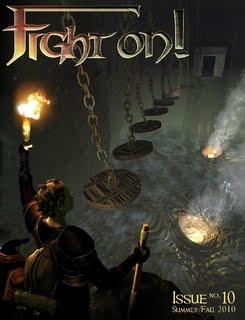
I'm sure a lot of you know this already, but some of you may not, so it's worth mentioning that the tenth issue of Fight On! has been released. The 140-page issue is available as both a PDF (for $7.00) and as a printed copy (for $9.99). Issue #10 is dedicated to the memory of Tom Moldvay and is filled with a wide variety house rules, musings, and adventures for old school RPGs.

I've got a copy of the PDF and will try to get a review of it up soon, but, from what I've read of it so far, Fight On! remains an excellent resource for anyone looking for ideas and inspiration for their campaigns. It's come a long way from that first issue back in the Spring of 2008, when it was less than a quarter the size of the current issue.

I'm glad to see Fight On! prosper, even if I've found most of my creativity these days goes into my Dwimmermount campaign and this blog, thereby leaving me with little to contribute to the 'zine. With the disappearance of OD&Dities again and the uncertain status of Knockspell, Fight On! (and Oubliette) is the only regularly produced old school fanzines of which I'm aware and it's encouraging to see it still going strong. Kudos to Ignatius Umlaut and his contributors for all their hard work and imagination!

Clerics versus Undead Monsters

As is well known now, the cleric was inspired, in large part, by the character of Dr. Van Helsing, as ably portrayed by Peter Cushing, in numerous Hammer horror films in the 1950s, 60s, and 70s. Consequently, the class's signature ability is not spell casting but its ability to "turn away" undead monsters, such as zombies, ghouls, and, of course, vampires.

As I noted in my earlier post on the subject, anti-clerics lack the ability to turn undead entirely in OD&D. This is a stance that, so far as I can recall, no other version of D&D adopts, not even Holmes, which otherwise does include OD&D's anti-clerics (or "evil clerics," as the good doctor calls them). AD&D, intriguingly, does not allow evil clerics to turn or destroy the undead, but they can neutralize or even command them. Moldvay/Cook/Marsh gives all clerics, regardless of alignment, the ability to turn undead, a stance also adopted by Mentzer.

Of all these options, I find the one adopted by Moldvay/Cook/Marsh and Mentzer to be the least satisfactory to me, as it makes all clerics equally efficacious against the undead, regardless of their deity (if any) and alignment. The implication seems to be that the simple fact that a character is a cleric is sufficient to have power over the undead. The AD&D position, meanwhile, is more coherent, inasmuch as alignment is significant, but it's also more dualistic (or perhaps "multipolar"), since it gives all alignments some power over the undead. OD&D, as noted, implies a "monopolar" reality, where Law, which is often equated with goodness, is the only force to which before which undead monsters flee.

Of course, in my Dwimmermount campaign, Law does not equal Good, or at least not all Lawful beings can be reckoned good ones, except in the narrow sense that they oppose Chaos, which seeks the destruction of all. The religion of Typhon, to cite a prominent example from the campaign, is a staunch defender of human civilization, a paragon of Law, but it also turns a blind eye to oppression and cruelty and supports strength as an indicator of rectitude. As in the LBBs, there are no non-Lawful clerics, excepting demon worshipers, which follow slightly different rules.

Given that all Lawful clerics, regardless of the deity they serve, can affect the undead, it seems clear to me that it is a cleric's Lawfulness, not his deity, that grants him this power, a position that carries with it cosmological implications I've embraced rather than shied away from in my campaign setting. Though there is no "church of Law," as we see in some early D&D materials, there is a Lawful cult, one that eschews the usual gods and personifies Law itself as a kind of Supreme Deity. This cult doesn't have clerics but rather paladins, who, interestingly enough, lack the ability to turn the undead (as in Supplement I), an oddity that I think helps to paint a delightfully muddled cosmology -- just the way I like it.

Anti-Clerics

One of the easily overlooked aspects of OD&D is that all clerics are Lawful in alignment. At level 6 or below, Neutral clerics are possible, but those "of 7th level and greater are either 'Law' or 'Chaos'." Somewhat contradictorily, a later section of Men & Magic states that "there are Anti-Clerics ... who have similar powers to Clerics." As I read this passage, it means that "anti-clerics" are a distinct class of their own. They even have a different spell list from Lawful clerics (that includes no healing spells), as well as a unique spell -- finger of death. Likewise, they have no power over the undead as ordinary clerics do.

If one looks at OD&D from the perspective of AD&D or post-LBB editions of Dungeons & Dragons, anti-clerics are just another one of those oddities that doesn't seem to make any sense. But, as I've argued before, OD&D implicitly accepts a "fairytale Christianity," which it equates with Law and opposed by an equally storybook conception of Satanism/demon worship, which it equates with Chaos (often called "evil" in various parts of the LBBs). In such a context, anti-clerics are perfectly reasonable.

In my Dwimmermount campaign, there are anti-clerics, though I don't call them that, since, like the word "superhero" that OD&D also uses (and Chainmail before it), it somehow doesn't feel "right" to me. Actually, there's no single name for them, since these demon worshipers lack a unified organization, operating as part of dozens of different secret cults, each one dedicated to a different lord (or lords) of the Abyss. All, though, are wholly opposed to Law and devoted to the destruction of the present cosmic order, believing it to be a self-delusion and not at all representative of the great truth that only their masters know, namely that there are no gods and nothing awaits Man after death. Interestingly, elves believe the same thing, which is why many pity Man's brief pointless existence.

To date, I haven't done a great deal with anti-clerics in the campaign, mostly because the areas of the world the players have explored haven't really given me much opportunity to do so. The cult of Turms Termax remains the primary antagonist, although the Eld of Areon are shaping up to be important secondary opponents. This is fine by me. My feeling is that any campaign worth its salt should be larger than whatever the player characters are doing at any given time. The demon cults are out there, lurking in the shadows, and one day the party may cross swords with them. Or not -- that's for my players to decide.