Tuesday, May 8, 2012

Ares Magazine: Issue #1

I've noted before that, during the time I subscribed to and most actively read Dragon, I found the Ares section to be consistently one of the magazine's high points. Part of it was that I'm first and foremost a science fiction fan, so the articles in that section naturally appealed to me. A bigger part, I think, was that the articles in the Ares section were, generally speaking, better written. Having re-read those sections over the last few months, I'm pretty sure I'm not seeing things through rose-colored glasses. Because of space considerations, Ares articles were lean and to the point; there was no room for authorial flights of fancy or rambling musings. They were almost all "meat." It helped, too, that there was a smaller pool of writers for the Ares section than Dragon generally and those writers were ones whose styles and content I found congenial.

Given my fondness for the section back in those days, it wasn't hard to imagine that I'd seek out copies of its predecessor, the "magazine of science fiction and fantasy simulation" published by SPI between 1980 and 1982. I figured that, if one small section called Ares was so enjoyable, what would a whole magazine called Ares be like? Unfortunately, in Baltimore in the early '80s, finding copies of Ares magazine wasn't easy, at least in the circles in which I traveled. There were only a couple of places I frequented that carried many SPI titles and, even then, their selection was more limited than that of local favorite, Avalon Hill. Nevertheless, I did manage to obtain a few copies of Ares back in the day and have subsequently filled out my collection. For the next few months, I'm going to be looking briefly at each issue and highlighting those sections that make an impression on me.

Issue #1 appeared in March 1980, with a cover by comics legend Howard Chaykin. That's pretty awesome any way you slice it. The issue begins with an editorial by the late Redmond Simonsen, in which he explains why Ares was founded, noting that
Fantasy, science fiction, and simulation gaming share a common cord of connective tissue: the constructed world. To a greater degree than any so-called "mainstream" fiction, works of science fiction and fantasy imply or explain worlds much more dependent upon the product of the imagination -- worlds inherently more poetic or allusive thereby.
Simonsen goes on to make a connection between Ares and SPI's other magazine, Strategy & Tactics, suggesting that, where S&T serves the historical side of things, Ares will serve the fantastical. It was definitely an ambitious vision and I can't help but wonder how well received it was by the larger gaming populace. As I said above, Ares wasn't widely known in my neck of the woods prior to its appearance in the pages of Dragon, but I have no idea if that was at all typical.

Next up is an Asian-themed fantasy short story called "Dragon ... Ghost" by M. Lucie Chin. Following that is a science article by John Boardman, Ph.D. entitled "No, You're Not Going to the Stars." The article discusses all the reasons why the ways space travel, as portrayed in science fiction, are impossible or unlikely. Boardman wrote many articles of this sort throughout Ares' run and, while fascinating, they all have a distinctly "party pooper" feel to them, like that annoying kid in school who enjoyed pointing out anachronisms in historical films and TV shows so as to ruin other kids' fun. Then there's another piece of fiction, "Gangsters," by Henrik Nordlie.

The main attraction of issue #1 is WorldKiller, a complete wargame "of planetary assault." Like Strategy & Tactics, every issue of Ares included a complete game of some sort, with rules, maps, and counters. Considering the cover price of $3.00, that was a pretty good deal. WorldKiller was designed by Simonsen and is fairly brief in terms of rules, though it's still written in the largely impenetrable (to me) SPI house style of using numbered cases to distinguish between sections (e.g. 1.1, 1.1.2, 1.1.2.6, etc.).  The remainder of issue #1 consists of short, snarky reviews of books, movies, and games by the SPI staff. Interestingly, a significant number of the game reviews are of SPI products, though, perhaps inevitably, they are reviewed with less condescension and vitriol.

Monday, May 7, 2012

Ghouls About Town

The ever-amazing Russ Nicholson just completed a piece of artwork for Dwimmermount, depicting two ghouls -- technically, ghasts -- from the colony of them that infests levels 2A and 3A of the dungeon. Unsurprisingly, he did a superb job and I look forward to seeing what else he creates for me in the weeks to come.
©2012 Russ Nicholson

Pulp Fantasy Library: The Lure of the Golden Godling

Though the Niall of the Far Travels series consists of ten short stories, I own only nine of them. The eighth installment, which comes between "The Cup of the Golden Death" and today's entry, is entitled "Out of the Eons" and appeared in the premier issue (August 1980) of a TSR periodical not many people remember, Dragontales. Dragontales was an anthology of short fiction that, so far as I know, did not last more than a couple of issues. I remember seeing copies of it in bookstores and hobby shops in the early '80s, but I never picked one up for myself. Consequently, I won't be discussing "Out of the Eons" here, though I will be making an effort to try and find a copy at some point in the future.

The ninth Niall story, "The Lure of the Golden Godling," appeared in issue #44 of Dragon (December 1980), begins with the barbarian walking the night streets of the city of Urgrik, where he comes upon what appears to be a man -- or a body -- lying motionless on a cobblestone street. Examining the shape closer, Niall soon realizes that it is neither a living nor a dead man at all, but rather a golden statue bundled up in some cloth:
It was no more than a foot high, and had obviously been carved by a master craftsman. It showed something amorphous, almost shapeless, yet possessed of some strange, other-worldly power. Its rounded eyes seemed to peer upwards at Niall, as though promising him untold wealth and power even as a tiny voice whispered soothingly inside his brain.

Niall growled under his breath. He did not like these mysterious manifestations of the many gods that infested his world.
Despite his distaste for anything having to do with the gods, Niall decides to hold on to the idol, which he reckons to be solid gold. He takes it back with him to his palace in the city and, before he reaches it, he is set upon by a beautiful young woman. The woman, who identifies herself as Thayya, begs Niall to give her the statue: "Come with me and you shall be rewarded," she says. The northern warrior senses a trap -- indeed, he hopes it is a trap, as he's in the mood for adventure -- but nevertheless agrees to come with Thayya.

Niall's instincts are correct. Though the young woman tries to ply him with gold and other enticements in exchange for the statue, when he falls prey to neither, she calls on assassins to try and slay him.
Niall bellowed with delight. His great sword came up into his hand and he swung it like a scythe. A head toppled from a neck, and then Blood-drinker was burying its keen blade into a shoulder, half severing it.

The Far Traveler moved like a cat. He was half across the room even as he was freeing his blade from bleeding flesh, lifting it to swing again, and then again. At each stroke of that shining steel, blood spurted. Heads were cloven, arms were sheared. Only now and again did he use his blade as a shield to deflect the blows that were aimed at him.

Niall was in his glory, with the ring of steel in his ears and the sight of armed men coming at him. For this he had been born, to fight—and to fight even harder against such odds.

He heard Thayya urging on the men amid whispered prayers to whatever gods she worshipped. She was backing slowly toward the door, eyes big with terror, as she saw how Niall fought.

Niall wanted to reach her, to take her with him to answer questions. But the mercenaries who fought him seemed to detect what it was he wanted. They flung themselves before him; they gave up their lives to protect the woman.

Thayya moved toward the doorway and slipped through it, closing and bolting the door behind her. Niall growled low in his throat, hurled himself even more savagely at the men who still faced him.

They went down before his blade until he was the only thing standing in the room. As the last man fell, Niall shook himself and lowered his sword. He moved toward the thick door that blocked the path deeper into the building. It was barred, bolted.

Niall shrugged. The woman was long gone.
Needless to say, Niall decides to find out more about both the golden statue and Thayya, a quest that takes him not just far away from Urgrik but involves him in the machinations of the very gods themselves. Ultimately, that's what makes "The Lure of the Golden Godling" such a compelling read. Gardner Fox does a lot to flesh out the gods of Niall's world -- their relationships, their petty feuds and jealousies, their need for human worshipers -- and this goes a long way, I think, it distinguishing this series from others of its kind. There's good reason Niall wishes to avoid having anything to do with the gods and "The Lure of the Golden Godling" makes the reader see the wisdom in his stance. It's a fun story and a very gameable one, too, something that a great many tales of gods and men are not -- another point in its favor.

Saturday, May 5, 2012

What I Did Last Night

My son and I played a game of The Awful Green Things from Outer Space and had a lot of fun, though my son's primary concern was keeping the crew's mascot alive.

Friday, May 4, 2012

Open Friday: "Outdated" Science Fiction

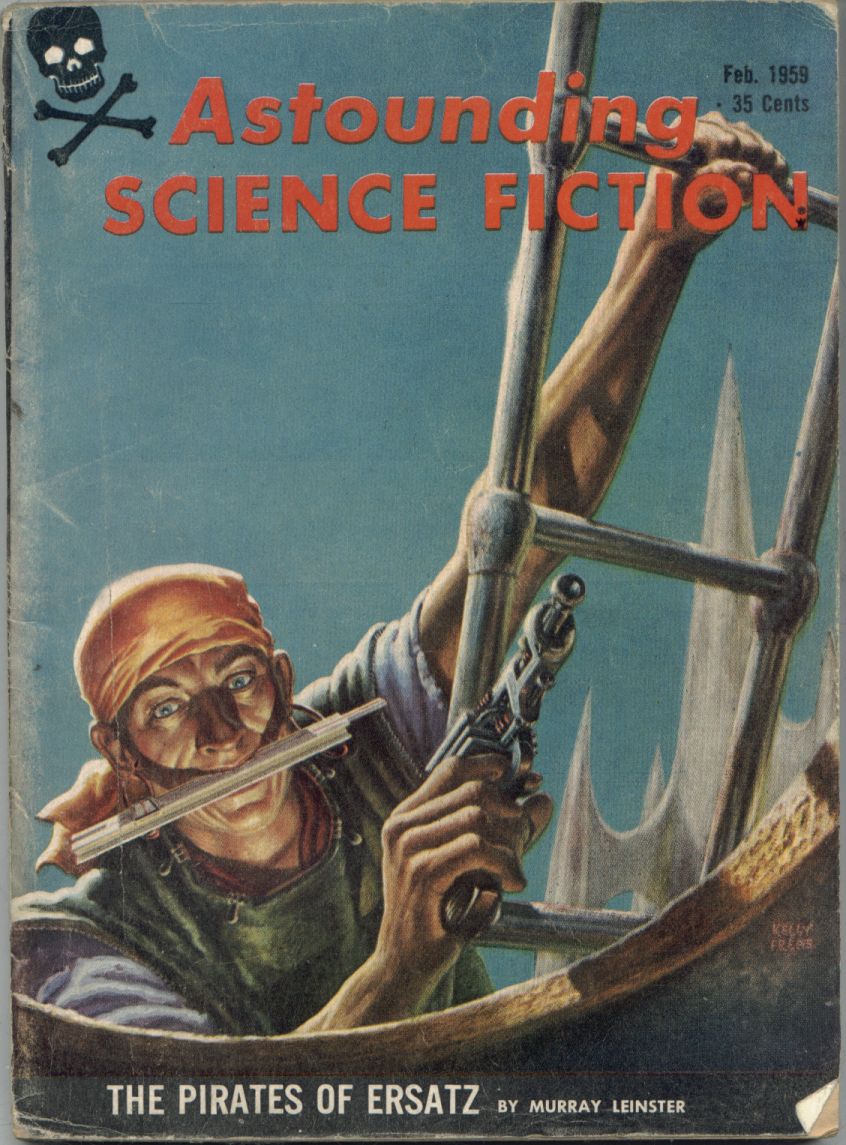
Does the fact that a science fiction book, movie, or game produced in the past uses science that's been superseded affect your enjoyment of it? I know when I was a teenager, I went through a phase where I started to reject a lot of older SF because I considered it "outdated." That's why, for example, I largely abandoned Traveller for a time in favor of the newfangled Traveller: 2300 -- it was more "up to date." Nowadays, I revel in older conceptions of science fiction and often find them much more enjoyable than whatever's trendy these days. And, in my darker moments, I look forward to the day, several decades hence, when everyone looks back at all the transhumanist sci-fi of the early 21st century and deems it just as ludicrous as Barsoom or space pirates with slide rules.

Thursday, May 3, 2012

More Worthy Projects

Given how well the Dwimmermount Kickstarter turned out, I'd be remiss in not mentioning here several other crowdfunding drives currently under way by folks whose work I've enjoyed in the past.

Barrowmaze II: Greg Gillespie wants to make the second installment in his Barrowmaze megadungeon as awesome as possible, which is saying something, considering how good the first installment was.

LotFP Hardcover and Adventures: Leave it to Jim Raggi to be insanely ambitious in his crowdfunding project. Mind you, if anyone in our little corner of the hobby could somehow manage to raise $149,500 this way, Jim would probably be the man.

Weird West Miniatures: Stuart Robertson is trying to get a set of six 28mm miniatures for his terrific Weird West RPG made.

And, of course, Steve Jackson's Ogre Kickstarter is still chugging along, closing in on half a million dollars. Shipping options for outside the US are now available, though they are expensive. Whether or not they're too expensive I leave to others to decide, but I'm pretty sure I'm going to grab a copy before the campaign ends next week.

Smith as Smith

If this isn't the most terrific photograph ever, I don't know what is: E.E. "Doc" Smith dressed up as C.L. Moore's interplanetary rogue, Northwest Smith, at the 20th Worldcon in 1962.

Retrospective: Mercenary

During the "Classic" Traveller era (1977-1986), Game Designers' Workshop produce three types of support products for the game: books, supplements, and adventures. The meaning of "adventure" is clear enough to need no explanation. A "supplement" was (generally) intended as an aid to the referee in running a Traveller campaign, such as pre-generated characters (1001 Characters), patron encounters (76 Patrons), or sector data (The Spinward Marches and The Solomani Rim). A "book" was an expansion of some aspect of the original three little black books that comprised the game. In a sense, they were an early example of the "core rules" concept lately championed by several contemporary RPGs -- later additions to the game elevated to the status of being equal in importance to its initial rulebooks.

I didn't discover Traveller until 1980 or '81 by which point there were already several examples of all the categories of support material. I had only a spotty collection of both adventures and supplements, but I owned every single book produced for it. That's because, unlike adventures and supplements, I viewed books as Official™ and thus absolutely essential for running and playing a "proper" Traveller campaign. In retrospect, it's an absolutely foolish notion, but, having read one too many editorials by Gary Gygax on the importance of buying and using only official AD&D products, the mentality was very easy to adopt with regards to other games.

Fortunately, when I started playing Traveller, there were only two additional books beyond the three that started the game. The first of these was Mercenary, published in 1978 and written by Frank Chadwick and Marc Miller. Mercenary was 52 pages long and provided lots of new rules and information for ground forces, both Army and Marines. So you got lots of news military equipment and vehicles, a discussion of mercenary work, and a bunch of sample adventure outlines for such characters. But the big draw of Mercenary (and its immediate successor, High Guard) was its expanded character generation rules.

For those of you who don't know Traveller well, here's a brief overview of character generation. Characters can enlist in one of six services, three of which are explicitly military (Army, Navy, Marines). They then go through 4-years terms of service during which rolls are made to see what skills, if any, they acquire during that term. The most skills a character can acquire in a single term is four (in his first term if the player rolls very well), but most terms grant only one or two skills. Once the character musters out, he'll have a handful of skills that reflect his time in his chosen service.

Mercenary changes this somewhat by providing lots more detail about a character's terms of service. Each term represents a four-year block, but Mercenary lets the player roll for each year within that term, to see not only what a character's specific duties were during that time but also provides many more opportunities to gain skills. The result is that a character generated under the rules of Book 4 are almost always much more talented than those generated under the original three LBBs.

It's no surprise, then, that, by the time I started playing Traveller, nearly everyone I knew used Mercenary (and High Guard) to create their characters. This meant almost no one played Scouts or Merchants, at least until they, too, got expanded character options later in the '80s. After all, why wouldn't you use these rules? Not only did they generate better characters but they were also official. By calling Mercenary "Book 4," GDW had placed it on the same footing as Books 1-3 that came in the boxed ruleset. Unless you were explicitly trying to get a reputation for stubbornness, the pressure on the referee to allow Mercenary was significant.

At the time, I don't remember having any qualms about allowing Book 4 into our campaigns, despite the weird way it warped them into focusing almost exclusively on mercenary tickets and the like. Of course, this may explain why some of my players wanted to move on to play a "real science fiction game" like Star Frontiers, since its adventures weren't just about traveling from world to world fighting local insurgencies. Nowadays, though, I have a less positive feeling about Mercenary, feeling that it inaugurated not only power inflation in Traveller but a cult of the official that was common enough that a little pushback against it was much needed -- especially by guys like me whose natural tendency was to look to a game's designer/publisher for guidance rather than relying on my own judgment. Oh, the follies of youth!

Tuesday, May 1, 2012

Inspiration and Emulation

Inspiration for all of the fantasy work I have done stems directly from the love my father showed when I was a tad, for he spent many hours telling me stories he made up as he went along, tales of cloaked old men who could grant wishes, of magic rings and enchanted swords, or wicked sorcerors and dauntless swordsmen. Then too, countless hundreds of comic books went down, and the long-gone EC ones certainly had their effect. Science fiction, fantasy, and horror movies were a big influence. In fact, all of us tend to get ample helpings of fantasy when we are very young, from fairy tales such as those written by the Brothers Grimm and Andrew Lang. This often leads to reading books of mythology, paging through bestiaries, and consultation of compilations of the myths of various lands and peoples. Upon such a base I built my interest in fantasy, being an avid reader of all science fiction and fantasy literature since 1950. The following authors were of particular inspiration to me. In some cases I cite specific works, in others, I simply recommend all their fantasy writing to you. From such sources, as well as just about any other imaginative writing or screenplay you will be able to pluck kernels from which grow the fruits of exciting campaigns. Good reading!
If I were going to pick the single greatest impact the old school renaissance has had on the hobby since its inception, it would not be a renewed appreciation of the megadungeon or the hexcrawl, even though that is one of the OSR's great victories. Rather, I'd say it was broader knowledge of the pulp fantasies that Arneson and Gygax, especially those enshrined in Appendix N of the AD&D Dungeon Masters Guide. I say this with confidence because, prior to about 2008, I can't recall ever seeing the phrase "Appendix N" used at all on gaming forums or blogs, let alone being used as a template for designing entire games. Nowadays, though, Appendix N is talked about well beyond the confines of the old school echo chamber.

I bring this up because, the other day, I was chatting with Victor Raymond. I told Victor, as I've told anyone who will listen for years now, that, while I've probably played far more Dungeons & Dragons than any other RPG, fantasy is for me a distant second to science fiction in terms of my personal interest. I mentioned that, prior to picking up D&D in 1979, my direct experience with fantasy literature of any sort was mostly limited to what I'd read in Buffinch's Mythology and similar books. D&D was thus, for me, a primary gateway to fantasy rather than being an outgrowth of my pre-existing interest in the genre.

Conversely, by the time I picked up Traveller in 1980 or '81 (I honestly can't remember which year it was), I was already very well versed in the classics of the genre. My local library had an extensive collection of Ace Doubles that I devoured, along with many other sci-fi paperbacks from the '50s and '60s. So, when I heard about Traveller, it immediately clicked with me. I knew exactly the books and authors that had inspired Marc Miller and so Traveller made sense to me in a way it didn't to many of my friends who equated "science fiction" with Star Trek or, more likely, Star Wars. To them, Traveller was strange and not at all what they were expecting, just as I expect that D&D probably seems strange to newcomers whose understanding of "fantasy" is rooted in something other than Appendix N literature.

But there's a further wrinkle that needs to be considered. A common complaint against D&D now that Appendix N is more widely known is that the game fails to emulate its source material. What class is Conan or the Gray Mouser? What level was Gandalf ("Fifth!" Yeah, yeah ...)? Where are all the dungeons? And so on. The problem with these questions, as I see it, is that D&D was never intended to emulate its sources at all. Rather, it took inspiration from them. Read the quote from Gygax above. The fantasy of Dungeons & Dragons is its own thing, just as the sci-fi of Traveller is its own thing, even though, in both cases, their creators looked to certain authors and books for the seeds of the ideas that would blossom into their creations. So, D&D is no more meant to emulate the Hyborian Age than Traveller is meant to emulate the Technic Civilization and I think it's silly to criticize either for failing to do so. That was never the intention of their creators.

The problem, I think, is that, at some point, as RPG designers became more self-aware of what they were doing, emulation came to replace -- or at least overshadow -- inspiration. I'm honestly not sure what the first RPG was where genre emulation was explicitly a design goal. Champions perhaps? Even then, it wasn't the only goal, merely one of several, but, over the years, it seems to have become much more prevalent to the point that designers use "genre emulation" as an explanation for why certain rules work the way they do.

None of this is intended to denigrate emulation, only to point out that there's a difference between being inspired by a book or a movie and trying to emulate that book or that movie. There is no contradiction in saying that D&D was inspired by The Dying Earth and yet have a magic system that doesn't closely match the one Jack Vance describes there. Based on their own words, neither Arneson nor Gygax intended for D&D to emulate any specific work of art, which is why you get weird stuff like the cleric class, which takes bit and pieces of several different characters and ideas from multiple media and brings them together into something unlike any of its inspirations.

The Articles of Dragon: "Dragonchess"


Issue #100 of Dragon (August 1985) was a milestone for the periodical, as well as for me. For the magazine, it was a portentous number to use as an occasion for celebration. For me, though I didn't know it at the time, it represented the end of an era. The same month that this was released was the last time I attended a "games day" hosted by a public library. It may have even been the last such gathering my local public libraries sponsored, since I don't ever recall hearing of others. Even if it wasn't, I remember well that my last one was a rather underwhelming affair, with far fewer participants than previous ones and most of those who did attend were much younger than I. There weren't nearly as many teenagers, let alone college students or adults, and that disappointed me.

From my perspective, it seemed as if the demographics of the hobby had changed over night and I didn't like the change, especially now that I was one of the "older kids" I looked up to when I was younger. In retrospect, it's obvious to me how hypocritical I was back then, wanting to distance myself from the 10 year-olds clutching their Elmore-covered Basic Sets the way I had done with Sutherland-covered one a mere six years before. But six years is a long time in the life of a child and, as a teenager, I wanted no reminders of my younger self. Thanks goodness that the teenagers of my younger years did not feel the same way!

There was more to it than adolescent snobbery, though. The hobby really did seem to be changing by late 1985 and, while I was still as keenly interested in it as ever, it became much harder to find people with whom to play and, for the most part, the new RPGs coming out held much less appeal to me than those published in the years before. Issue #100 wasn't my last issue of Dragon, but I did let me subscription lapse not long thereafter; it would never again play as central a role in my connection to and understanding of the hobby after that.

The funny thing is that, for all the fanfare surrounding issue #100, it wasn't a particularly memorable issue. The only things I still remember about it are the adventure set in 20th century London and Gary Gygax's article (and accompanying Greyhawk short story) about a chess variant called "dragonchess." Dragonchess is a three-dimensional version of chess, with boards representing the sky, the land, and the underworld. I'd known about 3D chess variants ever since I'd watched Star Trek in reruns in the mid-70s, but this was, I think, the first time I'd ever seen the rules for such a game -- and by Gary Gygax no less! Needless to say I fell completely in love with the idea of playing dragonchess.

There were, of course, two problems with this. First, and perhaps most importantly, I am a terrible chess player. I can barely hold my own in a regular game; learning and mastering a variant that uses three boards at once was almost certainly going to be beyond me. Second, to play dragonchess, one must assemble the boards for oneself and that, too, requires skills I did not possess. This didn't stop me from trying, of course, but I utterly failed to do so. Ultimately, I gave up the idea of having three boards stacked on top of one another and instead opted for having three boards placed side by side. This required me -- and the poor souls I goaded into playing with me -- to keep track of which squares on one board were "over" or "under" others. That was hardly insurmountable but it was nevertheless trying, particularly when one considers how many other aspects of standard chess Gygax changed in his variant.

Dragonchess had a much larger number of pieces -- 42 per side, consisting of 15 different types. Likewise, many of these pieces had unique moves unlike those in standard chess. Furthermore, some pieces behaved differently depending on which board they were currently situated, while others were bound to a single board. The object of dragonchess is the same as regular chess, so that is at least familiar. However, the larger number of pieces and types, not to mention the presence of three dimensions, made it much more difficult to grasp. That's not a criticism of the game itself, which looked like it'd be a lot of fun when played by two opponents who are both skilled at standard chess and well acquainted with the unusual aspects of dragonchess.

Alas, I was neither of those things and, while enthusiastic for the game, I was not very good at teaching its rules to others. Add to it that I didn't have a "proper" board and it's little wonder I never got the chance to play many games of dragonchess. Nowadays, I look back on my efforts with more than a little embarrassment -- the follies of youth! One of several that this issue of Dragon brings to memory.

This is the last installment in "The Articles of Dragon" series. Next week, I'll turn to new but related topic.