Showing posts with label wargames. Show all posts

Thursday, March 5, 2026

Interview: Rudy Kraft (Part I)

A long-standing and popular feature of this blog has been its interviews with designers, artists, and other luminaries of the hobby. From the beginning, I’ve believed it’s important to preserve and share their memories, insights, and experiences. They deserve to be heard not only by those of us who remember those now-ancient days firsthand, but also by later generations of roleplayers who might otherwise never encounter the stories behind the games they love.

That’s why I’m always especially pleased to speak with someone whose contributions were largely unknown to me in my own youth. Such conversations are reminders of just how many hands shaped this hobby in its formative years.

Rudy Kraft, who was involved in the early days of Chaosium – or The Chaosium, as it was then styled – very kindly agreed to answer a series of questions I put to him. As you’ll soon discover, he did so with remarkable generosity and detail. What follows is the first part of our conversation; the second will appear tomorrow.

1. How did you first become involved in the hobby of role playing?

I first got involved in gaming as a hobby because of my father. I was the oldest of five children—although we started gaming before the fifth child was born. We had family games of Clue and Monopoly—mostly Clue. At some point, my father bought me a Christmas present of the old Avalon Hill game Afrika Korps. He and I played that a lot often leaving it set up on the desk in my parents' bedroom. Because I liked this game, he bought additional Avalon Hill Games at least once a year until I went away to college in 1974.

Starting in elementary school, I became an enthusiastic reader of both science fiction and fantasy.  During this time, I read and reread The Hobbit and The Lord of the Rings and Asimov’s Foundation series on multiple occasions.  

During high school, some friends and I created a space exploration war game where one person acted as the moderator and the other people explored a star map from different locations until they ran into each other and presumably fought a war.  

When I was at Cornell University, I read a lot of science fiction and touched the periphery of SF fandom. In one fanzine I read about this new game, Dungeons & Dragons. This almost certainly occurred in August 1975. The game sounded interesting to me, so I ordered a copy of it which I received in September. Once I looked at it, it became obvious to me that I did not know how to get started in the game and I set it aside.

In October, I overheard two people talking about playing Dungeons & Dragons. It turned out that there was a small group of people playing the game regularly in the same dormitory where I ate my meals.  They played every Saturday, so I first started playing Dungeons & Dragons on the second Saturday in October 1975. In fact, I had a 50th anniversary celebratory session in October this year where, for the first time in years, I played rather than DMed a game of Dungeon & Dragons.

Following that first session, I became very addicted to playing Dungeon & Dragons to the point where it significantly adversely affected my grades. During those years, I bought Empire of the Petal Throne and Metamorphosis Alpha, but I never persuaded anyone to play them instead of D&D

Wednesday, November 5, 2025

Retrospective: Conquest of the Empire

Stop me if you've heard this before: I was never a wargamer, but I liked the idea of wargames, specifically simulating a military or other conflict through the use of a board, tokens, and dice. There's just something inherently appealing to me about this, which probably explains why I've spent more than four decades trying but rarely succeeding at finding a wargame that really clicked with me. I owned and played a number of Avalon Hill and SPI games in my youth, but, with the exception of Diplomacy, I was never very good at them (and even there I was hampered by my inexplicable tendency to play Austria-Hungary).

However, in 1984, Milton Bradley released a line of games under the banner of the "Gamemaster Series" that caught my attention. The series was an experiment in bringing wargames to the mass market. Each entry in the series came in a massive, shelf-dominating box filled with lavish components and a rulebook that looked intimidating compared to more traditional boardgames like Monopoly or Risk. The series began with Axis & Allies, designed by Larry Harris, and followed swiftly with another of his creations, Conquest of the Empire.

While Axis & Allies presented World War II in game form, Conquest of the Empire did the same thing for the Roman Empire's Crisis of the Third Century. The game was a grand-scale battle for supremacy across the Mediterranean world after the death of Marcus Aurelius. It was, in every sense, a spectacle, a game whose physical components alone promised an epic experience before a single die was rolled. As a young history buff with a particular affection for Greco-Roman history, this was the game I'd been waiting for.

To appreciate Conquest of the Empire, it helps to recall what the gaming landscape looked like in the mid-1980s. The boundary between “mainstream” and “hobby” games was much starker than it is today. Wargames were, as I noted above, largely the province of companies like Avalon Hill or SPI. They were sold in specialty stores to an audience comfortable with long rulebooks and hex maps. By contrast, the Gamemaster Series was an attempt to bridge that gap by combining high production values, streamlined rules, and compelling subjects to attract both traditional hobbyists and curious outsiders like myself. 

Axis & Allies was, I gather, very successful. Certainly my friends and I enjoyed playing it and we did so often. Of course, even in the 1980s, World War II was a staple of wargames. Conquest of the Empire thus deviated just enough to be considered daring. Furthermore, its subject, the period of the Military Anarchy, was less familiar and its map of the Mediterranean world, divided into provinces and trade routes, hinted at something more intricate than the average family game. Of course, that's precisely why I loved it.

Opening Conquest of the Empire for the first time is something I cannot forget. To start, the box was enormous. Inside lay nearly four hundred molded plastic miniatures, such as legionnaires with raised shields, catapults, coins, and galleys to patrol the Mare Nostrum. There were also cities to build, roads to lay down, and an oversized, vividly illustrated board depicting the known world from Britannia in the northwest to Aegyptus in the southeast. Following the death of Marcus Aurelius, the empire teeters on the brink of chaos. Each player takes the role of a would-be emperor, commanding armies, building cities, taxing provinces, and waging war until one emerges victorious. It's a straightforward and appealing premise – especially to my teenage self.

Like Axis & Allies, the game was structured around economic management and military conquest. Provinces provided income, which could be spent to raise legions, fleets, and fortifications. Armies moved along roads or across the sea, engaging in battles resolved by simple dice rolls. Catapults were useful in sieges and galleys could ferry troops to distant shores. Victory went to the player who amassed the most wealth and territory, though, in practice, the game often ended in exhaustion or mutual ruin long before an emperor was crowned.

That said, the game was not without its flaws. Its economy could snowball rapidly, favoring whoever secured a few prosperous provinces early on. Combat could be pretty random, with legions sometimes crushed or exalted on a handful of dice. The rules for roads and taxation added an appealing Roman flavor but little in the way of meaningful choice. Players spent much of the game counting coins, rebuilding destroyed forces, and waiting for their next chance to strike. One might argue that some of this is, in fact, realistic or at least true to history, but it didn't always make for a satisfying game.

Even so, Conquest of the Empire often felt epic. Setting up the board, arranging your legions, and surveying the Mediterranean was a ritual of grandeur. It was easy to imagine oneself as a latter-day Caesar, eyeing the spoils of empire. The game rewarded patience more than finesse and spectacle more than subtlety, but it delivered a sense of scale that my friends and I found incredibly alluring. It's little wonder that I still think about this game decades later.

From what I have read, it seems that Milton Bradley’s Gamemaster Series never achieved the mainstream success the company had hoped. Axis & Allies became a perennial favorite and spawned multiple editions and spin-offs, but Conquest of the Empire eventually vanished from store shelves, remembered fondly by those of us who had the chance to play it back in the day. I suspect part of the reason was that its theme was less immediately engaging to American audiences and its rules required a level of commitment somewhat closer to Avalon Hill than to Parker Brothers.

I don't mean that as a criticism at all. I absolutely adored this game and deeply regret that my original copy was lost sometime in the '90s. Conquest of the Empire might not have achieved what Milton Bradley had hoped for it, but, for me, it was a near-perfect "middle road" between simple boardgames and the esoteric complexities of "true" wargames. If there were more games like this, I might actually play them.

Monday, June 23, 2025

War!

As you can probably tell from both of my earlier posts today, there are soon going to be some large, pitched battles in my House of Worms Empire of the Petal Throne campaign. This isn't something I'd imagined some months ago, when we began entering the final stages of the campaign, but here we are. This turn of events makes sense, of course, given the way events are unfolding. However, I can't deny that this prospect fills me with a bit of apprehension. As I've said on many occasions over the years, I've never been a wargamer of any kind, despite my fascination with and some knowledge of military matters. I say this with some regret, both because this lacuna in my game education has no doubt skewed my perspective on certain things and because it leaves me somewhat at loss in knowing how to handle occasions of mass combat within a RPG.

That's why I'm turning to you, my readers, for thoughts and suggestions on how you have handled wars and large-scale battles in your roleplaying game campaigns. What rules or approaches did you use and how well did they work? Did they mesh well with the RPG you were playing? I'm honestly curious about every aspect of this question, since I have such limited experience with it in my own campaigns and would appreciate learning from those of you who've successfully incorporated mass combat into yours. 

That said, I should make a few things clear about my own preferences as a referee. Between my dislike of combat as an activity in itself and my feeling that most RPGs have too many rules, I have a natural aversion to any kind of mass combat system that plays out like a wargame. If I wanted to play a wargame, I'd play a wargame. What I want – and this may be impossible – is a solution that doesn't require me or the players to learn a whole new set of rules to simulate their characters' involvement in a big battle. Additionally, I'd like for what the characters do to have an effect on the outcome of the battle, even if they're not directly involved in everything that happens. I realize this is likely asking a lot, but I have lots of smart and knowledgeable readers, so maybe one of you can point me in the right direction.

To date, the only RPG I've ever played that had a decent set of mass combat rules was Pendragon and, even there, I wasn't wholly satisfied with the results. The main virtue of Pendragon was that the participation of the player characters still used the standard combat rules and the results of their individual battles had some impact on the final outcome of a larger fight. I didn't have to keep track of lots of wargame-y rules to adjudicate the battle satisfactorily. That's more or less what I want here, though, as I said, I may be asking for too much. 

Your thoughts on this matter are thus greatly appreciated. 

Wednesday, January 29, 2025

Retrospective: Invasion: Earth

By now, I scarcely need to remind people that roleplaying games are an outgrowth of wargaming, specifically miniatures wargaming. More than a half-century after the appearance of Dungeons & Dragons, this is a well-known and indisputable fact. Nevertheless, it's a fact worth mentioning from time to time, if only to provide context for how many early and influential RPGs were created and designed. It's also a reminder that, even though roleplaying games would eventually eclipse their predecessors, wargames remained an important component of the wider hobby for many years (and arguably still are, though I'm far from the best person to make that claim).

Game Designers' Workshop, best known nowadays as the original publisher of Traveller, began its existence in 1973 as a publisher of hex-and-chit wargames. Its first foray into what might be called roleplaying was in 1975 with En Garde!, though the game is closer to a dueling simulator with light character-driven elements than a "true" RPG (similar, in some ways, to Boot Hill in this respect). But, by and large, GDW's output during the first few years of its existence was tabletop wargames – nearly twenty by the release of Traveller in 1977.

Marc Miller, one of the founders of GDW, had long been a science fiction fan and among his first designs at the company (along with John Harshman) was Triplanetary, whose vector-based movement system inspired Traveller's own (and that of Mayday, itself an offshoot of Traveller). He also designed Imperium, a simulation of a series of interstellar wars between the vast, alien Imperium and the plucky, upstart Terran Confederation. Devotees of the Third Imperium setting may recognize this scenario as part of its historical background, but, at the time of its release, Imperium had no connection to Traveller – which hadn't yet been published and, when it was, later the same year, it was devoid of any kind of example setting. 

I bring all this up to emphasize that, at GDW, there was a great deal of interplay between its wargames and the roleplaying games it would eventually publish, with one influencing the other and then in turn influencing other games (or even the same ones in later editions). Thus, for example, Traveller incorporates into its official setting the scenario of Imperium, whose second edition in 1990 would then add details from Traveller. I consider this sort of cross-pollination a hallmark of Games Designers' Workshop, a company that, until the very end, was marked by fervid creativity.

1981 is a good example of what I mean. Traveller had, by that point, already been out for four years and had established itself as the hobby's premier science fiction roleplaying game (sorry, Space Opera!). GDW sought to support the game on multiple fronts, revising and clarifying the rulebooks, as well as releasing new ways to play the game, whether large scale interstellar naval battles (Trillion Credit Squadron), miniatures wargaming (Striker), or strategic wargames, like Fifth Frontier War and Invasion: Earth. GDW clearly had big plans for Traveller and its releases that year demonstrate that, I believe.

Unlike Fifth Frontier War, whose scope covers several subsectors of the Spinward Marches during a "current" war within the timeline of the Third Imperium, Invasion: Earth is both much smaller and "historical," which is to say, taking place in the past of the setting. Set about a century before the "present day," Invasion: Earth focuses on the final stages of the Solomani Rim War (or the War for Solomani Liberation, if your sympathies lie in that direction), as Imperial forces attempt to conquer Terra, a major bastion of the Solomani Cause. As the homeworld of humanity (or humaniti, according to Traveller's unique orthography), Terra holds great symbolic importance to the Solomani, who see themselves as its true children, in contrast to the Imperium, whose culture and very blood have been corrupted by contact with non-Terran aliens. 

Invasion: Earth, as its title suggests, is very narrowly focused on the attack and defense of the solar system, culminating in the planetary invasion of Terra. There's thus both space combat and ground combat, each reflecting a different theater of the ongoing Imperial invasion and Solomani counterattack. Rules-wise, it's fairly similar, both in terms of its specifics and its overall complexity, to Fifth Frontier War, which is ti say, it's a proper wargame for hex-and-chit aficionados, not something simplified for casual players like myself. Consequently, I never played Invasion: Earth, even as I admired the copy I saw in the collection of my friend's father – a common theme in my early encounters with wargames.

As I said above, GDW clearly had big plans for Traveller at the time of this game's release. Though intended primarily as a historical game, which, in the setting's timeline, the Solomani lost, there are notes in the back of the rules about how to use the game to simulate invasions of other planets within the Traveller universe. There are also suggestions on how to use the events of the war as fodder for adventures, either in the past or in the present of the Third Imperium setting. I wonder whether anyone ever took up these options for their own Traveller campaigns.

Invasion: Earth, like Fifth Frontier War, has long fascinated me. I love the idea of wargames or simulations intended to flesh out or expand upon some aspect of a roleplaying game's setting, but I've rarely had the opportunity to make use of it myself. For instance, I long wanted to find a way to play out a war in my House of Worms campaign, but I never had the opportunity to do so – or indeed a clear sense of how I'd make it work, but I keep thinking about it nonetheless.

Thursday, January 9, 2025

Retrospective: Birthright Campaign Setting

By now, it's pretty widely recognized that Dungeons & Dragons and, by extension, all roleplaying games ultimately descend from miniatures wargaming. After all, the subtitle of OD&D is "Rules for Fantastic Medieval Wargames Campaigns Playable with Paper and Pencil and Miniatures Figures." Yet, fairly quickly, this descent had become obscured, if not outright forgotten. The first version of D&D I owned, Holmes Basic, was first published in 1977, just three years after the release of OD&D and, by that point the game's subtitle had already been changed to "Rules for Fantastic Medieval Role Playing Adventure Game campaigns" (italics mine). The explicit connection to miniatures wargaming had been severed.

However, many implicit connections remained, most importantly in the way that most character classes, as they advanced in level, gained followers – sometimes a lot of them. High-level characters can also establish strongholds and rules over a territory, collecting taxes from the inhabitants. These and similar aspects of the game reveal, I think, that D&D never completely broke free of the bonds of miniatures wargaming, where free-wheeling campaigns driven by the machinations of players were common. D&D is very much an outgrowth of that style of play, even if most of the new generation of gamers, like myself, had little or no understanding of this fact. And, to be fair, TSR itself did very little to promote this style of play, aside from half-measures like the D&D Companion Set in 1984

TSR tried again a little more than a decade later with the release of the Birthright Campaign Setting in 1995. Created by Rich Baker and Colin McComb, Birthright was another example of the many impressive boxed sets released during the Bronze Age of D&D. The set consisted of three softcover books (a 32-page Atlas of Cerilia, describing the game's history and geography; a 96-page Rulebook that detailed changes to the AD&D 2e rules; and a 96-page Ruins of Empire book that detailed all the kingdoms of the setting), a couple of large poster maps, a battle mat, 112 cards with the stats for various military units, a DM screen, and a collection of reference sheets. It was, as I said, a very impressive package. The box was filled to the top with lots of stuff – a hallmark of the era.

One of the central features of Birthright that distinguished it from other D&D settings at the time was that it focused on rulership, whether of a kingdom (or smaller governmental unit) or an organization, like a guild, merchant company, or temple. Most player characters are assumed to be scions, possessors of ancient divine bloodlines that grant them a variety of supernatural abilities. These bloodlines stretch back to the gods themselves, who sacrificed their very essences in order to save the mortal races of Cerilia from the evil god Azrai. When a character is generated, the strength and type of his bloodline is determined randomly. However, through play, the bloodline can be strengthed or weakened, depending on his success or failures in defeating other scions. 

Bloodlines and their powers play a significant role in Birthright. Scions are, by their nature, no ordinary mortals. Their powers enable them to rise to prominent positions in Cerilian society, such as great military commanders, merchant princes, high priests, and, of course, the rulers of domains. Success in Birthright's domain management system depends, to a great degree, on the ruler's use of his bloodline strength and powers, though luck and good judgment play a role as well. It's an interesting conceit and, in my opinion, a rather clever one for a leveled game like AD&D. Since even 1st-level Birthright characters possess bloodline powers, albeit weak ones, they can jump right into the action by governing small territories or organizations, with the hope that, as they advance in influence and power, they can expand the holdings they govern as well.

Domains are governed according to a three-month "domain turn" during which a ruling scion (or regent) makes decisions about how he wishes to govern. These decisions involve taxation, maintenance, warfare, diplomacy, and more. There are also tables for handling random events that might occur during a turn. Of course, characters can also – and indeed are expected to – engage in adventuring during these turns, too, since defeating other scions and stealing their divine power is an important way to increase their own. Birthright regents don't just sit on their thrones and let others do the dirty work for them! It's probably not "realistic," but it's fun, in much the same way that a Star Trek captain's leaving his bridge to beam down to a hostile planet is. After, Birthright is still D&D.

Speaking of its being "still D&D," the Birthright campaign setting doesn't deviate too much from the defaults of Second Edition. All the expected character classes are there and any changes to them are minor at best. The same is true of the standard demihuman races, though elves have a slightly more sinister, or at least distrusted, character to them. The setting does make a distinction between wizards, who cast both "true magic" and realm magic, and magicians, who are specialists in illusion and enchantment. Only scions can become wizards, since both true and realm magic require the divine power of a bloodline to operate. Other than this, Birthright doesn't differ all that much, rules-wise, from AD&D 2e as it existed in 1995.

Though the setting assumes that most player characters will be scions, it's not mandatory. Characters lacking a bloodline are possible, though I'm honestly not sure why anyone would play one. They lack both the extra abilities that bloodlines provided and the hit point boost (+10) that comes with them. Non-scion characters get a +10% XP bonus on top of any other bonus they might qualify for, but that's the only benefit to not having a bloodline. I suppose another perk is that you're not as likely to be a target for ambitious scions hoping to empower themselves by killing you.

Like a lot of AD&D 2e settings, Birthright was very well supported by TSR, with a large number of supplements and adventures being published for it over a very short period of time. I never owned anything more than the original boxed set, so I can't really comment on how useful these were. I get the impression that, as one might expect, they were a mixed bag – some were excellent and added a lot to the setting, while others were less so. For myself, I felt that Birthright was complex enough as it was and can't imagine wanting to add more complexity. The domain management system, while compelling, required a lot of bookkeeping, for example, and the mass combat rules, though simpler than a full-on miniatures wargame, nevertheless required a lot of attention.

The Birthright campaign setting is one that greatly interested me at the time of its release. Unfortunately, that time also corresponded to when my interest in Dungeons & Dragons was rapidly fading. As I said, I bought the initial boxed set and read it with enjoyment. However, that never translated into making use of it. Instead, it languished on a shelf for years, until I finally sold it to someone who'd better appreciate it. Now, I regret that a tiny bit, since I think I now have a better handle on the kind of "movers and shakers" political campaign that the rules were designed to handle. Were I to referee such a campaign, though, I doubt I'd use AD&D, so it's a moot point anyway. 

If anyone reading this made good use of Birthright to run a campaign, I'd love to hear how it went.


Monday, October 28, 2024

Kings and Aces

Marc Miller, creator of Traveller, and one of the three founders of Game Designers' Workshop also attended Gamehole Con this year, as he does most years. I first met Marc many years ago, at the Origins Game Fair in 1991, which was, I believe, the last time the con was held in my hometown of Baltimore. I was a member of a Traveller fan organization called the History of the Imperium Working Group (HIWG) and several of us present at the con wanted to pitch some ideas to GDW for (Mega)Traveller adventures and supplements. We wound up going out to dinner with Marc, Chuck Gannon, and the Japanese translators of Traveller. We didn't succeed in our quest, but I did have the chance to meet several wonderful people, including Marc, with whom I've stayed in contact over the years.

Marc held several panels, one of which was devoted to the history of GDW. Every person who arrived in the conference room was given a deck of cards Marc had printed through DriveThruRPG. He's a big fan of specialized decks of cards and often brings them for sale at conventions. The decks he gave us were devoted to the topic of the panel. The face cards all featured important people in the history of the company, like Marc Miller, Loren Wiseman, and Frank Chadwick, while the number cards all featured games it had published, like Traveller, Twilight: 2000, or Space: 1889 (along with lots of wargames, of course). 
During the panel, Marc would go around the room, point to someone and ask them to draw a card randomly from the deck they'd been given. After doing so, the person would then read what was on the card and Marc will talk for a while about the person or game in question. In this way, the cards provided some focus for the discussion rather than relying solely on audience questions. Another benefit is that light was often shed on individuals or games that might otherwise not get discussed, like Chaco, a wargame about the 1932–1936 war between Bolivia and Paraguay. The game is one of Miller's earliest designs and was created, in part, as an educational tool to teach about South American history.

All the panels at Gamehole Con were too short – only an hour. They were all held in the same room, with a new one starting every hour on the hour, all day, every day. That meant that there was often a rush toward the end of each panel that caused a fair bit of disruption, as overzealous gamers tried to enter an ongoing panel before it was actually ended. I would have much preferred fewer, longer panels, so that we could luxuriate a bit in the stories and memories of the guests. 

In the case of Marc Miller, he has so many stories. He's now 77 years old and has been involved in the hobbies of wargaming and roleplaying for more than half a century. Yet, his memory is incredibly sharp and, with age, I think he's acquired a perspective that's refreshing in its humility. He talked a lot about how, as in the case of TSR, no one really knew what they were doing at GDW. They were making it all up as they went, having fun as they explored new ideas and took chances on making them reality. Some ideas were better than others and some approaches worked, but they learned a lot from each project, whether it proved a success or a failure. Marc expressed several times how blessed he'd been to have had the career he had, making games and making people happy. 

Not a bad legacy, eh?

Thursday, August 8, 2024

Retrospective: Revolt on Antares

While I've briefly touched on TSR's 1981 mini-game Revolt on Antares a couple of times before, I've never done a proper Retrospective post on it. I've decided to rectify that this week, both because it's an excellent, fun-to-play little hex-and-chit wargame and because, of all TSR's mini-games, it's the one with which I had the most experience playing. Consequently, I've got a lot more to say about Revolt on Antares compared to its seven sister games published over the course of 1981 and 1982.

Before getting to the game itself, I'd briefly like to draw attention to its place within the history of TSR. Revolt on Antares came out in '81, during a time when TSR was rapidly expanding both its release schedule and its ambitions. Though Dungeons & Dragons remained the company's bestselling line of products by far, there seems to have been genuine concern that its popularity was faddish and could not be sustained forever. TSR, therefore, began to experiment with other games (and approaches to games) as a hedge against the possible collapse in interest in D&D.

Mini-games, like Revolt on Antares, were part of that experiment. Coming on a clear plastic case, the game consisted of a short, 16-page rulebook, a sheet of cardboard counters, a colored map, and a pair of dice. Tom Moldvay designed the rules, while Kevin Hendryx served as its developer. Graphically, it makes full use of TSR's stable of young artists, like Jeff Dee, Dave LaForce, Erol Otus, Jim Roslof, and Bill Willingham, all of whom I'd consider representative of this experimental period in the history of the company. Dee's cover is especially memorable to me, probably because of how I often I played Revolt on Antares with my friends at the time.

As wargames go, this one is quite simple – but that was a big part of its appeal to me. Though I knew a lot of guys into wargames in my youth, I never really devoted much effort to playing them myself, with a couple of exceptions here and there. For the most part, this was simply a matter of not being sufficiently interested in wargames to devote the time necessary to learn and play them. I'd much rather have been playing roleplaying games than the Rise and Decline of the Third Reich

What immediately appealed to me about Revolt on Antares was its science fiction setting. I've been a huge fan of SF since I was a young child, growing up in the immediate aftermath of the Apollo program and watching reruns of Star Trek on a grainy black-and-white TV with my aunt. And, of course, like all little boys at the time, I was a fan of Star Wars. The combination of these facts with my TSR fanboyism made it perhaps inevitable that I'd purchase Revolt on Antares almost as soon as I saw it. 

The simplicity was, as I've already noted, a plus, especially when compared to other SF wargames I attempted to play around the same time. The rulebook quickly establishes the basic scenario:

Imirrhos, ninth planet of the star Antares, lies on the edges of Earth's Imperial Terran Empire. As the Empire grows weaker, Imirrhos boils with unrest and intrigue. The seven local ruling families (or "houses") fight for power. Some want the Terrans to leave, others need Imperial support. A few know of the Silakka, an alien race that is waiting to invade ...

The rulebook then offers up three different scenarios for play. The basic scenario is for two players and concerns the revolt against Terra. One player takes the role of a house leader leading the revolt, while the other is the Imperial Terran consul, who is attempting to crush the rebellion. The second scenario is also for two players and concerns the defense of Antares against the invading Silakkans. The third – and, in my opinion, most fun – scenario is for 2 to 4 players, with each player taking on the role of one or more houses as they jockey for control of Imirrhos. 

A big part of the appeal of Revolt on Antares are its characters. Each of the houses is led by a character with both a name and a unique ability. For example, House Orsini is led by Messalina Orsini, whose power of fascination enables her to subvert the loyalty of opposing units, while House Edistyn is led by Nureb Khan Edistyn, whose precognition ability allows him to roll two dice instead of one in combat, taking the best result. In addition, there are "Galactic Heroes" whom you can recruit, like the assassin Corvus Adromeda and Dr. Death, who can animate the bodies of fallen units as zombies. These heroes act much like house leaders in their use but may be recruited by any faction. There are also ancient alien artifacts, such as the Force Cannon and Energy Drainer, whose possession and use adds yet more mayhem into the mix.

Looking back on it now, it's clear that what made Revolt on Antares so appealing to me was its world building. Though the information Moldvay provides about Imirrhos and its inhabitants are as brief as its rules, they are surprisingly evocative. Names like Black Dougal Mackenzie or Ward Serpentine possess a certain mystery that made me want to know more – and, in the absence of such information, my friends and I imagined it for ourselves. That's precisely the stuff from which good games are made and, by that standard, Revolt on Antares is a very good game.

From a purely objective perspective, it's nothing special. As I keep saying, the rules for combat and movement are very, very simple. I'm sure long-time wargamers would justifiably scoff at their lack of depth. I can't really argue against such judgments, except to say that I had a blast playing Revolt on Antares again and again, each time coming up with new ideas about the implied setting of the game – not bad for a little game published four decades ago!

Thursday, May 23, 2024

Retrospective: Greyhawk Wars

I've never been much of a wargamer (take a drink). Despite that, I've always been interested in wargaming, particularly the hex-and-chit variety epitomized by Avalon Hill. Over the years, I've dabbled in wargames, such as my recent flirtation with the COIN series published by GMT, but I've never really committed to them in the way that many of my friends have done. I thus have a minor inferiority complex about this, feeling that my gaming "education" is somehow deficient because I haven't played wargames as often or as widely as my peers.

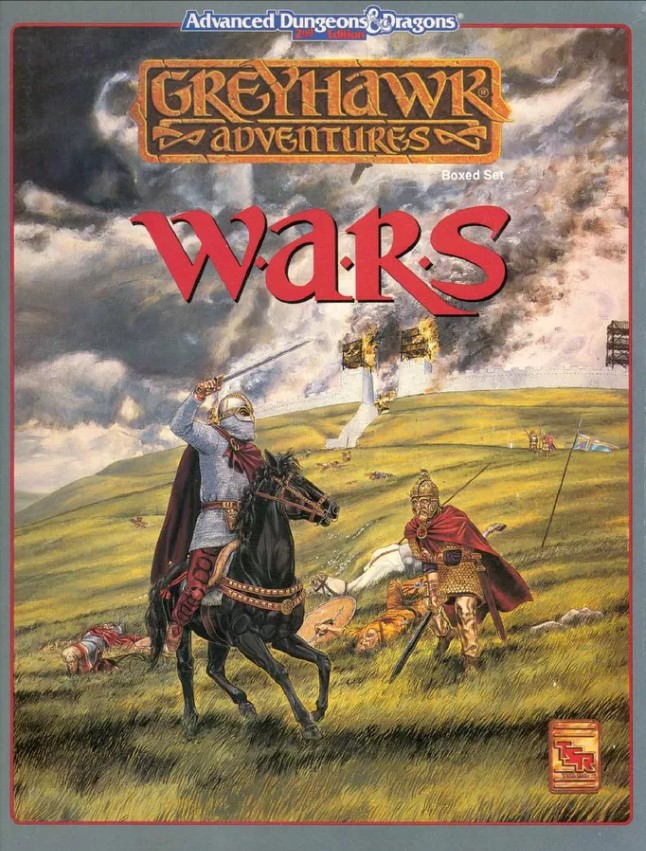
So, when TSR released a board wargame set in Gary Gygax's World of Greyhawk setting in 1991, I took immediate notice of it. This was my chance to get in some much needed wargaming experience. Alas, things didn't quite go as planned on this score, but I'll get to that soon enough. For the moment, let's focus on the matter of the game's title. According to the box cover, one could be forgiven for thinking it's called Greyhawk Adventures: Wars. However, the text of the rulebook repeatedly calls it simply Greyhawk Wars, which is how I've always referred to it, though some online spaces (like BoardGameGeek) favors the longer, more ponderous title.

In addition to the possible confusion over the title, it's also worth noting that, despite being a wargame, Greyhawk Wars was released under the Advanced Dungeons & Dragons 2nd Edition banner. This is in spite of the fact that it contains no roleplaying content whatsoever, not even the thin gruel provided by Dragons of Glory, another TSR strategic-level wargame set within a D&D campaign world. Of course, TSR had long been notorious about slapping the (A)D&D logo on just about everything, in an effort to build and expand its "brand." Compared to, say, wind-up toys or sunglasses, this particular bit of brand building was pretty innocuous and indeed could be justified in that it was intended to be the lead-in to a relaunch of the World of Greyhawk setting.

Though Gygax departed TSR for good by 1986, the company retained control of Greyhawk. Throughout the late 1980s, there were a handful of Greyhawk products released, most notably Greyhawk Adventures, but none of them, in my opinion, did a good job of carrying on the flavor and tone set by Gygax's original. If anything, they blandified the setting, reducing it to the worst kind of vanilla fantasy. Unsurprisingly, the setting's popularity – and, therefore, sales – declined, especially when compared to TSR's other two AD&D settings: Krynn and the Forgotten Realms

TSR probably recognized this fact, which is why, starting in the early '90s, the company attempted to better differentiate the World of Greyhawk in the hopes that it'd be more appealing to AD&D players. The first step in doing so was Greyhawk Wars. The wargame, designed by David "Zeb" Cook, concerns a massive war that engulfs the peoples and kingdoms of the Flanaess, one whose results upend the status quo presented in previous World of Greyhawk products. Whatever my personal feelings about the end result, it's hard not to admire the boldness of this approach. For years beforehand, Gary Gygax, in periodic Greyhawk updates published in Dragon, had been hinting at the possibility of such a large-scale "world war," but he never pulled the trigger on the idea, probably because he intended Oerth to be an open-ended "steady state" setting each Dungeon Master could customize according to his own desires.

Greyhawk Wars takes a very different approach. Instead of leaving the World of Greyhawk perpetually teetering on the edge of grand events, Cook opts to topple the whole structure, throwing long established peoples, places, and situations into chaos. At the end of the battles depicted in the wargame, a new order is established across the Flanaess, one where the forces of Good are battered, beaten, and on the defensive, while Evil, as represented by the Empire of Iuz, the Scarlet Brotherhood, and the successor states of the Great Kingdom is on the rise. The result is something that's definitely different from the original World of Greyhawk. Whether it's better is another matter.

As tabletop wargames go, Greyhawk Wars occupies a middle ground between being simple enough a newcomer can easily pick it up and so complex that only a hardened veteran of Third Reich could ever play it. The game rules are relatively short – only 8 pages – and straightforward. While there are lots of counters (representing military units), there are no hexes. Instead, the map of the Flanaess into movement "areas" of varying size, based to some extent on terrain. Also included in the game are a number of cards, some of which represent random events and treasures that can be used to augment the abilities of military units. Named NPCs (called "Heroes") play a role in the game, too, which lends it a slight roleplaying flair, though, for the most part, this is still very much a standard wargame. 

Greyhawk Wars is intended for 2 to 6 players, depending on the scenario, each with its own victory conditions. These conditions, though, are solely for gaming purposes and have no bearing on the canonical versions of these events, much in the way that a Confederate player in a wargame about the American Civil War can emerge victorious, contrary to history. The 32-page Adventurer's Book lays out the "true" conclusion of the Greyhawk Wars, the one I described above, with Evil ascendant and Good on the defensive. This is in contrast to the earlier Red Arrow, Black Shield module, which, while assuming a particular outcome for its world war, nevertheless considers the possibility of other outcomes and how they might affect ongoing campaigns. Greyhawk Wars allows for no such possibility and all subsequent Greyhawk products would follow the canonical version of history detailed in the Adventurer's Book.

As I alluded to at the start of this post, my own experiences with Greyhawk Wars weren't great. That's not a fault of the game, which is fine, if unexceptional. Rather, I had difficulty in finding others interested in taking the time to play any of its scenarios. Between setting up and playing, most took 3 hours or more – a short time compared to many wargames, I know – and that limited my pool of potential players. As a result, I don't think I ever played Greyhawk Wars more than a half-dozen times and rarely to conclusion. My perpetual quest for more wargaming knowledge and experience was thwarted once again.

All that said, I can't help but find Greyhawk Wars a fascinating window into the last decade of TSR's existence. The mere fact that the company published something approximating a classic hex-and-chit wargame set in Greyhawk is remarkable in its own right. That it was also the first part of a larger plan to reboot Gary Gygax's campaign setting into something they hoped would be more attractive to fantasy roleplayers in the 1990s is just as remarkable. I can't speak much about the success of the former, since, as I said, I didn't get the chance to play it much. As to the latter, that's the subject of next week's Retrospective post, so stay tuned.

Monday, November 20, 2023

Monsoon Season

Tom Wham is underappreciated in my opinion. Here's his "Gamesmanship" comic from issue #81 (September/October 1977) of Campaign magazine.

Saturday, February 25, 2023

Battleground

Though I am fairly certain I'd seen this before – indeed I had to check the archive of this blog to be sure I'd not posted on it long ago – a close friend of mine recently pointed me toward this series of videos that present episodes from the 1978 UK television program, Battleground. Each episode focuses on a different battle, such as the Battle of Edgehill from the English Civil War, the Battle of Waterloo from the Napoleonic Wars, or the Battle of Gettysburg from the US Civil War, and then shows a tabletop miniatures version of that battle as played out by two opponents.

The episodes are weirdly engrossing, particularly to someone such as myself, whose direct experience of miniatures wargaming is very limited. They all include a historical overview of the battle in question by the show's presenter, Ed Woodward, followed by the wargame proper. Though the quality of the posted videos is not high, you can nevertheless appreciate how much work went into the terrain and the miniatures used in them. Frankly, watching videos like this makes me wish I had the time, space, and money to devote myself to the hobby, because it looks like a lot of fun.

Anyway, take a look at Woodward's introduction to the series. It's short, very charming, and gives a good sense of the general tenor of the entire series. If you like it, you can then watch whole episodes, using the link above.

Wednesday, November 23, 2022

Diplomacy in the News

It's relatively rare to see a news story in the mainstream media that touches upon one of my interests. Consequently, I was surprised this morning to read about the claim that an "AI agent" named Cicero had "achiev[ed] human-level performance in the strategic board game Diplomacy."  Needless to say, this story caught my attention, as I was once a very avid player of Diplomacy and still retain a great fondness for it, though I haven't actually played it in many years. 

I'm naturally skeptical of these kinds of claims. I likewise lack the specific technical knowledge necessary to evaluate their veracity. Nevertheless, this is quite fascinating to me, since, if correct, it would represent a significant step in the evolution of computing. Mind you, much like chess, the degree to which being good at Diplomacy has any correlation to intelligence is separate question. In high school, my friends and I liked to flatter ourselves because we enjoyed playing "cerebral" games like this. I wonder if this story might be something similar, with the bravado of AI researchers standing in for that of fifteen year-old boys. 

Monday, November 1, 2021

"We're Doing Something Wrong."

I recently acquired One-Hour Skirmish Wargames by John Lambshead on the recommendation of a friend. It's a very interesting book from a number of perspectives and I might later do a full review of it. For the moment, though, I want only to draw your attention to a couple of paragraphs from the general introduction of the book, because I think they have a certain applicability to RPG design. 

There is a school of thought that persists to this day that because skirmish wargaming involves few models that each model must have concomitantly special rules. Often the player has been required to micromanage actions. For example a gunman model might not just shoot, but (i) locate the target, (ii) draw his pistol, (iii) cock his pistol, (iv) aim his pistol, (v) pull the trigger. The player might even be called upon to write out orders in advance detailing all these actions. This approach has meant that skirmish games have had a tendency to become complicated models of real life.

I well recall playing a game of Cold War fighter combat (air games are often a sub-branch of skirmish games) in the early 80s where a single pass by two Tornados at an element of MIG 25s that might have taken ten to thirty seconds of real time actually required all afternoon to play. If game-time is longer than real-time then we're doing something wrong. (Italics mine)

Tuesday, August 10, 2021

White Dwarf: Issue #4

Issue #4 of White Dwarf (December 1977/January 1978) features a cover by the incomparable John Blanche, who would later go on to become of the signature artists of Warhammer, in both its miniatures battles and RPG versions. Its opening editorial, by Ian Livingstone, bemoans the state of the British gaming industry, pointing out that, as of the time of publication, there was only one UK wargames company and none devoted to RPGs. I find this interesting, in light of the fact that Games Workshop would eventually become one of the juggernauts of the hobby and, while it no longer publishes its own RPGs, GW nevertheless remains a force to be reckoned with even in the 21st century.

"Alice in Dungeonland" by Don Turnbull is truly fascinating article in which the author describes eleven "features" of the "Alice level" of "the Greenlands Dungeon," which I can only assume was the "tent pole dungeon" of his home campaign. Equally fascinating is that, unlike Gary Gygax's Dungeonland, which directly translates people and places from Lewis Carroll's famous book into AD&D, the features of the "Alice level" are (mostly) inspired by things described in the Alice stories rather than directly imported. 

Lewis Pulsipher continues his series on "D&D Campaigns," this time discussing "some practical aspects of constructing dungeons and setting up a campaign." He notes that, more so than other articles in this series, it's intended for neophytes and "may not be of much use to veteran referees." Pulsipher is indeed correct in this assessment, as his advice, while completely sound, includes the sorts of things that most of us have reader dozens of times in many places. In fairness, some of this advice might have been genuinely new in 1977 (and, of course, it's always new to those who've never before served as a referee). 

The article entitled "Hyboria" is written by Tony Bath and provides an overview of his famed Hyboria miniatures wargames campaign. Though short, it's a terrific article for anyone interested in the process that led Bath to create his campaign setting. In some ways, it's better than Pulsipher's preceding article, even though it's far less detailed. I was also struck by his conclusions.

What are the lessons of Hyboria? Well, firstly, what you get out of a game is in relation to the amount of effort you put into it. Secondly, a well constructed fantasy soon takes on its own life, and from that point needs only minimal guidance. Finally, if you want to test the limits of your imagination and still keep the whole thing within a logical framework, there is no better medium than creating a fantasy world. Besides, it's fun!

I doubt anyone could disagree with anything he says here.

"Open Box" reviews Nomad Gods by Chaosium, Star Empires and Dungeon! by TSR, and Melee from Metagaming. Of the four games reviewed, Melee – the first part of The Fantasy Trip – is the one that receives the harshest criticism, mostly on the grounds that "there are no really original ideas in this game." The reviewer, Martin Easterbrook, seems to have felt that "anyone who has already adapted rules" would have no need of Melee, which is probably a fair point. It's a reminder, I suppose, that, in 1977, kit bashing of one degree or another was widely assumed; playing a game straight out of the box with no modifications was perhaps unusual, let alone the expectation that would could do so, hence reviews like this.

Don Turnbull returns with "Monsters Mild and Malign," where he talks about the process of creating new and unusual monsters with which to challenge players. He offers three of his own, in addition to citing examples he likes from other sources. More interesting to me was his principle of MERIT – "make empty rooms interesting too." According to this principle, the referee should set up

an array of magical effects, interesting traps, intriguing though valueless pieces of furniture, curious artifacts, new magical items or whatever strikes your fancy and which will present something of a challenge to intruders.

The question of empty rooms and the "best" way to present them remains a much debated matter. I confess that I continue to struggle with it myself, having come to no firm conclusions about it. It's a topic that's been on mind lately as I dive into the design of the main Vaults beneath the city of Inba-Iro in my upcoming sha-Arthan setting. I'll likely have more to say on this matter once I've begun play.

Brian Asbury presents a Barbarian character class that bears many similarities to the one that Gary Gygax would one day include in Unearthed Arcana, as well as many differences. This version of the barbarian is much less physically robust, having only six-sided hit dice (though it does appear to have been written for OD&D rather than AD&D), but, in exchange, it gets a variety of wilderness-related abilities, as well as fearlessness, ferocity, and the ability to catch missiles. I'm not sure I'd ever use the class myself, but I can't deny that it has a distinct flavor that differentiates it from fighting men or rangers. Meanwhile, Andy Holt's "The Loremaster of Avallon" presents an absurdly complex system for dealing with parried and unparried blows that I simply glossed over. I appreciate the value of detail in many areas, but combat is not one that matters much time, hence my preference for keeping it simple. Consequently, articles like this do nothing for me.

"Competitive D&D" by Fred Hemmings continues with the details of several more rooms from his competition dungeon, this time from its fifth level. Several of them are cleverly done and I was glad Hemmings shared them. However, I feel as if they'd have made more sense if they'd been given more overall context, even if it had made the article longer. Still, I remain fascinated by the kinds of dungeons referees designed in the early days of the hobby; articles like this give me a little more insight into the matter.

All in all, issue #4 was a good read. I particularly enjoyed the content that was clearly derived from play and spoke to the though referees put into the design of their dungeons and campaign settings. I hope that we'll continue to see this sort of thing in future issues, perhaps in lengthier and more detailed forms.

Wednesday, July 28, 2021

Retrospective: Dragons of Glory

My overall opinion of Dragonlance is, I think, well known and, in the thirteen (!) years since I first publicly expressed it, I haven't much mellowed. I remain convinced that, while Dragonlance may well have "saved" Dungeons & Dragons in some sense, the hobby is still paying the price of that salvation nearly four decades later. This does not mean, however, that the entire Dragonlance project was wholly devoid of worth. Indeed, in the course of changing the course of D&D and, by extension, the entire hobby, a number of genuinely interesting things were produced.

A case in point is 1985's Dragons of Glory, written by Douglas Niles and Tracy Hickman (though I suspect that it was Niles who was responsible for the bulk of the product). Ostensibly the eleventh module in the original Dragonlance series, Dragons of Glory is, in fact, not an adventure scenario at all but rather a stand-alone wargame set in the world of Krynn, complete with rules, maps, and hundreds of cardboard counters.

I dutifully purchased module DL11 upon its release, as I had all the previous modules in the series. As I've explained before, I was never a fan of Krynn as a setting or even of the specifics of Dragonlance – particularly its pre-generated characters – but I was quite taken with the idea of a lengthy series of connected scenarios that chronicled a war against a high fantasy Dark Lord. Thus, I cannibalized the DL modules to use in a campaign setting of my own devising (about which the less said the better) and rarely regretted that decision. Dragons of Glory was one such occasion. 

You see, the module presented a strategic-level simulation of the War of the Lance, with rules for movement, combat, and reinforcements, among other such details. The rules are simple, probably laughably so for anyone with much experience in the hobby of hex-and-chit wargaming. Not having such experience myself, I wasn't at all bothered by this. In fact, I considered it something of a plus, since, as a neophyte, I wasn't in a position to handle a more sophisticated wargame. 

Dragons of Glory was supposed to serve two purposes. As already mentioned, it was intended as a stand-alone wargame that could be played again and again, much in the way one might play Third Reich or Kingmaker. More interesting is the second purpose of the game: integrating the wargame with the module series. The idea here is that the referee (and another player) could take note of their play of the wargame and then use it to influence the play of the module-based campaign. For example, if a battle takes place in the wargame in a particular place, when the player characters make their way through that same place, the referee could use that fact to affect what those characters see and encounter there. Now, to be clear, there are no actual rules to govern this. Even the guidelines offered amount to little more than vague advice, but I cannot tell you how much the idea of using the results of a wargame to affect the play of a RPG inspired me at the time.

There's another unspoken angle here, namely that Dragons of Glory points the way – tentatively, to be sure – toward "alternate universe" versions of Krynn, where things don't necessarily play out exactly the way the adventure modules intend them to. That's always been one of my biggest beefs with the whole Dragonlance project: its expectation that certain events would happen in certain ways and that certain characters would be involved in them. I hated this approach then and I hate it even more now. If the project had been more flexible in allowing events to unfold differently in each campaign, I might have fewer objections. As it is, Dragonlance is a vast railroad with a pre-determined beginning, middle, and end. 

Dragons of Glory hints at the possibility of other approaches and that's probably why I still retain a certain fondness for it, despite its design shortcomings. DL11 is probably the first and only time that a module in this series toys with the idea of the War of the Lance having different trajectories than those presented in official TSR products, trajectories unique to each campaign. Again, I feel I should reiterate that Dragons of Glory itself does little to support this idea and I am likely being more charitable toward it than it deserves. Even so, I was so positively impacted by what little it does offer that I felt it deserved a second look. 

Tuesday, July 27, 2021

White Dwarf: Issue #2

Issue #2 of White Dwarf (August/September 1977) opens with an editorial by Ian Livingstone in which he addresses the disdain that tabletop wargamers supposedly held for roleplayers at the time. I know, from reading contemporary reports, that there was in fact some friction between the participants in these two related hobbies. I also know that almost all of the early adopters of RPGs were wargamers. Further, my own personal experience – for whatever it's worth – is that there was considerable overlap between the two hobbies. I can't recall ever seeing any evidence of antagonism, though we should bear in mind I didn't start roleplaying for more than two years after this editorial was penned. 

The first article proper is "Competitive D&D" by Fred Hemmings, a follow-up to the identically titled article in the previous issue. Hemmings provides extensive details of his scoring system for a dungeon he ran at event called "D&D Day," as well as an overview of the "pre-thrown" (i.e. pre-generated) characters used in the scenario. Speaking for myself, I didn't find the scoring system or his discussion of its rationale as compelling as I did the snippets of information he reveals about the dungeon itself, which included such elements as Pandora's Box, Mars, Hercules, Thor, and Monty Python, among others. Would that the article had simply been a write-up of the dungeon itself!

Ian Livingstone reviews "Asgard Miniatures," which he seems to have liked overall. I don't believe I ever own any figures from this line, but I recall their regular advertisements in gaming magazines well into the early 1980s. Lewis Pulsipher, meanwhile, reviews "The Green Planet Trilogy of Game," a series of science fantasy wargames published by Fact and Fantasy Games. I've never heard of any of these three games – Mind War, War of the Sky Galleons, Warriors of the Green Planet – and, from what Pulsipher says, it doesn't sound like I'm missing much (though he himself judges two of the three as "workmanlike" and having "appeal to certain gamers." More fascinating, I think, is his introduction where he bemoans the fact that game reviewers tend to be "faceless" and reveal little of their own "preferences and pet prejudices." To counter this, he lays his own cards on the table, such as his love of "realism" and his detestation of luck "as it allows inferior players to defeat a more skilled one." 

"Before the Flood" by Hartley Patterson is a brief reminiscence of a fantasy wargame (and setting) called Midgard that was played and developed in the pages of a fanzine of the same name. Patterson notes that Midgard predated Dungeons & Dragons but that it nevertheless seems to have anticipated many features of D&D. I love articles of this sort, since it's a useful reminder that there was "something in the air" in the early 1970s that would likely have given birth to RPGs at some point, even if Gygax and Arneson had not done so. 

"Open Box" is the issue's review feature, consisting of four different reviews. The first is for Steve Jackson's Ogre, while the second is TSR's Lankhmar boardgame. Both receive good reviews, though Ogre is better regarded. The third review is very negative and tackles War of the Star Slayers, a science fiction wargame of which I've never heard (a recurring theme in today's post). The final review is by Lewis Pulsipher and deals with Tunnels & Trolls. As one might expect, Pulsipher does not wholeheartedly like T&T, though he (mostly) takes pains to explain why he dislikes aspects of its design. More intriguing, though, is this section of his review, which I reproduce without comment:

The second part of Don Turnbull's "Monstermark System" appears in this issue and, like the first part, I have to say, perhaps to my shame, that I simply didn't see much point in all the ink spilt to measure the relative power of various D&D monsters. I know many referees, then and now, find this kind of thing useful and, if so, more power to them. I'm simply not one of them and thus my eyes glazed over as Turnbull presented his mathematical formulae. 

Much more fun was the "Open Chest" feature, which included submissions by readers. By and large, this consisted of magic items and monsters (like the dune stalker, which would later appear in the Fiend Folio). Also included was a humorous character class, the scientist, and its chaotic counterpart, the anti-scientist, whose level titles are quite amusing.
I can't make up my mind as to whether I find Administrator or Vondaniken funnier. Rounding out the issue is Andy Holt's "The Loremaster of Avallon," which follows his previous "What's Wrong with D&D?" In the article, Holt presents changes to D&D that he uses in his own campaign, focusing more on the magic system than other aspects of its rules. His changes are interesting and involve the use of 38 magical symbols to evoke effects. 

Overall, I'd say that this issue of White Dwarf shows much promise and suggests that it will quite quickly turn into something I will enjoy reading. It's very D&D-centric, of course, but that's to be expected (and is not unwelcome to me at any rate). There is already evidence of many of the traits I'd later come to associate not just with White Dwarf but with Games Workshop more generally, particularly its humor. I look forward to seeing them come even more to fore.

Monday, May 3, 2021

Fantasy Not a Threat


Behold the glory of the late 1970s! This is the cover of the March 1978 of the UK magazine, Battle for Wargamers, which is simply delightful. If you poke around online, you can find many more equally astounding covers from the same period. I picked this one, because the issue includes a letter to the editor written by Steve Jackson of Games Workshop fame.

Jackson, it should be noted, had written an article in the December 1977 issue, entitled "An Introduction to Fantasy Wargames." While I've not (yet) seen the article myself, it's my understanding that it's a very good overview of the topic, one that situates fantasy wargaming firmly within the wider wargaming tradition, paying particular attention to the innovations of Tony Bath. Nevertheless, as his letter above indicates, there was some resistance and even hostility to the inclusion of fantasy games in the pages of magazines like Battle for Wargamers.

That fantasy wargaming was initially poorly received in some quarters of the wider wargames hobby is well known and, frankly, not at all surprising. What's interesting to me is that Jackson makes an argument that echoes those made often today:
Before condemning Fantasy wargames out-of-hand, traditionalists ought to ask themselves whether they would like to see large, thriving wargames clubs taking in members from History, Fantasy and Board wargaming players, or would they prefer small struggling clubs concerning themselves with just one aspect of the hobby?

Of course, there's some truth to what Jackson says here. At the same time, are there are any large, thriving wargames clubs today? Did broadening the range of games result in "large, thriving wargames clubs," as he predicted? The answer depends, I imagine, on how one defines "wargames clubs," as well as whether the incontrovertible decline in the popularity of wargaming as a hobby has anything to do with the introduction of fantasy games into its ranks. It's a complex issue and I lack the historical knowledge necessary to offer any conclusions. 

I can only say that, while I am sympathetic to Jackson's perspective, being the intellectual descendant of those early fantasy wargamers, I don't think the situation is quite as clear-cut as he makes it out to be. Change may be "the way of the world these days," but change almost always brings with it destruction. I can't fault anyone who, in 1978, foresaw that the hobby as they knew and loved it, was in danger of changing beyond recognition and resisted that change. I feel much the same about the hobby of roleplaying, whose contemporary form and trajectory are at times utterly alien to me. Fortunately, technology has made it much, much easier today to find others who share my interests and perspective when it comes to the hobby. I can wholly absent myself from whatever the big publishers are doing and not lack for games to play or people to play them with. But, in 1978, that was probably harder, which is why I find myself at least a little bit sympathetic toward "the die-hard traditionalists" whom Jackson decries.

DCS Does Tolkien

Most aficionados of Dungeons & Dragons are, I suspect, familiar with the story of how OD&D originally included explicit references to monsters and beings from J.R.R. Tolkien's Middle-earth, such as hobbits, balrogs, and ents, among others. They also probably familiar with the fact that legal action was threatened against TSR by "the Tolkien estate" – actually the Saul Zaentz Company – because the inclusion of these creations were entirely unauthorized. What they might not know is that it wasn't Dungeons & Dragons that brought TSR to the attention to the Saul Zaentz Company but rather the 1976 wargame, Battle of the Five Armies.

I have no direct experience with Battle of the Five Armies. I wasn't a wargamer (take a drink) at the time and, in any event, the game was no longer available for sale by late 1979 when I first entered the hobby. I'm sorry I never saw it, as it features a number of pieces by David C. Sutherland III, such as this color box cover illustration, depicting Men, Dwarves, and Elves facing off goblins and wolves.

The cover to the rulebook also features another depiction of a similar scene, this time in black and white.

I'm a huge fan of "lost" artwork like this, which is to say, pieces by established artists that are not widely known. This is particularly true of artists who worked in the early days of the hobby, like Sutherland and Trampier, both of whom contributed immensely not just to the look of D&D but, due to the game's immense influence, to the wider world of fantasy. 

Wednesday, April 28, 2021

Fritz Leiber at GenCon

(L to R) Fritz Leiber, Gary Gygax, M.A.R. Barker, Ian Livingstone, Rob Kuntz
(foreground) Steve Jackson (UK)
Earlier this month, I posted an image of an article penned by author Fritz Leiber that appeared in the San Francisco Examiner on September 5, 1976. Leiber recounts his experiences as guest of honor at GenCon IX and, as one might expect, what he writes is of great interest. He begins by briefly recounting the recent history of wargaming, starting with the publication of Gettysburg by Avalon Hill in 1958. (Why he starts there rather than with Tactics in 1954, I am not sure) 

Moving on from that, he speaks of GenCon, the "oldest gathering of tabletop generals in America," which is "held at the pleasant Wisconsin resort-town near Chicago." According to Leiber, the convention's 

newest and most rapidly growing field seemed to be that of fantasy wargaming, where players enjoy the double excitement of being part of an ongoing adventure story to which they can each contribute, along with the regular perils of wargaming.
He goes on to discuss "the most popular fantasy wargame," Dungeons & Dragons, and describes it, along with its co-creator, Gary Gygax. 

I listened in on a game where Gary Gygax, TSR's head, a mustached man of youthful middle years reminiscent of Buffalo Bill, acted as "Dungeonmaster," guiding a dozen or so players in their personae as warriors, wizards, thieves, and priests, variously armed and armored, through a fantasy adventure that began in underground chambers, where monsters lurked, and then burst into a wilderness where there were rivers to ford, cliffs to climb, elephant-like creatures to avoid, and where moving trees pelted them with thorns.

The players could decide whether to flee, investigate and test, or attack, according to their individual natures. A heavily armored warrior went straight forward, swinging a battle axe. A sorceress cast a sleep spell. A roll of dice helped determine the outcome of each action.

I'm fascinated by early – remember: this is from 1976 – descriptions of roleplaying game sessions, especially when they're written by people not involved in the hobby. Leiber's description rings very true to me, but then he was both an imaginative man and someone who'd engaged in proto-RPGs for years. I'm also fascinated by the original art that frequently accompanies these articles, such as this one, which depicts the "elephant-like creatures" and "moving trees" Leiber mentions in his article. Notice, too, the dice at the bottom of the image.

Leiber also recounts a report of a session of Empire of the Petal Throne, refereed by the "mysterious Prof. M.A.R. Barker, a Minnesota scholar of Indian languages and a convert to Islam, inventor of the game, 'Legions of the Petal Throne' [sic] and creator of a fantasy language, Tsolyani, which rivals Prof. Tolkien's Elvish in complexity." The session itself sounds decidedly odd, even by the standards of Tékumel.

"We were following a road through the fog and all we could see were those shadowy black creatures with red eyes," the young man said.

"And then out of the fog these tiny black worms began to fall on us. Wherever they touched flesh, they burned like acid," the girl told me excitedly.

"And then the red-eyed creatures surrounded and killed us, and he had us carried off to the dungeons of his castle where he made a spell and resurrected us from the dead," her companion went on.

She finished happily, "Now he's got to decide whether to torture us all to death, or send us on an almost impossible quest."

Context must be everything, because I have no idea what any of this means, but the participants seemed to have enjoyed themselves nonetheless. 

Leiber ends the article by noting that TSR has just published a fantasy wargame based on his stories of Fafhrd and the Gray Mouser, which he and his friend Harry Fischer had devised "back in those primeval days when wargames were an eccentric private occupation." The new game has been updated to "modern fantasy wargaming conventions" and he is happy with the result. All in all, it's a terrific little reminiscence about GenCon IX by someone not directly involved in the hobby but with a better than average understanding of the concept and potential of roleplaying games. Thanks again to Thaddeus Moore for passing this article along to me, along with so many others about which I've written this month.