An advertisement for Mattel's Dungeons & Dragons Electronic Labyrinth Game from issue #51 of Dragon (July 1981).


An advertisement for Mattel's Dungeons & Dragons Electronic Labyrinth Game from issue #51 of Dragon (July 1981).
 Nowadays, Clark Ashton Smith is known primarily for the stories written as part of his various literary cycles, such as those of Hyperborea, Averoigne, and Zothique. That's quite understandable, given the general excellence of those series (Zothique being a particular favorite of mine), but it's important to remember that he also wrote a great many more stand-alone pulp stories that are every bit as good. If one were to judge quality solely on the basis of popularity, then one of Smith's best yarns is "The Seed from the Sepulcher," which has been included in more anthologies than anything else he ever wrote (more even than "The Return of the Sorcerer" or "The City of the Singing Flame," two other stories often judged to be among his greatest efforts).
Originally appearing in the October 1933 issue of Weird Tales (which also featured a Conan story by Robert E. Howard), "The Seed from the Sepulcher" tells the story of "James Falmer and Roderick Thone, professional orchid-hunters," who along with their two native guides, "had been following an obscure tributary of the upper Orinoco" in Venezuela.
The country was rich in rare flowers; and, beyond its flower wealth, they had been drawn by vague but persistent rumors among the local tribes concerning the existence of a ruined city somewhere on this tributary: a city that contained a burial-pit in which vast treasures of gold, silver and jewels had been interred together with the dead of some nameless people. These rumors were never first hand, but the two men had thought it worthwhile to investigate them.
Shortly before the start of the story, Thone had fallen sick and Falmer, curious about the supposed ruins, had gone ahead in a canoe with one of the guides, leaving the other to tend to his comrade. Falmer returned three days later, having found the ruins. He described them as "a queer sort of place, pretty much as the legends describe … Just a few crumbling walls overgrown and half-displaced by the forest trees, and a few falling pillars netted with lianas." As for the rumored treasure, there was none and disappointment had left Falmer taciturn and morose, which struck Thone as quite unlike his friend's usual demeanor.
Falmer, even during extreme hardship or jungle illness, had been heretofore unquenchably loquacious and cheerful. Now, he seemed sullen, uncommunicative, as if his mind was preoccupied with far-off things of disagreeable import. His bluff face had grown hollow – even pointed – and his eyes had narrowed to secretive slits.
Stricken with fever, Thone is in no mood to argue with Falmer when he states that he wishes nothing more than to head back to the Orinoco and home. "I've had all I want of this trip," he adds.
As Thone grew healthier, Falmer in turn seemed to sicken, much to his concern and that of the two guides, who watched him, "as if with some obscure expectancy." Falmer's sleep becomes turbulent and, with each passing day, he became stiffer and more sluggish. Yet, "there was no fever and the symptoms were wholly obscure and ambiguous." Later, Falmer "shook his head at intervals with a sort of shuddering motion that was plainly automatic and involuntary … After a while he began to moan quickly, as if in pain or delirium."
They went on in this manner for several hours; the heat grew more oppressive between the stifling, airless walls of the jungle. Thone became aware of a shriller cadence in the moans of his sick companion. Looking back, he saw that Falmer had removed his sun-helmet, seemingly oblivious of the murderous heat, and was clawing at the crown of his head with frantic fingers. Convulsions shook his entire body, and the dugout began to rock dangerously as he tossed to and fro in a long paroxysm of manifest agony. His voice mounted with a ceaseless high, unhuman shrieking.
Thinking quickly, Thone orders the boat ashore so that he can come to the aid of his afflicted comrade. Though he had no idea what afflicted him, he gives Falmer a dose of morphine. which eases his suffering and ends the convulsions, at least for the moment. He then takes the opportunity to examine Falmer's head.
He was startled to find amid the thick disheveled hair a hard and pointed lump which resembled the tip of a beginning horn, rising under the still unbroken skin. As if endowed with erectile and resistless life, it seemed to grow beneath his fingers.
Needless to say, Thone is horrified by this revelation but has little time to contemplate its implications. The morphine had sufficiently dulled Falmer's pain that he became "more his normal self than at any time since he return from the ruins" and began to talk, "as if he were anxious to relieve his mind of some oppressing burden."
"The pit! The pit!" said Falmer. "The infernal thing that was in the pit, in the deep sepulcher! … I wouldn't go back there for the treasure of a dozen El Dorados … I didn't tell you much about those ruins, Thone. Somehow it was hard – impossibly hard – to talk.
Falmer's newfound lucidity enables him to relate to Thone all that transpired while he explored the ruins – including the origin of his bizarre malady and it's horrific.
It's easy to see why "The Seed from the Sepulcher" is one of Clark Ashton Smith's most popular stories. The tale is chilling and plays off common fears about one's body being invaded or taken over by something. Consequently, it contains a few genuinely unsettling moments that Smith describes with obvious relish. When I re-read the story in preparation for this post, I was surprised by how uncomfortable it made me, particularly in the latter part of the story, once Thone (foolishly) had decided to return to the ruins to see for himself the source of his companion's dreadful malady. If you have a little time to spare, I highly recommend it.
How have I never seen this piece of Jack Kirby art before?

 |
| Wanted: For the Crime of Gygaxian Naturalism |
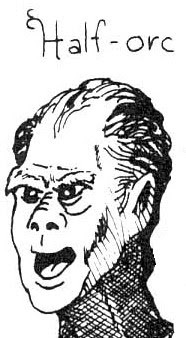
Despite Gary Gygax's repeated assertion that his conception of Dungeons & Dragons owes little to the works of J.R.R. Tolkien's The Lord of the Rings (which he nevertheless included in Appendix N), he sure did borrow a lot of individual elements from the novel! Orcs are regularly cited as the prime example of this peculiar phenomenon and rightly so, I think, because, as a distinct type of enemy, they are largely without any significant mythological precedent prior to the publication of Tolkien's tales. At the same time, orcs are, at base, little more than man-shaped monsters in service to Evil, not unlike similar creatures found in northern European folklore and in the pulp fantasy stories that proliferated in the first half of last century.
The same, however, cannot be said for the half-orc, references to which can also be found in The Lord of the Rings. The precise nature of half-orcs in Middle-earth is unclear, partly because I don't believe Tolkien ever settled the question of the nature of orcs, having changed his mind several times on the subject. What we can say for certain is that Tolkien's half-orcs – or "goblin-men," as he sometimes called them – were creatures that, while generally orcish, looked enough like Men that they move among them without attracting much comment. Half-orcs were thus useful as spies by the forces of Evil.
Half-orcs don't exist in Dungeons & Dragons prior to the publication of the AD&D Monster Manual in 1977, where there's a brief discussion of them at the end of the book's entry for "orc." There, Gygax states that
As orcs will breed with anything, there are any number of unsavory mongrels with orcish blood, particularly orc-goblins, orc-hobgoblins, and orc-humans. Orcs cannot cross-breed with elves. Half-orcs tend to favor the orcish strain heavily, so such sorts are basically orcs although they can sometimes (10%) pass themselves off as true creatures of their other stock (goblins, hobgoblins, humans, etc.).
This sounds a lot like the broos of Glorantha, does it not? In any case, the Players Handbook a year later gives us a a bit more information about them. Here, Gygax reiterates that
Orcs are fecund and create many cross-breeds, most of the offspring of such being typically orcish. However, some one-tenth of orc-human mongrels are sufficiently non-orcish to pass for human.
The remainder of the PHB's description is given over to game mechanics, with little else stated about the nature of half-orcs or the place within the implied setting of AD&D. We do learn that, with the exception of humans and halflings (!), all other playable races hate or have antipathy for half-orcs. This makes sense, given half-orcs' preference for classes like thief and assassin, marking them as having criminal and antisocial tendencies of a most unsavory sort. I have no idea why Gygax felt the need to include orc-human hybrids as a playable race in AD&D, though I suspect that, like half-elves, which first appeared in Supplement I to OD&D, he did so to appeal to the fans of The Lord of the Rings among early gamers. I think this was a profound mistake, one that has haunted D&D ever since.
I say this because orcs are monsters. According to the Monster Manual, they "are cruel and hate living things in general." Likewise, "they take slaves for work, food, and entertainment (torture, etc.)." They're not people in the same sense that, say, humans, dwarves, or elves are – or at least that's how I think they were initially conceived. Unfortunately, Gygaxian naturalism upended that particular apple cart and we discovered that orc lairs contain noncombatant females and young. No longer is an expedition into the Caves of Chaos a simple matter of defending the Realm against Evil; now it's an exercise in the mass murder of the defenseless.
The existence of playable half-orcs only complicates the matter further. It might just be possible to squint one's eyes and imagine that even baby orcs are an existential threat to the Realm of Law and Goodness and therefore fit only for extermination. Once you allow playable orc-human hybrid characters who are not required by the rules to be evil, let alone restricted from being good, you open the door to viewing orcs (and, by extension, all humanoid monsters) as people on par with the more traditional player character races. From there, you're well on the road out of the adventuresome pulp fantasy world D&D has long evoked and heading toward … something else entirely.

A FAITHLESS CLASS
You cast off your old life and took up your mighty sword in defense of the faithful. You thought yourself blessed when your masters judged you worthy to guard the Cathedral in Galgenbeck itself. But soon you saw the truth: the corruption, the decadence, the devilry that lurked within. You renounced your oaths and fled, hounded by the Two-Headed Basilisks for your vile apostasy.
Begins with 2d6 × 10s and d3 Omens.
HP: Toughness + d10
Your vows stripped you of your birth name and you cannot reclaim it. The Basilisks dubbed you:
1 |
First |
Austerity |
2 |
Second |
Justice |
3 |
Third |
Purity |
4 |
Fourth |
Rectitude |
5 |
Fifth |
Reverence |
6 |
Sixth |
Righteousness |
7 |
Seventh |
Sanctity |
8 |
Eighth |
Temperance |
9 |
Ninth |
Truth |
10 |
Tenth |
Zeal |
Widespread consulting of blasphemous texts.
Sacrifice of children to Vehru to secure the gift of prophecy.
Torture of innocents for amusement.
Simony: the sale of ecclesiastical offices for riches.
Sexual depravity among the ecclesiarchs.
Daemonic whispers echoing in the halls of the Cathedral.
Murder of a priest to advance the position of another.
Necromantic rituals practiced on the high altar of the Cathedral.
Steadfast, roll 3d6+2 for Toughness. Stolid, roll 3d6–2 for Presence. Roll d4 on the Armor table. Roll d6 to determine which of the following unique Zweihänders you wielded in service to the Two-Headed Basilisks:
Fulgent The blade glows in the presence of undead within 30 feet, but they attack you above all other targets.
Infrangible The blade is unbreakable by any means, even a fumble.
Minatory The blade is frightfully curved, granting +1 to morale rolls against enemies.
Piercing The blade deals +1 damage against tier 0 and tier 1 armor.
Tenacious If broken while wielding the blade, re-roll result of dead; second result of dead is needed to slay you.
Warding While wielding the blade, your defense DR is 11.
 The other day I was looking into a roleplaying game to which I'd recently seen references and was surprised to discover that, despite its having been published in 2022 and not being a fantasy game, it nevertheless made use of character classes. Of course, character classes, like hit points and experience points, to cite just two examples, are well-established elements of RPG design, owing to their having appeared in Dungeons & Dragons at the dawn of the hobby. That even a game published almost a half-century after OD&D makes use of them thus shouldn't be the least bit shocking.
The reason that I was surprised is that, for as long as I've been involved in the hobby, there have been loud complaints about character classes and their supposed deficiencies. One of the commoner complaints is that classes are too "restrictive" in some fashion. Others argue that the classes are "arbitrary" or even "unrealistic" in the way they categorize the skills and abilities of different adventuring professions/vocations. Still others say that classes are "simplistic," a relic of an earlier phase of game design before more "sophisticated" approaches had been imagined. Like training wheels on a bicycle, the hobby should abandon character classes now that it finally understands how to build a better game.
Seeing a new RPG make use of characters would seem to run counter to these long-stated complaints, not all of which are without some merit. Indeed, I have at various times been sympathetic to many of them, particularly those that focus on the limiting nature of character classes. Why shouldn't a fighter be able to learn how to pick locks or climb walls? Why shouldn't a magic-user be able to pick up a sword and fight? This is the line of thought advanced by Chaosium in its early advertisements for RuneQuest, which decried character classes as "artificial" and, on that basis, ought to be rejected in favor of "a realistic set of fantasy rules based on experience and reality rather than an arbitrarily developed abstract mathematical system."


Nevertheless, the first hints of an "official" setting for Traveller started to appear about a year after the game's publication. Book 4: Mercenary mentions "the Imperium" for the first time, though designer Frank Chadwick's introduction suggests that he intended this name simply to be a convenient placeholder for "a remote centralized government … possessed of great industrial and technological might, but unable, due to the sheer distances and travel times involved, to exert total control everywhere within its star-spanning realm."
Fans of the game were quick to pick up on this reference and it wasn't long before GDW presented a pre-generated sector of space for use by the referee who didn't wish to roll up his own, along with some details on the Imperium (now dubbed "the Third Imperium") of which it was a part. The Spinward Marches and the Third Imperium both proved very popular with Traveller fans and soon became inextricably linked with the game, even though Traveller was still perfectly usable as the basis for a SF setting of one's own creation. By the time I started playing the game in 1982, by which point GDW had already published a second pre-generated sector, I encountered almost no one who played Traveller in any setting other than that of the Third Imperium.
Though The Spinward Marches and other GDW products began to fill in the details of the Third Imperium and its interstellar neighbors, these details were initially quite sketchy and open to interpretation. During the period between 1979 and 1982 (or thereabouts), several third parties, like Judges Guild, were licensed by GDW to produce their own pre-generated sectors to fill in the larger map of "Charted Space" that the Third Imperium occupied. Many of these non-GDW sectors were quite idiosyncratic in their contents and would later be partially or wholly excised from the Traveller canon, as it solidified into something more definite.
One of the better examples of these third-party sectors was Beyond, written by Donald P. Rapp and published by Paranoia Press in 1981. Located "beyond the Great Rift, beyond the Imperium and beyond the law," the titular sector is a wild place, consisting of nearly 500 worlds inhabited by a mix of humans, Droyne, Aslan, and several unique alien species. It's also home to a number of interstellar governments that are independent of the Imperium and the other great empires of Charted Space. Consequently, Beyond is presented as a region of space that's perfect for adventurers who wish to avoid any "imperial entanglements," to borrow a phrase.
Beyond mimics the format and presentation of The Spinward Marches, being a 32-page digest-sized booklet, with each of Beyond's sixteen subsectors having a single page for its listing of world data. There are also six pages at the back of the book dedicated to "library data," Traveller's term for background information presented in a series of brief, faux encyclopedia-style entries. It's in the latter that we learn about the Church of Resurgent Anthropomorphic Philosophy, Starbase Arcturus II, the Zydarian Codominium, and more. The library data also describes Beyond's unique alien races, such as the arachnid-like Sred*Ni and the flying Mal'Gnar.
As you can see, Beyond is filled with a plethora of hyphens, apostrophes, and asterisks, not to mention lengthy names with convenient – or "humorous," as in the case of the aforementioned Church – acronyms. Taken together, this gives the sector a very different feel than the more sober, even stolid, approach GDW took with its own pre-generated sectors. That's not necessarily a bad thing and it certainly gives Beyond a distinct flavor that sets it apart – a flavor that might not be to everyone's taste. I know that, when I was a younger man, I didn't think much of Beyond (or its companion from Paranoia Press, Vanguard Reaches), precisely because it was less "serious" than GDW's own efforts. Nowadays, I'm a great deal more tolerant of Beyond's oddities, perhaps because I better appreciate the need for different styles and approaches within established settings, such as Traveller's Charted Space.
Mostly, though, Beyond is a relic from an earlier time in the history of Traveller, before the game had evolved to the point where one needed to know a large amount of background information scattered over multiple books to be able to understand its setting. Fond though I remain of the Third Imperium and its richly detailed history, I recognize that it can be very off-putting to newcomers, who simply want to engage in "science fiction adventures in the far future," to quote Traveller's longstanding tagline. Supplements like Beyond facilitate that pretty well and we could probably use more like it.

Garth Nix's "A Few Small Formalities …" kicks off the issue proper, with a humorous discussion of the use and abuse of bureaucratic red tape in Traveller. Accompanying the article are four sample forms the referee can inflict on players when their characters must interact with meddlesome local planetary rules and regulations. I've always enjoyed articles of this kind, but then I'm also fond of scenarios like the infamous "Exit Visa" from The Traveller Book, too, so perhaps I'm a poor judge of such things.
"Open Box" reviews a large number of interesting RPG products in this issue, starting with Steve Jackson's Sorcery!, which receives a rating of 7 out of 10. There are also reviews of several Middle-earth Role Playing supplements: A Campaign and Adventure Guidebook (6 out of 10), Angmar – Land of the Witch King (7 out of 10), The Court of Ardor (7 out of 10), Umbar – Haven of the Corsairs (7 out of 10), Northern Mirkwood – The Wood Elves' Realm (8 out of 10), and Southern Mirkwood – Haunt of the Necromancer (8 out of 10). Reading these reviews fills me with a great deal of nostalgia for the days of Iron Crown Enterprise's series of Middle-earth sourcebooks, only a few of which I ever actually owned. The issue's last review is Tarsus for Traveller, which receives a much deserved 9 out of 10 rating.
Dave Langford's "Critical Mass" is fascinating to me in that it regularly reviews books I never heard of, let alone read. This installment of the column is no different. The only book Langford discusses with which I am directly familiar is Helliconia Summer by Brian Aldiss, of which he thinks very highly (I was less impressed; my favorite of his novels has always been Non-Stop). Meanwhile, "White Dwarf Personalities" by Phil Masters and Steve Gilham is a fun little piece in which people and characters associated with the magazine, such as Ian Livingstone, Thrud the Barbarian, and the eponymous White Dwarf are given RPG stats for either AD&D or RuneQuest (sometimes both).
Speaking of Thrud, we get new episodes of his comic, along with Gobbledigook, and The Travellers. "Divinations and the Divine" by Jim Bambra is a workmanlike article on clerics in AD&D, focusing on the role of the class both in play and within the fictional "society" of a campaign. It's fine for what it is and clearly geared toward newcomers, but it's vastly better than many of the beginner's articles that White Dwarf ran in its early issues. "The Watchers of Walberswick" by Jon Sutherland is a short introductory scenario for use with Call of Cthulhu, dealing with the Deep Ones along the Suffolk coast of England. It's a solid, straightforward piece of work that could easily serve as the start of a new UK-based campaign.
"RuneQuest Hardware" by Dean Aston is a collection of new equipment for use with RQ. The items in question are an odd group, running the gamut from the mundane (nunchaku – hey, it was the '80s) to the exotic (magic talismans) and downright weird (hollow panel detector). Part 2 of "The Key to Tirandor" by Mike Polling brings a part of AD&D characters inside the titular city. The city is a very strange place, even by the standards of a fantasy roleplaying game, but there's an explanation for its many oddities – the city is an illusion, a projection of an insane dreamer's imagination – and discovering this truth is what the scenario is about. I have mixed feelings about this myself, though I recognize that there's a lot to be said in favor of breaking the usual mold of D&D adventures.
"Have Computer, Will Travel" by Marcus L. Rowland presents a couple of BASIC computer programs to aid in the creation of vehicles in Striker. I can't rightly comment on their utility, but, like the inclusion of nunchaku earlier, the inclusion of a computer program in a RPG magazine is a hallmark of the 1980s. "Going Up" by Lewis Pulsipher presents a new system for advancement in D&D that dispenses with experience points altogether, opting instead for tracking the number of sessions in which a character participates as a gauge of advancement. It's an interesting idea, especially for it time, though I am unsure of how it would work in practice.
"One Ring to Rule Them All" by Charles Vasey is a lengthy examination of Iron Crown's Fellowship of the Ring fantasy boardgame. Part review, part strategy guide, it's the kind of article that would probably appeal most to those who've played the game in question. Since I have not, there's not much more I can say about it. "An Assassins Special" by M.J. Stock, on the other hand, describes four new items for use by assassins in AD&D, ranging from the garotte to a dagger of slaying. It's another workmanlike article whose utility depends almost entirely on whether or not a referee sees the need for more specialized equipment in his campaign. Finally, there's "Baelpen Bulletins," which collects news items from the far-flung corners of the hobby scene, including several tidbits that never came to pass (such as FASA's Battlestar Galactica RPG and Close Simulation's Road Warrior RPG).
Milestone issues are always a challenge, I suspect, because there's a natural expectation that their content will necessarily be "special" in some way. That mostly wasn't the case here and that's no knock against the issue. For the most part, issue #50 is simply another decent, if unexceptional, issue of White Dwarf. The main thing that it does well is present a wide variety of content covering many different games from many different companies, which is no small thing. Here's to the next fifty issues!
One of the things at which the OSR excels is categorization and the creation of jargon to encapsulate these new categories. Though perhaps inevitable in any thoroughgoing examination of ideas, these practices can be somewhat off-putting to newcomers, not to mention conducive to tedious obscurantism. At the same time, categories and verbal shorthand are genuinely useful, despite the confusion they can engender to those not well versed in their intricacies.
As its title suggests, dungeons are a foundational element of the play of Dungeons & Dragons. It should, therefore, come as no surprise that, since its inception, the OSR had devoted a lot of virtual ink examining and re-examining dungeons from nearly every possible angle. Consequently, there's also been a concomitant amount of jargon invented to describe dungeons and aspects of them, such as megadungeon or the term I want to talk about now, funhouse dungeon.
Take a look at this map:




