Showing posts with label rules. Show all posts

Friday, February 6, 2026

Heart and Soul

A few weeks ago, one of my readers sent me a link to an old article from 2017 about the difficulties of playing Dungeons & Dragons behind bars. I can't be certain, but I probably saw this article when it was first published and I'd be surprised if many of you hadn't also seen it. It's an interesting piece of journalism on a number of levels, including its insights into how – and how much – RPGs are played in prisons. I knew this, of course. Back in the '90s, the owners of my local game store regularly sent packages of roleplaying games to a correctional facility that permitted their inmates to play them. If you think about it, this only makes sense. Convicts have a lot of time on their hands and RPGs are a great way to pass that time. In some respects, it's not too different from the amount of gaming that happens on military bases, where off-duty personnel have long stretches of downtime and limited entertainment options. 

The linked article focuses almost exclusively on the difficulties of obtaining and using dice within prisons, for the obvious reason that dice are often used for gambling and similar illicit activities. That's a genuinely fascinating topic in itself and almost worthy of a post on its own (not least because one of the solutions was the use of chits, like those in my beloved Holmes set). However, as I read the article, what struck me was that there was no clear mention of what the prisoners were using for rules. Do they have rulebooks? I assume they must, right? How else could they play D&D?

A common topic of discussion among gamers is their "desert island" RPG book, the one rulebook they'd want to have with them if they were stranded in a remote locale for an extended period of time. (Mine is The Traveller Book, by the way.)  This makes me think about a different but related topic: how necessary rulebooks really are and how I often I actually refer to them while playing. What if, instead of asking what single rulebook you'd want to have with you on a desert island, we instead ask, "What roleplaying game could you play without recourse to any rulebook?" That's a different question, but no less interesting a one. 

For myself and I suspect most people reading this, the answer is probably D&D. I've been playing Dungeons & Dragons in one form or another for more than 45 years. From the ages of 10 till 17, it was probably the activity, aside from going to school, in which I spent the most time. Consequently, the basic rules of D&D, its foundations and superstructure, if you will, are firmly embedded in my brain – so much so, in fact, that I bet I could reproduce many of its tables and charts from memory. Not all of them, of course, but enough of them that I'm not sure anyone would notice or mind. If they did, it's only because they remember the rules even better and I'd happily use their recollections to improve my own.

Again, I'll reiterate that there are many aspects of D&D, like the minute specifics of spells or monster stats, that I probably couldn't cite solely through mental recall. I don't pretend to have a photographic memory and, even if I did, all editions of D&D, even OD&D, have too many little bits and pieces for anyone to remember them all. However, I'm not sure it's necessary to do so. While playing, I think most of us kind of wing it anyway and, so long as our approximations of the rules don't deviate too much from everyone else's own doodle memories of the rules, it's generally good enough. My lifelong experience is that the specifics of the rules matter only when there's a dispute (or when playing with children, real or metaphorical).

The longer a game has been part of your life and the longer you've played it, the more it becomes something like a folk tradition rather than a set of instructions. People start to carry "the rules" around in their heads, even when those rules are "wrong," according to the text of the rulebooks. How often have you or one of your friends been surprised to discover that this or that rule didn't, according to the text, work the way you thought it did? How long were you playing D&D "wrong" in one way or another? I know I could offer many examples of rules I learned as a kid – or thought I had – and continued to do for years before someone more knowledgeable than I pointed out I was mistaken. I can't be the only one for whom this was the case.

I think this is fine. I'm not simply absolving myself for years of being mistaken about how dragon breath works in AD&D, for example. Rather, I'm saying that, at the end of the day, I don't think it matters whether you use all the game's rules and do so correctly, so long as everyone who's playing is satisfied with the results. I have zero interest in policing anyone else's fun, especially since, as I said, I make and no doubt will continue to make all sorts of errors in remembering and adjudicating rules. I don't enjoy that sort of thing and, frankly, have a hard believing that anyone does.

All of which leads me back to that desert island question I mentioned above. It’s one thing to ask what game you’d want to bring with you. However, it’s another one to ask what game you could bring with you in your head. I think that's a much more interesting question, because it speaks to the games you've played the most and that, by playing, have become a part of you. For me, I think the only answer could be Dungeons & Dragons, as it's the only RPG that is both simple enough to remember and that I've played enough over the decades that it has embedded itself deep within my soul. I'd love to have been able to say Traveller, too, but I'm not sure that's the case. 

What about you? What roleplaying game could you run almost entirely from memory without reference to any rulebooks?

Monday, November 17, 2025

The Problem with Starships

The Problem with Starships by James Maliszewski

In which I once again think out loud by a vexing part of Second Edition

Read on Substack

Tuesday, July 29, 2025

REPOST: The Articles of Dragon: Physics and Falling Damage

And so we return to falling damage once again.

Issue #88 (August 1984) presents a lengthy article by Arn Ashleigh Parker that uses physics -- complete with equations! – to argue that neither the as-published AD&D rules nor the purportedly Gygaxian revisions to same from issue #70 adequately reflects "the real world." Here's a scan of some of the equations Mr Parker uses in his article:
I'm sure it says something about my intellectual sloth that my eyes just glaze over when I see stuff like this in a roleplaying game. The very idea of having to understand acceleration, terminal velocity, and the like to arrive at a "realistic" representation of falling damage is bizarre enough. To do so as part of an argument against earlier rules is even more baffling. D&D's hit point system doesn't really stand up to extensive scrutiny if "realism" is your watchword. In my opinion, devoting so much effort to "prove" that terminal velocity is reached not at 200 feet as in the Players Handbook system or at 60 feet as in the revision but at 260 feet is a waste of time better spent on making a new monster or a new magic items – things that actually contribute meaningfully to fun at the game table. But I'm weird that way.

Amusingly, issue #88 also includes a very short rebuttal to the above article by Steve Winter. Entitled "Kinetic Energy is the Key," Mr Winter argues that, if one considers the kinetic energy resulting from a fall, you'll find that its increase is linear, thus making the original system a surprisingly close fit to the "reality." He makes this argument in about half a page, using only a single table (albeit one that draws on the earlier equations). While I agree with Winter that the original system is just fine for my purposes, it's nevertheless interesting that the author also makes his case on the basis of physics, as if the important point is that AD&D's rules map to facts about our world. It's a point of view I briefly held as a teen and then soon abandoned, for all the obvious reasons. Back in 1984, though, this was the height of fashion and many a Dragon article proceeded from the premise that the real world has a lot to teach us about how rules for a fantasy roleplaying game ought to be constructed ...

Friday, March 21, 2025

Rules, Rules, and More Rules

I'm currently refereeing three different campaigns at the moment: House of Worms, using Empire of the Petal Throne; Barrett's Raiders, using the Free League edition of Twilight: 2000; and Dolmenwood, using the rules of the same name. Of the three, only two – EPT and Dolmenwood – can be called "old school" in the usual sense of the term, though T2K has a lot in common with many old school games, specifically its focus on hexcrawling and resource management. That said, I wouldn't really call Twilight: 2000 "old school" without some big caveats. That's no knock against it, since my players and I have been enjoying ourselves with it for more than three years now, but I think it's important to note these things, particularly in light of the topic of this post.

Empire of the Petal Throne is a very early RPG. Released in 1975, it's a close cousin to OD&D in terms of rules, meaning that it's not very mechanically complex. Dolmenwood is a little bit heftier, being largely derived from Moldvay/Cook Dungeons & Dragons (1981), itself a clarification and expansion of OD&D. Twilight: 2000 (2021) uses a variation of Free League's "Year Zero" rules, versions of which can be found in most of the company's games, like Forbidden Lands or Vaesen. The T2K variant is a bit more complex than the others, owing to its inclusion of modern firearms and vehicles.

In each campaign, I rarely use the game's rules as written. I don't mean that I've introduced lots of house rules (though I have in a few cases). I mean that I often ignore the rules. When playing, I often don't want to slow down the flow of the session by having to refer to a rulebook or a chart. Instead, I prefer to rely on my memory and that of the players, which means that we're more likely to strictly apply those that we remember than those we don't. I call these kinds of rules "sticky" rules, because they stick in your memory. 

One of the reasons I prefer old school RPGs like D&D is that I find their rules much stickier than those of newer games. To some extent, that's simply a function of familiarity. I've been playing D&D and Traveller for more than four decades; I know them almost like the back of my hand. I lack this familiarity with games I learned more recently. On the other hand, there's no question that most older roleplaying games are much more mechanically simple than those that came later. Again, this is a generalization and there are plenty of counterexamples. My point is that, as both a referee and a player, I'm much more comfortable with fewer and simpler rules, since I'm much more likely to remember and, therefore, use them.

But, as I already noted, even in games like EPT or Dolmenwood, I regularly handwave or outright ignore rules in the heat of play. For example, Empire of the Petal Throne includes spell failure rules. Depending on a character's level, psychic ability, and the type of spell, there's a chance a spell might not function. At mid to higher levels, this chance is minute, but there's still a chance of failure. Despite this, I don't always make the players roll, since there are many occasions when I feel it unnecessary or disruptive to the flow of the action. I defer to my own judgment here rather than the rules and the players have never complained. Were they to do so, I wouldn't hesitate to use the rules as written, but I like to think that, after a decade of play, we've built up enough trust that that no players worries much about how I'd adjudicate in-game situations.

I think about this question a lot, because many aspects of the new Twilight: 2000 rules, chiefly the combat system, are more complex than I like. There's nothing wrong with them and, by many measures, they're much simpler than the original GDW T2K combat rules. However, I'm not fond of them and I frequently dispense with many persnickety aspects of them in the interests of speed and simplicity. Again, the players rare complain about this and accept my judgments. Had I the ability to start this campaign over again, I might have opted for simpler, more straightforward rules, but, after more than three years, it's too late for that, so we muddle through. 

That's more or less where I am with rules these days: when give the option, I prefer simple, even simplistic, rules over more elaborate and complex ones. I'm not opposed to trying to model complicated situations and activities mechanically and, under the right circumstances, could even find that enjoyable. However, as a referee running a weekly game over the course of many years, I have come to find that rules I can't keep in my head without recourse to a book or a chart or a table don't hold a lot of appeal for me anymore. Consequently, my latest drafts of the rules for Secrets of sha-Arthan are decidedly much simpler than earlier ones. It's yet another way that my experiences as a referee have colored my own design work – and for the better, I hope.

Wednesday, January 22, 2025

Traveller Distinctives: Social Standing

This post is the start of a new series, Traveller Distinctives, in which I look at an aspect of Traveller's rules that I consider unique or otherwise distinctive, whether from the perspective of other roleplaying games generally or science fiction RPGs specifically. The series will be both irregular in frequency and in its subject matter. That is, I'll post new entries in it as often as I like and I won't be following any kind of clear program. This isn't a "cover to cover" series so much as a "things James finds distinct about the Traveller rules" series. Additionally, I should point out that I'll generally be sticking to the text of the original 1977 rules, with occasional references to the 1981 version.

To kick things off, I'm starting small: Social Standing. Social Standing (or SOC) is one of the six "basic characteristics" all characters possess, along with Strength, Dexterity, Endurance, Intelligence, and Education. While the first four have clear analogs in OD&D, as does their being six in number, SOC has no such antecedent. Indeed, I'm not sure of any other significant roleplaying games published by 1977 that includes something similar, but, as always, I'm happy to be corrected.

According to Book 1, SOC "notes the social class and level of society from which a character (and his family) come." A little later, in the section on naming a character, there's a subsection devoted to titles, which reads (italics mine):

A character with a Social Standing of 11 or greater may assume his family's hereditary title. The full range of titles is given in Book 3. For initial naming, a Social Standing of 11 allows the use of Sir, denoting hereditary knighthood; a Social Standing of 12 allows use of Baron, or prefixing von to the character's surname.

What's notable here is that Traveller associates Social Standing with nobility and hereditary nobility at that. The referenced section from Book 3 – which, intriguingly, is found in the chapter about encounters – elaborates on this a bit. 

Persons with social standing of 11 or greater are considered to be nobility, even in situations where nobility do not take an active part in local government. Nobility have hereditary titles and high standing in their home communities.  

The emphasis on "home communities" is interesting, as is the mention of "local government." This is, I think, evidence that, in 1977 Traveller at least, there's little to no notion of an immense, sector-spanning government like the Third Imperium. Instead, there are just scattered worlds or perhaps small multi-world groupings. The ranks of nobility are, as follows:

  • 11 knight/dame
  • 12 baron/baroness
  • 13 marquis/marchioness
  • 14 count/countess
  • 15 duke/duchess
The list is an idiosyncratic one in that it ranks a count higher than a marquis, something not found in either the English or French systems of precedence with which I am familiar. Likewise, the pairing of the French marquis with the English marchioness is odd, but it's the future, so who cares? The text continues:
At the discretion of the referee, noble persons (especially of social standing 13 or higher) may have ancestral lands or fiefs, or they may have actual ruling power. 

This section is noteworthy, because a common knock against Traveller in my youth was that there was little to no explicit benefit to having a high SOC (and the title that went with it) after character generation. This was even true after the release of Citizens of the Imperium, which introduced an entire Noble career. In any case, what's obvious is that Traveller as written assumes a universe in which monarchy and aristocracy are still commonplace and effective – an egalitarian Star Trek future this is not!

Ranking above duke/duchess are two levels not reflected in social standing: prince/princess or king/queen are titles used by actual rulers of worlds. The title emperor/empress is used by the ruler of an empire of several worlds.

 Note "several worlds," not the thousands of the Third Imperium and other interstellar states of the later official GDW setting. Note, too, that the text states that a prince or king is an "actual ruler" of a world, again implying that space is full of governing monarchies of one sort or another.

The only other place where Social Standing plays an important role in Traveller is in resolving a character's prior service. Characters with SOC 9+ have an improved chance of gaining a commission in the Navy, while those with SOC 8+ have an improved chance of gaining a promotion in the Marines. This makes sense if the default assumption is that many, if not most, worlds have a hereditary aristocracy, since careers in the Navy and its subordinate service, the Marines, have been historically viewed as prestigious in similar historical societies on Earth. Likewise, Navy and Marines – along with the Army – can acquire improved SOC as part of mustering out, reflective no doubt of the esteem in which such services are held in such aristocratic societies.

What I find most noteworthy about social standing and the rules governing it in Traveller is how little there is of it. Consider that SOC is one of only six characteristics possessed by all characters, suggesting that Marc Miller considered it as foundational to a character as Strength or Intelligence. Despite this, there's not much present in the text of 1977 Traveller (or, for that matter, 1981) to guide the player or referee in understanding how it's meant to be used or what it means for the implied universe of the game. Instead, we get only hints here and there. The later Third Imperium setting is more explicit, in that there's an emperor and archdukes and so forth, but, even then, how this works for titled player characters is left somewhat vague.

For me, though, SOC is a distinctive element of Traveller, something we don't see in any contemporary RPG, science fiction or otherwise. It's a big part of why I don't consider the base game truly "generic" without modification. Putting social standing (and the possibility of hereditary titles) on par with other characteristics has strong implications for the kinds of settings for which it was designed. I'll return to this thought in my upcoming post about jump drive, since there are a number of connections between these topics, as I'll explain.

Tuesday, December 24, 2024

REPOST: The Articles of Dragon: "Falling Damage"

And so it begins.

Issue #70 of Dragon (February 1983) saw the appearance of "Falling Damage" by Frank Mentzer, the first of what would turn into several articles discussing this strangely contentious subject. I say strangely contentious because, until this article appeared, I don't think the "right" way to adjudicate falling damage was ever a topic of serious conversation, at least not among the gamers I knew. The LBBs provide rules for falling damage hidden away in the section on aerial combat in Volume 3, where it's stated simply that
for every 1" of height a rider must throw one six-sided die for damage occurring from the crash, i.e. a crash from 12" means twelve dice must be rolled and their total scored as points of damage
That passage is the basis for what was the standard interpretation of falling damage in every form of D&D -- 1d6 damage per 10' fallen. That is, until this article, where Mentzer claims that the rules in AD&D were hastily written by Gary Gygax and were, as such, unclear as to his actual intent. Instead of 1d6 damage per 10' fallen, the claim is advanced that Gary actually meant 1d6 damage per 10', with the dice being cumulative in effect. That is,
1d6 for the first 10' feet, 2d6 for the second 10' (total 3d6 for a 20' fall), 3d6 for the third 10', and so on, cumulative. The falling body reaches that 20d6 maximum shortly before passing the 60' mark.
According to Mentzer, this new system -- which in fact Gygax had "always used" -- is "definitely more realistic." (emphasis mine) There's that dreaded word, the hallmark of the Silver Age. It's something that, at the time, meant a lot to me, but that, as the years have worn on, I find myself caring less and less about. In a game where people can throw balls of fire from their hands and adventurers become tougher to kill as the result of slaying monsters and looting treasure, fretting over whether a 60' fall or a 200' fall deals 20d6 damage seems bizarre. More to the point, after nearly a decade of "doing it wrong" (Mentzer's words), did the difference matter enough to make the change?

Regardless, the claim that Gygax had "always used a geometrically increasing system for damage in AD&D games" strikes me as somewhat suspect. I suppose it's possible that, sometime after the LBBs were published, Gary changed the way he dealt with falling damage in his home campaign. But, if so, I find it surprising that he never noticed that in every other D&D product published after 1974, the 1d6 per 10' rule is the norm. Indeed, I'd hazard a guess that, if one were to look through the various modules and articles Gygax penned between 1974 and 1983, we'd find instances where the 1d6 damage per 10' rule was in fact used. There's a fun project for an enterprising soul out there!

Tuesday, December 3, 2024

"A Relaxation of the Rule"

There was an editor's note inserted into "Thrills and Chills: Ice Age Adventures" that I thought worthy of its own separate post. The article's author, Arthur Collins, describes the rules tweaks he recommends for each of the standard AD&D races in order to better reflect the Pleistocene Epoch. When he gets to elves, he says the following:

Elves would be +1 with spear and sling (instead of bow and sword, neither having been invented). While all races would have discovered ritual fermented or narcotic potations, to the elves would belong the specialty of making wine from wild grapes. Also, only wood elves would be around in Ice Age times.

Take special note of that last sentence: "Also, only wood elves would be around in Ice Age times." Appearing in italics immediately after it is the editor's note I mentioned above. It reads:

Since the Players Handbook says all player character elves are considered to be high elves, abiding by this stipulation would make it impossible for player-character elves to exist in this environment. If the issue must be resolved, DMs will have to either ignore the author’s recommendation or choose to allow a relaxation of the rule.

What a bizarre editor's note. Dragon was regularly filled with rules options and variants that ran counter to what was written in the Players Handbook and elsewhere and I can't recall seeing a note like this. Why here in particular? More to the point, it's a relatively minor detail in an article that is explicitly intended to alter the standard rules of AD&D to accommodate an unusual time period. I'm genuinely baffled that anyone would care that, yes, technically, by the book, wood elves are not allowed for use as player characters in 1982 (a rule that would be overturned in Unearthed Arcana just a few years later). 

There's a reason TSR and AD&D were viewed negatively in a lot of gaming circles back then. 

Tuesday, March 19, 2024

Dice for Accumulative Hits

Recently, an acquaintance of mine asked a question about original, pre-Greyhawk OD&D (1974) for which I had no immediate answer: how are hit points determined when a character gains a level? That may seem like a very simple question, but consider the following chart from Men & Magic:

If you look at the second column, you'll see there's an uneven progression of "dice for accumulative hits" – 1+1, 2, 3, 4, 5+1, etc. Though the chart above is for the fighting man, both the magic-user and cleric charts are quite similar in this regard, which is why I was asked the question about how hit points are determined upon gaining a level.

If the player of a first-level fighting man rolls 1d6+1 to determine his character's hit points, what does he do when his character acquires the 2000 experience points necessary to gain level 2? How many dice does he roll and add to the total? OD&D's rules are not especially clear on this point, as we can see:

The example in the text is rather unhelpful as it does not describe the process of rolling additional hit points upon gaining a level. Instead, it simply presents how to roll the hit points of Level 8 fighting man divorced from any other context. 

Empire of the Petal Throne was first published in 1975 and its rules are clearly a variant of pre-Greyhawk OD&D. Consequently, when I have some question about how the rules of OD&D are to be interpreted, I often take a look at EPT. There's no guarantee that EPT's presentation is necessarily representative of the original intention (if any) of OD&D's rules, but, if nothing else, they usually offer some insight into how one person chose to interpret those rules, which is better than nothing. 

In this case, EPT suggests that, upon gaining a level, the player rolls the number of dice prescribed by the rules and totals the result. If the total is higher than his character's previous hit point total, the new total is used. If it's lower, then the previous total is retained. This approach makes a lot of sense to me, since, among other things, it helps to ameliorate bad rolls for hit points over time (provided the character survives, of course). It also provides a simple way to deal with the uneven progression of hit dice. Whether this approach is what was intended in OD&D, I simply have no idea.

Of course, it's possible I'm simply missing something very obvious or that this topic has been well explained elsewhere. If so, I'd love to be corrected, since it's a question that really stumped me when I was asked about it. Back when I was playing OD&D in my Dwimmermount campaign, I had already come under the sway of the EPT interpretation and made ready use of it. Later, we adopted Greyhawk's one additional hit die per level approach, so I never had to grapple with this area of ambiguity. 

Thinking about it now, I can't help but assume it's a topic that's been examined thoroughly by better exegetes than myself, but perhaps not. Please let me know what, if anything, I've been missing in the comments.

Friday, January 12, 2024

Nothing New Under the Sun

The English mathematician and philosopher Alfred North Whitehead once famously remarked that the history of European philosophy consisted of a series of footnotes to Plato. By this, Whitehead did not mean that Plato had said everything that could ever be said about philosophy. Rather, he meant that Plato had set the terms for all subsequent discussions of European philosophy to such a degree that even those who disagreed with his conclusions were nonetheless thinking within a framework that he had created. I think something similar could be said of RPGs – to wit: the history of roleplaying games consists of a series of house rules to OD&D. 

We can debate the broader merits of this point of view another time. For the moment, my very specific point concerns the extent to which there's any point in creating "new" rules for a roleplaying game. At this point in history, a half-century after Arneson and Gygax forever changed the world, I feel very safe in saying that it's exceedingly unlikely that any game designer, no matter how clever, will come up with a rule/mechanic that hasn't already been conceived by many other designers before him. I'll go even further and state that it's exceedingly unlikely that any game designer, no matter how clever, will come up with a rule/mechanic that hadn't already been conceived within the first decade of the hobby. 

Given that, is there really any point, other than vanity, for a game designer to try and "innovate?" Hasn't nearly every possible configuration of rules been tried before? More to the point, haven't some configurations been found to be easier to learn and employ and thus more widely understood and accepted? Further, hasn't the configuration first introduced by Dungeons & Dragons fifty years ago – class + abstract experience-based advancement – been shown to be, by far, the clear winner in terms of widespread acceptance among players? One needs only to look at how commonplace D&D-derived systems are in computer and video games to see the truth of this.

Which brings me to Secrets of sha-Arthan, the exotic science fantasy roleplaying game I've been working on for the last two and a half years. While I've made a great deal of progress in developing its setting, its rules remain a moving target. Initially, I intended them to be a slight modification of those of Old School Essentials, which is itself simply a restatement of the 1981 Basic and Expert rules of Dungeons & Dragons. However, as I continued to tinker with it, I began to think, as no doubt many game designers before have, that I could reinvent the wheel. Slowly, my small changes to OSE started to become bigger and, with each change, the rules started to become more complicated and farther from the simplicity that has always attracted me to D&D and its descendants and clones.

Now I find myself wondering: should I just return to something closer to Old School Essentials? Certainly there will need to be some changes to accommodate the unique elements of the setting, but, by and large, Secrets of sha-Arthan is a game very much in the mold of Dungeons & Dragons and Empire of the Petal Throne (whose rules are themselves obviously derived from OD&D). Is there, aside from my own vanity, any need for the game's rules to deviate very much from the well-established template of D&D? Over the decades, I've played plenty of RPGs whose rules differed from those of D&D in ways both large and small, but how many of them, really, needed to differ so much?

I should add, by the way, that this critique applies even to many later iterations of Dungeons & Dragons itself, some of which make changes to the structure of OD&D that, to my mind, are unnecessary and even detrimental to play (I'm looking at you AD&D and your initiative system – among other things) but were likely introduced because someone believed he had a "great idea" to "improve" the rules. Yet, at least if my own experience is any guide, very few people ever used the AD&D initiative system as written, including Gary Gygax, preferring instead for the simpler roll-1d6-higher-goes-first of B/X. I don't think such people did so because they were stupid; rather, they did so, because they recognized that speed and intelligibility were more important than some abstract notion of a "better" rule. 

Nevertheless, the urge to tinker, to try and improve on a rules template that has stood the test of time is strong. It's a very difficult urge to resist, yet I am coming close to the perhaps inevitable conclusion that, aside from a few setting-specific tweaks, there's really no point in trying to one up D&D, because I will not be able to do so. Wouldn't my time be better spent in developing the setting and making it as compelling and accessible as possible? 

Monday, April 3, 2023

Armor as Damage Reduction

One of the first blogposts of the OSR that I remember being widely celebrated and discussed was "Shields Shall Be Splintered!" by Trollsmyth. If you've somehow never read it before, take a moment to follow the link and do so. The post isn't long and the idea behind it is a simple but clever one. 

I found myself thinking about Trollsmyth's post again recently, as I was re-reading a section of Unearthed Arcana that I rarely see discussed. In the Dungeon Masters' Section of the book, you'll find descriptions of new armor types. Among these are field plate armor and full plate armor, which, in addition to filling out the AD&D armor class table all the way to AC 0, introduce two new mechanics into the game that, so far as I recall, doesn't exist anywhere else: armor as damage reduction and damage to armor. 

Here's how those mechanics are described in the description of field plate:

For every die of damage that would be inflicted upon the wearer from any attack, physical or magical, the armor will absorb 1 point of the damage. (On a damage roll of 1, the wearer would take no damage.) For example, the armor will absorb 1 point of damage from the strike of a long sword, and the damage from an ice storm (3–30, or 3d10) would be reduced by 3 points, and the damage from the breath weapon of a 9 HD dragon is reduced by 9 points. However, after the armor absorbs 12 points of damage in this fashion, it is damaged and must be repaired. Until repairs are made, it cannot absorb further damage and is considered one armor class worse in protective power. Damaged field plate may be repaired by a trainer armor [sic] at a rate of 100 gp per point of absorbing power restored, and one day of time per point restored.

Full plate armor functions more or less identically, though its absorption is 2 points per die of damage and it has a total absorption capacity of 26 points before it needs repair. 

A couple of thoughts occurred to me as I re-read this section. Firstly, I had apparently forgotten the rules associated with these new armor types. I suspect that's because, like so many things that later appeared in Unearthed Arcana, I remember more strongly the original appearance of field and full plate in Gygax's "From the Sorcerer's Scroll" column in issue #72 of Dragon. Unless my recollection is gravely in error, those new types of armor did not provide any reduction to the damage inflicted on their wearers. Instead, they were simply better types of plate with accordingly better AC ratings. Damage reduction/absorption is thus something new to UA (though, as always, I am happy to be corrected on this point).

Secondly, I had long understood the rating of a type of armor in AD&D (and D&D, for that matter) to represent how difficult it was to damage its wearer. Characters with lower AC ratings were not "harder to hit," but harder to damage. I know that D&D often speaks of a "to hit" roll, but I take that to be shorthand for "to hit in a way that results in damage." If so, does an additional layer of damage absorption make any sense? Does this addition to the way hits and damage work in AD&D do violence to the combat rules or only to my peculiar interpretation of what hit and damage rolls represent in AD&D?

Armor as damage reduction isn't a new idea. Many RPGs that followed in D&D's wake – RuneQuest being one of the best examples – view armor in this fashion. However, those games broadly divorce the difficulty of striking an opponent in combat from the armor that they wear. D&D has always been a bit more vague on this subject, partly in the interests of efficiency. Whatever else you might say about D&D combat, it's fast. D&D has always sacrificed "realism" for speed of play, which I think is the right call in most cases. That's why I find the damage absorption rules for field and full plate rather odd. To my mind, they don't fit with the overall philosophy of D&D combat.

Of course, re-reading this section of Unearthed Arcana also made me wonder if Gygax's thinking had changed on the matter of armor and/or combat. If so, what might we have seen in his version of Second Edition? Might we have seen a broader implementation of damage reduction in the game? It's a question with no definitive answer, but it's fun to ponder nonetheless.

Thursday, December 8, 2022

Tedium and the Limits of Simulation

If you're a fan of the first edition of Gamma World (or, for that matter, Expedition to the Barriers Peaks), you'll immediately recognize the flowchart above. It's used to simulate a character's attempts to discern the use and operation of a technological artifact. The way it works is relatively straightforward. A token is placed on the square marked "S." Every hour of game time, a player rolls 1d10 up to five times to represent his character's efforts to puzzle out the workings of a piece of high-tech device. The roll is modified by his character's Intelligence score (and the presence of others helping him), The goal is to advance through the flowchart to reach the square marked "F," which indicates success in figuring out how the artifact works. Along the way, there's even the potential that these attempts might result in damage to the character and/or his companions, represented by the skull and crossbones symbols.

I've used this chart or ones like it many times in the past, since figuring out how to operate the tools of the Ancients is an important part of the fun of Gamma World. However, what I noticed is that the fun very quickly dissipates. After a half-dozen or so uses of the chart, the whole process ceases to be enjoyable and simply becomes tedious. I suspect I'm not the only one who felt this way, because the second edition of Gamma World, published in 1983, abandoned the use of these flowcharts entirely, opting for a different system that still involves a lengthy series of die rolls. Having made use of it as well, I can only say that I didn't find it any more consistently fun to use than the flowcharts.

I bring this up not to knock either system. Both are, in my opinion, valiant attempts to present a relatively simple method of simulating something that should be an important part of any post-apocalyptic RPG setting. Unfortunately, they fail – or, at least, they fail to do so in a way that holds up after more than a few uses. This, to mean, is an example of something that most roleplaying games struggle with in one place or another, namely the limits of simulation

I've been thinking about this over the last week or so, after re-reading the last two issues of White Dwarf, which include details of a system for crafting magic items. I think most people would agree that the making of a magic item, especially something as impressive as a magic sword or a staff, should be an involved and difficult process, one that requires time, effort, and significant resources. Ideally, it should also be the foundation of many sessions of engaging activity by the player characters. In practice, though, I've generally found the opposite. Rather than being engaging, they've been enervating, often to the point where a player eventually decides that it's simply not worth all the effort.

That's a real shame. On the other hand, it's not an uncommon problem in many (probably most) RPGs of my acquaintance. There are many activities that, from a "dramatic" point of view, which is to say, from the perspective of a character living within a given imaginary setting, ought to be both significant and compelling. Yet, these are quite hard to simulate within a roleplaying game without bogging gameplay down in tedious detail. Research, whether of forgotten lore or the mysteries of spellcraft, is another example of the kind of thing of which I'm thinking. Poring over a blasphemous tome to unlock its secrets is a momentous endeavor for a character, but how best to handle it via game rules?

I suspect there is no single answer to that or any other question. Naturally, each player has varying degrees of interest and indeed tolerance for devoting precious game time to the simulation of certain activities. What seems tedious to one might well represent the epitome of pleasure for another. We see this all the time in debates over, for instance, how complex and detailed combat ought to be. For some, D&D's very abstract combat is more than sufficient, while, for others, nothing short of Rolemaster will do the trick. If that sounds like I'm waffling on the matter, I suppose I am, but that doesn't make it any less true.

Probably a Crazy Idea

Among the most commonly forgotten and/or outright ignored rules in Dungeons & Dragons concerns wandering monsters. Once every 10 minutes of game time (in OD&D anyway; other editions of the game employ slightly different timescales), the referee rolls a six-sided die. A roll of 6 indicates that a wandering monster has appeared and one or more tables is consulted to determine their type and number. Even if one is not, as many contemporary referees seem to be, opposed to the idea of wandering monsters, it is very easy to let this rule fall by the wayside. I know this well, since it happens to be me regularly and has done since I first began to play D&D.

I have a theory of why this is so. Unlike combat, each of whose rounds is played out individually, the 10-minute turn is much less directly concrete and the activities occurring during it are often abstracted rather than explicitly played out. As a result, turns "stick" less in the mind than combat rounds. This is compounded by the fact that often nothing of note happens during the course of a turn beyond simply advancing further down a passageway (and mapping it, of course). After enough turns of "nothing" happening, they tend to blend into each other and all but the most fastidious referee is going to lose track of in-game time.

This is why I propose rolling for wandering monsters once every 10 minutes (or whatever interval) of real time. This may seem radical, even nonsensical, but I think there's merit to the idea. For one, it's much easier (for me anyway) to consistently keep track of actual intervals of 10 minutes. Second, it's an additional incentive for the players to get things done. Over many years of refereeing, I have observed that players have a tendency to, as one of the players in my House of Worms campaign would say, faff about. However, given the limited time available for play, it behooves the players to stay focused on the matter at hand. The threat of a wandering monster roll every 10 real minutes might serve to light a fire under them, don't you think?

Obviously, this approach demands some degree of flexibility. For example, I wouldn't make a wandering monster roll in the middle of an active combat, even if the 10-minute mark had arrived. There are probably a handful of other circumstances where I'd be similarly inclined. However, the wandering monster rule exists, I suspect, as a pacing mechanism, as well as a potential drain of resources, which is why it's vital to ensure it's used rather than forgotten. If tying it to the real-world passage of time aids in this, I don't see an immediate problem in doing so (though I am sure my readers will find plenty of problems I've overlooked).

Friday, December 2, 2022

Abstract Movement

Traveller is a very old roleplaying game, first appearing in the summer of 1977. As one might expect, the influence of Dungeons & Dragons – and the miniatures wargames out of which it grew – is evident. At the same time, Traveller is not merely "OD&D in space." Its design is not simply distinct from that of OD&D, but genuinely original and indeed innovative. I frequently marvel at how much better put together Traveller is than OD&D, despite only a three-year gap between their publication dates. Clearly, Marc Miller had learned a lot from his predecessors in the hobby.

One area of innovation that stands out in my mind is how Traveller handles combat movement. The game makes use of a lined grid of "bands," each one representing relative distance. Characters can walk between one band and another per combat round or run between two during the same time period. While the rules suggest that those interested in greater detail could make use of a square or hex map to track precise positions, the combat rules are presented with abstract range bands in mind. In play, I never had any trouble with range bands. In fact, I found they worked very well, especially in circumstances where we weren't making use of counters or miniatures on a map, which was most of the time. 

I started thinking about this as I continued work on the Secrets of sha-Arthan rules. At base, this will be a very D&D-like game and that's intentional. The setting is sufficiently strange that I don't want any potential players to get hung up on its rules. Plus, the rules of D&D work well and I see little point in reinventing the wheel. However – there's always a "however" – I have long found the movement rules of every edition unnecessarily fiddly. They're among the first rules that fall by the wayside when I am refereeing, especially if I'm playing online.

Consequently, I'm pondering the introduction of something akin to Traveller's range bands, albeit modified to take into account the peculiarities of dungeoncrawling, something with which Traveller rarely has to contend. Nevertheless, I hesitate. Such is the weight of hoary tradition, I suppose. Somehow, the idea of a D&D-like game that lacks detailed and specific movement rules feels wrong, as I know all too well that I'll almost certainly never use them as written.

I'd be very curious to hear others' thoughts on this, specifically those who have experience with using abstract movement systems in play. I feel increasingly strongly that the Secrets of sha-Arthan rules should better reflect the way I prefer to referee games, hence my consideration of a different approach to movement. Yet, I recognize that not everyone has the same playstyle I do and thus would prefer a system that is flexible enough to accommodate multiple styles. In any case, I'd like to hear your thoughts. If nothing else, they'll provide me with additional inputs as I ponder the matter for myself.

Thanks in advance.

Monday, November 21, 2022

What Does It All Mean?

Over the course of the last year, I've been sharing a number of creatures from the science fantasy setting I'm developing, sha-Arthan. If you look carefully, you'll notice there have been small but significant changes to the creatures' game statistics. The stats of the earliest entries are nearly identical to those found in Old School Essentials, which is itself nearly identical to the TSR era Basic and Expert Dungeons & Dragons rules. As I've developed sha-Arthan more and done some preliminary playtesting of it, I've also deviated from OSE and those changes are reflected in the game statistics of the creatures I post here. Since a number of readers have asked me to explain those changes, I thought I'd do so briefly in this post. 

I'll use the stats of the kelthaga as an illustration:

DR 14, HD 3** (13hp), Att 1 × touch (1d6 + Vigor drain), AB +2, MV 18p (6p), SV F12 D13 M14 E15 S16, ML 12, XP 65, NA 1d4 (1d6), TT None (see below)

DR stands for "Defense Rating" and is more or less the equivalent of the creature's ascending armor class score. 

HD is, of course, "Hit Dice" and is the number of d8 rolled to determine the creature's hit points. The asterisks indicate the number of special abilities the creature has for the purposes of calculating experience points, while the number in parentheses indicates its average hit points.

Att indicates the number and type of a creature's attacks, along with the damage caused by each one.

AB is "Attack Bonus" and represents the bonus added to a creature's d20 attack roll, which is compared against an opponent's Defense Rating.

MV is the speed at which the creature moves, given in paces, a unit equivalent to 5-foot (or 1.5-meter) increments. The first number is the creature's base movement rate, while the second one in parentheses is its encounter movement rate.

SV represents the creature's saving throws, with the letters being the following:

  • F = "Fortitude"
  • D = "Devices"
  • M = "Mental attacks"
  • E = "Evasion"
  • S = "Spell"
ML is the morale rating.

XP is the experience point value of defeating the creature.

NA is "Number Appearing," with the first number being the number encountered wandering through the Vaults beneath sha-Arthan, while the second indicates the number encountered in a lair. 

TT is "Treasure Type" and is used in conjunction with a table to determine the amount of treasure, if any, a creature has on its person or in its lair.

As you can see, most of the game statistics are like those found in most forms of Dungeons & Dragons, with a few changes here and there to better reflect the setting of sha-Arthan and my personal preferences as a referee. Like all such things, I continue to tinker with these details; they will probably not reach their final form until I've had the chance to playtest them more fully (which I hope to begin in the new year, but I make no promises).

Friday, October 7, 2022

What Are Levels For?

In light of my earlier post on levels, I find myself wondering: what are levels for? This is a sincere question on my part. Levels – by which I mean experience levels – are simply one of those things that Dungeons & Dragons has always had but whose purpose I never questioned. Obviously, levels are a marker of accumulated experience and thus advancement, but why does that even matter? 

In OD&D, there's an implicit suggestion that experience level is indexed to the difficulty posed by the typical inhabitants of a given dungeon level (hence the re-use of the key term). However, that suggestion is a very loose one, since the Monster Level Tables found in The Underworld & Wilderness Adventures don't present a one-for-one correlation between dungeon level and monster level (which is to say, hit dice – itself an inexact measure of relative difficulty). And, of course, the Wilderness Wandering Monster tables don't even make a pretense of correlating difficulty with monster level/hit dice, so what's going on?

Again, I want to reiterate I'm being sincere in asking about the purpose of levels in D&D. It may very well be that, despite my long years of playing the game, I've simply been too thickheaded to understand their point beyond providing a simple milestone for when a character gains access to more potent abilities. If so, I'd be grateful to anyone who can enlighten me on this matter. Plenty of other RPGs manage to get by without levels; why does D&D have them?

Thursday, September 22, 2022

The Enduring Appeal of Character Classes

The other day I was looking into a roleplaying game to which I'd recently seen references and was surprised to discover that, despite its having been published in 2022 and not being a fantasy game, it nevertheless made use of character classes. Of course, character classes, like hit points and experience points, to cite just two examples, are well-established elements of RPG design, owing to their having appeared in Dungeons & Dragons at the dawn of the hobby. That even a game published almost a half-century after OD&D makes use of them thus shouldn't be the least bit shocking. 

The reason that I was surprised is that, for as long as I've been involved in the hobby, there have been loud complaints about character classes and their supposed deficiencies. One of the commoner complaints is that classes are too "restrictive" in some fashion. Others argue that the classes are "arbitrary" or even "unrealistic" in the way they categorize the skills and abilities of different adventuring professions/vocations. Still others say that classes are "simplistic," a relic of an earlier phase of game design before more "sophisticated" approaches had been imagined. Like training wheels on a bicycle, the hobby should abandon character classes now that it finally understands how to build a better game. 

Seeing a new RPG make use of characters would seem to run counter to these long-stated complaints, not all of which are without some merit. Indeed, I have at various times been sympathetic to many of them, particularly those that focus on the limiting nature of character classes. Why shouldn't a fighter be able to learn how to pick locks or climb walls? Why shouldn't a magic-user be able to pick up a sword and fight? This is the line of thought advanced by Chaosium in its early advertisements for RuneQuest, which decried character classes as "artificial" and, on that basis, ought to be rejected in favor of "a realistic set of fantasy rules based on experience and reality rather than an arbitrarily developed abstract mathematical system."

Truth be told, I understand Chaosium's perspective well, especially of late, as my appreciation for the elegance of the design of Basic Role-Playing has increased. As I continue to (slowly) chip away at my Secrets of sha-Arthan setting, I'm seriously considering the abandonment of character classes altogether, opting instead for something much looser and closer to BRP's skill-focused design, since it more closely approximates the kind of weird science fantasy that inspired sha-Arthan in the first place.

Yet, there can be no denying that character classes, whatever their putative flaws, have stood the test of time. The very simplicity that critics decry is, in fact, one of their virtues. Classes are quite helpful for newcomers, since they narrow the range of choices during character generation to a flavorful handful of easy-to-understand archetypes. In a similar way, their artificial restrictions and limitations help to ensure that every character has a delineated mechanical role. This, too, is important to newcomers, who can sometimes be overwhelmed by the freedom inherent in roleplaying games, where there is no obvious "right" answer to the referee's perennial question of "What would you like to do now?"

Now, to those who've played RPGs for years, particularly those suffering from D&D fatigue, character classes may well seem like a played out concept that's no longer fit for purpose, one that's been superseded by a number of alternative ways to build a player character. I wouldn't dare to deny this, though I would point out that, except for a handful of exceptions – GURPS being one of those with which I have great familiarity – most roleplaying games include some sort of mechanical frame around which a player builds his character, whether it's the prior services of Traveller, the occupations of Call of Cthulhu, or even the clans/tribes/traditions/etc. of White Wolf's World of Darkness games. Some of these alternate approaches are a little more flexible than D&D's character classes certainly, but are they wholly different? (It's worth noting, too, that, like many other elements laid down by D&D, many video games make use of character classes and do so for the very reasons I've outlined here.)

In the final analysis, I think it's fair to say that character classes work. They might not "make sense" according to some lines of thoughts, but they serve the purpose for which they designed, namely to make it relatively easy to generate a character and to give that character a ready-made niche within the play of the game. That's not nothing. Indeed, it's a genuinely clever bit of design that I don't think gets as much praise as it deserves. 

Wednesday, August 24, 2022

The Sage Disagrees

The "Sage Advice" column in issue #33 of Dragon (January 1980) contains the following question and answer:

The question itself is a genuinely interesting one, as I don't believe either the Players Handbook or Dungeon Masters Guide explicitly answers it (as always, please correct me in the comments if I am mistaken). More interesting, though, is the answer by the Sage (Jean Wells), where she states both the official rule and her own disagreement with it, along with her preferred interpretation. During her tenure as the Sage, Wells often expressed her own opinions, often drawing on her experiences playing Dungeons & Dragons. However, I can't recall any other time where she admitted to disagreeing with the official rules and then offering her alternative.

Simply from a historical perspective, this is remarkable. With the publication of the DMG in August 1979, AD&D is complete and that completion ushers in the era of wholly official answers to any question one might have about the rules. This is the Everything-I-say-is-God's-Holy-Word era, which makes it all the more striking that Wells would state her disagreement in such an unambiguous way. I suspect this might be because Wells began playing D&D quite early, in the wild and woolly age of "why have us do any more of your imagining for you?" Her job required her to state the official answer and so she did, but she was still very much a woman of the afterward [sic] to the 1974 rules. 

Monday, August 22, 2022

"Ya Don't Tug on Superman's Cape"

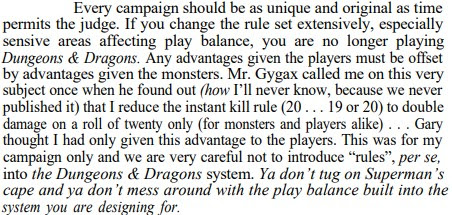
As I'm sure readers of this blog already know, "From the Sorcerer's Scroll" was the name of Gary Gygax's regular column in the pages of Dragon. It was here that he would share previews of upcoming AD&D rules additions and changes, as well as offer his opinions on various topics of the day. Those opinions were often controversial, particularly when they pertained to the "right" way to play Dungeons & Dragons and generated a lot of pushback in the letters pages to Dragon. In retrospect, I wonder if that wasn't part of their point.

The column that appeared in issue #27 (July 1979) is quite unusual, because Gygax turns it over Bob Bledsaw of Judges Guild. Bledsaw uses the space to offer up a "personal opinion," entitled "What Judges Guild Has Done for Dungeons & Dragons." It's a fairly interesting read in its own right, but there's a short section toward the end of the piece that I want to highlight in this post.

I find it remarkable that, while Bledsaw praises uniqueness and originality in one's own campaign, he also suggests that rules changes, especially those relating to "play balance," run the risk of changing the game so much that one is no longer playing D&D. This is the position Gary Gygax himself advanced in many of his "From the Sorcerer's Scroll" columns and elsewhere. Agree or disagree, there's a logic to it and I suspect that Bledsaw, whose company produced official D&D (and, later, AD&D) materials under license from TSR, knew that this was a line he had no choice but to toe.

After that, Bledsaw then gives an example of when Gygax corrected him regarding rules changes he was using in his own campaign. This concerned the "instant kill rule (20 … 19 or 20)." What's he talking about here? No edition of D&D with which I am familiar has an instant kill rule, let alone the one he seems to describe. On the other hand, Empire of the Petal Throne does and the rule Bledsaw mentions seems almost identical to it. Is this the rule Bledsaw meant? Had he imported the EPT rule into his home campaign? If so, why did Gygax care? I understand that Gary strongly disapproved of critical hits, which is fair. However, if Bledsaw was using them in his home campaign, what difference did it make? So long as he wans't importing them into Judges Guild D&D products – and he says he was not – I don't see why Gygax should "call [him] on this very subject."

Have I misread what Bledsaw is saying? 

Friday, August 12, 2022

Sage Smackdown

The "Sage Advice" column of Dragon was often of interest to me in my youth, largely because I wanted to know the "right" way to interpret the rules of D&D and (especially) AD&D. While Jean Wells acted as the magazine's Sage, there was a certain semantic bluntness to many of her replies. Take, for example, this one from issue #39 (July 1980): 

Wells minces no words about the fact that, in Advanced Dungeons & Dragons, there is no such thing as either a lawful neutral or a dwarf paladin. How could she say otherwise? The entire purpose of the "Sage Advice" column was to present the "official" answer to readers' questions and that's the official answer. If you wish to play AD&D by the book, as Gygax intended, you don't allow either lawful neutral or dwarf paladins in your campaign. End of story.

Of course, that raises another question: do you wish to play AD&D by the book? In my experience, not many people did, mostly out of an unwillingness to be bound by each and every rule presented in the rulebooks, some of which were, I don't think it can be denied, difficult to understand. I know it's popular in some circles to suggest that AD&D simply cannot be played "by the book," should one be desirous to do so. I don't think that's true at all, though, as I said, I rarely encountered instances of it. Even now, I suspect it's quite uncommon among all but the most dedicated referees and players.

I don't see this as good or bad one way or the other. I think there are benefits and drawbacks of strict "by the book" play, just as there are benefits and drawbacks of more flexible (for lack of a better word) approaches to the game. Mind you, I am temperamentally much better suited to the "non-game" of Original D&D than the highly structured baroqueness of AD&D, so perhaps I am not fit to judge the matter. I can only say that, while my younger self, cared deeply about playing the game the "right" way, nowadays, I care more about playing it my way.

Friday, June 24, 2022

Simplifying BRP Combat?

I'd like to call upon the wisdom of readers with long experience playing games derived from Chaosium's Basic Role-Playing. Lately, I've been looking with less judgmental eyes on RuneQuest and finding within it – I speak of its 1979 second edition rather than its current iteration – worthy of greater admiration, both for its setting and for its rules, both of which really were ahead of their time.

Nevertheless, one aspect of RQ continues to bedevil me, namely combat. BRP combat, particularly in its RuneQuest iteration, is much more fiddly than I'd like. The combination of strike ranks, attack rolls, defense rolls, criticals, impales, fumbles, hit locations, and armor absorption is simply too much for my feeble mind to handle. A lifetime of playing Dungeons & Dragons has, by and large, mentally conditioned me for fast and simple combats, each round of which can be resolved with only a couple of dice rolls and the most basic of math. RuneQuest is several steps more complex than I enjoy. And yet I can't deny that there can be many benefits from complexity. I sometimes mention that, a few years ago, I had the opportunity to play Rolemaster with a referee who knew its rules well and helped make the process of using them relatively painless for me. As a consequence, I re-evaluated my older assessment of them as too arcane for my tastes. Perhaps the same is true of RuneQuest's combat system? 

That's why I'd like to hear from anyone who's refereed an RQ campaign for some length. What was your experience with combat? Did you find a way to make it run more quickly and smoothly? Is there some crucial insight into its workings that might help me overcome my concern about its fiddliness? Alternately, is there some iteration of BRP that manages to streamline combat without losing too much detail? I know that OpenQuest is well regarded in some quarters, but I haven't kept up with its development since its original release. Is that still a good option or are there others I should consider? Shower me with your thoughts on this, please.