Wednesday, October 19, 2022

Retrospective: Pool of Radiance

My late childhood and early teen years coincided not just with the ascent of fantasy and science fiction in popular media but with the (likely related) ascents of RPGs and video/computer games. By the time I first encountered roleplaying games, there were already serious efforts to combine these two hobbies – and my friends and I were very interested in seeing what they had to offer. That's why we greedily snapped up Wizardry and Telengard and Adventure and many more, all of which we enjoyed but none of which fulfilled our dreams of an electronic entertainment that truly brought the fun of a fantasy RPG to a console or desktop.

There were many reasons why we felt this way, most of them related to the technical limitations of computers in the early to mid-1980s. Another reason was that none of the computer or video games at the time made use of a rules system as complex as that of most pen-and-paper RPGs, which had a negative impact on their depth of play. Wizardry was a solid step in this direction, which is why I loved it, but it was still sufficiently primitive in the scope of its rules that it couldn't hold a candle to Dungeons & Dragons or any other tabletop roleplaying game.

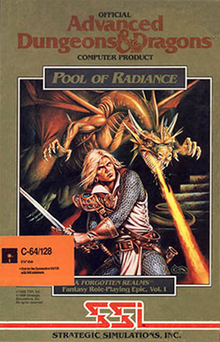
This largely remained the state of affairs until the late 1980s, when advances in both computer technology and program design saw the rise of increasingly sophisticated offerings. By this time, I was away at college and, while I didn't have a desktop computer of my own, many of my friends did so. It was through one of them that, in the Fall of 1988, I was first laid eyes on Pool of Radiance. Produced by Strategic Simulations, Inc. (SSI), Pool of Radiance was the first official Advanced Dungeons & Dragons computer game. Unlike the AD&D-branded Intellivision games of earlier in the decade, this one made use of the actual AD&D rules available at the time. This was a huge selling point to me, since all previous fantasy computer games used their own rules systems, which, as I noted above, were much less robust. 

The other thing that caught my attention was that Pool of Radiance was not a generic fantasy game. Instead, it made use of the then-new official AD&D setting of the Forgotten Realms. I'd been a fan of the Realms since I first encountered Ed Greenwood's articles in the pages of Dragon, so the use of the setting in Pool of Radiance was also a point in its favor. Further, the overall scenario of the game was designed not by the staff of SSI but by a team of RPG designers working at TSR, among them James Ward, David Cook, and Steve Winter. TSR fanboy that I was, this last fact assured me that, with Pool of Radiance, we were finally getting the goods: an honest to Crom digital adaptation of Dungeons & Dragons rather than a knock-off.

As one might expect, the centerpiece of Pool of Radiance was its character generator. The player is given the ability to generate up to six characters for use as his party of adventurers in the game. Ability scores are generated randomly, though the player possesses some capacity to alter them according to his preferences. Characters can belong to any of six races (human, dwarf, elf, gnome, half-elf, and halfling) and any of four classes (cleric, fighter, magic-user, thief, with demihumans given the opportunity to multiclass). Though representing only a portion of AD&D's full possibilities – there are no sub-classes or half-orcs, for instance – everything included in Pool of Radiance works the way it ought to in the tabletop version of the game. This was not a version of the game simplified for computers but the Real Deal™.

The game assumes the characters have come to the city of New Phlan and entered into the service of its council to reclaim the Old City, which has fallen into ruin and is now inhabited by a variety of monsters and evil humanoids. As the characters venture into these ruins, they gain experience and treasure, which enables them to explore ever more dangerous – and lucrative – areas. In time, they become sufficiently powerful and accomplished to move beyond Phlan and explore other locales that likewise would benefit from their presence. In short, Pool of Radiance is a good translation of the structure of most D&D campaigns into computerized form. 

The game's scenario is not groundbreaking or revolutionary in any real way, but it is nonetheless quite enjoyable, precisely because it is so similar to many people's experiences of playing AD&D. This similarity is buttressed by the inclusion of myriads of little rules and game elements, like saving throws, spell selection, magic items, and even demihuman level limits. To play Pool of Radiance is to play AD&D, albeit one that lacks the social interactivity that is, in my opinion, the foundation of why roleplaying is such a fun hobby. Even so, the game had a lot to offer and my friends and I spent far more time playing it than we probably ought to have.

In the decades since its release, computer RPGs have become vastly more sophisticated and immersive than was Pool of Radiance. Everything from their graphics, scenario design, and rules implementation have advanced by leaps and bounds, strengthened by improvements in technology and years of experience. Because of this, I doubt I could go back and play Pool of Radiance (or any of the many SSI AD&D computer games that followed in its wake) with any enjoyment. Yet, there's no question that this game was an important milestone in the development of the CRPG genre and for introducing a wider audience to Dungeons & Dragons – quite the legacy, if you ask me.

Tuesday, October 18, 2022

Affection for Second Edition

Since its inception, the focus of this blog has been on the first decade of the hobby of roleplaying – 1974-1984 or thereabouts, though I have regularly strayed outside this arbitrary period of time when the mood struck me. I did this because I felt this was the most interesting era of the hobby and also because the latter half of that decade was the period of my own introduction to it. Obviously, I continued to roleplay after 1984, but I long had the impression that most of my regular readers came here out of interest in the Golden Age of Dungeons & Dragons and other early RPGs.

On those occasions when I have wandered outside the confines of that seminal first decade, I've noticed much more interest than I would have expected. This is particularly the case with posts relating, even tangentially, to the Second Edition of Advanced Dungeons & Dragons. There is a marked increase in the pageviews and comments on posts about 2e, so much so that it frankly surprised me. There is, for example, much more interest even in posts gentling mocking the art of Second Edition than there typically is of my Pulp Fantasy Library entries. 

My surprise at this is entirely the result of my own myopia. Though I played 2e and even enjoyed doing so, it's never been My Edition. Likewise, when I finally abandoned playing Dungeons & Dragons in any form, it was during the Second Edition era, which probably clouds my judgment of it and its relative popularity. I've said before that, on reflection, I don't bear any ill will toward 2e and, in fact, don't think it's nearly as bad as its reputation in some old school circles.

I now find myself wondering both how widespread is the nostalgia for Second Edition and whether or not its fans feel that they're judged unfairly by aficionados of earlier versions of D&D. Because I only interact with a small sub-set of the larger old school RPG fandom – and likely a peculiar one at that – I have no real sense of how beloved AD&D 2e might be in the wider world. I can only say that, based on the response to my few posts about it, there's clearly some affection for it among my readership and I find that fascinating.

So, Second Edition fans: what do you think? Is 2e treated like the redheaded stepchild of the old school world or is it widely celebrated? I'm very curious about this, since I don't interact often with people whose favorite version of D&D is Second Edition AD&D and I'd love to know more about its place in the pantheon of RPGs. Please, enlighten me.

White Dwarf: Issue #54

Memory is a strange thing. Though I owned many of the issues of White Dwarf about which I've been writing in this series, some of them stand out more than others. Issue #54 (June 1984) is one of those I remember very well, in large part because of its striking cover by Peter Andrew Jones. In my opinion, the covers of Dragon were consistently good, while the covers of White Dwarf were more hit or miss. However, very few of the covers of Dragon stick in my head the way that White Dwarf's covers do. I suspect it's because the WD covers were generally wilder and more varied. They were rarely "safe" in the way that Dragon's were. That's not to say all of White Dwarf's covers were brilliant – they were not – only that many more captured my youthful imagination than did their counterparts on the front of Dragon.

Issue #54 is also memorable for its editorial by Ian Livingstone, which touches on the issue of the Satanic Panic. I reproduce his words here in their entirety:

Livingstone pretty well says it all, so I have nothing more to add beyond my usual bafflement that this actually happened. 

"Law of Nature" by Christopher Hunt is a good article on the subject of "logic in fantasy worlds." More precisely, Hunt is concerned with ensuring that fantasy settings make sense and follow intelligible rules, even though those rules may differ from "the constraints of our present world." I'm probably well disposed toward articles of this sort, because Hunt's advice is not far removed from my own general approach. In a similar vein, "Visiting Other Plains" by Ian Marsh offers advice on presenting barbarian cultures in fantasy (with an emphasis on RuneQuest) by reference to real world tribal cultures. Again, it's a good, if short, article of the sort I used to really enjoy reading.

Part 3 of Marcus L. Rowland's "The Name of the Game" focuses on science fiction RPGs, with Traveller taking pride of place, though he also references Star Frontiers, Space Opera, Star Trek, and Laserburn (which I presume had a strong presence in the UK than it did in the USA). Meanwhile, "Microview" by Russell Clark reviews two computer games, Apocalypse (6 out of 10) and Battle 1917 (7 out of 10). "Tabletop Heroes" by Joe Dever and Gary Chalk takes a look at miniature figures from Essex, Citadel, and Ral Partha with an eye toward their utility in Warhammer. 

"Open Box" reviews Murder on Arcturus Station for Traveller, rating it 7 out of 10, which seems a little low to me, especially since the reviewer, like myself, enjoyed it greatly. Kharé – Cityport of Traps, the second volume of Steve Jackson's Sorcery! gets an 8 out of 10. Espionage! and the adventure Border Crossing from Hero Games receive scores of 8 and 9 respectively. Finally, there's Pursuit to Kadath, an adventure for Call of Cthulhu published by Theatre of the Mind Enterprises. The scenario is rated 8 out of 10. All in all, a good selection of products that I think give a true sense of what the hobby was like at the time in terms of its diversity.

While Dave Langford's "Critical Mass" is usually quite forgettable for me, this issue's installment is a rare example of one that I still remember to this day. First, I remember that Langford simply refused to read, let alone review, Frank Herbert's Heretics of Dune. Second, he offers a lengthy excoriation of Battlefield Earth and its author, L. Ron Hubbard. He also reviews several other books that he likes, such as Pavane by Keith Roberts, but it's his takedown of Battlefield Earth that is the main event of his column: "It's dreadful and tedious beyond endurance."

Part 3 of "The Castle of Lost Souls" solo adventure by Dave Morris and Yve Newnham is as fun as its predecessors. I really enjoyed this series of articles when it was first published. "Down Among the Dead Men" by Alex McDonald is an examination of the undead in RuneQuest. More specifically, it expands on the treatment of the undead creatures found in the RQ rulebook. The article also mentions "Games Workshop's forthcoming Questworld pack," which, sadly, never came to pass. There are new episodes of "Thrud the Barbarian," "The Travellers," and "Gobbledigook," which are as delightful as ever.

"Temple of the Doomed Prince" by Phil Holmes is the first adventure I ever encountered for Tékumel. Statted for use with Empire of the Petal Throne, AD&D, and RuneQuest, it details a ruined temple to Ksárul, the titular Doomed Prince of the Blue Room. Though its overall design is nothing special, it's filled with plenty of atmosphere and cultural oddities that piqued my interest. At the time, I'd only ever heard of Tékumel, so this whetted my appetite for more information, though it'd be several more years before I'd actually hold a copy of Empire of the Petal Throne in my hands.

"Now You See Them, Now You Don't" by Fred Lee Cain presents two new monsters for use with Dungeons & Dragons: surrogates and shapelings. Surrogates are invisible golems, while shapelings are a naturally invisible humanoid species. Despite the descriptions of each, I found the monsters themselves rather thin gruel, notable primarily for their invisibility and little else. Finally, "Goals for Role-Playing" by J. Anthony Nanson is a short piece that outlines the kinds of goals characters might pursue – risk, business, romance – and then offers for suggestions for including them in adventures. Since the article is short, I can't really fault it for its vagueness, though I can't help but feel it barely touched upon the possibilities of its premise.

As I said at the beginning of this post, issue #54 is one that I remember very vividly, even though, by objective standards, it's not one of the magazine's best. Still, the mere presence of an adventure for use with Tékumel is certainly notable, since almost no EPT scenarios were ever published in any venue, not even the pages of TSR's own Dragon. Once again, White Dwarf demonstrates its uniqueness.
And then there was this photo from the back of the issue. Yes, it's real.

Monday, October 17, 2022

Pulp Science Fiction Library: Who Goes There?

Last week, I wrote about Clark Ashton Smith's "The Devotee of Evil," whose original appearance in the pages of Stirring Science Stories featured an illustration by the incomparable Hannes Bok. Seeing that illustration led me down a rabbit hole of investigation into the life and work of Wayne Woodard, known to history by his artistic pseudonym, Hannes Bok (apparently derived from the name of the composer Johannes Sebastian Bach). Among Bok's most famous pieces is the cover of the 1948 collection of science fiction stories by John W. Campbell, Jr, Who Goes There? (appended to the end of this post).

The collection's title comes from its lead story. Campbell first published it in the August 1938 issue of Astounding Science Fiction, the magazine he edited from 1937 to 1971. He did so under the nom de plume, Don A. Stuart, a pen name he'd used even before he took up editorship of the premier SF pulp of the Golden Age. In its original form, Who Goes There? is a novella consisting of twelve chapters, while the version that appeared a decade later in the collection mentioned above is expanded to fourteen chapters. An even longer version, bearing the title, Frozen Hell, was discovered just a few years ago among Campbell's papers, but it never appeared during his lifetime.

Despite their differences in length, the 1938 and 1948 versions are nearly identical in their essentials. The story concerns a team of thirty-seven men, most of them scientists of one type or another, stationed at an Antarctic research facility who have stumbled upon something strange. In this, the tale bears a superficial similarity to H.P. Lovecraft's At the Mountains of Madness, which appeared in three successive issues of Astounding a little less than two years prior. The similarity is primarily their shared setting of Antarctica, a continent still largely unknown in the 1930s, the decade that saw several scientific expeditions to it, most notably those of Richard Byrd. As an admirer of Lovecraft, At the Mountains of Madness is usually in my mind whenever a think of Antarctica and stories set there, particularly those of a science fictional and/or horror variety; Who Goes There? is both.

The novella begins shortly after the Secondary Magnetic Pole team under the leadership of the facility's second-in-command, McReady, returns, bearing an unusual find: the body of what appears extraterrestrial being frozen in a block of ice. The body was found on the South Polar Plateau, where it was "frozen since Antarctica froze twenty million years ago." The team that found it, consisting of McReady, Barclay, Blair, Dr. Copper, Norris, and Van Wall, speculate that 

"It came down from space, driven and lifted by forces men haven't discovered yet, and somehow – perhaps something went wrong then – it tangled with Earth's magnetic field. It came south, out of control probably, circling the magnetic pole. That's a savage country there, but when Antarctica was still freezing it must have been a thousand times more savage. 

They further speculate that one of the ship's passengers – the thing they brought back with them – had managed to get clear of spaceship's wreck and then quickly froze to death in the cold of Antarctica. The team hoped to examine the ship more closely, but their use of decanite and thermite bombs to soften the ice in which it was encased inadvertently set the ship's magnesium metal hull on fire and it, along with whatever secrets it might have held, was lost in a blinding inferno of heat and light.

There is disagreement between Norris, a physicist, and Blair, a biologist, regarding the danger in thawing the thing in the ice, with the former thinking it dangerous and the latter seeing no cause for concern. Norris worries that the thing, even if dead, might be host to microscopic organisms that, when thawed, could unleash a new plague upon the world. Blair, for his part, argues that alien germs would probably be no threat to Earth, since their biologies would probably be incompatible. The debate between the two goes on for some time with neither scientist ceding ground to the other. 

Before the facility's commander, Garry, can make a decision, Blair eagerly gives the men present a look at the thing, hoping that, by doing so, he will win the others over to his point of view. 

The room stiffened abruptly. It was face up there on the plain, greasy planks of the table. The broken haft of the bronze ice-ax was still buried in the queer skull. Three mad, hate-filled eyes blazed up with a living fire, bright as fresh-spilled blood, from a face ringed with a writhing, loathsome nest of worms, blue, mobile worms that crawled where hair should grow –

Seeing the alien's appearance has the opposite effect, shifting the men's mood against the possibility of thawing it. Nevertheless, Blair is persistent and Dr. Copper largely agrees with him. He believes that much could be learned about the nature of extra-terrestrial life and that this knowledge was worth the risk. The pair eventually win over Garry by arguing "things don't live after being frozen," especially not "higher animal life." Reluctantly, the commander acquiesces to their wishes and the block of ice is allowed to thaw overnight, under the watchful eye of Connant, the facility's cosmic ray specialist.

During his vigil, Connant falls asleep and, when he awakes, discovers that the presumed alien corpse is gone. 

"Your damned beast got loose. I fell asleep about twenty minutes ago, and when I woke up, the thing was gone. Hey, Doc, the hell you say those things can't come to life. Blair's blasted potential life developed a hell of a lot of potential and walked out on us." 

Copper stared blankly. "It wasn't – Earthly," he sighed suddenly. "I – I guess Earthly laws don't apply."

"Well, it applied for leave of absence and took it. We've got to find it and capture it somehow."

The men of the facility fan out, looking for the thing, assuming that it couldn't have got very far in the confined spaces of the buildings in which they dwell, They likewise assume that the extreme cold of the outdoors – the tale takes place toward the end of the Antarctic winter – would freeze it again and so it would avoid leaving the facility. 

Soon, Connant believes he has located the alien. It's made its way to Dogtown, the building where one of the men, Clark, houses the huskies used to pull their sleds. The dogs are howling, yelping, and snarling at one of their own, a dog named Charnauk. Charnauk reveals himself to – somehow – be the alien, its three red eyes giving it away. A combination of bullets, ax blows, and finally 220 Volts of electricity seemingly kills the thing, whose corpse Blair wants to examine more closely. In doing so, he concludes that the alien had somehow turned itself into Charnauk.

"Turned?" snapped Garry. "How?"

"Every living thing is made up of jelly – protoplasm and submicroscopic things called nuclei, which control the bulk, the protoplasm. This thing was just a modification of that worldwide plan of Nature; cells made up of protoplasm, controlled by infinitely tinier nuclei. You physicists might compare it – an individual cell of any living thing – with an atom; the bulk of the atom, the space-filling part, is made up of the electron orbits, but the character of the thing is determined by the atomic nucleus."

"This isn't wildly beyond what we already know. It's just a modification we haven't seen before. It's as natural, as logical, as any other modification of life. It obeys exactly the same laws. The cells are made of protoplasm, their character determined by the nucleus."

"Only in this creature, cell-nuclei can control those cells at will. It digested Charnauk, and as it digested, studied every cell of his tissue, and shaped its own cells to imitate them exactly. Parts of it – parts that had time to finish changing – are dog-cells. But they don't have dog-nuclei."  Blair lifted a fraction of the tarpaulin. A torn dog's leg, with stiff gray fur protruded. "That, for instance, isn't dog at all; it's imitation. Some parts I'm uncertain about; the nucleus was hiding itself, covering up with dog-cell imitation nucleus. In time, not even a microscope would have shown the difference."

"Suppose," asked Norris bitterly, "it had had lots of time?"

It's then that the men first begin to realize that the alien thing possesses the ability to assimilate any living thing. Worse still, there was a good chance that the thing was still at large and that one or more of the men had already been copied by it ...

Who Goes There? is a remarkable classic of science fiction, all the more remarkable because it was written in 1938. Campbell's writing is spare and dialog-heavy and his cast of characters, most of whom don't even have names, are often difficult to tell apart from one another. Nevertheless, the central idea of the story and the scientific basis for it remains compelling even today. It's no wonder that it inspired multiple films, the most faithful of which is John Carpenter's The Thing, which celebrated its fortieth anniversary earlier this year. If you've never read the original story, I highly recommend it.

Bok's cover illustration from the 1948 collection containing the story

Thursday, October 13, 2022

Wyst: Alastor 1716

Though Jack Vance is probably best known among fans of roleplaying games for his works of fantasy, such as his The Dying Earth and its sequels, his works of science fiction are every bit as remarkable, filled with the same memorable characters, imaginative locales, and wild reversals of fortune that are the hallmarks of his long career as a writer.  

During the 1970s, Vance wrote three science fiction novels set in an area of human-colonized space known as the Alastor Cluster. The third of these, Wyst: Alastor 1716, follows the travels of a restless young man who enters and wins an art contest, the prize for which gives him a round-trip ticket to any world in the Cluster he chooses, along with some spending money. The young man chooses Wyst, whose society is governed by the philosophy of "egalism" that decrees that every person is equal to every other – with somewhat predictable results. Like so many of Vance's works, Wyst is thus equal parts adventure story and satire.

I mention this all because Sword Fish Islands, the company behind the excellent Hot Springs Island, has published an illustrated, fine press version of Wyst: Alastor 1716 in cooperation with Spatterlight Press, which preserves and promotes Jack Vance's literary legacy. Sword Fish Islands very kindly asked me to write the afterword to this edition, which touches on, among other things, the role Vance's stories played in inspiring many of the earliest creators of roleplaying games, particularly Gary Gygax.

If you're a fan of well made, limited editions of classic literature, you might find this lovely new edition of Wyst to your liking.  

Oink! Oink!

When people ask me what I mean when I say that AD&D Second Edition was not well served by its art, I think of illustrations like this one, which appears in the 2e Dungeon Master's Guide. 

Doing It Wrong

I've been re-reading the AD&D Second Edition Dungeon Master's Guide, as part of my continuing exploration of the concepts of experience and level. I thought it might be worthwhile to take a look at how the various TSR editions of the game handle these matters. In doing so, I was surprised to see this bit of highlighted text:

As an option? What's going on here? Prior to looking at this section for the first time in untold years, I had assumed that, when it came to the awarding of experience points, 2e followed closely in the footsteps of its predecessor, with XP being given for the defeat of foes and the acquisition of treasure. That's certainly how I remember XP awards working in Second Edition. It's also how I remember playing the game back in the late '80s and early '90s. Was I playing the game wrong all those years ago?

Yes, apparently. If you play AD&D 2e by the book, there are only two ways that characters earn experience points. The first are the group awards, earned for "victory over their foes." This type of award has existed in every edition of Dungeons & Dragons since 1974 and is based on the hit dice and special abilities of the enemies defeated. The second are individual awards, given out on the basis of a character's class. Thus, a fighter gets an individual award of 10 XP per hit die of a defeated enemy per level, while a magic-user gets one by using spells "to overcome foes or problems" at a rate of 50 XP per level of the spell cast, among other awards. This second type of award is new to Second Edition.

When you look at the individual class awards, you'll notice something interesting. A class award for thieves is 2 XP per gold piece value of treasure obtained. What used to be a default means of obtaining experience – a "group award" in Second Edition's parlance – is now exclusive to thieves (and other rogues) and at twice the previous rate. I can see the train of logic that led to this element of the new edition's design: if you're committed to the idea of individual class-based awards, it makes sense that thieves ought to be rewarded for, well, stealing. However, the rules develop this notion in a way that completely excludes other classes for benefiting, experience-wise, from the acquisition of treasure. 

This is a huge shift away from the design of all prior editions of Dungeons & Dragons, which accepted the implicit pulp fantasy assumption that, to one degree or another, all characters are thieves, in the sense that they all benefit from treasure hunting, tomb robbing, and similar larcenous activities. Second Edition is a tacit repudiation of that conception of D&D, which I suppose only makes sense for a post-Dragonlance edition. The shift toward a more "heroic" presentation of the game was well under way by this point and perhaps this change is yet more evidence of it.

How I somehow managed not to take notice of it, though, is a genuine mystery.

Wednesday, October 12, 2022

Retrospective: Adventure

Like a lot of kids who grew up in the 1970s and '80s, I was simultaneously obsessed with and frustrated by the emerging technology of videogames – obsessed because, even in those benighted days, their potential was obvious; frustrated precisely because they were still a very long way from fulfilling that potential. Nevertheless, many of the videogames of my youth were truly amazing things, primitive though they must look to 21st century eyes. The best of them were paradigms of one's reach exceeding one's grasp, since technical limitations often prevented even the most talented designers from truly achieving what they set out to do. 

Neophilia is nevertheless a powerful thing. My friends and I enjoyed playing whatever video or computer games we could get our hands on, especially those with fantasy or science fiction themes. One of the earliest of the former that I remember playing was Adventure, released in 1980 for the Atari Video Computer System (rebranded as the Atari 2600 in 1982). The brainchild of Warren Robinett, who'd previously designed Slot Racers for Atari, Adventure is generally considered the world's first graphical fantasy game and it's precisely for that reason that I so loved it in my youth.

Behold! The Chalice
The premise of the game is quite simple: an unnamed Evil Magician has stolen the Enchanted Chalice and hidden it somewhere in the Kingdom. The player, whose "character" is represented by a square, must find the Chalice and return it to the Golden Castle where it belongs. Naturally, this is not as easy as it sounds. The Magician has created three dragons to hinder the player in his quest. These are Yorgle the Yellow Dragon, Grundle the Green Dragon, and Rhindle the Red Dragon. At higher levels of difficulty – there are three levels in all – there is also a Black Bat that carries objects throughout the Kingdom. This makes the player's quest more difficult, because the Bat not only moves important items around, it can also swap an item it's carrying with one you're carrying. This is especially annoying when you're carrying something like the Sword that's needed to slay the dragons – or even the Enchanted Chalice, as you're hurrying toward the Golden Castle to win the game.

Beware! Rhindle
Objectively, Adventure is not a particularly complex game or, at its lowest level of difficulty, a very hard one. Like many early videogames, much of its apparent difficulty comes from the limitations of the software and hardware of those bygone days. However, difficulty levels 2 and 3 genuinely up the ante, by introducing a number of random elements, mostly involving the placement of important items, that change gameplay in significant ways. They also include some features, like invisible mazes, that I absolutely dreaded as a child, because they were pretty much a death trap if a dragon were pursuing you. At the higher levels of difficulty, Adventure was thus more of a challenge.

Of course, it was precisely the challenging nature of the higher difficulty levels that made one feel as if one had accomplished something by succeeding in bringing the Enchanted Chalice back to the Golden Castle. That this often took many, many attempts only reinforced in our imaginations the immensity of what he'd done. That it all took place against the pixelated backdrop of a fantasy setting added further to its appeal. Outside of playing Dungeons & Dragons, which we'd only just discovered in the months prior to Adventure's release, there was no other game like it available at the time. In 1980, simply being the first was enough to hold our attention.

Ultimately, that connection to D&D, however tenuous, is probably what elevates Adventure to the lofty heights of the games most influential over my imagination. Like D&D itself, Adventure was released at just the right time in my own life, when I was at the start of my lifelong love affair with fantasy adventure games and when I'd not yet become a fault-finding snob who hates everything. Back then, I could still find wonder and excitement and even a little fear in a game where your in-game avatar is nothing more than a colored square and fearsome dragons look like ducks. I miss those days sometimes ...
The glory of the Golden Castle!

Tuesday, October 11, 2022

The Stafford House Campaign

Four years ago today, Greg Stafford, creator of Glorantha and one of the founders of Chaosium, passed into the eternity of the Gods World. In celebration of his memory, Chaosium has released the first volume of a new series called the Chaosium Archival Collection. This volume, The Stafford House Campaign, is a collection of essays Stafford wrote about his then-ongoing RuneQuest campaign during the period between 1978 and 1981, some of which originally saw print in Amateur Press Associations, like The Wild Hunt. 

I don't yet own a copy myself, so I can't speak of its complete contents. However, there's a lengthy excerpt available for free download on the Chaosium website. If that catches your fancy, you can buy the full 84-page version, in either a PDF or POD form. Based solely on the download, it looks like the whole collection will be worth it for anyone interested either in the development of Glorantha or in the early history of the hobby of roleplaying.

White Dwarf: Issue #53

Issue #53 of White Dwarf (May 1984) boasts a cover by Angus Fieldhouse depicting wgar appear to be orcs in the service of Saruman from The Lord of the Rings – notice the sigil of the white hand on their shields and battle standard. If so, it's an odd choice, since the issue contains a scenario for use with Warhammer based on the Battle of Pelennor Fields in which Saruman's forces did not participate, having already been defeated at Helm's Deep a couple of weeks prior. Even so, I like the illustration quite a bit; it nicely encapsulates many of the features I strongly associate with the Games Workshop "house style" for artwork.

Editor Ian Livingstone touches again on the issue of the roleplaying hobby's continued growth. He opines that gamers "who have been in the hobby for many years" might be "a little peeved" that "thousands of newcomers who view the hobby less seriously" than they have intruded their "exclusive" domain. It's an age-old aspect of the hobby, one I've experienced from both sides. If nothing else, this simply proves that there really is nothing new under the sun. Livingstone states that White Dwarf will continue to assist newcomers "by publishing introductory articles and scenarios," but that it would not do so "at the expense of its main editorial features." Whatever one thinks of this approach, I think it's instructive to consider that Games Workshop still exists today, while most of the other mainstays of the hobby, most notably TSR, no longer do so. 

Part 2 of Marcus Rowland's introduction to RPGs, "The Name of the Game," appears in this issue. This time, he focuses on games other than Dungeons & Dragons, starting with RuneQuest, which receives the bulk of the article's coverage. Rowland's comments on RQ are interesting. He emphasizes its detailed setting of Gloratha, its unique magic systems, its religions and cults, and, above all, its combat system, which he calls "the main reason for the game's success." He also includes brief discussions of several other RPGs: Tunnels & Trolls, Chivalry & Sorcery, Warhammer, and Man, Myth & Magic – quite an odd assortment to me, but perhaps this reflects the idiosyncrasies of the UK market in the mid-1980s.  

"Minas Tirith" by Joe Dever is a huge article that presents the Battle of Pelennor Fields from The Return of the King as the basis for a Warhammer fantasy battle scenario. The scenario is designed for two sides, the forces of Gondor and its allies and the forces of the Witch-King of Angmar. Of course, each side has enough units and sub-factions, not to mention named characters, that it would be quite easy to divvy them up into several players. The article includes not only stats for all the forces but suggestions of miniature figures appropriate to represent them. Though I've never been much of a miniature wargames player, I found the article weirdly inspirational and wished I could somehow get the opportunity to play it.

"Open Box" starts its reviews by looking at Games Workshop's Caverns of the Dead, an ostensibly system-neutral (yet obviously intended for D&D) boxed scenario that includes lots of maps and even a referee's screen. The reviewer rates it 7 out of 10 and notes that it's not quite as good a value for the money as a typical D&D module. Two more Fighting Fantasy books, Deathtrap Dungeon and Island of the Lizard King are reviewed, each earning 8 out of 10. I have a personal affection for Deathtrap Dungeon, due to its difficulty, which greatly appealed to me at the time. Finally, there's a review of Scouts for Traveller (7 out of 10). 

Dave Langford's "Critical Mass" comments upon another of Anne McCaffrey's Pern novels, Isaac Asimov's The Robots of Dawn, and Diana Wynne Jones's The Homeworld Bounders, among a few others. Meanwhile, "The Moonbane" is a piece of original fiction, "a short tale of gothic horror" by Chris Elliot and Richard Edwards. Much more interesting – to me anyway – are the latest installments of the comics "Gobbledigook," "The Travellers," and "Thrud the Barbarian." Also more interesting is Lewis Pulsipher's "Sign Here Please ...," a brief rumination on making pacts with devils in the context of fantasy roleplaying games. 

"The Naked Orc" by Rufus Wedderburn is "a study of orcish society." In some ways, it's a bit like Dragon's "Ecology of ..." series, except that it's focused on the politics and sociology of orcs rather than their biology. It's fine, I suppose, though there's nothing particularly clever or revelatory about it. "Spare Parts" is a Car Wars article written by none other than the game's creator, Steve Jackson himself (apparently written on his British namesake's typewriter while on a visit to England). It's mostly a puff piece in which Jackson talks about his plans for game, including a computer version from Origin (which did indeed come out in 1985).

Part 2 of Dave Morris and Yve Newnham's "The Castle of Lost Souls" solo adventure appears here, continuing the scenario begun in the previous issue. "Three of a Kind" by Michael Clarke presents three NPCs for use with Traveller; they can be used either as patrons or antagonists. "Of Oak, Ash, and Mistletoe" by Robert Dale is a collection of spells drawn from Celtic myth for use with RuneQuest. "Under Siege" by Joe Dever and Gary Chalk is a discussion of sieges in the context of miniatures wargaming, complete photographs. 

"Slave Hunt" is this month's installment of "Fiend Factory." Like many of the early installments of the feature, editor Albie Fiore weaves a loose scenario around four new monsters for use with D&D. The new monsters, all submitted by different authors, are all small humanoid creatures of various kinds, none of them particularly notable in my opinion – but that's a common problem of new monsters for the game. Finally, there's "Bits and Pieces," a random collection of material for Dungeons & Dragons. While the material isn't particularly memorable, it's listed as having been collected by Roger E. Moore, who was already an editor at Dragon at the time and would go on to be its editor-in-chief in 1986.

This is another solid issue of White Dwarf with a diverse range of articles covering a variety of games. What I most notice is the growing presence of articles dedicated to Warhammer and miniatures wargaming more generally. This is a trend that will only increase in the coming years and eventually lead to the magazine's becoming explicitly a house organ of Games Workshop in a way that it hadn't been previously. It also would lead to my ceasing to read, since I read primarily for its coverage of D&D, Call of Cthulhu, and Traveller.