Showing posts with label 2e. Show all posts

Wednesday, February 25, 2026

Retrospective: The Ruins of Myth Drannor

I know that, for many fans of old-school Dungeons & Dragons, Ed Greenwood’s Forgotten Realms represents a decisive (and unwelcome) break from the game’s early days, both in content and especially in presentation. I don’t agree with that assessment, though this isn’t the place to rehearse that entire argument. What I will say is that revisiting TSR’s Forgotten Realms products from the late 1980s through the 1990s, I find a body of work that is not the betrayal its detractors claim, but is instead a mixed bag – occasionally frustrating, frequently ambitious, and at times genuinely impressive.

A good case in point is The Ruins of Myth Drannor, a 1993 boxed set detailing the fabled elven “City of Song.” Myth Drannor had long loomed large in the background of the setting. For years prior to this set’s release, Greenwood referenced it repeatedly as a shining example of magical harmony undone by hubris and catastrophe. Consequently, when the boxed set finally appeared, I eagerly snapped it up.

From the first time I read about it, I imagined Myth Drannor as one of the great fallen cities of the Realms. Its destruction defined much of the Forgotten Realms’ melancholy grandeur. The Realms, at least as I understood them, were not a setting on the ascent but a world in decline, a place of fading glories and lingering ruins, closer in spirit to pulp fantasy than to high heroic triumphalism. Myth Drannor is where this comes into sharp focus. 

Transforming such a mythic ruin into a playable location was no doubt a challenge. Myth Drannor is not a megadungeon in the traditional sense. Rather, it is a shattered metropolis sprawled across the forest of Cormanthyr. Its districts, academies, towers, temples, vaults, and magical zones warped by a magic effect that once protected the city. TSR had previously attempted little else on this scale. One might point to Dwellers of the Forbidden City as an early precursor, though the comparison only goes so far. In spirit, its closest analog may be Chaosium’s Big Rubble for RuneQuest, which is still, in my opinion, the gold standard for “ruin crawl” locales.

In many respects, The Ruins of Myth Drannor succeeds admirably in its goals. Greenwood presents the city as an environment. It is effectively a mini-sandbox, a vast urban wilderness suitable for exploration, salvage, factional conflict, and long-term campaigns built around survival amid arcane devastation. The conceptual foundation is solid. The boxed set offers history, factions, current inhabitants, and numerous adventure hooks. This is all good stuff. Where it falters is in execution.

The set does not consistently provide the Dungeon Master with the tools necessary to bring so large a space to life in play. The maps are expansive and the descriptions evocative, but there is surprisingly little in the way of random encounter tables, stocking guidelines, event generators, or even name lists to help a referee improvise within such a vast environment. Instead, we are given several more fully fleshed-out adventures and a handful of small, somewhat uninspired mini-dungeons that can be dropped in as needed. Those adventures are serviceable, but they do not quite match the promise implied by the scale of the city itself. 

This absence of these kinds of referee tools is all the more striking because the physical presentation of the boxed set is impressive. The poster maps are sweeping, delineating districts and geography. They convey scale beautifully. One can easily imagine months of play wandering the overgrown avenues and shattered towers. Yet, that same scale exposes a weakness. Much of the city is described in broad strokes. The maps suggest more than the text delivers or indeed could deliver.

The background material is quintessentially Greenwoodian, dense with names, lineages, magic, and history. For readers invested in the Realms as a setting, this lore is rich and rewarding. For referees seeking immediately usable material, however, it can feel overwhelming. Even as someone who once delighted in “Realmslore,” I occasionally found myself wishing that some of the word count devoted to ancient history had instead gone toward practical game tools.

One element the boxed set gets absolutely right is its intended level range. The Ruins of Myth Drannor is not for novice characters. The ruins teem with formidable threats, like elven and mind flayer liches, demons, devils, magical constructs, and strange, magic-eating abominations. These are adversaries suited to mid and high-level characters. For referees who enjoy high-level play – and who know how difficult it can be to challenge powerful characters – Myth Drannor fills a genuine need. It offers a compelling and dangerous playground for experienced adventurers.

In the end, I think The Ruins of Myth Drannor exemplifies much of TSR’s output during this period. It is ambitious, atmospheric, and lavishly presented. It's also frustrating. It gestures toward an open-ended and exploratory style of play that strongly matches old school sensibilities, but it stops short of fully embracing the procedural support such play demands.

Even so, I still very much like this boxed set. When it was released, I used it and mined it for material to use in my campaign. Its flaws required work on my part as referee, of course, but the raw material was there, waiting to be shaped. Perhaps that is the most old-school aspect of it after all: not a perfectly engineered product, but a rich, uneven trove of ideas demanding engagement.

Myth Drannor, both as a fictional city and as a boxed set, stands as a monument to a fallen age – within the Realms and within TSR itself. Imperfect, excessive, occasionally exasperating, yet grand in conception, it reminds us that decline and greatness are not mutually exclusive. Sometimes they are, in fact, the same thing viewed from different angles.

Wednesday, February 18, 2026

Retrospective: Forgotten Realms Campaign Setting

Let's begin by making a clarification. This week's Retrospective concerns the AD&D Second Edition boxed set released by TSR in 1993 called the Forgotten Realms Campaign Setting. This is not to be confused with the AD&D First Edition product released in 1987 called the Forgotten Realms Campaign Set, about which I've already written a Retrospective post – though the former is indeed a revision and expansion of the latter. Why the two products have such similar yet still different titles eludes me. I expect the answer is most likely an oversight on the part of TSR's production team.

In any case, the 1993 product is a simultaneously terrific and frustrating product. At the time of its release, I was just beginning a campaign set in the Realms – the last AD&D campaign I would run before more or less abandoning the game for other RPGs – so its appearance was a godsend. Though I already owned (and loved) the 1987 set, it was several years out of date, both with the current AD&D rules and with events in the setting itself, so a more substantial update than the Forgotten Realms Adventures hardback was long overdue.

Say what you will about TSR in the 1990s, but one thing the company did very well was produce boxed RPG products and this one is no different. Coming in a sturdy, deep box, the Forgotten Realms Campaign Set was positively stuffed with material: a 128-page A Grand Tour of the Realms, 64-page Guide to Running the Realms, a 96-page Shadowdale book (not to be confused with the terrible adventure module of the same name), several Monstrous Compendium pages and cart-apart sheets of cards, and, of course, four large, full-color maps of the Realms. It's a truly impressive collection of softcover books and other accessories.

A Grand Tour of the Realms is the heart of the boxed set, providing an overview of the setting and its locations. It's packed with information – probably too much, to be honest – and that's both a blessing and a curse, as I'll eventually explain. When I was refereeing a Realms campaign, it was probably the book I consulted the most often. By contrast, the Guide to Running the Realms, though seemingly intended as the Dungeon Master's companion book to the setting, is much less useful. More than half of its pages are spent detailing NPCs, large and small, as well as the various deities of the setting. It's not a useless book by any means, but I rarely looked at it.

Shadowdale is better. It's a deep dive into the most famous of the Dalelands, making it a suitable starting point for a new Forgotten Realms campaign, as well as a "home base" for adventurers who want to roam the region between the Moonsea and the Sea of Fallen Stars. The Dale is described in exhaustive detail – a recurring pattern in this boxed set – with almost every location given at least a short paragraph, often more. Several of these locales even have interior maps. Finally, there's a lengthy adventure, "Beneath the Twisted Tower," for beginning characters that not only makes good use of the material already presented but could easily serve as the kick-off to an entire campaign in and around the Dales.

Combined with all the other extras included inside the box, the Forgotten Realms Campaign Setting is a terrific product, one that really does give the Dungeon Master nearly everything he could possibly want for starting a new campaign in Ed Greenwood's storied setting. I know I found it invaluable when I was refereeing my campaign decades ago, especially as I hadn't been keeping up with all the changes TSR wrought on the Realms during the years since the release of the original 1987 boxed set. In terms of simple utility, this is a good candidate for the best setting material TSR produced during the company's existence (though there's an embarrassment of riches to choose from).

At the same time, if you're familiar with both the original boxed set and/or Greenwood's articles about the Realms in the pages of Dragon, it's hard not to be a little frustrated by the 1993 set. I've already noted several times now how much material is found within the three included books – so much that it could be overwhelming. I understand that not everyone is put off by lots of detail and, as a longtime fan of Tékumel, I feel vaguely hypocritical for grousing about the much more modest information found in the Forgotten Realms Campaign Setting. Still, I feel as if the nature of the Realms started to change in this era, moving away from a more open-ended, almost sandbox-y setting into something more defined and therefore less flexible, at least when compared to its roots.

A big part of that probably has to do with not merely the Time of Troubles but how many products TSR had already produced for the setting. TSR turned the Forgotten Realms into the default, baseline setting of Second Edition, which meant that it shoehorned all manner of stuff into the setting that didn't really fit with Greenwood's original depictions of it. For example, several regions were made less fantastical and more like analogs of real world cultures and historical periods. This genericized the Realms and bled it of its original flavor. That disappointed me even at the time and does so even more now.

For all that, I still have a lot of affection for this boxed set. I not only made good use of it, but it's a fine example of a style of RPG product that no one really makes anymore – a largely complete description of a setting in a single box. I know there are all sorts of reasons why such a product is no longer as feasible as it was in the early 1990s, but that doesn't change my nostalgia for it. At the end of the day, I feel the only true judge of a gaming product is how much fun it engendered in play. By that standard, I consider the Forgotten Realms Campaign Setting a winner.

Wednesday, February 11, 2026

Retrospective: Forgotten Realms Adventures

After spending last week’s Retrospective criticizing Shadowdalethe product intended to help transition the Forgotten Realms AD&D setting into Second Edition, I thought it might be worthwhile to take a more positive look at another release from shortly thereafter: the 1990 hardback Forgotten Realms Adventures. Written by Jeff Grubb and Ed Greenwood, the same duo behind the original 1987 Forgotten Realms boxed set, Forgotten Realms Adventures (or FRA, as my friends and I called it) functioned as a bridge between that First Edition boxed set and the newly released Second Edition rules. Unlike Shadowdale, I have far more positive associations with this book. While it isn’t without flaws, it’s better written and, more importantly, genuinely useful.

At 154 pages long, Forgotten Realms Adventures is shorter than either the Second Edition Player's Handbook or Dungeon Master's Guide, but it still feels much of a piece with them in terms of its layout, art, and graphic design. If you like that sort of presentation, with its cramped three-column text, blue highlights, and Stephen Fabian interior artwork broken up by full-color, full-page illustrations by icons of the Silver Age, like Caldwell, Easley, and Elmore, then you'll in for more of the same. If, like me, you merely tolerate it as an artifact of its era, you'll probably be less happy. (And if you actively dislike it, odds are good you never bought or played any AD&D 2e stuff to begin with.)

Content-wise, the book is, quite literally, a mixed bag. Its first chapter is devoted to updating the Realms to not merely Second Edition but also to the consequences of the Time of Troubles/Avatar Crisis. A whole post (or series of them) could probably be written about the whys and wherefores of TSR's changes to the Forgotten Realms setting (which had already been changed from Greenwood's vision in several ways), but, in the interests of brevity, I'm going to gloss over most of them here. What's most important to understand is that the aforementioned Time of Troubles involved the fall of the gods from their Outer Planar homes to the Realms, thereby throwing the setting into chaos.

That chaos was intended by TSR as cover for introducing changes to the Forgotten Realms. Some of those changes were necessitated by changes in the rules of Second Edition, while others were to make the setting more amenable to the "angry mothers from heck," who'd been plaguing the game almost since its inception. Given that, Forgotten Realms Adventures isn't a completely coherent book. It's written and presented more like one of those annual encyclopedia updates some of us probably remember from our youths. The goal here is to give players and Dungeon Masters involved in Realms campaigns with all the rules and setting information necessary to use it with the newly-released 2e – at least until the release of a natively 2e boxed setting in 1993.

That first chapter is actually pretty good in my opinion, largely delivering on the promise of Second Edition to make AD&D more flexible and receptive to setting-specific changes. So, there's discussion on how, for example, certain classes fit into the Realms and what 2e options for them should be employed. Chapter 2 expands on this approach by focusing on priests, whose powers and abilities depend heavily on the details of the setting. Those first two chapters are nearly forty pages long and, while that might seem like a lot, most of the material is only vital if you're making use of a specific character class in play. That's why I made the comparison with those old encyclopedia updates. Forgotten Realms Adventures is not a book you're meant to read cover to cover but refer to when needed.

As a setting, the Forgotten Realms is known for two things: the prevalence of magic and Ed Greenwood's love of setting detail. The bulk of the book provides both in copious amounts. Chapter 3 offers up many, many new wizard spells, while Chapter 4 describes two dozen settlements, large and small, within the setting. These descriptions include both a high-level map of the location and a key of important places and people within it. These are very useful and something I appreciated at the time, when I was refereeing a Realms campaign. Chapter 5 looks at several important secret societies within the setting and Chapter 6 looks at gems and jewelry, a topic Greenwood had previously covered in issue #72 of Dragon (April 1983).

As I said, FRA is a mixed bag of content. It's not as well presented as, say, Dragonlance Adventures, but neither is it the mess that was Greyhawk Adventures. It's not really a stand-alone book. It's clearly written for people who are already making use of the Forgotten Realms setting and who already know its ins and outs. For those people – and I was one of them – this was a good and useful addition to my AD&D library and I regularly turned to it in play. However, it has minimal to no utility for anyone else. It's completely useless as a primer to the Realms, which is almost assuredly the reason TSR decided a couple of years later to release a new and expanded boxed version of the setting (about which I'll talk next week). Of course, that was never the book's purpose and I think it unfair to judge it on that basis. Viewed as an update to an existing setting, I thought it quite decent and, even after all these years, still have considerable affection for it, warts and all.

Wednesday, February 4, 2026

Retrospective: Shadowdale

Since I alluded in yesterday’s post to a shift in how TSR approached the Forgotten Realms, it seems worthwhile to examine the point at which that shift became unmistakable: Shadowdale, the 1989 AD&D module by Ed Greenwood. The first of three linked adventures intended to usher the setting into Second Edition, Shadowdale also served to advance the “Time of Troubles” metaplot through which TSR fundamentally reshaped the Realms. Lest anyone think otherwise, let state at the outset that, as an adventure, Shadowdale is deeply flawed. As a historical artifact, however, it is far more compelling, marking a decisive change in how the Forgotten Realms was framed and understood, both by TSR and its audience.

In many respects, Shadowdale is not really an adventure module at all, at least not in the sense that term had traditionally been understood. Rather than presenting a locale to be explored or a problem to be solved, Shadowdale instead serves primarily as a vehicle for presenting unfolding setting events over which the player characters have no control. Certainly, the characters are present during moments of great importance, like the fall of the gods to Toril or the assault on Shadowdale by the Zhentarim, but their role is largely one of observation. Outcomes are predetermined, major NPCs dominate the action, and the larger flow of events proceeds regardless of player choice. The module reads less like an invitation to adventure than as a dramatization of a story someone else has already decided.

This represents a sharp departure from earlier presentations of the Forgotten Realms. In the version of the Realms seen in Greenwood’s many Dragon articles, the 1987 campaign set, and its early supplements, the Realms functioned as a richly detailed backdrop rather than an unfolding narrative. History was largely static, providing a deep reservoir of implications, ruins, and grudges for Dungeon Masters to draw upon. Even powerful NPCs, such as the much-derided Elminster, were framed less as protagonists than as fixtures of the setting. They were figures with their own agendas, but not the only drivers of action within the setting. There was still plenty of scope for the player characters to leave their marks on the world.

Shadowdale signals a shift away from that understanding. With the Time of Troubles, the Realms acquired a timeline with canonical turning points and inevitable outcomes. The fall and return of the gods is more than a bit of background; it's a story to be told and told in a particular way. The module establishes that such events will happen whether or not the players intervene, as well as that future products will assume they have happened exactly as written. In doing so, it subtly but decisively shifts ownership of the setting away from DMs and players and toward the publisher.

This is not simply a matter of railroading, though Shadowdale certainly does that. The deeper issue is one of priority. The module is designed to support novels, sourcebooks, and future adventures rather than to stand on its own as a flexible piece of play material to inspire. The prominence of NPCs makes sense in this context, because they are central to TSR's narrative of the Realms, but their dominance leaves little room for the player characters to matter in any meaningful way. At best, the PCs can assist, but, more often, they will simply, as I said above, observe.

I believe it would be deeply unfair to lay all of this at Ed Greenwood's feet. In retrospect, Shadowdale reads less like an expression of his original conception of the Forgotten Realms than like a compromise between that earlier vision and TSR’s late-80s priorities. Greenwood’s affection for his NPCs and his fondness for intricate lore were always present, but earlier Realms material generally kept these elements in the background. Here, under the pressure to launch Second Edition with a bang and to synchronize the setting with an ever-expanding range of novels, those tendencies are brought to the fore. The result is a Realms that feels less like a setting to be explored and more like a story to be witnessed.

Shadowdale and its sequels offer little opportunity for meaningful choice, improvisation, or emergent play. Encounters are often structured to showcase NPC competence rather than to test player ingenuity. Deviating from the expected course of events is not merely difficult but implicitly discouraged, as doing so threatens the integrity of the metaplot the module exists to establish. This is admittedly not new territory. TSR had been down this path already with Dragonlance, but here it feels even more jarring, at least to me, perhaps because Krynn only ever existed as a vehicle for storytelling whereas the Forgotten Realms was intended as something more open.

For all these shortcomings and more, Shadowdale is nevertheless important. Its influence was profound and long-lasting. It set the template for how the Forgotten Realms would be handled throughout much of the Second Edition era. For players and DMs who enjoyed that approach, the module represented an exciting moment of transformation. For others, especially those of us who valued the older conception of the Realms as a flexible sandbox, it marks the beginning of an estrangement that would only deepen in the years to come.

Seen in retrospect, Shadowdale is, therefore, best understood as a turning point rather than as a mediocre adventure. It is the moment when the Forgotten Realms decisively stopped being merely a place where adventures happened and became, instead, a stage for stories to be told. Whether that change constitutes progress or decline is ultimately a matter of taste. What is beyond dispute is that, after Shadowdale, the Realms would never quite be the same again.

Thursday, January 29, 2026

Retrospective: Cities of Bone

I've mentioned before my affection for the Al-Qadim line for Second Edition AD&D. Though not without flaws, I thought it did a better job of translating its source material into Dungeons & Dragons terms than did Oriental Adventures (which I also like). One of the reasons I feel this way is that Al-Qadim leaned very heavily into the fantastical rather any attempt at historical Arabia. That was a choice I appreciated then and still do now and one I often wished Oriental Adventures had embraced to the same extent.

This approach is especially evident in the boxed supplement, Cities of Bone. Until I read a comment to last week's Retrospective, I'd almost forgotten about it. Though I owned the original Arabian Adventures book, I wasn't a devoted follower of the line and only picked a select number of its supplements. This was one of them and, though I never made use of it in play, I enjoyed reading it. I hope that's not damning Cities of Bone with faint praise, because that wasn't my intention. Certainly, the only real metric by which to judge a RPG supplement or adventure is how useful it is in play, but there are often products, like this one, that are nevertheless inspirational. 

In this case, that inspiration comes from subject matter very near and dear to my heart: ancient ruins, undead, and necromancy, subject matter that was also of great interest to Clark Ashton Smith. That's the real reason I am looking back on Cities of Bone: there are bits of it that feel like they could easily have been drawn directly from the works of the Bard of Auburn. That's not to say that they were, at least not directly, but I'm inclined to agree with last week's commenters that there's a broadly Smithian vibe to the whole thing. It's fitting, too, since Smith earliest works of fiction, written when he was an adolescent, had Arabian or Orientalist settings. 

Written by Steven Kurtz and released in 1994, during TSR’s final flourish of lavish boxed sets, Cities of Bone appeared after previous supplements had already established Al-Qadim's Zakhara setting as a land of bustling bazaars, glittering genie courts, and swashbuckling adventure. Against that backdrop, Cities of Bone stands out precisely because it turns away from the living world and toward the titular ruins of ancient kingdoms – and those who both dwell within them and would despoil their buried treasures for their own benefit.

Cities of Bone included a 64-page adventure book, a 32-page campaign guide, and an additional 8-page supplement, as well as the usual maps, handouts, and loose accessory sheets that could be found in all TSR's boxed sets of the era. I can't deny that, for all my complaints about this era, the boxed sets it produced were often beautifully presented. There's a strange joy in opening them up and goggling at all the stuff TSR managed to pack inside. That's true here as well, double so, because Al-Qadim products have these faux gilt pages and striking arabesque decorations. 

What I remember most about Cities of Bone was the way it handled the ruins it presents. Rather than being generic dungeon crawls transplanted into the desert, they're rooted in the historical, cultural, and religious context of Zakhara. Likewise, some of the undead encountered within them are tragic figures, bound by oaths, regrets, or unfinished duties rather than simple malevolence. Many scenarios hinge on moral and ethical choices, such as how to treat the dead, how to honor the past, how to balance the lure of wealth with the demands of propriety and faith. It's an unusual approach, one that's subtly at odds with uncritical tomb robbing that D&D implicitly espouses. 

I call Cities of Bone a "supplement," but it's really more of a grab-bag of locations, NPCs, and scenarios intended to be used however the Dungeon Master wants. In a sense, they support – no pun intended – sandbox play, as the characters wander about the Land of Fate and encounter these ruins to explore. Some of the scenarios are short and largely inconsequential, while others are longer. By far, "Court of the Necromancers" is the best of the bunch and clearly seems to be channeling Clark Ashton Smith's "Empire of the Necromancers" – not that that's a bad thing!

All of which is to say that Cities of Bone is far from a must-have supplement, but there’s still enough stuff in it that I was glad to have been reminded I even owned it in the first place. I like ruins; I like the undead. There’s plenty of both here, along with some nice maps and snippets of history that help to give everything an extra overlay of… something. Mood? Atmosphere, maybe? A sense that these places were once alive and important and are now only half-remembered, half-understood, waiting to be misused or disturbed by characters who don’t fully grasp what they’re poking at.

As a whole, Cities of Bone is definitely a product of its time. It's uneven and occasionally frustrating, but also oddly earnest in its ambitions. It’s not polished enough to recommend without reservation, nor is it inspired enough that I'd recommend anyone seek it out. However, referees who enjoy plundering older supplements for ideas, imagery, and the occasional spark of inspiration, would find it has its uses. I myself can easily imagine lifting things from it and then weaving them into something of my own. In that sense, Cities of Bone succeeds in the modest way many such supplements do.

Thursday, November 13, 2025

Retrospective: The Complete Priest's Handbook

When the second edition of Advanced Dungeons & Dragons appeared in 1989, one of its implicit goals was to make the game’s classes more flexible and setting-driven. Nowhere was this more apparent than in the treatment of clerics. First Edition AD&D more or less followed the template laid down by OD&D, where the cleric was an odd hybrid of Templar, exorcist, and battlefield medic. This was a pragmatic invention designed to plug holes in early play (someone had to turn undead and heal wounds). The cleric class was thus foundational to the game, but rarely inspiring. If my experience is anything to go by, few players aspired to be a cleric and would only acquiesce to doing so because the party needed healing.

The Complete Priest’s Handbook, published in 1990, represents TSR’s most serious attempt to rethink the cleric, building on what had already been established in the 2e Player's Handbook. Written by Aaron Allston, it stands as one of the most conceptually ambitious entries in the “Complete” series, as well as one I really liked at the time of its release. The supplement's title is significant. Second Edition, you may recall, replaced the term "cleric" with "priest" as the name of the broad class category. “Cleric” became only one example within that category – a type of priest, much as the druid was another. This terminological shift heralded a new approach to divine spellcasters. Where 1e’s cleric was monolithic, 2e’s priest was varied. There could be hundreds of priestly archetypes, each distinct to its faith and overall ethos. Allston’s book took that conceptual flexibility and attempted to make it practical.

At the heart of The Complete Priest’s Handbook lies 2e’s concept of specialty priests as a flexible framework for portraying the servants of specific gods or cosmic powers. Rather than treating every priest as a lightly re-skinned version of the same armored miracle-worker, Allston provided Dungeon Masters with clear guidelines for customizing spell access, weapons, armor, granted powers, and restrictions to reflect each deity’s nature. A priest of a war god might wield swords and command battle magic, while one devoted to a god of secrets could be forbidden to fight openly but gifted with divinations and hidden knowledge. The idea had its roots in Dragonlance Adventures (1987) and the 2e Player’s Handbook, of course, but Allston expanded and refined it in meaningful ways. He demonstrated that the faiths of a campaign world should shape the rules of divine magic, not the other way around.

Much of the supplement reads less like a player’s guide than a campaign design manual. Allston encouraged DMs to think about pantheons, from who the gods are, what their worshippers are like, and how their clergy interact with worldly institutions. He presented religions as social, political, and metaphysical forces, not merely sources of spells. From here, he moves on to designing priesthoods, walking the reader through the process of defining a faith’s beliefs, organization, duties, and other details, with each choice shaping both flavor and play. Allston even made space for philosophical or non-theistic priests, who draw power from devotion to an ideal or cosmic principle. That idea was barely hinted at previously, but, in this supplement, it's offered as an unambiguous possibility (one that I embraced wholeheartedly in my Emaindor campaign from high school).

In many ways, The Complete Priest’s Handbook was TSR’s first real attempt to treat religion as a serious worldbuilding concern rather than an afterthought. The gods and their faiths were no longer just color for the background; they became engines of conflict, patronage, and adventure. The priest was not simply a healer or support character but a representative of a larger belief structure and institution. One can argue that this was always true in AD&D and perhaps it was, but, for many of us, it took books like this to make us think seriously about what that actually meant in play.

Like all entries in the “Complete” line, The Complete Priest’s Handbook included a selection of kits, optional templates meant to add flavor and specialization. Ironically, I never found most of them especially interesting. Too many represented vague social roles, like the Nobleman Priest, the Peasant Priest, and so on, rather than more distinctive archetypes like the Crusader or the Missionary. Arguably, 2e priests didn’t need kits at all. Between their spheres of magic and granted powers, the class already had plenty of built-in flexibility. However, compared to what other classes received in their "Complete" books, this section felt oddly underbaked.

What truly stands out, though, is how The Complete Priest’s Handbook reflects a broader shift in TSR’s design philosophy. Second Edition was increasingly interested in building distinct, coherent settings for AD&D. One could reasonably argue this was motivated by a desire to sell more products, but, even so, it had an intriguing creative side effect: it pushed the rules toward flexibility and world-specific interpretation. Instead of assuming a single “cleric” archetype for every world, 2e encouraged Dungeon Masters to make each campaign’s religions – and thus its priests – unique.

Of course, the book is not without its flaws. Balancing specialty priests was left largely to the DM’s discretion and the examples varied widely in quality. Allston’s approach assumed a polytheistic setting where divine diversity was the norm, leaving monotheistic or dualistic campaigns to do some extra work. Yet, these are minor quibbles compared to the book’s larger accomplishment. The Complete Priest’s Handbook encouraged DMs to shape faith to fit their worlds and, just as importantly, to let their worlds shape faith in return. For a game as rule-bound as AD&D sometimes was, that felt genuinely liberating.

For all my reservations about the "Complete" series as a whole, I still regard The Complete Priest’s Handbook as one of its true high points, a book that took a neglected class and made it central not just to the mechanics of the game but to the presentation of the setting in which it was played.

Wednesday, September 24, 2025

Retrospective: Vikings Campaign Sourcebook

Perhaps it's simply a facet of my getting older that I can now look back on AD&D Second Edition with a lot more equanimity than I once did. Mind you, I've been traveling this particular road for some time now, but, lately, I've found myself thinking ever more fondly of 2e, which I know is heresy in certain old school circles. Earlier in this blog's existence, I accepted without question the received wisdom that Second Edition heralded AD&D's decline. After all, it was the edition that promoted railroad-y adventure design, unnecessary rules complexity, and an endless parade of splatbooks. There’s some truth to those criticisms, but, as is often the case, the reality is more complicated. As I mellow in my old age, I’ve been struck by just how many interesting, even innovative, things TSR attempted under the 2e banner, even if not all of them succeeded.

One of the best examples of this spirit of experimentation is the Historical Reference (HR) series, the so-called “green books” published between 1991 and 1994. These seven volumes attempted to show that AD&D 2e could serve as a kind of universal fantasy engine, capable of handling settings well outside the game’s usual mold. Importantly, they weren’t intended as dry exercises in historical simulation. Instead, they leaned into a blend of history, legend, and myth, presenting material grounded in real cultures but always leavened with enough fantastical elements to remain recognizably D&D.

The first entry, the Vikings Campaign Sourcebook (1991), written by 2e’s chief architect, David “Zeb” Cook, set the tone for what followed. Vikings had been part of D&D’s DNA from the beginning. Deities & Demigods included Odin, Thor, and Loki, while Gygax’s Appendix N highlighted Poul Anderson’s The Broken Sword, a novel steeped in Norse myth and heroic fatalism. Cook was tapping into a deep well already familiar to most players and the Vikings Campaign Sourcebook offers Dungeon Masters and players alike a toolkit for adventures inspired by the Viking Age.

The book begins with a broad overview of Norse society (law, honor, family, and daily life) along with a timeline of major events between the years 800 and 1100. Cook wisely avoids the caricature of Vikings as nothing more than berserk raiders, instead presenting them also as explorers, traders, and settlers. This emphasis on cultural breadth is, in fact, one of the book’s strengths and I find I appreciate that aspect of it even more now than I did when I first read it.

Character options include modifications to the standard AD&D classes, along with two entirely new ones, the berserker and the runecaster. It’s an odd choice to present these as separate classes rather than kits, especially since The Complete Fighter’s Handbook (released a couple of years previously) had already popularized kits as the preferred method for customizing characters. Whether this was simply Cook experimenting with format or an editorial decision from TSR is unclear, but it does highlight how much the HR series was still finding its footing. Additional rules cover equipment, magic items, and monsters, many of the latter being existing AD&D creatures modified to fit Norse myth more closely.

One of the book’s most enjoyable sections is its gazetteer of the Viking world, which is simply medieval Europe as seen through the eyes of the Norse. This is accompanied by a full-color foldout map, a TSR flourish I’ve always appreciated. In fact, I find this gazetteer and map more immediately inspiring than some of the book’s rules material, though that says as much about my own tastes as it does about Cook’s writing.

It must be said, though, that the Vikings Campaign Sourcebook is not an in-depth exploration of Norse history or culture. It was never meant to be. At 96 pages, it can only sketch the outlines of the period, leaving the DM and players to fill in the gaps with their own research or imagination. In that sense, it succeeds more as a primer or springboard than as a comprehensive treatment of its subject.

Despite this, the book plays well to AD&D’s inherent strengths. Heroism, exploration, and myth were already central to the game’s ethos and Cook’s presentation provides just enough historical texture to make a Viking campaign feel distinctive without drowning it in pedantry. For all its limitations, the result is a supplement that feels genuinely usable at the table.

Re-reading it now, I’m struck by how emblematic it is of TSR’s adventurousness during the 2e era. This was the same period that produced not only the Complete Handbook series and the later Option books, but also settings as varied as Dark Sun, Spelljammer, and Al-Qadim. The HR series was part of this broader impulse to push beyond “generic fantasy” and explore what else AD&D could do. The Vikings Campaign Sourcebook may not have been perfect, but it was ambitious and I think that matters.

More than three decades later, the Vikings Campaign Sourcebook deserves to be remembered not just as a curiosity but as evidence that AD&D Second Edition was more interesting and more daring than its detractors usually allow. Mechanically, it has many flaws, but it also captures something essential about both D&D and the Norse material it adapts, namely, the thrill of stepping into a world where myth and history intertwine and where characters stand larger than life. For Dungeon Masters curious about running Viking adventures (or simply looking to mine inspiration) Cook’s book still has much to recommend it, as do all the books in the HR-series.

Wednesday, March 19, 2025

Retrospective: The Complete Book of Elves

By the early 1990s, AD&D 2nd Edition was in full swing, and one of its defining features was the proliferation of entries in the Player's Handbook Rules Supplement (PHBR) series, commonly called the Complete books. These were player-focused supplements initially aimed at expanding the options for various classes that were eventually expanded to other topics, including races. The series is mixed bag, with most volumes following in the footsteps of The Complete Fighter’s Handbook – solid and unremarkable. However, a few stand out for how bad they were, The Complete Book of Elves, published in 1993, being my candidate for the worst (feel free to nominate your own in the comments).

Written by Colin McComb, The Complete Book of Elves is, at its core, an expansion of the already-powerful elf race in AD&D. But whereas earlier material presented elves as skilled but balanced adventurers with unique strengths and weaknesses, this book instead leans hard into the idea that elves are just better –smarter, faster, more artistic, more magical, more attuned to nature, and, of course, longer-lived – than virtually every other playable race in the game.

This emphasis is the start of where the book runs into trouble. It doesn’t just provide players with more options for elven characters; it actively reinforces an attitude of elven superiority, sometimes to an absurd degree. Take, for example, this passage:

No elf will ever simply perform a function when he can do it with flair and style. If a human forges a sword, he creates a piece of metal that cuts and slashes. If an elf forges a sword, he creates a masterpiece of balance, beauty, and power.

That's more or less the tone of the entire book. Elves are naturally superior to humans and other races in virtually every way that matters. Their weapons are better, their magic is more refined, their civilization more enlightened, their senses sharper, their emotions deeper. Even their music is better! 

If it were merely a matter of tone, The Complete Book of Elves would simply be remembered as insufferable. However, the book follows suit with its rules expansions as well and this, in my opinion, is where it reaches a new level of egregiousness. The new elven kits, which are supposed to offer distinct roleplaying options, tend to be overloaded with benefits and underweighted on drawbacks. The bladesinger, for instance, is a combat-ready spellcaster with virtually no downside beyond its limitation to one weapon. The wilderness runner is an elf so in tune with nature that he can literally run faster than a horse. Even some of the purported elven disadvantages, like the elves' reluctance to use heavy armor, are framed as virtues rather than limitations.

It’s not as if the book is poorly writtenMcComb has a decent grasp of language and some of the information he presents, particularly concerning elven philosophy and their approach to magic, is interesting. However, it is so unbalanced in its portrayal of elves that it feels almost like a work of in-game propaganda rather than a neutral sourcebook. I don't think that was McComb's intention, but, even if it were, I think he went a bit overboard in his approach. I distinctly recall that, during the '90s, The Complete Book of Elves was the butt of frequent jokes by all but the most dedicated elf fanboys. In my local group, we referred to it as "The Complete Book of Gods," because of its overpowered kits and supercilious prose.

Despite this, The Complete Book of Elves still holds some interest today, if only from a historical perspective. It's an artifact of a time when AD&D was leaning much more heavily into the "story" or "narrative" approach that was pioneered almost a decade earlier in Dragonlance. The book has less concern for mechanical balance than it does for presenting a nonhuman race in sufficient detail for maximum player immersion. I don't think that's necessarily a bad thing – I'm a longtime fan of Roger E. Moore's "Point of View" series in Dragon, for example – but I can't help but feel as the racial Complete books, especially this one, go too far in this direction. 

Ultimately, I think The Complete Book of Elves serves as an object lesson in the dangers of overindulging a single race or concept in a game. I prefer it when a supplement expands options, not elevates one choice as obviously better than all the others. Based on my undoubtedly biased experience, this book simply exacerbated an existing problem: players already drawn to elves didn’t need more reasons to see them as superior. It's a flawed and indulgent book, worth a read only if you want a window into some of the worst tendencies of TSR and AD&D during the early to mid-1990s. 

Monday, January 13, 2025

When Greatness By Right Is Thrust Upon You ...

Whenever TSR released a new campaign setting for AD&D during the Second Edition era, Dragon magazine would include a special section advertising it. Issue #219 (July 1995) included one for Birthright, which featured the following pages:

Thursday, January 9, 2025

Retrospective: Birthright Campaign Setting

By now, it's pretty widely recognized that Dungeons & Dragons and, by extension, all roleplaying games ultimately descend from miniatures wargaming. After all, the subtitle of OD&D is "Rules for Fantastic Medieval Wargames Campaigns Playable with Paper and Pencil and Miniatures Figures." Yet, fairly quickly, this descent had become obscured, if not outright forgotten. The first version of D&D I owned, Holmes Basic, was first published in 1977, just three years after the release of OD&D and, by that point the game's subtitle had already been changed to "Rules for Fantastic Medieval Role Playing Adventure Game campaigns" (italics mine). The explicit connection to miniatures wargaming had been severed.

However, many implicit connections remained, most importantly in the way that most character classes, as they advanced in level, gained followers – sometimes a lot of them. High-level characters can also establish strongholds and rules over a territory, collecting taxes from the inhabitants. These and similar aspects of the game reveal, I think, that D&D never completely broke free of the bonds of miniatures wargaming, where free-wheeling campaigns driven by the machinations of players were common. D&D is very much an outgrowth of that style of play, even if most of the new generation of gamers, like myself, had little or no understanding of this fact. And, to be fair, TSR itself did very little to promote this style of play, aside from half-measures like the D&D Companion Set in 1984

TSR tried again a little more than a decade later with the release of the Birthright Campaign Setting in 1995. Created by Rich Baker and Colin McComb, Birthright was another example of the many impressive boxed sets released during the Bronze Age of D&D. The set consisted of three softcover books (a 32-page Atlas of Cerilia, describing the game's history and geography; a 96-page Rulebook that detailed changes to the AD&D 2e rules; and a 96-page Ruins of Empire book that detailed all the kingdoms of the setting), a couple of large poster maps, a battle mat, 112 cards with the stats for various military units, a DM screen, and a collection of reference sheets. It was, as I said, a very impressive package. The box was filled to the top with lots of stuff – a hallmark of the era.

One of the central features of Birthright that distinguished it from other D&D settings at the time was that it focused on rulership, whether of a kingdom (or smaller governmental unit) or an organization, like a guild, merchant company, or temple. Most player characters are assumed to be scions, possessors of ancient divine bloodlines that grant them a variety of supernatural abilities. These bloodlines stretch back to the gods themselves, who sacrificed their very essences in order to save the mortal races of Cerilia from the evil god Azrai. When a character is generated, the strength and type of his bloodline is determined randomly. However, through play, the bloodline can be strengthed or weakened, depending on his success or failures in defeating other scions. 

Bloodlines and their powers play a significant role in Birthright. Scions are, by their nature, no ordinary mortals. Their powers enable them to rise to prominent positions in Cerilian society, such as great military commanders, merchant princes, high priests, and, of course, the rulers of domains. Success in Birthright's domain management system depends, to a great degree, on the ruler's use of his bloodline strength and powers, though luck and good judgment play a role as well. It's an interesting conceit and, in my opinion, a rather clever one for a leveled game like AD&D. Since even 1st-level Birthright characters possess bloodline powers, albeit weak ones, they can jump right into the action by governing small territories or organizations, with the hope that, as they advance in influence and power, they can expand the holdings they govern as well.

Domains are governed according to a three-month "domain turn" during which a ruling scion (or regent) makes decisions about how he wishes to govern. These decisions involve taxation, maintenance, warfare, diplomacy, and more. There are also tables for handling random events that might occur during a turn. Of course, characters can also – and indeed are expected to – engage in adventuring during these turns, too, since defeating other scions and stealing their divine power is an important way to increase their own. Birthright regents don't just sit on their thrones and let others do the dirty work for them! It's probably not "realistic," but it's fun, in much the same way that a Star Trek captain's leaving his bridge to beam down to a hostile planet is. After, Birthright is still D&D.

Speaking of its being "still D&D," the Birthright campaign setting doesn't deviate too much from the defaults of Second Edition. All the expected character classes are there and any changes to them are minor at best. The same is true of the standard demihuman races, though elves have a slightly more sinister, or at least distrusted, character to them. The setting does make a distinction between wizards, who cast both "true magic" and realm magic, and magicians, who are specialists in illusion and enchantment. Only scions can become wizards, since both true and realm magic require the divine power of a bloodline to operate. Other than this, Birthright doesn't differ all that much, rules-wise, from AD&D 2e as it existed in 1995.

Though the setting assumes that most player characters will be scions, it's not mandatory. Characters lacking a bloodline are possible, though I'm honestly not sure why anyone would play one. They lack both the extra abilities that bloodlines provided and the hit point boost (+10) that comes with them. Non-scion characters get a +10% XP bonus on top of any other bonus they might qualify for, but that's the only benefit to not having a bloodline. I suppose another perk is that you're not as likely to be a target for ambitious scions hoping to empower themselves by killing you.

Like a lot of AD&D 2e settings, Birthright was very well supported by TSR, with a large number of supplements and adventures being published for it over a very short period of time. I never owned anything more than the original boxed set, so I can't really comment on how useful these were. I get the impression that, as one might expect, they were a mixed bag – some were excellent and added a lot to the setting, while others were less so. For myself, I felt that Birthright was complex enough as it was and can't imagine wanting to add more complexity. The domain management system, while compelling, required a lot of bookkeeping, for example, and the mass combat rules, though simpler than a full-on miniatures wargame, nevertheless required a lot of attention.

The Birthright campaign setting is one that greatly interested me at the time of its release. Unfortunately, that time also corresponded to when my interest in Dungeons & Dragons was rapidly fading. As I said, I bought the initial boxed set and read it with enjoyment. However, that never translated into making use of it. Instead, it languished on a shelf for years, until I finally sold it to someone who'd better appreciate it. Now, I regret that a tiny bit, since I think I now have a better handle on the kind of "movers and shakers" political campaign that the rules were designed to handle. Were I to referee such a campaign, though, I doubt I'd use AD&D, so it's a moot point anyway. 

If anyone reading this made good use of Birthright to run a campaign, I'd love to hear how it went.

Wednesday, November 27, 2024

Retrospective: Al-Qadim: Arabian Adventures

I'm a sucker for historical fantasy – or even just fantasy that's heavily inspired by a particular historical period, society, or culture. That's one of the reasons I so eagerly awaited the release of Oriental Adventures in 1985: I saw it as an opportunity for Dungeons & Dragons (or AD&D) to finally present monks and ninjas and samurai within a more suitable context than the riotous goulash in which the game has existed since its inception. In my experience, most (A)D&D players never cared about this as much as I did, even back in the day, but such concerns grew increasingly important to me, especially during my teen years.

Consequently, when TSR announced that it'd be giving the Oriental Adventures treatment to the myths, legends, and folklore of the Middle East, I was pretty excited. Though Bulfinch's Mythology didn't include a section on these tales, I was nevertheless quite familiar with the stories of A Thousand and One Nights, not to mention the charming films featuring Sinbad the Sailor I'd seen as a child. And course D&D had long included monsters like the djinn, efreet, ghoul, and roc, in addition to the flying carpet and ring of wishes, all of which have their origin in Middle Eastern mythology.

Entitled Al-Qadim: Arabian Adventures, this 158-page softcover was written by Jeff Grubb with the assistance of Andria Hayday. Grubb was a powerhouse designer at TSR at this time, having previously created Marvel Super Heroes, shepherded the Forgotten Realms Campaign Set to publication, and conceived Spelljammer, among many other influential projects. He brings the same imagination and enthusiasm for Al-Qadim that he did for its predecessors, resulting in a book of which I remain very fond, despite certain shortcomings. 

In the book's introduction, Grubb acknowledges that Arabian Adventures takes inspirations from three different versions of Arabia. The first is the Arabia of history, whose people, culture, and history spread from the Atlantic Ocean to India as a result of the Islamic conquests starting in the 7th century. The second is the Arabia of myth and legend. Finally, there is the Arabia of Hollywood, like the aforementioned Sinbad movies. Of the three, the second and third are the most important to Al-Qadim, which is not intended to be historically or culturally accurate but is, echoing the foreword to OD&D, "strictly fantasy."

Like Oriental Adventures before it, Arabian Adventures is not a stand-alone game but rather a supplement to AD&D, then in its second edition. Its purpose is to provide new and alternative rules for use with 2e rather than being complete in itself. Thus, for example, we get a variety of new character kits, as well as new equipment, nonweapon proficiencies, and spells. All of these are intended to differentiate the inhabitants of Zakhara, the Land of Fate, from those coming from more Western European-inspired locales, just as OA had done for the peoples of Kara-Tur. Al-Qadim is decidedly not generic in its presentation, but instead places everything within a very specific cultural and social context derived from the three sources Grubb mentioned in his introduction.

By and large, the end result is excellent, better in some ways than Oriental Adventures in my opinion. The character kits – a concept that didn't exist at the time OA was published – do a very good job of tailoring AD&D's existing character classes for an Arabian-inspired setting. While most of them are interesting and flavorful, the ones I most liked were those that covered roles uncommon or unknown in other settings, like the barber, beggar-thief, and merchant-rogue. Likewise, the new spells and proficiencies went a long way toward making a Zakharan character feel distinct from his counterparts in other realms.

Where Al-Qadim falls down is its being branded with and tied to the Forgotten Realms campaign setting. This is not the fault of Grubb or Hayday, nor does it strongly weaken the quality of their work. In the early 1990s, TSR was very keen on tying all of its AD&D products to one or more of its existing settings. Since the Realms were TSR's "go-to" AD&D setting, the company plugged almost everything into it, including Zakhara (just as had previously been done with Kara-Tur). It's a pity, because I think Zakhara would have been much more interesting had it simply been its own thing, divorced from the rest of TSR's AD&D settings of the time.

One way that this impacts Arabian Adventures in a negative way is that we don't get any unique demihuman or nonhuman playable races. All the standard AD&D races, like dwarves, elves, and halflings, are present in Zakhara and, aside from the usual game mechanics associated with them (ability bonuses, special abilities, etc.), they're really little different from Zakharan humans, sharing the same customs, beliefs, and so on. There's nothing strictly wrong with this approach, but Oriental Adventures gave us several new nonhuman races to play and I think doing so went a long way toward making Kara-Tur feel distinct. I would have liked to have seen the same for Al-Qadim.

The other "flaw" in Al-Qadim is that it's pretty clearly meant to be an alternate Players Handbook. Unlike Oriental Adventures, there's not much in the way of referee material included in this book. There are no new monsters or magic items, for example, and while both those omissions would eventually be dealt with in follow-up products – several, in fact! – their lack in this book was something I felt pretty keenly at the time. I would have preferred something a bit more expansive in its content, but, as I said at the beginning of this post, Arabian Adventures isn't a stand-alone product and, given TSR's approach to publishing AD&D at the time, there was probably little to no chance it would have included such material when it could more profitably be sold in later releases.

All that said, I really like Al-Qadim and regret that, like so many other AD&D products with which TSR flooded the market in the '90s, I never got the chance to make much use of it. One of my friends was a big fan of the line and purchased a lot of the later material, including the Land of Fate boxed set. From what I could tell, all of the setting's support material was of a very high quality – imaginative and fun, with plenty of great ideas to aid the Dungeon Master in refereeing his very own version of A Thousand and One Nights. It's one Second Edition's better supplements and deserves more love than it generally gets.

Wednesday, October 9, 2024

Retrospective: Dark Sun

Having devoted last week's Retrospective post to The Complete Psionics Handbook, my thoughts inevitably turned to 1991's Dark Sun campaign setting – a setting specifically created to provide a place for Second Edition AD&D fans to make full use of the game's new psionics rules without having to worry about the potentially adverse effects these psychic powers might have on, say, the Forgotten Realms or the World of Greyhawk

Designed by Timothy B. Brown and Troy Denning, Dark Sun was presented as "a world ravaged by sorcery" and "the most challenging AD&D game world yet." This new setting took inspiration from both the post-apocalyptic and Dying Earth sub-genres, with a dash of Burroughsian sword-and-planet for good measure. Dark Sun was thus a significant departure from the vanilla fantasy of traditional D&D and AD&D. This departure wasn't just in terms of its content, but also its presentation, making ample use of the dark, edgy art of Gerald Brom and Thomas Baxa, two relative newcomers to TSR's stable of artists, who, together, created an esthetic for Dark Sun that clearly differentiated it from everything the company had previously done. 

Like all of TSR's settings for Second Edition, Dark Sun was released in a large, boxed set, filled to the brim with gaming materials. The two main components of the set were 96-page softcover books. The first of these, entitled simply "Rules Booklet," presented new and altered AD&D rules for use with the setting. The second, "The Wanderer's Journal," was an in-character presentation of the "arid and bleak" world of Athas, which is "beset by political strife and monstrous abominations, where life is grim and short." Also included was a 16-page booklet, "A Little Knowledge," which consists mostly of a short story but also includes details of an adventure. The adventure proper is presented in two small 24-page, spiralbound flip books, one of which has illustrations to show players, like those in Tomb of Horrors or Expedition to the Barrier Peaks. Also included are poster maps of the city-state of Tyr and the region in which it's situated, known as the Tablelands.

Before getting on to the actual content of the boxed set, I'd like to say a little more about its presentation. Dark Sun is an impressive package. I remember when I got copy of it, being quite taken aback not only by how much was included in the set, but also by the unique format it took. This was particularly true in the case of the flipbooks, something I'd never seen previously in an AD&D product (or indeed any RPG product that I can recall). I suspect that they were intended as something of an experiment by TSR, one that carried over into most of the adventures subsequently published for the setting. I never really warmed to this format, which was in my experience quite unwieldy, which is one of the reasons I didn't buy any of those adventures. I'll get to the other reason shortly.

Athas itself is a very imaginative and engaging setting – sort of a cross between Barsoom and Zothique. As presented in "The Wanderer's Journal," the world's history is fragmentary at best. All that is certain is that present-day Athas is a shadow of its former self, its land ravaged by sorcery run amok and littered with the ruins of happier, more sophisticated times. Now, Athasian civilization is centered around scattered city-states, each ruled by an immortal sorcerer-king, who protects his subjects from the dangers of the wasteland in return for utter obedience. The sorcerer-kings also war amongst themselves, each attempting to expand his control of the Tablelands at the expense of his rivals, while various factions within and without attempt to take advantage of the situation. 

Though intended for use with AD&D 2e, Dark Sun makes many changes to the standard rules and assumptions of the game. Though all of the usual AD&D races are available, many are changed significantly, like the halflings, who are wild, feral beings reputed to engage in cannibalism. Joining them are new races, like muls (half-human/half-dwarf hybrids bred for their hardiness), half-giants, and thri-kreen. Character classes are similarly affected, with all being changed (or outright disallowed, like the paladin) in some way. Wizards, for example, must decide whether to increase their power by employing defiling magic that destroys the environment – the reason Athas is now barren – while clerics serve not gods, which don't exist in this setting, but the elemental forces of nature. 

Psionics also play a major role in Athas, with psionicists being common throughout the setting's population. Most intelligent beings – and many unintelligent ones, like monsters – are able to wield the powers of the mind. Psionics is, in many ways, more important in Dark Sun than is magic, though both have their place. In fact, magic and psionics can be employed together and it's explained that the sorcerer-kings owe their power and immortality to being able to wield both. "The Wanderer's Journal" suggests in various places that the relationship between magic and psionics played some sort of role in the ancient apocalypse that laid waste to Athas, thereby setting up a mystery that would be explored in later supplements and adventures.

This is where, in my opinion, Dark Sun faltered. The adventures produced for it all centered around major events within the setting, like the slave revolt that overthrows the sorcerer-king of Tyr and establishes it as a free city. Later adventures build upon these events, further changing and altering the setting as Big Things happen in accordance with a plan established by TSR. This isn't an inherently terrible way of developing a setting, though it's not my preference. However, what made it frustrating was that many of the setting's big events, like the aforementioned defeat of the sorcerer-king, are the result of actions by named NPCs, not the player characters. Furthermore, some of these events even happen in the pages of tie-in novels rather than adventures – a testament, I suppose, of just how popular and lucrative AD&D novels were in those days.

It's a pity, because Dark Sun is a genuinely imaginative and unique take on fantasy. Athas is a great setting, one with lots of possibilities for adventure, as well as a style and feel that differs from everything else that TSR was producing at the time. I was blown away by Dark Sun when I first bought it and really wanted to run a campaign with it. That never happened, for many reasons, but a big one was that I worried that TSR would, through its adventures or novels, derail whatever it was I had in mind with their event-driven releases. To be fair, the company did the same to the Forgotten Realms as well, but the Realms had the benefit of being standard fantasy and thus there was little need for any official guidance on how to use it. Athas, being new and different, would have benefited immensely from some better adventure material to aid referees looking to make use of the setting.

This is why Dark Sun will always be, for me, "the one that got away" – a fantasy setting that could have been fantastic and groundbreaking but instead never really achieved its full potential. A shame!

Wednesday, October 2, 2024

Retrospective: The Complete Psionics Handbook

The Complete series of rules supplements for Advanced Dungeons & Dragons Second Edition was, at the time of its inception at the tail end of the 1980s, a genuine innovation – supplements specifically focused on a particular character class or race and providing new ideas, rules, and options for use with them. Later, thanks in large part to White Wolf's "World of Darkness" games, this type of book would become commonplace in the hobby, but, when the Complete series first appeared, there were few prior examples of these "splatbooks," as they'd become known in the gamer argot.

Despite my TSR fanboy proclivities, I never embraced the Complete books. I liked them in principle but was never impressed with their actual content. I also recognized quite early on that their mere existence would likely place a lot of pressure on Dungeon Masters to adopt them, since many players would want access to new options for their characters. Furthermore, I anticipated an inevitable power creep in these options, as each new book in the series tried to outdo its predecessors.

Because of this, I didn't consider the Complete books must-buys and, after the first two, intended to avoid them entirely. However, early in 1991, TSR released the fifth book in the series, The Complete Psionics Handbook, and I was sufficiently intrigued that I bought it as soon as I saw a copy. Written by Steve Winter, this 128-page book presents a completely new system for introducing "extraordinary psychic powers" – psionics – into AD&D, with an eye toward making their use clearer and easier to use for both players and DMs. Psionics had been a part of Dungeons & Dragons since the publication of Eldritch Wizardry in 1976. That original version, created in part by Steve Marsh, served as the foundation upon which the AD&D Players Handbook would later build its own expanded version of psionics. Neither version was, in the opinions of many, clear or easy to use, so a revision was definitely needed.

Winter's psionics system took a lot of inspiration from the earlier versions but was nevertheless its own thing. He carried over a lot of the names and concepts found in Eldritch Wizardry and the Players Handbook, like ego whip and tower of iron will, for example, and placed them within a large, better conceived mechanical framework. One of the biggest problems with the earlier systems was that they felt very ad hoc and unbalanced. There was scarcely any attention given to how psionics would work in relation to other aspects of the AD&D rules. By contrast, these concerns seem to have been at the forefront of Winter's mind as he wrote The Complete Psionics Handbook and it shows.

First and foremost, psionics in this book are primarily the purview of a single character class: the psionicist. While it's still possible for members of other classes to possess a "wild talent," that's unusual. By taking this approach, Winter analogizes psionics with spellcasting and indeed could be said to have reimagined psionics as an alternate magic system – the points-based system that so many D&D players had been desiring almost since the game's beginning. One of the advantages of this approach is that it enabled psionicists to operate as just another character class alongside all the "standard" ones rather than being these weird – and potentially overpowered – outliers whose presence was likely to upset a campaign.

Reimagined as members of a new class, psionic characters' powers and abilities are now tied to level, just like all the classes. As a psionicist advances, he gains new psionic disciplines, devotions, sciences, and defense modes, as well as more psionic strength points (PSPs) in pretty much the same way a cleric or a magic-user gains new spells with experience. This is a simple and frankly obvious change that turns psionics into something that's workable even at low levels of play, something that was often not true in previous versions. In additional, all psionic powers are better detailed and described, giving players and DMs a better handle on what they can and cannot do within the game. It's all very well done.

At the time of its release, I had nothing but praise for The Complete Psionics Handbook. It had managed to take a strange edge case within the rules of First Edition AD&D (and OD&D before it) and convert it into a system that I could actually imagine myself using and enjoying. Not only that but I found myself actively thinking of ways I could do so. Winter's version of psionics felt fresh and fun and, above all, playable, a word I'd never have used to describe any previous version of psionics. That's no small feat and one of many reasons why I am ever more convinced that, despite the distaste many show for it in this corner of the hobby, I can't bring myself to say that Second Edition was an unmitigated disaster. If it was capable of fixing psionics, how bad could it be?

Wednesday, August 7, 2024

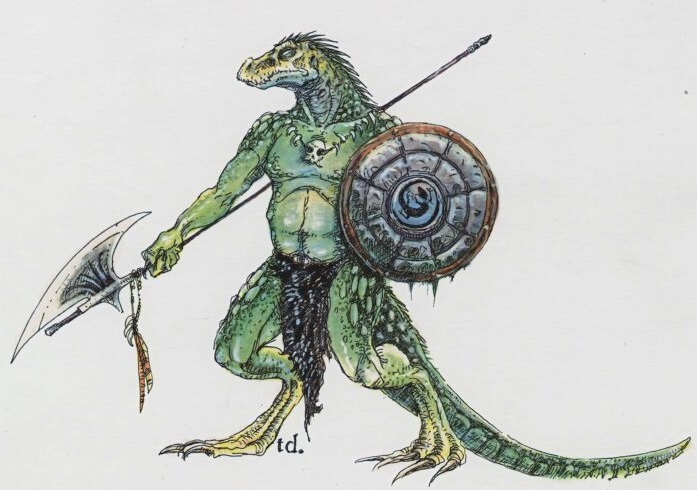
A (Very) Partial Pictorial History of Lizard Men

Lizard men were introduced into Dungeons & Dragons in the pages of its first supplement, Greyhawk (1975). The first illustration of them appears on the inside cover of Supplement I, provided by Greg Bell. As we'll see, this image established the general outlines of what D&D's lizard men look like and nearly all of those that follow will use it as the foundation on which to build their own specific interpretations.

The next time we see a lizard man is the Monster Manual (1977), with artwork provided by Dave Trampier. There's a lot of similarity between Tramp's depiction and that of Bell above, like the tattered loincloth, spiny ridges on the head, and serpentine tongue. This is my default mental image of a lizard man, probably because it's the first one I ever saw. 


In the 1980 Rogues Gallery, Jeff Dee provided an illustration of a lizard man – or, rather, a human who was reincarnated as a lizard man by druidic magic. Aside from the additions of bracers and pirate boots, the latter of which are quite common in Dee's artwork, this looks pretty similar to the work of both Bell and Trampier. 
That same year, Grenadier Models acquired the AD&D miniatures license, producing numerous boxed sets of 25mm figures. One of these sets, Denizens of the Swamp, featured lizard men on its cover by Ray Rubin. The lead lizard man looks almost identical to Trampier's version from the Monster Manual. 
The Sinister Secret of Saltmarsh was published in 1981 and contains this piece by Harry Quinn. Once again, we can see the influence of both Bell and Trampier, though I'd say Trampier has the upper hand. Look, for example, at the skull necklaces the lizard men are wearing, as well as their shields.
The module's immediate sequel, Danger at Dunwater (1982), also features lizard man art, this time depicted by Timothy Truman. Truman's take on the monster is much more bestial and savage.
The same year, the AD&D Monster Cards appeared. Jim Roslof offereed us his take on the lizard man, which doesn't differ all that much from the one found in the Monster Manual. Note again the presence of the skull necklace.
The 1983 Dungeons & Dragons cartoon series featured lizard men several times during the course of its run. Here's a trio of them, one of which (again) wears a skull necklace.

Jim Holloway's depiction of lizardmen in the AD&D Second Edition Monstrous Compendium is notable for downsizing the head and back ridges while also extending them to the end of the tail. Holloway also shortened the snout and shrank the size of the mouth. 

Tony DiTerlizzi's interpretation of lizard men appeared in the 1993 Monstrous Manual. It's very distinctive in many ways, such as the legs. Interestingly, DiTerlizzi gave the lizard man a polearm that looks very similar to the one Greg Bell included in his original illustration. I wonder if this was intentional.
Lizard men are not monsters about which I think a great deal, so it was instructive to take a look at their depiction during the TSR era. While there are undoubtedly many I've not included here – feel free to post your favorites in the comments below – what strikes me most about the ones I have included is how similar they are. Greg Bell laid a foundation in 1975 that Dave Trampier then built upon; all subsequent artists have either directly copied or slightly altered their work.