#OnThisDay 1983: BBC South East at Six explored the magical world of Dungeons & Dragons, with the help of Games Workshop founders Steve Jackson and Ian Livingstone. pic.twitter.com/dxuhI5k2pe
— BBC Archive (@BBCArchive) October 6, 2023

Showing posts with label dever. Show all posts
Showing posts with label dever. Show all posts
Wednesday, November 8, 2023
"No, real life is quite horrible."
Several people sent me pointers to this while I was busy elsewhere last month – thanks to everyone who did so – but it's fascinating enough that I wanted to spread the love. It's a video segment from the BBC regional magazine, South East at Six, devoted to roleplaying games. Originally airing on October 6, 1983, the segment is notable for including interviews with Games Workshop founders Steve Jackson and Ian Livingstone, as well as Gary Chalk and Joe Dever. The segment is short, only a little over four minutes, but it's well worth your time. Take a look!


Friday, December 23, 2022
The Definitive Edition

To do that, Holmgard Press has announced the Definitive Edition of Lone Wolf in the United Kingdom. This edition consists of hardcover books with all new cover and interior illustrations, along with several other improvements and embellishments. There's no word yet as to when (or if) this edition will be released anywhere else in the world, though I hope it will be, since there's a lot of interest in this series outside the UK.
You can find out more about the Definitive Edition and other Lone Wolf-related news at its official website.
Wednesday, August 24, 2022
Retrospective: Lone Wolf
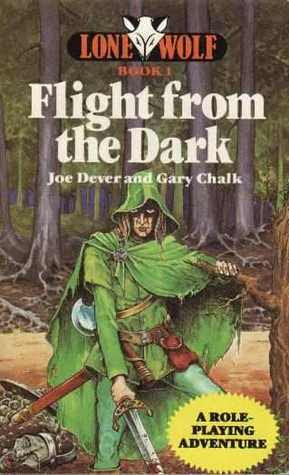 Lately, I've had a great deal of interest in solo fantasy gaming. Though there were plenty of early examples, starting with Buffalo Castle in 1976, the trend toward solitaire adventures really started to pick up steam in the early 1980s, with the publication of The Warlock of Firetop Mountain. The success of that book – and the Fighting Fantasy series more generally – showed that there was definitely a large audience for solo gaming and it wasn't long before innumerable knock-offs and imitators appeared on the scene.
While some of these imitators weren't very good, a few of them stand out in retrospect as having brought something genuinely original and imaginative to the table. Among these is the Lone Wolf series by Joe Dever and Gary Chalk. Like Steve Jackson's Sorcery!, Lone Wolf was a series of connected gamebooks, in which the reader takes on the role of a single character whose adventures form a single narrative. In each of its five books (published over the course of 1984 and '85), the narrative advances toward its conclusion and the character along with it.
The character the reader plays is Silent Wolf, the last surviving member of the Kai, a monastic order of warriors known for their remarkable skills and disciplines. At the start of the first book in the series, Flight from the Dark, the Kai monastery is attacked by flying creatures sent by the Darklords, the eternal enemies of the lands of Sommerlund and Durenor. Silent Wolf only survives because, while his masters and fellow initiates are preparing for a great celebration, he is in a nearby forest collecting firewood, as punishment for his inattention in his lessons. When he returns, it is too late to stop the slaughter and Silent Wolf has no choice but to seek out the king of Sommerlund to warn him of the Darklords return.
In broad outline, the narrative of the Lone Wolf series is broadly similar to that of Sorcery! and indeed of many fantasy novels, with the reader playing a pivotal role in staving off an invasion by evil forces. That's no knock against it, since it makes it immediately accessible to anyone with an interest in fantasy, especially the younger readers for whom this series was likely written. What sets it apart, at least from the perspective of other solitaire gamebooks, is its approach to advancement, which substitutes for more complex experience systems in RPGs.
The Kai possess knowledge of certain disciplines – quasi-magical abilities like healing, mindshield, and sixth sense, that aid him in his quest. To begin, Silent Wolf only possesses a few of these disciplines. However, as he progresses from one book to another in the series, his mastery of the disciplines increases and the reader may select more disciplines to learn. By the end of the series, then, Silent Wolf is much more powerful – and versatile – in his abilities. This is important, as the challenges he faces increase as well. This is another way in which the Lone Wolf series simply but enjoyable replicates the escalating nature of D&D-style fantasy roleplaying games.
Much like the Fighting Fantasy books, Lone Wolf's game mechanical elements are quite simple. There are only two ability scores, Combat Skill and Endurance, both of which are employed primarily when engaged in combat against enemies. Combat is not complicated, but it's more interesting than one might expect in a gamebook. Rather than relying on random rolls, there's a random number table that looks like a checkerboard whose squares all contain a number from 0 to 9. The reader is directed to close his eyes and point a pencil at the table, with the result being wherever the pencil's point lands. The result is then used in conjunction with the ratio of the Combat Skill ratings of both attacker and defender to generate a result. It's not a perfect system by any means, especially since, after a while, one becomes familiar with the layout of the random number table, even when one's eyes closed. However, as presented, the system isn't wholly predictable, which means combat can turn unexpectedly deadly if one is not careful.
All in all, the Lone Wolf series is fairly fun. Each book in the original series of five – there were many more published after its conclusion – has a large number of entries, which opens up a good range of choices to the reader. That's important in solitaire adventures, since they're necessarily more limited than adventures played with actual human beings. Lone Wolf is helped, too, by the evocative artwork of Gary Chalk. The illustrations nicely set the tone of the whole series and blew me away when I first saw them. Like the Russ Nicholson art of The Warlock of Firetop Mountain or John Blanche's illustrations in Sorcery!, Chalk's pieces in Lone Wolf gave these books a unique look unlike anything produced in the USA at the time. British fantasy of the early 1980s was truly remarkable and the Lone Wolf series is yet another example of why.

Subscribe to:
Posts (Atom)