Showing posts with label king arthur. Show all posts

Wednesday, October 1, 2025

Retrospective: The Grey Knight

With October now upon us, it seems only right to turn this month’s Retrospective posts toward the spooky side of the hobby. The challenge, though, is finding something I haven’t already covered. After more than 400 entries in the series, the pickings are slimmer than I’d like. That’s why I’ve decided to start this Halloween mini-series with something a little unexpected and off the beaten path, namely, The Grey Knight for Chaosium’s Pendragon.

Originally published in 1986, The Grey Knight is the first stand-alone adventure for game and, as such, would probably be well remembered regardless of its quality. Written by Larry DiTillio, who'd already penned the classic Call of Cthulhu campaign, Masks of Nyarlathotep, the scenario is, in fact, close to a masterpiece and remains one of the most highly regarded products ever released for Pendragon. Even after nearly four decades, it stands out as a model of what a Pendragon adventure can and should be: part tournament, part quest, part courtly drama and, unexpectedly, part ghost story.

That last element is worth dwelling on, especially at this time of year. Pendragon is not usually thought of as a scary game, yet The Grey Knight shows how easily Arthurian legend can slip into the uncanny. The Matter of Britain is already filled with magic, prophecy, and the otherworldly; DiTillio simply leans into those shadows. His creation, the Grey Knight, feels wholly at home in this tradition. He's a towering figure in blackened plate, with death’s head helm and a charnel aura, less a man than the embodiment of Vengeance itself. His first appearance at Camelot’s Easter tournament, heralded by lightning and an unnatural chill, sets a tone of dread that lingers throughout the adventure.

The tournament scene is only the beginning. When the mysterious Lady in Black accuses Arthur of past misdeeds and demands the king defend his honor by facing her own dark champion, Sir Gawaine immediately offers to stand in his liege's place. The duel is delayed for six weeks, giving Arthur’s knights, which is to say, the player characters their true task: to recover a legendary whetstone, one of the Thirteen Treasures of Britain, without which Gawaine cannot hope to triumph against the Grey Knight.

What follows is a masterful blend of the game’s strengths, from the thrill of jousts to the intrigue of courtly politics to the strangeness of myth-haunted locales. As in the finest Arthurian tales, the familiar and the fantastic are inseparably entwined. Beneath the story’s supernatural trappings lies a very human injustice, festering until it bursts forth in the shape of the Grey Knight, a wrong that will not stay buried.

This is what makes the scenario such an effective fusion of Pendragon’s themes with horror. The supernatural here is not mere ornamentation but the outward sign of a moral wound at the heart of Arthur’s reign. The Grey Knight is terrifying not simply because he cannot be easily defeated, but because he reveals how even Camelot’s highest ideals, like honor and justice, can be obscured by shadow. Still, The Grey Knight is more than a ghost story. It is also an exemplary showcase of Pendragon’s range as a roleplaying game. Every type of knight, from the pious to the glory-hungry, is given a chance to shine.

It is no surprise, then, that The Grey Knight has been reprinted and revised more than once. It set a standard for what a Pendragon adventure could be. At the same time, its central antagonist, the armored challenger rising from beyond the grave to demand satisfaction from Arthur’s court, is a reminder that the tales of Arthur and his Round Table have always been touched by darkness. 

This October, as I try to find something new to say about horror in roleplaying, The Grey Knight is a great place to start. As an adventure, it proves that the supernatural need not be grotesque or Lovecraftian to unsettle and that even games as heroic and inspiring as Pendragon can still be used to unsettle and discomfit. Its horror lies in the intrusion of the uncanny into a world otherwise governed by honor, passion, and destiny. By showing how the fantastic can tilt into the eerie without ever leaving the chivalric frame, it opens a door to a different kind of horror, one that lingers precisely because it feels both out of place and inevitable.

Wednesday, April 10, 2024

Retrospective: Prince Valiant: The Story Telling Game

When I was kid, I always looked forward to the Sunday edition of the local newspaper, because it had this enormous color comics section. Truly, there were dozens upon dozens of these strips – everything from Peanuts to Garfield to Hagar the Horrible and more. Also present were a number of "old" comics, like Mark Trail, Apartment 3-G, and Mary Worth, whose continued presence baffled me. Who read these comics? Certainly not I, nor any of my childhood friends. 

However, there was one "old" comic that I often did read: Prince Valiant. I did so partly because of the comic's subject matter, Prince Valiant was set, as its subtitle proclaimed, "in the days of King Arthur" and I had long been a devoted fan of Arthurian legendry. Furthermore, Prince Valiant was beautifully drawn and had a very – to me – strange presentation. There were no speech balloons or visual onomatopoeia, just lots of text arranged like storybook. 

I was never a consistent reader of Prince Valiant, but, when I did take the time to do so, I almost always enjoyed it. There was a sincerity to the comic that I appreciated as a youngster, as well as an infectious love of heroism and romance (in all senses of the term). I wouldn't say that Prince Valiant played a huge role in my subsequent fondness for tales of fantastic adventure, but there's no doubt that it played some role, hence why I took an interest in Greg Stafford's 1989 roleplaying game adaptation when it was released.

Stafford is probably best known as the man behind Glorantha, the setting of RuneQuest. For me, though, Pendragon will always be his magnum opus – and one of the few RPGs I consider "perfect." Consequently, when I eventually learned of the existence of this game, I was intensely interested. How would it differ from Pendragon? What specifically did it bring to the table that justified its existence as a separate game rather than, say, a supplement to Pendragon? These are questions whose answers I wouldn't learn for quite some time. 1989 was something of a tumultuous year for me; I was busy with other things, and it'd only be sometime in the mid-1990s that I would finally lay eyes upon Prince Valiant.

The most obvious way that Prince Valiant differs from Pendragon is revealed in its subtitle: "The Story-Telling Game." Now, some might immediately think that, in this instance, "storytelling" is simply a synonym for "roleplaying" and you'd be (mostly) right – sorta. The important thing to bear in mind is that Prince Valiant is intended as an introductory game for newcomers to this hobby of ours. Consequently, Stafford tries to use common sense words and concepts that aren't rooted in pre-1974 miniatures wargaming culture. Hence, he talks about "storytelling" rather than "roleplaying" and "episodes" rather than "adventures" or "scenarios" and so forth. The result is a game that's written in a simpler, less jargon-laden way than was typical of RPGs at the time (or even today).

At the same time, Stafford's use of the term "storytelling" isn't simply a matter of avoiding cant. Prince Valiant is, compared to most other similar games, intentionally very simple in its rules structure, so that players can focus on the cooperative building of a compelling narrative set in Hal Foster's Arthurian world. Additionally, the game provides the option of allowing even players to take over the story-telling role within an episode, setting a new scene or introducing a new character or challenge. The chief storyteller, which is to say, the referee in traditional RPGs, is encouraged not to ignore these player-inserted story elements but instead to run with them, using them as a way to introduce unexpected twists and turns within the larger unfolding narrative. 

The other clear way that Prince Valiant differs from Pendragon is its rules, which can fit on a single page. This makes them easy to learn and remember, as well as to use. Unlike more traditional RPGs with their assortment of funny-shaped dice, Stafford opted in Prince Valiant to use only coins. For any action where the result is not foregone, a number of coins are flipped, with heads representing successes. The more heads flipped, the better the success. In cases where a character competes against another character, such as combat, successes are compared, with the character achieving the most successes emerging victorious – simplicity itself! 

Last but certainly not least, Prince Valiant differs from Pendragon because of the pages upon pages of beautiful artwork derived from the comic. Not only does this give the game its own distinctive look, it also highlights its adventuresome, Saturday matinee serial tone in contrast to the heavier, occasionally darker tone of Pendragon and the myth cycles on which it drew. That's not to say Prince Valiant is unserious or "for kids," only that it's a fair bit "lighter" than its "big brother" and thus probably more suitable for younger and/or less experienced players. In that respect, it makes an excellent first RPG.

It's worth noting, too, that the bulk of Prince Valiant's 128-page rulebook is made up not of game mechanics but of advice and tools for players and storytellers alike. Stafford quite obviously distilled the lessons he learned from his many years of playing and refereeing roleplaying games, presenting them in a conversational, easy-to-understand way. Indeed, I've met many people over the years who've claimed that Prince Valiant's true value is not so much as a game in its own right, despite their affection for it, but as an introduction to roleplaying. True though this is, it's also undeniably an excellent game that I'd love to play some day.

That's right: I have never played Prince Valiant and am not sure I ever will. The copy I read years ago was owned by someone else and I've never found a used copy at a reasonable price. I recall that there was an updated or revised version published a few years ago. It doesn't appear to be available through the Chaosium website, alas. Mind you, I certainly don't lack for good RPGs to play; it'd just be great to give this classic one a whirl one day.

Friday, April 22, 2022

King Arthur's Knights

Looks like it's time to add another Arthurian game to the list of those I never owned. In this case, I never even heard of it. In fact, I can't even recall seeing any evidence of its existence in the Chaosium catalogs that came in the company's boxed sets during the early 1980s (or I somehow missed it). 

In any case, it seems that Greg Stafford designed a competitive boardgame based around the legends of King Arthur and the Knights of the Round Table, which was published in 1978. Does anyone reading this reading post own or, alternately, has anyone ever played it? I'm curious to know a bit more about it, particularly the extent to which it has any design similarities to Pendragon. 

Thursday, April 21, 2022

Once There Was a Spot

About two weeks ago, I asked readers to comment on roleplaying games they'd never played but wished they had. The responses were quite interesting and I'd like to thank everyone who took the time to comment on the post. Reading through them, one of the RPGs that was among the most commonly mentioned was Chaosium's Pendragon. Seeing the name of Greg Stafford's masterpiece mentioned so often warmed my heart. I'm incredibly fond of the game and am currently a player in a Pendragon campaign that's been running for more than a year now. However, I must admit that I often wonder how well known the game is outside of the circles in which I move. I'm generally of the opinion that Pendragon deserves to be better known, since it's one of a handful of roleplaying games I'd judge to be "perfect."

I'm not being hyperbolic when I call Pendragon perfect. I have a couple of good reasons to think this, reasons that have the benefit of having been repeatedly put to the test in multiple campaigns I've refereed or played in over the decades since the games original release in 1985. The first is straightforward: its rules are simple yet evocative. More than that, they actively encourage players to get into the mindset of Arthurian legendary characters – and do so without the necessity of having to engage in amateur thespianism. The personality traits and passions system really does make it easier for players to get into their characters' heads in a way that leads to play reminiscent of what you read in Malory. 

The second – and more substantial – reason I call Pendragon perfect is its built-in campaign structure. I've been harping on the joys of long campaigns since I returned to this blog almost two years ago. In discussing this matter with others, a common objection is that it's "too hard" to keep a campaign going for years on end, for both creative and logistical reasons. While I don't believe this is true (obviously), I do understand why someone who hadn't successfully been involved in a long campaign might think it was. That's the beauty of Pendragon: the game already does a lot of the heavy lifting for you. The rulebook provides a complete outline of decades of in-game events, from the end of Uther's reign to the fall of the death of Arthur. This is more than enough scaffolding for even a novice referee to build a sprawling, multi-generational campaign that would take, literally, years to complete, especially if you include the additional detail of supplements like The Boy King. 

Pendragon assumes that player knights will undertake only a single significant adventure during the course of a year. The game's use of "adventure" is similar to that used by Malory in Le Morte d'Arthur, meaning a major event or confrontation. When combined with the timeline of Arthur's reign the game outlines, the referee is easily able to set events in motion, with the characters providing additional momentum through their own actions, choices, and alliances. As the knights marry, have children, assume greater responsibilities, and eventually die, there's plenty of scope for all manner of drama and intrigue. After a few game years, a Pendragon campaign practically runs itself, making it an ideal vehicle for referees with little experience of long campaigns.

As I said, I'm currently playing in a Pendragon campaign and having a great deal of fun. My first knight. Sir Adtherp, is nearly 40 years old now, having served first the Earl of Salisbury and then Arthur for close to two decades. He has several sons but none are yet old enough to replace him, so I expect, barring an unexpected turn of events, I'll be playing him for several more game years at least. On the other hand, if events should claim Adtherp's life, he has brothers whom I could play until Adtherp's sons come of age, or else I could create a new character entirely. Things are always happening in the campaign, which is humming along quite nicely, thanks in no small part to the remarkable design of the game itself, which is why I never cease to sing Pendragon's praises.

Tuesday, January 11, 2022

Knights of Camelot Art

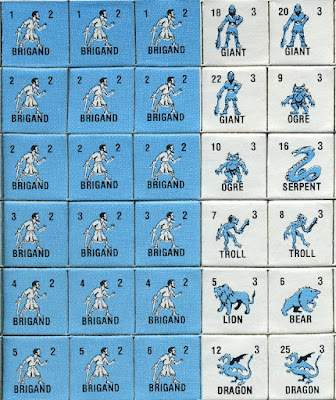
The more I look into TSR's 1980 boardgame, Knights of Camelot, the more entranced I've become by it. Take a look at some of its counters, with art that looks to me like the work of Dave Sutherland:

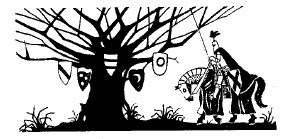
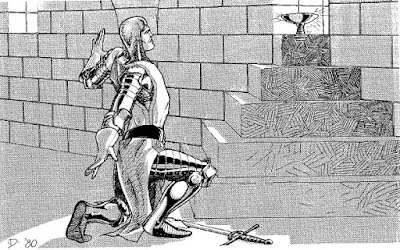
Mind you, I have an inordinate fondness for counters, so perhaps not everyone will be as impressed as I am. In that case, here are some interior illustrations for your delectation:

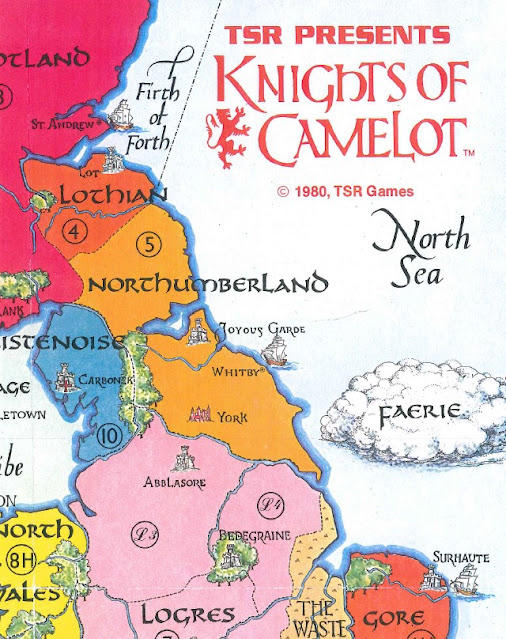
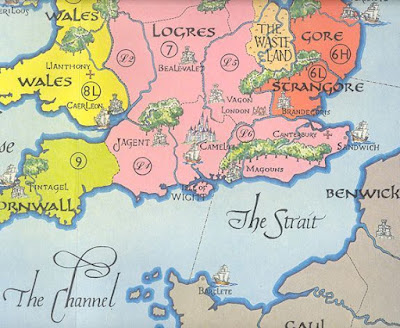
If you're a fan of TSR's artwork from that remarkable period between 1979 and 1982 as I am, this is like catnip. Darlene's map, which serves as the game board, is similarly eye-catching.
What a terrific looking game this must have been! I wish I'd seen a copy back when it was originally released. The legends of Arthur and his knights played a huge role in my early introduction to the hobby, so I imagine I would have enjoyed this game as much as I did Greg Stafford's masterful Pendragon.

Thanks, once again, to Thaddeus Moore for providing me with these images.

Monday, January 10, 2022

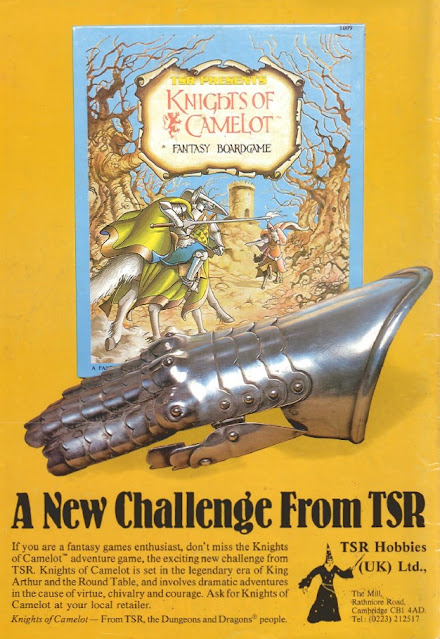
A New Challenge from TSR

One of the things that strikes me about some of the game companies of my youth, like TSR, is how many different games they produced – so many, in fact, that, even a TSR fanboy like myself, couldn't keep up with them all. I owned (and played) most of TSR's RPGs and many of its boardgames, but there were still several that escaped my grasp.

I was reminded of one of them, Knights of Camelot, when I saw this advertisement on the back cover of White Dwarf #22. Was this ad unique to the UK market? If it wasn't, I never saw it prior to this point. Mind you, I never actually saw Knights of Camelot itself outside of the pages of TSR's "Gateway to Adventure" catalog. That's odd, because my local area had excellent distribution of gaming products generally and it was rare that at least one of the game or hobby shops I frequented didn't stock a given product. Judging from the exorbitant prices of used copies of the game, I'm guessing its print run might have been small.

This is a pity. In looking into the game, Knights of Camelot seems quite interesting. For one, it's designed by Glenn and Kenneth Rahman, who are probably best known for another TSR design, Divine Right. For another, it's illustrated by Jeff Dee, Dave Sutherland, Dave LaForce, and includes a map by Darlene that looks quite stunning from the images of it I've seen. 

Looks like I have another game to add to my list of white whales …

Tuesday, November 1, 2011

REVIEW: The Death of King Arthur

The stories of King Arthur and his Knights of the Round Table are probably the most famous tales from the European Middle Ages to survive to the present day. First appearing in recognizable form in Geoffrey of Monmouth's History of the Kings of Britain, written in Latin in the 12th century, Arthur quickly became an "international sensation," especially in France, where later authors spun their own tales of the British king and his companions. Many of these later tales were only loosely connected to Geoffrey's own and were sometimes even contradictory. This is only to be expected given the wide variety of inspirations these other writers drew upon, not to mention the diversity of the audiences for which they were intended. Consequently, by the end of the Middle Ages, the corpus of Arthurian legend was a jumbled mess.

Into this environment stepped Sir Thomas Malory, a 15th century knight of Warwickshire and a member of Parliament, who, during his lifetime, was in and out of prison with regularity for a large number of crimes, including ambush, extortion, robbery, and rape. According to certain allusions he himself makes, it's believed that, while in prison, Malory wrote (or at least began to write) Le Morte d'Arthur -- The Death of Arthur -- an attempt to tell the entire story of King Arthur and his knights under a single cover. To do so, Malory needed to find ways to fit several centuries' worth of conflicting stories together and it's a matter of opinion regarding how well he succeeded. Even so, Le Morte d'Arthur is probably the most famous version of the Arthurian legends, at least in the English-speaking world, where it served as the basis for many later versions, such as Tennyson's Idylls of the King, Sidney Lanier's The Boy's King Arthur, T.H. White's The Once and Future King, and John Steinbeck's The Acts of King Arthur and His Noble Knights, among others.

Malory's original work was first printed 1485 and has been continuously in print for the last half-millennium. To call it a "classic" of English literature is probably an understatement. Of course, like most classics, relatively few people have ever read it, an omission made all the easier for some to justify owing to its archaic English. Though perhaps not as easily intelligible to modern ears as, say, Shakespeare, Le Morte d'Arthur's English is certainly closer to contemporary speech than Chaucer's The Canterbury Tales. For this reason, there's long been a market for "translations" of Malory, which attempt to update its 15th century idiom for modern readers, the latest of which is Peter Ackroyd's The Death of King Arthur.

Ackroyd is an English writer and critic, well known for his biographies of famous Britons. He's also previously penned a translation of The Canterbury Tales, which at the very least indicates his familiarity with the process he's undertaking in The Death of King Arthur. In "A Note on the Text," Ackroyd describes his method of translation thusly:
In my translation I have changed the name of the text from Le Morte d'Arthur to The Death of King Arthur; this gives a more accurate summary of its contents. I have tried my best to convert Malory's sonorous and exhilarating prose into a more contemporary idiom; this is a loose, rather than punctilious, translation. I have also chosen to abbreviate the narrative in pursuit of clarity and simplcity. I hope that by these means the essential story of Arthur and his knights emerges more clearly, and that the characters of Camelot are drawn more convincingly. Malory is often rambling and repetitive; much that would have amused and interested a medieval audience will not appeal to a modern readership. I have also amended Malory's inconsistencies. Despite these alterations, I hope that I have been able to convey the majesty and pathos of the great original.
Anyone who reads this blog with any regularity will know that I regard punctiliousness as a virtue rather than a vice in translation -- all the moreso when the "translation" is simply between older and newer speech rather than between different languages. Consequently, I approached The Death of King Arthur with trepidation.

That trepidation was somewhat justified, as Ackroyd's translation is much more than that; it is, as the cover of the book proclaims, a "retelling" of Le Morte d'Arthur. It is a very good retelling, one that is both coherent and often beautiful, but I hesitate to say that it is Malory's tale. Now, my hesitation might, ultimately, be a matter of semantics and my own sense that there's no need to "translate" from 15th to 21st century English. Even as an American, I don't find Malory's English hard to grasp and its rambling and repetitive character is very often the root of the "sonorous and exhilarating prose" that Ackroyd rightly praises. Consider the following passage, which opens the book. Here's Malory's version (using modern spellings):
It befell in the days of Uther Pendragon, when he was king of all England, and so reigned, that there was a mighty duke in Cornwall that held war against him long time. And the duke was called the Duke of Tintagil. And so by means King Uther sent for this duke, charging him to bring his wife with him, for she was called a fair lady, and a passing wise, and her name was called Igraine.
Ackroyd's "translation" reads:
In the old wild days of the world there was a king of England known as Uther Pendragon; he was a dragon in wrath as well as in power. There were various regions in his kingdom, many of them warring one against another, and so it came about that one day he summoned a mighty duke to his court at Winchester. This nobleman was of Cornwall, and he was called Duke of Tintagel; he reigned over a western tribe from the fastness of his castle on the rocks, where he looked down upon the violent sea. Uther Pendragon asked the duke to bring with him to court his wife, Igraine, who had the reputation of being a great beauty. She was wise as well as beautiful, and it was said that she could read the secrets of any man's heart on the instant she looked at him.
Quite the difference, isn't it? Ackroyd's version is by no means unlovely. Indeed, there is poetry in it -- "a dragon in wrath as well as in power," for example -- but it's not really a translation so much as a retelling and indeed an embellishment upon what Malory wrote. I have no problem with that whatsoever, but I'll admit to being baffled as to why Ackroyd considers his book a translation of Malory rather than a new book altogether. Not only do his words differ from those of Malory but he adds details nowhere to be found in the text, such as Igraine's ability to read the hearts of men simply by looking at them. I mention my complaint with some sheepishness, since, as I said, Ackroyd's prose is smooth, vibrant, and often moving. The Death of King Arthur is an excellent introduction to Arthurian legend and even longtime aficionados may find enjoyment in it, but it's not Malory -- or at least it's no more Malory than was T.H. White or John Steinbeck.