Showing posts with label counters. Show all posts

Tuesday, January 11, 2022

Knights of Camelot Art

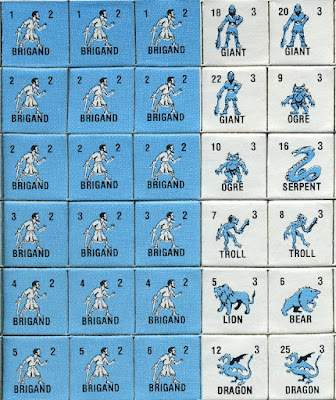
The more I look into TSR's 1980 boardgame, Knights of Camelot, the more entranced I've become by it. Take a look at some of its counters, with art that looks to me like the work of Dave Sutherland:

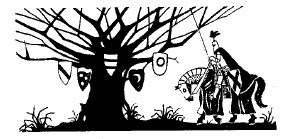
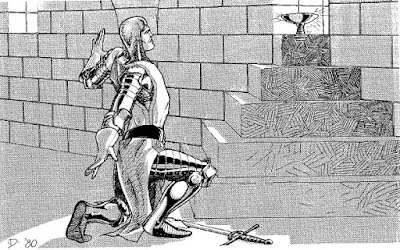
Mind you, I have an inordinate fondness for counters, so perhaps not everyone will be as impressed as I am. In that case, here are some interior illustrations for your delectation:

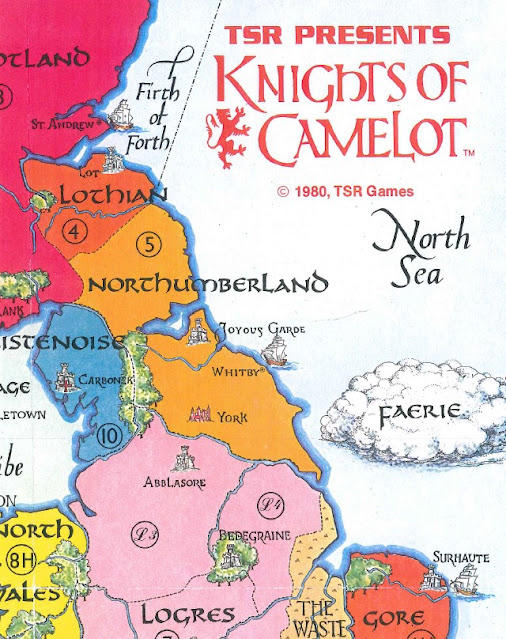
If you're a fan of TSR's artwork from that remarkable period between 1979 and 1982 as I am, this is like catnip. Darlene's map, which serves as the game board, is similarly eye-catching.
What a terrific looking game this must have been! I wish I'd seen a copy back when it was originally released. The legends of Arthur and his knights played a huge role in my early introduction to the hobby, so I imagine I would have enjoyed this game as much as I did Greg Stafford's masterful Pendragon.

Thanks, once again, to Thaddeus Moore for providing me with these images.

Friday, February 12, 2021

Age of Heroes

Along with Revolt on Antares, another of TSR's minigames that I played regularly was Saga: Age of Heroes, designed by Steve Marsh. It's a fun little game about Norse mythology, in which the players play heroes seeking to earn sufficient glory to be welcomed into Valhalla after death. Like all the minigames, it's fairly simple in its design but nevertheless manages to pack a number of fun little wrinkles into it, like runes, magic items, and divine intervention. 

The game is also notable for its artwork, such as these counters, depicting the game's heroes.

There's also this amazing piece by Erol Otus, which demonstrates, as if there were any doubt, that he was capable of far more than nightmare-inducing slime monsters.
The game's map is quite remarkable too, featuring artwork by (I think) Jim Roslof, though I'm unsure whether Roslof is also responsible for the map proper. Regardless, it's a very striking bit of cartography and I can still remember its areas to this day.
There's something incredibly appealing about minigames, not just TSR's but also those designed by Steve Jackson and others: compact, straightforward rules with a minimum of components whose design is still deep enough to hold one's attention for more than a single game. I've thought about designing games like this on numerous occasions and maybe one day I'll get around to it. For now, I'm content to remember how much fun I had with these little games. They deserve more attention than I think they got back in the early '80s when they originally appeared.

Friday, February 5, 2021

Revolting Memories

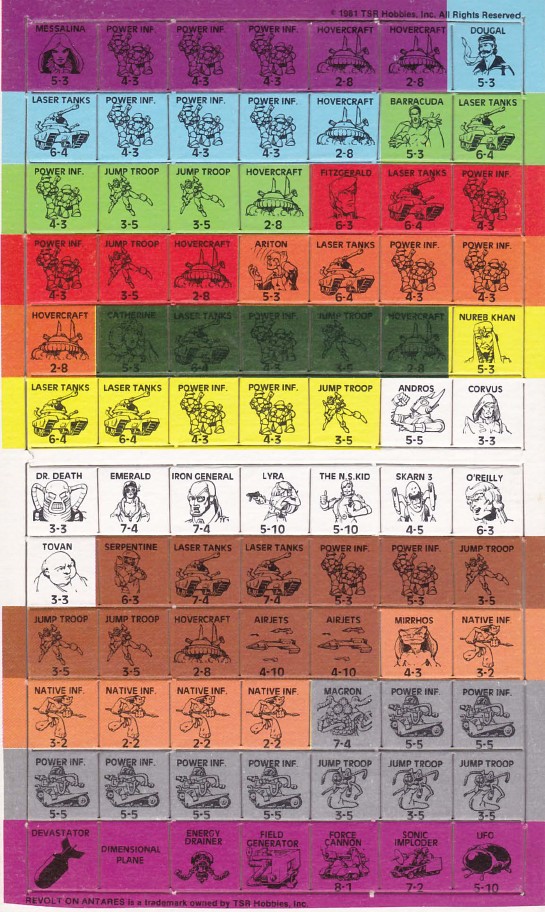
In my youth, I adored the TSR minigames, especially Revolt on Antares, designed by Tom Moldvay and whose counters, depicted above, were illustrated by Jeff Dee. I can't tell you how many times I played this game with my friends while we hung around in someone's basement, waiting for the rest of our group to arrive to play D&D. 

While I enjoyed the straightforward, almost bare bones rules of the game, it was its little setting details that I found most compelling. The leaders of the warring noble houses had names like Black Dougal Mackenzie and Catherine "the Mad" Braganza, while Galactic Heroes carried monikers like Corvus Andromeda and Doctor Death. Silly? Perhaps but they struck just the right pulpy, space operatic tone with me and my young self imagined who these people were and how they related to the distant, ill-described Imperial Terran Empire [sic] that laid claim to Antares 9. 

If nothing else, it's a reminder that it's far from necessary to flesh out a setting in exhaustive detail. Sometimes, just a few evocative names and a piece of well chosen art is enough to do the job – or at least it was when I was a young man. Less can be more.

Tuesday, April 5, 2011

For the Love of Counters

Counter Sheet from GDW's Snapshot
When I entered the hobby in late 1979, its connection to wargaming, especially miniatures wargaming, though more tenuous than it once had been, was still not completely severed. One way that this was apparent was that fact that many boxed RPGs included both cardboard counters and maps among their components, with the expectation that they'd be used to adjudicate combat and movement on the tabletop. Four games I distinctly recall taking this approach were TSR's Gangbusters, Star Frontiers, and Boot Hill and GDW's Traveller, by way of its boxed supplement Snapshot.

My friends and I didn't always use the counters and maps when we played these game but we did so frequently enough that, whenever I think of them, my memories include pushing little pieces of cardboard across a poster-sized map. What's interesting is that, to a lot of people involved in the old school renaissance nowadays, this is anathema, much like the use of miniatures and dungeon tiles/floor plans. Back then, though, we never gave it a second thought, since not only was this the way these games were "supposed" to be played -- otherwise, why else did the games include these components? -- but that's how we saw them and, indeed, many other RPGs being played.

Counter Sheet from Star Frontiers
Even more interesting, I think, is that, lately, I've found myself longing for that way of playing RPGs. Some of it is clearly nostalgia, as I associate those games with a particularly great time in the hobby and my involvement in it. But it's more than that, as it so often is. For me, counters and maps represent a time when publishers and players alike still remembered that RPGs are games, right down to having pieces like both wargames and boardgames. The term "tabletop roleplaying" is of a much later vintage, after computer games calling themselves "roleplaying games" had appeared, but the very existence of the term suggests that, to many people, a tabletop was an essential component to the hobby and not just as a surface on which to roll dice.

I bring this up not just as a trip down memory lane, though I won't deny there's some of that at work in this post. I mention it as a mild corrective to the notions many of us have about the place and utility of miniatures and other similar representations in RPGs. I suspect there's some degree of contrariness at work here, since, in recent years, the use of miniatures has come to be associated with the post-TSR editions of Dungeons & Dragons and in a decidedly negative way. I think that's too bad, if only because I think it further divorces current discussions of old school gaming from part of how these games were played in the past.
Counter Sheet from Universe
And of course, I also wouldn't mind seeing a revival in the use of cardboard counters and maps in old school gaming. I think their use helps to lend a little tactical complexity to things like combat and it helps remind us that there's more to this hobby than sitting around with friends pretending to be an elf. At the very least, the greater use of counters (or miniatures) and maps might go some way toward reminding us all that there's nothing at all antithetical to roleplaying about their use. Indeed, some might find, as I did as a younger man, that their use can contribute greatly to roleplaying. Plus, sometimes it's just fun to push around a little cardboard square to represent your character's grav car as he chases after space pirates on an alien world. What's not to like?