Showing posts with label osric. Show all posts

Monday, April 12, 2021

Before the OSR

I must confess it still baffles me that, even after all these years, the nature of the Old School Renaissance remains a matter of contention in some quarters. Given that, I suppose it should be no surprise that there's no universally accepted start date for the OSR, though I think a good case can be made for 2007 or 2008. I favor 2007 myself, though 2008 is also a good choice, since it's the year in which Gary Gygax died, as well as the year in which old school blogs really exploded in number and influence. 2008 is also, not insignificantly, the year in which the Fourth Edition of Dungeons & Dragons was published and I think we'd be remiss in overlooking 4e as a symbolic Bright Red Line. The OSR owed much of its early energy to the shudders of revulsion many felt at the marketing campaign that presaged Fourth Edition's arrival.

One of the reasons a start date is difficult to pin down is that, prior to both the dates I mention above, no less than three significant rules sets inspired by old school Dungeons & Dragons appeared. To varying degrees, each one exists outside the OSR ecosystem, despite the fact that the OSR owes huge debts of thanks to all three. Without their trailblazing examples, I'm not sure retro-clones would have existed, or, if they had, they might well have appeared later or taken different forms than they did. 

The first of these was Castles & Crusades, first published by Troll Lord Games in 2004. Though I do not play it, I have a personal affection for C&C, since it was my gateway to old school gaming. Like a lot of people, I'd returned to playing D&D in 2000, with the publication of Third Edition. Also like a lot of people, I grew tired of 3e and was looking for an alternative to its ponderousness. C&C was the very first game I checked out in my quest, having been drawn there due to Gary Gygax's association with Troll Lords. The designers of C&C were, I think, among the first people to recognize that Wizards of the Coast's Open Game License (OGL) and System Reference Document (SRD) gave publishers the raw materials from which to rebuild something akin to AD&D

While one can quibble about the final result, C&C was close enough for my tastes at the time that I readily embraced it. More importantly, the game eschewed all the skills, feats, prestige classes, and other cruft that made Third Edition such cumbersome mess. Better still, C&C built up an active, enthusiastic, and imaginative community around itself. Reading the C&C forums was joyous: every other thread wasn't devoted to dissecting the rules or arguing over the best way to "build" a character. People were just playing the game and having fun doing it. As a new refugee from WotC D&D, this was revelatory and I'll always be grateful for it.

Around the same time, I also came across the Basic Fantasy Role-Playing Game (BFRPG), which was first published in 2006. Basic Fantasy takes a similar tack to C&C, in that it leverages the OGL and SRD to recreate a defunct edition of Dungeons & Dragons, in this case, as its name suggests, the Moldvay/Cook/Marsh Basic and Expert rules. BFRPG went farther, in my opinion, than C&C in using WotC's resources to present a game that played like its inspirations. This was important, because it demonstrated just how much could be done with the OGL and SRD if you were determined to do so.

BFRPG is significant in another way. Castles & Crusades was the invention of Troll Lord Games and some aspects of its design, such as the Siege Engine core mechanic, remained proprietary, which limited the ability of third parties to support it. By contrast, everything about BFRPG is completely "open," allowing anyone and everyone to add to it as they wished. Even more, the game's site actively promotes supplements and adventures produced by others, which is the same spirit I associate strongly with the earliest days of the OSR, when ideas flew fast and furious and everyone involved was sharing and promoting one another's wacky ideas. 


Also released in 2006 was the Old School Reference and Index Compilation, better known as OSRIC. The original purpose of OSRIC was to provide a legal framework for the creation of adventures and supplements to support Advanced Dungeons & Dragons. However, because, at the time, AD&D was no longer readily available, except through the second hand market, some gamers began to use OSRIC as its own ruleset, playing it rather than using it for its original purpose. In doing so, OSRIC effectively became the first retro-clone.

OSRIC went far beyond C&C and BFRPG in terms of its willingness to make use of the content of the SRD to recreate an earlier edition of D&D. Indeed, at the time it was first released, there was some concern that Wizards of the Coast might object and take legal action to suppress it. OSRIC was thus the veritable canary in the coalmine. Because no legal action occurred, it emboldened others to follow suit and, within a couple of years, there were many retro-clones released. Without the boldness of OSRIC, that might never have happened.

Nowadays, I don't see as much talk about Castles & Crusades, Basic Fantasy Role-Playing Game, or OSRIC as I once did, but the fact remains that the contemporary OSR owes a great debt to each of these pioneering games. Without them, I doubt we'd where we are today.

Monday, November 7, 2011

REVIEW: Darker Paths I: The Necromancer

If you're an old school gamer, especially if you're preferences tend toward fantasy roleplaying, the last few years have produced a wealth of new material, much of it every bit as good as what we got back in the day. For some, though, it's an embarrassment of riches and they've found it hard to keep up with the steady stream of old school games, supplements, and adventures. That's perfectly understandable -- I, too, find it difficult to stay current -- but it's also unfortunate, because it often means that worthy offerings are overlooked.

A good example of such an overlooked offering is Joseph Bloch's Adventures Dark and Deep. ADD, as you might guess from its acronym, is a fantasy RPG inspired by Advanced Dungeons & Dragons. More specifically than that, it's a speculative RPG intended to provide one possible answer to the question, "What might AD&D's second edition have looked like if Gary Gygax had remained at TSR to complete the project himself?" Answering that question is certainly a huge undertaking and some might even think a quixotic one, but Bloch demonstrated a great command of both first edition AD&D and, perhaps more importantly, Gygax's public statements on how he intended to revise that game for a new edition. The end result is a game that I think does justice to the "what if?" question posed above.

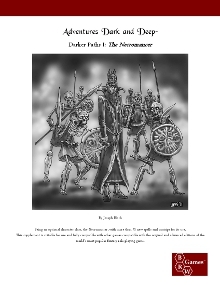
Darker Paths I: The Necromancer is a 24-page PDF supplement to ADD, providing a new sub-class of the mage. The necromancer is, of course, restricted to evil aligned characters, as well as to humans and dark elves. This will limit its appeal to many players, though evil PCs are a longstanding tradition of the hobby. Even if the sub-class sees little use by players, it's still quite useful to the referee in creating adversaries to use in adventures. As written, the necromancer functions much like an ordinary mage; its two primary differences are its ability to affect (i.e. turn or control) the undead and its unique spell list.

That unique spell list encompasses nearly 100 spells, most of them original to this product. With so many new spells, it's fair to say that they take up the vast majority of The Necromancer's word count. I didn't personally find that to be a problem, since I thought many of these spells were quite clever and I'll be gleefully swiping them for Dwimmermount's own version of the necromancer. More impressive, though, is the way that these spells feel very much like they were products of post-Unearthed Arcana AD&D. Moreso than the spells in the Players Handbook, the spells of Unearthed Arcana have long struck me as being imbued with a specific flavor that undoubtedly stems from Gygax's peculiar take on fantasy. Some of that same peculiarity is on display here, too, in spells with names like funeral shroud, empty tomb, conqueror worm, and span of the mayfly. It's a great collection of new spells and well worth the $5.00 cost of the PDF, even if you play something other than ADD (or AD&D or OSRIC).

Darker Paths I: The Necromancer is a well-done and useful product. It's definitely a niche product, primarily of interest to old school fantasy gamers looking to expand their repertoire of magic spells and the classes that can wield them. If you're among that number, you'll greatly enjoy what Joseph Bloch has produced here.

Presentation: 7 out of 10
Creativity: 8 out of 10
Utility: 7 out of 10

Buy This If: You can't get enough new sub-classes and spells or you're looking for a well-done necromancer class to use with your class-and-level fantasy RPG.
Don't Buy This If: You've got more than enough spells and sub-classes or would rather that necromancers not be treated as a unique class.

Tuesday, September 27, 2011

OSRIC Players Reference Available

As impressive as the current release of OSRIC is -- especially in its Black Blade Publishing version -- it's probably a little too impressive to be used as a player's reference book. At nearly 400 pages, OSRIC includes a lot of material intended for use by the referee rather than by players. That's where the OSRIC Players Reference comes in. It strips OSRIC down to the 140 pages that players require to generate characters and to play the game at the table.

You can get the PDF version of the book for free at the link above. Alternately, you can get a print version from Lulu.com in either a regular or pocket size. Both are inexpensively priced and for use with the current version of the hobby's first retro-clone. If you're using OSRIC at your table, the Players Reference is definitely worth taking a look at.

Thursday, June 30, 2011

Mail Call

Mail service having resumed this week after a two-week strike, I've been receiving a number of packages that had been trapped in limbo. One of them was the Black Blade edition of OSRIC, which, so far as I know, is nearly identical, content-wise, to its predecessor, but is much more sturdily bound and contains more artwork.

Here's a shot of the cover.
Looking at its spine, you can see this one is one thick (386 pages) and solid tome.
And here's just one of the new pieces of art included in the book (by Brian "Glad" Thomas).
All in all, it's an impressive package, all the moreso because it sells for a mere $26.00. I'm not much of an AD&D guy these days, but I can't deny that, reading through this today, I felt some of the same electricity I feel when I first opened up my Players Handbook way back when. I'll be talking more about this edition of OSRIC in the days to come; it really is a remarkable piece of work.

Sunday, April 3, 2011

Black Blade to Publish Castle of the Mad Archmage

Looks like Black Blade Publishing is undertaking the most ambitious megadungeon project to date by publishing Joe Bloch's Castle of the Mad Archmage, including two new levels (which brings the total levels to 14). While there have been other megadungeon projects prior to this point, what makes this one especially interesting to me is the format Black Blade has chosen to adopt for its publication:
  • A 220-240 page hardcover containing the encounter keys and level by level detail for all 14 levels
  • Full-color poster maps on heavyweight stock for all 14 levels
  • A folio or folder to organize and store the poster maps when they're not in use
  • A deluxe box or slipcase for storing both the level key hardcover and the map folio with all of the poster maps
I can't recall a megadungeon product that ever gave so much thought to its physical presentation, which, I think, combined with the terrific creativity of Joe's megadungeon (especially the maps, which are just awesome), will make this one of the stand-out products of the old school renaissance. I honestly can't wait till it's released.

Wednesday, October 13, 2010

REVIEW: The Sanctuary Ruin

The Sanctuary Ruin by Eric Jones is the first adventure module released by Ludibrium Games. Like James Raggi's adventures, it's not written for a specific old school fantasy game system, although its text references both Labyrinth Lord and OSRIC as examples of the games for which it was written. Judging from the actual stats included in the adventure (which are few), I'd say that The Sanctuary Ruin was written using Labyrinth Lord for its rules, but it could easily be used for almost any class-and-level system.

The Sanctuary Ruin is available as a 10-page PDF selling for $2.99 or as a similarly lengthy printed volume selling for $6.99. The module's layout is simple and clean, using two-columns broken up with some atmospheric black and white spot art, also by Eric Jones. The cartography is similarly unpretentious and attractive. The text itself is straightforward, clear, and free from any obvious editorial problems. From a purely technical point of view, The Sanctuary Ruin is very well done.

As its name suggests, this module describes a ruined sanctuary not far from a wayshrine in a wilderness area known as the Ironwood within the Margravate of Blackmarch, which would appear to be Ludbrium Games's house setting. Not many details are provided about the Margravate or the Ironwood, making it easy for referees to drop the dungeon and surrounding locales into another setting. Indeed, the bulk of this module is taken up with the eponymous ruin, so it's really a dungeon module rather than a wilderness one, never mind a sandbox. Given that it's designed for characters of levels 1-3, that only makes sense.

The dungeon is small, consisting of 20 rooms inhabited primarily by goblins and vermin. Like everything else in this product, it's well presented and straightforward, but it lacked a hook or unique angle that made it stand out from the many other humanoid lairs I've seen in other adventure modules over the last 30 years. The same must be said of the inn, the rumors, and the wilderness encounters also included with this module and I feel bad for saying so, because The Sanctuary Ruin is well written and presented. Reading it, you can tell that its author really took his time to get everything right and he largely succeeds.

Unfortunately, what Eric Jones got right is something lots of other people have gotten right repeatedly since the dawn of the hobby. This is a standard introductory adventure and, while I can appreciate that not everyone who starts a new campaign will want to press The Keep on the Borderlands or The Village of Hommlet into service for the umpteenth time, it becomes increasingly hard for me to get excited about yet another humanoid lair on the borders of civilization, even if it's presented as lovingly as The Sanctuary Ruin is. Of course, newcomers will likely have a different reaction, particularly those who aren't as jaded as I am when it comes to the old standbys of introductory dungeons. For old timers, though, there's not a lot that makes The Sanctuary Ruin noteworthy other than its excellent production values and the obvious care to which its creator went to create it. Here's hoping we see more work from Eric Jones in the future and it will be a bit more daring in its content.

Presentation:
8 out of 10
Creativity: 5 out of 10
Utility: 6 out of 10

Get This If:
You're either new to old school gaming and looking for a well-done intro module or are an old hand who simply wants a different presentation of the classic humanoid lair dungeon module.
Don't Get This If: You had your fill of humanoid lair dungeons decades ago.

Thursday, September 16, 2010

REVIEW: Old School Magic

Old School Magic is the latest PDF by Charles Rice, a 29-page supplement for OSRIC introducing nine new magic-using classes and new spells for use by them. Unsurprisingly, it's a very meaty product, with nearly every one of its two-column pages devoted to the presentation of mechanical material. About 5 pages pertain to more "philosophical" subjects, including rebuttals/defenses of Rice's approach to design against criticisms I've made in past reviews (at least I think they're directed toward me, but then, as we all know, I think everything's about me, right?). I'll address those sections later in this review. First, I'd like to look at the new classes and spells Old School Magic introduces.
  • Alchemist: This would appear to be the very same class I reviewed in an earlier product and my feelings about the class remain much the same.
  • Artificer: An interesting but very weak class, devoted to the crafting of magic items. Members of this class have no ability to cast spells but instead imbue items they construct with such magic. This struck me as more appropriate as an NPC class.
  • Conjurer: A magic-user specializing in summoning creatures to battle on his behalf, the conjurer consequently has a very limited selection of spells. As members of this class advance, their summoned creatures become more powerful and numerous, but summoning is their sole magical ability. I found this class rather weak as well, especially given that its XP requirements are the same as standard magic-users.
  • Elementalist: Another specialist magic-user with a limited selection of spells, the elementalist is at least potent within his sphere. I very much like the idea of this class, even if I'm not sure about its implementation here.
  • Hermit: Again, another great idea -- a solitary divine spellcaster whose austere lifestyle grants him remarkable proficiency with divination and healing -- that I don't think gels quite right. In any event, this is another class that strikes me as more appropriate for NPCs than adventurers.
  • Holy Man: This is an alternative class to the cleric in low magic campaigns, focusing on fighting undead and medicinal knowledge.
  • Naturalist: Another alternative class, this time for the druid, the naturalist is a kind of cunning man with knowledge of the wild places of the world.
  • Sage: This is a nice expansion of sages as presented in Supplement II and the Dungeon Masters Guide, with lots of useful abilities, but, again, I have a hard time seeing him as an adventurer.
  • Seer: Another specialist magic-user with a limited spell list, this time focusing on detection and divination. The seer's only unique ability is its resistance to illusion, which give members of the class a greater chance of seeing things as they truly are.
As you can see, all of Old School Magic's classes fall into two categories: intriguing non-adventuring classes (some of which don't quite match up with AD&D/OSRIC's implied setting) and highly specialized -- but underpowered -- adventuring classes. The non-adventuring classes are, by and large, very well done; they're flavorful and channel recognizable fantasy archetypes, but I have a hard time imagining a player choosing to create any of them as a character, as they're more "stay at home" types. The adventuring classes are all more or less "specialist wizards," to use 2e parlance. However, they all pay for their expertise in a narrow field by having extremely limited spell selections, which I fear will make them a lot less attractive than the standard magic-user as PC options.

Old School Magic also introduces 31 new spells, most of them intended to fill out the spell lists of the aforementioned specialist wizards. Most of the spells are clever and provide some much needed versatility to the conjurer, elementalist, and seer classes. Unfortunately, there simply aren't enough new spells to put these classes on par with even the illusionist, the lone pre-2e example of a specialist magic-user. Where the illusionist typically has between 8 and 12 spells per level, the specialists of Old School Magic generally have about half that (or less, especially at high levels). Certainly they all get some minor class abilities, like the seer's resistance to illusion, but I'm not sure they make up for the loss of versatility in terms of spell selection, at least not enough that I'd choose to play one over a standard magic-user.

Early in Old School Magic, after discussing "levels of magic" and "laws of magic" (which I'll get to in a moment), Rice takes a couple of paragraphs to answer criticisms made in the past (by me primarily, unless I'm mistaken) about his approach to game design. Rice places himself in the "variety is the spice of life camp," stating that he liked the "wild and woolly" days when publications featured "new classes of every shape and description, some balanced, most not in one way or another, either overpowered or purposely gimped and cordoned off as 'NPC only' classes." That's fair enough and I appreciate his addressing this upfront.

Now, obviously, given my past reviews, his position differs from my own. I am not now nor have I ever been a fan of having a class for everything. That's an approach that, while having a long old school pedigree, I don't care to see revived. But then I'm generally of the opinion that AD&D probably had too many classes, so what do I know? This is an example of a philosophical difference, I suppose. I remember all those classes from the pages of Dragon back in the day and I was generally baffled by most of them. What was the point in having an armorsmith class or a scribe class? They seemed so unnecessary to me. Clearly, not everyone felt the same way, which is why they kept getting created and published, so there's an audience for them, even if I'm not a member of it.

Fortunately, the new classes all contain good ideas and, even though I won't be using any of them in my campaign, I might well re-purpose bits and pieces of them in other fashions. In addition, Rice's discussions of "levels of magic" -- low, medium, and high -- and the "laws of magic" both contain interesting concepts, particularly the latter. He makes suggestions for other approaches to magic that replace or supplement the tradition spell slot system. Again, there are lots of good ideas to be had here, such as mana channeling and astrological magic, that more than justify the $3.50 price tag of Old School Magic, particularly if, like its author, you prefer a smorgasbord of new classes, abilities, and game mechanics in your campaigns. Even if you don't, you still might find some inspiration here for unusual NPC spellcasters; I know I did.

Presentation:
6 out of 10
Creativity: 8 out of 10
Utility: 6 out of 10

Get This If:
You love having lots of different classes in your game or are just looking for a few ideas about spellcasters to pilfer for your own game.
Don't Get This If: You're not a fan of having lots of different flavors of magic-user.

Monday, February 15, 2010

REVIEW: Old-School Psionics

Old-School Psionics by Charles Rice is an optional supplement for OSRIC that presents a psionics system for use with that game. Unlike OSRIC itself, which hews as closely to its AD&D inspirations as possible within the restrictions of the Open Game License and copyright law, Old-School Psionics is a fresh take on its subject matter, a "what if" product in the words of its author. Consequently, the system it presents, while having some elements in common with its 1e predecessor, is largely an original creation. That's frankly a wise decision, as AD&D's psionics, like those in OD&D's Eldritch Wizardry, are an unholy mess that no one I've ever met could use without significant house ruling.

Unlike AD&D psionics, which was intended primarily as an adjunct to the existing class system, Rice instead presents psionics as the domain of a new character class called the mentalist. There are provisions for "wild talents," which is to say, psionic members of other classes but they're supposed to be exceedingly rare and their aptitude with psychic abilities is decidedly lesser. Again, this is a good decision and reminds me of the psionicist class created by Arthur Collins and appearing in issue 78 of Dragon, one of my favorite articles from the magazine back in the day and one I used extensively as the basis for a psionics-based AD&D campaign.

Where Collins's class was tied into the existing AD&D psionics system (albeit with modifications), Rice's mentalist is its own creature, being somewhat like an illusionist who wields psychic abilities instead of spells. These abilities are divided into four disciplines, with the mentalist acquiring greater access to them as he advances in levels. Psychic abilities are cast not from slots but through the expenditure of psionic strength points, the mentalist's pool of which increases with level. The class also gains a few other level-dependent abilities, such as crafting psychic items and traveling to the astral and other planes. As with the previously-reviewed alchemist class, I would quibble with any level-based ability being placed at 20th level, which makes it even less likely to be obtained than mighty spells such as wish, but that may be a matter of taste.

Each of the psionic disciplines has seven levels of abilities, with 3 or 4 such abilities per level. The result is a very tight collection of powers rather than the usual cornucopia I associate with AD&D spells. In this respect, the abilities more closely resemble AD&D psionic powers and their fewer number helps lend a different flavor to them compared to standard magic. They likewise seem to be well matched against magic, being somewhat more potent individually but balanced by the fact that they can be used more rarely, given the number of psionic strength points needed to do so.

Old-School Psionics also includes a number of psionic monsters, many of them old favorites, such as the aboleth, brain mole, and intellect devourer, as well as "new" ones that reinvent D&D favorites that WotC did not include in the D20 SRD. These are all nicely presented and tie into the new psionics system so that they can be used to their full potential. Rounding out the 22-page PDF is an overview of the Nexus Campaign, an extraplanar setting based around the city of Nexus where one can find portals to infinite worlds and whose governance is in the tentacles of the mysterious Unseen Masters, an ancient psionic race.

Retailing for $3.00, Old-School Psionics is well worth picking up, if only for inspiration in constructing one's own psionics system for AD&D, OSRIC, or another retro-clone. The system Rice presents is easy to use and flavorful, feeling sufficiently different from "ordinary" magic that including it in one's campaign would bring something genuinely new to it. That said, I was disappointed that Old-School Psionics does not include a psionic combat system, which was the part of AD&D's psionics rules that were perhaps the most unintelligible -- and the ones I most wanted to find some way to use. As someone who attempted to make sense of it myself, I am deeply sympathetic to Rice's decision to avoid it, but I nevertheless had hoped that a product calling itself Old-School Psionics would have included it. Secondly, unless I somehow missed it (which is possible), there is no discussion of how psionic strength points are regained after being used by a mentalist.

In the end, though, these are quibbles. Old-School Psionics is a solid product and one I'm glad to own. It's a good example of the kind of mechanical material I'd like to see more of: presenting simple but still flavorful rules for subjects that aren't covered in existing retro-clones and simulacra. Here's hoping we'll see a future expansion that tackles psionic combat.

Presentation: 7 out of 10
Creativity: 8 out of 10
Utility: 6 out of 10

Get This If:
You're looking for a straightforward way to add psionic abilities to your D&D game.
Don't Get This If: You somehow understand the original AD&D psionics rules or don't think mental powers belong in a fantasy game.

Friday, January 29, 2010

REVIEW: Supplement #1: The Alchemist

Supplement #1: The Alchemist is a short (5-page, one of which is the cover and another the Open Game License) PDF product by Charles Rice. It introduces a new character class for use with OSRIC, although it could quite profitably be used with almost any old school/retro-clone version of D&D. The PDF is clearly written and cleanly laid out. The cover artwork by Joe Calkins is nice enough, better I think than that included in previous Vigilance Press releases, but it doesn't really suggest an alchemist to me.

The alchemist class is not described as either a player of non-player character class, leaving that up to the referee to decide for his own campaign. That's for the best in my opinion. In the old days, the term "NPC class" was code for a new (probably overpowered) PC class. There was an unspoken assumption that only TSR could create new PC classes and so there was this kabuki dance in the pages of Dragon when it came to clever new sub-classes, which everyone involved knew would be used for PCs, even if no one would admit this outright.

The alchemist is one such clever new class, one that both represents a genuine literary archetype and employs a different mechanical model than any of the existing classes. Unlike, say, the magic-user, the alchemist has no inherent magical abilities, relying instead on various formulae he can make (often at significant cost), such as acids, poisons, and medicines, in addition to the ability to create potions. The effectiveness and extent of these formulae increases with level: low-level alchemists are both limited in their abilities and prone to unpredictability and error, while high-level members of the class are much more powerful. At 20th level, alchemists has mastered the ability of transmutation and, depending on the referee, may attempt a potentially wide variety of changes between materials and states. I'll quibble that this ability is earned at too high a level for an AD&D-style character class, even as I appreciate its openness to individual interpretation by the referee. Regardless, the rules for alchemy are simple without being simplistic and offer a lot of options without being overwhelming.

Interestingly, the alchemist uses the thief combat and saving throw tables, in addition to the thief's Hit Dice and armor selection (weapons are more limited). This called to mind Gary Gygax's proposed mountebank class, albeit without the implications of deceit and quackery. Still, it wouldn't be hard to play an alchemist in that vein, which may explain why I was so taken with it. It's definitely a "non-magical magical class," if you get my meaning, and, as such it might not suit every type of campaign. In a more low-magic, pulp-inspired setting, I can imagine an alchemist being a very useful addition to an adventuring party. Even in a more "traditional" group, the class would have its uses, with acids providing an alternative to lockpicking and medicines to clerical healing, for example, although neither replaces the more potent abilities of those other classes.

I like the alchemist and would certainly allow a player to take it up if he wished to do so, but then alchemy and alchemical-inspired "magic" plays an important role in my Dwimmermount campaign. In the end, I suspect one's reaction to this product will depend greatly on what one thinks about alchemy and how it ought to be presented in a fantasy setting. The Alchemist definitely takes a generally more "mundane" approach, with alchemy being similar to a more fantastical form of chemistry -- a "science," even if it's sometimes less than exact. Again, that may not be to everyone's taste, thus limiting the utility of this product if you don't share a similar perspective. If you do, it's well worth its $1.00 price tag.

Presentation:
6 out of 10
Creativity: 8 out of 10
Utility: 7 out of 10

Get This If:
You'd like expanded -- but not complex -- treatment of alchemy and want a class designed to take advantage of it.
Don't Get This If: You're happy with the existing approach to alchemy and don't see the need for an alchemist class.

Monday, December 7, 2009

REVIEW: Gazetteer of the Canterbury Isles

The Gazetteer of the Canterbury Isles is the first expansion of the World of Arkara setting, which I reviewed last month. Like its predecessor, it is written by Charles Rice for OSRIC, but is readily convertible to any old school fantasy RPG. The Gazetteer is a 16-page PDF, which sells for the eminently reasonable price of $2. The product uses a simple, two-column layout with a high text density. I found it easy to read and noted no significant typos and editorial issues. Artwork is sparse, consisting of a couple of pieces of black and white line art and two maps, one of which is of the Canterbury Isles themselves (seen on the cover image) and another of the City of Bondaea. Both maps are certainly usable as rough guidelines in play but lack a scale, a problem carried over from the original release.

The Canterbury Isles are located in a frontier area to the northwest of the main continent. While this removes them somewhat from the conflicts on the mainland, that doesn't mean they're idyllic. Originally the home of elves and dwarves, the coming of humans has changed the complexion of the land. Once, there was an accord between all the races, but, two centuries later, it has all but evaporated and humans and elves look set to war upon one another, with the dwarves retreating into the earth to avoid being embroiled in such madness. Though perhaps a little clichéd, the political situation in the Canterbury Isles is nevertheless one ripe with adventuring possibilities, at least if one's tastes tend toward political and/or military adventures. Those looking for more "traditional" adventuring possibilities can certainly find them, of course, but the focus of the product is unambiguously on the tensions between elves and humans.

The gazetteer itself briefly details a few areas on the islands, generally giving each two or three paragraphs of information to each, with a couple receiving lengthier treatments. This is, I think, a good level of detail, especially considering the smaller focus of this product compared to its predecessor. Much more detail is lavished on the city of Bondaea, the largest human settlement. Sixty-one locations are at least named within the city and most of them receive at least a short description, although, again, some receive much more (and others much less). The map does number several buildings without keying them so as to allow referees to add their own sites within the city. I think this is an excellent idea, although many of these undetailed buildings are clustered together rather than evenly spread out the city.

The product provides four pages of NPC descriptions, some of them very lengthy, along game stats for the characters in question. I'm not entirely sure how I feel about this. On the one hand, good NPCs are worth a great deal to a referee when designing and running adventures and many of the NPCs here are quite well done, intelligently portrayed and suggestive of how they could be used in a game. On the other hand, many of the NPCs are quite important movers and shakers of the Canterbury Isles. That's to be expected, given the emphasis placed on political machinations in this region of the world of Arkara, but I do think the product would have been better served if at least some of its detailed NPCs had been lower level, serving as examples of how to use the political situation "on the ground" to spark interesting adventures. As it stands, the Canterbury Isles strike me as a place where characters might go after they've already been adventuring a while and are looking for a place to establish their strongholds and begin playing politics -- not a bad thing by any means but one that will hold appeal for every referee.

The product concludes with two new character classes, both of which seem to be NPC-oriented. The first is the guardsman, a fighter variant with the chance to see through illusions, detect poisons and traps, and hear noise. He can also become immune to backstab and interpose himself between an opponent and another character, taking the damage on himself. It's an interesting idea for a class, although I'm not certain it'll hold much appeal for player characters. There's also a cloistered cleric class, which is a more scholarly, less martial version of the cleric. I've always been fond of the idea of such a class, ever since I read Len Lakofka's version in Dragon many moons ago. Ironically, despite its medieval inspiration, I think the variant would probably be of interest to referees to make clerics more like swords-and-sorcery-style priests than the "fighter with magic" approach of D&D.

All in all, I'd say that the Gazetteer of the Canterbury Isles is marked improvement over the original World of Arkara in terms of its focus and presentation. It may be a little too focused for some referees, but that's not necessarily a flaw in the product itself. I continue to hope for better maps in future products, ones with scales if nothing else. And while I don't mind new game mechanics where appropriate, I still can't shake the feeling that new game rules are de rigeur in World of Arkara products, even when there's no compelling reason for them. I'll say again that I think there's a lot of potential in Arkara and I hope Rice continues to produce additional expansions for the setting. I fear that the piecemeal way it's being released doesn't play to its strengths, namely its bare bones approach, but that may change as additional regions receive their own gazetteers and we can better see how they fit together into a greater whole.

Presentation:
6 out of 10
Creativity: 7 out of 10
Utility: 6 out of 10

Buy This If: You're keen on political and military style adventures and campaigns.
Don't Buy This If: You're looking for something a place to set a low-level campaign.

Thursday, November 5, 2009

REVIEW: World of Arkara

World of Arkara: Gazetteer of the Known World is a 25-page PDF written by Charles Rice, which outlines an original fantasy setting for use with OSRIC, along with setting-specific rules variants. Its brevity recalls Gary Gygax's original The World of Greyhawk folio, but its presentation is frustratingly different. The product is divided into three sections, of which the shortest is the actual gazetteer. The other two sections detail the gods of the setting and character options and each is lengthier than the four and a half pages devoted to the physical and socio-cultural aspects of the world.

World of Arkara's layout is simple and readable, which I find a virtue in a hobby whose products frequently have unnecessarily "busy" layouts. There are only a handful of illustrations -- four, to be precise -- and all are quite serviceable, if not particularly interesting. There is a single map of the setting included, which is unfortunately lacking a scale, making it hard to tell just how far apart its continents and islands are from one another. Similarly, nothing on the map is labeled except for various kingdoms and regions, not even the mountains, forests, and occasional river that are detailed. This makes the map next to useless except in giving a very vague sense of things: "The Battlegrounds are north of the Shadow Realm" and so on. The text itself is reasonably clear and I noticed no significant editorial issues that affected my ability to read the product.

The first section of the book runs seven pages and details the three pantheons of Arkara: the Pantheon of Light, the Pantheon of Darkness, and the Gray Pantheon, each associated with a particular ethical alignment grouping, namely good, evil, and neutrality respectively. Each deity write-up includes useful details, such as sacred animals, holy days, clerical vestments, and so on. In addition, clerics of each god have access to certain additional spells normally usable only by another spellcasting class, such as charm person in the case of clerics of Asteria, the goddess of love, beauty, and marriage. The Pantheon of Light is the largest of the three, but none of its deities are described beyond the little details I noted earlier. Meanwhile, the gods of the Pantheon of Darkness are fewer in number and each gets a paragraph or more discussing their religion and role in the world. The Gray Pantheon is the smallest of the three and is treated similarly to the Pantheon of Light in terms of detail.

The second section of the book runs four and a half pages and presents an overview of the realms and regions of Arkara. Each realm or region is given a description that runs for at least one paragraph, but most get several more. This presents the most basic information about each locale, along with some snippets of history, and who (if anyone) rules the area in question. This section is something of a mixed bag. Some areas struck me as too thinly detailed about which to gain any impression, while others inspired ideas in me. Most of them suffer, in my opinion, from having fairly banal names -- Chariot Highlands, Fire Island, Realm of the Sun King -- which made it hard to get a feel for Arkara. Creating good names is difficult and there's no consensus on what constitutes a good name, but I found myself wishing there was a bit more "punch" to Arkara's naming conventions, which came across to me as rather bland.

The third section of the book is devoted to characters and includes one new character class, the Crusader, and options for "tweaking" existing classes. The Crusader is a bit like a weaker paladin without alignment restrictions. The class lacks spells but can heal, turn undead, and gains bonus damage against Crusaders of opposing orders. While I see nothing wrong with the class, it seemed somewhat superfluous to me, at least without more setting-based context. Class variants include the Anti-Paladin (Paladin), Bounty Hunter (Ranger), Hunter (Ranger), and Poacher (Ranger). Each of these drops or alters existing abilities so as to offer a slightly different take on the original archetype. There's also a section on "Character Class Flavor" that provides some setting-based context for the standard classes. This was welcomed, although, again, it's a mixed bag, with some classes, like the magic-user, getting many paragraphs of detail, and others, like assassins or druids, receiving very little. Concluding the section is a social class and advancement system and a discussion of crime and punishment. An appendix provides some details for players wishing to use OSRIC Unearthed in Arkara.

In the end, I'm left with very mixed feelings about World of Arkara. There's definitely potential here, but that potential hasn't yet been fulfilled. For a product calling itself a gazetteer, there was too little information on the world itself. I know that Rice plans to do a series of follow-up products that focus on each of the realms/regions -- one is already available and will be reviewed here soon -- but I nevertheless think the initial product should provide more information than it does on this score. As it is, there's not enough to grab me and make me want to use this setting, particularly given the weakness of the map, which is simply too undetailed to be usable.

Similarly, I think there are too many new rules and rules tweaks presented here. While I do like the clerical spell options, which reminds me of The World of Greyhawk, the additional character class and variant classes are unnecessary and took up space better spent on fleshing out the setting. It's here, I think, where Rice's background as a D20 writer shows most clearly. The D20 market was very "crunch-heavy" and its fans demanded new rules and rules variants. That's not (generally) the old school approach, where new rules and rules variants are introduced sparingly and as needed rather than according to some a priori plan.

World of Arkara sells at $3.00, which is a fair price for what you get. For an additional dollar, you can purchase a bundle that includes this product, a regional description of the Canterbury Isles, and an adventure. That's a very good deal, even considering my qualms about the initial release. For my part, I'll reiterate that I think the Arkara setting has potential and it will be interesting to see if Rice can fulfill it. I nevertheless do think this product could have been stronger than it is and hope there will be a revised and expanded edition in the future.

Presentation: 6 out of 10
Creativity: 6 out of 10
Utility: 5 out of 10

Buy This If: You're looking for a sketch of a setting you can loot for ideas.
Don't Buy This If: You're looking for a latter day World of Greyhawk-style folio product.

Thursday, October 15, 2009

The Primary Activity in Adventures

Though I tend to speak more these days about OD&D and its retro-clones. I should state upfront that I am a big fan of OSRIC. I own a hardcover version of its rules and remain in awe of its magnificence. What it lacks in High Gygaxian charm, it more than makes up for in clarity and keen insight. A good case in point is the following passage I read just the other day:
OSRIC is a game of adventure, and the primary activity in adventures is exploration. Even though the rules for combat take up more space in this rulebook, play tends to focus more on exploration than combat. Whether the party is investigating an old ruined shrine, delving into an abandoned dwarfish mine, traversing an unknown wilderness, sailing uncharted waters, or venturing beyond the physical world into the planes of existence, exploration is central to adventure and thus to the game.
That right there is probably one of the most spot-on descriptions of what Dungeons & Dragons is about that I have ever read. I think the degree to which that description resonates with you is probably a good gauge of your sympathy for the Old Ways.

Tuesday, October 6, 2009

XRP Hardcopy Sale

Expeditious Retreat Press is having a hardcopy sale for the OSRIC-compatible Advanced Adventures line of modules, making it a good time to pick up some of their excellent products. I've been considering buying the monster book, Malevolent and Benign, for some time; I might finally take the plunge now that it's on sale.

The sale lasts through the month of October.

Friday, September 18, 2009

OSRIC Supplemental: Open Call for Contributors

Kellri posted the following over at his blog:
Preliminary work is getting under way on the Knights & Knaves Alehouse for a new book tentatively entitled the OSRIC Supplemental. Discussion right now is centered on what material will & should be covered - including wilderness travel & hazards, planar cosmology, magic item & spell creation, mass combat, strongholds, aerial combat, sample dungeon maps and more.

In keeping with the spirit of OSRIC, this will be entirely an open collaborative project by and for fans of Gygaxian 1e AD&D. If you've always wanted to write for your favorite game, have a talent for creating old school maps and artwork, or just want to give us your two cents worth now is your chance. Come on over and dive in!
I'm tempted to submit something to this myself, but we'll see if time allows it. Regardless, it sounds like a very exciting project and I'll certainly be paying close attention to it, especially with Kellri acting as compiler and editor. His Old School Encounters Reference is a work of genius and one of the best things ever to come out of the old school renaissance. I have little doubt that OSRIC Supplemental (or whatever it winds up being called) will be every bit as excellent.

Tuesday, June 30, 2009

OSRIC is Mine

Thanks to the kindness of Tim Brannan, who saved me from having to pay Lulu's ungodly Canadian shipping costs, I now own a shiny, new, hardcover copy of OSRIC. I'd already seen the final release version of this game in PDF form months ago, but that couldn't compare to the, well, majesty of holding all 380+ pages of it in my hands this afternoon. OSRIC is an extraordinary piece of work -- by far and away the most ambitious of all the retro-clone/simulacrum games published to date. I'm frankly in awe of what Matt Finch and Stuart Marshall accomplished and there's no question I'll get a lot of use out of this book.

That said, I'm still a bit disappointed that OSRIC isn't a fully open game like Swords & Wizardry and Labryinth Lord. Had it been released in such a fashion, I suspect that OSRIC might be getting wider use by publishers than it seems to be. I admit I may simply not have noticed evidence to the contrary, but, from where I'm sitting, it seems as if S&W and LL are garnering more attention and support, both by gamers and third party publishers. That the 1e conversions of Goodman's Dungeon Crawl Classics aren't using OSRIC disappoints me. Heck, even Expeditious Retreat Press's Malevolent and Benign, which is explicitly sold as "a first edition bestiary," isn't an OSRIC product, which strikes me as very odd.

I'm sure there are reasons why OSRIC, the original retro-clone, now seems (to me anyway) to have been overshadowed by its younger siblings, but it's sad nonetheless. I was, for most of my gaming existence, a staunch 1e aficionado and I still retain much love for AD&D, even if my own tastes have moved closer to OD&D in recent years. Consequently, I want to see OSRIC prosper. Even if it's not likely to be my go-to game for old school fun these days, I think it's important that the standard bearer for the Gygaxian patrimony of the hobby be successful and widely used by gamers and publishers alike, which is why I hope my perceptions are mistaken.

Regardless, the print version of the game is simply awesome. Many hearty congratulations to everyone involved in its release and much thanks from me for making the kind of contribution to the old school renaissance I can only dream of doing.

Monday, June 8, 2009

Speaking of OSRIC ...

Looks like the book is finally available in print through Lulu.com in a variety of formats: hardcover, paperback, economy, and full-color hardcover.

It's a shame how annoying Lulu has become to deal with if you live outside the United States, because I'd love to snag some copies of this book, but I'm afraid the cost of shipping simply makes it prohibitive.

Friday, May 15, 2009

REVIEW: Knockspell #2

As a general rule, I avoid reviewing any products with which I have even a slight association, but I am going to make an exception in the case of issue 2 of Knockspell magazine. I do so because I think it's both a noteworthy product in its own right, as well as another milestone in the development of the old school renaissance. That said, do bear in mind that I contributed two short articles to this issue and weigh my words here accordingly. Although I believe I can offer a fair review of this issue, the possibility of undue bias nevertheless exists and I'd be remiss not to mention it.

Issue 1 of Knockspell was an excellent kick-off for this magazine devoted primarily to supporting Mythmere Games' Swords & Wizardry. Issue 2 builds on the virtues of its immediate predecessor by expanding its page count (t0 86 pages, up from 61) and improving on its presentation. In addition, this issue sees the announcement that Knockspell will now be the "official" magazine for OSRIC, as well as for S&W, although Matt Finch states in his Editor's Note that he doesn't "like the word 'official.' Don’t look for any offi cial rules or official anything else to be coming out of this magazine, but you can expect to see more 1e material starting to show up in these pages as we continue to expand the magazine’s scope." Such a statement is nothing new in the old school community, of course, but it's always good to see this philosophical point restated, as it's at the core of the Old Ways it hopes to revive.

As I noted above, the presentation of this issue is a vast improvement over that of the first one. That's almost certainly due to Jeff Preston's coming on board as art director for Knockspell. Everything looks a great deal more polished than it did in issue 1 but without losing that hobbyist quality that's so essential to the appeal of endeavors like this. The interior illustrations are terrific, with many old hands like James Holloway and Liz Danforth joining the best of the new generation of old school artists. The color cover by Peter Fitzpatrick, depicting an adventurer being lowered down into a forgotten ruin, is inspiring and nicely sets the tone for this issue, a good portion of which is devoted to the thief character class.

Given how much material is packed within its 86 pages, it'd be impossible to comment on it all in any reasonably-sized blog post. Therefore, here are some of the issue's highlights in my opinion:
  • Allan Grohe's discussion of "dungeon dressing," using the example of doors and how they can be used in different ways.
  • Jason "Philotomy Jurament" Cone's expansion of his superb essay on "The Dungeon as Mythic Underworld."
  • Four alternate thief classes for Swords & Wizardry, two each for the Core Rules and White Box versions of the game, plus an additional one in an interesting article task resolution in S&W.
  • Another fine Fomalhaut adventure by Gabor Lux.
  • Interviews with Stuart Marshall, Chris Gonnerman, Dan Proctor, and Matt Finch, where they each talk about the retro-clone games they've created.
  • Michael Curtis offers up an amazing article on "Dungeon Oddities" that has already inspired me as I continue to work on my Dwimmermount megadungeon.
  • Spell Complexity rules inspired by the fantasy supplement to Chainmail.
  • An Arnesonian magic system.
  • Many new magic items and creatures.
This list doesn't do issue 2 justice, as there are many more articles, both large and small, to be found within its pages. What's remarkable, I think, is not just the diversity of articles, but their quality. There wasn't a single article that left me wondering, "How did that get in here?" Furthermore, each one gave me something to think about, even the additional thief classes, which is high praise given that I've already written a thief class of my own (and which appears in this issue).

Issue 2 of Knockspell really does exemplify Mythmere Games' tagline "Imagine the Hell Out of It." For $10.15, you get an impressive amount of imagination, to be used as-is or to inspire your own creativity. I'm not exaggerating to say that this issue reminded me of Dragon during its Golden Age height. What we have here is a hobbyist periodical that manages to walk that fine line between amateur and professional that I consider the "sweet spot" for old school products. This isn't something thrown together in a slapdash fashion nor is it a slick and soulless cash grab. It is, I think, a textbook example of just what hobbyists can do nowadays, given the technology currently available.

Knockspell #2
thus sets a very high bar for its future issues and for future old school products in general -- something about which I doubt anyone can complain.

Presentation: 8 out of 10
Creativity: 8 out of 10
Utility:
7 out of 10

Buy This If:
You're looking a terrific collection of articles to inspire your old school fantasy adventures and campaigns.
Don't Buy This If: You've already got all the inspiration you need.

Monday, May 11, 2009

REVIEW: Old School Encounters Reference

In my recent review, I lamented the fact that there were so few products in print that were of utility equal to that of Judges Guild's Ready Ref Sheets. In saying so I reveal the poor state of my memory, because I should have remembered Scot "Kellri" Hoover's fourth installment in his "Classic Dungeon Designer Notebook" series, Old School Encounters Reference. Like much of the best old school material released these days, CDDN #4 is available for free, which is all the more remarkable, as it is probably the most useful 160 pages in old school gaming. Indeed, what Kellri has assembled in this PDF is not only a worthy successor to the Ready Ref Sheets, but also one of the best "introductions" to what old school gaming is all about ever written. I think it's the perfect companion for Matt Finch's superb A Quick Primer for Old School Gaming, providing as it does heaping helping "practical Zen moments" in the form of pages upon pages of tables, charts, and other reference material.

CDDN #4 boasts of "contain[ing] everything the Dungeon Master needs for designing encounters for 1st edition Advanced Dungeons & Dragons adventures," but that doesn't really do it justice. For one thing, the Old School Encounters Reference is useful not just for designing adventures, but also for world building in general, as I'll explain. For another, its contents are eminently usable not just for AD&D, but for any game of Gygaxo-Arnseonian heritage. I'd even venture to guess that referees of games even farther removed from the D&D family tree could benefit from this PDF, since a goodly portion of its charts and tables are not tied to game mechanics of any kind.

The Old School Encounters Reference is divided into eight sections: Men, Humanoids & Demihumans, The Underworld, The Wilderness, Settlements & Civilization, Treasures, The Campaign, and Forms & Appendices. Each section begins with a pertinent quote from Gary Gygax or a pulp fantasy author. Though dense with information, the layout is clear and easy to use. That in itself is a marvel, considering how often professionally produced charts and tables prove to be confusing and impractical in their presentation. Just as marvelous is the extensiveness of all the tables, presenting more options than most referees will likely ever use. This is the heart and soul not only of products like this but also old school gaming in general -- the willingness to employ a vast palette of alternatives, a veritable smörgåsbord of ideas both mundane and bizarre, the random combination of which can produce gloriously unexpected results.

There is simply so much information in the Old School Encounters Reference, that it'd be impossible to describe them all. Here are but a few of the highlights of each section:
  • Men: Dozens of pregenerated NPCs of every class, pregenerated henchmen/hirelings, NPC details and motivations, pregenerated NPC adventuring parties, spellbook contents for magic-users from 1st to 18th+ level.
  • Humanoids & Demihumans: Humanoid ability scores, tribal spellcasters, humanoid and demihuman group generattion.
  • The Underworld: Wandering monster charts, doors & locks table, ruin table, tricks & traps (including special/magical effects), animated statues, quests & geas results.
  • The Wilderness: Random terrain generation, weather generation, wilderness encounter tables, encounters at sea, hunting & foraging tables, random herbs.
  • Settlements & Civilization: Inn & tavern rumors, markets & bazaars, shrines & temples, random structures, underworld guilds.
  • Treasures: Treasure assortments for levels 1-9, treasure assortments by type, treasure maps, quick & weird magic items.
  • The Campaign: Adventure locations, adventure names, adventure antagonists, exotic places, random gods.
  • Forms & Appendices: Bibliography, dice ranges, record sheets and logs.
I've been using the Old School Encounters Reference in my Dwimmermount campaign since the beginning and it really is the perfect way to jog my imagination and inspire me, not to mention eliminate some of the tedium of generating NPCs and treasures. It's a near-perfect companion for any old school D&D referee and I'm frankly amazed that some enterprising publisher hasn't offered Kellri a contract to publish it. Of course, I think the PDF serves the old school community far better than any published product would do, since it's readily available and accessible so long as you can get online.

If the Ready Ref Sheets are a treasure trove, the Old School Encounters Reference is a dragon's hoard. It's one of the few old school projects of recent vintage that I'd deem as a "must have," both for what it includes and for what it is -- an umatched example of creativity by someone who doesn't just get what the old school is all about on some abstracted, airy-fairy philosophical level but who knows what it's like to play these games and what's needed to do so successfully. The Old School Encounters Reference is like looking into a veteran referee's binder of notes without the need for having to decipher his bad handwriting. It's simply amazing and, if you don't already have a copy on your hard drive, you need to get one now.

Presentation: 8 out of 10
Creativity: 10 out of 10
Utility:
10 out of 10

Get This If: You play or referee old school D&D, love random rolls, and/or wish to see the essence of old school gaming distilled into table form.

Don't Get This If: You don't believe in the oracular power of dice.

Saturday, May 2, 2009

REVIEW: OSRIC Unearthed

OSRIC Unearthed is a 42-page PDF written by Charles Rice and retailing for $7.00. Obviously, it's intended for use with OSRIC, but some of its contents could be fairly easily adapted to other old school fantasy RPGs -- some but not all. I say that because a goodly portion of OSRIC Unearthed is devoted to "martial arts" (a broad term encompassing a variety of combat styles and maneuvers, not just Asian-derived unarmed combat) and uses OSRIC's weapon proficiency rules as their basis. Games like Labyrinth Lord and Swords & Wizardry both lack such rules, making it harder to introduce these martial arts into those games without also importing weapon proficiencies or something akin to them. It's not an insurmountable difficulty by any means, but I felt I should mention that, unlike many old school products, OSRIC Unearthed is fairly strongly mechanically connected to its native rules set.

The product is cleanly laid out and easy to read. I encountered no obvious editorial or layout issues, although I was a bit baffled by the extensive table of contents, when an index would probably have been more immediately useful. The layout itself is reminscent of OSRIC's own without being a direct copy of it. OSRIC Unearthed is illustrated through the use of black and white clip art that varies in quality and appropriateness, with the best pieces reminding me of artwork from the early Silver Age of D&D, which only seems fitting given how much inspiration this product draws from TSR products of that era, such as Unearthed Arcana and Oriental Adventures. The end result is sober and workmanlike rather than inspired.

The first part of OSRIC Unearthed (pages 2-22) consists of eight new character classes. They're a mixed bag in my opinion, with some being quite excellent and others fairly banal. They are:
  • Barbarian: This class is a nice marriage of the ideas behind the AD&D barbarian (fear/hatred of magic, commanding a horde, etc.) with those of more recent vintage (berserker rage), without all the infelicities of either one. It's not perfect by any means, but it's better than either of its inspirations.
  • Bard: This is an interesting take on the class, being much more closely focused on using music to achieve quasi-magical effects than was its AD&D counterpart, yet without explicit spellcasting. It also has the benefit of being a complete class unto itself rather than a proto-prestige class.
  • Brawler: An intriguing class, this one is a Western-style "martial artist," an expert in unarmed combat. My main beef with it is that it pretty much demands the use of the new martial arts rules (about which I'll talk shortly).
  • Knight: A less egregious version of the AD&D cavalier, it's nevertheless not a class that I see a great need for. That said, for referees who do, it's a well-done option.
  • Ninja: The first of several new Oriental character classes, the ninja is a thief/assassin with a dash of illusionist thrown in. This is a class I was prepared to dislike on principle, but its presentation won me over.
  • Noble: Like the bard, the noble has the ability to inspire others as its primary class abilities. I'm not at all convinced anyone would want to play such a class nor do I see much need for it.
  • Samurai: This class comes across as just a variant of the knight, which I suppose it is.
  • Thief-Acrobat: I never much cared for this class in AD&D (another proto-prestige class) and this version, which is a fairly straight translation of it, didn't change my mind about it.
  • Yamabushi: This is a modified version of the traditional monk placed within its Oriental context.
There's a short list of new weapons, almost of them Asian in origin. Then there's the new martial arts rules, which take up most of the remainder of the book (pages 23-35). These rules allow characters to use their weapon proficiency slots to purchase "styles," each of which has several combat "maneuvers" under it. No more than a single maneuver can be used per attack and each one grants some combat boon, sometimes in exchange for a drawback. Most of these maneuvers grant very small bonuses, either to hit or to damage under specific circumstances and some have special effects, such as lowering an opponent's armor class for a time, for example. The styles themselves are very broad, covering everything from Asian unarmed combat to specific weapon styles. The author definitely understands the dangers of bonus inflation and deftly avoids that in these rules, which feel very old school in their mechanics, if not their conception. Many basically amount to lightly mechanized "flavor" abilities, which some referees may or may not see as worth their while.

The remainder of the book consists of a handful of new magic items and suggestions for how to run OSRIC campaigns with either an Arthurian or Oriental flavor -- no surprise given that its author D20 campaign rules for both from RPGObjects.

Mechanically, OSRIC Unearthed is superb. I have absolutely no qualms with its new rules, all of which feel continuous with the approach of OSRIC itself. In this respect, I'd call it "Unearthed Arcana done right," but then I generally feel that the Gygaxian original felt like a break with what had come before it rather than a logical extension. Content-wise, OSRIC Unearthed is a bit less sound, not because its ideas are bad ones -- they are not -- but because so many are focused on Oriental-style D&D that they may not be of use to referees who run straight-up Western campaigns. Of course, some of its contents, like the ninja, as I noted, are good enough that they almost demand "re-tooling" outside an Asian setting. I respect that the author made the martial arts rules useful even in non-Asian settings, but it's also clear that they work best in that campaign context.

Consequently, OSRIC Unearthed has a high quotient of "outré" material that won't be useful to everyone. That's not necessarily a bad thing, but I think it will limit this product's appeal, which is a pity given how well done it is. I'd love to see more OSRIC material from Charles Rice in the future; here's hoping his next product might be more "traditional" in its content so that it will attract the attention it deserves.

Presentation: 7 out of 10
Creativity: 9 out of 10
Utility: 6 out of 10

Buy This If: You're interested in adding new classes and martial arts to your games and aren't put off by a lot of Asian-themed content
Don't Buy This If: You have no interest in Asian-themed fantasy and/or see no need for secondary and tertiary character classes, like the barbarian or the knight.

Tuesday, April 28, 2009

REVIEW: The People of the Pit

The People of the Pit is, quite simply, one of the more interesting adventure modules to come out of the old school renaissance. Written by Alphonso Warden and published by Brave Halfling, this 42-page product retails for $10.00. Though written for OSRIC characters of levels 5-7, it's easily adaptable to characters of higher or lower levels, as well as to other fantasy RPGs.

In terms of its production values, The People of the Pit is probably the most attractive Brave Halfling product I've seen so far. Though it retains the two-column layout of earlier products, the dense text is broken up by a dozen pieces of superb black and white art by John Bingham, all of which have a terrific old school feel to them, from the hideousness of the eponymous People of the Pit to the adventurers and their pack mules preparing to face them. I also appreciated the fact that the cover does not ape the appearance of old AD&D modules, instead opting for a unique look. Also included are four removable maps, all of which have a slightly pixelated appearance. They're serviceable but not particularly attractive. The text itself is well-written and clear. I noticed no obvious editorial glitches beyond the fact that the module can't seem to decide whether its title includes the definite article or not, with the outside and inside covers disagreeing with another on this matter.

As one might expect from its title, The People of the Pit draws on the 1918 Abraham Merritt short story of the same name for inspiration. Indeed, the module's text uses quotes from Merritt's work to good effect throughout. As one might expect, I was quite pleased to see this, since Merritt is both an under-appreciated fantasist generally but also an under-appreciated influence on D&D. Gygax specifically places him alongside Howard, Leiber, and Vance, as one of the "most immediate influences on AD&D" in Appendix N of the Dungeon Masters Guide. Fortunately, some people are making an effort to bring Merritt out of the shadows and expose a new generation to his fervent imagination and luxurious language.

The module itself is an open-ended one, providing multiple means by which the characters can become involved in it, as well by which they can proceed once involved. All of these events point them toward the City of the Pit, a subterranean city inhabited not only by the loathsome, slug-like People of the Pit, but also their human and demihuman slaves, as well as abominable hybrid beings that serve as the priesthood of the God of the Pit. The People's regular communion with the God of the Pit is what enables these other-planar beings to remain on the Prime Material Plane. Cutting them off from that communion would thus cast them out of the world and eliminate the threat they pose to it.

Long-time D&D fans may experience moments of déjà vu while playing this module, since the City of the Pit bears many similarities to the drow metropolis of Erelhei-Cinlu from The Vault of the Drow -- except, of course, that it's likely Erelhei-Cinlu is in fact an echo of Merritt's work, given how highly Gary regarded the writer. That said, the City of the Pit is far less of a mini-sandbox than was the drow city; it's more like a small subterranean wilderness area, complete with its own wandering monster table. That's not a criticism so much as an acknowledgment that The People of the Pit feels more like a single-use module rather than as a touchstone for further adventures. That's probably just a failure of imagination on my part, though, since there are enough loose ends and "rough edges" for clever referees to pick up and use as the basis for follow-up adventures.

If I have any complaints about The People of the Pit, they're minor ones. First, I wasn't especially fond of the unsubtle references to Abraham Merritt (the Kingdom of Merritt under the leadership of a chieftain called Abraham, for example). In my own Dwimmermount campaign, there's a decadent, subterranean race of men called the Tirrem, a name I feel is a bit less obvious while nevertheless honoring their origins. Second, the adventure includes two "timed events," which are basically encounters that occur independent of character action but according to the passage of time instead. Both these events foreshadow things the PCs may encounter later in the module. For some reason, their presentation irked me. Perhaps it's because I think they might have worked better as entries on a random encounter table rather than as examples of auctorial fiat. That said, these are both minor issues in what is otherwise an excellent, atmospheric module that draws heavily on the game's pulp fantasy roots. Would that more old school adventures were as remarkable as this one.

Presentation:
8 out of 10
Creativity: 9 out of 10
Utility: 7 out of 10

Buy This If: You're looking for a mid-level adventure that draws heavily on D&D's pulp fantasy roots
Don't Buy This If: You're not interested in the pulp fantasy roots of the game or in modules set in a subterranean realm devoid of dark elves