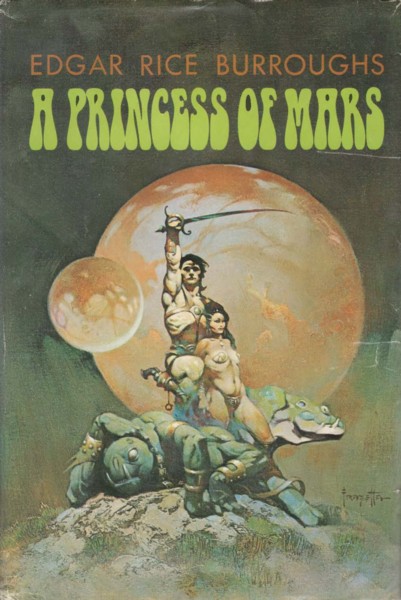
Edgar Rice Burroughs is easily one of the most successful and influential creators of fantasy and science fiction of all time. His works, from the stories of Tarzan to the adventures of John Carter, have inspired generations of writers, including Robert E. Howard, whose personal library possessed more books by ERB than any other author. Despite this, neither he nor his literary creations are especially well known nowadays. I think that's a great shame for many reasons, not least of which being that he told fun and engaging adventure stories that still hold up decades after their first publication.
A case in point is The Moon Maid, which almost no one remembers anymore, especially when compared to the Barsoom or Amtor series. Originally serialized in the pages of Argosy All-Story Weekly, starting with the May 5, 1923 issue, all of its constituent parts were eventually collected into novel form and published in 1926. The story The Moon Maid tells of its protagonist, Julian, is, in some ways, quite similar to the story of John Carter or Carson Napier: an Earthman travels to another world, faces innumerable alien threats, and wins the heart of a princess. In other ways, though, it is unique and it is that uniqueness that makes it well worth reading.
Unlike the Barsoom or Amtor stories, which are set, more or less, in "modern" times, The Moon Maid is set in the future – two futures, as it turns out – of when it was published. The first future is the year 1967, a few years after the conclusion of a decades-long Great War that began in 1914. The conclusion of that war established peace and world government, just in time for "that historic day," June 10, 1967 when
Earth received her first message from Mars, since which the two planets have remained in constant friendly communication, carrying on a commerce of reciprocal enlightenment. In some branches of the arts and sciences the Martians, or Barsoomians, as they call themselves, were far in advance of us, while in others we had progressed more rapidly than they. Knowledge was thus freely exchanged to the advantage of both worlds. We learned of their history and customs and they of ours, though they had for ages already known much more of us than we of them. Martian news held always a prominent place in our daily papers from the first.
As you can see, The Moon Maid takes place in the same universe as the adventures of John Carter, who still lives on the Red Planet. This information is related to the reader by an unnamed narrator who meets the story's true protagonist, the aforementioned Julian, while traveling on a transoceanic liner. Julian is "a fine looking chap, lean and bronzed" and serves as an officer of the Air Corps of the International Peace Fleet. He is also, or so he claims, an immortal being who is continually reincarnated as his own descendants, a process that also leaves him with knowledge of the future, which is to say, the second future depicted in the novel. This second future is 2024, when Earth's first interplanetary vessel is preparing to travel to Mars.
Julian then recounts to the narrator the story of this voyage, which he "remembers" even though it takes place in the future and involves his own grandson, also named Julian. The bulk of The Moon Maid consists of Julian's memories of what happened when the Earth ship, named the Barsoom in honor of its ultimate destination. Accompanying Julian aboard the Barsoom was an officer named Lieutenant Commander Orthis, whom he described as "one of the most brilliant men I have ever known, and at the same time one of the most unscrupulous, and, to me at least, the most obnoxious." Orthis is responsible for the scientific breakthrough that enables the Barsoom to travel successfully between planets, but he is noted for having "married a nice girl and abandon[ing] her," as well as being rumored to be "affiliated with a secret order that sought to overthrow the government." This, of course, is in contrast to Julian, who is courageous, upstanding, and honest, as are all Burroughs's heroes.
Shortly after the Barsoom has traveled past the Moon, Orthis comes to dinner in the messroom "noticeably under the influence of liquor." Julian, as his superior officer, sends him back to his quarters, which Orthis resents. He grows angry and rants at Julian, claiming that it was his labor and intellect who made this journey possible and he would not be upstaged by anyone. This scene allows Burroughs to talk briefly about the inefficacy of Prohibition – remember this was published in 1923, when the Eighteenth Amendment was still in force – and how it had been repealed. In any case, Orthis takes perverse revenge on Julian by destroying the Barsoom's engines, sending the vessel careening toward the Moon.
Needless to say, the Barsoom and its crew, including Orthis, survive the crash into the Moon, where the main action of The Moon Maid takes place. I say into, not onto, because Julian and his comrades discover that the Moon is in fact hollow. Its interior is quite habitable, filled with plants and animals, and illuminated by the glow of radiocative rocks. There are also two intelligent species. The first are the savage Va-ga, cannibalistic centaur-like people, who are an early foe of Julian and his shipmates. The second are the U-ga, who look very similar to Earthmen and whose princess, Nah-ee-lah, Julian considers alluringly beautiful. As one might expect, Nah-ee-lah, as the titular Moon Maid, figures prominently; the travails of her people at the hands of a revolutionary group known as the Kalkars is the central conflict of The Moon Maid.
Reading through this, what most impressed me was not any individual element of the tale Burroughs tells but rather the way that he is able to mix and match elements from his previous stories to create something that is somehow distinctive. One might reasonably expect The Moon Maid simply to be a retelling of A Princess of Mars with elements of At the Earth's Core. That it isn't is, I think, a testament to Burroughs's storytelling ability. The "futuristic" setting, the element of reincarnation, and the French/Russian revolution plotline (with the Kalkars standing in for the Jacobins/Communists) all work together to create an action-packed escapade that doesn't read like just another chapter in the adventures of John Carter or Carson Napier. The Moon Maid is a fun story; I wish I'd read it sooner.