Showing posts with label atlantis. Show all posts

Monday, May 22, 2023

Pulp Fantasy Library: The Edge of the World

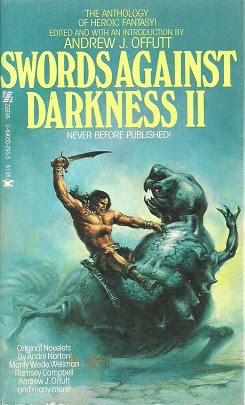
1979 saw the publication of not one but two different stories of Kardios of Atlantis by Manly Wade Wellman: "The Seeker in the Fortress" and "The Edge of the World." The former appeared in Gerald W. Page and Hank Reinhardt's Heroic Fantasy anthology, while the latter graced the pages of the fourth (and penultimate) entry in Andrew J. Offutt's long-running Swords Against Darkness series. Kardios had appeared in every previous volume of Swords Against Darkness, so it's hardly surprising he'd turn up there again. 

"The Edge of the World" receives its title from the "mighty city of Kolokoto," which lay, seemingly literally, at the edge of "a terrifying nothingness" that marked the world's end. Of course, Wellman elicits the reader's skepticism about this supposed fact early on, as he notes that it was "the sixty or so priests who did most of the thinking for Kolokoto's citizens" who declared this to be so. The subsequent unfolding of the story does little to lessen that skepticism.

Kardios enters the story first by word of mouth, as one of the aforementioned priests, Mahleka, has an audience with Kolokoto's "disdainfully beautiful" queen, Iarie. The queen, who is "as dictatorial as she was lovely," sits upon an ebony throne guarded by two tamed monsters.

One of these, the rather molluscoid Ospariel, was carapaced in a green shell, from which peered brilliant eyes above a stir of tentacles. The other, Grob, might be a great crouching ape, if apes had branched horns and were covered with green scales the size of lily pads.

Iarie has summoned the priest to find out the source of a "disturbance among the people," one that she had heard "shouted over the lower market-reaches." Mahleka explains that "the people [have] gathered to welcome Kardios the wanderer."

Iarie has heard the name of Kardios before, who was reputed to have survived the sinking of Atlantis, "overthrown mighty rulers," "conquered monsters," and "brought to an end the worship of several gods." This interests the queen, who asks that the Atlantean be brought before her, but Mihaka, as "her chief and most knowledgeable advisor," is already one step ahead of his mistress. "I've already ordered that done," he explains.

Though initially viewing him with contempt, Iarie soon becomes intrigued by Kardios, especially after learning that he had entertained the people in the marketplace with a song dedicated to the goddess "Ettaire, the bringer of love." She asks him to sing her the same song, which he does. So impressed is she by his skill that she commands him to take dinner with her that very evening, to which Kardios readily agrees. 

Over dinner, Kardios and Iarie discuss the religion of Kolokoto and its chief god, Litoviay, who is "worshipped by acts of mischief." This piques Kardios' interest, causing him to wonder why the god's priests forbid anyone to travel over the mountain range that separates the city from the edge of the world. "Why not let the people go over the range and fall into space? That would be in character." Iarie shrugs off such questions, since she is much more interested in making the Atlantean wanderer "especially happy." She sends away her servants and takes Kardios, along with a flagon of wine, to her bedchamber so that they may "talk, mostly of the love-goddess Ettaire, and how best to worship her."

The next morning, Kardios is awakened by "two burly men in black chain mail" holding curved swords. Iarie explains to him that they are her "most discreet guardsmen ... Safe with my secrets, for both are mute." She adds, "Kardios, I'm sorry you woke. I had hoped you would die happy." 

"You'd murder me so that I would not tell?" he asked Iarie, and her smile grew the more triumphant.

"How accurately you estimate the situation," she answered him sweetly. "I'm a lonely woman, and from time to time I invite a stranger to divert me overnight. Naturally, I can't let such partners go and gossip about it. What would my people think?"

Kardios manages to knock the two guardsmen unconscious. The queen, undeterred, sets Ospariel and Grob on him, which he also defeats, thanks to his star metal sword. With no more tricks up her sleeve, Iarie resorts to crying rape, which summons more guards to her bedchamber. The Atlantean flees into the depths of the palace to avoid capture, succeeding only because a young weaver-girl named Wanendi gives him a place to hide undetected (once again cribbing a page from Conan – and from himself). 

From Wanendi he learns much about the city, its queen, and its place at the edge of the world.

Kolokoto, said Wanendi, had been built many generations ago for the announced purpose of discouraging travelers from falling off the edge of the world. It was a manufacturing city, with a thriving trade in excellent textiles. Royalty and certain merchants got the profits. Weavers like Wanendi managed to live just short of want. Queen Iarie was the latest tyrant to uphold the law of not crossing Fufuna into nothingness, and the mischief-god Litoviay marshalled a line of stone sentinels to enforce that law.

The girl also provides Kardios with some clothing that will enable him to blend in better with the locals. He repays her for this and her other kind deeds with treasure he acquired in Nyanyanya before setting off with the intention of escaping over the barrier mountain range – a feat no one had ever accomplished before. Of course, that's easier said than done ...

"The Edge of the World" is another enjoyable Kardios yarn, engagingly told. I am constantly impressed by how charmingly Wellman spins these tales, filled as they are with the well-worn tropes and clichés of pulp fantasy. It's evidence, I suppose, that a master is capable of producing something worthwhile even out of the basest materials. Once again, I cannot recommend these stories enough. I was very pleasantly surprised by them and I suspect many of you will be as well.

Monday, May 8, 2023

Pulp Fantasy Library: The Seeker in the Fortress

Continuing with my tour of Manly Wade Wellman's tales of Kardios of Atlantis, we come to the fourth in the series, "The Seeker in the Fortress." Like its predecessors, this story first appeared in an anthology, in this case Heroic Fantasy, edited by Gerald W. Page and Hank Reinhardt and published by DAW in 1979. Also like its predecessors, the story takes a well-worn sword-and-sorcery plot – the beautiful princess held against her will by and in need of rescuing – and develops it in unexpected ways. This is, I think, where Wellman's genius lies and why the adventures of Kardios have entertained me far more than I had expected they would.

"The Seeker in the Fortress" opens, not with Kardios wandering into some new land or stumbling upon some odd situation but with the description of the titular fortress, which, as the reader soon learns, is the sanctum of a powerful wizard.

Trombroll the wizard had set his fortress in what had been a small, jagged crater, rather like an ornate stopper in the crumpled neck of a wineskin. Up to it on all sides came the tumbled, clotted lips of the cone. Above and within them it lodged, a sheaf of round towers with, on the tallest, a fluttering banner of red, purple and black. At the lowest center, where the fitted gray rocks of the walls fused with the jumbled gray rocks of the crater, stood a mighty double door of black metal. Slits in the towers seemed ready to rain point-blanketed missiles, smoking floods of boiling oil. In this distance rose greater heights, none close enough to command the fortress.

As a stylist, Wellman is nowhere near the equal of Howard, Leiber, or Vance, but he often pens passages like this, which are both evocative and nicely set the scene. 

Waiting outside Trombroll's fortress is Prince Feothro of Deribana, who "stood among his captains and councilors and shrugged inside his elegant armor." Coming to greet him is the wizard's herald, dressed "in elaborate ceremonial mail." The herald reminds the prince that his master is "supreme in magic" and that "the winds and the thunder fight his battles." Despite this bombast, Feothro remains unimpressed. 

"Trombroll has plagued the world long enough," returned Feothrro, sternly enough. "He threatens plague and famine, and demands tribute to hold them back. Tell him we've come to destroy him. These armies are the allied might of Deribana and Varlo, sworn to end Trombroll's reign of evil. Varlo's King Zapaun is as my father, has pledged his thrice lovely daughter, the Princess Yann, to be my consort. Let Trombroll come out and fight."

"Why should he?" inquired the herald. "We have wells of water, stores of provisions. And we also have that exemplary triumph of beauty, the Princess Yann herself."

"Princess Yann!" howled Feothro. "You lie!"

All looked aloft. Two guards were visible, escorting between them a slender figure in a bright red garment. Then all three drew back out of sight.

The herald then warns the prince and his assembled host that, should they attempt to storm the castle, "the unhappy princess will die an intricate death even now being invented for her." Feothro is incensed by this and looks to his advisors for a plan that might enable him to defeat Trombroll without bringing about the untimely death of his betrothed.

As if on cue, Kardios enters the story, having just been captured after "prowling here and there among the various commands." Initially, the prince believes him to be one of the wizard's spies, but he soon comes to understand that this Atlantean wanderer, known as "an adventurer among monsters," might offer a way to achieve his goals.  Kardios agrees, saying "Maybe I happened along in good time to help you." He tells Feothro not to attempt a siege; instead, he should allow Kardios to find a way into the wizard's fortress on his own to rescue Princess Yann. Though he threatens the Atlantean not to fail, Feothro nevertheless agrees and the story kicks off in high gear. 

The remainder of "The Seeker in the Fortress" is great fun, a rollicking pulp fantasy adventure, as Kardios encounters – and overcomes – one problem after another in his quest to free the imprisoned princess. The challenges Wellman sets before Kardios are varied and not all of them can be beaten through brute force or swordplay. Further, the Atlantean prefers less violent solutions when possible: "I don't kill unless I must," he explains to one of his defeated foes. It's an excellent change of pace from the earlier installments in the series, not to mention a terrific reminder of the utility of trickery and charm when sneaking into an evil wizard's lair. This is my favorite story of Kardios so far, not to mention one of the better sword-and-sorcery yarns I've read in some time and I highly recommend it.

Monday, May 1, 2023

Pulp Fantasy Library: The Guest of Dzinganji

Having enjoyed re-reading Manly Wade Wellman's "The Dweller in the Temple" for last week's installment of the Pulp Fantasy Library, I decided to work my way through his remaining three tales of Kardios and using them as the basis for new posts. Before turning to the third in the series, "The Guest of Dzinganji," which first appeared in the Andrew Offutt-edited anthology, Swords Against Darkness III in 1978, I briefly wanted to make a couple of general comments about pulp fantasy literature that are relevant to all the stories of Kardios (and, by extension, to many similar pieces of fiction).

First, I think it's easy to overlook just how important anthologies were to the survival and growth of sword-and-sorcery literature during the period between the late 1960s and early 1980s. That's because the native form of this style of fantasy is the short story, the publication of which had previously depended on magazines, many of which, like Weird Tales, declined or ceased publication entirely by the start of the '50s. This turn of events left a void in the market that anthologies would eventually fill. Though published less often than their pulp predecessors, these anthologies were nevertheless significant vectors for the transmission of pulp fantasy sensibilities to a new generation of readers.

Second – and this comment is especially relevant in the case of the present tale – there can be little denying that pulp fantasies frequently used and re-used the same basic plots and story elements. How many of them, for example, involve a lone wanderer entering a new place and stumbling upon some problem whose solution has eluded every previous person who's come across it? This is not a weakness in my opinion, as the enjoyment of almost any story lies not in its specific components but in how the author makes use of them. There can thus be multiple stories with the same basic set-up but whose executions vary considerably, some good and some bad. 

In the case of "The Guest of Dzinganji," I feel that Wellman has achieved the former: a good story that makes use of commonplace pulp fantasy elements. These elements are, in fact, so commonplace that Wellman has already made use of them in his previous Kardios yarns. Yet, he somehow manages to use them one more time in this fun little adventure. As with "The Dweller in the Temple," Kardios follows an unknown trail and sings an improvised song as he strums his harp. This time, though, the trail abruptly ends at "an abyss as deep as any he had ever seen."

Down it went, down, down. Standing on the rocky shelf where the trail stopped, he peered. Hazy blue distance below. As he studied that depth, a flat click sounded in the air. He looked up.

Twelve times his length across, another cliff soared into the sky. Against the settling sun moved a dull-shiny something. It hung from chains to a great road or cable that came from far above where the ohter clilff's overhang held it. It was like a great metal basket drifting toward him. He drew back, wondering if his sword would be needed.

Kardios soon realizes that the basket is some kind of conveyance up the cliff-face. As he watches it travel up and down, he hears "a dry voice," which orders him, "Go away and forget." The voice comes from "a man in a ragged gray gown" who sat farther along the ledge between the two cliffs. The nameless old fellow seems to be a seer of some kind, for he knows the name of Kardios, as well as his role in sinking Atlantis. He explains to the wanderer that he has stayed here on the ledge "to warn men to turn back from Flaal. But the tales of treasure draw them. They never return."

The old man urges Kardios not to "let greed tempt you into Flaal."

"What happens to those who go there?"

The white head shook. "My wisdom doesn't reach to Flaal; magic shuts me out. I know only that Dzinganji rules there with a ready ear to listen for visitors and a ready method to entertain them. Dzinganji is a god, Kardios, and an evil one."

"I've met evil gods," said Kardios. "I killed Fith, who oppressed the giant Nephol tribe. I killed Tongbi, who was unpleasantly worshipped in Nyanyanya. What if I kill Dzinganji?"

"I'd be happily amazed. Don't say I didn't warn you."

"I'll never say that," promised Kardios.

This was when Wellman succeeded in completely winning me over. The level of self-awareness that Kardios displays is remarkable, stopping just short of commenting on just how absurd it is that he has yet again run into a so-called god whose villainy demands death at his capable hands. It's a testament to Wellman's skill as a writer that, despite this, the story that follows does not descend into parody; if anything, Kardios's recognition of the situation only serves to make what follows more interesting.

Kardios makes use of the metal basket to reach Flaal, which was "a city, domed and steepled in crystal and gleaming gold and silver. Under the soles of his sandals, the pavement was golden." He had no doubts as to why men were drawn to this place, but it appeared to be completely empty. He called out received "no answer but his own echo." In spite of this, Kardios presses ahead to see what else he might find.

In time, he finds at least one inhabitant of the place.

A superbly proportioned female figure, he saw at once. Her clothing was taut, scanty and many-jeweled. Her pale blonde hair was caught at the temples with a glittering band. Her sandals were cross-gartered in silver to her knees.

"Warm welcome to Flaal, Kardios," said her musical voice. "You're strong and young. You'll be of service to us and your pay princely."

She smiled. Her face was dreamily lovely, her eyes pale blue as the spring sky washed by winter's tears. "My name is Tanda."

Again, the similarities to initial situation in "The Dweller in the Temple" is striking and, in the hands of a lesser writer, would rightly be grounds for criticism, if not outright mockery.  Here, it serves to lull the reader into a false sense of déjà vu so that Wellman might catch him off-guard with subsequent revelations – or so it was for me. 

Tanda is guarded by two towering warriors clad in golden arm and wielding huge, axe-like weapons. This raises the wanderer's suspicions, all the more so when the woman explains that "Dzinganji created them, to perform his will." When Kardios attempts to press on into Flaal without first agreeing to "make submission" to Dzinganji like all "guests" in the city, the two sentinels attack him. During the battle, he notices that his opponents move strangely and do not seem to bleed when struck. When he emerges victorious, Tanda is unhappy.

"Dzinganji will be displeased," said Tanda in a reproachful voice.

"They were trying to kill me," reminded Kardios, bending above the two silent figures. "Did I truly kill them? Where's the blood?"

There showed only a trickle of clear fluid from the wounds he had inflicted. "It looks more like oil than blood," he said.

"They were machines," said Tanda. "Flaal is guarded by machines."

With that, "The Guest at Dzinganji" takes another unexpected turn and it's not the last. Every step of the way, Wellman zigs rather than zags and the result is a pulp fantasy yarn that is familiar without being hackneyed – and original without straying too far from a tried-and-true formula of the genre. It's good fun and exactly what I want out of stories of this kind.

Monday, April 24, 2023

Pulp Fantasy Library: The Dweller in the Temple

A frequent counterfactual thought on this blog concerns the state of literary fantasy (broadly defined to include science fiction and horror, among others) had writers like Robert E. Howard and H.P. Lovecraft lived beyond the 1930s. I have no firm opinions on the matter, since there are simply too many variables to consider. Indeed, it's quite possible any resulting alternate history in which, for example, REH lived into old age rather than committing suicide in 1936 might nevertheless not be notably different from our own. 

A point in favor of this conclusion is provided by Manly Wade Wellman, who's probably best known among players of Dungeons & Dragons for his stories of Silver John, the wandering Appalachian singer and battler of the occult. Wellman was born in 1903, just three years before Robert E. Howard, and his professional writing career began three years after Howard's own, making them rough contemporaries of one another. Wellman, however, lived a half-century longer than REH and continued to write almost until his death, though his output certainly slowed after the 1960s. 

Even so, I'm not sure anyone could argue that Wellman is more well known than Howard (or Lovecraft). This is in spite of the fact that Wellman's work appeared in multiple volumes of Andrew J. Offutt's very influential Swords Against Darkness anthologies published in the late 1970s. (The series is important for the history of D&D because its third volume, which included a yarn by Wellman, was listed in Gary Gygax's Appendix N of "inspirational and educational reading.") If anything, I'd say that Wellman is less well known than either of them, suggesting that long years are no guarantee of greater fame than writers who died comparatively young.

That's too bad, because, in addition to his tales of Silver John the balladeer and occult detective John Thunstone, Wellman also penned six stories about Kardios, a survivor of Atlantis, the last of which was published in 1986, just months after the author's death. Though he first appeared in 1977, Wellman had apparently conceived of Kardios sometime during the 1930s, but had trouble selling him because Robert E. Howard had beaten him to the punch with Kull. However, Andrew Offutt (and, later, Gerald W. Page, Hank Reinhardt, and Jessica Amanda Salmonson) recognized the uniqueness of the character and it's through their efforts that we can read about his exploits today.

"The Dweller in the Temple" quickly demonstrates the uniqueness of Kardios by having the Atlantean do something I cannot imagine Conan or most other mighty-thewed barbarian heroes doing: singing. While traveling along the road alone, he "unslung the harp from behind his broad shoulder and smote the strings. He improvised his own words and melody, while his long sword thumped his leg as though joining in." Kardios' impromptu concert meets with the approval of a dozen or so young men, who "thronged around him, smiling and slapping the hafts of their javelins."

"Three times welcome, my lord," said a spokesman. "We'll escort you to your city."

"City?" echoed Kardios, keeping a hand near his sword hilt. "What city? I didn't even know there was one."

"Just over the hill yonder," said the spokesman, pointing. "Your city of Nyanyanya."

"It must be a fine one for you to name it two or three times," said Kardios. "But I never heard of it until this moment."

"Come and reign there, as was foretold.

Though wary, Kardios acquiesces to their offer, especially after the young men "closed around him like an honor guard ... Those sharp-pointed javelins rode at the ready." 

Nyanyanya "was not a large city, but it was beautiful, a grateful refuge for a tired traveler" such as Kardios. He is met there by a crowd of admirers, along with an old man, who identifies himself as Athemar the high priest. Athemar crowns Kardios king by placing a golden circlet on his head, which the wanderer at first takes to be a joke.

"We wouldn't dare joke, Kardios," murmured one of them.

"Never," Athemar assured him. "You see, we have an interesting way of choosing our kings. When one departs, another is mystically brought to us, by decree of the Dweller in the Temple. A committee meets him and brings him to us. It's been like that since Nyanyanya became a city." He stroked his beard. "That was lifetimes ago. But your palace waits for you."

By this point, the Kardios – as well as the reader – is aware that this situation is extremely suspect and indeed probably a trap. Although he recognizes that his life is likely in danger, he does not try to escape. "He would never be happy without knowing the end of this quaint adventure."

Athemar leads Kardios to "a graceful building of the rose-gray stone," where he is shown "a spacious room with a central fountain, chairs and tables and divans, and a red-cushioned throne that seemed chiefly made of emeralds." Before he has a chance to take this all in,

girls entered, spectacularly beautiful girls, gold-haired, jet-haired, jasper-haired, smiling. Their rich, clinging costumes were as brief as the very soul of wit.

"Here are some of your subjects, awaiting your orders," Athemar said to Kardios. "Whatever you may command of them." 

The girls all vie for Kardios' attention, encouraged by Athemar, but, taking a page from Conan, he is most interested in a serving girl named Yola, who alone among them seemed genuinely concerned about him. Kardios is correct in this assessment; it is from her that he first learns something of the mysterious Dweller in the Temple about whom the high priest had spoken earlier.

"What's this Dweller in the Temple you worship here in Nyanyanya?"

"Tongbi," she whispered fearfully.

"Tongbi," he repeated the name. "What sort of god is he?"

"A great god. Great and dreadful."

"Why dreadful? Does he kill your people?"

"No." Her hair tossed as she shook her head. "I don't think he ever killed a single citizen of Nyanyanya."

This piques the interest of Kardios, who asks Athemar for more information about Tongbi. The old man is surprised by this.

Athemar frowned. "The girl told you his name?"

"And said that he was powerful, and has never yet killed a citizen of the town. That's to his credit. How ancient a god is this Tongbi, and how is he served?"

A councilor cleared his throat and tweaked his spear-point beard. "You're our king, mighty Kardios," he said. "The king isn't called on to vex himself with religious matters. Athemar and his junior priests do the worshipping and serving of Tongbi." 

This is all highly suspicious, of course, and Kardios knows it, but his natural curiosity – and sense of adventure – prevent him from fleeing Nyanyanya. He is determined to get to the bottom of whatever is going on here, as well as the nature of the prophecy that supposedly "foretold" his arrival here.

"The Dweller in the Temple" is a charming, enjoyable romp in the best traditions of pulp fantasy. Kardios handily distinguishes himself from the many rootless, wandering protagonists of the genre, demonstrating not just thoughtfulness – a trait he shares with many others – but also kindness and, above all, humor. Kardios regularly cracks wise and makes light of his circumstances. Perhaps unsurprisingly, he reminds a lot of John the Balladeer, Wellman's more famous creation, right down to his propensity to endear himself to others through song. Also, like the tales of Silver John, this one is written in a light, breezy style that sets it apart from the self-seriousness that too often characterizes fantasies of this kind. If you can find a copy, it's well worth a read.

Monday, January 23, 2023

Pulp Fantasy Library: The Cat and the Skull

Of all of Robert E. Howard's characters, I would argue that Kull is perhaps his most misunderstood – and not without reason. Though Howard wrote more than a dozen stories featuring the Atlantean king of Valusia, only three of them were published during his lifetime. Compared to, say, Conan or Solomon Kane, who appeared in many more stories, Kull seems almost like an afterthought, a character Howard discarded after the publication of "Kings of the Night" in November 1930. 

Conan, who first appeared twenty-five months after Kull's published swan song, plays a huge role in explaining why Kull is largely unknown today. Even among those aware of Kull, there's often a false sense that he's little more than a "rough draft" of the Cimmerian, an impression that isn't helped by the knowledge that Howard re-purposed a rejected Kull story, "By This Axe I Rule!," for Conan's debut, "The Phoenix on the Sword." 

This is a great shame in my opinion. As characters, Kull and Conan have similarities, to be sure, but they also have differences. These differences are much more apparent when one reads the various unpublished Kull stories that Glenn Lord found in REH's famous storage trunk. Lord, a fan and fellow Texan, tracked down "the Trunk," as it is sometimes known, in 1965, finding that it contained about half of everything Howard had ever written, most of which had never been published in any form – including numerous Kull stories in various stages of completion.

Two years after the discovery of the Trunk, the anthology King Kull was released by Lancer, who'd already found great success with its line of Conan paperbacks. And just like those Conan paperbacks, this volume included posthumous "collaborations" between Robert E. Howard and editor Lin Carter. In this case, Carter finished three incomplete tales of Kull to varying degrees of success. Among the wholly Howardian stories presented for the first time in King Kull is one entitled "Delcardes' Cat" therein but whose proper title is "The Cat and the Skull."

The start of the tale is compelling.

King Kull went with Tu, chief councillor of the throne, to see the talking cat of Delcardes, for though a cat may look at a king, it is not given every king to look at a cat like Delcardes'. So Kull forgot the death-threat of Thulsa Doom the necromancer and went to Delcardes.

Thulsa Doom! Now, there's a name to seize the imagination. Though generations know him as the antagonist in John Milius' Conan the Barbarian, he is, in fact, the archnemesis of Kull and this story marks his first ever mention (and, as it later turns out, appearance) in fiction.

Kull is no fool and is thus skeptical of the existence of a talking cat. Tu is even more "wary and suspicious" in part because "years of counter-plot and intrigue had soured him." Indeed, he suspected that the supposed talking cat "was a snare and a fraud, a swindle and a delusion," not to mention "a direct insult to the gods, who ordained that only man should enjoy the power of speech." Does this sound at all like the opening of a Conan story? The yarn begins almost whimsically and I cannot deny that I was immediately seized with interest in seeing where Howard took things.

The cat, whose name is Saremes, is the companion – not pet! – of Delcardes, a Valusian noblewoman, who is herself described as "like a great beautiful feline," whose "lips were full and red and usually, as at present, curved in a faint enigmatical smile." She has come to the court of Kull to crave a boon from the king. The boon in question is marriage to Kulra Thoom of Zarfhaana, a match that would be forbidden, because "it is against the custom of Valusia that royal women should marry foreigners of lower rank." Delcardes knows this and argues that "the king can rule otherwise," much to the consternation of Tu, who reminds Kull that such a breach of tradition "is like to cause war and rebellion and discord for the next hundred years."

Kull will have none of this.

"Valka and Hotath! Am I an old woman or a priest to be bedevilled by such affairs? Settle it between yourselves and vex me no more with questions of mating! By Valka, in Atlantis men and women marry whom they please and none else."

Delcardes sees this as the perfect opportunity to remind Kull of the cat who accompanied her. The cat 

lolled on a silk cushion, on a couch of her own and surveyed the king with inscrutable eyes ... she had a slave who stood behind her, ready to do her bidding, a lanky man who kept the lower part of his face concealed with a thin veil which fell to his chest. 

The noblewoman explains that Saremes was "a cat of the Old Race who lived to be thousands of years old." She then asks him to ask the cat her age.

"How many years have you seen, Saremes?" asked Kull idly.

"Valusia was young when I was old," the cat answered in a clear though curiously timbered voice.

Kull started violently.

"Valka and Hotath!" he swore. "She talks!"

Delcardes laughed softly in pure enjoyment but the expression of the cat never altered.

"I talk, I think, I know, I am," she said. "I have been the ally of queens and the councillor of kings ages before even the white beaches of Atlantis knew your feet, Kull of Valusia. I saw the ancestors of the Valusians ride out of the fear east to trample down the Old Race and I was here when the Old Race came up out of the oceans many eons ago that the mind of man reels when seeking to measure them. Older am I than Thulsa Doom, whom few men have ever seen.

"I have seen empires rise and kingdoms fall and kings ride in on their steeds and out on their shields. Aye, I have been a goddess in my time and strange were the neophytes who bowed before me and terrible were the rites which were performed in my worship to pleasure me. For od eld beings exalted my kind; beings as strange as their deeds."

This is great stuff in my opinion. Apparently, Kull thought so too, because his interest is greatly piqued, so much so that he then asks the cat.

"Can you read the stars and foretell events?" Kull's barbarian mind leaped at once to material ideas.

"Aye; the books of the past and the future are open to me and I tell man what is good for him to know." 

It's at this point that Kull's skepticism of the existence of a talking cat – a skepticism that Tu still holds – gives way to hope, hope that Serames might possess knowledge that will enable him to make the right decisions as he ponders how to rule Valusia and meet the challenge of Thulsa Doom the necromancer. 

What follows is an odd pulp fantasy tale, one in which the barbarian king of a civilized land spends much time discussing fate, prophecy, and free will with a talking cat. I ask once again, does this sound like a Conan story? "The Cat and the Skill" is a fun story, one that nicely balances thoughtfulness with action, honesty with intrigue. That – and I hope no will be surprised to learn this – Serames is revealed to be a fraud, just as Tu warned, in no way takes away from my enjoyment of the story. What transpires before this revelation is thoroughly captivating and a much-needed reminder that Kull is no "rough draft" of anyone, but rather a uniquely engaging character in his own right.   

Monday, December 19, 2022

Pulp Fantasy Library: Adventure in Lemuria

If you look at the nearly 300 entries in the Pulp Fantasy Library series on this blog, you'll notice that there are a number of names that recur again and again – Robert E. Howard, Fritz Leiber, H.P. Lovecraft, C.L. Moore, and Clark Ashton Smith, to name just a few. By and large, I expect that many, if not most of these names, would be familiar even to casual readers of fantasy, science fiction, and horror, as they're among the writers of the Pulp Era generally acknowledged to be the best and most worthy of lasting attention. 

At the same time, they're not the only writers from that storied period of popular literary history. For every Robert E. Howard or H.P. Lovecraft, who are esteemed widely today, there are probably a dozen other workaday writers whose tales entertained their readers in the past but who have subsequently been forgotten. As a mediocre writer myself, I can't help but feel a little kinship with these men and women, more than a few of whom, I think, are worthy of interest, if not necessarily of effusive praise. 

A case in point in Frederic Arnold Kummer, Jr. He was born and grew up in Baltimore County, Maryland, where I spent my own formative years. His career as a pulp fictioneer was short; he published 34 stories during a two-year period between 1939 and 1940. While most of them could broadly be called "science fiction" in nature (many were sword-and-planet or space operas), a handful belong to the category of sword-and-sorcery. One such fantasy yarn was "Adventure in Lemuria," which appeared in the May 1939 issue of Fantastic Adventures, edited by the legendary Ray Palmer (later of Amazing Stories).

"Adventure in Lemuria" is another entry in the very popular genre of fantasy stories set in the prehistoric past of Earth, before one or more mythical continents had sunk beneath the waves following a cataclysm of some kind. I imagine it was Ignatius Donnelly's Atlantis: The Antediluvian World that kicked this genre off, but, in the years after its initial publication in 1882, many others had elaborated upon his claims or developed their own. As its title suggests, Kummer opted not for Atlantis or Hyperborea as the setting for his tale, but rather Mu, located somewhere in the Indian Ocean. Lemuria is another, older name for Mu and one Kummer uses primarily for the title. 

The story's protagonist is a stranger to Mu.
"Khor the Wanderer, men call me," he said. "From the land of Crete in the Upper Sea, I come. For more than a hundred moons have I traveled east. And now I have reached this land of Mu, called by the travelers the home of the gods."

Khor's world would seem to be vaguely like Howard's Hyborian Age in that it's heavily based on aspects of the ancient world of Earth, though mythologized and including many fantastical elements. Khor's Crete, for example, would seem to be some analog of the Bronze Age Minoans, given by his use of a double-headed axe in battle, said weapon being an important symbol of that ancient civilization. On the other hand, the reader should no more mistake Khor's Crete for the real Crete than he should Conan's Cimmeria for the real one. Kummer, like Howard, is using the names and broad details of the ancient world as a foundation on which he builds his fantasy.

Shortly after arriving on Mu, Khor observes "a slender dark-haired young man clad in a blue mantle" attempting to fend off an attack by "four warriors in gleaming gilded armor, squat swarthy men, their faces aglow with fierce exultation."  

Khor marveled at the skill with which the youth, armed only with a light hunting sword, defended himself against the four flashing blades; yet it was evident that his was a losing battle, that the men in the golden armor were intent upon keeping him occupied until a loss of blood and exhaustion would cause him to drop, an easy victim, at their feet.

It was this latter fact that decided Khor. Brave men, he felt, would fight to kill ... but this wearing out an opponent and then slitting his throat at one's leisure was the work of cowards. Grimly he raised the burnished bronze axe, and, with a shout of encouragement to the man in the blue mantle, sprang from the shadow of the trees.

Khor's attitude is another way in which "Adventure in Lemuria" reminds me of Howard's work. The Cretan wanderer adheres to a rough but honest code of honor of a sort not too different from that of Conan. He saves the youth, who name we learn is Jador, not because he objects to what appears to be banditry but because he disapproves of the way that the four golden-armored men toy with their would-be prey. 

Jador thanks Khor for his assistance and reveals that he is the ruler of Zac, "which is part of the great nation of Lemuria ... Mu."

"A prince!" Khor grinned ironically, glancing at the bodies of the gold-clad warriors. "And these ...?"

"Followers of my half-sister, Lalath." The youth's face darkened. "Five years since, when I was still a child, she seized the throne of Zac. Only through the loyalty of my guard was I able to escape. Five years in hiding, I spent, and now, having come of age, I seek to regain my throne, reestablish the worship of Narayama, the true god, in place of blood Molech. Today, accompanied by a few loyal retainers, I came here to await the arrival of those who espouse my cause, peasants, merchants, nobles, all sworn to assemble here during the night, attack the city tomorrow. By mischance we encountered Lalath's warriors ... and the rest you know."

Khor, being an experienced and well-traveled man, tells Jador that "no handful of rebels" will be sufficient to achieve what he intends. The prince, however, is unperturbed and explains that "Narayama the true god shall aid us." He then adds, "When I return to the throne of Zac, you will be rewarded. Thanks and may the gods keep you."

Despite his intention to leave the young man to his doom, Khor cannot abandon Jador. Instead, he joins him in his ascent up a nearby mountain, upon which "lies the secret tomb of [Jador's] ancestors," where he shall pray to Narayama for guidance. The prince takes Khor's change of heart as evidence that the Cretan "must have been sent by the true gods," just as he does the wanderer's suggestion he might could aid him by entering the city alone and "at the appointed hour fall upon the guards of some postern gate, open it to admit your armies" – a plan to which Jador readily agrees.

Of course, things don't go quite as simply as that. Khor is captured before he can execute his plan and he is taken as a prisoner before Lalath, where he is given the choice of joining her or becoming another sacrifice to Molech. It's at this point that the story really takes off and Kummer – and Khor – reveals he has a trick up his sleeve, leading to a fairly satisfying climax. "Adventure in Lemuria" is a brisk, straightforward yarn that held my attention for the entirety of the time I was reading it. Certainly, it doesn't hold a candle to even the lesser entries in, say, the Howardian canon, but it was fun and, when it comes to pulp fantasy, that's not nothing. If you'd like to give it a read yourself, it's been collected, along a number of other similar tales, in Heroes of Atlantis & Lemuria.

Monday, March 7, 2022

Pulp Fantasy Library: Atlantis: The Antediluvian World

A brief caveat: Atlantis: The Antediluvian World is not a work of fiction – at least not of an intentional kind. At the time it was published (1882), it was presented as speculative archeology, however dubious that claim might have been, even by the standards of its own time. More to the point, its author, Ignatius L. Donnelly, did not believe he was writing fiction but rather that he was advancing "several distinct and novel propositions" regarding "an Atlantic continent … known to the ancient world as Atlantis." He believed this so strongly that he continued to advance his theses for the remainder of his life, writing a sequel in 1883 and inspiring countless other writers in the ensuing decades. 

It's largely on this basis that I'm including it as this week's Pulp Fantasy Library post. Considered purely in terms of its influence on later fiction, Atlantis: The Antediluvian World is an important product of human imagination and creativity, easily on par with the avowedly literary efforts of H.P. Lovecraft, or J.R.R. Tolkien. Indeed, if you've ever read a story involving Atlantis, whether it be Clark Ashton Smith's tales of Poseidonis, Robert E. Howard's Kull yarns, or even the adventures of Aquaman, to cite just a few, you owe a debt to Ignatius Donnelly and his obsession with proving that Atlantis was not only real but "the region where man first rose from a state of barbarism to civilization."

Donnelly himself is a fascinating fellow, in the way that only men from the past seem to be. Born in Philadelphia in 1831, he became a lawyer and moved to the Minnesota territory, where he attempted to found a cooperative farm and utopian community with several others. Though the farm failed, leaving him in debt, Donnelly managed to use his rhetorical skills to become Minnesota's second lieutenant governor after statehood. Later, he was elected to the U.S. House of Representatives and to seats in both houses of Minnesota's state legislature. As a politician, he advocated for women's suffrage, a progressive income tax, and an eight-hour workday, among many other causes radical for their time. And, of course, he was also an advocate of the belief that Atlantis "is not a fable, as has been long supposed, but veritable history." Like Whitman, Donnelly contained multitudes.

Atlantis is a lengthy and ponderous book, divided into five parts, each consisting of six or more chapters. The tome begins with a chapter in which Donnelly lays out "the purpose of the book" by asserting the following theses:

1. That there once existed in the Atlantic Ocean, opposite the mouth of the Mediterranean Sea, a large island, which was the remnant of an Atlantic continent, and known to the ancient world as Atlantis.

2. That the description of this island given by Plato is not, as has been long supposed, fable, but veritable history.

3. That Atlantis was the region where man first rose from a state of barbarism to civilization.

4. That it became, in the course of ages, a populous and mighty nation, from whose overflowings the shores of the Gulf of Mexico, the Mississippi River, the Amazon, the Pacific coast of South America, the Mediterranean, the west coast of Europe and Africa, the Baltic, the Black Sea, and the Caspian were populated by civilized nations.

5. That it was the true Antediluvian world; the Garden of Eden; the Gardens of the Hesperides; the Elysian Fields; the Gardens of Alcinous; the Mesomphalos; the Olympos; the Asgard of the traditions of the ancient nations; representing a universal memory of a great land, where early mankind dwelt for ages in peace and happiness.

6. That the gods and goddesses of the ancient Greeks, the Phoenicians, the Hindoos, and the Scandinavians were simply the kings, queens, and heroes of Atlantis; and the acts attributed to them in mythology are a confused recollection of real historical events.

7. That the mythology of Egypt and Peru represented the original religion of Atlantis, which was sun-worship.

8. That the oldest colony formed by the Atlanteans was probably in Egypt, whose civilization was a reproduction of that of the Atlantic island.

9. That the implements of the "Bronze Age" of Europe were derived from Atlantis. The Atlanteans were also the first manufacturers of iron.

10. That the Phoenician alphabet, parent of all the European alphabets, was derived from an Atlantis alphabet, which was also conveyed from Atlantis to the Mayas of Central America.

11. That Atlantis was the original seat of the Aryan or Indo-European family of nations, as well as of the Semitic peoples, and possibly also of the Turanian races.

12. That Atlantis perished in a terrible convulsion of nature, in which the whole island sunk into the ocean, with nearly all its inhabitants.

13. That a few persons escaped in ships and on rafts, and, carried to the nations east and west the tidings of the appalling catastrophe, which has survived to our own time in the Flood and Deluge legends of the different nations of the old and new worlds.

To anyone with even the slightest interest in the subject of Atlantis – or the decades of pulp fantasy musings on the subject – none of these propositions is the least bit surprising. At the time, though, they were bold and original, if not at all historically well-founded. Atlantis was a success for Donnelly and its ideas were disseminated widely, so much so that they now form an important substrate of both popular culture and esoteric beliefs. 

Growing up, the mother of two friends of mine, with whom I first began playing RPGs, had an extensive library of books that, at the time, we called "New Age." Among them was a copy of Atlantis: The Antediluvian World, alongside the works of authors inspired by it, like Edgar "The Sleep Prophet" Cayce and various Theosophists. I'd sometimes take the books off her shelves and peruse them, looking for interesting sections that might inspire D&D adventures. Even as a kid, I found most them more than a little ridiculous, but Donnelly's book held my attention, perhaps because of its author's self-seriousness and obvious enthusiasm for the "revelations" he is imparting to his readers. It's not difficult to see why it caused a stir in its day or why its central theory, however implausible, continues to maintain a hold over the popular imagination almost a hundred and fifty years later.

Monday, January 24, 2022

Pulp Fantasy Library: The Death of Malygris

The final story of Smith's Poseidonis cycle was, appropriately, "The Death of Malygris." By his own account, he was pleased with the tale, particularly for its inclusion of "much genuine occultism and folklore." The editor of Weird Tales, the redoubtable Farnsworth Wright, didn't think much of the story and rejected it as "more like a prose poem than a story" – a common criticism of Smith's tales he rejected. H.P. Lovecraft, on the other hand, admired it, calling it "splendid" in a letter to Robert Bloch. Smith would later re-submit "The Death of Malygris" to Wright, who was more well inclined this time. He not only published the story in the April 1934 issue of Weird Tales, but even commissioned Smith to provide an accompanying illustration as well.

The sorcerer Malygris, who had previously appeared in "The Last Incantation" (ironically, the first episode of the Poseidonis cycle), had long exercised power over Susran, capital of Poseidonis, power greater than that of even its king, Gadeiron. Recently, rumors arose that Malygris had at long last died, a claim denied by the other wizards of the city, but one that Gadeiron and his chief advisor, the magician Maranapion, hoped to be true. Because Malygris was a "master of illuding shows, of feints, and beguilements," Gadeiron believes that the old sorcerer pre-emptively made use of his enchantments to hide the fact that he has died, so that, even in death, he might still lord it over the people of Susran. For this reason, the king addresses the assembled wizards.

"Not idly have I called ye to this crypt, O sorcerers of Susran: for a work remains to be done. Verily, shall the corpse of a dead necromancer tyrannize over us all? There is mystery here, and a need to move cautiously, for the duration of his necromancy is yet unverified and untested. But I have called ye together in order that the hardiest among ye may take council with Maranapion, and aid him in devising such wizardry as will now expose the fraud of Malygris, and evince his mortality to all men, as well as to the fiends that follow him still, and the ministering monsters."

Seven of the twelve wizards agree to assist Maranapion in this endeavor. Two others, the brothers Nygon and Fustules, conceived an "audacious plan" of their own. During the next night, they carefully stole into the tower of Malygris, which they soon found devoid of any guardians or protections. Emboldened by this, they sought out the chamber of Malygris, at the center of which contained his "chair of primeval ivory" upon which sat "the old archimage … peering with stark, immovable eyes."

Nygon and Fustules felt their awe return upon them, remembering too clearly now the thrice-baleful mastery that this man had wielded, and the demon lore he had known, and the spells he had wrought that were irrefragable by other wizards. The specters of these things rose up before them as if by a final necromancy. With down-dropped eyes and humble mien, they went forward, bowing reverentially. Then, speaking aloud, in accordance with their predetermined plan, Fustules requested an oracle of their fortunes from Malygris.

There was no answer, and lifting their eyes, the brothers were greatly reassured by the aspect of the seated ancient. Death alone could have set the grayish pallor on the brow, could have locked the lips in a rigor as of fast-frozen clay. The eyes were like cavern-shadowed ice, holding no other light than a vague reflection of the lamps. Under the beard that was half silver, half sable, the cheeks had already fallen in as with beginning decay, showing the harsh outlines of the skull. The gray and hideously shrunken hands, whereon the eyes of enchanted beryls and rubies burned, were clenched inflexibly on the chair-arms which had the form of arching basilisks.

"Verily," murmured Nygon, "there is naught here to frighten or dismay us. Behold, it is only the lich of an old man after all, and one that has cheated the worm of his due provender overlong."

Perhaps predictably for a Clark Ashton Smith yarn, the true situation is not as the wizard brothers believe it to be. One of the familiars of Malygris, the viper featured in "The Last Incantation," springs upon them, while a voice echoes "Fools! ye dared to ask me for an oracle. And the oracle is – death!"

Meanwhile, Maranapion, knowing nothing of the fates of Nygon and Fustules, led the seven remaining wizards in a series of "impious charms and unholy conjurations, and fouler chemistries" intended to prove that Malygris is indeed dead, as he suspected. They start with a spell of invultuation, the crafting of plasmic copy of Malygris, which they cursed with their spells so that, by the principle of sympathy, the body of Malygris might decay. Then, making use of "the blue, monstrous eye of the Cyclops" – a crystal ball – they watch as their enemy seated in the tower above Susran slowly rotted. 

Too easy, the reader might think and indeed it is. Malygris did not ascend to the heights of power in Poseidonis without being well prepared against the machinations of his foes, especially those as potent as King Gadeiron's wizardly advisors, as the reader soon discovers. "The Death of Malygris" is a story of hubris and revenge, filled with images of creeping doom and putrescence. It's thus a fitting end to the stories of Poseidonis, the last outpost of Atlantis.

Smith's own depiction of Malygris in his chair.

Monday, January 3, 2022

Pulp Fantasy Library: The Last Incantation

January is the month of Clark Ashton Smith's birth – along with several other notable writers – so I thought I might devote the next five Mondays to works that are part of his lesser known story cycles, such as Mars, Poseidonis, and Xiccarph. These cycles contain fewer stories than those of Averoigne, Hyperborea, and Zothique, which may partly explain why they have received comparatively little acclaim. That's a shame, because they're every bit as rich in both ideas and hypnotic prose as his better known efforts.

A near-perfect case in point is "The Last Incantation," which first appeared in the June 1930 issue of Weird Tales. It's one of Smith's earliest published works of fiction and the influence of his years as a poet is quite evident. Indeed, the story is scarcely a story at all, being little more than a brief, melancholy vignette. Despite its concision, "The Last Incantation" is a thoughtful, heartfelt meditation on age and the limitations of memory. Re-reading it shortly after the turn of another year granted it a greater degree of poignancy than I had expected.

The tale concerns the magician Malygris, who dwelled in a tower "above the heart of Susran, capital of Poseidonis," the last outpost of the once-great civilization of Atlantis.

Malygris was old, and all the baleful might of his enchantments, all the dreadful or curious demons under his control, all the fear that he had wrought in the heart of kings and prelates, were no longer enough to assuage the black ennui of his days.

A long-time reader of Smith might well be tempted to roll his eyes upon reading this passage; he's already seen this many times before. Remember, though, how early CAS wrote "The Last Incantation." Consequently, Malygris is likely the first of Smith's sorcerers to be so afflicted and, as I will argue, his affliction is a truly moving one. 

We soon learn that Malygris has a familiar, who took "the form of a coral viper with pale green belly and ashen mottlings" and lived within the head of a unicorn that hung above the door to his chambers. The demon keeps watch over his master, as he attempts – and fails – to derive any pleasure from the power and possessions he has amassed after a long lifetime. He takes no joy in his present and sees little hope for a positive change in his future.

Then Malygris groped backward to the years of his youth, to the misty, remote, incredible years, where, like an alien star, one memory still burned with unfailing luster – the memory of the girl Nylissa, whom he had loved in days ere the lust of unpermitted knowledge and necromantic domination had entered his soul. He had well-nigh forgotten her for decades, in the myriad preoccupations of a life so bizarrely diversified, so replete with occult happenings and powers, with supernatural victories and perils; but now, at the mere thought of this slender and innocent child, who had loved him so dearly when he too was young and slim and guileless, and who died of a sudden mysterious fever on the very eve of their marriage, the mummy-like umber of his cheek took on a phantom flush, and deep down in his orbs was a sparkle like the gleam of mortuary tapers.

Feeling genuine emotion for the first time in so long, an idea occurs to Malygris and he asks his familiar:

"Viper, am I not Malygris, in whom is centered the mastery of all occult lore, all forbidden dominations, with dominion over the spirits of earth and sea and air, over the solar and lunar demons, over the living and the dead? If I so desire, can I not call the girl Nylissa, in the very semblance of all her youth and beauty, and bring her forth from the never-changing shadows of the cryptic tomb, to stand before me in this chamber, in the evening rays of this autumnal sun?

His familiar replies that he can indeed do this. Even so, Malygris hesitates and wonders aloud whether he should do this – a moment of doubt not common in Smith's haughty necromancers, who rarely question the probity of their actions.

The viper seemed to hesitate. Then, in a slow and measured hiss: "It is meet for Malygris to do as he would. Who, save Malygris, can decide if a thing be well or ill?"

"In other words, you will not advise me?" the query was as much a statement as a question, and the viper vouchsafed no further utterance.  

With that, Malygris casts aside his doubts and commits to "the ritual that summons the departed," so that he might once more see Nylissa, whom he had loved in his youth and whose memory, even now, quickens his heart and fills his soul with longing. 

Of course, this being a Clark Ashton Smith story, I do not think anyone will be surprised to learn that events do not go at all as Malygris had hoped. "The Last Incantation" differs from other similar stories (such as "Xeethra") in that Malygris suffers neither a grisly fate nor a divine curse. Rather, he learns a lesson – a painful one, to be sure, but a lesson nonetheless, one from which I think more of us, in this nostalgia-soaked age, might well profit. 

Monday, September 20, 2021

Pulp Fantasy Library: The Screaming Skull of Silence

Among the creations of Robert E. Howard, Kull of Atlantis occupies a strange place. On the one hand, he might reasonably be called a "first draft" of the vastly more famous Conan the Cimmerian. Both are crafty barbarians who rise to the rulership of a civilized, if decadent, kingdoms, for example. On the other hand, Kull, when he is remembered at all, is thought of primarily as King Kull, ruler of Valusia, whereas Conan's reign as king of Aquilonia is less celebrated than his time as a wandering warrior (and occasional thief). This is somewhat ironic, given that Conan's first published appearance, "The Phoenix on the Sword," features Conan as king and is in fact a rewrite of another, unpublished story, "By This Axe I Rule!," whose protagonist is Kull. 

The relative obscurity of Kull, at least in popular culture, can to some extent be ascribed to the fact that only three of Howard's stories of him were published during his lifetime. The other were largely unknown until the 1967, when Lancer published King Kull. As you can see from the cover accompanying this post, the book's editor, Lin Carter, shares authorship with Robert E. Howard, thanks to Carter's having "completed" three fragmentary stories originally penned by Howard in the 1930s. Like most so-called "posthumous collaborations," I don't think much of Carter's efforts, but there's no question that King Kull was an important publication for appreciating Howard's broader literary legacy. If nothing else, it gave fantasy fans a fuller picture of Kull and his world so as to distinguish them from Conan and the Hyborian Age.

"The Screaming Skull of Silence" is one of the stories first appearing in the 1967 collection, where it's simply titled "The Skull of Silence" (the longer title being given later after an examination of Howard's papers). After his success with "The Shadow Kingdom" and "The Mirrors of Tuzun Thune," he submitted this yarn to Weird Tales for publication but the capricious Farnsworth Wright rejected it and I can see why. "The Screaming Skull of Silence" is quite short in length and filled with philosophical musings about the nature of reality and our place within it – hardly the stuff of thrilling pulp adventure. But then Kull, moreso than Conan, is prone to such musings; it's an important part of his character and why I find him every bit as compelling as the storied Cimmerian. 

The story opens with Kull, seated upon the throne of Valusia, "listening idly to the conversation of Tu, chief councillor, Ka-nu, ambassador from Pictdom, Brule, Ka-nu's right-hand man, and Kuthulos, the slave, who was yet the greatest scholar in the Seven Empires." 

"All is illusion," Kathulos was saying, "all outward manifestations of the underlying Reality, which is beyond human comprehension, since there are no relative things by which the finite mind may measure the infinite. The One may underlie all, or each natural illusion may possess a basic entity. All these things were known to Raama, the greatest mind of all ages, who eons ago freed humanity from the grasp of unknown demons and raised the race to its heights."

The idea that the world we inhabit is actually an illusion of some kind is an old one and one Howard has pondered elsewhere. In this tale, though, it serves as the starting point for a larger discussion that, in turn, ties into its plot. In any case, Ka-nu, the Pictish ambassador, recognizes the name of Raama and dubs him "a mighty necromancer." Kuthulos objects to this simple characterization of him.

"He was no wizard," said Kuthulos, "no chanting, mumbling conjurer, divining from snakes' livers. There was naught of mummery about Raama. He had grasped the First Principles, he knew the Elements and he understood natural forces, acted upon by natural causes, producing natural results. He accomplished his apparent miracles by the exercise of his powers in natural ways, which were as simple in their manners to him, as lighting a fire is to us, and as much beyond our ken as our fire would have been to our ape-ancestors."

From this description, Raama would seem to be a scientist of some sort. The councillor, Tu, seems to understand this as well as asks Kuthulos why Raama did not "give all his secrets" to mankind, to which the slave replies, 

"He knew it would not be good for man to know too much. Some villain would subjugate the whole race, nay the whole universe, if he knew as much as Raama knew. Man must learn by himself and expand in soul as he learns."

Hearing this leads to more objections from Kuthulos' interlocutors, leading to further discussion of the nature of things and whether sight or sound have an essence of their own, apart from our perceptions of them. Kuthulos acknowledges that, yes, somewhere, there exists the essence of such things. Ka-nu pipes up saying that the essence of silence – its "spectre" – does indeed exist and that had long ago been shut up in a great castle by none other than the very Raama they had discussed earlier. Brule agrees.

"I have seen the castle – a great black thing on a lone hill, in a wild region of Valusia. Since time immemorial it has been known as the Skull of Silence."

"Ha!" Kull was interested now. "My friends, I would like to look upon this thing!"

Needless to say, Kuthulos tries to discourage Kull from this path, telling him "it is not good to tamper with what Raama made fast," but the Atlantean is undeterred. He then sets off with his companions to find the Skull of Silence and see for himself if the legends of what it contains are true.

"The Screaming Skull of Silence" is short, as I said. Yet, within the span of a few pages, it contains several engaging ideas that I think elevate it above many similar pulp fantasies. I can't completely disagree with Farnsworth Wright's rejection of the story, as it's not the most exciting sword-and-sorcery yarn ever written, nor is it even Howard's most genuinely thought-provoking one. Nevertheless, I enjoyed it and found myself inspired by some of the ideas it plays with. Given its length, I think it well worth a read.

Monday, March 29, 2021

Pulp Fantasy Library: Straggler from Atlantis

While the Pulp Fantasy Library series encompasses more books and authors than those listed in Gary Gygax's Appendix N, I nevertheless regularly consult the list when preparing to write another entry. Today's post connects to not one but two names included in that famed appendix: Manly Wade Wellman and Andrew J. Offutt. 

I've written about Wellman many times previously, mostly in reference to his Appalachian Silver John stories, which are worthy of great praise, if only because their protagonist is a bard-like character I don't dislike (I have an intense dislike for the bard class, for reasons I might one day articulate here). Offutt, on the other hand, on the other hand, receives far less attention, mostly because, outside of his work on Thieves' World, I'm not all that familiar with his fiction. His work as an editor is much more celebrated and it's in this context that his name appears in Appendix N. 

Offutt's Swords Against Darkness series, consisting of five books published between 1977 and 1979, was an anthology of original "heroic fantasy in the tradition of Robert E. Howard" by established and up-and-coming writers. Gygax specifically singled out the third volume in the series for special mention in Appendix N, though I'm not entirely sure why (I doubt it was because of Poul Anderson's contribution). Despite this, I think all five volumes are worthwhile reads, containing some memorable pieces of short fantasy fiction, such as Wellman's "Straggler from Atlantis."

The story, the first of six published between 1977 and 1986, introduces us to Kardios, the last survivor of Atlantis. 

Of Atlantis. He, too, was of Atlantis – wait; of Atlantis no more. For Atlantis was lost Atlantis now, sunk to ocean's deep bottom, with Queen Theona and all her people. How he had survived he could not imagine, nor where, nor on what unknown shore.

Kardios awakens on a beach and soon finds himself face to face with an immense creature, a giant who identifies himself as Yod. The unexpected appearance of the giant – or Nephol, as we learn – frightens Kardios, who then makes a feeble attempt to attack him, only to faint away once more. Awakening a second time, he finds himself in the company of several more giants, who ask him about his identity and his past. He explains that he is a harper, who came from "back in the hills" to the Atlantean capital, seeking employment at Queen Theona's palace, hoping "she might want me for her palace guard, or to make music for her, or perhaps both." 

In coming to the capital, Kardios inadvertently brings about the sinking of Atlantis. Precisely how he does this isn't, in itself, a key point in the story and, as I have discovered in looking into the story, it's a point of some contention among Wellman's fans, some of whom feel that it's ridiculous on its face. I'm unsure of my own feelings on the matter. I suspect that Wellman intended this bit of Kardios' background to be tragic, to leave his protagonist haunted by his role in bringing about the end of his own civilization. If so, Wellman is not wholly successful in his intention. I'll leave to others, when they read the story, to decide for themselves. Fortunately, the success of "Straggler from Atlantis" doesn't depend on whether one finds Kardios' backstory compelling (and, in fact, there's a brief suggestion that this "strange story" might be untrue).

Regardless, the Nephol believe that Kardios is in their debt for having "helped [him] back to life." They have a task for him.

Moons ago, there had been a great bolt from heaven, and the Nephol were sure the gods spoke to them. Some of them saw the bolt strike, not far from where they lived in caves. These reported that it seemed to burst into a great shattered spray of blazing embers, which flew in all directions. But from its very midst, a living, moving thing came away safe.

This living, moving thing, whom the Nephol call Fith, is a strange, amorphous creature that feasts upon the Nephol, flowing over their bodies and dissolving them down to their bones. Fith now dwells in a deep place near its home, periodically coming out to look for food. So long as the Nephol leave it livestock on a regular basis, Fith leaves them alone. However, the giants are growing tired of this arrangement and ask Kardios to enter monster's cave – a space too small for the giants to enter – to face the alien beast and, with luck, defeat it. 

Kardios is naturally skeptical that he can do anything that the Nephol cannot do. They disagree, pointing out that the Atlantean is faster than they are and perhaps faster than Fith. Combined with his small size, Kardios might possess the necessary traits to eliminate the threat. To aid him, the Nephol offer Kardios a variety of weapons; he chooses a strange icy-blue blade that the giants tell him "came out of the fire when Fith's chariot smashed and flamed up on the ground." So armed, he enters the subterranean place where the blobby beast dwells.

Though published in 1977, "Straggler from Atlantis" feels like a pulp fantasy from decades earlier. The story is light on details, focusing instead on Kardios and the quest he accepts from the giants, as well as the alien being he must fight. The world Kardios inhabits is similarly sketchy. Wellman provides few specifics beyond the story Kardios tells of the final days of Atlantis and even these are brief. There's a vaguely "ancient world" feel to the tale, akin to Greek mythology, though the giants' name for themselves suggests Biblical influence as well. As the kick-off for a series of short stories, it does the job well enough that I might seek out its sequels, which is is often the best praise I can offer a pulp fantasy yarn.

Monday, January 18, 2021

Pulp Fantasy Library: The Mirrors of Tuzun Thune

Robert E. Howard's character Kull of Atlantis is not as well known as Conan, even among fans of fantasy, and understandably so. For one, Kull appeared in only three published stories between August 1929 and November 1930. For another, Kull is a much more "restrained" character than the Cimmerian, being much more conventionally chivalrous and, I'd wager, less compelling than the hotblooded barbarian to readers of the pulps. Consequently, the stories of Kull, both those published during Howard's lifetime and those published later (mostly in the 1960s and '70s), to the extent that they're remembered at all, are conflated with those of Conan. This situation is only made worse by the fact that REH himself re-purposed at least one Kull story as a tale of Conan, which established a precedent followed by others, such as Marvel's Roy Thomas. 

I think this is a shame, not just from a historical perspective, but also because I think that Kull is an intriguing protagonist in his own right, one whose differences from Conan demonstrate well Howard's range as a writer. This comes through clearly in the second published Kull story, "The Mirrors of Tuzun Thane," which appeared in the September 1929 issue of Weird Tales. The yarn begins with with one of my favorite passages in all of Howard, as Kull struggles with a dark mood.

There comes, even to kings, a the time of great weariness. Then the gold of the throne is brass, the silk of the palace becomes drab. The gems in the diadem and upon the fingers of women sparkle drearily like the ice of the white seas; the speech of men is as the empty rattle of a jester's bell and the feel comes of things unreal; even the sun is copper in the sky and the breath of the green ocean is no longer fresh.

Kull sat upon the throne of Valusia and the hour of weariness was upon him. They moved before him in an endless, meaningless panorama, men, women, priests, events and shadows of events; things seen and things to be attained. But like shadows they came and went, leaving no trace upon his consciousness, save that of a great mental fatigue. Yet Kull was not tired. There was a longing in him for things beyond himself and beyond the Valusian court. An unrest stirred in him and strange, luminous dreams roamed his soul.

Kull is so immersed in his thoughts that even his boon companion, the Pictish warrior, Brule, can rouse him from them. Then, "a girl of the court" with golden hair and violet eyes whispers to the king of the wizard Tuzun Thune, who, she says, possesses "the secrets of life and death." Kull asks the girl to tell him more of the wizard, which she does, explaining that he is

"A wizard of the Elder Race. He lives here, in Valusia, by the Lake of Visions in the House of a Thousand Mirrors. All things are known to him … he speaks with the dead and holds converse with the demons of the Lost Lands."

Intrigued, Kull sets off to meet Tuzun Thune alone, hoping that "this mummer" might be able to cure him of his melancholy. 

Upon meeting him, Kull interrogates the wizard, asking him, "Can you do wonders?" What follows is memorable and another example of the ways in which the tales of Kull differ from those of Conan.

The wizard stretched forth his hand; his fingers opened and closed like a bird's claws.

"Is that not a wonder – that this blind flesh obeys the thoughts of the mind? I walk, I breathe, I speak – are they not all wonders?

Kull meditated a while, then spoke. "Can you summon up demons?"

"Aye. I can summon up a demon more savage than any in ghostland – by smiting you in the face."

Kull started, then nodded. "But the dead, can you talk to the dead?"

"I talk with the dead always – as I am talking now. Death begins with birth and each man begins to die when he is born; even now you are dead, King Kull, because you were born.

Kull is unimpressed by these clever responses and declares the wizard to be "no more than an ordinary man." It's at this point that Tuzun Thune suggests that Kull "look into my mirrors" and reveals that the walls and ceiling of his home consisted almost entirely of perfectly jointed mirrors. The king does so and, in so doing, sees first scenes from the past and then the future before being directed into another mirror "of the deepest magic," in which Kull sees only himself – or does he? 

Fascinated by his reflection, the king begins to wonder "Am I the man or is he? Which of us is the ghost of the other?" This thought slowly overtakes him and, even after he leaves Tuzun Thune's home, he continues to ponder it, in the process becoming more and more unsure of whether the world he inhabits is the real one or whether the world beyond the mirror is. His advisors begin to worry about his state of mind, fearing that Valusia will come to a bad end because of it.

"The Mirrors of Tuzun Thune" is a unique story, marrying the conventions of pulp fantasy to a philosophical exploration of the nature of identity and indeed reality itself. No one's world is going to be shattered by this story: it's interesting but not especially profound. But I enjoy it nonetheless, in large part, I think, because of just how different it is from Howard's Conan stories. Though Conan is no blockhead, he prefers to leave questions such as these to teachers and priests. I can't imagine the Cimmerian starring in a story like this one (though Roy Thomas clearly disagrees with me) and that's more than enough to make it memorable. 

Monday, January 9, 2012

Pulp Fantasy Library: A Voyage to Sfanomoë

In addition to his more well-known tales of Hyperborea, Averoigne, and Zothique, Clark Ashton Smith also wrote a number of short stories set in the last vestige of Atlantis. Known as Poseidonis, Smith wrote only four tales set in this civilization teetering on the brink of (literal) collapse, the second of which, "A Voyage to Sfanomoë," appeared in the July 1931 issue of Weird Tales. I'll admit that neither Poseidonis nor this particular story are among my favorites in Smith's canon. However, I have a fondness for "A Voyage to Sfanomoë" in large part due to its mixing of fantasy and science fiction. That's a common enough element of many pulp fantasies, but it seems particularly appropriate to a story dealing with Atlantis, whose legend, going back to Plato at least, has included the suggestion that the Atlanteans had access to science and technology unlike that of any human civilization before or since.

Favorite of mine or not, "A Voyage to Sfanomoë" nevertheless opens in a typically Smithian fashion:

There are many marvellous tales, untold, unwritten, never to be recorded or remembered, lost beyond all divining and all imagining, that sleep in the double silence of far-recessive time and space. The chronicles of Saturn, the archives of the moon in its prime, the legends of Antillia and Moaria—these are full of an unsurmised or forgotten wonder. And strange are the multitudinous tales withheld by the light-years of Polaris and the Galaxy. But none is stranger, none more marvellous, than the tale of Hotar and Evidon and their voyage to the planet Sfanomoë, from the last isle of foundering Atlantis. Harken, for I alone shall tell the story, who came in a dream to the changeless center where the past and future are always contemporary with the present; and saw the veritable happening thereof; and, waking, gave it words:
Hotar and Evidon were brothers in science as well as by consanguinity. They were the last representatives of a long line of illustrious inventors and investigators, all of whom had contributed more or less to the knowledge, wisdom, and scientific resources of a lofty civilization matured through cycles. One by one they and their fellow-savants had learned the arcanic secrets of geology, of chemistry, of biology, of astronomy; they had subverted the elements, had constrained the sea, the sun, the air, and the force of gravitation, compelling them to serve the uses of man; and lastly they had found a way to release the typhonic power of the atom, to destroy, transmute, and reconstruct the molecules of matter at will.
However, by that irony which attends all the triumphs and achievements of man, the progress of this mastering of natural law was coincidental with the profound geologic changes and upheavals which caused the gradual sinking of Atlantis. Age by age, aeon by aeon, the process had gone on: huge peninsulas, whole sea-boards, high mountain-ranges, citied plains and plateaus, all went down in turn beneath the diluvial waves. With the advance of science, the time and location of future cataclysms was more accurately predictable; but nothing could be done to avert them.
These three paragraphs set the scene rather nicely, in addition to preparing readers for what is to come. Brothers Hotar and Evidon decide that neither magic nor science can ultimately save Poseidonis and so resolve that, rather than try, they will instead escape it by traveling to another world -- the Sfanomoë of the title. I don't think I'm giving anything away by revealing that, this being a Smith tale, there can be no escaping the inevitability of oblivion, though Hotar and Evidon's efforts to do so possess a charmingly melancholy appeal. Perhaps it speaks to my advancing age that I find stories such as this so attractive to me, I don't know, but I genuinely like "A Voyage to Sfanomoë" and recommend it if only for its science fantasy portrayal of Atlantis (though it holds other appeals as well).

Monday, August 8, 2011

Pulp Fantasy Library: Thunder in the Dawn

Assuming the name "Henry Kuttner" occasions any recognition whatsoever, it's likely in relation to his wife, C.L. Moore, who created such memorable pulp fantasy characters as Jirel of Joiry and Northwest Smith. Of course, it's also possible one might recognize Kuttner's name from his stories inspired by the work of H.P. Lovecraft, though these are not as well known, let alone read, as the Mythos tales of some of his contemporaries. It's far less likely that one knows Kuttner for his sword-and-sorcery tales set in a pre-sunken Atlantis, four of which appeared in Weird Tales between 1938 and 1940.

The first of these stories is a novella called "Thunder in the Dawn," which was long enough to split into two parts and published in the May and June 1938 issues. This story introduces us to the swordsman Elak and his sidekick Lycon. Not long after he appears in a tavern in the seaside city of Poseidonia, an assassin sets upon Elak, using both magic and blade in his task. Elak escapes death because of the unexpected arrival of yet another man, a druid by the name of Dalan, whose own command of fire magic defeats the assassin. Together, they interrogate the would-be killer and learn that he was sent by a warlock (unimaginatively) named Elf.

Lycon, like the reader, is left confused by this turn of events. Why does Elf wish to slay Elak?
Elak shook his head. "Tell him, Dalan."

"Cyrena? The northernmost kingdom of Atlantis?" Lycon asked. "I know Orander rules it, but that's all."

"A dozen years ago Norian ruled Cyrena," the Druid said. "He had two stepsons, Orander and Zeulas. Zeulas killed him."

Elak moved uneasily.

"Zeulas killed him," Dalan repeated, "in a fair fight, and both men had provocation. Because of this Zeulas, though he was the elder, did not assume the crown. He left Cyrena to wander, a homeless vagabond, through Atlantis."

Lycon turned to stare at Elak. "By Ishtar! You don't mean--"

"He is Zeulas," the Druid said. "His brother, Orander, rules in Cyrena. Or -- did rule."
With Elak's true identity revealed, the trio set off on a quest to save Orander and defeat the warlock Elf. Along the way, they are joined by Lady Velia, Elak's one-time lover whom they free from her abusive husband. There are giant spiders, humanoid monsters, elementals, and more. The result is something that feels remarkably like a D&D adventure. There are even frequent references to the Nine Hells and the fiendish entities that dwell there.

"Thunder in the Dawn" is a quick, fun read, but, beyond escapism, it lacks much in the way of lasting value. Compared to, say, many of Howard's Conan yarns, it's amazingly shallow and "fluffy." Indeed, there are times when it feels like an attempt at a pastiche of Howard, with its evocation of a pseudo-historical past age and its appropriation of names of real-world places and cultures (the Vikings and the Picts) to lend verisimilitude to its narrative. Kuttner isn't much of a stylist either; his descriptions are often cursory and his plotting simple. However, his dialog can be quite effective, especially in its use of humor and irony. He's no Clark Ashton Smith or Jack Vance, but I think he is superior to Howard in this regard. It's largely for this reason that I found myself enjoying "Thunder in the Dawn" despite its many inadequacies. There were even times when I was reminded of Fritz Leiber in the interactions between Elak and Lycon -- and that's never a bad thing.

Monday, June 28, 2010

Pulp Fantasy Library: The Double Shadow

"The Double Shadow" by Clark Ashton Smith is a story of Poseidonis, the last outpost of Atlantis, after the rest of the fabled island-continent has sunk beneath the waves forever. Smith told Donald Wandrei that it was a personal favorite of his and H.P. Lovecraft praised it as "full of vivid colour & creeping menace, & with an atmosphere worthy of E.A.P." Despite this, "The Double Shadow" had difficulty being published, with Weird Tales rejecting it in 1932. It was accepted by rival periodical, Strange Tales, but the magazine folded before the story could be published. Smith then re-submitted it to Weird Tales, where it was again rejected, leading him to self-publish it, along with several other of his stories, in 1933. The twin blows of the deaths of Robert E. Howard and H.P. Lovecraft made Weird Tales more receptive to Smith's submissions and, at his insistence, the magazine finally published "The Double Shadow" in February 1939, nearly seven years after he completed it.

The story relates the events leading to the doom of its narrator, Pharpetron, an apprentice of the great wizard Avyctes, with whom he has studied for years.
Together, we have delved more deeply than all others before us in an interdicted lore; we have solved the keyless hieroglyphs that guard ante-human formulae; we have talked with the prehistoric dead; we have called up the dwellers in sealed crypts, in fearful abysses beyond space. Few are the sons of mankind who have cared to seek us out among the desolate, wind-worn crags; and many, but nameless, are the visitants who have come to us from further bourns of place and time.
As you can see, Smith is at his best in this story, combining his gift for prose poetry with his command of archaic vocabulary. The rhythm of his words carries the reader along effortlessly, painting an enthralling picture of decaying Poseidonis and its jaded sorcerers plumbing the depths of esoteric knowledge in an effort to stave off the ennui that has overthrown the rest of their dying culture. I am reminded of his story of Zothique, "The Empire of the Necromancers," except that, instead of reading like a dark fairy tale, "The Double Shadow" is more immediate and personal, perhaps due to its first person narration.

In his quest for ever greater mastery of the arcane, Avyctes dares to delve beyond anything he has ever done before:
Well had it been for Avyctes -- and for me -- if the master had contented himself with the lore preserved from Atlantis and Thule, or brought over from Mu and Mayapan. Surely this would have been enough: for in the ivory-sheeted books of Thule there were blood-writ runes that would call the demons of the fifth and seventh planets, if spoken aloud at the hour of their ascent; and the sorcerers of My had left a record of a process whereby the doors of far-future time could be unlocked; and our fathers, the Atlanteans, had known the road between the atoms and the path into far stars, and had held speech with the spirits of the sun. But Avyctes thirsted for a darker knowledge, a deeper empery; and into his hands, in the third year of my novitiate, there came the mirror-bright tablet of the lost serpent-people.
The mention of serpent people never bodes well, as Kull discovered, and as Avyctes and Pharpetron also learns after exerting great effort to solve the mystery of their ancient tablet -- "the formula for a certain evocation, which, no doubt, had been used by the serpent sorcerers." Alas, "the object of the evocation was not named" and "there was no corresponding rite of exorcism nor spell of dismissal." Despite Pharpetron's anxiety at these facts, Avyctes nevertheless proceeds with the rite, boasting
"I have called up, in all the years of my sorcery, no god or devil, no demon or lich or shadow, which I could not control and dismiss at will, And I am loath to believe that any power of spirit beyond the subversion of my spells could have been summoned by a race of serpents, whatever their skill in demonism and necromancy."
Such arrogance seals the fate of Avyctes -- and Pharpetron too -- but the story of that fate is one well-told. Smith's unique talents as a writer are powerfully on display here and "The Double Shadow" moves along at a brisk pace. Despite the archaism and formality of its characters' speech, it never once feels forced or stilted. Instead, it comes across as a suspenseful record of actual history, relating dire events from the distant past. Its a superb effort and one of Smith's masterpieces. I recommend it without hesitation.