Tuesday, May 13, 2025
REVIEW: Dragonbane
Monday, June 3, 2024
Yet More Thoughts about Skills
Last month, I presented a draft of a proposed new character class for inclusion in Secrets of sha-Arthan, the tomb robber. A common question about the class, both in the comments and in separate emails, concerned my inclusion of skills among the tomb robber's abilities. Long-time readers will no doubt remember that, in the early days of this blog, I was a fairly strong opponent of the inclusion of a skill system into class-based RPGs like Dungeons & Dragons. I was likewise an opponent of the thief class introduced in Greyhawk, viewing it as a self-justifying class for which there is no real need.
In the early days of the Old School Renaissance, such positions were pretty common, maybe even normative. This was, after all, the beginning of the re-evaluation of the virtues of Original D&D (1974), when a lot of us who'd either never played OD&D (raises hand) or who had long ago abandoned it in favor of later elaborations upon it, embraced it with zeal. Remember, too, that the OSR grew up amid the wreckage of Third Edition, whose mechanical excesses served as negative examples of what could happen when D&D's design "strays" too far from the foundations laid down by Arneson and Gygax in 1974. And one of 3e innovations was the addition of a skill system separate from class abilities.
Looking back on it now, I can see that my desire to avoid what I perceived as the flaws of Third Edition often led me to rhetorical intemperance. That's certainly the case with regards to skills, though, in my defense, I started to moderate my stance relatively early. That moderation was the result of play, particularly in my Dwimmermount megadungeon campaign, where I came to recognize just why the thief class and skill systems had organically evolved. Even so, I retained a certain wariness about both, since I continued to feel, as I still do, that character skills should never become a crutch for lazy play, which is to say, interacting with the game world solely through the game mechanic of skill rolls.
That said, what ultimately changed my opinion for good was my House of Worms Empire of the Petal Throne campaign (take a drink). EPT, as many of you probably know, includes a skill system – the first, I believe, to appear in any roleplaying game. The skill system is certainly primitive by comparison to those in later RPGs, like Traveller or RuneQuest, of course. Indeed, the skill mechanic is vague and not very well integrated into EPT's overall play, but it's there. Consequently, when refereeing House of Worms, I made regular use of it.
What I discovered is that none of my earlier, hyperbolic concerns proved true at all. Skills never dominated play, nor did they encourage lazy play. The players rarely initiated skill rolls as a means to avoid having to think in-character or grapple with a problem presented to them. Instead, they might ask, "Does my character's Scholar skill give him any idea about the architectural style of this ruin?" or "Might my Jeweler-Goldsmith skill give me some idea of the value of this gemstone?" Sometimes, I'll call for an actual percentile roll to determine whether the skill grants the character the requested knowledge or not, but many times I'll simply make a judgment as to whether or not the skill is sufficiently expansive to grant it. Ultimately, the decision of how to adjudicate skills rested with me, the referee.
For me, that's the key. I dislike skill systems that demand a referee do something in response to a player-initiated successful roll. I much prefer those where skill use is a negotiation between player and referee and the final decision of whether a skill is relevant – or whether a roll is even needed – lies with the referee. Maybe that's common sense, but it's not the way I've often seen skill rolls used. Instead, they're more likely to be something a player employs to ensure a referee does (or does not) do a given thing within the context of the game. "I made a successful Stealth roll, so my character can sneak across the room without being seen by the guards" or "I got a success on my Persuasion roll and convince him not to report this to his superiors."
Skills – or perhaps competencies might be a better term – can be a good way for players and referees to cooperate in interacting with the setting and events within it. That's how I've been handling skills in House of Worms and I've taken that experience into Secrets of sha-Arthan as well – or at least I hope to do so.
Friday, October 28, 2022
Secrets of sha-Arthan: Study
Time and Cost
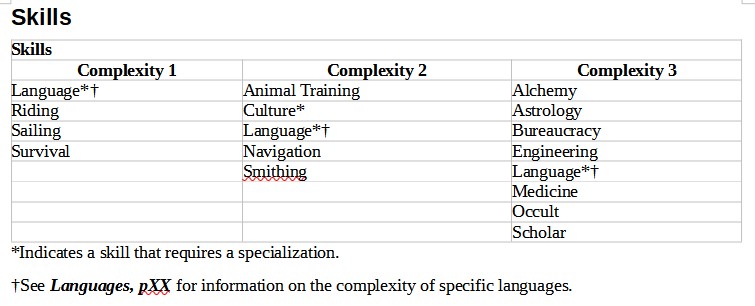
The time and cost necessary to learn a new skill depend on its complexity.
The table below assumes the character is involved in active study: at least eight hours each day during the required length of time devoted solely to study the skill he wishes to acquire. The days need not be consecutive, but the character cannot make a study roll until he has devoted one month (30 days) of 8-hour periods to the skill.
Teachers
Study Rolls
At the conclusion of every month of active study, the character must make a study roll. The study roll is the same as the character’s untrained skill save (see Skill Saves), modified by his Wits (see Ability Scores). If successful, the character advances in his study. Once a character has made successful study rolls for every month required of the skill he is studying, he has acquired the skill.
If unsuccessful, the character has learned nothing during the past month and must redo it (and the skill roll), provided he devotes the required time and money to the task. This process continues until either the character succeeds or he spends three consecutive months not engaged in active study (see Time and Money above), in which case he is considered to have abandoned study of the skill. He then loses all progress made up to this point and must restart the study of the skill from the beginning.
Monday, October 10, 2022
Learning by Experience
Friday, September 30, 2022
Thinking about Skills
For myself, I don't have any objection to skills per se. I certainly don't think skills are in any way contrary to the spirit of old school gaming, unless "old school" is taken to mean primitivism. Even then, the case against skills is weak, since Empire of the Petal Throne, published by TSR in 1975, a year after the release of OD&D, includes a skill system. Likewise, many other RPGs published within a few years of Dungeons & Dragons, such as Traveller, include skills and skill systems. If they don't qualify as "old school," I'm not sure what the word means.
All that said, I nevertheless do have some reservations about the inclusion of skills in a game with character classes, since I think they can undermine the uniqueness (and indeed purpose) of character classes. A lot depends, I think, on how skills are conceived in a game, but, by and large, it's generally my opinion that, if you have an extensive skill list and a mechanical system to support it, there's really no need for character classes.
The fine folks over at Chaosium would seem to have shared this perspective, since RuneQuest, an old school fantasy RPG with a skill system, has "no artificial character classes." While I don't agree that character classes are necessarily artificial, I do think that a robust skill system tends, at the very least, to weaken the mechanical role of character classes, if not completely eliminate the need for them. Consequently, I've largely come to conclude that D&D and RuneQuest (or Basic Role-Playing, if you prefer) represent two different but equally coherent approaches to mechanizing characters in a roleplaying game. Neither is inherently better than the other; both have their place.
My thoughts on this at the moment arise out of my continued work on sha-Arthan, my science fantasy setting. Originally, I thought of the setting as a natural fit for something obviously D&D-like, hence why my initial work included the creation of new character classes, including several intended for solely for the nonhuman species of sha-Arthan. One of those new character classes, the scion, was distinguished primarily by its collection of skills, which, while different from those of the thief, functioned very similarly to them. I tweaked the scion's skill list often and, in doing so, found myself adding a skill here or a skill there to other classes, in order to better represent what I saw as each class's purpose within the setting. Eventually, I found myself pondering an even broader skill system for all classes and the raison d'être of the scion largely evaporated. So, I went back to the drawing board.
Now, I find myself thinking about scrapping character classes entirely and going for something more like Basic Role-Playing, allowing the player to decide what skills his character possesses from a list available to all characters. There are definite advantages to this approach and it's certainly worked well for games like RuneQuest. Still, part of me likes the simplicity of character classes. They're a great way for newcomers to get into a game, especially a game whose setting, like that of sha-Arthan, is a little more complex than that of vanilla fantasy.
I'm still pondering the issue and have come to no firm conclusions yet. I imagine that, as I develop the setting more, I may get a clearer picture of the best way forward.
Thursday, September 22, 2022
The Enduring Appeal of Character Classes
The other day I was looking into a roleplaying game to which I'd recently seen references and was surprised to discover that, despite its having been published in 2022 and not being a fantasy game, it nevertheless made use of character classes. Of course, character classes, like hit points and experience points, to cite just two examples, are well-established elements of RPG design, owing to their having appeared in Dungeons & Dragons at the dawn of the hobby. That even a game published almost a half-century after OD&D makes use of them thus shouldn't be the least bit shocking.
The reason that I was surprised is that, for as long as I've been involved in the hobby, there have been loud complaints about character classes and their supposed deficiencies. One of the commoner complaints is that classes are too "restrictive" in some fashion. Others argue that the classes are "arbitrary" or even "unrealistic" in the way they categorize the skills and abilities of different adventuring professions/vocations. Still others say that classes are "simplistic," a relic of an earlier phase of game design before more "sophisticated" approaches had been imagined. Like training wheels on a bicycle, the hobby should abandon character classes now that it finally understands how to build a better game.
Seeing a new RPG make use of characters would seem to run counter to these long-stated complaints, not all of which are without some merit. Indeed, I have at various times been sympathetic to many of them, particularly those that focus on the limiting nature of character classes. Why shouldn't a fighter be able to learn how to pick locks or climb walls? Why shouldn't a magic-user be able to pick up a sword and fight? This is the line of thought advanced by Chaosium in its early advertisements for RuneQuest, which decried character classes as "artificial" and, on that basis, ought to be rejected in favor of "a realistic set of fantasy rules based on experience and reality rather than an arbitrarily developed abstract mathematical system."
Tuesday, November 1, 2011
Adventuring Skills
Break Locks: Dwarves, elves, and Men can break open a lock on a roll of 1–2 on 1d6, while gnomes and goblins can do so on a roll of 1. This roll can be modified by Strength. Note that locks opened this way are broken, not picked, which makes a loud noise, particularly when applied to locks on doors, and may alert nearby monsters of the character's presence.
Climb: All characters can climb sheer surfaces on a roll equal to or under their Dexterity score on 1d20, if they have rope and a grappling hook to aid them. Only thieves can do so without such aids. Likewise, the referee should apply penalties to particularly difficult climbs or when conditions make the ascent unusually hard.
Find Traps: Elves, goblins, and Men can find non-magical traps by actively searching on a roll of 1 on 1d6, while dwarves and gnomes can find them on a roll of 1–2.
Listen: Men can hear sounds from behind a door on a roll of 1 on 1d6, while nonhuman characters hear them on a roll of 1–2.
Observation: If actively searching, non-elves discover secret doors and other hidden features on a roll of 1–2 on 1d6, while elves discover them on a roll of 1–4. However, if elves pass within 10' of a secret door or hidden feature, there is a 2 in 6 chance they take notice, even when they are not actively searching.
Thursday, April 21, 2011
Some Observations on Skill Systems
Me, I don't really care one way or the other and will happily play either type of game without much fuss. It's rare that I dislike a game based on whether it uses classes or skills as opposed to the alternative. In playing skill-based games, I have noticed a couple of interesting things, though, both in myself and even in those who are strong advocates of the "superiority" of skill-based over class-based systems. First, I don't demand rolls for trivial uses of a skill, unless they're done under extreme or challenging circumstances. This is, of course, standard procedure and has been for a long time. For example, there's this passage from Chaosium's Basic Role-Playing:
This term [automatic actions] describes activities which are always successful under normal circumstances. There is no need to roll any dice for these. They are assumed 100% successful. These include walking, running, talking, seeing, hearing, and any other normal basic function.Of course, we all remember referees -- we may have even been them ourselves -- who didn't abide by this advice and required skill rolls for everything: "I ride to the next town." "Make a skill roll." "I fail." "Oops, you fall off your horse and take 1D6 damage." "But I'm a knight; I've been riding a horse since I was a boy." "Too bad, you failed your skill roll." That rather narrow-minded interpretation of skill use doesn't long survive contact with actual play, so the advice quoted above only makes sense. In these circumstances, there is no actual difference between a class-based or a skill-based game, except that a character sheet in the latter lists a level or percentage associated with riding horses, while in the former it's just assumed.
Attempting to do these things under extraordinary conditions, or trying to do them with close scrutiny, requires a die roll, as outlined in the next section.
The second interesting thing I've noticed about skill-based gameplay is a consequence of the first one already discussed. If we accept that skill rolls ought not to be demanded under "normal circumstances," it follows, then, that, as BRP suggests, "extraordinary circumstances" are when a skill system is actually needed. What I've found, though, is that, in such extraordinary circumstances, referees are often quite prone to fudging the results of a skill roll; I know I used to do this unashamedly and I was not the only one to do so. Part of the reason, I think, is that it seems wrong to many gamers to have the outcome of some extraordinary circumstance hang on a single dice roll. "You have to defuse the bomb quickly or everyone will die. What's your Demolitions skill?" "35%" "Make a roll." "Uh, 74." "Boom!" The situation is even more common when the skill rolls in question pertain to finding hidden or unusual things, like secret doors or clues. "I search the room." "Make an Observe check." "I fail." "You don't find anything out of the ordinary." And so we see elaborate rationalizations as to why the skill roll didn't really fail or even a further narrowing of the definition of "extraordinary circumstances," all in the name of seeing a character succeed at something the rules otherwise say he'd failed.
None of the foregoing is meant to suggest there's anything wrong, let alone bad, about skill systems in RPGs. I mention this simply because I've noticed that, in practice, skill systems are rarely used much differently than the non-quantified skills assumed to exist in class-based games. The primary difference between the two approaches is esthetic and, believe me, I'm not one to knock esthetics. When I designed Thousand Suns, for example, I didn't hesitate to use a skill system, because, as a sci-fi game, it seemed to make more sense to have characters defined by their areas of training and knowledge rather than by an archetype-based class. It's the same reason why the game uses the metric system -- it feels right in a science fiction game, even though the game would have worked just as well if I'd have adopted US standard measurements. It's the feel of a skill system that appeals to a lot of people, not its actual mechanics. It's the sense that skills are somehow more "realistic" or better reflect reality, and I can raise no objection to such subjective notions. But they are subjective and that needs to be borne in mind in discussing the merits of skill vs. class systems.
This brings me to a broader, final point. I don't think we can underestimate the impact that conceptualizing "adventures" as "stories" has had on RPGs and how they're played. If we see an adventure as having a definite, specific end before play even begins, it seems inevitable that, rather than being an aid to play, a skill system, with its quantification of many activities and areas of knowledge, is an impediment to it. On the other hand, if we see an adventure as simply being a situation into which the PCs are thrown, whose ultimate outcome depends on a combination of choice and luck, a skill system -- or, indeed, any random element -- is a contributing factor to that ultimate outcome.
In my second Thousand Suns session last weekend (which I'll post about eventually), a character failed an important skill roll and I let it stand without any fudging. As a result, the PCs could not achieve their current objective and were forced to move on. Had I conceived the "climax" of that adventure as depending on the success of that skill roll, I'd have been disappointed and might well have succumbed to the urge to fudge its result. But the adventure was just a situation in which the PCs found themselves at that moment. Failure meant only that one particular outcome to the adventure was closed off, but there were other possible outcomes, not to mention other adventures/situations. Rather than being an obstacle to our fun, the failed skill roll enabled it, pushing the characters and thus the campaign in a direction the players might not have chosen if they'd had the choice. Speaking only for myself, that's what all the best game systems do, regardless of whether they use classes or skills as their foundation.
Thursday, November 25, 2010
Space Opera Help Requested
In creating my character, though, I soon realized that, so far as I could see, there's no skill mechanic in the game whatsoever. There are "characteristic rolls" (CRs), which are 1D20 rolls under inconsistently variable target numbers (i.e. some CRs use the characteristic itself as the target, while others have a fixed target and have modifiers derived from the characteristic being tested), but there don't appear to be any skill rolls, unless I'm missing something. The descriptions of skills sometimes note specific game mechanic benefits (e.g. "build structures 5% faster for every level of experience"). Other skill descriptions provide no such guidance, despite the fact that all skills have levels and its implied that having, say, Advanced Mathemetics/5 is better than having Advanced Mathematics/4.
So, does anyone out there have any idea what I'm missing? I confess that a big part of the problem is that Space Opera is simply horribly organized and needed information is often difficult to find. Once you know where everything can be found in the two rulebooks, it's not so bad, but the trick is figuring out where everything can be found. In this case, I confess I can't quite figure out if there are rules for skill use I simply haven't found or there are no rules at all, at least none beyond the jumble of sub-systems found in some of the skill descriptions. As I said, if anyone knows better, please enlighten me.
Thanks!
Wednesday, June 30, 2010
Skills I Can Live With
Now, over the course of my Dwimmermount campaign, the players have occasionally expressed an interest in their characters' learning something, such as a foreign language. Gaztea, Brother Candor's thief henchman, is in the process of learning Ancient Thulian, for example, and she's also experimenting with basic alchemy by virtue of the fact that we'd established she was a failed wizard's apprentice turned criminal (and has 17 Intelligence to boot). Since there's no formal way to handle the acquisition of such knowledge in the game, I've been winging it, expecting that time, money, and a tutor are what's needed for learning.
Then, just recently, I was re-reading my copy Empire of the Petal Throne and I saw a rule I'd forgotten about. Section 420 of the rulebook includes rules for "Original Skills," which are background skills not unlike the secondary skills of AD&D. At creation, a player rolls percentile dice to determine how many such skills his character starts with and from what categories. EPT has three categories: "plebeian," which covers ordinary arts and crafts, like baking and tailoring, "skilled," which covers more advanced arts and crafts, such as animal training and ship-building, and "noble," which covers very specialized knowledge requiring considerable study to acquire, such as alchemy or mathematics.
There are several things I like about EPT's "original skills" system. First, with very few marginal exceptions, the skills don't undermine the class system but rather complement it. Second, there's no universal mechanic associated with skill use. Possession of the skill brings with it no mechanical expectations; indeed, many of these skills have no means of resolution beyond referee fiat. And the skills that do have mechanics are tied closely to level, which I find quite agreeable. Finally, the system includes a means of acquiring new skills -- actually, it includes two. The first is based on level, as it's assumed characters will acquire new skills from various categories as they increase in level. The second is through the expenditure of time and money, with plebeian skills taking 2 months and 1000 gold pieces to learn, while noble skills take 6 months and 10,000 gold pieces.
EPT's system isn't without flaws and when/if I adopt it for use in my Dwimmermount campaign, I'll likely make some changes to it, but, taken as a whole, it's an approach to the question of specialized knowledge of which I approve. It's built to work in concert with the skill system without either weakening class archetypes or introducing mechanics uncongenial to my refereeing philosophy. I'm glad to was reminded of it.
Tuesday, April 6, 2010
Musings on RuneQuest Skills
Anyway, while looking at my RQ II rulebook today and I paid careful attention to the skills it includes. If one leaves out combat-related skills, here is the standard complement of adventuring skills:
- Camouflage
- Climbing
- Evaluate Treasure
- Hide in Cover
- Hide Item
- Jumping
- Listen
- Lock Picking
- Map Making
- Move Silently
- Oratory
- Pick Pockets
- Read/Write Foreign Language
- Read/Write Own Language
- Riding
- Speak Foreign Language
- Speak Own Language
- Spot Hidden Item
- Spot Trap
- Swimming
- Tracking
- Trap Set/Disarm
On the one hand, I suppose I shouldn't have been at all surprised. Despite its subsequent development, RuneQuest in its early days shared a lot with Dungeons & Dragons, Tunnels & Trolls, and other fantasy games, where characters were assumed to be ne'er-do-wells in search of fame, fortune, and power by delving into ancient ruins and contending with foul monsters. In that context, the skills make perfect sense. On the other hand, it's still striking to see how different one's perceptions of a game don't always match up to the reality of how the game is actually presented. When I think of RQ nowadays, I am almost always thinking not so much of the game itself but of the game world with which it is associated, Glorantha, and the full-bore Glorantha that only came to pass after many years and many supplements describing it -- the serious mythopoeic Glorantha that seems to have pushed aside the wild and woolly gaming Glorantha of yore.
I'm not sure there are any deep insights to be gleaned here, but I thought I'd share my thoughts nonetheless. I'll have more to say about RuneQuest and the role it plays in the old school renaissance in the days to come.