Showing posts with label steve jackson games. Show all posts

Wednesday, September 17, 2025

Retrospective: GURPS Space

When Steve Jackson Games released GURPS in 1986, it was already clear what kind of roleplaying game it wanted to be. Unlike TSR’s Dungeons & Dragons or GDW’s Traveller, GURPS didn’t offer a default setting. Instead, it presented itself as a toolkit. It was intended as a modular, universal system one could bend toward whatever genre one preferred. What gave this claim weight wasn’t its rulebook, which was necessarily broad in its content, but its supplements. Each one attempted to answer the question, "Could this generic system really handle everything from dungeon crawls to post-apocalyptic road wars?"

One of the first such supplements Steve Jackson Games released was GURPS Space (1988), co-written by William A. Barton and Steve Jackson himself. In hindsight, it feels like one of the pivotal books of the line, the one that established GURPS’s reputation as more than just a flexible rules engine. It showed how you could take a broad genre, in this case, science fiction, in all its wildly different incarnations, and provide the referee with the tools needed to create (or recreate) any SF setting he could imagine.

By the late ’80s, science fiction roleplaying was in a state of flux. Traveller (in both its classic form and the then-new MegaTraveller) was still the reigning champion of the genre, but its dominance was showing cracks. West End’s Star Wars had burst onto the scene in 1987 with cinematic flair and wide acclaim, while TSR’s Star Frontiers had quietly stalled, its last release appearing in 1985. Against this backdrop, GURPS Space (1988) offered something no other SF RPG of the period did. It didn’t compete on the basis of a single setting, canonical future history, or a familiar franchise license. Instead, it handed referees the raw materials with which to build their own universes, be they grounded hard SF colonies, two-fisted pulp romps, or baroque planetary romances in the tradition of Vance and Burroughs.

It was precisely this approach that first caught my attention. At the time, I hadn’t yet played or even read GURPS. I knew it only dimly through advertisements, probably in Challenge magazine. But when I finally encountered GURPS Space, I was enchanted. Here was a book that didn’t tell me what science fiction ought to be but instead gave me the tools to make it whatever I wanted. I bought a copy almost immediately, followed by GURPS itself, largely on the strength of this one supplement. This would have been around 1990 or ’91, just after the release of the second edition, which is why the cover you see above accompanies this post rather than the original 1988 cover.

I was not disappointed. The worldbuilding section alone struck me as one of the most useful pieces of RPG design of its era. It provided step-by-step procedures for generating star systems, planets, ecologies, and cultures that felt simultaneously playable and evocative. The alien-design rules were equally impressive, demonstrating how the flexible mechanics of GURPS could be harnessed to create a wide array of nonhuman beings, from the truly strange to the more familiar. Even the treatment of technology impressed me. By abstracting progress into “tech levels” (an idea borrowed and refined from Traveller), the book offered a simple but powerful shorthand for describing entire societies without resorting to endless lists of weapons and gadgets (though, in time, GURPS would provide those as well).

Of course, GURPS Space bore the characteristic style of the line: dry, methodical, almost textbook-like. GURPS Space was never going to win any rewards for its writing, nor did it offer the convenience of a ready-made universe. This is both a strength and a weakness. For referees seeking inspiration and tools, it was definitely a godsend. For players wanting a game they could pick up and play straight away, however, it could feel intimidating or even sterile. Of course, that was the point. GURPS Space wasn’t trying to compete with the likes of Star Wars. It was offering something entirely different: freedom. 

Taken as a whole, GURPS Space is one of the most significant supplements in the history of the line. It established the idea of GURPS as the “toolkit RPG,” a system whose real strength lay not just in its rules but in the genre handbooks that supported them. In my own case, it was the book that convinced me GURPS supplements were worth buying even if I wasn’t actively playing the game (which, truth be told, was most of the time). I wasn’t alone in this. Many referees I knew freely admitted to pillaging GURPS books for ideas and procedures to import into their homebrew campaigns. I strongly suspect Steve Jackson Games realized this and leaned into it, tailoring its supplements to appeal as much to curious referees as to dedicated GURPS players.

Looking back, it’s easy to see why GURPS Space made such an impression. It is fundamentally optimistic about exploration and the potential of alien contact, yet flexible enough to support darker, more cynical futures. It treats science fiction not as a single genre but as a sprawling field of traditions, each with its own possibilities. Above all, it captures what Steve Jackson Games was attempting to do with GURPS, namely, provide tools rather than a finished product and trust the imagination of referees and players to supply the rest.

That is ultimately why I still look back fondly GURPS Space, even though I don't play GURPS nor am I likely to do so anytime soon. Like so many of the supplements that followed in its wake, it doesn’t prescribe so much as inspire. Every table, every guideline, every suggestion is an invitation to ask questions and ponder answers. It’s not a book that hands you a ready-made campaign setting but one to spark ideas you might otherwise have not come up with on your own. In that sense, it’s less a manual than a launchpad, still capable of sending the imagination into orbit nearly four decades later.

Monday, December 9, 2024

What the @!¢%*# is GURPS?

Though I was a fan of Ogre and Car Wars, both designed by the American Steve Jackson (not the British one), I didn't pay close attention to the other games his company was publishing. Consequently, when GURPS arrived on the scene in 1986, I largely paid it no heed, aside from the very peculiar advertisements I remember seeing in the pages of Dragon and elsewhere, like this one.

What's most immediately striking to me about this ad – aside from the painful lack of a question mark – is that nowhere does it explain what GURPS actually stands for. That's probably intentional, since the oddity of the game's title is memorable and might serve to pique interest in it. By the time I first played GURPS in the early '90s, it was already common knowledge that this was the Generic Universal Role Playing System, so it never really bothered me. But to a contemporary reader of Dragon? I wonder what he'd have thought.

Tuesday, February 21, 2023

For Every Era ...

As I mentioned in my Retrospective post, I haven't played a lot of GURPS, though I've long admired the ambition of its design. I recall seeing advertisements for the game in various gaming magazines long before I ever opened a copy of the rulebook. This one, from early 1985, really piqued my interest in GURPS, in large part because of the artwork, which had the kind of sober, serious – even a little dull – style that I often find compelling. 

Wednesday, February 1, 2023

Retrospective: GURPS

Though I've never been a devoted user of universal roleplaying game systems, I've long been intrigued by the idea of them. My first brush with the concept was probably Basic Role-Playing, which I encountered through the first edition of Call of Cthulhu in 1981. Chaosium used BRP (derived from RuneQuest) as the foundation on which it would build the rulesets of its other roleplaying games, like Stormbringer. Ringworld, and the aforementioned Call of Cthulhu. Hero Games did something similar with the rules of Champions.

For me, the appeal of a universal system lay in the promise of never again having learn new rules just because I wanted to play a new game (or setting). As both a referee and a player, I'm indifferent to rules, except to the extent that I forget them or confuse them with the rules of another game with which I'm also familiar. In general, once I find a ruleset that works well enough for my purposes, I stick with it. This probably explains why I've played so much D&D and Traveller over the years, despite the existence of purportedly "better" systems for fantasy and science fiction: I know these rulesets and they're more than adequate for my purposes.

In my youth, I knew plenty of people who had adapted the rules of Dungeons & Dragons to their favorite genres or settings. This was, I gather, a common practice in the days when there were only a handful of different game systems. Even at the time, this felt odd to me, despite my affection for D&D and my facility with its rules. Nevertheless, I understood the impulse. Why reinvent the wheel? Why did every RPG have to have its own unique – and frequently idiosyncratic – game system? Wouldn't things be easier if you and your fellow players had to learn just one ruleset rather than a new one every time you started a campaign?

So, when I first heard about Steve Jackson's "Great Unnnamed Roleplaying System," I was more than a little intrigued. Though I had never played Jackson's previous RPG, The Fantasy Trip, I knew it was well regarded and, from what I had gathered, the then-upcoming GURPS was designed as a successor to and an expansion of the core concepts behind The Fantasy Trip. Plus, I was a very big fan of Jackson's Ogre and Cars Wars, both of which my friends and I played regularly. By my lights, this pretty much guaranteed that GURPS – or whatever its "real" name would eventually be – would be a winner.

The first publication to carry the GURPS name, Man to Man, was released in the summer of 1985, along with a collection of scenarios entitled Orcslayer. Man to Man was a kind of preview of GURPS, presenting the game's combat system. I never saw a copy of it at the time – indeed I've still never seen one – so its release came and went without much notice from me. By the time the full GURPS Basic Set was published the following year, in 1986, I had largely forgotten about the whole thing, so it too escaped my attention. I'm not entirely sure why this was, though I suspect, given the timing of its release, that I was distracted by other matters. 

When I did finally see a copy of GURPS, it was already on its third edition. This would have been sometime in the late 1980s. The game was no longer sold as a boxed set with multiple booklets but as a single softcover volume. I ordered my copy through the mail, based on an advertisement I'd seen somewhere (Dragon? Challenge?), which reminded me that GURPS did indeed exist and that I'd once been quite interested in the project. I was very happy to receive it, along with a copy of the GURPS Space supplement, since I was then, as I am now, more or a sci-fi fan than a fantasy one.

I was very impressed with GURPS when I first read it. The rules were simple and easy to understand. The presentation was similarly straightforward – a no-nonsense layout with black and white art and informative little sidebars throughout. I loved how modular everything seemed, with skills, advantages, and disadvantages all capable of being added or swapped out, depending on the setting and genre of the campaign you were planning to run. Likewise, the supplementary material, like Space, provided lots of tailored options for the referee to consider. All in all, GURPS exceeded my expectations.

Unfortunately, I never got the chance to play much GURPS in the months immediately after I first bought it. It wasn't until several years later, after I'd graduated from university and moved to my present home, that I rectified this. My local friends had played GURPS extensively, having effectively abandoned all other game systems in its favor for several years beforehand. They thus knew the system's ins and outs and were quite happy to share their thoughts on the matter. By and large, their experiences were positive, but they also recognized that, at least in its third edition – things may have changed in more recent editions – the rules creaked somewhat the farther one got from the power and technological level of medieval fantasy. In short, GURPS had something of a scaling problem, particularly as one moved toward science fiction.

This was disappointing to hear, but it didn't stop me from making use of GURPS several times over the years. Whatever its flaws might be, it was still a simple and convenient way to play campaigns that deviated from those presented in other commercially available RPGs. It was a terrific "toolkit game" and its supplements were often among the most inspiring and best researched I'd ever seen. I continued to support the game for years, despite playing it only sporadically. That's no knock against the game itself so much as an acknowledgment that, despite my appreciation for it and what it tries to do, GURPS never succeeded in joining my list of go-to RPGs. I definitely think there's a place for a game like GURPS, which is much more accessible and user friendly than, say, HERO. That said, I'm much less convinced these days that a one-size-fits-all universal system is even possible, let alone desirable and so GURPS remains on my shelf, unplayed.

Tuesday, January 10, 2023

White Dwarf: Issue #63

Issue #63 of White Dwarf (March 1985) is graced with a cover by Italian-born artist Gino D'Achille, who is probably most well-known for the work he did on the Ballantine editions of the Barsoom novels from 1973 (or the DAW Gor books, if that's more your preference). In his editorial, Ian Livingstone continues to ponder the state of the hobby, with particular emphasis placed on the peculiar ways that licensed properties are divvied up among companies. He notes, for example, that Games Workshop publishes the Doctor Who boardgame, while FASA publishes the RPG. He also notes that, while TSR publishes Battle System ("which sounds like Warhammer"), Citadel produces the official AD&D miniatures line. Livingstone's correct to note the oddity of this, but it's been pretty much par for the course for as long as the licensing of media properties has existed (and remains so to this day).

The issue kicks off with "Arms and the Man" by Michael Holman, which builds on Andy Slack's article on vehicle combat in Traveller from White Dwarf #43. Holman introduces a number of new vehicle systems, including offensive ones, as well as an expanded vehicle combat procedure. It's all good stuff, though it highlights, as did Slack's article before it, just how much Traveller needed vehicular combat rules simpler than those in Striker. 

Dave Langford's "Critical Mass" occasionally elicits my interest – not so this month, which is why I will pass over it without comment. Much more compelling to me is "Open Box," which very positively reviews Toon (9 out of 10), a game for which I have more affection than is probably justified. Also positively reviewed are a pair of videogames from Triffid Software, The Secret River and The Wizard's Citadel, which score a combined 8 out of 10 (somehow). I must admit I was surprised to see videogames reviewed in "Open Box." In the past, such things appeared in a separate column, "Microview," but I suspect it had been axed sometime prior to this. There's a side by side review of FASA's Star Trek III Starship Combat Game and Task Force's Star Fleet Battles Volume II. The comparison is not completely fair, since SFB Volume II is not a stand-alone product but a supplement. Even so, White Dwarf gives them 8 and 7 out of 10 respectively. Finally, there are reviews of the D&D modules, The Veiled Society (9 out of 10) and Quest for the Heartstone (4 out of 10). I'll be looking at the latter in a separate post tomorrow.

Part 5 of Graeme Davis's Eye of Newt and Wing of Bat concludes by tackling miscellaneous magic items. This is probably the least satisfying entry in the series, because it looks at only a small percentage of the miscellaneous items found in the Dungeon Masters Guide and presents no unified system for handling their manufacture. On the one hand, that's understandable, given the diversity of the miscellaneous magic items. However, the point of the series is to present a system to aid referees and players in adjudicating the creation of magic items. Without that, I think it's a little less useful than it might have otherwise been.

Carl Critchlow gives us the first part of "Thrud the Destroyer," which amusingly riffs off both the awful second Conan movie and The Magnificent Seven – fun stuff, as always. "The Travellers" and "Gobbledigook" are also enjoyable, though neither compares to this month's "Thrud." The third and final part of Jon Sutherland and Gareth Hill's "The Dark Usurper" Fighting Fantasy scenario appears in this issue, too. It's much like the previous parts, which is to say, passable as a solitaire scenario, though nowhere near as good as even an average full-length Fighting Fantasy book.

Much more compelling is Marcus L. Rowland's "Draw the Blinds on Yesterday," a Call of Cthulhu scenario set in the 1980s. The adventure concerns a missing flight between Athens, Grece and London, England, thanks to an unsuccessful attempt to summon Cthugha from Fomalhaut. Also involved is the last surviving Gorgon, an extraterrestrial species that is the origin of the myths of Medusa and her sisters. It's a delightfully bonkers scenario that somehow works, despite (because of?) its strange mix of elements. 

"Setting the Scene" by Joe Dever and Gary Chalk is another fascinating miniatures-oriented article. This time, the authors look at the pitfalls of how best to make use of miniatures and scenery at the table. It's a topic I'd never really considered before, given my limited use of miniatures over the years. As usual, Dever and Chalk do a fine job of briefly laying out the problems and offering solutions, accompanied by useful color photographs. Every time I read one of their articles, I find myself deeply regretting that I never bothered to take up miniatures painting back when I still had the eyesight and hand-eye coordination to make a serious go of it. The folly of youth!

"Howzat!" by Mark Wilkinson, David Bailey, and Richard Bramah is humorous RuneQuest article that presents the rules (and game mechanics) for "elfball," a Gloranthan analog to cricket. There are even a few new spells for use during the game, like batting trance and team spirit, as well as additional spells for use by umpires. It's silly but fun, the kind of thing that I long considered a distinctive aspect of the UK game scene in the '80s. "A Not So Lonely Mountain" presents a pair of short scenarios involving the characters' ascent up a mountain – and the monsters they encounter along the way. I like this style of introducing new opponents in a RPG and wish it was done more often.

"Imperial Trooper" by Nic Weeks is look at the elite military forces of the Imperium of Traveller. It's mostly "fluff," in that it introduces no new rules or equipment for use with the game and, on that score, is good enough, though it does differ somewhat from GDW's own presentation of similar topics elsewhere. Concluding the issue is James Carmichael's "Help for the Hobbit Abroad," which presents some halfling-specific magic items, like pots of cooking and the pipe of the storyeller. (One of these years someone will figure out something to do with halflings that's more interesting than simply being Tolkien's hobbits with the serial numbers filed off – or, better yet, jettison them entirely!)

And so we come to the end of another issue of White Dwarf. As usual, it's a mixed bag, filled with a wide variety of material geared toward an equally wide variety of games. That was always White Dwarf's great strength when compared to Dragon and its relentless focus on Dungeons & Dragons. Of course, this sometimes meant that some issues of White Dwarf might not be as interesting to me as others, but that was a chance I was willing to take at the time. Re-reading these issues remains a delightful trip down memory lane; I look forward to the next one.

Tuesday, November 29, 2022

White Dwarf: Issue #59

Issue #59 of White Dwarf (November 1984), with its cover by Peter Andrew Jones, is another issue I remember well, since it was published during the run of years when I had a subscription to the magazine. In his editorial, Ian Livingstone notes that the "Fiend Factory" feature, which began all the way back in issue #6 and many of whose entries formed the basis for TSR's Fiend Folio, would now be presenting new monsters for more RPGs than just Dungeons & Dragons. Small though this change is, it is nevertheless an important turning point in the history of White Dwarf and reflects, I think, the rise to prominence of other games on the UK scene. 

The issue begins with "The Mad Gods' Omelette," a parodic fantasy short story by Dave Langford. It's actually quite funny in the way it skewers the increasing self-seriousness of the contemporary works in the genre, particularly those that took their cues from Moorcock. One of my favorite bits in the story is a comment by the protagonist Erryj, possessor of "the black, runecarved artificial leg Slugbane," upon hearing that "the Dark Gods walk the earth once more."

"The Dark Gods?" Erryj gave Dylan Worm a searching glance. "Aye, I have heard tell of such. Speak you of the Elder Gods? ... The Younger Gods? The Dead Gods? The Agnostic Gods?" With each utterance, a greater stillness filled the room.
As I said, it's quite funny and much more enjoyable than Langford's "Critical Mass" column this or any other month. Mind you, this month's installment of the book review column holds some interest in that Langford looks at William Gibson's first novel, Neuromancer, which he likes a great deal, though he criticizes its "frenetic" pace. I suppose it wouldn't be a proper "Critical Mass" column if Langford didn't find fault in nearly everything he reviews.

"Open Box" takes a look at three different adventures for Call of Cthulhu: The Curse of the Chthonians (9 out of 10) from Chaosium, Glozel est Authentique! (5 out of 10) from TOME, and The Horrible Secret of Moneghan Island (7 out of 10) from Grenadier. These reviews are all fair, based on my own experience. Also reviewed are the Gamemaster Pack and For Your Information for James Bond 007, which earn 4 out of 10 and 3 out of 10 respectively. This continues the trend of giving rather negative reviews to James Bond 007 RPG products, something I find inexplicable, given my own fondness for the game. On the other hand, neither of the reviewed products are exceptional in any way, so perhaps they are fairer than it might seem on first glance. Finally, there's a review of Chaosium's Ringworld, which receives a mediocre 6 out of 10, even though the reviewer praises both the background information and the rules set – odd!

"The Ninja" by Chris Elliott and Richard Matthews is yet another stab at a ninja character class for AD&D. Though there are a few new wrinkles – such as non-magical "spells" – the class is just another Japanese-flavored assassin variant with too many abilities. The class is intended to be used in conjunction with "Hour of the Tiger," an AD&D scenario also included in this issue. The adventure involves the infiltration of an imperial palace and demands stealth and cunning, not to mention reconnaissance, to succeed. It's well done and probably challenging, particularly to players for whom brute force is standard operating procedure.

Marcus Rowland's "A Matter of Faith" presents four religious cults for use with a variety of modern-day RPGs, such as Mercenaries, Spies, and Private Eyes; Top Secret, James Bond 007, Superworld, Champions, Call of Cthulhu, Golden Heroes, and Villains & Vigilantes. The cults range from The Temple of Excellence, Inc., which teaches that transcendence is possible through the acquisition of skills, to Technodeology, which believes that God does not yet exist and must be created as a computer. Rowland fleshes out each cult briefly and provides notes for customizing it for the RPG in which it's used. Very good stuff!

"Two Decks are Better than One" is a Car Wars article by Steve Jackson about the inclusion of double-decker buses into the game. "Eye of Newt and Tongue of Bat" by Graeme Davis is the first part of a series of articles intended to provide a system for the manufacture of magic items in AD&D. This installment focuses on staves, wands, and scrolls. I've long liked the idea of a system like this in principle, because I think that the process of creating new magic items should be both involved and interesting. However, most such systems offer only tedium without much else and, sadly, this system isn't much different.

"On the Road" by Anna Price is an outline for a RuneQuest scenario in which the characters accompany a caravan across the Plains of Prax. Though skeletonic, it provides enough detail, including several random tables, to make the overall situation compelling. "A Brush with the Lore" by Gary Chalk and Joe Dever tackles the matter of choosing an appropriate brush and paints for miniatures. "Core" introduces the Consular Office of Reconnaissance and Exploration, a Zhodani organization intended to be used as antagonists in an ongoing Traveller campaign. Like many such things, it's fine for what it is, but not especially memorable. 

"Gladiators in RuneQuest" by Matthew Pook briefly discusses the matter of blood sports in the game, while "Pit Fighting" by James Waterfield contextualizes somewhat the practice within the setting of Glorantha. "The Great Hunt" by Simon Iff describes the Reavers, powerful minions of the demon prince Orcus who do his bidding on the Prime Material Plane. This article includes lots of background material about the Reavers and their origins, as well as their activities. Though very high-powered, I immediately saw uses for these creatures in certain campaigns. "Ars Arcana" by Kiel Stephens continues to look at unusual uses for D&D spells and does so quite engagingly. Any article that can teach me a few new tricks for a game I've been playing for decades earns a gold star.

This is a very good issue, filled with lots of variety, in addition to old favorites like "Thrud the Barbarian," "Gobbledigook," and "The Travellers." To my mind, this is peak White Dwarf and is what I think of when I think of the magazine in its heyday. 

Tuesday, October 25, 2022

White Dwarf: Issue #55

Issue #55 of White Dwarf (July 1984), with its cover by Les Edwards, is one I remember quite well, in part because it was published during the time when Games Workshop USA was located in Columbia, Maryland. Maryland being my home at the time, this situation made it much easier for me to find issues of WD, both current and back issues. The fact that the cover was science fictional in nature probably also plays a part in my memory of it.

In his editorial, Ian Livingstone mentions that TSR "had to sack about 150 employees during the last year and several other companies have ceased trading." 1984 was definitely a significant year for the history of both TSR and the wider hobby, though of course I didn't realize it at the time. Livingstone goes on to say that "this is not the end; it merely signals change." He suggests that "adventure gaming," as he calls it, is still growing in popularity and that book companies and computer games companies will benefit from the "changing desires" of the buying public. He was probably more correct in his prognostications than he imagined.

The final installment in Marcus L. Rowland's "The Name of the Game" focuses on RPGs other than fantasy and science fiction. He puts particular emphasis on superhero and espionage games, though games like Call of Cthulhu, Gamma World, and Car Wars also get nods. The main benefit of articles like this is historical; they're a good snapshot of the time in which they were published. Speaking of history, "Spiderbite" by Oliver Johnson is an introductory scenario for both D&D and AD&D whose premise involves historical research. The characters are approached by a cleric of scholarly bent who wishes to learn more about an ancient tomb complex located in the jungles of the south. Though short and relatively straightforward, the tomb is a well-done little dungeon seemingly inspired by the adventures of Indiana Jones and other pulp treasure seekers.

"Open Box" reviews a number of notable products, starting with Forces of Fantasy, the first supplement for Warhammer, which scores 7 out of 10. Four (A)D&D modules are also reviewed: Temple of Death (10 out of 10), The Assassin's Knot (7 out of 10), Tomb of Martek (9 out of 10), and Ravenloft (8 out of 10). I find it fascinating that the reviewer, Dave Morris, gave Temple of Death a perfect score, his only complaint being that it was written for Expert rather than Advanced D&D. Equally fascinating is his complaint that Ravenloft is the module's "series of tedious puns" – a fair criticism but far from the worst aspect of this highly influential scenario. Sherlock Holmes, Consulting Detective is viewed with great favor (9 out of 10), as are three volumes Commander's SSD Books for use with Starfleet Battles (all scoring 9 out of 10). 

I suppose it's a reflection of how poorly read I am compared to Dave Langford that only one of the books he reviews in this month's "Critical Mass" – Stephen R. Donaldson's Daughter of Regals – has ever graced my shelves. Actually, that's not true: he also mentions Moorcock's The Weird of the White Wolf and Bane of the Black Sword, though he says nothing much about them. Much more intriguing is "The Unquiet Grave" by Phil Holmes, in which he takes a look at the undead as portrayed in myth and literature, with an eye toward their use in fantasy RPGs. "Punks in 2034" is a short and self-explanatory Car Wars article by Steve Jackson (the USA one, not the UK one). It wouldn't be the '80s without some punks, after all ...

"Man and Beast" by Tom Parry and Jerry Vaughn is a treatment of zoolatry – animal worship – as the basis for cults in AD&D. The article provides information on initiation and advancement within the cults, as well as animal talismans, which are magic items that grant various powers related to the cult's animal patron. Interestingly, advancement within a cult isn't tied to a character's experience level, but is something independent of it. I rather suspect that the idea behind this is derived from the cults of RuneQuest – not that I mind, since cults are one of the most compelling ideas in RQ.

Part 4 of Dave Morris and Yve Newnham's "The Castle of Lost Souls" solo adventure appears in this issue and is as enjoyable as the previous parts. Normally, I skip over the letters page; I will make an exception this issue, because of the following "letter," which I found amusing:

As usual, we get more "Thrud the Barbarian," "Gobbledigook," and "The Travellers." There's also "Flying the Flag" by Joe Dever and Gary Chalk, which talks at some length about the trials and tribulations of creating flags and standards for use with miniature figures. It's a surprisingly interesting article and I say that as someone who's never been much of a miniatures guy. "Mystic Triptych," as its name suggests, is a collection of three small articles for use with RuneQuest, my favorite being Oliver Johnson's stats for the night shriekers from Dougal Dixon's After Man. 

"The Gods of the Shapelings" by Fred Lee Cain is a follow-up of sorts to last month's "Fiend Factory," which introduce the naturally invisible shapeling race. Their gods are written up Deities & Demigods-style and are vaguely interesting (which is more than can be said of the shapelings themselves). "Arch Enemies in FRP" by J.H. Dickson is about what you'd expect: a bit of advice to the referee about making memorable enemies. Finally, there's "The Edge of Infinity" by Marcus L. Rowland, an excellent Ttraveller piece that considers alternate approaches to sector design, including curved and folded space, in addition to wormholes and parallel dimensions. Good stuff!

Though this issue is one I remember well, it's not one of my favorites. That's no knock against it, mind you. Rather, it's (yet more) recognition that it's difficult to put together a consistently excellent periodical, since it's so dependent on its submissions. With luck, next issue will be one of the greats.

Tuesday, October 11, 2022

White Dwarf: Issue #53

Issue #53 of White Dwarf (May 1984) boasts a cover by Angus Fieldhouse depicting wgar appear to be orcs in the service of Saruman from The Lord of the Rings – notice the sigil of the white hand on their shields and battle standard. If so, it's an odd choice, since the issue contains a scenario for use with Warhammer based on the Battle of Pelennor Fields in which Saruman's forces did not participate, having already been defeated at Helm's Deep a couple of weeks prior. Even so, I like the illustration quite a bit; it nicely encapsulates many of the features I strongly associate with the Games Workshop "house style" for artwork.

Editor Ian Livingstone touches again on the issue of the roleplaying hobby's continued growth. He opines that gamers "who have been in the hobby for many years" might be "a little peeved" that "thousands of newcomers who view the hobby less seriously" than they have intruded their "exclusive" domain. It's an age-old aspect of the hobby, one I've experienced from both sides. If nothing else, this simply proves that there really is nothing new under the sun. Livingstone states that White Dwarf will continue to assist newcomers "by publishing introductory articles and scenarios," but that it would not do so "at the expense of its main editorial features." Whatever one thinks of this approach, I think it's instructive to consider that Games Workshop still exists today, while most of the other mainstays of the hobby, most notably TSR, no longer do so. 

Part 2 of Marcus Rowland's introduction to RPGs, "The Name of the Game," appears in this issue. This time, he focuses on games other than Dungeons & Dragons, starting with RuneQuest, which receives the bulk of the article's coverage. Rowland's comments on RQ are interesting. He emphasizes its detailed setting of Gloratha, its unique magic systems, its religions and cults, and, above all, its combat system, which he calls "the main reason for the game's success." He also includes brief discussions of several other RPGs: Tunnels & Trolls, Chivalry & Sorcery, Warhammer, and Man, Myth & Magic – quite an odd assortment to me, but perhaps this reflects the idiosyncrasies of the UK market in the mid-1980s.  

"Minas Tirith" by Joe Dever is a huge article that presents the Battle of Pelennor Fields from The Return of the King as the basis for a Warhammer fantasy battle scenario. The scenario is designed for two sides, the forces of Gondor and its allies and the forces of the Witch-King of Angmar. Of course, each side has enough units and sub-factions, not to mention named characters, that it would be quite easy to divvy them up into several players. The article includes not only stats for all the forces but suggestions of miniature figures appropriate to represent them. Though I've never been much of a miniature wargames player, I found the article weirdly inspirational and wished I could somehow get the opportunity to play it.

"Open Box" starts its reviews by looking at Games Workshop's Caverns of the Dead, an ostensibly system-neutral (yet obviously intended for D&D) boxed scenario that includes lots of maps and even a referee's screen. The reviewer rates it 7 out of 10 and notes that it's not quite as good a value for the money as a typical D&D module. Two more Fighting Fantasy books, Deathtrap Dungeon and Island of the Lizard King are reviewed, each earning 8 out of 10. I have a personal affection for Deathtrap Dungeon, due to its difficulty, which greatly appealed to me at the time. Finally, there's a review of Scouts for Traveller (7 out of 10). 

Dave Langford's "Critical Mass" comments upon another of Anne McCaffrey's Pern novels, Isaac Asimov's The Robots of Dawn, and Diana Wynne Jones's The Homeworld Bounders, among a few others. Meanwhile, "The Moonbane" is a piece of original fiction, "a short tale of gothic horror" by Chris Elliot and Richard Edwards. Much more interesting – to me anyway – are the latest installments of the comics "Gobbledigook," "The Travellers," and "Thrud the Barbarian." Also more interesting is Lewis Pulsipher's "Sign Here Please ...," a brief rumination on making pacts with devils in the context of fantasy roleplaying games. 

"The Naked Orc" by Rufus Wedderburn is "a study of orcish society." In some ways, it's a bit like Dragon's "Ecology of ..." series, except that it's focused on the politics and sociology of orcs rather than their biology. It's fine, I suppose, though there's nothing particularly clever or revelatory about it. "Spare Parts" is a Car Wars article written by none other than the game's creator, Steve Jackson himself (apparently written on his British namesake's typewriter while on a visit to England). It's mostly a puff piece in which Jackson talks about his plans for game, including a computer version from Origin (which did indeed come out in 1985).

Part 2 of Dave Morris and Yve Newnham's "The Castle of Lost Souls" solo adventure appears here, continuing the scenario begun in the previous issue. "Three of a Kind" by Michael Clarke presents three NPCs for use with Traveller; they can be used either as patrons or antagonists. "Of Oak, Ash, and Mistletoe" by Robert Dale is a collection of spells drawn from Celtic myth for use with RuneQuest. "Under Siege" by Joe Dever and Gary Chalk is a discussion of sieges in the context of miniatures wargaming, complete photographs. 

"Slave Hunt" is this month's installment of "Fiend Factory." Like many of the early installments of the feature, editor Albie Fiore weaves a loose scenario around four new monsters for use with D&D. The new monsters, all submitted by different authors, are all small humanoid creatures of various kinds, none of them particularly notable in my opinion – but that's a common problem of new monsters for the game. Finally, there's "Bits and Pieces," a random collection of material for Dungeons & Dragons. While the material isn't particularly memorable, it's listed as having been collected by Roger E. Moore, who was already an editor at Dragon at the time and would go on to be its editor-in-chief in 1986.

This is another solid issue of White Dwarf with a diverse range of articles covering a variety of games. What I most notice is the growing presence of articles dedicated to Warhammer and miniatures wargaming more generally. This is a trend that will only increase in the coming years and eventually lead to the magazine's becoming explicitly a house organ of Games Workshop in a way that it hadn't been previously. It also would lead to my ceasing to read, since I read primarily for its coverage of D&D, Call of Cthulhu, and Traveller.

Friday, October 7, 2022

"Has Steve Jackson lost his mind?"

An advertisement from issue #120 (April 1987) of Dragon magazine. 

Tuesday, June 28, 2022

White Dwarf: Issue #40

I have no idea what artist Emmanuel's cover to issue #40 of White Dwarf (April 1983) is supposed to depict. Despite that, it's exactly the kind of cover I strongly associate with the magazine: weirdly evocative and vaguely science fictional or fantasy in its subject matter. Somewhat relatedly, Ian Livingstone's editorial notes that fantasy RPGs remain much more popular than science fiction ones and he wonders why that is. It's a question I regularly ponder myself. The closest I've come to an answer is that fantasy is a more strongly codified and, therefore, familiar gaming genre, where even those RPGs that deviate from the Tolkien-descended consensus tacitly acknowledge its supremacy. The same is not true of science fiction, with its welter of sub-genres and approaches.

"Zen and the Art of Adventure Gaming" by Dave Morris reminds us that we're solidly into the '80s and its fascination with all things Japanese. His article is an attempt to present feudal Japan in RuneQuest terms, with new weapons, armor, and skills, in addition to a very brief treatment of kami and magic. Being on something of a RuneQuest kick lately, I found this article a welcome one, though its brevity limits its utility considerably. I now find myself regretting that I never picked up Land of Ninja during the years when Avalon Hill was publishing RQ under license from Chaosium.

"Dungeon Master General" by Alan E. Paull presents a system for handling large scale combats in Advanced Dungeons & Dragons. Paull's system is a relatively simple one that eschews miniatures and downplays precise measurements in favor of speed and ease of use. Consequently, the system is loose and relies on referee judgment and common sense in many areas, such as the adjudication of morale. Not having used it myself, I can't speak to how well it works, but I nevertheless appreciate articles like this. I've long been of the opinion that D&D is in need of a mass combat system that does not expect the referee to break out a sand table every time he wishes to simulate a clash between armies. Paull's system may or may not succeed in doing this to most people's satisfaction – I suspect the latter – but it's a worthy project nonetheless.

Dave Langford's second "Critical Mass" column focuses on two authors whose works have been discussed on this blog in the past: Robert Asprin and Stephen R. Donaldson. In the case of Asprin, Langford reviews Myth Conceptions, the third in the author's Myth series. Langford doesn't think much of the book or its humor; I can't say that I disagree with him. It's very difficult to write a series of humorous novels without eventually descending into an unintentional parody and that's more or less what happened to Asprin. As for Donaldson, Langford reviews White Gold Wielder, the third and final book in the second trilogy of Thomas Covenant. Langford doesn't think better of this novel and, again, I can't really disagree with him. The second trilogy showed promise early on, with the protagonist being much less awful than he was in his previous outing, but it's still a convoluted, self-serious slog with a couple of interesting ideas that don't justify the time I invested in reading it.

"Open Box" reviews Soloquest 2: Scorpion Hall for RuneQuest, giving it an 8 out of 10. Also reviewed are a quarter of AD&D modules: Hidden Shrine of the Tamoachan (8 out of 10), Ghost Tower of Inverness (8 out of 10), White Plume Mountain (8 out of 10), and Dwellers of the Forbidden City (5 out of 10). Perhaps I am biased, but I find it difficult to believe that Dwellers of the Forbidden City rates only a 5 or that either Ghost Tower of Inverness or White Plume Mountain, both of which are contrived funhouse modules, deserve ratings as high as they received. Chacun à son goût. Illuminati receives a 7 out of 10, while Starstone, a generic fantasy module published by Northern Sages (and with which I am unfamiliar) receives a 9 out of 10.

"The Eagle Hunt" by Marcus L. Rowland is an AD&D scenario for 1st–3rd level characters. Its premise is that an ancient artifact, the titular Green Eagle, has been stolen from the king's treasure vault and the two detectives dispatched to locate it have themselves gone missing, thereby necessitating a public reward of 20,000gp for anyone who can recover it. "The Eagle Hunt" is a lengthy and engaging adventure, quite different from the usual low-level scenarios one regularly sees. Likewise, the Green Eagle's true purpose, if discovered, has the potential to open up interesting possibilities in a D&D campaign.

"Trading" by Oliver Dickinson presents a simple trade system for use with RuneQuest, one vaguely reminiscent of that found in Traveller (not that that's a bad thing). Speaking of Traveller, Andy Slack offers up "Explorer Class Scoutships," a detailed look at a new type of starship, complete with game stats and deckplans. Part II of "Inhuman Gods" by Phil Masters treats readers to the deities of yet more non-human beings, such as the firenewts, flinds, and frogmen. "RuneQuest Characters" by Nelson Cunningham provides the code for a GAP (game assistance program) intended to generate random RQ characters. I love that the article includes a section entitled "What to do when it crashes." Good times! Finally, "Treasure Chest" gives us six more D&D magic items, because we can never have too many magic items, can we?

Issue #40 is a very strong issue, filled with plenty of meaty and imaginative articles, many of which have a unique flair that differentiates them from what I saw in the pages of Dragon and other American gaming periodicals of the same era. Re-reading this issue, I found myself unexpectedly nostalgic for the White Dwarf of old, before the magazine became wholly devoted to Warhammer and its spin-offs. I consider myself fortunate to entered the hobby at the time I did. We shall not see its like again.

Wednesday, January 26, 2022

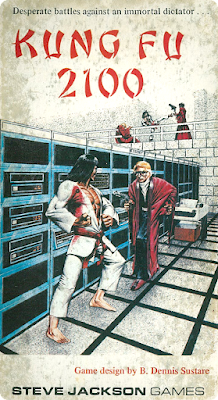
Retrospective: Kung Fu 2100

I'm a huge fan of "micro-games" (also known as "mini-games" and "pocket games," among many other monikers). I was an avid player of TSR's forays into this field, but it was the designs published by Steve Jackson Games that first introduced me to the concept. Broadly speaking, most micro-games existed in a space somewhere between boardgames and wargames and came in small containers, whether ziplock bags, plastic clamshells, or pocket boxes. All micro-games featured relatively simple rules and components, which is why they were generally playable in about an hour or so. This was a big part of the appeal of micro-games to me and my friends. We'd often pull out Revolt on Antares or Ogre when we were waiting for the rest of the gang to assemble for D&D. They were a fun way to pass the time, even if you were just watching others play them (most micro-games were two-player). 

Last night, a friend mentioned a micro-game I hadn't thought about in a long time, Kung Fu 2100. Originally appearing in the pages of issue #30 of The Space Gamer (August 1980), the game would eventually be released as a separate product later that same year. That's how I first encountered it, as I rarely saw, let alone read The Space Gamer. Nevertheless, I was a keen player of Steve Jackson's micro-games (especially Car Wars) and snapped them up whenever I came across new ones. In the case of Kung Fu 2100, that happened while on vacation with my family and I chanced upon a little game store that was surprisingly well stocked with games I'd never seen before, including this one.

Kung Fu 2100 is wonderfully strange. Designed by Dennis Sustare, whose contributions to the hobby are many, the game's premise is a delightful goulash of 1970s pop cultural concerns, from cloning to martial arts to the end of human civilization. According to the history presented in its rulebook, human cloning is perfected in 2006, a complicated process that requires not only high technology – take a look at the computer banks and dot matrix printer depicted on the cover! – but the wealth to afford it. The cloning process involves the growth of a physical copy of the biological donor, as well as a copy of the donor's personality, memories, and experiences. Taken together, this opens the door to virtual immortality to those with financial means, setting off riots and unrest, as the masses realize what this means for society. The powerful, who come to be known as CloneMasters, eventually restore order, but only be repressive means, right down to outlawing the possession of most modern technology by anyone but themselves.

If this sounds utterly ridiculous, it is, but, as the premise of a game where one player takes the role of members of a secret society pledged to end the tyranny of the CloneMasters, it's perfect. Members of the Society of Thanatos, as it is known, train from childhood to use only their bodies to fight, since most weaponry is now forbidden to anyone but the CloneMasters and their servants, some of whom are Thanatos turncoats. The masses, who revere these martial artists as heroes, call them Terminators and cheer them on. The game itself focuses on an attack by the Terminator player on a CloneMaster fortress, with the goal of slaying the CloneMaster who dwelled within. The goal of the CloneMaster player, of course, is to prevent this from happening. 

Kung Fu 2100 consisted of a fortress map, some counters, a rulebook, and record sheets – fairly standard components for a micro-game. The sequence of play involves multiple phases of movement, combat, and recovery within each turn, with the Terminator and CloneMaster players alternating between them. Combat, specifically hand-to-hand combat, is quite interesting, in that Terminators (and their enemy counterparts, the Janizaries [sic] or "Jellies") having a choice of tactics to choose from, such as Iron Fist, Lightning Foot, Monkey Soul, and Body of Mist. These tactics are compared to one another on a combat results table, with some each having situational advantages and disadvantages. It's a neat little system that's both easy to use and flavorful. Like many micro-games, Kung Fu 2100 also includes rules for solo play, which is useful on days when no one else is available.

Sadly, this wasn't a game I played much back in the day, not for lack of interest. However, with so many other micro-games available to us, we tended to opt for those that we'd played before, leaving Kung Fu 2100 an also-ran at best. I'm not quite sure what happened to my copy of it. After my conversation last night, I find myself wishing I still had it, if only to take a closer look at its components and luxuriate in the warmth of late '70s pop culture cranked up to 11. Even better would be to get the chance to play it again.

Tuesday, July 6, 2021

Different Worlds: Issue #22

Issue #22 of Different Worlds (July 1982) is a special RuneQuest issue, as its cover by Lisa Free, depicting a morokanth setting a trap for herdmen, makes clear. Like the ducks, morokanth are an aspect of Glorantha that's nearly impossible to explain easily and, even then, I'm pretty sure that they'll be baffling to most people (including myself). Regardless, issue #22 is a very good one that's not solely geared toward dedicated Glorantha aficionados.

The first article presents a "gateway" cult for RQ by Michael Kolb, entitled "Cult of Dionysus." As you'd expect, it details the cult of the Greek god for use with the game. I found the article interesting, because, unlike many previous articles presenting new cults, this one includes no new spells or rules. Instead, it shows how to use the existing RQ spells and rules to model an interpretation of the cult of Dionysus. Whether you agree with Kolb's presentation or not, I think there's something very positive about his approach of not using rules as the way to expand the scope of a game.

"Advice from Rurik" by Steve Perrin is a question-and-answer column for RuneQuest. Named after the sample character in the RQ2 rulebook, the column deals with both rules and the setting of Glorantha. "RuneFix1" by Greg Stafford presents a series of changes to the RuneQuest rules "adopted in the Chaosium house campaign." Amusingly, one of the largest changes concerns the acquisition of languages. I can't speak to the utility of any of the changes, but I am always happy to see evidence of RPGs actually being played by the people whose names appear in its byline. 

"Terraforming Part One" by Doug Houseman is a Traveller "source article" that discusses the topic of planetary engineering and includes game statistics and deckplans for a pair of starships. "Hela's House of Dark Delights" by Ken St. Andre is a solo adventure for Tunnels & Trolls. As someone with a growing interest in solo RPG adventure design, I found this useful. "Eight New Weapons for RuneQuest" by Paul Cardwell Jr. does what its title suggests. Most of the weapons detailed are "exotic" ones like atlatls, boomerangs, and caltrops.

This issue's reviews positively covers Worlds of Wonder, 76 Patrons, and Uragyad'n of the Seven Pillars (the last two for Traveller). It also negatively reviews C&S Sourcebook II and The Dungeon of King Lout, the latter of which I've never heard. Reviewer Dave Nalle sums up his feelings in the following way:

This product is ridiculously overpriced, almost contentless, and an affront to my pride as a gamer. There is no reason why anyone would buy this. You can design your own random and unrealistic dungeon (if you want) in the same time it would take you to prepare The Dungeon of King Lout and you would save $5.95.

Ouch!

John T. Sapienza continues to look at cardboard miniatures, this time focusing on Steve Jackson's Cardboard Heroes products. Larry DiTillio's "The Sword of Hollywood" returns, with some brief gossip about then-upcoming movies, like Revenge of the Jedi [sic]. Meanwhile, John Nubbin reviews Conan the Barbarian at length – and he doesn't think very much of it. Nubbin is critical of nearly everything, starting with its story (which "makes no sense"), but expanding to include the editing, acting, even its soundtrack (which he calls "awkward"). I have many problems with the film myself, but, even so, I think Nubbin's review is often needlessly nitpicky and mean-spirited. 

The issue concludes, as most issues do, with Gigi D'Arn's column. This time, she continues her coverage of TSR's purchase of SPI and its subsequent actions, such as the canceling of all SPI game events at Origins. In retrospect, it's not at all surprising how badly things ultimately turned out for SPI and its many excellent games. What a waste! Gigi also relates a darkly amusing story of something she overheard in a game shop: "That's the D&D role-playing game. It's based on Mattel's D&D electronic game."

I really enjoyed this issue and look forward to reading the next issue – though I should note now that I seem to have misplaced part of my collection of these issues, including issue #23. I'll keep digging around in my "files" to find the missing issues, but it's possible I might not be successful before next week, in which case I'll think of some way to continue this series. 

Tuesday, June 8, 2021

Different Worlds: Issue #18

Issue #18 (January 1982) features a very striking cover by Kevin C. Ellis, which presages the issue's heavy science fictional content. The first example of this content is Paul Montgomery Crabaugh's "Swords on Deck." It's a very short article focusing on melee combat in Traveller, offering expanded rules for archaic weapons like swords and animal attacks. A second Traveller article immediately follows, "Changes for Trillion Credit Squadron" by Doug Houseman. Houseman reflects on the first year of GDW's Trillion Credit Squadron convention tournaments and makes some suggestions on how its rules could be changed in light of what he has observed. 

More science fiction content follows, in the form of another article by Crabaugh, this one for Heritage's Star Trek: Adventure Gaming in the Final Frontier. His article, called "Beyond the Final Frontier," provides seven pages of new and expanded rules for use with the game. It's a very good article, filled with many good ideas. Within a year, though, FASA would produce its own Star Trek roleplaying game and Heritage's version would become a forgotten relic of the early days of the hobby. John Sapienza follows up Crabaugh with an in-depth study of the Star Trek miniatures available from Citadel. 

Sapienza is the author of a second article, "Is It Magic? What Does It Do?" This is a D&D variant on how to handle the detect magic spell. As with many such variants, what Sapienza offers is more detail and complexity through the use of a series of random tables. I have mixed feelings about such variants. On the one hand, I recognize that some campaigns genuinely benefit from such elaboration; on the other hand, I've personally found the opposite to be the case. Henry J. Padilla's "Starfreighter Athena" presents a well-armed merchant vessel for use with Traveller, including a set of deckplans. Mart Connel's "Fast Towns" harnesses the idea of chronographs – graphic representations of how long it takes to travel between points on a map – to aid the referee in quickly generating towns for use in a fantasy roleplaying game. An interesting idea! Meanwhile, Patrick Amory's "How to Design Cities" looks to history and geography as a guide toward its titular purpose.

 "The Tale of the Jolly Soldier" by Ken Rolston is a lengthy, non-Gloranthan scenario for use with RuneQuest. Greg Stafford reviews the infamous Fantasy Wargaming under the title "Another Editorial Blunder." Its a lengthy – and brutal – review and deservedly so, I think. That said, Fantasy Wargaming remains one of those objectively awful RPGs with which I nevertheless retain a weird fascination and even fondness. The majority of this issue's other reviews are science fictional, most focused on Traveller, like Ordeal by Eshaar, High Passage, Simba Safari, and Action Aboard. It's a reminder of just how significant Traveller once was in the RPG world that so many products could be published to support it. 

Gigi D'Arn's column includes a report about the ongoing legal disputes between Metagaming's Howard Thompson and Steve Jackson. This is something of which I was not aware at the time, so I find these contemporary accounts intriguing. D'Arn also notes that, when the economy is bad, sales of games tend to rise, as people stop traveling and instead stay home to do things with close friends and family. Consequently, she predicts that 1982 will be a good year for the hobby. 

Given my science fictional predilections, I really enjoyed issue #18 of Different Worlds. Even so, I also think this is one of the best issues published to date, filled with plenty of good and useful articles. I hope it presages more to come.

Tuesday, October 13, 2020

RuneQuest Classics

One of the unalloyed goods of recent years has been the technology of print-on-demand. Not only has it made it practical for individuals or small groups of people to publish their own RPG books, such as the excellent Planet Eris Gazetteer, but it's also enabled larger publishers to make their older titles available once more. Steve Jackson has done this with its GURPS library, for example, as has Game Designers' Workshop. 

Now, Chaosium has joined their ranks. Numerous RuneQuest books published in the 1970s and '80s are now available as POD books. These include not just the first and second editions of the RQ rulebook itself, but other classic volumes, like Big Rubble, Borderlands, Griffin Mountain, Pavis, and Trollpak. Making these again available is important for players discovering RuneQuest for the first time – the game, along with Chaosium itself, is currently undergoing a very welcome renaissance lately – as well as for roleplayers simply wishing to read some of the finest RPG materials ever written. Nearly all of the books now available through print-on-demand are justly called classics; several, though, continue to tower over the hobby decades after their original publications. 

Chaosium is to be applauded for releasing these RuneQuest classics. I hope they will one day do the same for their other superb games, like Call of Cthulhu and Pendragon, both of which also have vast libraries of wonderful books that have been out of print for far too long. 

Friday, September 11, 2020

Interview: Steve Jackson


2019 saw the re-release of the classic fantasy roleplaying game The Fantasy Trip after thirty-six years. Its designer, Steve Jackson, was kind enough to answer a series of questions I put to him about his designs, his involvement in the hobby, and the future of The Fantasy Trip, now that it is in print once again.

1. How did you first become involved in the hobby of roleplaying?

I first played when I was in college – a game of D&D. One game. But a couple years later I got involved in a Traveller campaign.

2. When did you decide to pursue a career in game design?

I’m not sure exactly – it came on me gradually – but it would have been after Ogre, in 1978 or so.

3. Do you mean that, when you first started working at Metagaming, you hadn't yet decided to take up game design as a career?

I was not an employee – I was working as a freelancer – but no, I didn’t think of it as a career at first. It was just an interesting thing to do, since I was a gamer.

4. You developed Monsters! Monsters! while at Metagaming, which was designed by Ken St. Andre, What do you remember about this project? Were you already familiar with Tunnels & Trolls at the time?

I had seen T&T but had not played it, if I recall correctly. I remember that the development work was fun; I remember thinking that if creatures had a Move stat there should be a movement system. I liked the concept of the monsters coming out of the dungeon to get even.

5. One of your most well known early designs is Ogre, a game that was a favorite of mine as a younger person. I recall that Keith Laumer's Bolo stories were its literary inspiration. Is that correct?

That was my very first design, and yes, the Bolo stories, and Colin Kapp’s “Gottlos," are in the acknowledgements for the game. My Ogres probably look more like Bolos, but they act more like Gottlos. I could say more but I don’t want to spoil Gottlos, which, if your readers can find it, they would enjoy.

6. Melee began at least partly as a response to your dissatisfaction with the combat system in Dungeons & Dragons. What deficiencies in particular did you wish to correct and were you satisfied with the results?

D&D combat just wasn’t tactical at all. Anybody could attack anybody; nobody could hide behind anybody or anything; thieves could backstab without regard to where backs might be, and so on. I was fairly satisfied. I continue to tweak it, though more for quick play than any sort of “accuracy.” It’s not supposed to be a detailed simulation; it’s for people who need some positional cues to enjoy the fantasy.

6. Did Wizard have a similar origin story?

Wizard grew out of Melee. The combat system wanted a magic system, and it got one.

7. With the publication of In the Labyrinth in 1980, you had written everything that was needed for a complete fantasy roleplaying game, which became known as The Fantasy Trip. I've always wondered about the origin of the name. How did it come about?

The Fantasy Trip name was Howard Thompson’s idea.

8. Among the things for which The Fantasy Trip is known are its programmed adventures. Where did the idea for this come from?

I think Tunnels & Trolls was the first game to do programmed adventures. And they’re still doing them!

9. The setting of The Fantasy Trip is Cidri, an immense world created by a superhuman race called the Mnoren and filled with gates leading to other times and places. Was there a literary antecedent for this kind of setting? What did you hope to achieve by presenting this rather than a more conventional fantasy setting?

The big reason for doing Cidri that way was to allow for everyone’s worlds to be included.  There’s room for everything. The scope is reminiscent of Niven’s Ringworld, but this is not a ringworld. I don’t say what it is.

10. When you re-acquired the rights to The Fantasy Trip and prepared to make it available again for the first time in decades, were there aspects of the game you knew you wanted to change? What were they?

I knew in particular that I wanted to modify the system for experience gained through character points, because, with several campaigns having run continually for over 30 years, it was clear that after enough advancement all characters became very similar and almost unstoppable. Whether the new system puts the numbers in the right place is a thing we will have to wait and see, but it’s now possible to gain a lot of spells and skills without having an Einstein, never-miss-a-roll level of IQ, and that’s important.

11. Were you surprised by the immensely positive response to the re-release of the game?

A little surprised and very gratified, yes! I knew that there were people out there waiting for it. I didn’t realize how many. And there has also been uptake of new players.

12. What were your thoughts on seeing one of your earliest RPG designs becoming available to the public once more?

Most of them were thoughts like “Woo hoo!”

13. The new edition of the Fantasy Trip has been available for a little over a year now and there have been multiple expansions released for it, including adventures and the Hexagram zine. What's next for the game? Do you have any plans to write something yourself?

We have several things coming out in the last part of 2020, and a lot scheduled for 2021 – you picked a good time to ask, because recently Phil and I reviewed the schedule.

2020 - Hexagram 5 will ship and Hexagram 6 will go to press for early 2021 release. We are doing a large (36” square) playmat for each issue. You don’t have to buy them, of course, but they will be available. And pretty!

The colored megahex tiles will ship - they may be in Warehouse 23 as you read this. There are three colors - rock, earth, and grass - and there are a lot of tiles in each set.

Ardonirane, a city book by David Pulver, will ship.

Old School Monsters, a bestiary of traditional fantasy-game creatures, will go to press. This will include both cards and counters for the monsters.

The Fantasy Trip Adventures 2, a collection of five 12-page adventures, will go to press. This will include counters for the monsters.

And there are some cool little things like the “Compass Rose” and a puzzle of the Soothsayer Octopus cover from Decks of Destiny.

2021 - We will ship Hexagram 6, certainly 7, probably 8, probably not 9. Schedule on the zine is deliberately loose; it depends both on when we need a release and on how much  material we get. We may or may not do playmats; it depends entirely on what winds up in the zine.

Old School Monsters and The Fantasy Trip Adventures 2 will ship.

We will complete and ship the big “Bestiary” book late in the year. It will include counters and monster cards.

We will ship at least one long solo adventure, and maybe two or even three if they all move smoothly through testing.

We will ship The T’Reo School, which is like a citybook, but describes a college of martial wizardry.

We will ship a whole batch of super-short adventures – the working title is MicroQuests.

We may release miniatures; we may release miniature terrain. That is a big decision. A survey about that is coming very soon as I type this.

You asked about my own writing. At the moment I am acting as TFT line editor, so everything passes through my hands. This does not leave me time to write anything long, but I create short material as the spirit moves me – I have three articles in Hexagram 5. That’s actually more articles than I like to publish by any one person in a single issue, but they were ready and they fit and they were all very different. (Having said that, there is one tentative 2021 or 2022 project with my name on it, but though it’s big, it’s made up of lots of small parts, and I might be able to handle that. We’ll just have to see.)

Wednesday, September 9, 2020

Retrospective: Dungeon Floors

I have a conflicted relationship with miniatures. On the one hand, they played a big role in drawing me deeper into the hobby. Seeing painted minis used at local games days was a huge thrill. Even seeing unpainted ones in the display glass cases at the hobby shops I frequented fired my young imagination. My friends and I would spend a lot of time staring at these tiny metal figures and discussing which ones most looked like player and non-player characters in our campaigns. 

I bought quite a boxes of Grenadier miniatures, as well as loose figures by Ral Partha and others. I tried my hand at painting them, but never developed any significant skill at it. Consequently, most of my miniatures remained unpainted. Despite this, my friends and I did make some use of them, typically for representing marching order and similar mundane purposes. 

That changed somewhat when I came across Dungeon Floors by Heritage USA. Dungeon Floors contained a collection of set of cards on which had been printed stone and wooden floor pieces, in addition to stairs, doors, and other furnishings. By cutting them apart, the cards could be arranged in any number of ways, thereby creating the layout of a dungeon or other adventure locale. 

This was a revelation to me at the time. I had previously seen photos of gamers who had constructed elaborate three-dimensional dungeons for use with their miniatures, but I can't recall ever encountering them "out in the wild," so to speak. Even if I had, I lacked the talents and resources to make such dungeons. Thus, the appearance of Dungeon Floors was a godsend. I went through a brief but intense love affair with this product, which I supplemented with additional pieces I made out of cardboard. I'm almost embarrassed to admit it, but, until I came across this little box, I had never really considered the idea of using cardboard geomorphs scaled to 25mm miniatures. Such a simple idea and yet it was beyond my adolescent mind!

My love affair was Dungeon Floors eventually ended, not because of the floors themselves, which served me well. Rather, the issue was that I didn't have enough miniatures, nor did I have the "right" ones. If I were going to make good use of Dungeon Floors, I'd need figures to represent all the monsters they characters would encounter over the course of an adventure. Even had I unlimited money with which to buy these minis, I don't think it was possible at the time to find figures for every creature or opponent I had in mind. This realization took the wind out of my sails when it came to using miniatures or dungeon floors. I drifted away from both and only in recent years have I begun experimenting with them again.

It's a pity, because I continue to see the appeal of visual representations in an adventure. I simply lack the skills or, frankly, finances needed to support such an approach to the hobby. Fortunately, there are inexpensive alternatives, like the Cardboard Heroes line from Steve Jackson Games. I also understand that 3D printing is becoming better and less expensive, though, again, I have no real experience with it. For now, I'll stick with the "theater of the mind" approach I've been using for years, though part of me will always look back wistfully on Dungeon Floors and imagine what it'd be like to use them again.

Wednesday, August 8, 2012

Retrospective: Toon

The various "ages" I outlined way back at the start of 2009 were intended to apply only to Dungeons & Dragons (hence the title of the original post), but D&D didn't exist in a vacuum. It's true that its preeminent position probably insulated it from many of the trends and fashions taking hold elsewhere in the hobby, but I don't think it ever managed to avoid them entirely. So, when I wrote that the Silver Age of D&D (1984-1989) by "a growing concern for 'dramatic' coherence," I don't think it's at all unreasonable to suggest that that concern was already present in the wider hobby.

Now, "dramatic coherence" can be interpreted in many ways, but what I meant by it was something akin to "emulation," which is to say, the sense a RPG's rules ought to reflect -- even encourage -- play that reflects what goes on in the sources that inspired the game. A common knock against Dungeons & Dragons, especially nowadays, is that it doesn't in fact emulate its sources very well at all. My own feeling is that this is both a fair criticism and beside the point, because, while inspired by fantasy literature, D&D wasn't written with the goal of emulating its sources, at least not in any consistent way.

However, many others RPG were written with this goal in mind, the first one I remember encountering being Champions, since its rules, particularly for combat, were clearly an attempt to model the worlds of superhero comic books. Another good example of a RPG written with genre emulation in mind -- and a more successful one in my opinion -- was Toon, written by Greg Costikyan and published by Steve Jackson Games in 1984. Toon describes itself as
set in the crazy world of cartoons. In this world, anything can happen. The laws of physics only work when you notice them. Mice, rabbits, ducks, and moose all speak perfect English. Characters spend most of their time plotting to cheat each other, blow each other up, eat each other, or otherwise commit mayhem. But nobody ever dies!
What's interesting about the paragraph above is that while Costikyan is very clear about the intentions behind Toon, he also sneaks in a (largely) unspoken assumption: "the crazy world of cartoons" is like that of the Warner Brothers' Looney Tunes. That's not a flaw; my friends and I certainly didn't see it as such when we bought and played the game. But, much like D&D, Toon's inspirations aren't as expansive as one might think. Rather than being "the Cartoon Roleplaying Game," as it titles itself, it's actually focused on emulating only a sub-set of cartoons, just as D&D looked primarily to a sub-set of fantasy literature for its inspirations.

Toon also stands out as a lot more meta-textual than I remember other RPGs as being. For example, the rulebook (which is 64 pages long, as God intended all RPGs to be) includes "A Special Message for Experienced Roleplayers," which I'm going to reproduce in full here, since it's quite unique for its time:
TOON isn't like any other roleplaying game you've ever known. In most RPGs, the idea is to plot and plan — to think before you act — and to make sure your character survives, thrives, and becomes more proficient at everything he or she does.
FORGET ALL THAT.
Survival? Who cares? You can't ever really die, so you've got nothing to lose by jumping right into the thick of things and having fun.
Think before you act? No chance. If you take the time to think every action through, the game's going to get bogged down and nobody will have any fun, The action in a TOON game should be fast — insanely fast. Remember, you're supposed to be a cartoon character. When was the last time you saw a cartoon character do something logical? ACT before you THINK.
Here's something else that's special about TOON: It doesn't matter how stupid, weak, or inept your character is. Poor die-rolling doesn't mean a bad character. Half the fun of TOON is failing . . . because of the silly things that happen when you fail! So "bad" characters are just as much fun — maybe more fun — than "good" characters.
So, to repeat:
FORGET EVERYTHING YOU KNOW and ACT BEFORE YOU THINK.
Much of the foregoing is commonplace nowadays, banal even, but it wasn't in 1984, at least not to me. That's probably why I was so blown away by Toon and really wanted to play it. Here was a game that took emulation of its source material seriously while at the same time not taking itself (or roleplaying games generally) very seriously. It's hard to convey how revelatory that was to my teenage self. The only other game I had played that did something similar was Paranoia, released the same year and written, not coincidentally, by the same author.

None of this is to say that Toon is perfect, because it isn't. As a game, I think it's a bit schizophrenic, simultaneously providing lots of specific rules for certain activities (like breaking down doors and tracking, to cite two examples that come immediately to mind), while also encouraging the referee -- or Animator -- to ignore these and other rules in the name of "fun." Again, that's not really a criticism, so much as an admission of frustration on my part. Toon has one foot planted, albeit precariously, in the earlier era of RPGs and another in the new one that was aborning. So the game is neither fish nor fowl, which made it a lot harder for me, despite my keen interest in it, to get a handle on how it was meant to be played. I suspect the answer is "however you want to play it," but I've never been wholly convinced, then or now, that that's a satisfactory answer. At the very least, it's not an answer with which I'm always comfortable.

In the end, I rather like Toon, both for its subject matter and for its approach, despite the frustration it arouses in me. That probably says more about me than it does about Toon itself. There's no question I had fun with the game when I first got, as did my friends. Mostly, we were just winging it, using the rules as inspiration and suggestions for our own rather loosely-framed sessions of comic mayhem. I suspect that's exactly how Greg Costikyan imagined the game would be played and, since we enjoyed ourselves, I can't really complain, even if the game isn't one I have much desire to pick up again anytime soon.