Showing posts with label sustare. Show all posts

Wednesday, January 26, 2022

Retrospective: Kung Fu 2100

I'm a huge fan of "micro-games" (also known as "mini-games" and "pocket games," among many other monikers). I was an avid player of TSR's forays into this field, but it was the designs published by Steve Jackson Games that first introduced me to the concept. Broadly speaking, most micro-games existed in a space somewhere between boardgames and wargames and came in small containers, whether ziplock bags, plastic clamshells, or pocket boxes. All micro-games featured relatively simple rules and components, which is why they were generally playable in about an hour or so. This was a big part of the appeal of micro-games to me and my friends. We'd often pull out Revolt on Antares or Ogre when we were waiting for the rest of the gang to assemble for D&D. They were a fun way to pass the time, even if you were just watching others play them (most micro-games were two-player). 

Last night, a friend mentioned a micro-game I hadn't thought about in a long time, Kung Fu 2100. Originally appearing in the pages of issue #30 of The Space Gamer (August 1980), the game would eventually be released as a separate product later that same year. That's how I first encountered it, as I rarely saw, let alone read The Space Gamer. Nevertheless, I was a keen player of Steve Jackson's micro-games (especially Car Wars) and snapped them up whenever I came across new ones. In the case of Kung Fu 2100, that happened while on vacation with my family and I chanced upon a little game store that was surprisingly well stocked with games I'd never seen before, including this one.

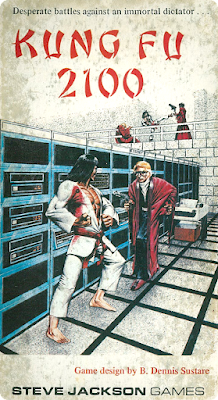
Kung Fu 2100 is wonderfully strange. Designed by Dennis Sustare, whose contributions to the hobby are many, the game's premise is a delightful goulash of 1970s pop cultural concerns, from cloning to martial arts to the end of human civilization. According to the history presented in its rulebook, human cloning is perfected in 2006, a complicated process that requires not only high technology – take a look at the computer banks and dot matrix printer depicted on the cover! – but the wealth to afford it. The cloning process involves the growth of a physical copy of the biological donor, as well as a copy of the donor's personality, memories, and experiences. Taken together, this opens the door to virtual immortality to those with financial means, setting off riots and unrest, as the masses realize what this means for society. The powerful, who come to be known as CloneMasters, eventually restore order, but only be repressive means, right down to outlawing the possession of most modern technology by anyone but themselves.

If this sounds utterly ridiculous, it is, but, as the premise of a game where one player takes the role of members of a secret society pledged to end the tyranny of the CloneMasters, it's perfect. Members of the Society of Thanatos, as it is known, train from childhood to use only their bodies to fight, since most weaponry is now forbidden to anyone but the CloneMasters and their servants, some of whom are Thanatos turncoats. The masses, who revere these martial artists as heroes, call them Terminators and cheer them on. The game itself focuses on an attack by the Terminator player on a CloneMaster fortress, with the goal of slaying the CloneMaster who dwelled within. The goal of the CloneMaster player, of course, is to prevent this from happening. 

Kung Fu 2100 consisted of a fortress map, some counters, a rulebook, and record sheets – fairly standard components for a micro-game. The sequence of play involves multiple phases of movement, combat, and recovery within each turn, with the Terminator and CloneMaster players alternating between them. Combat, specifically hand-to-hand combat, is quite interesting, in that Terminators (and their enemy counterparts, the Janizaries [sic] or "Jellies") having a choice of tactics to choose from, such as Iron Fist, Lightning Foot, Monkey Soul, and Body of Mist. These tactics are compared to one another on a combat results table, with some each having situational advantages and disadvantages. It's a neat little system that's both easy to use and flavorful. Like many micro-games, Kung Fu 2100 also includes rules for solo play, which is useful on days when no one else is available.

Sadly, this wasn't a game I played much back in the day, not for lack of interest. However, with so many other micro-games available to us, we tended to opt for those that we'd played before, leaving Kung Fu 2100 an also-ran at best. I'm not quite sure what happened to my copy of it. After my conversation last night, I find myself wishing I still had it, if only to take a closer look at its components and luxuriate in the warmth of late '70s pop culture cranked up to 11. Even better would be to get the chance to play it again.

Wednesday, January 5, 2022

Retrospective: Heroes of Olympus

In the nearly half-century since the publication of Dungeons & Dragons, a great many roleplaying games have followed in its wake. Odds are good that you probably haven't heard of most of them, let alone had the chance to play them. That's certainly true in my case, for lots of reasons, including the youthful TSR fanboyism that limited my field of vision for too long. Consequently, I regularly encounter RPGs of which I'd never heard previously and that represent a part of the hobby's history that is otherwise obscure to me.

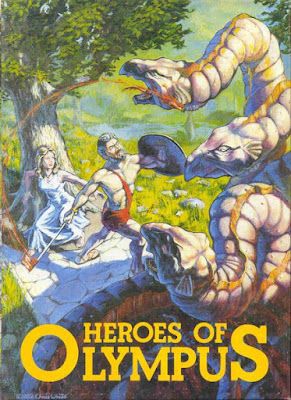
Heroes of Olympus was completely unknown to me until very recently. Written by Dennis Sustare – author of Bunnies & Burrows and Swordbearer, as well as originator of the druid as a playable character class – and produced by Task Force Games in 1981, Heroes of Olympus, as its name suggests, is a roleplaying game steeped in the mythology of ancient Greece. That's a subject that's received far less attention than one might have expected, given the importance of those legends not just to Western culture as a whole but to popular adventure fiction (including RPGs). 

A couple of months ago, a friend of mine indicated that he had long wanted to play this game and offered to start up a campaign, if a few other mutual friends and I were willing to participate. I was initially reluctant, to be sure, mostly due to the fact that I already participate in quite a few other roleplaying game campaigns and wasn't sure I could justify another. At the same time, I was very intrigued, both by the subject matter of Heroes of Olympus and aspects of its design. Having now played in it since late last year, I'm glad I set aside my reservations and did so.

Heroes of Olympus is explicitly modeled on the stories of Jason and the Argonauts, which are probably as close to RPG-style adventures as you can find in Greek myth. Character generation includes both random and point-buy elements, starting with one's ancestry, which is random. Most Heroes of Olympus player characters will be the sons of gods/mythological beings (e.g. nymphs) and/or royalty of one of the petty kingdoms that dot the eastern Mediterranean. For example, my own character is Eurymachos, son of King Autolykos of Imbros and the Muse Euterpe. Players allocate points among combat skills (sword, club, wrestling, etc.), physical attributes (great strength, excellent vision, etc.), and other skills (seamanship, riding, etc.). Game mechanics largely rely on percentile dice rolls, hence skills are rated 1–100.

As one might expect of a Greek-themed RPG, Heroes of Olympus involves lots of maritime travel between the lands of Greece and Asia Minor and the myriad islands of the region. Having a galley, as my character does, is thus a huge benefit, since it makes traveling from place to place easier. The general "time period" of the game is the immediate aftermath of the Trojan War, with the heroes doing great deeds during this tumultuous era. Many of those deeds involve fighting, which explains why the game includes three different combat systems, one of which covers naval battles. The other two cover duels between individuals and battles between heroes and "normal" men. These systems involve the allocation of points between attack, defense, initiative, and trickery (special maneuvers). It took me quite a while to wrap my head around the way these systems work, but, once I did, things ran more smoothly. They're still a little clunky and even tedious at times, especially when compared to simpler systems like those in D&D, but there's nevertheless a certain fun to be had in the way they handle battles. 

Magic does exist in the game, though it seems mostly to be of divine origin. This makes sense, if one looks to the source material, where Greek heroes rarely rely on sorcery to achieve their ends. Still, a character favored by Hecate or Hermes might gain access to spells (as is the case for one of the PCs in the campaign in which I'm playing). Much more information is given about the gods themselves, as well as the various sorts of mythical beings one might encounter. It's all useful stuff, if limited in its scope. I imagine Sustare assumed referees and players alike could easily seek out information on Greek mythology to create their own material.

No one should forget that Heroes of Olympus is more than four decades old. This is not a modern RPG on almost any score and, even by the standards of the time in which it was written, it's, by turns, unclear, incomplete, and occasionally contradictory. Yet, it's also a great deal of fun – or at least that's been my experience. The Greek myths are a primal fount of adventure stories. Having the opportunity to play in that particular sandbox is a blast, even with a game whose rules are not always up to the task. I'd never argue that Heroes of Olympus is a lost classic of roleplaying game design, but it's got a lot to like about it, not least being the way it uses its ancient Greek inspirations as the basis for engaging sword-and-sandal exploits in a world full of gods and monsters. I wish I'd known about it sooner.

Tuesday, June 15, 2021

Different Worlds: Issue #19

Issue #19 of Different Worlds (February 1982) is filled with tentacles, starting with its cover by Roland Brown. Inside, many of its articles are devoted to Chaosium's then-new horror roleplaying game, Call of Cthulhu, which of course pleases me, as it's one of my all-time favorite RPGs. 

The issue kicks off with two excellent side-by-side articles by Sandy Petersen and Lynn Willis, in which each of them discuss the process of creating Call of Cthulhu from their perspective. These are both excellent articles and I wish I could do them justice with a brief summary. In general, Petersen focuses on the design of the game's rules and setting, while Willis talks about the "nuts and bolts" of making the game as a physical product, though each touches on other aspects as well. I already knew some of what was presented in these pieces, such as the origins of the game, but there was much more I'd never heard before. Good stuff!

"Guns Against Cthulhu" by Dick Wagenet presents variant rules for handling firearms in Call of Cthulhu and other modern Basic Role-Playing games. "Underground Menace" meanwhile is a Call of Cthulhu scenario by Sandy Petersen, set in and around Lake Superior in northern Michigan. Following it is a single page of errata and "second thoughts" on the rules of Call of Cthulhu. Not specifically related to Call of Cthulhu but relating to the 1920s time period is "The Gang Leaders" by Glenn Rahman. It's a collection of biographies and game statistics for famous criminals like John Dillinger and Pretty Boy Floyd for use with FGU's Gangster! I enjoyed reading it, even though I've never played Gangster!, helped no doubt by the terrific contemporary photographs of the gangsters themselves.

"Safe Storage for Figures" by John T. Sapienza reviews several cases and storage containers intended to hold and protect miniature figures, complete with photos. "Thieves of Sparta" by B. Dennis Sustare presents guidelines for adapting Task Force's Heroes of Olympus to the setting of Thieves' World. The article is notable for the fact that Sustare is himself the designer of Heroes of Olympus. This month's reviews include Call of Cthulhu (very favorable), Adventure Class Ships, Volume 1 (for Traveller, also favorable), and Palace of the Silver Princess. The latter review is interesting in that the reviewer, Anders Swenson, comments on its conflation of "player" and "player character," a pet peeve of mine, which Swenson calls "the perennial FRP identity crisis." That said, his overview opinion of the module is positive.

There are also reviews of the notorious roleplaying game, Spawn of Fashan, other reviews of which I recall from my youth. Amusingly, the reviewer, Charles Dale Martin, spends the entirety of his review criticizing various aspects of the game, but still concludes "it may be still worth buying" on the strength of its referee's section. No similar charity is extended to Patrick Amory's review of Deities & Demigods. Amory lambastes it for its overall approach, saying it "contains monsters not religions." While I largely agree with that particular point, he is much harsher than I, concluding that it "is not of the slightest interest to anyone in the FRP market and should be avoided like leprosy." Ouch!

The issue ends with Gigi D'Arn's column. Most of this issue's gossip is filled with ephemera but a few rumors stand out. Among these are Richard Snider's hiring by Avalon Hill, Lawrence Schick's hiring by Coleco, the upcoming D&D video game for Intellivision, and GDW's cease-and-desist order filed against Edu-Ware for computer games illegally derived from Traveller. There's also talk of an upcoming RuneQuest supplement by Ken Kaufer called Dorastor. A product with a similar title would eventually appear, featuring some of Kaufer's work (along with many others), but it would not appear until more than a decade later during the brief RuneQuest Renaissance of the early 1990s masterminded by Ken Rolston.

Being a fan of Call of Cthulhu as I am, I enjoyed this issue a great deal. I hope I'll be similarly impressed with issue #20.

Tuesday, February 23, 2021

Different Worlds: Issue #3

Issue #3 of Different Worlds (June/July 1979) features a positively delightful cover by Tom Clark. It's exactly the kind of weird, "out there" art, neither clearly fantasy nor sci-fi, that I associate with the 1970s. Beautiful! The issue begins with a review of Bushido by Steven Lortz. The review is quite positive, praising the game for providing players with more to do than "kill and pillage." Immediately afterward come the next two articles in the "My Life and Role-Playing" series, this time offering up articles by two truly heavy hitters: Dave Arneson and Steve Perrin.

Arneson's contribution is both long and filled with details, most of which are probably well known nowadays. He states early on that "Blackmoor was not the first RPG that I was in. Not by a long shot." He then goes on to relate tales from earlier campaigns, such as the Napoleonic one set in the town of Brownstein [sic] and his adventures stirring up trouble in South America, two events discussed at greater length in the Secrets of Blackmoor film. The rest of the article is filled with biographical details, insights into Arneson's personal perspective on RPGs as an activity, and additional bits of history. Steve Perrin's article is similar, though the details differ, of course. Of particular interest to me is Perrin's reminiscences about the foundation of the Society of Creative Anachronism in 1966 and his involvement in it – involvement, I might add, that played a role in his development of both the Perrin Conventions for OD&D and the rules behind RuneQuest. 

"Research and Rules" is a short article by Steve Marsh, offering five steps for the creation of good RPG rules: Define the Thing to be Written About, Define the User/Situation, Get Acquainted with the Material, Simulate the Rules in Your Present Situation, and Understand the Whys. The article is brief, so none of these steps gets much attention, leaving the end result less satisfying than it might have been. Mike Ginderloy's "Specialty Mages" variant for Dungeons & Dragons gets a third part, this time presenting lightning, crystal, acid, and wind mages. 

"Role-Playing: How to Do It (An Immodest Proposal)" is a lengthy article by Clint Bigglestone, in which he offers his thoughts on both playing and GMing, with an emphasis on the former. Bigglestone is very interested in the creation of plausible characters based on all the factors that describe him, from his physical and mental game stats to cultural background. He also reminds readers that a RPG is a game and one should never lose sight of that fact, no matter how attached one becomes to a character. Dennis Sustare's "Druid's Valley" is an overview of his Bunnies & Burrows campaign setting. I found it incredibly fascinating, because he not only details the setting and its characters but also talks about events from his campaign and his reasoning as a referee. I love this kind of stuff and continue to find these articles some of the best material in Different Worlds.

"The Three Feathered Rivals Cult" by Ray Turney is, of course, a new cult for use with RuneQuest. "A Letter from Gigi" includes numerous bits of then-current gaming gossip, such as the ongoing lawsuit between Arneson and Gygax. Speaking of Gygax, the column comments on the advertisement from White Dwarf featuring Elise Gygax. Also mentioned is the appearance of "yet another article on pole arms" in the pages of Dragon. Apparently people were making fun of Gary's obsession even back in the day. "Different Views" is a collection of letters from readers, one of whom, John T. Sapienza, provides the issue's last article, "A New Cleric Cure System." A variant for D&D, Sapienza effectively rewrites the cleric class, turning it into more of a flexible healer class than a warrior-priest with some healing ability. I'm not sure I like it, but it's an intriguing take on the subject.

Issue #3 of Different Worlds is another good one, particularly in those articles were writers and designers of the hobby let us peak in on their own gaming. That's a topic of which I never tire and hope that future issues will bring more of this. Though I do appreciate rules options and variants, those can be found anywhere. What Different Worlds offers that I've rarely seen elsewhere is a glimpse of what it was like to play in the early days of the hobby and that is worth a great deal to me.

Wednesday, February 10, 2021

Retrospective: Bunnies & Burrows

Looking back on my early introduction to the hobby of roleplaying, one of the things that strikes me is how many RPGs available at the time of which I'd never heard, let alone had the chance to play. 1976's Bunnies & Burrows by B. Dennis Sustare and Scott Robinson, published by Fantasy Games Unlimited, is a very good example of a game utterly unknown to me at the time. I think the very first time I ever came across a reference to it was in an editorial or article by Roger E. Moore (in either Dragon or Polyhedron), where he describes an AD&D session he ran in which the characters were all transported to the world of Bunnies & Burrows and he presented each of his players with a miniature rabbit painted to look like their characters. Sometime afterwards, I was able to confirm that B&B did in fact exist and was not a joke or a parody but quite serious, though it would be many more years before I ever laid eyes on a copy of the game (though I did read GURPS Bunnies & Burrows in 1992).

Subtitled "the fantasy world of intelligent rabbits," B&B states, in its introduction, that "a currently popular novel has demonstrated that rabbits are suitable subjects for fantasy games." The novel in question, I assume, is the 1972 novel, Watership Down, by Richard Adams, a book I knew only vaguely from having seen stills from the the 1978 animated film in the pages of Starlog or a similar magazine. It's also worth noting that the term "fantasy game" is, at this early date, a synonym for "roleplaying game" and doesn't necessarily mean that the game in question will include typical fantasy elements, like magic or monsters. Bunnies & Burrows strictly contains neither, though both appear after a fashion, at least from the limited perspective of rabbits. That said, the idea that rabbits have a society of their own, right down to having distinct professions (character classes) one might take up, is quite fantastical and is the primary conceit on which B&B is built. 

As one might of a RPG published just two years after OD&D, Bunnies & Burrows show a lot of influence from its illustrious predecessor. Rabbit characters have eight ability scores, consisting of D&D's six plus Speed and Smell. Again, like OD&D, they are generated by the roll of three six-sided dice. Unlike OD&D, these ability scores can increase over time through successful use. There eight professions, one corresponding to each of the ability scores: Fighter (Strength), Runner (Speed), Herbalist (Smell), Scout (Intelligence), Seer (Wisdom), Maverick (Dexterity), Empath (Constitution), and Storyteller (Charisma). Each profession offers a variety of skills unique to it, from the fairly straightforward (a Fighter's combat talents) to the more peculiar (a Seer's improved ability to see the future). There's quite a lot of fascinating stuff to be found here. I was simultaneously amazed at the comparative sophistication of the rules, despite their early date, and intrigued by the world implied by some of the sub-systems introduced.

The implied world has many elements that I like. The combat rules, for example, are explicitly presented as applying primarily to fights between rabbits. That's because almost every predator in the game is vastly more potent than a rabbit and any fight involving them will inevitably lead to the rabbit's demise unless he is very clever (or fast!). Likewise, there are extensive rules for locating and using beneficial herbs (hence the importance of the Smell ability score). Sustare and Robinson clearly put a great deal of thought into B&B, attempting to model what the world might look like from the perspective of a rabbit while at the same time presenting it in a way that might hold the attention of someone more used to Dungeons & Dragons.

If Bunnies & Burrows has a real flaw, it's that its audience is very small indeed. Even after reading the rules and admiring its designers' ingenuity, I nevertheless found myself wondering what one does in a B&B campaign. There is a section in the rulebook on running the game but it's brief and ultimately comes down to "use your imagination," which, while fair, isn't helpful to those of us who haven't read Watership Down and similar books. There are rules for creating, mapping, and maintaining a rabbit warren, which are interesting, but I'm not sure they're sufficient to hold one's attention long-term. Likewise, rules for mating and reproduction (the first in a RPG?) are included and genuinely necessary but, unlike similar rules in, say, Pendragon, they don't seem to have a clear use in the game beyond color. 

At the same time, I can't help but admire Bunnies & Burrows. Even today, it stands out as an oddity, a genuinely unusual subject for a roleplaying game likely aimed at a very specific group of players. In 1976, it was revolutionary – evidence that this strange new hobby had potential beyond the world of dungeons and dragons, potential that has been proved again and again in the decades since and shows no signs of running dry.

Tuesday, February 9, 2021

Different Worlds: Issue #1

Different Worlds premiered in February 1979 with Tadashi Ehara as its editor, a position he held for the entirety of the magazine's run. Ehara states, in his inaugural editorial, that Chaosium wanted to produce "a magazine to cover all aspects of role-playing, from Dungeons and Dragons to Bunnies and Burrows, from Traveller to En Garde! Even SPI's Commando." Thus, Different Worlds was intended to cover the entirety of the hobby rather than focusing on a specific game or even group of games. In this, Different Worlds was no different than Dragon, White Dwarf, or Imagine, though I have little doubt that its origins on the west coast of the United States colored its content in ways both subtle and obvious.

The issue kicks off with Charlie Krank's "Beginner's Brew," the subtitle of which is "What is all this stuff?" Krank then explains what an RPG is and what its various elements (referee, players, dice, etc.) are and how they all relate to one another. The article is basic, as one might expect, but what interests me most is that such an article was deemed necessary at all. Yes, it was written in early 1979, barely five years after the invention of the hobby, but how many readers of Different Worlds wouldn't know what a roleplaying game was? Of course, Imagine regularly included such articles, too; perhaps it was simply considered a requirement at the time, much like examples of play in RPG rulebooks.

Next up is the first part of Mike Gunderloy's D&D variant, "Specialty Mages." Specialty mages, as opposed to "True Mages," (i.e. OD&D magic-users) are somewhat more robust (d6 hit dice) and have a wider range of weapons (swords and spear) but have a narrower, more focused list of available spells. The first part focuses on the Mages of Earth, providing lists for spell levels 1–10 – yes, 10. This is not explained, simply presented as if it were a fact, which I suspect reflects early house rules of an additional level above 9. I myself remember encountering such things in the early '80s, which suggests it was a widespread notion. I'm curious to see what Gunderloy might do in the second part of the article.

"My Life and Role-Playing" is a collection of articles of varying lengths by notable game designers and writers of the period, in which they talk about their early experiences with the hobby – how they discovered it, what led to their creating a game of their own, etc. – and, in several cases, give us insight into their home campaigns. The range of writers is indeed vast, consisting of (among many others) Ken St. Andre, Marc Miller, Greg Costikyan, Dennis Sustare, Lee Gold, and Dave Hargrave. I could devote a post or more to each of these articles, since nearly all of them contain historical tidbits that were otherwise unknown to me. For example, Marc Miller not only mentions his unpublished fantasy RPG, Companions of the Road but also Frank Chadwick's If I Were King … (which might be an earlier version of Liege Lord). Equally interesting is reading about Dave Hargrave's disappointment with OD&D and how it fueled his desire to come up with his own design. It's terrific stuff and I'm so very glad I read it.

Ed Simbalist, one of the creators of Chivalry & Sorcery and Space Opera, presents "Archaeron," his home fantasy campaign setting, along with a hand drawn map of its main area. What's most appealing about the article is not so much its content, which, if I am honest, isn't all that remarkable, but Simbalist's own comments on why he designed the setting in the way he did. I adore articles of this sort and wish more game designers – or indeed just gamers – would do something like this. Greg Stafford provides "The Cult of Geo," a new cult for use with RuneQuest, the first bit of content in the issue specifically geared toward a Chaosium game. 

Steve Lortz's "What is a Role-Playing Game?" is an odd article, not quite in the same genre of Charlie Krank's earlier piece from the same issue. Rather than being a discussion of RPGs from the perspective of a neophyte, it is rather an examination "rule organization," with a focus on things like time, scale, and sequences, among related topics. He demonstrates his point of view more fully by outlining the rules structure of an imaginary game, Cannibals and Castaways, in which the player characters attempt to survive on a desert island inhabited by cannibals. There's even an example of play, followed by yet more analysis of RPG rules, this time with an eye on "move structure in RPGs," "move" here being a synonym for "action." As I said, it's an odd article and I must confess I found it tedious and generally uninteresting to me (but my disinterest in rules discussion is legendary). The issue concludes with an article by P.E.I. Bonewits and Larry Press to support Authentic Thaumaturgy. 

My overall impression of Different Worlds is immensely positive after only a single issue. Unlike Imagine, which seemed to take a while to find its footing, it's pretty clear that Different Worlds already has a good sense of what it's about. Since I only ever read a single issue of the magazine back in the day and one fairly late in its run – I can't recall the issue number but I will remember it when I get to re-reading it – this is all new to me. I anticipate that there will be many moments of discovery and pleasure along the way; I cannot wait to read more.

Friday, October 8, 2010

Open Friday: Three Castles Award

As some of you may be aware, Rob Kuntz conceived of a new award, the Three Castles Award (so named after Castles Blackmoor, Greyhawk, and El Raja Key -- yeah, I too think it's a bit much to insert one's own creation into such a pantheon too, even when, as in this case, there's certainly merit to the cause for doing so), which is intended to honor "designers of the highest merit for outstanding work in the industry of Role Playing Game design." You can read more specific details about the award here, including its submission guidelines.

According to those guidelines, gaming products -- meaning "RPG rules, settings, adventures, sourcebooks and/or combinations of these" -- published between October 1, 2009 and October 1, 2010 are eligible for consideration for the 2011 award. The submission window is between October 1 and December 31, 2010, meaning that we're just at the start of it now.

I'll admit that I personally find the scope of the award a bit too broad, since, theoretically, any RPG product could be submitted and win, but I also think that alternatives to awards like the Origins and ENnie Awards are a good thing. For today's question, though, I thought I'd ask: what products published within the aforementioned dates do you think are worthy of recognition by this award? If you had the ability to do so, which products would you submit for consideration?

Wednesday, June 24, 2009

Retrospective: Swordbearer

The early 80s were a funny time in gaming, both for me personally and for the hobby generally. By "funny," I mean a combination of "interesting" and "unusual." Gaming, particularly fantasy gaming, was now firmly ensconced as a popular pastime, with everyone trying to cash in on the craze. And there was lots of experimentation with different rules, formats, styles of presentation, and so on.

The result was a kaleidoscope effect, making my visits to places like The Compleat Strategist simultaneously exhilarating and confusing. What were all these different games and which ones would I like? There were reviews in Dragon and White Dwarf, of course, as well as the opinions of the guys in the game store, but, even then, I knew that reviews didn't tell the whole story and that the opinions of reviewers didn't always jibe with my own preferences.

There was also the fact that, then as now, D&D exerted a strange effect over most gamers. By 1982, D&D was starting to feel a little "stale" to me and I was keen for new gaming horizons. It's not that I didn't play other RPGs -- I did, particularly Traveller and Call of Cthulhu -- but D&D was my introduction into the hobby and had left its mark on my imagination in a way no other game ever would. Consequently, even when I was looking to replace D&D with another game, D&D was still there in my mind. It was the game against which I was judging other games and I know now that that probably lessened my ability to give other RPGs the fair shake they deserved.

It was in this context that Swordbearer entered my life. I knew Heritage Models quite well, having purchased many of their miniatures and having enjoyed their Dwarfstar microgames like Barbarian Prince and Outpost Gamma (both of which, along with the rest of the line are available as free electronic downloads at this site, thanks to the kindness of their current copyright holder, Reaper Miniatures). So, when I saw this odd little boxed game, which proclaimed its contents to be "realistic, fast-playing, complete, expandable," I picked it up, hoping to find a game to cure my D&D malaise.

I read Swordbearer with great relish. Consisting of three landscape-format books of varying length (illustrated throughout with black and white art by the then-unknown Denis Loubet), Swordbearer wasn't quite what I expected. The game has no classes, being a skill-based one in which any character can conceivably learn any skill. The system isn't particularly complex by today's standards, but it seemed a fair bit more involved than D&D. That made it harder for me to get into it than I'd hoped, but I soldiered through nonetheless. The magic system is interesting and based on a node system that's inspired by a modified version of Asian elemental theory. There's also spirit magic that's based on the four humors of classical Western medicine.

What set Swordbearer apart, though, was its broader "social" focus than D&D. There were many, many more playable intelligent races, including the bunrabs, an obvious nod to designer Dennis Sustare's earlier Bunnies & Burrows RPG. This made it possible to create a campaign that felt very different than the implied pseudo-medieval setting of most of the fantasy RPGs with which I was familiar at the time. There were also rules about social status that tied into the game's abstract wealth system, as well as just what being a member of a particular social class meant in the context of the game world.

All of this may seem like old hat nowadays, but, in 1982, it was a revelation to me and it gave Swordbearer a "serious" feel to it that both impressed and frightened me at the same time. I very much wanted to play Swordbearer, but didn't think I was "good enough" a referee to do so, a feeling I'd also gotten from RuneQuest, another game I owned but never really managed to play. Looking back on it now, I feel bad I never had the chance to try out Swordbearer with my friends. I think, even though the gravitational pull of D&D ultimately proved irresistible, my gaming would have benefitted a lot from having had the chance to test out some of Swordbearer's innovations.

After my recent interview with its designer, I dusted off my copy from the garage and have begun re-reading it and it's quite the trip down memory lane. It's also sparking some ideas in my head that might see use in my Dwimmermount campaign. Copies of the game pop up on eBay fairly regularly and the ghost of Fantasy Games Unlimited (which published the game's second edition) sells both PDF and print copies here. You might consider picking up a copy, if only to see firsthand some of the diversity the gaming of the early 80s had. It really was a magical time, both for the hobby and the industry, and we shall not see its like again.

Monday, June 22, 2009

Interview: Dennis Sustare

In examining the early history of the hobby, it's often easy to forget the diversity of individuals and ideas that were extant at that time. Because both fanzines and conventions were thriving and because there was an openness to new approaches, it was quite possible for such individuals to disseminate their ideas widely, often attracting the attention of the companies publishing RPGs. One such individual was Dennis Sustare, among whose many contributions to the hobby were the creation of D&D's druid class and the first RPG in which the players portray animals, Bunnies & Burrows. Mr Sustare kindly agreed to answer some questions I put to him about these and other related matters.

1. How did you become involved in the role-playing hobby?

Previously I played chess, go, and board wargames (such as the Avalon Hill games). In grad school at Wisconsin, in a small on-campus wargame convention, there were a few people playing early versions of D&D with Chainmail combat rules. I was intrigued, and got into a local gaming group of other grad students (astronomy, biochem, chemistry, law, and myself in zoology). This was back with the original three D&D booklets, in the woodgrain box (plus the Chainmail rules).

2. You're specifically thanked in the credits of Supplement III to OD&D, where you're called "the Great Druid." There's also a druid spell in AD&D called "Chariot of Sustarre," which was named in your honor. What role, if any, did you have in the creation and/or development of the druid class?

When the thief class was released in the Greyhawk supplement, as an addition to the original fighter, cleric and magic-user, we became interested in other possible classes beyond these four. I wrote up and mimeographed a set of rules for a new druid class, for our internal play. After some playtesting in our game, I revised it with a new mimeograph rule set, still just for our own use. But when we went to early GenCons, a copy got into Gary's hands, and thanks to some advocacy by Tim Kask, they revised the rules once more and published them in the Eldritch Wizardry supplement. Tim added the Chariot spell at the time (it was not one of my original spells, and the misspelling of my name was deliberate). I consider this my first published game design, although Bunnies & Burrows was released the same year (1976).

3. What were your inspirations in creating the druid class? I once surmised that the class had been based on the character of Dalan from Henry Kuttner's "Elak of Atlantis" tales, while Erik Mona of Paizo mentioned Talbot Mundy's Tros of Samothrace as a likelier possibility. Were either of us close to the mark or was there a different inspiration for the class?

Nope, sorry. I never read the Talbot Mundy stories, though on looking them up now, they sound interesting. I read lots of Kuttner and Moore, but don't recall ever reading the Elak stories.

Instead, I was familiar with druids from literature about early England, especially during Roman times. The most immediate inspiration, of course, was their mention as a monster in Greyhawk (but not as a character class). Initially, I was trying to make them related totally to plants and animals, but felt they needed a little more firepower (literally).

4. One of your most famous creations was the game Bunnies & Burrows, which you wrote with Scott Robinson and which was first published in 1976. Besides Richard Adams's novel Watership Down, what inspired you to undertake this project, since it was quite a departure from other games that were published at the time?

Scott and I were both zoology grad students at Wisconsin. Once we got interested in roleplay, we thought it would be fun to try to design an animal-based fantasy roleplay game. In our early development of the game, Scott usually ran scenarios and I was the sole player many times. Since Scott Bizar, at Fantasy Games Unlimited, was enthusiastic about publishing many different roleplay variants, I submitted the polished rules to him, and he happily accepted them for publication. Charlie Loving did the 1st edition illustrations, after playing in some early games during development. When it was revised for second edition, Jeff Dee added illustrations, including a new cover.

5. How was B&B received in the gaming community when it was released?

I think as just one more of a multitude of roleplay variants that began to flood the market. including those with various genres of science fiction, pirates, pre-revolutionary France, gangsters, superheroes, samurai, and many more. Those few who actually gave it a fair try usually wound up enjoying it, though.

6. You also wrote Swordbearer, a fantasy RPG that included numerous innovations, such as an abstract wealth system and a magic system based on the of Asian philosophy. Did Swordbearer arise out of a dissatisfaction with our existing fantasy RPGs or did the game have a different origin?

Once B&B came out, several other publishers were interested in my doing some designs for them. Arnold Hendrick approached me from Heritage to develop an FRP competitor for D&D. My original design for Swordbearer (which went through several title changes... I requested Avatar as my first title, but Heritage did not think anyone would know what that was) had much more original design than the final form. For example, I had created all new non-Tolkien races, but Heritage nixed most of them, since they wanted the game to utilize the races represented in their existing miniature lines. I was not dissatisfied with existing fantasy RPGs as such, but was trying to create a system that would not lead to such "Monty Haul" campaigns. This was what led to the abstract wealth system, based on social class rather than mere accumulation of unending piles of gold coins. Once Swordbearer was released, unfortunately, Heritage was already on its way to its demise as a game company. I also produced Heroes of Olympus (based on Greek myth) for Task Force, and scenarios and other small games for Heritage, Steve Jackson, Paranoia, Citybook, etc.

7. B&B placed an emphasis on problem solving and overcoming obstacles through wits and Swordbearer was, as you say, an attempt to avoid the Monty Haul syndrome to which many RPGs fell prey. Would you say that this is a reflection of your preferred gaming style?

Absolutely. This is the main reason I always preferred mature GMs who created a rich, complex and challenging background, rather than just drawing another 1000-room dungeon with a random monster and treasure in each room. Some of our most entertaining adventures involved extended attempts to defeat a single, diabolically clever trap, or to fulfill a particularly demanding quest. It is also why I tended to enjoy low-level adventures much more than high-level ones. Low level characters cannot just set off tactical nukes every time they encounter a new group of monsters.

8. Like a number of tabletop RPG designers, you eventually made the transition to the video games industry. Did you find the transition difficult and what, if any, differences did you see between the two industries?

Actually, my transition was from Assistant Professor at Clarkson College to the video games industry. I never made a living from tabletop RPG, and did those designs mostly for fun. But I knew people in the industry, and when Paul Jaquays offered me a job at Coleco, I snapped it up. The transition from college teaching was not so tough, since I was treated as more of a professional at Coleco than I had been as a professor. The main challenge was constraining the video game designs to the idiosyncrasies of specific platforms, since the demands of systems such as Atari 2600 were so different from ColecoVision or IntelliVision. Also, Coleco was one of the first companies to divide up tasks among specialties, rather than requiring designers to have all abilities at once. So we had graphic designers, programmers, writers, and musicians, with the game designers more like what game producers do today. Many of the Coleco products were based on licensed arcade properties, so we would exhaustively play and analyze an arcade game, then try to design a game that would capture the feel of the arcade on the video game platform. My scientific background of investigation really helped me, especially combined with my RPG design background.

9. Do you still play tabletop RPGs and, if so, which ones?

Not really. When I attended the inaugural meeting of the North Texas RPG Convention (just held in the Dallas/Ft Worth area), I did play in a couple of games, such as one using Matt Finch's Swords & Wizardry rules, which are similar to the earliest D&D rules. But that was the first time I had played F2F RP for many years. I have a character in Adventure Quest Worlds, but that is the only online multiplayer game I am in right now. And I no longer design for MUDs or MUSHs. It's tempting to design a scenario for Matt's S&W system, but I am going to resist that temptation.