Monday, March 21, 2022

At the Table

Does anyone know where/when this photograph is from? A reader sent it to me recently and asked if I could identify it. The two men are obviously Gary Gygax and Brian Blume. Based on the products displayed on the table in front of them, I'd peg the year to be sometime in 1981. Beyond that, I couldn't really say. Was this a promotional image produced by TSR? Did it accompany a newspaper or magazine article? I'd love to know more, if anyone has any insight into its origins.

Ramsey Campbell Interview

As a fan of the horror tales of Ramsey Campbell, I was beyond delighted to see that Dan Collins and Paul Siegel of the Wandering DMs channel recently had him as their guest. It's a very good, though regrettably short – just an hour! – interview, but there's a lot of excellent discussion during that time, including the relationship between fantasy and horror. Check it out if you have the time to do so.

Pulp Fantasy Library: Smoke Ghost

Fritz Leiber is an author who gets a lot of love on this blog and deservedly so. His tales of Fafhrd and the Gray Mouser are, I think, among only a handful of stories that can credibly be claimed as feeling like playing Dungeons & Dragons and other fantasy roleplaying games. This is implicitly acknowledged by Gary Gygax himself, who not only included Leiber in Appendix N of the AD&D Dungeon Masters Guide, but called him, along with a small number of other authors, one of "the most immediate influences" upon the game. 

Leiber was a very prolific writer and his contributions to the canon of pulp fantasy are not limited to the adventures of the Twain. Indeed, one of his earliest published stories is set in 20th century Chicago and features a subject that some might consider horror. Nevertheless, I think it's an important and compelling tale that takes a staple of the fantastical literary tradition – the ghost story – and updates it for the modern era while also making it genuinely timeless.

"Smoke Ghost" appeared in the October 1941 issue of Unknown Worlds and tells the story of advertising executive Catesby Wran. One day, while dictating to his secretary, he asks the young man a very strange question.

"Have you ever seen a ghost, Miss Millick?" And she had tittered nervously and replied, "When I was a girl there was a thing in white that used out of the closet in the attic bedroom when you slept there, and moan. Of course it was just my imagination. I was frightened of lots of things." And he just said, "I don't mean that traditional kind of ghost. I mean a ghost from the world of today, with the soot of the factories in its face and the pounding of machinery in its soul. The kind that would haunt coal yards and slip around at night through deserted office buildings like this one. A real ghost. Not something out of books."

Miss Millick is confused by Wran's line of questioning, thinking that "he'd never been like this before." Nevertheless, he continued to ponder this topic.

"Have you ever thought what a ghost of our times would look like, Miss Hallick? Just picture it. A smoky composite face with the hungry anxiety of the unemployed, the neurotic restlessness of the person without purpose, the jerky tension of the high-pressure metropolitan worker, the sullen resentment of the striker, the callous viciousness of the strike-breaker, the aggressive whine of panhandler, the inhibited terror of the bombed civilian, and a thousand other twisted emotional patterns. Each overlying and yet blending with the other, like a pile of semi-transparent masks?"

I can't speak for anyone else, but I found this a powerful passage that remained in my mind for some time after reading it. It's little wonder that Miss Millick called it "an awful thing to think of." Undeterred by his discomfort, Wran keeps musing aloud about this topic.

"Yet, that's just what such a ghost or vitalized projection would look like, Miss Millick," he continued, smiling in a tight way. "It would grow out of the real world. It would reflect all the tangled, sordid, vicious things. All the loose ends. And it would be very grimy. I don't think it would seem white or wispy or favor graveyards. It wouldn't moan. But it would mutter unintelligibly, and twitch at your sleeve. Like a sick, surly ape. What would such a thing want from a person, Miss Millick? Sacrifice? Worship? Or just fear? What could you do to stop it from troubling you?"
Wran continues in this vein for some time, adding more and more details to his sketch of what a modern day ghost might be like. Leiber is at the absolute top of his game here. As the details pile up, we're left not just with a frightening picture of a 20th century specter but also of a mind slowly deteriorating under the weight of the terrifying thoughts it bears, the conclusion to them being this:

"It's a rotten world, Miss Millick," said Mr. Wran, talking at the window. "Fit for another morbid growth of superstition. It's time the ghosts, or whatever you call them, took over and began a rule of fear. They'd be no worse than men."
We soon learn that Wran's musings have a cause: he's been seeing a black figure wherever he goes, following him. Wran hopes that the figure is a manifestation of a psychosis, because the alternative – that it is real – is too awful to contemplate. "Good thing I'm seeing the psychiatrist tonight," Wran thinks to himself. Surely, if anyone can help rid him of this dreadful vision, it's Dr. Trevethick – or so he hopes. 

"Smoke Ghost" is not in the public domain, like many of the stories I discuss here, so I can't point readers to a place online where you can read it. The story is, however, included in many anthologies not just those specifically devoted to Fritz Leiber's short fiction. If anything I've written above intrigues you, I highly recommend you make an effort to find the story and read it. It is, in my opinion, one of the best ghost stories I've ever read, one that gets to the heart of why ghosts continue to haunt us, even in this age of materialism, science, and psychology. 

One of the accompanying illustrations by Edd Cartier

Friday, March 11, 2022

Taking the Sting Out of Poison

During the time when I was subscriber to Dragon, there was an article entitled "Taking the Sting Out of Poison." Written by Chris Landsea, it appeared in issue #84 (January 1984) and was itself something of a follow-up to a previous article "Poison: From AA to XX" by Charles Sagui. Sagui's article appeared in issue #32 (December 1979), which was before I was even aware of the existence of Dragon, let alone a regular reader. However, I was nevertheless familiar with it, because it had been reprinted in Best of Dragon Vol. II. As I mentioned recently, I was a huge fan of Best of Dragon and can still remember many of the articles included in these volumes, including Sagui's.

I bring this up as a bit of background to an inchoate thought I've been having lately regarding poison in Dungeons & Dragons. Now, I've never really had a problem with save or die mechanics and have, in fact, defended them in the past. I'm still not opposed to them in principle, but I've been thinking a lot about hit points and what they're supposed to represent in D&D. If we are supposed to believe, as Gary Gygax suggests in the AD&D Dungeon Masters Guide, that only a small portion of a character's hit point total represents his "actual ability to withstand physical punishment" with the rest being a measure of his "skill in combat ... "sixth sense" ... sheer luck, and the fantastic provisions of magical protections and/or divine protection," why does the character's ability to survive most poisons come down to a single roll of the dice? Would it not, in keeping with the Gygaxian understanding of hit points, make more sense if poison dealt damage and a saving throw, if used at all, served to mitigate the amount of the damage?

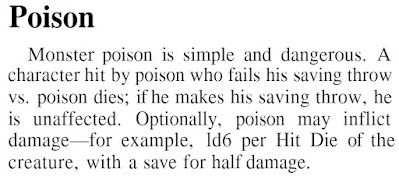
As I thought about this more, I dimly remembered that the the much-beloved D&D Rules Cyclopedia included the following optional way of dealing with poison:

Admittedly, I haven't thought much about the implications of this approach. On first blush, though, I must admit to finding it appealing. Poison is still very deadly. Consider, for example, a giant spider, whose poison under this scheme would dealing 4d6 damage on a failed saving throw and even 2d6 on a successful one. That's not nothing by any reasonable definition, but it introduces a little more variability in the result, as well as being more consonant with the what hit points seem to represent.

I don't know; I'm still pondering this. No doubt some will think I'm going soft in my old age and perhaps that's true. I can only say that I've been spending more time reading other RPGs roughly contemporaneous with D&D and AD&D, like Gamma World and RuneQuest, among others, and looking at how they handle deadly effects like poison. There's quite a range of approaches and some of them strike me as worthy of serious consideration. That's in addition to my aforementioned questions about the interface between such effects, hit points, and saving throws. As always, I appreciate hearing others' thoughts on this matter.

Thursday, March 10, 2022

What Are You Playing Right Now?

I'm very curious about the gaming habits of the regular readership of this blog. To that end, I have a few questions I'd like to ask. 

If you're so inclined, please take a moment to reply in the comments to this post.

If you are currently playing in or refereeing a roleplaying game:

  1. What RPG(s) are playing/refereeing?
  2. How long have you been playing this/these particular campaign(s)?
  3. How often do you meet to play?

If you are not currently playing in or refereeing a roleplaying game:

  1. How long has it been since you last played/refereed?

Thanks!

Wednesday, March 9, 2022

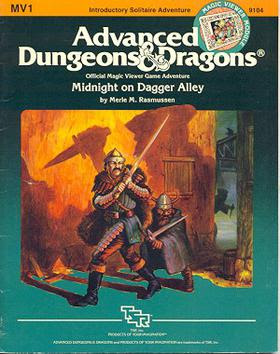
Retrospective: Midnight on Dagger Alley

In my scheme of the broad history of Dungeons & Dragons, the year 1984 falls either at the start of the Silver Age of the game or toward the end of the transitional period of the Electrum Age. Regardless of where one places it – or indeed if one even accepts the idea of neatly defined historical "ages" – I think it's indisputable that 1984 marks the year when TSR fully committed itself to taking D&D in new directions. This was the year that Dragonlance series launched, the first adventure modules based on other media properties appeared, the Companion Rules were published – and when TSR expanded the experimentation with solo play begun in the previous year.

During 1984, TSR published no fewer than four solo adventures, the majority of which were designed for use with the Basic and Expert rules sets (no surprise, given how well they were apparently selling at the time). The only one written with AD&D in mind was Midnight on Dagger Alley by Merle M. Rasmussen, best known as the creator of Top Secret. The module is the first solitaire "magic viewer modules," so called because it makes use of a strip of transparent red film to read text and maps that have been printed in such a way as to be otherwise illegible. It's a clever solution to the problem posed by the invisible ink modules released in 1983: ensuring re-playability. Unlike its predecessors, Midnight on Dagger Alley is presented in such a way that it can be used multiple times. However, it would seem that the module was not all that well received among potential customers, as TSR never produced another adventure like it.

A player of the module chooses one of three pre-generated characters, a lawful neutral human monk, a neutral evil half-elf assassin, or a neutral elf thief. Two things immediately stand out about these characters, beyond the fact that they are all level six. The first is that they all possess thieving abilities to some degree. The second is that none of them have a good alignment (and indeed one of them is explicitly evil). This surprises me in retrospect, since the Silver Age is when TSR began to worry about "angry mothers from heck" and how they viewed the content of Dungeons & Dragons. In this context, Midnight on Dagger Alley a little like a throwback to the pulp fantasy roots of the game.  

Each character has his own unique task in the city of Goldstar, where the module is set. The text of the module is divided into four parts, each associated with a different part of the city: dungeon, street, upper level, and roof. Each part contains numbered entries whose text is (mostly) illegible due to be hidden underneath printed patterns that only disappear with the use of the magic viewer. There are also maps of the relevant parts of the city that function in the same way. Much like a Choose Your Own Adventure book, the player of Midnight on Dagger Alley movies between entries by making choices that direct him to other entries. And much like the Fighting Fantasy series – and, of course, D&D itself – there are dice to be rolled, for combat among others, that also play a roll in advancing through the entries.

I owned a copy of this as a teenager and had a surprisingly good time with it. My main complaint about it was that it was quite short – only eight pages in length – and the three scenarios associated with the pre-generated characters all took place within a very limited space of the city. That was clearly done for logistical reasons and, having tried my hand at writing a solitaire adventure or two over the years, I am sympathetic to Rasmussen's plight. Still, there are only about 120 entries in total, most of them quite short, so the range of action is indeed quite limited and that's a genuine drawback. On the other hand, I appreciate what Rasmussen and TSR were attempting to achieve with Midnight on Dagger Alley, even if their reach exceeded their grasp.

Tuesday, March 8, 2022

A Tale of Two Covers

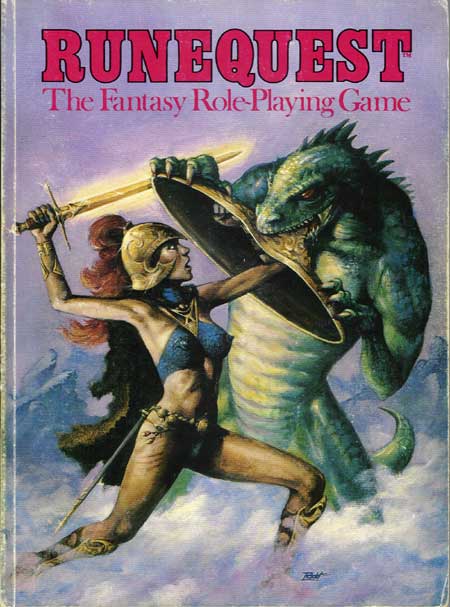
This is cover to the 1980 boxed version of the second edition of Chaosium's RuneQuest. The illustration is by Luise Perrin and originally appeared as the cover of the 1978 first edition of the game. It's a piece of artwork I strongly associate with both RQ and Glorantha, owing to its wide use in advertisements for the game during the early 1980s.

This is the cover to the Games Workshop edition published in the same year. Throughout the early to mid-1980s, GW regularly produced UK versions of American RPGs, often with different artwork. In the case of RuneQuest, the UK cover is clearly inspired by Luise Perrin's original but isn't a direct copy of it.
Never having owned the GW version, I don't know the name of the UK cover artist (please enlighten me in the comments). Whoever he is, there's no question he's more technically proficient than Luise Perrin. Compare the reptilian monster in each version and you'll quickly see what I mean. The warrior woman's pose from the GW cover likewise shows a greater command of human anatomy. Yet, somehow, even leaving aside the issue of the UK version's cheesecake, I find Perrin's version vastly more compelling to me. There's a mythic, dream-like quality to it that I think better suits the tone and content of RuneQuest. 

Am I mistaken?

White Dwarf: Issue #30

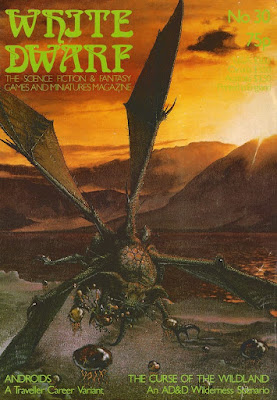
Issue #30 of White Dwarf (April/May 1982) features a very odd cover by Nicholas Bibby. What is that thing? Meanwhile, Ian Livingstone's editorial takes notes of the fact that Dungeons & Dragons is now a very broad brand, encompassing electronic games, video games, coloring books, and possibly a film one day. Livingstone's is neutral in his feelings about this development, whereas I was, at the time, quite enthusiastic about the pop cultural triumph of D&D. Nowadays, I'm a fair bit less excited about all this, but what do I know?

"Androids in Traveller" by Roger E. Moore is a terrific article that focuses on introducing artificial human beings into GDW's science fiction roleplaying game. Moore does an excellent job first of describing these "technologically produced manlike organisms made of organic material" and then contextualizes them within the Third Imperium setting. After that, he provides rules modifications for using them in play, including modifications of the character generation system. It's very done in my opinion and introduces some fascinating possibilities for both roleplaying and scientific speculation. 

Part 2 of Paul Vernon's "Designing a Quasi-Medieval Society for D&D" continues to discuss the economy. This time, his focus is on mercenaries and resources owners, which strike me as a rather odd pairing. As he did in last month's installment, Vernon bores down to the nitty-gritty details of how a town might work in the implied setting of D&D without sacrificing playability. That's why this series has impressed me so far. I've read plenty of articles that have attempted to bring "realism" of one sort or another – social, political, economic, historical – into D&D but did so at the expense of what makes the game fun to play. Vernon does no such thing and his discussion of the economics of hiring mercenaries or dealing merchants and business owners is grounded in "D&D as she is played," to borrow a phrase. While not everyone will care about these topics, for those who do, Vernon has provided plenty of food for thought.

"Unarmed Combat in RuneQuest" by E. Varley is a short article that introduces some new combat skills into the game, namely those pertaining to combat without weapons. Never having used the rules, I can't comment on their actual utility. Based solely on my read of them, they appear straightforward and easy to use. Also related to RuneQuest is "Griselda Gets Her Men" by Oliver Dickinson. This is the second short story of the ne'er-do-wells of New Pavis and it's every bit as good as its predcessor. 

"Open Box" presents multiple reviews, starting with Thieves' World from Chaosium, reviewed by the aforementioned Oliver Dickinson (10 out of 10). Also reviewed are Champions (7 out of 10) and The Island of Doctor Destroyer (8 out of 10). Interestingly, the reviewer, Dave Morris, wonders whether Champions is suitable for long-term play, given the power level of even starting Champions characters. It's an interesting question; not being much of a superhero gamer myself, I have no answer. Yaquinto's Adventurer gets a decent review (8 out of 10), while GDW's Invasion: Earth is given a more lukewarm reception (6 out of 10).

"The Curse of the Wildland" by Phil Masters is an introductory AD&D adventure. Its premise is very straightforward, with the characters enlisted by the leadership of a small village to deal with the titular curse that is wreaking chaos. I'm a sucker for introductory adventure, so I think pretty well of this one, which is nicely done, even if its set-up is something of a cliché. "Ideas for Traveller" by Bob McWilliams is a clever little article. McWilliams asserts that Ttraveller "is essentially a game about life," by which he means that it takes place in a world in which humanity pursues goals that are not all that different from those of today, albeit in a sci-fi context. Consequently, a referee looking for inspiration can turn to almost any everyday situation, book, or film and find it. He then provides multiple examples of how this might work in practice, resulting in a short but nevertheless helpful little article.

"The Apocrypha according to St. Andre" is an article by the creator of Tunnels & Trolls, Ken St. Andre, in which he talks about his own background, the origins of T&T, and his own gaming. He says little that is unknown to long-time fans of St. Andre or T&T but it's nevertheless interesting to peer into the mind of one of the earliest designers of a RPG. St. Andre is quite open and honest about his inspirations and preferences; there's not much artifice or pretense in what he has to say. There's little mythmaking in this article and that's quite refreshing, regardless of whether or not one is a fan of Tunnels & Trolls.

The issue ends with six more D&D monsters in "Fiend Factory." The theme this time is "In Good Company," meaning monsters that are frequently in league with other creatures, such as the stirge demon (which allies with stirges) and a vampire wolf (which allies with vampires). "Treasure Chest" provides six new D&D spells, none of which stand out as notable. That's probably because many are very specific, utility spells like resist electricity, know duration, or hide portal.

White Dwarf is clearly firing on all cylinders at this point. By this point, it's become a very solid magazine with a wide array of excellent content. It's also a superb counterpoint to Dragon, in terms of both its creative voice, which is a bit more "rough around the edges" than TSR's house organ, and in terms of the games it regularly covers. I begin to understand better why partisans of the magazine's early years think so highly of it.

Monday, March 7, 2022

It Beats Swallowing Goldfish

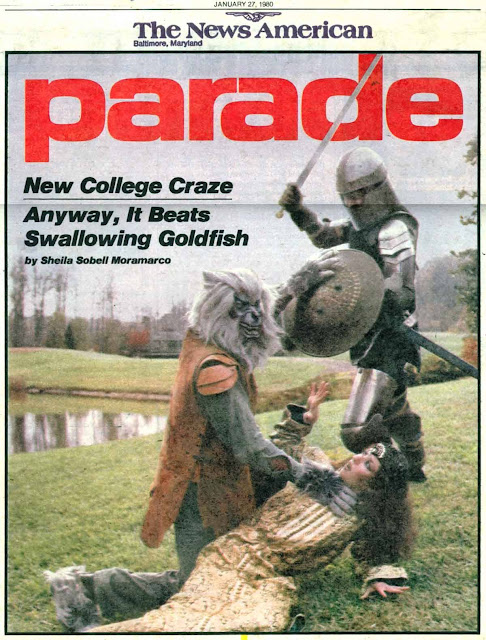
I've mentioned many times before that, when I first got into roleplaying games, I sought out newspaper and magazine articles that talked about the then-novel hobby. Thanks to the Internet, I've been able to locate evidence of some of the articles I remember from my youth, such as this one from the January 27, 1980 issue of Parade. For those who don't know, Parade is a supplement inserted into the Sunday edition of certain American newspapers. When I was a kid growing up in Maryland, Parade appeared first in The News American paper and, later, in The Baltimore Sun.

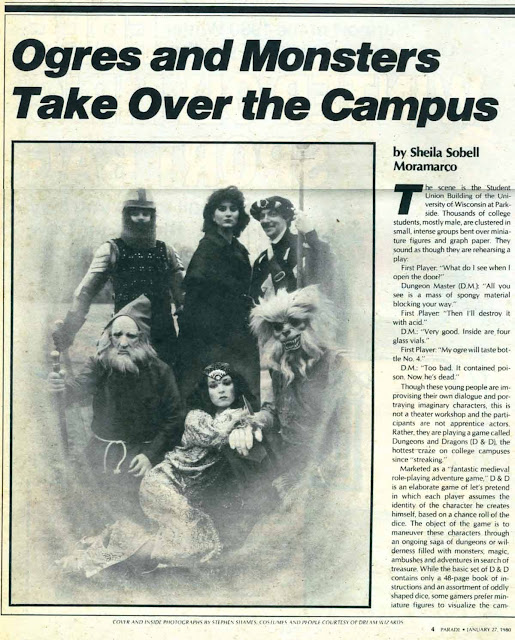
Quite the cover, isn't it? Take a look at the first page of the article on the inside of Parade.
Why these cosplayers/LARPers appear at all is a good question, since the accompanying article makes no reference to them. I can only assume that this was done to attract the eyes of readers. Based on my recollections, many articles like this included incongruous photographs since, at the time, I suppose very few people understood what "roleplaying" actually entailed. The mistaken notion that wearing a costume was part of the hobby is an old one, going back to at least as far as early reports of the disappearance of James Dallas Egbert in 1979, if not further. 

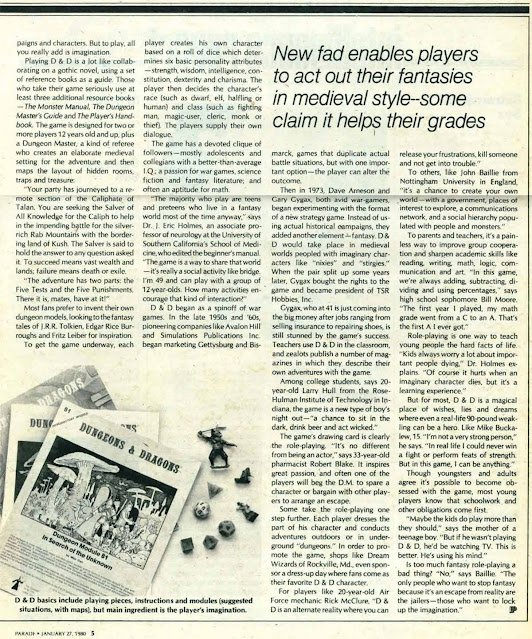
In this case, it's especially frustrating, because the article itself is pretty good and includes some quotes from J. Eric Holmes about roleplaying and D&D that are both positive and illuminating for outsiders.
From the vantage point of 2022, it's often difficult to remember that roleplaying wasn't just seen as a weird hobby for weird people, it was well nigh incomprehensible to many people, hence the appearance of so many articles like this one. That that's no longer the case is thanks in no small part to the success of Dungeons & Dragons, a game whose appearance and popularity really did change the world forever.

Pulp Fantasy Library: Atlantis: The Antediluvian World

A brief caveat: Atlantis: The Antediluvian World is not a work of fiction – at least not of an intentional kind. At the time it was published (1882), it was presented as speculative archeology, however dubious that claim might have been, even by the standards of its own time. More to the point, its author, Ignatius L. Donnelly, did not believe he was writing fiction but rather that he was advancing "several distinct and novel propositions" regarding "an Atlantic continent … known to the ancient world as Atlantis." He believed this so strongly that he continued to advance his theses for the remainder of his life, writing a sequel in 1883 and inspiring countless other writers in the ensuing decades. 

It's largely on this basis that I'm including it as this week's Pulp Fantasy Library post. Considered purely in terms of its influence on later fiction, Atlantis: The Antediluvian World is an important product of human imagination and creativity, easily on par with the avowedly literary efforts of H.P. Lovecraft, or J.R.R. Tolkien. Indeed, if you've ever read a story involving Atlantis, whether it be Clark Ashton Smith's tales of Poseidonis, Robert E. Howard's Kull yarns, or even the adventures of Aquaman, to cite just a few, you owe a debt to Ignatius Donnelly and his obsession with proving that Atlantis was not only real but "the region where man first rose from a state of barbarism to civilization."

Donnelly himself is a fascinating fellow, in the way that only men from the past seem to be. Born in Philadelphia in 1831, he became a lawyer and moved to the Minnesota territory, where he attempted to found a cooperative farm and utopian community with several others. Though the farm failed, leaving him in debt, Donnelly managed to use his rhetorical skills to become Minnesota's second lieutenant governor after statehood. Later, he was elected to the U.S. House of Representatives and to seats in both houses of Minnesota's state legislature. As a politician, he advocated for women's suffrage, a progressive income tax, and an eight-hour workday, among many other causes radical for their time. And, of course, he was also an advocate of the belief that Atlantis "is not a fable, as has been long supposed, but veritable history." Like Whitman, Donnelly contained multitudes.

Atlantis is a lengthy and ponderous book, divided into five parts, each consisting of six or more chapters. The tome begins with a chapter in which Donnelly lays out "the purpose of the book" by asserting the following theses:

1. That there once existed in the Atlantic Ocean, opposite the mouth of the Mediterranean Sea, a large island, which was the remnant of an Atlantic continent, and known to the ancient world as Atlantis.

2. That the description of this island given by Plato is not, as has been long supposed, fable, but veritable history.

3. That Atlantis was the region where man first rose from a state of barbarism to civilization.

4. That it became, in the course of ages, a populous and mighty nation, from whose overflowings the shores of the Gulf of Mexico, the Mississippi River, the Amazon, the Pacific coast of South America, the Mediterranean, the west coast of Europe and Africa, the Baltic, the Black Sea, and the Caspian were populated by civilized nations.

5. That it was the true Antediluvian world; the Garden of Eden; the Gardens of the Hesperides; the Elysian Fields; the Gardens of Alcinous; the Mesomphalos; the Olympos; the Asgard of the traditions of the ancient nations; representing a universal memory of a great land, where early mankind dwelt for ages in peace and happiness.

6. That the gods and goddesses of the ancient Greeks, the Phoenicians, the Hindoos, and the Scandinavians were simply the kings, queens, and heroes of Atlantis; and the acts attributed to them in mythology are a confused recollection of real historical events.

7. That the mythology of Egypt and Peru represented the original religion of Atlantis, which was sun-worship.

8. That the oldest colony formed by the Atlanteans was probably in Egypt, whose civilization was a reproduction of that of the Atlantic island.

9. That the implements of the "Bronze Age" of Europe were derived from Atlantis. The Atlanteans were also the first manufacturers of iron.

10. That the Phoenician alphabet, parent of all the European alphabets, was derived from an Atlantis alphabet, which was also conveyed from Atlantis to the Mayas of Central America.

11. That Atlantis was the original seat of the Aryan or Indo-European family of nations, as well as of the Semitic peoples, and possibly also of the Turanian races.

12. That Atlantis perished in a terrible convulsion of nature, in which the whole island sunk into the ocean, with nearly all its inhabitants.

13. That a few persons escaped in ships and on rafts, and, carried to the nations east and west the tidings of the appalling catastrophe, which has survived to our own time in the Flood and Deluge legends of the different nations of the old and new worlds.

To anyone with even the slightest interest in the subject of Atlantis – or the decades of pulp fantasy musings on the subject – none of these propositions is the least bit surprising. At the time, though, they were bold and original, if not at all historically well-founded. Atlantis was a success for Donnelly and its ideas were disseminated widely, so much so that they now form an important substrate of both popular culture and esoteric beliefs. 

Growing up, the mother of two friends of mine, with whom I first began playing RPGs, had an extensive library of books that, at the time, we called "New Age." Among them was a copy of Atlantis: The Antediluvian World, alongside the works of authors inspired by it, like Edgar "The Sleep Prophet" Cayce and various Theosophists. I'd sometimes take the books off her shelves and peruse them, looking for interesting sections that might inspire D&D adventures. Even as a kid, I found most them more than a little ridiculous, but Donnelly's book held my attention, perhaps because of its author's self-seriousness and obvious enthusiasm for the "revelations" he is imparting to his readers. It's not difficult to see why it caused a stir in its day or why its central theory, however implausible, continues to maintain a hold over the popular imagination almost a hundred and fifty years later.