Wednesday, January 11, 2023

Beware the Gifts of Dragons

The Electronic Frontier Foundation, no stranger to the hobby, has posted an article on its blog about the ongoing Open Game License controversy. It's not a formal legal opinion on the matter, though the author, Kit Walsh, is an attorney and clarifies a few points about copyrights, open licenses, and contracts from a legal perspective. 

My main takeaway from the post, aside from the obvious fact that Wizards of the Coast is behaving in a "rude and unfair" way, is that the existing version 1.0a of the OGL is, unfortunately, not written as clearly as one might like, if the goal is for its terms to be legally irrevocable. This is a criticism I've seen of the Open Game License before, but, until now, it's never really mattered, because WotC seemed content to let the situation stand as it had for more than two decades. However, it seems quite possible that the terms presented in the draft of version 1.1 are completely legal, however much that flies in the face of the previously stated intent of the original OGL.

As more and more creators and publishers publicly state that they intend to drop the OGL from their current and future publications, I'm not certain that Wizards of the Coast can say or do anything that will undo the fear, uncertainty, and doubt engendered by the last few days. The cynic in me wants to believe that that was always WotC's intention, but I suspect the truth is that they simply didn't think the consequences of this action through and are quite surprised by the intensity of the public backlash.

Yesterday, Ray Winninger, the former Executive Producer in charge of Dungeons & Dragons at WotC, had this to say in response to a question about the OGL situation:

There's still no response from Wizards of the Coast about this, though they will apparently be "sharing more soon," whatever that means. In any case, this story is far from over and I expect there will be a few more twists and turns before the week is done.

Retrospective: Quest for the Heartstone

1984 marks a significant turning point in the history of both TSR Hobbies and its most popular and successful game, Dungeons & Dragons. By my reckoning, it's the start of D&D's Silver Age. It's a year marked by the advent of Dragonlance and the continued exile of Gary Gygax to Hollywood. 1984 also sees the increased brandification of D&D, as well as its kiddie-fication, much to the chagrin of my snobbish adolescent self.

The latter point is what's most relevant to this post, because the D&D module Quest for the Heartstone was self-avowedly "designed to be compatible with the ADVANCED DUNGEONS & DRAGONS® Action Toys from LJN, Ltd." Indeed, there are multiple passages in the adventure where the text suggests things like "You may use the HOOK HORROR™ Monster produced by LJN Toys, Ltd. for this encounter." Likewise, all of the module's pre-generated characters, like STRONGHEART™, MERCION™, and RINGLERUN™ are "based on the Official ADVANCED DUNGEONS & DRAGONS® Action Toy figures produced by LJN Toys, Ltd." 

If you're already tired of seeing all the needless capitalizations, trademark symbols, and references to LJN Toys, Ltd. in this post, just try to imagine what it's like reading the entire text of this 32-page adventure, where they appear again and again. Even by the low standards of grasping corporate brand-building, this is beyond ridiculous. I can't help but feel a deep sympathy for Michael L. Gray, who had the dubious honor of having to write this, no doubt with the brief that he find a way to shoehorn in every Action Toy from LJN, Ltd. 

The scenario presented in Quest for the Heartstone is an odd one. King Ganto of Ghyr died peacefully in his sleep at the age of 82 without an heir. His widow, Queen Leahra, is still a young woman – in her mid-thirties, according to the text – and is expected to remarry in order to provide Ghyr with a successor to her deceased husband. However, she has no desire to do this, since her "heart belongs only to Gantos." For that reason, she has rejected numerous suitors from among the nobility of the kingdom. Patriarch Loftos communes with his deity, He Who Watches, and learns the location of the legendary heartstone, which true to its name, enables its possessor to "see into the hearts of men." If the heartstone could be recovered, the queen could find an appropriately worthy man to marry and thereby make the king of Ghyr. Naturally, Loftos decides to enlist a party of adventurers to retrieve the heartstone and save the kingdom.

The module's set-up leaves me with a lot of questions that are probably best not asked. In the end, the initial situation exists solely to provide an excuse for the characters to travel from Castle Ghyr across the Northern Marsh to the Mountains of Ice, where Loftos says the heartstone lies. This is an Expert Rules adventure, intended for characters of levels 5–10, so a wilderness trek is therefore obligatory before reaching the dungeon proper. The dungeon itself is interesting in that it becomes more difficult as one ascends it, since the whole thing is a sort of tower built into the mountainside. As dungeons go, it's nothing special, but it's neither is it awful. The whole thing is a vaguely funhouse affair, with little rhyme or reason to its contents beyond being a "challenge" for those who wish to retrieve the heartstone.

The bigger issue for Quest for the Heartstone is its audience. Who was this module written for? The D&D toys it regularly references were likely aimed at children younger than even the ages 10 and up favored by TSR's D&D line. Meanwhile, regular players of D&D, including older children, would probably find all the references to the toys more than a little annoying – never underestimate the desire of older kids to distance themselves from anything they deem to be "baby-fied." And so I ask again: who is this for? What did TSR think they were doing by publishing this module and how did it advance even their ill-considered mid-1980s plans to turn Dungeons & Dragons into a multimedia property?

These questions are even more baffling to me, given that the module is pretty well made. The maps of the dungeon are nicely executed isometric ones by David "Diesel" LaForce. Likewise, the adventure is profusely illustrated by Jeff Easley. Easley provides not only the interiors of many of the rooms of the dungeon but also his takes on several iconic AD&D monsters that have been converted for use with D&D, like the dragonne and roper. Whatever the wisdom in making this adventure, it is not a low-quality effort on the part of TSR. Quest for the Heartstone looks every bit as good as any other TSR publication of the era.

As I said, 1984 is something of a turning point for TSR. The successes of the late '70s and early '80s enabled increasingly foolhardy decisions that put the company in a very precarious situation whose ultimate outcome was handing control of the company over to Lorraine Williams, a woman whose decisions were no better than those of Gary Gygax or the Blume brothers, even if her errors of judgment were of a very different kind. Given the current state of affairs regarding D&D and its current corporate master, this is an instructive reminder that the game has rarely been well managed for long and yet it has somehow endured despite it all.

Tuesday, January 10, 2023

Let Chaos Reign

While there has not yet been any official comment from Wizards of the Coast in response to the supposed draft of version 1.1 of the Open Game License, a number of other creators and companies whose publications depend on the continued viability of the existing 1.0a version have made the current state of their plans known. Here are some of those of which I am aware. Please feel free to add more in the comments below.

That may not seem like a long list but consider the titles. Both Basic Fantasy and Castles & Crusades, two games that play important roles in the prehistory of the OSR, are there, which says a lot, I think, about how much this situation has the potential to up end even our little corner of the wider hobby. Equally important on that front is Old School Essentials, an elegant restatement of the Moldavy/Cook/Marsh rules that has deservedly received a lot of praise – and play – over the last few years. I would not be the least bit surprised to see many more creators and companies issue similar statements in the days to come, particularly if WotC continues its silence on the matter.

At this point, I feel that the damage has been done and is irreparable. Even in the event that Wizards of the Coast issues a repentant mea culpa and presents a new draft of version 1.1 of the OGL that does not attempt to "de-authorize" its predecessor, I'm not sure anyone would believe them. And why should they? The reality is that WotC is a subsidiary of a huge, multinational conglomerate; expecting it to behave in a fashion where anything but the bottom line matters has always been a fool's bet. We might somehow dodge this particular bullet, but there's no guarantee that WotC won't try to pull something similar – or worse – in the future. Why take the risk?

I'd originally planned to keep my Secrets of sha-Arthan fairly close to the conventions of Dungeons & Dragons and its clones. Now, though, I'm less inclined to do so, even if that necessitates rewriting portions of my current draft. As it is, I already don't use any of the character classes, races, spells, monsters, or magic items of D&D, so the rewrites might not be unduly onerous. Plus, it'll give me the chance to make the final game much more its own thing, which is probably what I should have done in the first place. 

Looks like 2023 has already started with a bang. I wonder what more will unfold in the days and weeks to come.

Teddy's Diary

 Does anyone else remember Teddy from a series of Games Workshop advertisements in White Dwarf?

White Dwarf: Issue #63

Issue #63 of White Dwarf (March 1985) is graced with a cover by Italian-born artist Gino D'Achille, who is probably most well-known for the work he did on the Ballantine editions of the Barsoom novels from 1973 (or the DAW Gor books, if that's more your preference). In his editorial, Ian Livingstone continues to ponder the state of the hobby, with particular emphasis placed on the peculiar ways that licensed properties are divvied up among companies. He notes, for example, that Games Workshop publishes the Doctor Who boardgame, while FASA publishes the RPG. He also notes that, while TSR publishes Battle System ("which sounds like Warhammer"), Citadel produces the official AD&D miniatures line. Livingstone's correct to note the oddity of this, but it's been pretty much par for the course for as long as the licensing of media properties has existed (and remains so to this day).

The issue kicks off with "Arms and the Man" by Michael Holman, which builds on Andy Slack's article on vehicle combat in Traveller from White Dwarf #43. Holman introduces a number of new vehicle systems, including offensive ones, as well as an expanded vehicle combat procedure. It's all good stuff, though it highlights, as did Slack's article before it, just how much Traveller needed vehicular combat rules simpler than those in Striker. 

Dave Langford's "Critical Mass" occasionally elicits my interest – not so this month, which is why I will pass over it without comment. Much more compelling to me is "Open Box," which very positively reviews Toon (9 out of 10), a game for which I have more affection than is probably justified. Also positively reviewed are a pair of videogames from Triffid Software, The Secret River and The Wizard's Citadel, which score a combined 8 out of 10 (somehow). I must admit I was surprised to see videogames reviewed in "Open Box." In the past, such things appeared in a separate column, "Microview," but I suspect it had been axed sometime prior to this. There's a side by side review of FASA's Star Trek III Starship Combat Game and Task Force's Star Fleet Battles Volume II. The comparison is not completely fair, since SFB Volume II is not a stand-alone product but a supplement. Even so, White Dwarf gives them 8 and 7 out of 10 respectively. Finally, there are reviews of the D&D modules, The Veiled Society (9 out of 10) and Quest for the Heartstone (4 out of 10). I'll be looking at the latter in a separate post tomorrow.

Part 5 of Graeme Davis's Eye of Newt and Wing of Bat concludes by tackling miscellaneous magic items. This is probably the least satisfying entry in the series, because it looks at only a small percentage of the miscellaneous items found in the Dungeon Masters Guide and presents no unified system for handling their manufacture. On the one hand, that's understandable, given the diversity of the miscellaneous magic items. However, the point of the series is to present a system to aid referees and players in adjudicating the creation of magic items. Without that, I think it's a little less useful than it might have otherwise been.

Carl Critchlow gives us the first part of "Thrud the Destroyer," which amusingly riffs off both the awful second Conan movie and The Magnificent Seven – fun stuff, as always. "The Travellers" and "Gobbledigook" are also enjoyable, though neither compares to this month's "Thrud." The third and final part of Jon Sutherland and Gareth Hill's "The Dark Usurper" Fighting Fantasy scenario appears in this issue, too. It's much like the previous parts, which is to say, passable as a solitaire scenario, though nowhere near as good as even an average full-length Fighting Fantasy book.

Much more compelling is Marcus L. Rowland's "Draw the Blinds on Yesterday," a Call of Cthulhu scenario set in the 1980s. The adventure concerns a missing flight between Athens, Grece and London, England, thanks to an unsuccessful attempt to summon Cthugha from Fomalhaut. Also involved is the last surviving Gorgon, an extraterrestrial species that is the origin of the myths of Medusa and her sisters. It's a delightfully bonkers scenario that somehow works, despite (because of?) its strange mix of elements. 

"Setting the Scene" by Joe Dever and Gary Chalk is another fascinating miniatures-oriented article. This time, the authors look at the pitfalls of how best to make use of miniatures and scenery at the table. It's a topic I'd never really considered before, given my limited use of miniatures over the years. As usual, Dever and Chalk do a fine job of briefly laying out the problems and offering solutions, accompanied by useful color photographs. Every time I read one of their articles, I find myself deeply regretting that I never bothered to take up miniatures painting back when I still had the eyesight and hand-eye coordination to make a serious go of it. The folly of youth!

"Howzat!" by Mark Wilkinson, David Bailey, and Richard Bramah is humorous RuneQuest article that presents the rules (and game mechanics) for "elfball," a Gloranthan analog to cricket. There are even a few new spells for use during the game, like batting trance and team spirit, as well as additional spells for use by umpires. It's silly but fun, the kind of thing that I long considered a distinctive aspect of the UK game scene in the '80s. "A Not So Lonely Mountain" presents a pair of short scenarios involving the characters' ascent up a mountain – and the monsters they encounter along the way. I like this style of introducing new opponents in a RPG and wish it was done more often.

"Imperial Trooper" by Nic Weeks is look at the elite military forces of the Imperium of Traveller. It's mostly "fluff," in that it introduces no new rules or equipment for use with the game and, on that score, is good enough, though it does differ somewhat from GDW's own presentation of similar topics elsewhere. Concluding the issue is James Carmichael's "Help for the Hobbit Abroad," which presents some halfling-specific magic items, like pots of cooking and the pipe of the storyeller. (One of these years someone will figure out something to do with halflings that's more interesting than simply being Tolkien's hobbits with the serial numbers filed off – or, better yet, jettison them entirely!)

And so we come to the end of another issue of White Dwarf. As usual, it's a mixed bag, filled with a wide variety of material geared toward an equally wide variety of games. That was always White Dwarf's great strength when compared to Dragon and its relentless focus on Dungeons & Dragons. Of course, this sometimes meant that some issues of White Dwarf might not be as interesting to me as others, but that was a chance I was willing to take at the time. Re-reading these issues remains a delightful trip down memory lane; I look forward to the next one.

Monday, January 9, 2023

Blast from the Past

As many readers of this blog undoubtedly already know, Wizards of the Coast is rumored to have plans to "de-authorize" version 1.0a of the Open Game License. Leaving aside the big questions of whether the rumors are true and whether or not WotC has the legal authority to initiate such a monumental change, I find myself reminded of this:

That's the opening salvo in TSR's "war on the Internet" of the mid-1990s, when the company dubiously claimed that "any software, bet books, modules, tables, stories, or rules modifications which contain elements from our copyrighted properties, including characters, settings, realm names, noted magic items, spells, elements of the gaming system, such as ARMOR CLASS, HIT DICE, and so forth" were "infringements of TSR copyrights" unless they had been produced under license from TSR. Such belligerent and litigious behavior is what earned the company the nicknames T$R and They Sue Regularly. 

Ryan Dancey, the architect of the Open Game License, intended it, in part, to be a "laying down of arms" by Wizards of the Coast, an act of good faith to demonstrate that the then-new custodians of the world's first roleplaying game – this was 2000, remember – would not behave as TSR had done. It was also a way to safeguard the mechanics and ideas of D&D by "freeing" them, echoing Ted Johnstone's cri de coeur that "D&D is too important to leave to Gary Gygax." Dancey felt that D&D was too important to leave even to WotC, the company of which he was vice president at the time. 

People more knowledgeable than I have a better handle on the legal and other ramifications of this possible turn of events. I highly recommend Rob Conley's series of posts on this topic, but many others have likewise written capably about it. Speaking personally, my concern is solely for the possible repercussions on the Old School Renaissance, a lot of whose foundational texts, such as OSRIC, Labyrinth Lord, and Swords & Wizardry, owe their existence to the OGL. If WotC is able to rescind even Version 1.0a of the OGL, despite previous assurances that this was impossible, it would send shockwaves throughout the hobby by overturning a state of affairs that has existed for more than two decades. 

I suppose it's still possible that the leaked Version 1.1 of the OGL is merely a draft or even a trial balloon, but, even if that were true, I think this whole affair undermines the faith publishers have in the safe harbor that the OGL is supposed to provide them. Indeed, I would not be the least bit surprised if more than a few notable publishers decide to decouple their games from both the OGL and the D20 SRD. If so, we might see a return to the situation that existed in the '70s and '80s when publishers hid behind slightly altered terminology, such as Judges Guild's "hits to kill" instead of "hit points," in order to produce material broadly compatible with D&D without the need for a license (and royalty scheme) from TSR.

I will definitely have further thoughts on this matter in the coming days. If nothing else, I'll likely revisit the history of TSR's ham-fisted attempts to put the RPG genie back in the bottle, as well as take a look at just how much of D&D's purported intellectual property is obviously derivative of prior art. Interesting times!

Realism Is So Affordable

Pulp Fantasy Library: The Satyr

H.P. Lovecraft's career as a writer was seriously hampered by the fact that he would regularly withhold publication of his stories unless they were printed without alteration. His friend and colleague, Clark Ashton Smith, whose 130th birthday is this coming Friday – Friday the 13th, appropriately enough – had no such qualms. He understood well that, if one were to make a living as a writer of pulp fiction, one had to be both prolific and willing to acquiesce to even the most whimsical of editorial alterations. Consequently, Smith saw a phenomenal number of his stories published during his lifetime. Weird Tales alone published fifty-three of his tales, more even than Robert E. Howard, another of HPL's friends who understood the compromises necessary to make money as a writer.

Smith's willingness to compromise extended not only to the content of his writing, but also to the markets to which he'd peddle his work. In the case of "The Satyr," one of the earliest stories in his Averoigne cycle, he made concessions to both. After repeated rejections from his usual publishers, who regarded it as "overly risqué," he sold it to La Paree Stories, a "spicy" pulp, whose pages were filled with erotic fiction and nude photography. Further, he changed the story's original ending to make it less ambiguous – a man's gotta eat, after all! The link above, sadly, goes to the version that appeared in the July 1931 issue of La Paree Stories; the original ending would not be restored until 2006.

As so many of Smith's tales do, "The Satyr" opens amusingly:

Raoul, Comte de la Frenaie, was by nature the most unsuspicious of husbands. His lack of suspicion, perhaps, was partly lack of imagination; and, for the rest, was doubtless due to the dulling of his observational faculties by the heavy wines of Averoigne. At any rate, he had never seen anything amiss in the friendship of his wife, Adele, with Olivier du Montoir, a young poet who might in time have rivalled Ronsard as one of the most brilliant luminaries of the Pleiade, if it had not been for an unforeseen but fatal circumstance. 

The references to Pierre de Ronsard and La Pléiade place the story in the mid-16th century, which is later than most of his Averoigne stories, whose time period is more clearly medieval. Count Raoul, despite his usual trusting nature, somehow begins to suspect that perhaps there is something untoward in the relationship of his wife and the handsome young poet who composes "melodious villanelles and graceful ballades ... in celebration of Adele's visible charms." 

it is hard to know just why M. le Comte became suddenly troubled concerning the integrity of his marital honour. Perhaps, in some interim of the hunting and drinking between which he divided nearly all his time, he had noticed that his wife was growing younger and fairer and was blooming as a woman never blooms except to the magical sunlight of love. Perhaps he had caught some glance of ardent or affectionate understanding between Adele and Olivier; or, perhaps, it was the influence of the premature spring, which had pierced the vinous muddlernent of his brain with an obscure stirring of forgotten thoughts and emotions, and thus had given him a flash of insight.

So, when he discovers that his wife and Olivier had recently left his chateau to go "for a promenade in the forest," he sets off after them – armed with his rapier.

Even ignorant of what her husband has planned, Countess Adele is worried. 

Adele and Olivier had wandered beyond the limits of their customary stroll, and were nearing a portion of the forest of Averoigne where the trees were older and taller than all others. Here, some of the huge oaks were said to date back to pagan days. Few people ever passed beneath them; and queer beliefs and legends concerning them had been prevalent among the local peasantry for ages. Things had been seen within these precincts, whose very existence was an affront to science and a blasphemy to religion; and evil influences were said to attend those who dared to intrude upon the sullen umbrage of the immemorial glades and thickets.

Olivier, however, is not concerned, claiming that Adele's worries are based on "stories to frighten babes and beldames." He reassures her, "There is enchantment here, but only the enchantment of beauty." The pair proceed deeper into the forest, until at last they come upon a beautiful clearing that possessed both "an air of antique wisdom" and "tranquil friendliness." "Was I not right?" Olivier queried. "Is there ought to fear in harmless trees and flowers?"

I doubt it will come as a surprise to anyone that Adele's fears are well grounded. Even as "the spell of their desire" is upon them and "everything beyond their own bodies, their own hearts" is "vaguer than a dream," they nevertheless become aware that they are being watched.

The apparition was incredible; and, for the space of a long breath, they could not believe they had really seen it. There were two horns in a matted mass of coarse, animal-like hair above the semi-human face with its obliquely slitted eyes and fang-revealing mouth and beard of wild-boar bristles. The face was old - incomputably old; and its lines and wrinkles were those of unreckoned years of lust; and its look was filled with the slow, unceasing increment of all the malignity and corruption and cruelty of elder ages. It was the face of Pan, as he glared from his, secret wood upon travellers taken unaware.

In both versions of the story, the leering vision serves as a catalyst for Adele to fling herself into the arms of Olivier and, at long last, they give into the unspoken ardor that they had long felt for one another. Later, their passion consummated, they lie together in the clearing, at which point Raoul finds them. In the published 1931 version, the Count prepares to impale both lovers with a thrust of his blade, but is prevented from doing so by the sudden appearance of the titular satyr, who grabs Adele and carries her off while laughing maniacally. In Smith's original version, Raoul succeeds in slaying the adulterers as he had planned. The satyr never appears in the flesh; instead, the count only hears his laughter.

Both endings have their merits. For myself, I prefer Smith's version, as there is some ambiguity as to whether or not the satyr exists at all or whether it might instead be a manifestation of Raoul's own bloodlust. In any case, "The Satyr," though a lesser work within the Smithian oeuvre, is a quite effective tale of horror and passion – fitting perhaps, given its title. 

Friday, January 6, 2023

Magic Missile vs Shield

An Observation about Gygax's Modules

Between 1978 and 1985, TSR Hobbies published eighteen stand-alone adventure modules carrying the byline of Gary Gygax, starting with Steading of the Hill Giant Chief in 1978. Because it was the first of its kind, module G1 does not include a suggested level range on its cover. Instead, there is an interior section, labeled "CAUTION," that states the following:
Only strong characters should adventure into the Steading of the Hill Giant Chief if the party is but 3 or 4 strong. 6th or 7th level characters are suggested only when the party numbers 5 or more and only if most of the party is of higher level. The optimum mix for a group is 9 characters of various classes, with an average experience level of at least the 9th, and each should have 2 or 3 magic items.

The module's immediate sequels, The Glacial Rift of the Frost Giant Jarl and Hall of the Fire Giant King, include similar notes of caution that more or less reproduce what is stated above. When the three modules were collected together under one cover as Against the Giants in 1981, they were given a suggested level range of 8–12, which seems a bit higher than how I read Gygax's words.

Also published the same year was module D1, Descent into the Depths of the Earth, includes its own note of caution:

Those familiar with the previous modules in this scenario will be aware that they are designed for play only by players of above-average ability who have characters of high level – 9th or 10th minimum, counting multi-classed characters as roughly equal to a single classed character two levels higher than the character's higher level (three levels if triple classed) ... The module is designed for characters of about 10th level, with a party size of 7 to 9.

Module D2, Shrine of the Kuo-Toa, offers similar advice, as does module D3, Vault of the Drow. Later reprintings of these modules (again, in 1981) would combine D1 and D2 and peg its level range at 9–14 and D3 at 10–14. (The conclusion to the Giants-Drow series, 1980's Queen of the Demonweb Pits, is largely by David C. Sutherland III but Gygax is given a "with" credit, since it's at least partially based on his ideas. In any event, it too is listed as being appropriate for character levels 10–14.)

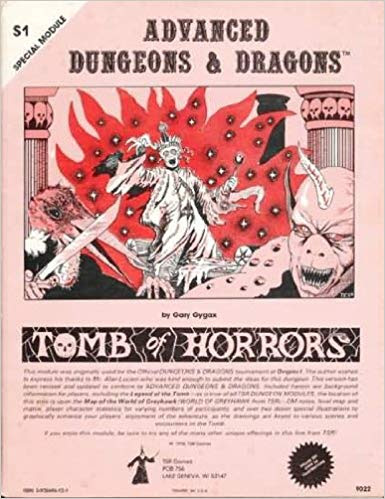
I find it interesting, as others undoubtedly have, that the first six modules TSR released for use with AD&D were all aimed at fairly high-level characters – roughly the 8–12 range. The seventh module released in 1978, Tomb of Horrors, doesn't include the same note of caution regarding levels. Instead, only that it is "A THINKING PERSON'S MODULE" with few monsters and whose challenges are meant to be" solved by brains and not brawn." That said, Tomb of Horrors does include a roster of pregenerated characters that range in level from 6 to 14. The later 1981 reprinting opts instead for a 10–14 range. 

In 1979, TSR publishes The Village of Hommlet. Again, it has no level range listed on its cover, but "Notes for the Dungeon Master" explains that "this module is designed for beginning play" and that experienced players "should start new, 1st level characters." The cover of the 1981 reprint – a recurring theme! – states that it is for "Introductory to Novice Level." Later in 1979, Gygax's name would also appear on The Keep on the Borderlands. This is the first of his modules to specify a level range on its original cover, in this case 1–3. 

There's then a gap of three years before Gygax's name again graces the cover of a D&D module of any kind. That's when The Forgotten Temple of Tharizdun is published, with a stated level range of 5–10. The next year, 1983, we see Dungeonland and its sequel, The Land Beyond the Magic Mirror, both of which are suggested for levels 9–12. 1984's Mordenkainen's Fantastic Adventure is for the same level range, while 1985's Isle of the Ape, Gygax's last published adventure module for TSR, is for levels 18+.

Looking at the totality of his published output, as I've just done, it would seem that, by and large, Gygax wasn't all that interested in low-level adventures – or at least he wasn't interested in writing them. This might be because he simply found higher-level scenarios more compelling or because he felt there was a greater need for published examples of what higher-level play could be. Either way, he devoted himself to writing a significant number of modules in the 9th–12th level range, with only a small number of outliers. 

Personally, I find this quite fascinating, if only because it runs counter to the conventional wisdom that Dungeons & Dragons, as a game line and as a product, benefits most from having lots of support for low to mid-level play. If you look at TSR's output over the years of its existence, you'll see lots of adventures in the levels 4–7 range and comparatively fewer at higher levels (though, again, there are outliers here and there). I know that my own personal preference has always been toward a similar middle span of levels and have often felt that every edition of D&D starts to creak after about level 9 or so, though Gygax would seem to have felt differently. If so, it makes me wonder all the more what his version of Second Edition might have looked like.

EDIT: I inexplicably left out both Expedition to the Barrier Peaks (8–12) and The Lost Caverns of Tsojcanth (6–10), two modules I like a great deal.