Tuesday, January 17, 2023
White Dwarf: Issue #64
Tuesday, November 29, 2022
White Dwarf: Issue #59
The issue begins with "The Mad Gods' Omelette," a parodic fantasy short story by Dave Langford. It's actually quite funny in the way it skewers the increasing self-seriousness of the contemporary works in the genre, particularly those that took their cues from Moorcock. One of my favorite bits in the story is a comment by the protagonist Erryj, possessor of "the black, runecarved artificial leg Slugbane," upon hearing that "the Dark Gods walk the earth once more."
"The Dark Gods?" Erryj gave Dylan Worm a searching glance. "Aye, I have heard tell of such. Speak you of the Elder Gods? ... The Younger Gods? The Dead Gods? The Agnostic Gods?" With each utterance, a greater stillness filled the room.As I said, it's quite funny and much more enjoyable than Langford's "Critical Mass" column this or any other month. Mind you, this month's installment of the book review column holds some interest in that Langford looks at William Gibson's first novel, Neuromancer, which he likes a great deal, though he criticizes its "frenetic" pace. I suppose it wouldn't be a proper "Critical Mass" column if Langford didn't find fault in nearly everything he reviews.
"Open Box" takes a look at three different adventures for Call of Cthulhu: The Curse of the Chthonians (9 out of 10) from Chaosium, Glozel est Authentique! (5 out of 10) from TOME, and The Horrible Secret of Moneghan Island (7 out of 10) from Grenadier. These reviews are all fair, based on my own experience. Also reviewed are the Gamemaster Pack and For Your Information for James Bond 007, which earn 4 out of 10 and 3 out of 10 respectively. This continues the trend of giving rather negative reviews to James Bond 007 RPG products, something I find inexplicable, given my own fondness for the game. On the other hand, neither of the reviewed products are exceptional in any way, so perhaps they are fairer than it might seem on first glance. Finally, there's a review of Chaosium's Ringworld, which receives a mediocre 6 out of 10, even though the reviewer praises both the background information and the rules set – odd!
"The Ninja" by Chris Elliott and Richard Matthews is yet another stab at a ninja character class for AD&D. Though there are a few new wrinkles – such as non-magical "spells" – the class is just another Japanese-flavored assassin variant with too many abilities. The class is intended to be used in conjunction with "Hour of the Tiger," an AD&D scenario also included in this issue. The adventure involves the infiltration of an imperial palace and demands stealth and cunning, not to mention reconnaissance, to succeed. It's well done and probably challenging, particularly to players for whom brute force is standard operating procedure.
Marcus Rowland's "A Matter of Faith" presents four religious cults for use with a variety of modern-day RPGs, such as Mercenaries, Spies, and Private Eyes; Top Secret, James Bond 007, Superworld, Champions, Call of Cthulhu, Golden Heroes, and Villains & Vigilantes. The cults range from The Temple of Excellence, Inc., which teaches that transcendence is possible through the acquisition of skills, to Technodeology, which believes that God does not yet exist and must be created as a computer. Rowland fleshes out each cult briefly and provides notes for customizing it for the RPG in which it's used. Very good stuff!
"Two Decks are Better than One" is a Car Wars article by Steve Jackson about the inclusion of double-decker buses into the game. "Eye of Newt and Tongue of Bat" by Graeme Davis is the first part of a series of articles intended to provide a system for the manufacture of magic items in AD&D. This installment focuses on staves, wands, and scrolls. I've long liked the idea of a system like this in principle, because I think that the process of creating new magic items should be both involved and interesting. However, most such systems offer only tedium without much else and, sadly, this system isn't much different.
"On the Road" by Anna Price is an outline for a RuneQuest scenario in which the characters accompany a caravan across the Plains of Prax. Though skeletonic, it provides enough detail, including several random tables, to make the overall situation compelling. "A Brush with the Lore" by Gary Chalk and Joe Dever tackles the matter of choosing an appropriate brush and paints for miniatures. "Core" introduces the Consular Office of Reconnaissance and Exploration, a Zhodani organization intended to be used as antagonists in an ongoing Traveller campaign. Like many such things, it's fine for what it is, but not especially memorable.
"Gladiators in RuneQuest" by Matthew Pook briefly discusses the matter of blood sports in the game, while "Pit Fighting" by James Waterfield contextualizes somewhat the practice within the setting of Glorantha. "The Great Hunt" by Simon Iff describes the Reavers, powerful minions of the demon prince Orcus who do his bidding on the Prime Material Plane. This article includes lots of background material about the Reavers and their origins, as well as their activities. Though very high-powered, I immediately saw uses for these creatures in certain campaigns. "Ars Arcana" by Kiel Stephens continues to look at unusual uses for D&D spells and does so quite engagingly. Any article that can teach me a few new tricks for a game I've been playing for decades earns a gold star.
This is a very good issue, filled with lots of variety, in addition to old favorites like "Thrud the Barbarian," "Gobbledigook," and "The Travellers." To my mind, this is peak White Dwarf and is what I think of when I think of the magazine in its heyday.
Tuesday, November 15, 2022
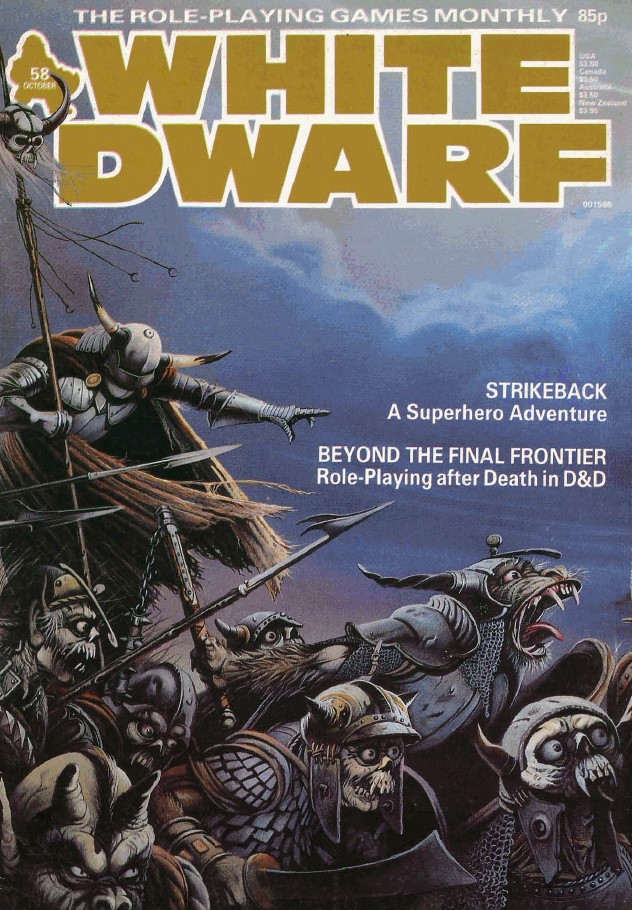
White Dwarf: Issue #58
Tuesday, November 8, 2022
White Dwarf: Issue #57
Ian Livingstone's editorial uses Games Workshop's release of its Judge Dredd and Doctor Who games as an opportunity to ponder the matter of licensed RPGs. He wonders why there are now so many games based on pre-existing characters and settings when Dungeons & Dragons, a generic and open-ended game without a direct media antecedent, remains the best-selling RPG. The matter of roleplaying games based on media properties is something I've thought a lot about over the years and re-reading Livingstone's brief comments on the matter have brought them to mind again. I may need to write a post about it in the coming days, if only to attempt to organize my own inchoate thoughts on the subject.
"Mind over Matter" by Todd E. Sundsted tackles the ins and outs of psionics in AD&D and other fantasy RPGs. By and large, the article's intended as advice to the referee and, on that level, is fine if uninspired. Dave Langford's "Critical Mass" is the usual collection of snarky reviews mixed with occasional praise, with the latter being heaped on Frederik Pohl's Heechee Rendezvous and Gordon Dickson's Lord Dorsai. Langford also takes the opportunity to tie his reviews into roleplaying games, when he uses the "Neanderthal ethics" of E.E. Smith's Subspace Encounter as a springboard for discussing the "moral bias" of adventure scenarios. He doesn't dwell on the topic at any length, however. His intent seems merely to have been to get referees (and players) to consider the matter rather than simply ignore it.
"Open Box" starts with a quartet of (mostly negative) reviews of Mayfair Role Aids releases: Elves (3 out of 10), Dwarves (3 out of 10), Dark Folk (3 out of 10), and Wizards (6 out of 10). While there's no question that most Role Aids books weren't very good, I can't help but feel the reviewer, Robert Dale, is being unduly harsh here. Much more positively reviewed is The Traveller Adventure, which receives a well-deserved 9 out of 10. Powers & Perils, a game whose mere existence continues to baffle me, is given a very generous 8 out of 10, largely, it seems, on the basis of how much of its contents might be adapted to other fantasy RPGs. Finally, James Bond 007 is given a mediocre 6 out of 10.
"Sky Rig" by Paul Ormston is a Traveller scenario with a classic set-up: the characters are tasked to investigate why contact was lost with an orbital refinery in a gas giant. It's a fun little adventure in an unusual locale and I made good use of it in my youth. "For the Blood is the Life" by Dave Morris offers up an alternative to the traditional Gloranthan vampire in the form of the vampyr (and demi-vampyr). Morris's complaint is that, mechanically, there's no good reason for Gloranthan vampires to drain blood, which he considers an important part of the lore of the creature, hence the alternative version he offers, whose continued existence depends on blood.
The second article in the "Night's Dark Agents" series by Chris Elliott and Richard Edwards provides game mechanics for better integrating ninjas AD&D, RuneQuest, and, believe it or not, Bushido. Once again, I note how quintessentially 1980s it is to have an article like this in a gaming magazine. "The Life of a Retired Wizard" by Lewis Pulsipher is a consideration of what magic-users, whatever their level, might do with themselves after they stop adventuring. Though short, it's a thoughtful article whose intent seems to be to encourage referees to give some thought to the question of how magic works and is used in his setting.
Part 2 of "The Sunfire's Heart" AD&D adventure by Peter Emery is as good as the first part. The scenario has some excellent maps and challenging encounters, as well as some delightfully old school elements, such as riddles that provide clues to the adventurers. This month's "Thrud the Barbarian" introduces readers to Eric of Bonémaloné and his demon sword Stoatbringer, while "Gobbledigook" and "The Travellers" continue to chug along somewhat less memorably. "The Staurni" by Andy Slack presents a version of the aliens from Poul Anderson's The Star Fox for use with Traveller.
"Majipoor Monsters" by Graham Drysdale details seven monsters for D&D drawn from the works of Robert Silverberg. Having never read Lord Valentine's Castle and its follow-ups, I can't really speak to the fidelity of these write-ups. "Racy Bases" by Gary Chalk and Joe Dever looks at how to improve the bases of miniature figures. I found the article oddly compelling, even though I've never been much of a miniatures user (let alone painter). "Words of Wisdom" by Kiel Stephens concludes the issue with some thoughts on a handful of new and unusual ways to make use of D&D spells, such as using levitate as an attack against an unwilling target or magic mouth as an alarm.
There's a lot to like about this issue of White Dwarf – or so I thought when I first read it all those decades ago. Even now, I think both "Sky Rig" and "The Sunfire's Heart" are well done and could easily imagine making use of them in a fantasy or science fiction RPG I were refereeing. That's more than I can say about many issues of this or any other gaming magazine I've owned over the years.
Tuesday, November 1, 2022
White Dwarf: Issue #56
Issue #56 of White Dwarf (August 1984) features a cover by Chris Achilleos, who's probably most well-known for his contributions to Heavy Metal magazine. This particular illustration doesn't do much for me personally, but it's very much in keeping with the brash tone of the magazine during this time. In his editorial, Ian Livingstone sees a possible silver lining in the troubles of US game companies like TSR, namely, the emergence of "a thriving British RPG industry." Games Workshop certainly benefited from the decline of TSR in the mid-1980s; whether any other UK companies did so is an interesting question.
Speaking of the mid-1980s, what could be more appropriate than an article about ninjas? "Night's Dark Agents" by Chris Elliott and Richard Edwards is fairly typical of this surprisingly resilient genre of article. Rather than focus on how to include ninjas into any specific RPG, the authors instead talk about the reputed training, skills, weapons, and attire of ninjas in history and legend. It's fairly well done for what it is, but it's hardly groundbreaking in an era when nearly every gaming periodical published multiple periodicals of this sort.
"Open Box" reviews Games Workshop's "Battlebikes," giving it 7 out of 10. This game piqued my imagination at the time, but I never saw it in stores, let alone owned it. Also reviewed is "Turbofire" from Auto Ventures, a product and a company of which I've never heard. The product, which is given 8 out of 10, is apparently a multi-system adventure/campaign scenario designed for use with Car Wars, Battlecars, and Highway 2000 – how strange! Hârn, Cities of Hârn, and three installments of the Encyclopedia Hârnica are all reviewed together, collectively scoring 8 out of 10. The reviewer (Simon Farrell) speaks well of all the products; his main critique seems to be that, because they are presented in a system-neutral fashion, the referee will have to do a lot of work creating game stats for NPCs, monsters, etc. Finally, there's a review of Mayfair's The Forever War game, which garners a 7 out of 10.
For a change, Dave Langford's "Critical Mass" includes discussions of books I've actually read, like Donald Kingsbury's Geta (released in the USA under the title Courtship Rite, which is how I know it). It's a strange work of imaginary socio-anthropology about a colony of humans who survive on a hostile planet where only a handful of Earth plants can grow and whose diet must be supplemented by cannibalism. The book is better than it sounds! Langford also reviews Jack Vance's Lyonesse, which he likes less than The Dying Earth and its sequels, an opinion I share. Later in the column, Langford offers his opinions on the best, worst, most pretentious, and most sexist SF authors.
Wednesday, September 2, 2009
Retrospective: Bushido
When gamers talk about "medieval" or "feudal" Japan, they're usually referring to the Sengoku or "Warring States" period of the mid-fifteenth through the beginning of the seventeenth centuries. This was a period of decentralization and destabilization, as power shifted away from the shogunate to local daimyos, bringing with it lots of military conflict and political intrigue. This makes it well nigh perfect for the kinds of mayhem characters in RPGs create, which probably explains the appeal of the era -- well, that and the ninjas.The difficulty with Sengoku era Japan is that it takes place not only in the past but also in a foreign country. Most gamers haven't the foggiest notion about Japanese culture beyond what's been popularized (typically inaccurately) through comics, movies, and TV shows. To create a RPG set in the era that hits all the right notes is thus a difficult task. Many gamers want their historical games to be "authentic," but don't necessarily want them to be "realistic." That is, they're not content with games that get socio-cultural details wrong, even as they're not so keen for those details to get in the way of creating the cool character of their dreams.
It's a tough line to walk and, in my experience, very few RPGs of this sort ever succeed completely. One of the rare exceptions is 1981's Bushido. Published by Fantasy Games Unlimited and written Paul Hume and Bob Charette (who'd go on to lasting fame with their game Shadowrun), Bushido opted for a what might be better called a "mythic" approach to the Sengoku period. That is, the game's setting, Nippon, is historical Japan -- the place names and geography are the same -- but it's not strictly historical, since it's filled with ahistorical NPCs, events, and, in some cases, supernatural beings. It's a bit like the Ars Magica approach to medieval Europe, albeit subtler, since Nippon is much more "realistic" overall than AM's Mythic Europe. Consequently, Nippon somehow doesn't come across as nearly as intimidating as it might if it were presented simply as historical Japan, thereby making it a far better RPG setting in the process.
As a game, Bushido is very interesting. Its rules are complex, although not as complex as one might expect from an FGU product. Much detail is given to combat, which is both expected for an RPG of the era and for one set in medieval Japan. Of course, Bushido has rules for far more than combat, including skills, ki powers, and magic. As one would expect, the game also treats questions such as honor and status within Nipponese society, as well as how one acquires and loses them. It's here, I think, that Bushido really shines, at least if my experiences with the game are any indication. Players quickly acclimate themselves to the rhythms and values of Nipponese life once they see that many of the usual RPG problem-solving tactics will get them killed or, worse, ostracized. There's something truly glorious in observing this transformation in one's players and it's a testament to good game design that such a transformation is even possible, let alone likely.
I have a lot of fond memories of Bushido, which always struck me as more "serious" than any of its competitors, including TSR's late entry Oriental Adventures. I often call Bushido the "Japanese Pendragon" and I think it's apt: both games treat their subject matter with respect, adopting an approach that's neither too historical nor too fantastical, a middle road that encourages good roleplaying in a culture whose values are often at odds with those of contemporary Western society. That's an impressive achievement in any era. That it was achieved more than 25 years ago is all the more remarkable.
Plus, you've got to love any game whose random encounter table includes almost as many different types of "rude peasants" as the Dungeon Masters Guide does harlots.