Showing posts with label avalon hill. Show all posts

Friday, March 6, 2026

Interview: Rudy Kraft (Part II)

4. Were you ever formally an employee of Chaosium or were you simply a freelance writer and designer for the company?

I was never an employee of Chaosium. All the work I did for them was as a freelance writer and designer. I was, for four months, an employee of Judges Guild. I was never an employee of any other game company although I was flown to Las Vegas to interview with Coleco for a job as a game designer in Connecticut. I was recommended for this job by Jennell Jaquays, with whom I had worked on several projects. I ended up turning the job down because at that time, Coleco only had a handheld gaming device with which I was not impressed. To be fair, I have never used a handheld gaming device or controller other than for the original Pong. All my electronic gaming has been on computers, so my judgment in this area might have been flawed.

Also, the pay being offered by Coleco was not significantly above what I was making as a combination freelance game designer, book seller, and legal secretary for my mother. And after spending four winters in Ithaca, New York and one winter in Decatur, Illinois, I preferred to live in the Bay Area to avoid snow. Other than my four months with Judges Guild, I was never a formal employee of a game company. Even my work as editor of Gryphon was done as a freelancer where I got paid a certain amount of money for gathering the articles and editing them for each issue of the magazine.  

5. You also wrote a number of products published by Judges Guild. How did that come about and what do you recall about it?

My involvement with Judges Guild came about when Greg decided to exclude the Broken Tree content from Snake Pipe Hollow.  As best I can tell, he did so for reasons of space not quality. Greg told me that they had signed an agreement with Judges Guild to produce licensed RuneQuest products. He suggested that I expand the material and submit it to them. I did so. I do not have any detailed memories of my work on that project, but it did lead to a job offer. Unlike the job offer from Coleco, which occurred several years later, I accepted this job offer and moved to Decatur, Illinois in January 1980. I remained there for 4 months during which time I designed and worked on several projects for the Judges Guild.  

I attended the Origins game conventions in Philadelphia in June of 1979 and again in 1980. I wanted to make contacts and look for work in the gaming industry. The job with Judges Guild partially arose out of the 1979 trip. My work on Frontiers of Alusia with SPI arose out of the 1980 trip.

I remember many things about my involvement with Judges Guild quite clearly and some not at all.  While I was Judges Guild, I injured my back moving heavy boxes. Prior to that time, I had no problems with my back. Since that time, I have had intermittent chronic back pain which requires precautions to avoid ongoing pain. I think it’s likely I would have eventually had back problems anyway, but I didn’t need it to trigger at age 22.  

I left Judges Guild because the owner, Bob Bledsaw, became concerned because there was a burglary in a building somewhat near the Judges Guild offices. He decided to address the burglary by buying a gun and leaving it in the office so whoever was there could protect themselves. This probably seemed like a perfectly sensible plan from the perspective of someone living in downstate Illinois, but it seemed crazy to me as a 22-year-old from Palo Alto, California. As a result, I left the Judges Guild and went home.

However, this was not a hostile breakup. I continued to produce projects for Judges Guild for several years thereafter. I began to represent Judges Guild at San Francisco Bay area game conventions by running a booth in the dealer hall. I don’t remember the specific financial arrangements, but it was financially profitable, albeit not greatly so, for both Judges Guild and myself.  

The RPGGeek website shows that I had been involved in 26 projects as a designer. Some of them are duplicate entries or things where I only contributed a short element. However, 10 of them were separate Judges Guild products. 

My contributions to the Book of Treasure Maps II, Book of Treasure Maps III, Legendary Duck Tower, Duck Pond, and Portals of Torsh were done as a Judges Guild employee. Treasure Maps II involved me completing work that someone else had already started. I started Treasure Maps III but Edward Mortimer completed it after I left. Legendary Duck Tower had been started by Jaquays while she was a Judges Guild employee. I finished it while I was working there. Its title was a pun on her Dark Tower D&D adventure. Obviously, Duck Pond took the punning title sequence one step further.

The other five products were items that I designed freelance after I left Judges Guild. Wondrous Relics was inspired by my RuneQuest product, Plunder. I thought it would be fun to make a bunch of new magic items for Dungeons & Dragons. I should pull out a copy and see if there is anything worth using in my current campaign.

The three portal products were designed to create an interconnected series of worlds where each product would provide a background for a world which Dungeon Masters could add to their campaign, if they wanted to have multi-planet campaign.  

I don’t remember much about design process of each of these items except that in September of 1980, I bought an Apple 2+ computer. From that point on I was typing my work, and my mother’s legal work, on that computer. At the time, there wasn’t any standardized word processing program, so I still submitted everything on paper, and it had to be retyped by the game publisher. I don’t remember the specific word processing program I used, but it was nowhere near as user friendly as the current ones.  So, for example, if I accidentally deleted something, there was no control Z to bring it right back. I had to retype it. Thus, there were number of occasions where work was lost because of accidental deletions or a failure to save combined with a computer crash, which also occurred much more often than it does now. In addition, there was no internal hard drive, so everything had to be saved onto a separate floppy disk.

I stopped representing Judges Guild at Bay area conventions in 1983 or 1984 after I got a part-time job at a local bookstore which became a full-time job that lasted until 1985 when I left to go to law school. 

Thursday, March 5, 2026

Interview: Rudy Kraft (Part I)

A long-standing and popular feature of this blog has been its interviews with designers, artists, and other luminaries of the hobby. From the beginning, I’ve believed it’s important to preserve and share their memories, insights, and experiences. They deserve to be heard not only by those of us who remember those now-ancient days firsthand, but also by later generations of roleplayers who might otherwise never encounter the stories behind the games they love.

That’s why I’m always especially pleased to speak with someone whose contributions were largely unknown to me in my own youth. Such conversations are reminders of just how many hands shaped this hobby in its formative years.

Rudy Kraft, who was involved in the early days of Chaosium – or The Chaosium, as it was then styled – very kindly agreed to answer a series of questions I put to him. As you’ll soon discover, he did so with remarkable generosity and detail. What follows is the first part of our conversation; the second will appear tomorrow.

1. How did you first become involved in the hobby of role playing?

I first got involved in gaming as a hobby because of my father. I was the oldest of five children—although we started gaming before the fifth child was born. We had family games of Clue and Monopoly—mostly Clue. At some point, my father bought me a Christmas present of the old Avalon Hill game Afrika Korps. He and I played that a lot often leaving it set up on the desk in my parents' bedroom. Because I liked this game, he bought additional Avalon Hill Games at least once a year until I went away to college in 1974.

Starting in elementary school, I became an enthusiastic reader of both science fiction and fantasy.  During this time, I read and reread The Hobbit and The Lord of the Rings and Asimov’s Foundation series on multiple occasions.  

During high school, some friends and I created a space exploration war game where one person acted as the moderator and the other people explored a star map from different locations until they ran into each other and presumably fought a war.  

When I was at Cornell University, I read a lot of science fiction and touched the periphery of SF fandom. In one fanzine I read about this new game, Dungeons & Dragons. This almost certainly occurred in August 1975. The game sounded interesting to me, so I ordered a copy of it which I received in September. Once I looked at it, it became obvious to me that I did not know how to get started in the game and I set it aside.

In October, I overheard two people talking about playing Dungeons & Dragons. It turned out that there was a small group of people playing the game regularly in the same dormitory where I ate my meals.  They played every Saturday, so I first started playing Dungeons & Dragons on the second Saturday in October 1975. In fact, I had a 50th anniversary celebratory session in October this year where, for the first time in years, I played rather than DMed a game of Dungeon & Dragons.

Following that first session, I became very addicted to playing Dungeon & Dragons to the point where it significantly adversely affected my grades. During those years, I bought Empire of the Petal Throne and Metamorphosis Alpha, but I never persuaded anyone to play them instead of D&D

Wednesday, April 16, 2025

Retrospective: Q Manual

After seeing that advertisement for the James Bond 007 RPG, I found myself thinking about it, something I hadn't done in quite some time. I've been a fan of the espionage genre since I was quite young, influenced at least in part by my affection for the early James Bond films. Consequently, when the roleplaying game was released in 1983, I was an early adopter and had a great deal of fun with it.

One of the things that really set James Bond 007 apart from its competition, like Top Secret. was its remarkably elegant and thematically consistent design. Much of that is probably owed to the efforts of its lead designer, Gerard Christopher Klug, who seems to have had a rare talent for mechanical innovation in service to genre emulation. I adored James Bond 007 for its action resolution and chase systems, as well as its emphasis on style as well as substance. It was a really tight, inspiring design.

Since I've already written a Retrospective post about the game itself, I thought a good way to return to discussing James Bond 007 would be through the Q Manual, published the same year as the core rules. Subtitled The Illustrated Guide to the World's Finest Armory (not a misspelling; the 007 RPG used American spellings throughout), the book conjured images of white-coated technicians, deadly attaché cases, and Roger Moore raising an eyebrow as Desmond Llewelyn stammers his way through the latest miracle of British engineering. That’s exactly what the Q Manual delivers: an in-universe catalog of gadgets, vehicles, and weapons straight from the MI6 labs, lovingly detailed and immaculately presented.

The book takes the form of a “field guide” issued to agents of the British Secret Service, complete with an introduction by Q himself and dossiers on the equipment available to operatives in the field. That this fiction is maintained throughout the book is no small achievement. One of the many things that sets James Bond 007 apart from other spy RPG is the importance given to tone and presentation. The Q Manual, written Greg Gorden, leans hard into this, turning what could have been a dry list of gear into a flavorful extension of the world of the game. 

One of the most striking things about the supplement is its production values. Victory Games, being a subsidiary of Avalon Hill, inherited that company's penchant for clean layouts and effective use of art and typography. The illustrations in The Q Manual are clear, reminiscent of technical drawings, which only enhances the feeling that one is paging through a genuine intelligence dossier rather than a gaming supplement. Even the typefaces and formatting choices reinforce the conceit, giving it a restrained, professional look that stands apart from the appearance of most other RPG books of that era.

Mechanically, the Q Manual provides complete game statistics for each item, compatible with the system presented in the basic game rulebook. Everything from the iconic Walther PPK to rocket-firing cigarettes is detailed with both practical and, at times, tongue-in-cheek commentary. In this way, the book acts as both a mechanical expansion and a setting book, grounding its fantastical gadgets in a consistent rules framework while reinforcing the tone and flavor of the Bond universe. It’s a great example of rules and presentation working hand in glove.

Of course, all of this is just another way the Q Manual reinforces what makes the James Bond 007 RPG so special: its commitment to genre fidelity. Like the best RPG supplements, it doesn’t merely tack on new rules or equipment. Instead, it deepens the player’s immersion in the world of the game, reminding him that this is a game about style, daring, and cool-headed efficiency in the face of over-the-top supervillainy. Every gadget and vehicle included serves not just a mechanical purpose, but an esthetic one, enabling players to act (and feel) like true agents of Her Majesty’s Secret Service.

Re-reading it now, more than forty years later, I was struck by the book’s clarity of purpose and sincerity. It does not wink at the audience nor lapse into self-parody, as even the later Bond films would sometimes do. Instead, it treats the world of Bond as one worthy of exploration and emulation, not as camp, but as aspirational fantasy. I think that's a key to why both this supplement and the entire James Bond 007 game line were favorites of mine. 

No supplement is perfect. Like the game itself, the Q Manual assumes a particular flavor of "espionage" – clean, glamorous, and British to its core. There is little room here for the messy realities of the Cold War or the moral ambiguities of Le Carré. But this is James Bond, not Tinker, Tailor, Soldier, Spy. The Q Manual knows what it is and does it exceptionally well. Honestly, that's what I love about it, even now. It captures a particular fantasy of espionage and invites you to step into it, martini in hand and mission dossier at the ready. It's refreshing to revisit something so joyfully committed to the escapism it's offering.

Thursday, March 6, 2025

REVIEW: Sun County

When RuneQuest burst upon the roleplaying game scene in 1978, it quickly became known for both its percentile-based skill system (which would later become the basis for Chaosium's house system, Basic Role-Playing) and its rich Bronze Age fantasy setting, Glorantha. Glorantha is steeped in mythology, both real and fictional, which not only distinguishes it from other fantasy RPG settings but has also made it one of my favorite imaginary settings of all time

Between 1979 and 1983, Chaosium released numerous superb supplements, many of them boxed sets, fleshing out Glorantha to the delectation of its growing legion of fans. Then, in 1984, Chaosium entered into a deal with wargames publisher, Avalon Hill, who'd publish a new edition of RuneQuest but stripped of Glorantha. Though the company reversed this decision later, its support for Glorantha was desultory at best, much to the disappointment of long-time devotees. 

I wasn't one of these devotees. I knew of RuneQuest, of course, but I was a diehard player of Dungeons & Dragons and indeed somewhat skeptical of RQ at the time. Consequently, I largely missed out on the game until the early 1990s, when Avalon Hill hired Ken Rolston to revitalize its version of the game. This he did through a renewed focus on Glorantha. His tenure kicked off a RuneQuest renaissance that gave birth to multiple excellent expansions of Glorantha, many of which are still regarded as classics. This was the period when I first fell in love with the setting, a love that has only grown in the three decades since. 

Currently, RuneQuest and Glorantha are undergoing what might well be called a second renaissance. Since the publication of RuneQuest: Roleplaying in Glorantha in 2018, Chaosium has released a steady stream of excellent new material for the game and its setting. Just as importantly, the company has made a lot of its older material available again in electronic and print-on-demand form, both through its own store and through DriveThruRPG. Its most recent classic re-release is Sun County, written by Michael O'Brien, with contributions from Rolston, Glorantha creator Greg Stafford, and others. 

Before discussing the contents of the book itself, I'd like to briefly comment on the 2024 remastering. The book's interior layout is clear and straightforward. It makes use of two columns and splashes of column – titles, headers and footers, tables, etc. It's been years since I saw the 1992 original, so I can't say if the use of color is new, but it's attractive nonetheless. There's a new foreword by Shannon Appelcline, which contextualizes Sun County within the larger history of RuneQuest (some of which I've mentioned above). As someone who enjoys learning about the history of the hobby, I love this sort of stuff and am glad it was included. 

Originally published in 1992, the 2024 re-release of Sun County is a 124-page sourcebook, packed with detailed setting material, rules expansions, and adventure scenarios. The first half of the book is dedicated to fleshing out the region of Sun County itself – its geography, culture, and history – while the second half presents a series of interconnected adventure that showcase different aspects of the rigid society of the Sun Dome Templars, a militant theocracy devoted to Yelmalio, Son of the Sun. As a setting, Sun County is one of isolationism and decline. The Sun Domers are a proud but stiflingly conservative people, desperately clinging to a past that has long since left them behind. Their deity, Yelmalio, is cold and indifferent sun and their stiff hierarchy, strict moral codes, and inflexible traditions make them an excellent counterpoint to the vibrant and increasingly chaotic world around them. Sun County leans into these themes, both in its descriptive text and in the several included scenarios.

From a presentation standpoint, Sun County stands out for its strong authorial voice. This is not an encyclopedic setting book filled with dispassionate information but rather a living, breathing culture, conveyed through in-character documents, legends, and anecdotes (as well as game mechanics). This has long been a hallmark of the better Gloranthan materials, but Sun County does it with a degree of clarity and usability that makes it, in my opinion, much more accessible than other books of this kind. The reader still needs to be already familiar with Glorantha, of course, but Sun County does a good job of explaining itself without too many references to other products.

The reader is treated to details about the cult of Yelmalio and related subcults, as well as the Sun Dome Temple itself, the seat of both religion and government within the County. Equally well detailed are its elite soldiers and citizen levies, which play significant roles here. A collection of random encounters and events serve both as sparks for adventures and to highlight unique aspects of Sun County, like the Yelmalian beadles who deal with unlicensed beggars or succubi who prey upon the sexually inhibited Sun Domers. These sorts of details flesh out the setting in straightforward, practical ways that I appreciate.

As I mentioned earlier, slightly more than half the book consists of adventures set in and around Sun County. Two of these pertain to a Harvest Festival in the town of Garhound, just beyond its borders. Garhound makes a great starting point for non-Yelmalian characters to visit the land of the Sun Domers. Another scenario affords characters the opportunity to become landowners in the County, while two further adventures concern the locating of lost artifacts associated with Yelmalio. There's also a collection of ideas for the Gamemaster to flesh out on his own. Taken together, these scenarios cover a lot of ground, though I do wish there'd been a few that dealt more directly with navigating the ins and outs of Sun County's often-strict society. 

The book features strong black-and-white illustrations by Merle Insinga and Roger Raupp (the latter of whom also did the cover) that reinforce the setting’s stark, sun-bleached aesthetic. The imagery depicts the militaristic and hierarchical nature of Sun County, though there are also plenty of pieces that highlight other sides of the setting, like the contests of the Harvest Festival and the hidden threats to the region. The maps, though functional, are generally not as evocative as those found in earlier, Chaosium era products like Pavis or Big Rubble, but they serve their purpose well enough.

Sun County is a great setting book. It captures something rarely seen in RPGs: a genuinely believable culture, shaped by its environment and history, filled with tensions that make it ripe for adventure. This is precisely the kind of supplement I like, where cultural and philosophical conflicts drive the action as much as physical threats. More than thirty years after its original release, Sun County holds up very well. Its portrayal of the Sun Domers is compelling but nuanced, like the best Gloranthan supplements, then or now. It makes a great addition to any campaign set in or near New Pavis and the River of Cradles. Sun County's main downsides are that it was written for RuneQuest's third (Avalon Hill) edition and, as such, its game statistics and the political situation depicted within it will need to be updated if used in conjunction with the current version of the game. That's a small criticism of what is otherwise an excellent and well-presented supplement. I hope its publication is a portent of more to come in this vein from Chaosium.

Monday, December 9, 2024

Fantasy Lives!

I've written about Powers & Perils before, so I won't repeat myself here. I will, however, share this advertisement for it that I remember seeing in several gaming magazines in the mid-80s.

Monday, September 30, 2024

Dungeons & Diplomacy

In light of my theorizing in my earlier post about the influence of Diplomacy on the development of Dungeons & Dragons, there's this paragraph from Jon Peterson's magisterial Playing at the World:

By the end of the 1960s, both Gygax and Arneson had long histories with Diplomacy; some of their exploits receive consideration in the later sections of this chapter. The influence of Diplomacy on Dungeons & Dragons is subtle, but not insignificant. In something of the same matter as Diplomacy, Dungeons & Dragons stipulates the existence of coalitions of players – that is, parties – but without in any way defining how players might ally and cooperate in a party.

Anyone interested in a more thorough examination of this topic should probably check out Peterson's book, which goes into far more detail than I ever could. Still, I think it's worth remembering that Gygax, Arneson, and their contemporaries were playing a wide variety of different wargames in the years leading up to the creation of D&D and all of them probably contributed in some way, often unconsciously, to the game that would ultimately be published in 1974. 

Tuesday, July 4, 2023

White Dwarf: Issue #80

And so, with issue #80 (August 1986), we come to the end of my retrospective on Games Workshop's White Dwarf. Even so, I'll likely have some concluding thoughts on the entire series next week, since I feel, after so many months of posts on the magazine, there's still a lot to be said about it. This issue features a strong cover illustration that recalls the work of Frank Frazetta – no surprise there, since the artist, Ken Kelly, was the nephew of Frazetta's wife and had the chance to study Frank's works and technique up close and personal.

Paul Cockburn's editorial focuses on a new Reader's Poll included at the end of the issue. The poll is quite lengthy, lengthier than many previous ones, in part, I suspect, because Games Workshop was trying to understand its current readership as it charted its course into the future. After nearly ten calendar years of publication, White Dwarf had changed a great deal, as had Games Workshop itself. It, therefore, makes sense that the company would want to take stock of its readers in order to better serve them.

"Open Box" kicks off with a very positive review of Games Workshop's printing of the third edition of Call of Cthulhu. Normally, I'd have a critical word or two about WD's habit of advertisements dressed up as a reviews, but, in this case, I'll make an exception. The GW hardcover printing of CoC's third edition is indeed an excellent product, one of the best versions of the game ever, in fact. I only wish I still had my copy. Also reviewed are two adventures for FASA's Doctor Who RPG, The Hartlewick Horror and The Legions of Death. The former receives greater praise, primarily because it's less complex and more suitable to referees of all levels of experience. Palladium's The Mechanoids gets a negative review, with the reviewer (Marcus L. Rowland again) suggesting that it'd work better as a war game than as an RPG. Destiny of Kings for AD&D is favored over Swords of the Daimyo (also for AD&D). Realms of Magic for Marvel Super Heroes is treated positively for the most part, though the reviewer (Peter Tamlyn) expresses some dissatisfaction with the added complexity this supplement introduces. He also criticizes the excessive use of the trademark symbol throughout the text, necessitated, no doubt, by Marvel's lawyers. Finally, there's Avalon Hill boardgame, Dark Emperor, by Greg Costikyan, which merits only middling praise.

Nigel Cole's "Combat in Doctor Who" attempts to correct some errors and oversights in FASA's RPG. Meanwhile, "Something Special" by Hugh Tynan introduces ten new special abilities for use by characters in Judge Dredd the Role-Playing Game. "Clouding the Issue" by Chris Barlow takes a look at the various detection spells available in AD&D with an eye toward sorting out the inconsistencies. "Crime Inc." by Graeme Davis presents a system for creating organized crime groups for use with any 20th century RPG. The system takes into account a group's size to give the referee an idea of how many members of various ranks it possesses, along with the extent of its reach into illicit activities. It's nothing fancy, but it looks genuinely useful in fleshing out enemy groups for a wide variety of RPGs. 

Dave Langford's "Critical Mass" returns to form by providing capsule reviews of a plethora of books, most of which I've never read, the exception being The Anubis Gates by Tim Powers. It's funny: I've rarely been a fan of Langford's columns, but, despite that, I think I'll miss reading them nonetheless. I suppose that's mostly a function of the fact that they've been a fixture of the magazine since issue #39, which grants them an almost-venerable status. On the other hand, I've always liked both "Thrud the Barbarian" and "Gobbledigook" (the latter reduced to half a page in this issue), so it makes sense that I might feel a pang of regret in saying goodbye to them.

"The Reliant" by Thomas M. Price presents an escape craft, complete with deck plans, "for SF role-playing games," though the titular spaceship is presented using terminology and concepts clearly derived from Traveller. "Roleplaying for Everyone" by Peter Tamlyn is a thoughtful essay on the development and expansion of the concept of roleplaying. Tamlyn looks at the evolution of RPG design and how it has facilitated (or impeded) the adoption of the hobby by a large segment of the public. He also examines the growth of solo gamebooks, like Fighting Fantasy, and ponders what impact they, along with the then-new How to Host a Murder games might have. It's a solid piece that's mostly interesting from a historical perspective, since it was written nearly forty years ago, but I found it a worthwhile read nonetheless.

The best thing in this issue, in my opinion, is Graham Staplehurst's adventure "Ancient & Modern." Described as "a scenario for schizophrenic roleplayers," it draws on work of author Brian Lumley, specifically his tales of the primal continent of Theem'hdra, a kind of Conan-meets-the-Cthulhu-Mythos sort of sword-and-sorcery setting. "Ancient & Modern" takes place in two times, the ancient past and the present day, with players portraying two sets of characters using two different game systems, most likely AD&D for the former and Call of Cthulhu for the latter, though the scenario is written to accommodate other possibilities. The outcome of events in Theem'hdra affect those in the 20th century, so there is a direct connection between the two halves of the scenario. I've long wanted to referee a scenario of this sort before, so I was very intrigued by "Ancient & Modern."

Closing out the issue is another installment of "'Eavy Metal," complete with many color photographs of beautifully painted miniature figures. As I'm certain I've said many times before, I genuinely appreciate articles like this, because I've never been very good at painting minis. Seeing what others more skilled than I have done with them is a treat and an education about a side of the hobby with which I have very little experience.

There you have, the final issue of White Dwarf that I'll be reading as part of a series of posts. I do wish that this had been a more remarkable issue than it was, so that it might have weakened my resolve to move on to something else. Alas, it was not and so I now must bid farewell to White Dwarf. For the most part, I enjoyed this trip down memory lane and am glad that I took the time to do it. After a final post next week, in which I attempt to sum up my various thoughts about WD and its place in the larger hobby, I'll move on to another topic. Polyhedron perhaps?

Tuesday, May 23, 2023

White Dwarf: Issue #75

Issue #75 of White Dwarf (March 1986) sports a horror – or I should I say Call of Cthulhu? – themed cover by Lee Gibbons, whose work appeared several times in the past few months, most notably issue #72. This issue marks a changing of the guard at the magazine, with Ian Marsh taking over its reins from Ian Livingstone. In his inaugural editorial, Marsh admits to "an element of trepidation" about his new job, especially at a time when WD is "mutating slowly into a different beastie." He elaborates on this, explaining that there is a "shift away from the usual formulaic style" of the magazine, by which I think he means an end to the regular, monthly columns and other features that have defined its content since the beginning. Regardless, the times, they are a'-changin' at the Dwarf.

"Open Box," for example, consists almost entirely of reviews of Games Workshop products, starting with the Supervisors Kit for Golden Heroes (8 out of 10) and Terror of the Lichemaster (9 out of 10) for use with Warhammer. There's also a review of Judgment Day (9 out of 10), an adventure for Judge Dredd – The Role-Playing Game. Rounding out the GW products covered this issue is its edition of the venerable science fiction boardgame Cosmic Encounter (also 9 out of 10 – I'm sensing a theme here). Finally, there's a look at Chaosium's second Call of Cthulhu companion, Fragments of Fear, which earns 7 out of 10. While it's inevitable that a periodical published by a company involved in the industry it's covering will include reviews of products it also publishes – TSR's Dragon certainly did – I nevertheless can't help but feel a line was crossed this issue, given the preponderance of Games Workshop releases reviewed. Perhaps next issue will be better?

I feel like a bad person for only enjoying Dave Langford's "Critical Mass" when he snarks about books about books and authors I, too, dislike. This month he brings the hammer down on the Darkover novel, Hawkmistress:

There will no doubt be hordes more 'Darkover' tales from Marion Zimmer Bradley: publishers love issuing books very similar to previous ones. Hawkmistress ... despite its veneer of science-fantasy, seems hauntngly familiar. Heroine Romilly wears breeches and gets on well with animals, but Daddy wants her to don girlish clothes and marry. One knows instantly that the chap Romilly finds most loathsome is Daddy's intended bridegroom: and so it proves. With hawk and horse our heroine to find her way in the world.
The interesting thing about Langford's critique of the novel is not that he thinks it's bad – he calls its "a readable yarn" – but that it is essentially a romance novel in very thin science fantasy dress, which I think is a fair criticism of her oeuvre (and that of Anne McCaffrey, come to think of it).

"Getting the Fright Right" is this month's installment of Colin Greenland's "2020 Vision" column. It's a collection of reviews of then-current horror movies, broadly defined, ranging from The Return of the Living Dead to Fright Night to Teen Wolf. Greenland's reviews of these films is interesting, because, as the article's title suggests, he takes some time to talk about the proper balance of thematic elements within a horror movie to make it enjoyable for him. I like this approach to reviews, since, even when I disagree with them, I at least understand where the reviewer is coming from and that's quite useful.

"Thrud Gets a Social Conscience" is this issue's installment of "Thrud the Barbarian," humorously addressing the claim that the comic (and, by extension, the entire genre of sword-and-sorcery) is sexist. This leads to an amusing exchange between Thrud and his occasional female guest star, Lymara the She-Wildebeest, about how her attire reinforces negative sexual stereotypes.

There are also new installments of "Gobbledigook" and "The Travelles," but they're not nearly as amusing.

Oliver Dickinson's "RuneQuest Ruminations" is a look at the third edition of RQ (published by Avalon Hill) with a special focus on those parts of its rules that he found vexing or inadequate in some way. A lot of the article is very "inside baseball" to someone like myself whose experience with RuneQuest is limited. What most comes across, though, is how much of a shock and disappointment this edition of the game was to many of its long-time fans, particularly in the way that it downgraded Glorantha to the status of an afterthought. 

"How to Save the Universe" by Peter Tamlyn is a lengthy and thoughtful look at "the delights of superhero gaming." Tamlyn's main point seems to be that there are a lot of different styles of play within superhero RPGs – more than enough to satisfy almost every preference. Consequently, one should not dismiss the entire genre as "kid's stuff." "Gamesmanship" by Martin Hytch is an oddly titled but similarly lengthy and thoughtful look at "injecting a little mystery" back into AD&D adventures. The overall thrust of the article concerns the way experienced players treat so many of the game's challenges in a procedural fashion, quoting rules and statistics rather than entering into the fantasy of it all. It's difficult to summarize Hytch's advice in a short space; suffice it to say that it's mostly quite good and filled with useful examples. I may write a separate post about it, because I think he does an excellent job of addressing the many questions he raises.

"Mass Media" by Andrew Swift looks at the nature of communications technology at various tech levels in Traveller. It's fine for what it does but nothing special. On the other hand, Graeme Davis's "Nightmare in Green" AD&D adventure is phenomenal. Aimed at 4th–6th level characters, it concerns the threat posed a collection of nasty, plant monsters crossbred by a mad druid. I'm a big fan of plant monsters, so this scenario immediately caught my attention, all the more so since some of the monsters are inspired by the works of Robert E. Howard and Clark Ashton Smith. 

That brings us to another highlight of this issue. You may recall that, back in issue #68, reviewer Marcus L. Rowland gave a very negative review to GDW's Twilight: 2000. This led to a flurry of letters in issue #73, both pro and con Rowland's review. With this issue, Frank Chadwick, designer of the game weighs in and he pulls no punches.
"The Heart of the Dark" by Andy Bradbury is "an illuminatingly different" Call of Cthulhu scenario, because it does not directly feature any encounters with the Mythos or its associated entities. Indeed, the adventure includes no game statistics of any kind "since it is doubtful that they will be needed." This is a pure, roleplaying scenario filled with lots of investigation, social interactions, and red herrings. It's intended as a change of pace 

"Local Boy Makes Good" by Chris Felton looks at character background in AD&D, with lots of random tables for determining social class, birth order, father's profession, and so on. I suppose this could be of interest to others, but not to me. Finally, Joe Dever begins a new series on preparing and using oil paints for miniature figures. I know nothing about this topic; despite that, I find it weirdly fascinating, like all of Dever's articles in his monthly "Tabletop Heroes" column.

Issue #75 of White Dwarf continues the recent trend of feeling slightly "off" to my sensibilities. There's still plenty of excellent content, but there's also an increasingly detectable undercurrent of change and not for the better. Perhaps I am simply hypersensitive to this because I know that WD will soon be little more than a house organ for Games Workshop and I am constantly one the lookout for signs – any signs – of this imminent transformation. Regardless, I will keep plowing ahead, though, for how much longer, I don't yet know.

Tuesday, January 17, 2023

White Dwarf: Issue #64

Issue #64 of White Dwarf (April 1985) features a cover by Peter Andrew Jones that, as so many previous covers of the magazine have, mixes elements of fantasy and science fiction. Meanwhile, Ian Livingstone's editorial discusses his visit to Planet Photon in Dallas, Texas, the originator of the "laser tag" phenomenon of the '80s and '90s. What I find interesting is that Livingstone seems to think, as many people did at the time, that "real" roleplaying was an inevitability and that venues like Planet Photon were the first steps on that road. Nearly forty years later, I'm still unconvinced that even VR technology will ever prove more than a novelty.

"News of the World" by Jon Smithers is a lengthy article that looks at "government, law, and conflict in fantasy campaigns." It's basically an extended examination of how the referee can use governments and their laws to foster compelling conflicts in a RPG campaign. It's a worthy topic and the article is decent enough. My main complaint is that Smithers devotes a lot of space to a single type of conflict, war, while reducing less blatant forms of conflict to afterthoughts.

Dave Langford's "Critical Mass" is, as I've commented before, a source of frustration to me. Most columns I find rather dull, in large part because it's difficult to muster much interest in decades-old reviews of books I've never read (and, in many cases, never heard of). At the same time, it's clear that Langford is a talented and often witty writer, though I have long suspected that, like many reviewers, he played to his audience by amping up his negativity and general curmudgeonliness – not that I'd know anything about that. Amusingly, this month's column begins by noting that readers have complained he has become "too nice." Langford is, of course, mock appalled at this and explains that, if the charge is true, it's only because that "publishers have hit on the idea of offering [him] good stuff." He then proceeds to gush over Terry Pratchett's The Colour of Magic, thereby undermining what he just said. (I kid ... maybe? I realize I'll be a pariah by admitting this, but I've never liked Pratchett's writing and find the Discworld series rather puerile, but there it is, my dark secret revealed.)

"Open Box" devotes most of its two pags to a massive review of the third edition of RuneQuest. This is the edition published by Avalon Hill, which caused a stir at the time for both its price and its removal of Glorantha as the default campaign setting of the game in favor of "Mythic Earth." Overall, the reviewer, Oliver Dickinson, seems pleased with the new edition (9 out of 10). Also reviewed is Secret of the Ancients for GDW's Traveller, an adventure the reviewer, Marcus L. Rowland, liked better than I did (7 out of 10). That said, he recognizes its many flaws and recommends it primarily for completists and those deeply invested in the backstory of the Third Imperium setting.

If you're looking for something in a Traveller vein that's more fun, I present you with the issue's installment of Mark Harrison's The Travellers comic. This month, we're treated to "Gavin's Swan Song," as the titular xeno-hating psychopath indulges in ultra-violence while singing the following:
I'm sure it speaks poorly of me that I found – and still find – this quite funny. This issue's "Thrud the Barbarian" and "Gobbledigook" are amusing, too, but it's The Travellers I still remember all these years later.

"Starfall" by Marcus L. Rowland is a terrific (and long) adventure written for use with FASA's Star Trek. The scenario involves a distress call from a civilian Klingon vessel in the vicinity of the Neutral Zone. The twist is that, while the distress signal is genuine and the Klingons aboard are political dissenters fleeing execution by the Empire, they're also extreme hardlines who believe that the Empire is too soft in its dealings with the Federation. The whole thing has a delightfully late Cold War quality to it – go figure; it's from 1985 – making it one of my favorite Star Trek adventures of all time. I had a lot of fun using it back in the day.

"Megavillains" by Simon Burley and Peter Haines is the inaugural entry in the new "Heroes & Villains" feature for Games Workshop's Golden Heroes (which I really must write a post on someday). The article presents Earthlord, an angry elemental earth-spirit angry at the despoiling of the Earth. Ho-hum. Much more interesting is "Dawn of Unlight" by Graham Staplehurst, which presents an adventure in Middle-earth's Mirkwood for both AD&D and Middle-earth Role Playing. The scenario features a cult of Men devoted to Ungoliant, which creeped me out as a younger person, but then I hate and fear spiders. Because of that I was weirdly fascinated by this adventure, as well as by its AD&D conversion. Around this time, I was in the midst of one of my periodic fits of obsession with Tolkien and "Dawn of Unlight" scratched that itch.

"Dark Agents of the Night" by Phil Masters is yet another article about ninjas, this time focusing on modern, science fiction, and superhero games. For what it is, the article is fine, even good, because it includes examples of how to make use of ninjas in these genres. However, I simply cannot understand why White Dwarf published so many articles about ninjas in its pages – oh, right, yes I do: it was the 1980s. "Trogaar" is the name of this month's "Fiend Factory," presenting four new (A)D&D monsters themed around the desert: sand golem, desert orc, cactus cat, and sand sniper. I hate to snark at these, since they're all serviceable but mostly obvious additions to D&D menagerie and I find it hard to muster any enthusiasm for any of them.

"Bearers of the Mark" by Steve Williams and Mark White is a cult for use with Call of Cthulhu. It's fine but rather vague in its immediate utility. For example, many details are left (intentionally?) undescribed, meaning that the Keeper will need to do a fair bit of work before including the cult in his own campaign. "Proxy Painting" by Joe Dever and Gary Chalk is another good piece relating to minis painting. This time, they tackle the subject of painting services that, for a fee, will paint your figures for you. The article is accompanied by photos of these services' handiwork. As a non-painter, I found this article particularly fascinating. Finally, there is "Spells for Friends" by Martin Fowler and David Marsh, which offers up six new D&D spells that provide benefits to two individuals bound by the spell. It's a solid idea and some of the spells look like they'd be handy in certain campaigns.

Issue #64 is one of those issues that I remember quite well, primarily because of its two big adventures, both of which I liked a great deal. Re-reading them now in preparation for this post was enjoyable. They served as great reminders of why I subscribed to White Dwarf during my high school years. It's a pity the magazine would, within a few more years, become little more than an advertisement for Warhammer. 

Wednesday, November 23, 2022

Diplomacy in the News

It's relatively rare to see a news story in the mainstream media that touches upon one of my interests. Consequently, I was surprised this morning to read about the claim that an "AI agent" named Cicero had "achiev[ed] human-level performance in the strategic board game Diplomacy."  Needless to say, this story caught my attention, as I was once a very avid player of Diplomacy and still retain a great fondness for it, though I haven't actually played it in many years. 

I'm naturally skeptical of these kinds of claims. I likewise lack the specific technical knowledge necessary to evaluate their veracity. Nevertheless, this is quite fascinating to me, since, if correct, it would represent a significant step in the evolution of computing. Mind you, much like chess, the degree to which being good at Diplomacy has any correlation to intelligence is separate question. In high school, my friends and I liked to flatter ourselves because we enjoyed playing "cerebral" games like this. I wonder if this story might be something similar, with the bravado of AI researchers standing in for that of fifteen year-old boys. 

Tuesday, November 15, 2022

White Dwarf: Issue #58

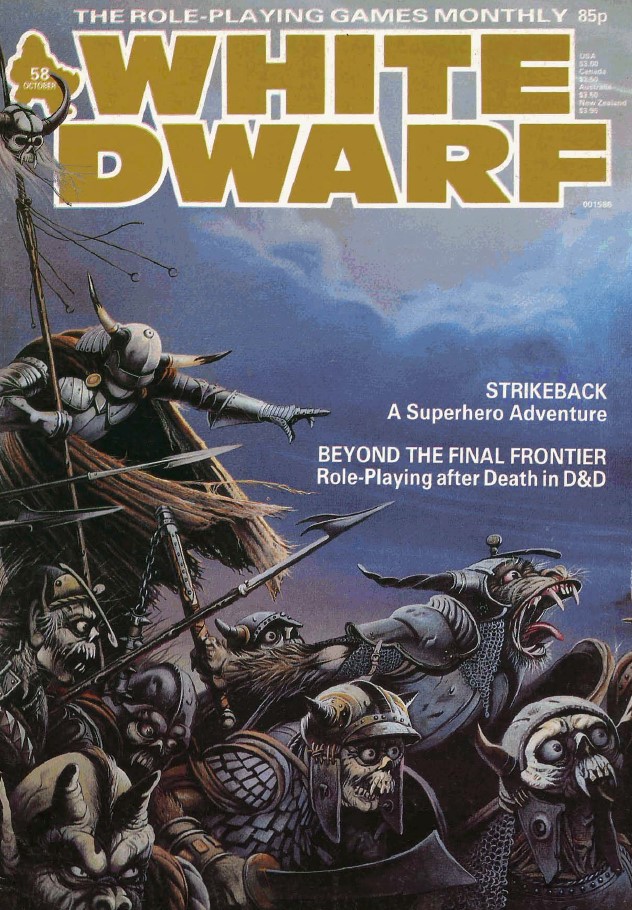
Issue #58 of White Dwarf (October 1984) has a terrific cover by Chris Achilleos, an artist whose work I've long appreciated. Ian Livingstone's editorial bemoans the fact that Chaosium has signed a deal with Avalon Hill to publish the next edition of RuneQuest, which will retail at a much higher price in the UK, owing to import costs. Those import costs will be necessary since Avalon Hill has terminated Games Workshop's license to produce a British edition of the game. Livingstone goes on to speculate that this move will undermine RQ's growth in the UK. Whether he was correct in his prediction, I can't say. All I know for sure is that, for several years in the 1980s, RuneQuest was more popular than Dungeons & Dragons in Britain, which baffled my younger self, who could scarcely conceive the possibility that D&D would ever play second fiddle to another fantasy RPG (or indeed any other game).

The issue proper begins with Stephen Dudley's "It's a Trap!," which looks at designing traps in AD&D and other fantasy games. Though short, it's a thoughtful look at the subject and includes an example to illustrate Dudley's main points. In short, he suggests that while traps need not be "realistic," they should nevertheless function according to an intelligible logic. Likewise, the referee should include a means of disarming them or, lacking that, a means to circumnavigate them, even if doing so presents different challenges. 

"Open Box" begins with a mediocre (5 out of 10) review of FGU's Lands of Adventure, a game I've long wanted to see but never have. If the review is any indication, I'm not missing much. More favorably reviewed is Middle-earth Role Playing. The game scores 9 out of 10 in its book form and 7 out of 10 in its boxed form, based on the fact that the boxed set is more expensive and doesn't offer enough any significant additional value. Bree and the Barrow Downs, on the other hand, only garners 6 out of 10, because it's more a sourcebook than an adventure and thus of much more limited utility. Q Manual for the James Bond 007 RPG receives a much deserved 9 out of 10. It's one of the few RPG equipment books I've ever felt deserving of real praise. Finally, there's Star Trek the Role Playing Game, another favorite of mine. The reviewer gives it 9 out of 10 and I'd be hard pressed to disagree.

Dave Langford's "Critical Mass" keeps chugging along, reviewing plenty of novels I've never heard of, let alone read, along with a few I have. Most notable this issue is his praise for Robert Holdstock's Mythago Wood and his dislike of Jack Chalker's Twilight at the Well of Souls. The third part of "Night's Dark Agents" by Chris Elliott and Richard Edwards is surprisingly good. Whereas the previous two installments were filled with the usual mid-80s gaming material about ninjas, this one focuses on the nitty gritty details of how ninjas operated in the field. The material on their preparations and the tactics employed is both interesting and useful, as is the material intended for referees in running ninja-based games. Not being as enamored of ninjas as many gamers, I was impressed that this article held my attention as much as it did.

"Beyond the Final Frontier" by Graeme Davis is not, as its title might suggest, an article about roleplaying in the Star Trek universe. Rather, it's an examination of the beliefs of various real world historical cultures about death and the afterlife in the context of continuing to play a character in a fantasy RPG after he has died. The article is sadly short, but Davis offers some useful ideas for how to handle this in a campaign. "Grow Your Own Planets" presents a computer program, based on then-current astrophysics, that generates star systems and the details of the planets therein. Given the date of its creation, the program is necessarily limited in its output, but I can imagine it would have been very appealing to referees of science fiction RPGs.

"Strikeback" by Marcus L. Rowland is an adventure for use with Champions or Golden Heroes. The scenario is a fun one involving time travel, the Bavarian Illuminati, Baron Frankenstein, Dracula, Sherlock Holmes, and more. It's a kind of League of Extraordinary Gentlemen romp before the fact and, speaking as someone who made use of the adventure at the time, I highly recommend it. "Chun the Unavoidable" by Oliver Johnson, meanwhile, is an adaptation of certain elements of Jack Vance's The Dying Earth for use as a low-level AD&D scenario. I really liked this in my youth, largely for its write-ups of archveults, deodands, and pelgranes, in additional to the eponymous Chun the Unavoidable. 

"For a Few Credits More" by Thomas Price looks at the subject of money in Traveller. This is a solid treatment and I appreciate the way Price considers the ways that technology, whether high or low, might impact currency. Naturally, as an article written in the pre-Internet age, some details look dated – or perhaps "quaint" is a better word – but then Traveller has always been slightly retro, so this isn't really a knock against it. "Thinking in Colour" by Joe Dever and Gary Chalk presents helpful hints on the matter of shading, highlighting, and mixing paints for miniatures. Once again, I find myself wishing I'd devoted more time and effort to learning how to paint in my youth.

"Cameos" by Peter Whitelaw presents two short scenarios for use with RuneQuest. Both are set in Pavis and are quite short, so the referee will need to flesh them out considerably before making use of them. That said, they're both quite flavorful and do a good job of showing off what makes Glorantha such a compelling fantasy setting. "Bigby's Helping Hand" includes yet more ideas for using AD&D spells in unusual ways, along with ideas for using beggars as NPCs. Also included in this month's issue are further episodes of "Gobbledigook," "Thrud the Barbarian," and "The Travellers," the last of which receives a two-page spread.

This is a very good issue of White Dwarf and one whose content I enjoyed and made use of once upon a time. Re-reading it, I was reminded on several occasions of just how vibrant the magazine was at its height. There's a good variety of material and it's quite well presented. Though I was naturally more well inclined toward Dragon, there's little question in mind that, when White Dwarf was firing on all cylinders, it was the superior magazine. Issue #58 is a good example of that superiority. 

Tuesday, August 16, 2022

White Dwarf: Issue #46

Issue #46 of White Dwarf (October 1983), with its striking cover by Gary Mayes, is one I owned but about which I have few strong memories. I'm not entirely sure why that is, because it's not a bad issue by any means. Were I to guess, I imagine it has more to do with the fact that many of its preceding issues are simply so good that, by comparison, it seems less remarkable. That's actually a fairly common problem during the early '80s when it comes to RPG products more generally: there was a surfeit of good material being published at the time, so much so that it's easy to overlook some of it in retrospect.

Phil Palmer's "Strangers in the Night" kicks off the issue. It's an article devoted to the subject of wandering monsters in AD&D. Palmer's musing on the matter are quite good in my opinion, emphasizing the need to tailor wandering monster tables to the locale to which they're connected, as well as the utility of including random events among their entries. This isn't groundbreaking advice by any means, but it's the kind of thing that gets overlooked, even by experienced referees, so I appreciate his discussion of it.

"Open Box" offers up lengthy reviews of three products, starting with the RuneQuest Companion, which earns an 8 out of 10. Also reviewed is the second edition of FGU's Chivalry & Sorcery. This, too, receives a rating of 8 out of 10, which surprised me somewhat. C&S has a deserved reputation for being quite complex and I assumed that would be held against the game. However, C&S also has a lot of genuinely clever ideas within its pages (e.g. its magic system) and the reviewer felt that those ideas more than outweighed its mechanical unwieldiness. Finally, there's the Mayfair boardgame Sanctuary, based on the Thieves' World series, which received a 7 out of 10. 

Dave Langford's "Critical Mass" column is very hit or miss with me, in part because the books he reviews vary considerably in content. That's completely understandable, of course. However, it does mean, especially when I re-read these columns, that my interest is often commensurate with whether I've read the books in question. Since this issue's column doesn't include a single book I can recall having read, I'll confess to my eyes glazing over a bit. Apologies to all the Langford fans out there! 

Charles Vasey looks at two fantasy boardgames at some length, Dragonhunt and Titan, both from Avalon Hill. Vasey likes both games, though he gives Titan a slight edge in terms of its design. On the other hand, Dragonhunt seems to him to be more truly fantastical in terms of its presentation and overall subject matter. I own a copy of Dragonhunt, but have never played it, so I can't speak to his claims. I've sadly never set eyes upon Titan, a game that interests me, since it was designed by the late, great TSR artist, Dave Trampier. 

Part 3 of Dave Morris's "Dealing with Demons" is the finale of this series describing demons for use with RuneQuest. It's a very good entry for the same reason that Part 2 was: the demons detailed here are wholly original creations without any basis in existing folklore or mythology. I appreciate the creativity that went into imagining these dark beings, not to mention his enumeration of the books and authors that inspired him. "Worldly Power" by Phil Masters presents a handful of new government types for use with the Traveller world generation system, along with a few adventure seeds that make use of them. This is a perfectly fine article. However, as a Traveller snob, I find most of the material unnecessary, since the existing Traveller government codes can handle nearly all of those Masters proposes without the need for creating new codes.

"The Wizard's Library" by Lewis Pulsipher is a genuinely interesting article. In it, he proposes to look for inspiration for RPGs in non-RPG books. Hardly revolution, you might say and you'd be correct if the books he proposes to use were fiction. Instead, he suggests looking to non-fiction books, such as history, archeology, and architecture books, among others. Like so many things Pulsipher writes, none of this is revolutionary but it's clever nonetheless and might serve as a source of unlikely inspiration for harried referees looking to spice up their campaigns.

Part 5 of Daniel Collerton's "Irilian" presents yet another section of the city, complete with a map, along with an adventure set in this area. The focus this time is on guilds, companies, and societies within the city. There's also a full map of a wizard tower that plays an important role in the accompanying scenario. As with previous entries, this is all very well done and its true value lies not so much in any individual installment as in the piling up of details that lead to a fuller picture of Irilian and its inhabitants. As I believe I mentioned before, in my youth, I found Irilian so well done that I dropped it right into my old campaign setting, albeit under a different name. This is an excellent series and proof of why White Dwarf was such a terrific magazine once upon a time.

"Play-by-Mail Games" by A.D. Young is an overview of computer-moderated PBM games, which, apparently, was a new and interesting thing at the time. Though I never participated in any PBM games, despite my interest, I (again) must confess that this article never got my full attention. That's not a comment on its quality, so much as its age. Neither of the games discussed – Empyrean and Heroic Fantasy – ever crossed my radar back in the day and neither sounds sufficiently interesting even as historical curiosities, alas.

We get more Thrud, The Travellers, and Gobbledigook, which makes me happy, especially the first two comics. "Death in Green" is a D&D/AD&D mini-scenario dealing with yet another secluded rural village that has come under attack by unknown forces. In this case, the forces are a variety of plant monsters – six kinds in fact – that are this month's "Fiend Factory" entries. "Swashbuckler!," meanwhile, is a collection of rules suggestions for spicing up combat in RuneQuest with moves worthy of Errol Flynn. Finally, there's "The Hellwalk Spell" by Lewis Pulsipher. Inspired by Roger Zelazny's Amber series, the spell transports its target to a pocket dimension, where they must engage in combat against random foes. As a one-off challenge, this could be fun, I suppose. However, I think it would get tedious if it were used too often in a game.

As you can see, this is a perfectly fine issue, filled with a variety of different articles for many different games. Unfortunately, with the exception of the latest Irilian entry, none of them really grabbed my attention in the way previous issues' articles did.  Though I stand by the theory I advanced at the beginning of this post, another possibility occurs to me. During this period, White Dwarf was rapidly expanding, adding more content with each issue, including several new columns devoted to other aspects of gaming beyond roleplaying. It could be that the addition of these new pages diluted the perceived goodness of the other articles to such an extent that I no longer saw some issues as being as good as they actually were. I'll keep this in mind as I look at future issues.

Tuesday, August 9, 2022

White Dwarf: Issue #45

Issue #45 of White Dwarf (September 1983), featuring a very weird cover by Gary Ward, is an important one in the history of the magazine, at least for me. First, this issue marks the premier of two new comic strips, both of which are very dear to me. Ian Livingstone would seem to agree, since he uses his editorial to announce this fact and urges readers to give the new comics "a chance to settle in." I gather from his comments that not all readers like comics in their gaming magazines, which is understandable, as gaming comics tend to be very hit or miss (mostly the latter, in my experience). Second, this issue also marks the appearance of the very first battle scenario for Warhammer in the pages of White Dwarf. It is an omen for things to come.

The issue kicks off with "Open Box," which reviews Avalon Hill's Wizards. This is a game I regularly saw in game stores but never owned or played. The reviewer, Alan E. Paull, found its presentation somewhat frustration, but liked its gameplay enough to give it 7 out of 10. Meanwhile, Oliver Dickinson gives Pavis 9 out of 10, which is, I think, a little stingy. The older I get, the more I have come to appreciate the output of Chaosium in the late '70s and early '80s, with Pavis and Big Rubble among its masterpieces. Also reviewed are three modules for AD&D and one for D&D: Tomb of the Lizard King (9 out of 10), Pharaoh (10 out of 10), Oasis of the White Palm (10 out of 10), and Blizzard Pass (6 out of 10) respectively. With the exception of Blizzard Pass, I think these ratings are a bit generous, but tastes differ, of course, and I recall thinking much better of the "Desert of Desolation" series at the time than I do now.

Dave Langford's "Critical Mass" spends most of its space on a lengthy review of C.J. Cherryh's Downbelow Station, which was the winner of the previous year's Hugo Award for best novel (for what it's worth). Langford seems genuinely well disposed toward Cherryh as a writer, but doesn't think this is her best effort. He also does quick reviews of three other books, including Italo Calvino's If On a Winter's Night a Traveler, which is an admittedly strange book to review in White Dwarf, though "Critical Mass" frequently devoted itself to books other than those that could easily be called fantasy or science fiction. 

Part 2 of Dave Morris's "Dealing with Demons" focuses on lesser demons, describing them and their abilities for use with RuneQuest. The article's main attraction, in my opinion, is that these demons are (mostly) original rather than drawing on real world myths and legends. It's a clever approach to the topic, I think, though they're a good fit for RQ's Glorantha setting is another matter (assuming that was the intention, since the article is silent on the matter). "Gateway to Adventure" by Bob McWilliams is a "cameo" adventure, which is a coinage of McWilliams for "small scenes or themes that could be fitted into an ongoing campaign." In this case, the cameo is about researching an interplanetary transport device – the titular Gateway – that leads somewhere else. McWilliams doesn't provide any information on what's beyond the gate, leaving that to the referee to decide, which is admittedly a little unsatisfying. On the other hand, the set-up is fairly good and it's an unusual one for Traveller, which is a plus.

"Stop, Thief!!" by Marcus L. Rowland is a short article detailing the contents, along with individual weight and costs, of the items in a typical thieves' kit. I personally don't care for this level of detail, but I can appreciate its utility in certain circumstances. Part 4 of Daniel Collerton's "Irilian" is as good as its predecessors. In addition to the usual mix of local businesses, this installment describes the town's guards, bureaucracy, and ruling council. It's packed with the kind of detail that a referee needs if he intends to use a town as regular locale for his campaign. There's also an adventure set in the town relating to religious corruption and false relics – good stuff!

As I mentioned earlier, this issue marks the debuts of two new comic strips. The first is Thrud the Barbarian by Carl Critchlow. Thrud is a delightful parody of Conan and his mighty-thewed knock-offs. Most of Thrud's adventures involve random mayhem and destruction as a result of his penchant for attacking first and then thinking later, if at all. I'm especially fond of his encounter with an Elric clone, but most of his stories are great. Also premiering in this issue is Mark Harrison's The Travellers, which is a similarly broad parody of science fiction, filtered through the lens of GDW's Traveller. If anything, it's even more delightful than Thrud and I simply adored it back in the day (and still do).

"Divinations" by Oliver Dickinson is largely a collection of errata and clarifications to RuneQuest and RQ products. As such, it's only of interest to diehard fans. "Thistlewood" is a Warhammer Fantasy Battles scenario intended for two, four, or six players, plus an umpire. The scenario is a fairly typical "defend a sleepy little village against invaders" kind of thing, but it's filled with lots of charming details and information from the early days of Warhammer, before it became the behemoth of later years, so I find it strangely compelling nonetheless. Of particular note is the fact that the scenario is written by Joe Dever, best known for his work on the Lone Wolf series of gamebooks.

"Fiend Factory" offers up four new elemental monsters for use with D&D and AD&D. The somewhat misnamed "Elemental Items" by Daniel Hooke is actually a collection of eight new magic items that pertain to the para-elemental planes. Finally, "Super Mole" is a gossip column about the RPG industry, written by an anonymous author, after the fashion of Gigi D'Arne of Different Worlds but without the bitchiness. Most of the gossip is ephemeral stuff that has little lasting value, but I did find the section relating to Chaosium and its licensing of RuneQuest to Avalon Hill fascinating. According to Super Mole, Greg Stafford stated that the Chaosium crew simply wanted to design games and had no interest in "printing, selling, credit control," and the more tedious, business-related aspects of producing RPG materials. This is something I've long suspected to be the case (and indeed may have read somewhere else), but it's fascinating to see it stated here so baldly.

Issue #45 is another solid one. White Dwarf has really hit its stride in my opinion, though I am undoubtedly biased, since I'm now well into the run of issues with which I am most familiar. We're not quite yet at the point when I was a regular subscriber, though that will come soon and I'm rather excited to revisit those particular issues. In the meantime, though, I continue to enjoy these revisits to one of the truly great magazine's of our hobby.

Wednesday, January 12, 2022

Retrospective: Outdoor Survival

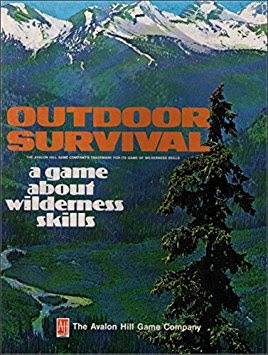
I don't think I'd ever heard of Outdoor Survival prior to 2007. That's the year when I first started looking seriously into the history of Dungeons & Dragons, with a special focus on the original 1974 version of the game. What I soon discovered is that this rather odd 1972 Avalon Hill game played a role, albeit a minor one, in the development of D&D. Nowadays, I think this fact is pretty well known, even among those who don't play old school RPGs, but, at the time, it was news to me. This is in spite of the fact that Volume 1 of the Little Brown Books includes Outdoor Survival on page 5, as the second entry in its list of "recommended equipment," right after D&D itself.

The actual use of Outdoor Survival in D&D isn't explained until fairly late in OD&D, about halfway through the third and final volume. There, in a section entitled "The Wilderness," it's suggested that the referee use the game's board for "off-hand adventures in the wilderness," which is to say, adventures whose wilderness locales are not determined by the referee beforehand. Because of this, it was once quite fashionable in the OSR to base one's starting campaign map on the one in Outdoor Survival, a fad I myself could not resist

None of this says anything about Outdoor Survival itself, though. As I said in my opening paragraph above, it's designed by James F. Dunnigan, a legend in the wargames world. His first design, Jutland, was published by Avalon Hill in 1967, followed by many others, including PanzerBlitz in 1970 (also from AH). Dunnigan was also the founder of SPI and, believe it or not, the designer of the Dallas RPG. It's worth noting here that the game indicates that it was "produced and jointly distributed by the Avalon Hill Game Company … and Stackpole Books." Unlike Avalon Hill, Stackpole Books still exists and is a publisher of nonfiction books about arts and crafts, travel, and the outdoors. (As I understand it, Dunnigan claims, in his The Complete Wargames Handbook, to have designed Outdoor Survival as part of a bet about his ability to design a game on any subject.)

In addition to the game rules and the components needed to play, Outdoor Survival included a 24-page booklet entitled "A Primer about Wilderness Skills for Players of the Game." This is an honest-to-goodness handbook on the basics of surviving in the wild, covering everything from direction finding to killing and tracking game to first aid and more. Flipping through it reminded me of Boy Scout Handbook I had in elementary school. Its back page is an advertisement for larger treatments of all these topics in books sold by, you guessed it, Stackpole Books.  

The game proper is comparatively simple. As its title suggests, it's intended as "a simulation of the essential conditions for staying alive when unprotected man is beset by his environment." The celebrated game board represents a wild area consisting of 13,200 square miles, with a wide variety of terrain types (woods, rough, desert, swamp, etc.). This area is divided into hexagons five kilometers (three miles) across. This makes me wonder if OD&D's use of five-mile hexes is the result of a misreading of the rules to Outdoor Survival or a deliberate choice on the part of Arneson and/or Gygax. I doubt I'm the first person to have noticed this seeming discrepancy.

Play depends on which of five scenarios one chooses. They consist of "Lost," "Survival," "Search," "Rescue," and "Pursue," each with slightly different rules and victory conditions. In general, though, each scenario involves the player or players – solo play is possible – attempting to navigate the board's variable terrain in order to find food, water, and shelter, while avoiding various natural hazards. Each player keeps track of his counter's "life level," which measures food and water consumption. The less of each recently consumed, the slower the counter can move. Play is actually quite simple at its base, though there are a number of optional rules that add further "realism" and complexity, should one desire such a thing.  

Though I own a copy of Outdoor Survival for "research purposes," I've never actually played it. From what I have gathered online, opinion about its virtues is quite divided, with some viewing it as a straightforward, easy-to-learn introduction to simulation games and others seeing it as dull and tedious. Whatever the truth of the matter, it has a place in the early history of Dungeons & Dragons for the role it played in the conception of wilderness travel. That's not insignificant. If nothing else, it's a reminder that inspiration can come from the unlikeliest of places.

Wednesday, November 17, 2021

Retrospective: Telengard

I didn't own a computer until I was well into the start of my third decade of life. Nevertheless, from my elementary school days on, I had ready access to them, thanks to friends and classmates whose families were more technophilic than my own. For example, my best friend in the latter years of grade school (and who shared my love of D&D) owned a TRS-80 on which I spent endless hours playing a primitive Star Trek game. Similarly, a high school buddy of mine had an Apple IIc, making it possible for me to play Wizardry. So, while I didn't have a computer of my own, I was quite familiar with many of the primitive models available in my youth and used them when I was able.

Of all these, the one I remember most is the Atari 400 8-bit computer. A neighborhood friend, whose older brother was a gaming mentor, owned one – or, rather, his father did – and our little circle of boys used to gather round it in his living room to goggle at this marvel of modern technology. We also played games, as we were able, most of them quite forgettable. Of course, we didn't care at the time. The mere existence of a computer game was usually enough to hold our attention, resulting in a lot of wasted time.

Looking back on those days, one game continues to stand out in my memory as being better than the rest: Telengard, released by Avalon Hill in 1982. Telengard was what would nowadays be called a "dungeon crawler" in that the focus of play was navigating one's randomly generated character through an immense, 50-level dungeon filled with all manner of monsters, traps, and treasures. Like most computer games of that era, it was exceedingly limited, both in terms of options and presentation, but that didn't matter. To a thirteen year-old in the early '80s, Telengard was unbelievably cool – and about as close as you could get to digitizing the experience of playing Dungeons & Dragons.

That's because Telengard pretty much was D&D. I'm honestly surprised that TSR didn't sue or at least legally threaten Avalon Hill over the game. Characters in the game had the exact same ability scores as in D&D and the purpose of the game was to amass experience points through defeating monsters and finding treasure, thereby achieving higher levels of power, just like D&D. The selection of monsters (36 in all) included a number obviously derived from D&D, such as the gnoll and experience point-draining wraiths and spectres. Spells and magic items were likewise derivative of Gygax and Arneson's creation, with elven cloaks and boots, magic missile, and cure light wounds available, among others. As I said, I'm startled that TSR let this slide.

The primary difference between Telengard and D&D is that the computer game had no character classes. Instead, every character was equally adept at casting spells and engaging in combat. Spellcasting was handled through the use of a spell point (or "spell unit") system, but was otherwise reminiscent of the way D&D handled magic. Interestingly, turn undead was a spell; indeed, the spell list is a mixture of those available to clerics and magic-users in D&D. This gave your character a bit more versatility than in D&D, but that's understandable as Telengard provided neither an option for multiplayer nor for the acquisition of henchmen. Instead, your character was left to his own devices in facing off against the dangers of the dungeon.

To call Telengard unforgiving is an understatement. Not only were the contents of dungeon rooms random (though, like D&D, scaled to level), the entire game was played in real time. In fact, the game manual, as I recall, takes great pains to point this out to the player. There are no safe areas except outside the dungeon itself. Further, you cannot save your progress within the dungeon. The combination of these factors meant that caution was advisable, just as in D&D. Of course, the computer was even more merciless than a living referee; no amount of whining or wheedling could convince it to keep your character alive after a foolhardy decision or a bad throw of the virtual dice.

And yet, we loved it. Some of that love was no doubt a function of neopohilia. The very idea of playing a fantasy game on a computer was simply so captivating in itself that we didn't care how hard it was to survive. At the same time, I also think that its difficulty appealed to our competitive instincts and desire for genuine challenge. Being able to escape the dungeon with enough gold to gain a new level felt like a genuine accomplishment, especially when we knew just how easy it was to turn the wrong corner and run into a dragon or a vampire, not to mention a teleporter trap that sent us to some unknown lower level. The very unfairness of Telengard was part of its attraction, I think – but then the minds of teenage boys are strange things.

I don't know that I'd enjoy Telengard or a game like it anymore. At the time, though, it was genuinely engrossing and I can still remember how much fun we all had facing off against the program. There are days when I wish I could have these kinds of experiences again.

Tuesday, July 20, 2021

White Dwarf: Issue #1

I've talked about my experiences with White Dwarf before. It's a RPG magazine that I only read intermittently back in the day and so my memories of it are not as vivid as those of Dragon. Likewise, when I did read it more regularly, it wasn't until late 1982, long after White Dwarf was well established and had settled into a comfortable run. Consequently, I have no direct knowledge of the magazine's early days, which I imagine were pretty wild and woolly. That's why, after the cessation of my examination of Different Worlds, I knew that my next series would be dedicated to White Dwarf.

Issue #1 is listed as June/July 1977, which is one year after the first issue of TSR's Dragon appeared. I think that's significant, because it's a useful reminder of just how early it appeared in the history of the hobby. Remember, too, that the AD&D Dungeon Masters Guide explicitly references White Dwarf in a section entitled "Aids to Playing Advanced Dungeons & Dragons," mentioned by side by side with Dragon. The only other third party publications mentioned in that section are those by Judges Guild. This is telling and should be borne in mind as this series goes forward.

The very first article to appear is entitled "Metamorphosis Alpha," written by Ian Livingstone, the magazine's editor and co-founder of Games Workshop. For the most part, the article is simply an overview of the TSR RPG of the same name. However, the article is more than that, offering new rules for gravitation, as well as discussions of stories like Robert Heinlein's Orphans of the Sky and Non-Stop by Brian Aldiss that influenced the game's creation. More interestingly, Livingstone offers some criticisms and suggestions for improvement.

Back to the rules themselves and criticisms. There are not many but just enough to irritate. The initial task of designing the starship and its contents is lengthy – unless your players want to play for the next four years solid, I suggest a smaller starship (same number of decks). 
Don Turnbull's "Monstermark System" presents a complex mathematical system for assessing the relative challenge of a D&D monsters relative to others (and to the level of player characters). Honestly, I have little basis for evaluating the the utility of the system, since I've never used it. Truth be told, I've never seen much use for this kind of evaluation, but I readily concede that I'm probably unusual in not caring about such matters. I know that the Monstermark System has a solid reputation among fans of D&D, so I have little doubt that Turnbull had come up something worthy of consideration.

"Open Box" is a collection of reviews, focusing on two wargames: SPI's Sorcerer and Avalon Hill's Starship Troopers. Meanwhile, "Competitive D&D" by Fred Hemmings tells the tale of one referee's desire to "score" a dungeon expedition, as two competing parties attempt to make their way through it. I've long been curious about this sort of set-up, so I read the article with some interest. "D&D Campaigns" by Lewis Pulsipher is the first part of a series dedicated to exploring how to establish a D&D campaign and adapt the game's rules to particular styles of play. The article is fine as far as it goes, very similar to other articles Pulsipher was publishing in other magazine's at the time. 

"The Warlord" by Steve Jackson – co-founder of Games Workshop, not (confusingly) Steve Jackson Games – is a discussion of the self-published boardgame The Warlord by Mike Hayes. I'd never heard of the game before, which is apparently quite similar to Risk but with nuclear missiles. "What's Wrong with D&D" by Andrew D. Holt offers complaints and suggestions for "fixing" the game's combat and magic systems. Ho-hum. Alan Youde's "Poison" adopts the poison rules in Metamorphosis Alpha for use with D&D. Shrug. There's also a new magic item (helm of vision) by Steven Littlechild.

All in all, the first issue of White Dwarf feels very amateurish – as it should. It's an uneven mix of material, none of which is bad, but very little of which stands out as noteworthy, with the possible exception of "Monstermark System." Nevertheless, it shows clear promise and I know from personal experience that it does improve with time. Much like Different Worlds (or Dragon, for that matter), it takes a while before a roleplaying magazine finds its footing and I have little doubt the same will be true of White Dwarf.