Showing posts sorted by relevance for query conan tsr. Sort by date Show all posts

Wednesday, November 11, 2020

Retrospective: Conan Unchained!

Robert E. Howard's Conan the Cimmerian and Dungeons & Dragons have been connected since the beginning. Volume III of 1974's OD&D makes explicit reference to him in the section describing the "Angry Villager Rule," for example, while 1976's Gods, Demigods & Heroes includes one interpretation of his game statistics. Gary Gygax offered up a different interpretation of the character in issue #36 of Dragon (April 1980). And, of course, the barbarian character class, which Gygax first presented in issue #63 (July 1982) seems to been greatly inspired by Conan, right down to his distrust of magic. 

Consequently, it probably came as little surprise when the AD&D module Conan Unchained! appeared in 1984. If anything, one might have reasonably wondered why it took so long for something like to have occurred. I suspect that it was the increased pop cultural presence of Conan following first the 1982 John Milius movie and then its 1984 sequel that led to this formal marriage of Howard and TSR, as the still of Arnold Schwarzenegger on the cover makes clear.  

Written by David Cook, Conan Unchained! is a fascinating module – and, by "fascinating," I mean that it in its fullest sense. To begin with, simply seeing an official Conan module for AD&D is enough to hold my attention. Conan is given game stats that are very impressive. He's a 13th level fighter and 7th level thief, in addition to having ability scores ranging from 10 (for Wisdom) to 18 (90) (for Strength, obviously) and 100 hit points. Statted up alongside Conan are Valeria of the Red Brotherhood, Juma the Warrior (possibly based on a comics character of the same name), and Nestor the Gunderman (from REH's unfinished story "The Hall of the Dead," who also appears in the Conan the Barbarian comic from Marvel). Naturally, one might ask: why are these character included at all? As written, they're intended to be used as player characters, though Cook does allow for the possibility that players might wish to use their own characters, provided they're adapted to the rules changes intended to reflect the Hyborian Age.

Chief among those rules changes are the addition of "luck points," which can be used in a variety of ways, from making an extra attack per round to knocking an opponent unconscious with a single blow (armed or unarmed) to performing "a heroic action beyond the scope of the rules." My natural inclination is to look askance at such things, but I suspect that, in play, these luck points work reasonably well, emulating the action of the Conan movies, if not necessarily Howard's original tales. Also introduced are fear checks to simulate the "instinctive fear of the unnatural" felt by characters like Conan. Failing a fear check results in the inability to attack for a round, with new checks being allowed every round. Again, it's not a terrible idea, though I do wonder why a saving throw, such as paralyzation could not have been re-purposed for this. Other rules changes include an accelerated healing rate, since healing magic is rare or non-existent in the world of Conan.

Equally fascinating is this section, which I reproduce here:

The most relevant portion of the above is "the choices the characters have will be very limited. You must be careful to gently control plot encounters." As you know, I'm no fan of heavily plotted adventure modules, but I am willing to make some allowances in limited circumstances. This, however, goes far beyond anything I can countenance and is very much in keeping with the style championed by Dragonlance. It's too bad, because I'm a huge fan of David Cook's work at TSR. 

The adventure itself isn't especially notable, consisting of a mix of exploratory encounters, random encounters, and the aforementioned plot encounters. The action pushes the characters along from Turan, where a war is brewing, to the Sea of Vilayet, to the mysterious citadel of an evil sorcerer. It's a bit of a mess, even viewed through the forgiving lens of pastiche and I found it hard to care much after a while. The only real interest to me was that the action takes place roughly in the same location as "The Devil in Iron," which I discussed earlier this week. 

At the end of the day, Conan Unchained! is yet another oddity from the period between 1982 and 1984, when TSR was casting about mightily in an effort to harness the burgeoning mass market popularity of D&D so as to secure its long-term profitability. The results were decidedly mixed and quite possibly laid the groundwork for TSR's decline and eventual demise. That future is more than a decade in the future at this point, but, even so, I can't help but feel that chasing licenses like Conan was energy better spent on other creative avenues that might have yielded more fruit.

Wednesday, June 6, 2012

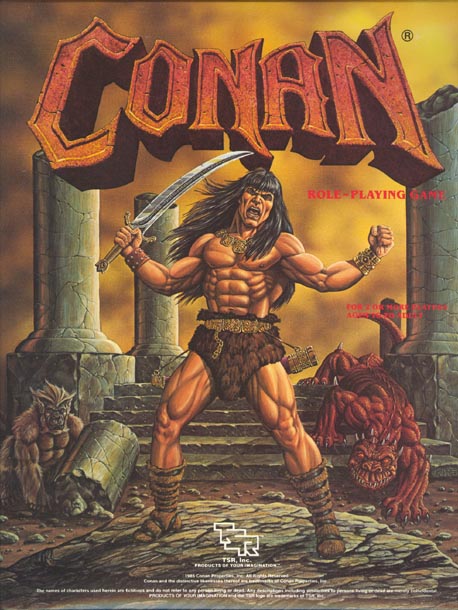
Retrospective: Conan Role-Playing Game

In my opinion, one of the things TSR did right during its existence was produce a wide variety of roleplaying games rather than endlessly churning out material for Dungeons & Dragons. There are several reasons why I think this is so, the most important of which is that these new games provided an outlet for players and game designers alike to try new things without feeling the need to inflict their desire for novelty on D&D. By this I meant that a great many of the slings and arrows D&D suffered over the years have been the result of people getting bored of its ways of doing things and then trying to change it to suit different tastes. Far better in my opinion is to play or to create new games specifically that speak to those tastes.

In my early years in the hobby, my friends and I regularly stopped playing Dungeons & Dragons when we felt the call of a different genre or even style. TSR happily provided us with plenty of other games from which to choose -- Gamma World, Gangbusters, Star Frontiers, Top Secret -- as did other game companies. We rarely stayed away from D&D for long, but I think our regular "sabbaticals" from it helped keep us interested in it over the long term. I still think that way today, which is why I see it as a good thing for a group to play many different RPGs (so long as it doesn't give way to the dreaded "gamer ADD").

I bring this up because one of the last non-D&D TSR roleplaying games I remember buying was 1985's Conan Role-Playing Game. Designed by David "Zeb" Cook, it's a complete game in a single box, consisting of a 32-page rulebook, a 16-page reference guide, and a 48-page guide to the Hyborian Age. I remain amazed at how often TSR produced RPGs whose rulebooks were 64 pages or under; it's frankly a thing of beauty -- all the moreso because, in most cases, these games didn't need to be any longer. Conan was a fairly "light" game, using a series of six "talent pools" to adjudicate every action a character takes in the game. The pools are broad in nature (Prowess, Fighting, Endurance, Knowledge, Perception, and Insight), under which are more specific talents that represent areas of unusual skill, like Brawling for Fighting or Reading/Writing for Knowledge. Talent checks are resolved using percentile dice and compared to a color-coded result chart, as was the style at the time. In cases where a character is attempting to do something an NPC is opposing (combat, for instance), two talents are compared, with the opposing talent subtracted from the active one to determine what line on the chart to read. Though the rulebook didn't do a particularly good job of explaining all this, in practice, the system was quite easy to use.

For my friends and I, though, what made Conan such a fascinating game, aside from its source material, was its character creation system, which encouraged players to think about who their character was and how he fit into the Hyborian Age. The "character folio" (i.e. record sheet) included a section entitled "story" with a series of blanks for the player to fill in, like Mad Libs. So, it would say "(Character Name), (Sex) of (Father) and (Mother), was born in the land of (Homeland). (Character Name) grew (Appearance). As a youth, (Character Name) learned (Talents)." And so on. The idea is to frame one's character abilities into something that is coherent, interesting, and fitting for an adventurer in a Robert E. Howard yarn. It's a simple thing really, but I can't stress how revelatory this approach was to my friends and I. We found it so much easier to get into the spirit of things this way.

Of course, it probably helped that Conan Role-Playing Game was clearly a labor of love on the part of David Cook. His fondness for the stories of Conan is well known and this game is like a love letter to the tales of the Cimmerian. For example, the game's magic system is mechanically loose and difficult for characters to master, with many opportunities for both disaster and long-term consequences. This is, of course, as it should be, for magic in the Hyborian Age is usually a dark affair not to be trifled with. This didn't stop one of my friends from creating a sorcerer character, named Talon after the twisted bird-like claw he had on one hand -- a reminder of his playing with things Man Was Not Meant to Know. Just as well presented is the game's setting, which is presented in the form of a faux notebook written by an archeologist named Ervin H. Roberts who was convinced that there was "an age undreamed of" in prehistory. It's a little silly, of course, but in a good way that I think encourages fun rather than hinders it.

I vaguely recall that TSR produced a handful of modules of to support Conan Role-Playing Game (in addition to those produced for AD&D), but I may be misremembering. Regardless, I don't believe the game did very well for the company, or at least it didn't do well enough, because it wasn't on store shelves for long. I think that's a shame, because Conan was well-presented, straightforward, and fun. It could never replace Dungeons & Dragons in the eyes of my friends and I, but that's hardly the benchmark by which a game ought to be judged. Unfortunately, I think that's exactly the benchmark TSR used, which is why most of their non-D&D RPGs had extremely short lives. A pity.

Wednesday, November 18, 2020

Retrospective: The Adventures of Indiana Jones Role-Playing Game

The history of TSR between 1982 and 1984 is a strange and fascinating one. It's simultaneously when Dungeons & Dragons is at the height of its popularity (and profitability) and when TSR seems to have had no idea how to build on that success. Instead, TSR adopted multiple strategies, such as attempting to turn D&D into a brand name with which to sell non-gaming products to re-imagining the game into something more story-driven and, it was assumed, more accessible to potential customers unfamiliar with either pulp fantasy or its wargames roots. Another strategy was one that's still employed to this day, even by the current producers of D&D: license a hot property – or a not-so-hot one – and hope it'll result in expanded sales.

TSR's history with licensed properties is decidedly mixed. For example, Jeff Grubb's Marvel Superheroes is rightly considered an unqualified success, both as a near-perfect RPG design and as an example of the potential value of the right licensed property. On the other hand, the 2001: A Space Odyssey module for Star Frontiers is a classic example of "what were they thinking?" licensing, only slightly more intelligible than Dungeons & Dragons-branded sunglasses. TSR's AD&D Conan modules and Conan Role-Playing Game are, I think, an example of a middle case, namely a good idea poorly – or at least insufficiently well – executed. Throughout the early to mid-80s, TSR was clearly throwing lots of spaghetti against the wall to see what stuck; the results were, more often than not, a mess.

An infamous case in point is 1984's The Adventures of Indiana Jones Role-Playing Game. Designed by David Cook, the game was, like so many others at the time, a boxed set consisting of a 64-page rulebook, a map of the 1930s world, a referee's screen, a collection of player handouts, and cardboard cut-outs to represent characters, buildings, and vehicles, plus dice. Taken purely on these terms, The Adventures of Indiana Jones is a nice package and I can imagine that it would have seemed quite attractive purely on this basis. Of course, the main reason anyone bought the game – myself included – is because the pulp-inspired action-adventure world of Indiana Jones was very appealing. I have little doubt that every gamer who saw Raiders of the Lost Ark in the summer of 1981 (or even The Temple of Doom three years later) thought, "This would make a great roleplaying campaign."

So, unlike, say, 2001: A Space Odyssey, which still baffles me to this day, I don't wonder why TSR grabbed this license as soon as it was feasible for them to do so. The world of Indiana Jones is definitely the stuff from which a game RPG could be made. Alas, The Adventures of Indiana Jones was not that RPG – and it's not because of its game mechanics. Mechanically, the game was fine, if nothing special. Like many games at the time, Indiana Jones uses another variation on the color-coded results chart that Marvel Super Heroes employed to such great success. There are even small moments of brilliance in its particular take on the chart, with exceptionally good and bad results being called Lucky and Bad Breaks respectively and each having unique effects, depending on the attribute being checked. 

The game's real problem, the one that utterly cripples it is its lack of character creation rules. Instead, there are a total of seven pre-generated characters from which players can choose: Indiana Jones, Marion Ravenwood, Sallah, Willie Scott, Short Round, Jock Lindsey (the pilot from the beginning of Raiders), and Wu Han (Indy's ally at the start of Temple of Doom, who dies). Now, I can understand including these characters as examples and even encouraging people to use them, but not including any rules for creating your own characters? That's a bizarre design choice, especially since the movies themselves imply that the world of Indiana Jones is much bigger than him and his immediate circle, filled with lots of other heroic and dastardly people trekking across the world in pursuit of valuable ancient artifacts. (There are also no experience rules; characters earn "player points" that enable them to reduce the severity of damage – that's it)

It's such a pity, because, as I've said several times now, there's a great deal of potential in the pulpy 1930s the movies presented. Further, the game itself is a decent introductory RPG that provides not only lots of fun little components but also a few interesting little sub-systems like the Chase Flow Chart intended to aid the referee in conjuring up the action of the movies. There's nothing revolutionary here, to be sure, and no one should think otherwise. This is not a forgotten gem of a roleplaying game, unfairly maligned despite its virtues. Rather, The Adventures of Indiana Jones is a textbook example of a missed opportunity – a nigh-perfect setting/world that could have, with a bit more imagination, have been a fun and successful RPG. Alas.

(And before anyone brings it up in the comments, no, TSR did not try to trademark the word "Nazi." TSR and this game can legitimately be criticized for many things; this is not one of them and I wish this particular urban legend would go away for good.)

Friday, July 3, 2009

Interview: David "Zeb" Cook (Part I)

Another of the new designers to join the ranks of TSR in the late 70s and early 80s was David Cook. He would eventually remain at the company for over fifteen years, during which time he would be involved in numerous significant RPG projects, including the Expert Rulebook, Star Frontiers, the licensed Conan RPG, the Planescape campaign setting, and, of course, the second edition of Advanced Dungeons & Dragons. An avid player of games of all sorts, including the wargames that gave birth to the hobby, Mr Cook has since left the roleplaying field, moving on, like many others, to the computer games industry. He generously agreed to answer my many questions of him. The first part of this interview appears here, with the second part to follow tomorrow.

As always, I ask that your comments be pertinent and presented respectfully.

1. Like a lot of people in the early days of the hobby, you discovered roleplaying through wargames. What do you remember about your first encounters with Dungeons & Dragons at the University of Iowa?

I had been part a wargames club -- everything from Diplomacy to a massive go at War in Europe. It met at the union on weekends and was a good way to spend an afternoon. I found it as a freshman and it was a kind of vindication of these games that I'd played (mostly by myself). So here I was happily doing the boardgame thing when one of the members (Wolfgang, I think) had this game they were playing in a side room. After a couple of sessions I had a chance to join. It was white box D&D, and I played a dwarf, not really understanding what it was about. It was like a miniatures game but you only had one guy and had to act out what you did. Nobody could explain it well and none of us really knew what we were doing. But after that session I was pretty much hooked. It was this great combination of games and theater (I was a theater minor) that just seemed perfect.

Our campaigns were basic, but we had some creative people -- aspiring writers, theater types, pre-law, the whole gamut. The university club was an active group -- they published a fanzine (with some good ideas), created interesting worlds, and had a generally good time.

There were a lot of memorable moments -- like the time one of the group created a fighter with 17 strength and 3 dexterity (yay, random rolls!). He wore pop-bottle thick glasses and decided the character had vision as good as he did without the glasses. It made for great role playing and much accidental death.

2. What made you give up your previous career as a high school teacher and try your hand at game design? Did you find the transition between the two careers difficult or did your experience as an educator assist you in your design work?

Do you know how much high school teachers got paid in Nebraska at the time? Not much (although I still took a pay cut when I first started at TSR). I like teaching but I don't think I was cut out for it full time -- especially in a town of 300 people. I saw this ad in Dragon magazine that TSR was looking for designers and my wife, bless her, encouraged me to apply. (She's as much a gamer as me.) It was a big leap - we were expecting a child at the time. I knew I could do the job (at least I thought I could) but I was pretty surprised when they hired me.

I think the fact that I loved history and had a strong English background helped. Gary was an old school gamer -- miniatures, wargames, the lot -- and the fact that I knew and played a lot of those things myself helped. But ultimately it was the fact that I could write passably (I won't say well, looking back on it) and knew games that made the difference. I'm not sure that being a teacher made me a better designer, but it did help later on at places like conventions where I felt more comfortable in front of crowds. I suppose being a teacher also helped in improvising -- you had to be ready to adapt what you were doing in class if it was bombing. You need a lot of that as a designer.

3. Your name is associated with the second part of the much-beloved 1981 edition of D&D, the Expert Rulebook. What were your goals for this project? That is, what did TSR hope to accomplish with the publication of the Expert Rulebook?

Well, the problem up to that point had been that D&D was hard to learn if you didn't have someone to teach you. So several Basic sets came out with that goal. Then we decided we needed try again and grow beyond just the basics. So the red book focused on the basic of dungeons, while the Expert Set was about expanding the player's world to do wilderness adventures. It was a pretty natural progression. Obviously the other goal was to expand the audience so we could sell more product. Originally there was the thought that we could create a set that would transition players from the red and blue box and into AD&D. However, legal issues prevented that, so it became a separate game line. It was still supposed to be easier to learn and use than AD&D more suitable for a younger audience.

4. Do you feel you were successful in making the Expert Rulebook easier to learn and use than AD&D? Were there any particular features of its presentation that you felt made the game more accessible and suitable for a younger audience?

Yes, easier to learn than AD&D, though we still couldn't break the mass market barrier. Probably the biggest features that made it easier were the attention paid to organization (by the editor more than me) and the streamlining of things. That meant the Expert set didn't try to cover everything which did mean forgoing some sub-systems that added density to AD&D.

5. While at TSR, you also worked on many classic D&D modules, two of which, The Isle of Dread and Dwellers of the Forbidden City, are among my personal favorites. Both show a clear pulp fantasy influence, the former reminding me of many "lost world" tales and the latter having a vaguely Howardian "Red Nails" vibe. Are you a fan of pulp fantasy and, if so, who are your favorite authors and stories?

Well, I'm not surprised by the "Red Nails" reference since that was what I was clearly going for. It's my favorite Conan story and the city was based off of it. It was originally something I did for my own campaign and then used it as my resume when I applied to TSR.

I love pulp stories and grew up reading a lot of the classic pulp stuff. As a kid I read Conan, Solomon Kane, most al the Tarzan novels, Doc Savage, the Shadow, Vance, Lovecraft, etc. The Fafhrd and Gray Mouser stories by Leiber were among my favorites -- he created this really interesting world and characters that made great stories. Laumer, deCamp, Farmer, Zelazny, Lin Carter, Bloch were a few more. Of course Tolkien, but also a lot of the golden and silver age writers shaped my imagination in junior high and high school.

Monday, November 9, 2020

Claw the Unconquered

Back in the mid-80s, my friends and I were very briefly – but intensely – enamored of TSR's Conan Role-Playing Game by David Cook. At the time, I don't think any of us were all that familiar with Conan outside of Marvel's comics or the Schwarzenegger movies, the second of which had come out the summer before the RPG was published. (I had read some of the Lancer Conan books by this point, but they didn't make a huge impact on me)  As I recall, the game had a fun and easy to use character generation system that produced appropriately pulpy characters. One of my friends generated a character who had a physical deformity – a claw on one hand – that was the result of a curse or black magic or something similar. He called the character Talon, which, at the time, I thought was pretty clever, and had many adventures during the Hyborian Age.

Many years later, I learned of the existence of Claw the Unconquered, DC comic that ran for only a dozen issues, beginning in June 1975. Like my friend's character, Talon, Claw is afflicted with a curse – an ancestral demonic pact, we eventually learn – that results in members of his family having a bestial claw in place of his right hand. I don't know if my friend ever read Claw and based his character on it or it's a case of independent invention.

Claw's real name is Valcan, an outlander who has come to the realm of Pytharia, seeking fame and fortune.

Let say right now that the art in Claw is excellent, nearly the Platonic form of what I associate with the comics of my youth. That's not surprising, since it's the work of the late, great Ernie Chan (credited as Ernie Chua, at the time), who worked on many comics during the time, including Conan the Barbarian for Marvel. The writer was David Michelinie, best known for his time at Marvel Comics, a few years later.

Claw's titular appendage is something Valcan hides with a red gauntlet, largely because of the reaction it elicits in others, as we learn early in the first story.
The ruler of Pytharia is named Occulas of the Yellow Eye, who dwells within Castle Darkmorn. As a young prince, Occulas learned of an omen that "the hand of justice," which is "webbed like a dragon's paw," would one day threaten his rule. Concerned for his future, Occulas scoured the world looking for anyone who bore such a mark. Eventually, his agents succeeded, finding the farmer Kregar, who possesses a hand like that foretold by the omen. They first accuse him of treason and then slay him, along with his wife, leaving their infant son an orphan. I trust no one will be surprised to learn that that infant grew up to be Valcan, who was apparently raised by some mysterious individual, who found him shortly afterwards. 
Naturally, when a now-older Occulas hears of a demonic-handed outlander wandering about the streets of his capital city, he takes a keen interest in him and places a bounty of 10,000 dreknars on his head and right hand. 

Truthfully, it's a solid set-up for a sword-and-sorcery comic. Since the title only ran for twelve issues, I assume it nevertheless failed to catch the reader public's imagination. As is so often the case with unsuccessful characters like this, Claw has made cameo appearances in other comics over the years, including in the pages of The Warlord. I wonder if part of the reason for the comic's demise was its perceived similarity to the incredibly popular Conan the Barbarian and The Savage Sword of Conan over at Marvel. If so, I can understand that, given the visuals, but it's a shame nonetheless, since, even in the very first issue, it's clear that Michelinie intended to take the series in a very different direction than did Roy Thomas with his own magazines. At the same time, the 1970s is a graveyard for failed fantasy comics and the fact that Claw the Unconquered is among the dead says little about the quality of its core concept.

Wednesday, July 21, 2010

Interview: Paul Jaquays (Part I)

To long-time roleplayers, Paul Jaquays needs no introduction. One of the earliest and most prolific freelancers of the hobby, Mr Jaquays has written, edited, and illustrated many of its most well regarded products, including landmark adventures such as Caverns of Thracia, Griffin Mountain, and "Night of the Walking Wet." He kindly consented to an interview, the first part of which is presented below and covers his entry into the world of gaming, both as a player and as a writer/editor/illustrator. Part II, which will appear tomorrow includes additional insights into his RPG career, as well as his his professional activities in the years since.

1. How did you become involved in the roleplaying game hobby?

I found RPGs by way of my younger brother's subscription to The General magazine. In the fall of 1975, I was working an evening shift at my college's radio station. The station played a lot of pre-recorded content, so I had nothing much to do between program changes. So when my younger brother Bruce called and told me about a sample magazine copy he had received called The Space Gamer (issue #2) I had time to listen. He proceeded to read me two reviews of a new game called Dungeons & Dragons. In looking back at one's life, one can usually find significant events that change the direction your life will take thereafter. This was one of those moments.

Hearing the game described, I knew I had come across something that I had been looking for since childhood ... a way to play out adventure fantasies like those in Conan, The Lord of the Rings and the Fafhrd and Gray Mouser stories. I immediately ordered the rule sets and as many expansions as they had available. (Greyhawk, and maybe Blackmoor). I also dashed off some quick illustrative sketches for the magazine, my first submissions to a game publication of any kind. Greyhawk (and, I think, Chainmail) arrived in time for us to pore over them at the Thanksgiving break, but the rules didn't arrive until January of 1976 when I was out of the country on a school trip (I arrived home to discover that my brother and my buddies had gotten started without me). Within six months we were not only playing OD&D regularly with several DMs, but had also begun publishing our own game fan magazine, The Dungeoneer.

2. You mention The Dungeoneer, which is notable for not only being one of the earliest fanzine for D&D but also for having published some of the earliest adventures for the game. Looking back on it now, what contributions to it make you the most proud?

It's the adventures that stand out, and not simply because no one else was doing mini-adventures in 1976. When I read comments about the magazine or talk to fans (old and new), no one talks about the monsters, or the art, or the magic items and rules variants. It's always the adventures. I'm both flattered and honored when I read that gamers are constructing full campaigns around settings like "Night of the Walking Wet."

Second, it's that we were able to publish as many issues as we did back in a time when we (my gaming group) were all going to school full time, working at least part time, and trying to actually fit in gaming time. I know it's "get off my lawn" type talk, but I had to assemble the pre-press for every one of those magazines with rubber cement from typewriter-created galleys, PMTs (photo-mechanical-transfers of art), and sometimes the original art pieces themselves, and of course, press-on type for headlines.

Finally, it was something that I could do with my friends. I was the only member of that group to go on to a full time creative career, but my friends like J. Mark Hendricks, Merle Davenport, and artist Aaron Arocho still have their names memorialized in the hearts of Old School Gamers.

3. When did you decide you were interested in working professionally in the RPG field?

Almost immediately, I recognized that the RPG industry needed artists desperately and that this was a way to get my art published. Even before I started playing RPGs, I submitted sketches to The Space Gamer for publication. By the time I graduated from college, I had illustrated two microgames for Metagaming, been published in the first issue of Dragon magazine and numerous The Space Gamer issues, and was publishing my own D&D fan magazine.

In the spring of 1978, a couple months before graduation, I flew from Michigan to Texas to interview with Metagaming Concepts. They were considering bringing me on staff as an artist. After I returned to school, they let me know that they were going to hire a secretary instead (or perhaps another secretary as I remember several pretty young blonde girls being associated with the Metagaming offices). There were also some apologetic comments about them being atheists and me attending a Christian college. Not something you can say regarding a job interview these days, that's for sure.

After graduation, I tried to a pursue a more traditional commercial art career, ending up as a full time layout and paste-up artist for a quick-printer that had been my part-time employer during school. That job was brief. The city had blocked off the street on which the printer was located, eliminating all but foot traffic ... and soon my job with it. I no longer remember the specifics, but Chuck Anshell, who had purchased The Dungeoneer from from me and then taken it Judges Guild, arranged for me to come down and interview. I drove from Jackson, Michigan to Decatur, Illinois. I accepted the offered job (and the minimum wage paycheck it entailed), but only if I could continue to work out of my apartment in Michigan.

4. You're probably most famous in D&D circles for your Judges Guild work, particularly Dark Tower and the Caverns of Thracia. Do you have any particular memories about creating those two adventures?

I remember beginning to plan out bits of the adventure for Dark Tower while on the day long drive back from that first trip to Decatur, Illinois. Later, when I was home, I scrounged through my own game dungeons to cull the best "special" encounters for Dark Tower (other encounters ended up going into Morkendaine Manor, which I wrote for The Dungeoneer that fall). The whole Set vs. Mitra theme was greatly inspired by Conan the Barbarian fiction. I think the Conan story, "Red Nails," may have had some influence on the theme also, with it's rival bands warring within an ancient, enclosed space. I've always been fascinated by archaeology and the idea of excavating ancient ruins and finding them nearly intact. So I extrapolated that to a pair of opposing towers dedicated to opposing gods and then buried by some catastrophe.

Later, adherents of both faiths would excavate the buried towers and renew the battle. While many of the bits in Dark Tower came from my imagination, at least one was inspired by an encounter that designer Kerry Lloyd (of Thieves Guild fame) described during a visit to my home. He talked about a ring-shaped hall filled by a giant moving ball (think of the rolling stone ball in Raiders of the Lost Ark - which this predated by two years). The tomb of Racox in the dungeon is a tribute to my college buddy and fellow gamer (and room mate at the time), Randy Cox. And no, he didn't die.

During the development of Dark Tower, I had a meeting with Gary Gygax at a Metro Detroit Gamers convention. Gary had reviewed my manuscript and noted where my use of potions (and I think scrolls) had deviated from AD&D canon. For my house rules, I allowed multi-use potions and then spiced up their descriptions using tables based on some found in the Alarums & Excursions APAzine. My potions had color, flavor, and consistency. Some were pills. Others powders. Those non-canonical details were excised from Dark Tower. I think I may have actually used random dice rolls to fill some of the spaces in the underground areas ... though I did my best to try and inter-relate encounters and spice them up beyond simple random monster and treasure sets.

The core inspirations for Caverns of Thracia were threefold. The first was to ally the various "beast" races of AD&D as a unified force. The second was to build encounters that took place in multiple levels of a cave, where the open upper areas were situated above open lower areas. The final inspiration (that I remember) was the rather primitive, but unique plate armor used by Mycenaean soldiers. These became the human guards of the upper reaches of the Caverns.

At some point, Caverns of Thracia was changed from an AD&D project to a D&D project. I remember the biggest problem from this was that at least one of my beast men (the Jackalwere) was an AD&D creature. Thus, I had to create the Dog Brothers to fill that same role.

5. You were also involved in the creation of Griffin Mountain for RuneQuest, which is generally considered one of the best products ever published for that game. Did you enjoy writing for RuneQuest? Did you find it a different experience from writing for Judges Guild or TSR? Or were there a lot of similarities in how you approached these various projects?

I had discovered RuneQuest the summer before joining Judges Guild at Origins in Ann Arbor, Michigan. It quickly became the favorite RPG of my brother, my room mate and me. We played in other games in our gaming group, but when we ran games, it was RuneQuest. At some point, a good share of the adventures I wrote for other game systems (AD&D, D&D and even DragonQuest) were converted to work with RQ rules for my personal campaigns.

RuneQuest was perhaps my favorite system for which to create adventures. I found the game's Bronze Age time-of-myths type setting more appealing that the pseudo medieval setting of D&D. The biggest challenge for writing RQ adventures was creating monsters and NPCs with appropriate and balanced skills and stats. Monsters had to be detailed out almost to the same degree as player characters, which was ultimately time-consuming and even tedious. Stats for high level NPCs were even more challenging ... because my campaigns never had high level characters. My co-author on Griffin Mountain, Rudy Kraft, was excellent at setting up stats, so we had complementary skills as a team.

Writing for Judges Guild and TSR came at different times in my career. For Judges Guild, I could pretty much write whatever I wanted, how I wanted, and as much as I wanted. I mostly just wrote adventures that I conceptualized. The first Book of Treasure Maps was one of two products that were purely Judges Guild assignments, not original concepts. Writing for TSR was a whole different animal and came about in the late 80s. The industry had changed in the intervening years and become a bit more professional. TSR had writing style guides, word limits, design formats, a need to adhere to game world canon (not just rules canon) and ... deadlines.

For TSR, I was always writing and or editing to fill a predetermined product niche ... whether it was short pieces for collections, or full blown adventures. For at least a couple, the design description was so loose that I could do almost anything I wanted so long as it loosely fit the catalog copy (Talons of Night and The Shattered Statue). I actually did more editing for TSR than I did original design or authoring.

Friday, December 16, 2022

Jeff Easley in Savage Sword of Conan

A commenter to my earlier post pointed out that former TSR staff artist Jeff Easley was responsible for the frontispiece to issue #30 of Marvel's Savage Sword of Conan (June 1978). I did not know this, so I poked around online for a little bit and found the image in question. The issue in which it appeared was published almost four years before Easley began work at TSR, so it's a good example of artwork from earlier in his career and I thought others might be interested in seeing it. There are no doubt many more examples of Easley's pre-TSR art to be found.

Wednesday, February 3, 2021

Retrospective: Dungeon of Dread

It's increasingly my contention that the years between 1982 and 1984 are among the most interesting in the history of TSR. It's during these years that the company is clearly struggling with the faddish popularity of Dungeons & Dragons, trying to find ways to harness that popularity for both immediate and long-term profit. Consequently, the period is one of wild – and often absurd – experimentation, one not inaptly encapsulated in the metaphor of "throwing spaghetti against the wall to see what sticks." 

There were a lot misfires during this time period, as TSR seemed to adopt a two-pronged approach to broadening the market for their products. On the one hand, there were the bizarre craft items, like D&D-themed needlepoint sets, targeted at non-gamers, while on the other hand, there were the toys and storybooks, aimed at children, presumably with the goal to seed an interest in the kind of fantasy that D&D offered. As a somewhat self-serious middle aged man, it's easy for me to cringe at both these approaches, but, from a purely business perspective, they're not inherently flawed. Indeed, focusing on younger children had great potential, even if I might balk at the specific products that TSR approved for sale under the banner of the Dungeons & Dragons brand.

Part of this strategy involved the publication of a series of "choose your own adventure" style books in a series called Endless Quest, the first four of which appeared in June 1982. All of these initial offerings were written by Rose Estes. I know nothing of Estes prior to her work on this series, except that she was apparently employed by TSR and may have worked under James Ward in the company's Education Department. A few months ago, I wrote a post about this, in which Ward makes reference to "a simplified version of the DUNGEONS & DRAGONS game … geared for the people who have never heard of the D&D game, and don't know how to play it at all." If this is correct – and I have no way of knowing if it is – this "simplified version" of which Ward speaks evolved into the Endless Quest series.

The concept of solo adventure books was not a new one. The aforementioned Choose Your Own Adventure series began in 1979 (based on the earlier Sugarcane Island book by Edward Packard) and Tunnels & Trolls released its pioneering Buffalo Castle in 1976. Producing D&D-branded versions of the same was actually a very good idea, one that Steve Jackson and Ian Livingstone also had, releasing The Warlock of Firetop Mountain a couple of months later in the same year. I'd been an avid reader of the early Choose Your Own Adventure books, to which I'd been exposed by a librarian several months prior to my introduction to D&D. Had the Endless Quest books been available at the time, I have no doubt I'd have been a fan of them as well. As it was, they came out a little too late – I was almost thirteen at the time – and scoffed at them as yet another example of "kiddie D&D," tween-age boys being almost as insufferable as middle-aged men.

A few years ago, I picked up a used copy of the first entry in the series, Dungeon of Dread, and read through it. The book assumes that the reader is an adult human fighter, described rather specifically as 5'9" tall and weighing 150 pounds, outfitted with a sword, a dagger, leather armor, and a collection of typical adventuring gear, like rope and flasks of oil (no 10-foot pole, alas). Your adventure begins as you awaken one morning to find a halfling, named Laurus, rifling through your belongings, looking to steal them while you slept. He begs for his life and tells you about an evil wizard named Kalman, whose prisoner he once was, and whose lair is filled with equal amounts of treasure and danger. Naturally, you decide to seek out his lair and explore it with the halfling, hoping to defeat Kalman and enrich yourself in the process.

While far from a great work of fantasy literature, Dungeon of Dread, isn't awful, especially when compared to, say, the Choose Your Own Adventure books. The prose is more sophisticated and the numbered sections longer, more like that of a light novel aimed at older children, than a mere gamebook. Again, I should emphasize that it's nothing spectacular as a work of fiction, but it certainly achieves its goal of painting a picture of what adventuring in the implied setting of Dungeons & Dragons might be like, aided by Jim Holloway's illustrations. The dangers the reader encounters are a mix of classic monsters, along with a goodly supply of vermin, which, I think, firmly anchors it in its time period. Overall, I think Dungeon of Dread is more forgiving in its choices than either Choose Your Own Adventure books or Fighting Fantasy, but I also think that's at least partially a function of its more novelistic style, which sets it apart from its competitors.

I get the impression that, of all the strategies TSR attempted to appeal to a younger audience, the Endless Quest series was one of the most successful. Over the course of five years, the series swelled to three dozen entries by a number of different writers and encompassed multiple game lines besides Dungeons & Dragons, as well as licensed properties like Tarzan and Conan. I don't doubt that they succeeded in their intention of introducing a new generation of kids to roleplaying games.

Thursday, September 17, 2009

Interview: Ed Greenwood (Part I)

As I mentioned in my retrospective yesterday, I've been a fan of Ed Greenwood for a long time, having enjoyed his many articles in the pages of Dragon. It was here that I first heard of the Forgotten Realms, long before anyone at TSR had the bright idea to turn into an official AD&D campaign setting. I was therefore very gratified when Ed agreed to be interviewed here, resulting in what is probably the longest interview I've yet conducted, the first part of which appears below.

Ed has agreed to answer any questions readers might have as a result of something he said in this interview. Feel free to post them in the comments and I'll collect them all at the end of the series and pass them along to him for reply. When he gets round to doing so, I'll make another post or two in which I'll share his answers.

1. How did you become involved in the hobby of roleplaying?

From my very earliest memories, the house I grew up in, and those of grandparents and uncles and aunts I visited, were full of books, music, adult converse, and games. From cribbage to chess, various NATO strategy games to euchre to checkers, we played games constantly. Back in DRAGON #218, in the First Quest column, I told the story of how a remarkable young woman named September, who soon died of cancer, introduced my group of school friends to Dungeons & Dragons, then in its fledgling stages (1975, also when I attended my first GenCon, Gencon 8, in Lake Geneva). I started running and playing in campaigns a little later, in 1978 (and my next GenCon was number 13; after that, I missed a few years, then attended GenCon 17 and every one since).

I first started reading DRAGON regularly, devouring its contents each month, with issue 19. An incomplete rule and a mismatch between the number of armies for one kingdom between the counter sheet and the rules in the TSR fantasy boardgame DIVINE RIGHT spurred me to write my first article for DRAGON, a short suggested errata piece for the game, but the editor held onto that piece for a later (issue 34) “theme” issue on the game. In the meantime, I had started creating monsters for the game (I’m still designing them, and did so many that for a time, I was known at TSR as “the Monster Man”), and the monster known as the Curst was my first publication in DRAGON, in issue 30. It was closely followed by the Crawling Claw in 32, and by then I was flooding the magazine with articles, which soon led to my being named Contributing Editor (an unsalaried title) and starting to write not just what struck me as interesting, but assignments from the editors (like the Ecologies articles).

2.. You mentioned Divine Right, does that mean you're a fan of military/political simulation games?

I’m a fan of all sorts of games, military/political simulation and otherwise, from DIPLOMACY to WINTER WAR. I’m not fond of games that take days or weeks to play, or that have rules so complicated that actual lawyers have to spend hours puzzling them out, or games where knowing Arcane Rule 336(b) will result in a guaranteed win for one side, always. I’m also not fond of games that experts can enjoy but a novice feels lost or bullied or unhappy when playing with experts (from contract bridge on up through various board, strategy, and card games - - and yes, I include the later editions of MAGIC: THE GATHERING in this, wherein all the instants and interrupts and mutable lands and all the rest resulted in a game great for tournament enthusiasts but no longer fun for your Mom and Dad to try to learn).

However, give me something NOT entirely governed by the luck of the cards or draw or whatever, and that has a cool terrain board with strategic roads, bridges, or other areas, and I’m in. Everything from MYTHOS (the card game) to BATTLE OF BRITAIN (the West End games one-player game) to AWFUL GREEN THINGS FROM OUTER SPACE or ELEFANT HUNT. What I lack is time and opportunity, not enthusiasm.

3. What do you recall most about the early days of the hobby?

Mimeographed and photocopied “homemade” adventures, APA-zines like ALARUMS & EXCURSIONS, and because I lived in Toronto, the stores Mr. Gameway's Ark and later The Battered Dwarf. More than all of these, however, it was the general sense of community, despite poor communications and lack of money on the part of most local gamers. We drove long distances for get-togethers in strangers’ basements and public libraries we’d never heard of or seen before, just to get together with other gamers. There were no local conventions for roleplaying. Wargames, yes, but roleplaying, no.

4. As I understand it, you first conceived of the fantasy setting that would become the Forgotten Realms when you were still a child. How much of that original creation survived as the Realms was developed in later years?

Yes, I was six when I first thought of the Realms and started writing (short stories) about it. Almost all of my original creation and concepts survived as the Realms was published, although a lot of it still hasn’t seen print (and probably won’t, now, with the “time jump” between the 3e Realms and the 4e Realms), though my Moonshae Isles were replaced by an existing “Celtic/matter of Britain” campaign Doug Niles, a TSR staff designer of the time, had been working on, and there have been many additions (such as Kara-Tur) or recastings of my largely-offstage kingdoms like Unther and Mulhorand to more closely resemble real-world historical (or “Hollywood historical”) settings.

The great majority of the Realms map, cities, countries, and characters you read about are my creations, and a fair amount of them predate the D&D game.

5. Do the Realms have any literary antecedents? That is, are there are any particular books or authors who strongly influenced you in the creation of the setting?

Yes and no. No, no authors strongly influenced me in the creation of the setting. However, the setting was born out of my love of all sorts of fiction, particularly fantasy fiction, that I read voraciously in my youth. Fritz Leiber’s Fafhrd & Gray Mouser tales influenced me in that when reading the new ones as they first appeared in the pages of FANTASTIC, I noticed they were stand-alone episodes but took place in the same setting, and that by reading a bunch of them, one learned more and more about the setting without the stories ever stopping to really turn and impart information about the world. I borrowed that idea in my fledgling Realms stories, which concerned the aging, wheezing, sly old crook of a merchant, Mirt the Moneylender (based on Falstaff, Poul Anderson's Nicholas van Rijn, and Guy Gilpatrick’s Glencannon), traveling along the Sword Coast from port city to port city - - usually a step ahead of creditors and foes who wanted to put swords through him!

However, I drew on everything fictional I loved (Dunsany, Zelazny, and many, many more) to imagine the sort of fantastic world I’d like to visit, and then wrote about it.

6. In those early days, what would you say was the relationship between the D&D rules and the Forgotten Realms? That is, did the nature of the rules dictate how you developed the setting or did you bend the rules where they were incompatible with your own ideas?

I didn’t worry about rules at all; I was concerned about presenting the world (which predated the game, and most of the time was already detailed in, say, a city or the lineage of a ruling family or local legends, before the game rules came along) in full detail, so it could “seem real.” In many instances, describing the world for a TSR printed Realms product pointed out where there were gaps in the game rules (oops, we have nothing to help DMs with, say, poisonous gases blown by winds across a battlefield), but when you see “hard” rules in a Realms game product, they were almost always written by a staff designer from my detailed notes of the situation. I developed the 2nd Edition character stats “shorthand” for the game, purely to save wordcount when co-writing the FR ADVENTURES hardcover, but my “development” of the setting predated the game, so game rules couldn’t dictate it. What DID influence the development of the published Realms was TSR’s wants and needs for specific elements (“We need a pirate ship setting; where in the Realms would we find one? Where would Conan-like barbarians come from? Do you have a larger city we could publish?”) for the unfolding game line. I have designed, including writing rules, for the first three editions of the game, but have always been a freelancer rather than an employee of the game’s publisher.

Tuesday, October 2, 2012

Ares Magazine: Special Edition #1

In addition to its seventeen regular issues, Ares also released two "special editions," the first of which appeared in Summer 1983. If you're curious what's constitutes a special edition, managing editor Geoffrey Golson helpfully provided the following:
The Special Editions will maintain the same format of the regular game issues, but will concentrate on different aspects of the magazine's formula. Sometimes we'll delve deeper into science fact, other times we'll explore myriads of game variants.
My own feeling is that the special editions (of which there were two) were an attempt by TSR to make use of material they already had but couldn't find a way to include in a regular issue of the periodical. For example, this first special edition's highlight is a massive supplement for the Universe RPG detailing an alien race. I also think that TSR was simply experimenting with different formats, trying to find some way to make Ares work for them now that they held the editorial reins.

The issue kicks off with "White Hole Bomb" by Curtis L. Johnson. This is a "science fact" article that discusses the possibility of creating artificial singularities to use as weapons of war. While the science may be considered dubious nowadays, the article at least makes an attempt to present then-current ideas as fodder for speculation. It's a far better approach than the killjoy articles John Boardman wrote for most of the magazine's run. Next up is "Conan the Barbarian" by L. Sprague de Camp, which is little more than a timeline of Conan's life according to both Howard's original stories and the later pastiches. As these things go, it's fairly innocuous, though, as usual, De Camp can't resist getting in his digs at REH, especially with regards to his "abnormal" devotion to his mother.

There are two fiction pieces in this issue. The first, "The Oaken Sword," is by Ian McDowell and is an Arthurian tale whose protagonist is Mordred Mac Lot. Mordred is here portrayed sympathetically, as a rakish youth who feels disappointment at his true father's unwillingness to admit to his paternity. The second story, "Nitimandrey & the Cabinet Maker's Vision," by Jessica Amanda Salmonson, concerns the titular king who is visited by a poor cabinet maker who has received a terrible vision that the king decides must never come to pass. Edward Bever then offers rules variants for use with the Dawn of the Dead simulation game to make the game "more like the film."

The remaining half of the magazine (32 of 64 pages) is devoted to "First Contacts," which describes an alien race known as the Sh'k''tlp. Written by Greg Costikyan, this is, as I noted above, more a full-length supplement to Universe than a mere article. It presents not only information on the race's history, society, and culture, but also rules modifications for Universe to enable players and referees alike to create Sh'k'tlp characters for use in their campaigns. It's very well-done but suffers a bit because there's only a single very small and not very clear illustration of a Sh'k'tlp, making it difficult to visualize what these rather alien aliens look like. There's also the fact that their name is unwieldy to the point of being unpronounceable, but that was the style at the time.

I personal liked the first special edition of Ares, particularly the "First Contacts" supplement. However, I can't help but wonder how it was received at the time. Unless one were a hardcore Universe fan -- did such beasts even exist -- more than half the pagecount was devoted to something of very limited utility. Of the other half, most of it was taken up by fiction pieces and, while decent enough, neither one is science fiction. Once again, Ares seems to have suffered from an identity crisis to its likely detriment.

Thursday, January 14, 2010

Gygax on Tolkien (Again)

Victor Raymond contacted me yesterday about a discovery he recently made that he thought would be of interest to me. It's an article from a fanzine called La Vivandière. As its name suggests -- vivandières were women, often wives, who accompanied French soldiers during the Napoleonic Wars and acted as provisioners -- the fanzine's focus was on miniatures wargaming and Victor surmises that it was probably associated with a Minneapolis wargames shop known as La Belle Alliance, which later became the the Little Tin Soldier Shop. What's interesting is that the article Victor sent to me is by Gary Gygax and entitled "Fantasy Wargaming and the Influence of J.R.R. Tolkien" -- and it was published in 1974.

The date is of particular importance, because nearly every discussion of the role of Tolkien's work in influencing Gary Gygax is based on evidence from a much later date, after the threatened lawsuit against TSR by the Tolkien estate. Indeed, many commentators presume, based on this fact, that Gary had to have been, at the very least, disingenuous when he downplayed the influence of Tolkien and that his doing so was based primarily on his desire to distance TSR from its having infringed Tolkien's copyrights. I've never bought this theory, feeling that the bare text of D&D, even in its original form, with all those references to hobbits and ents and orcs, pretty clearly showed that Tolkien was, at best, a superficial influence on the game as Gygax conceived it.

The article probably won't settle the matter definitively -- we gamers like to argue, after all -- but I do think it'll go a long way toward putting to rest the notion that Gygax was lying when he later claimed that Tolkien's work mostly provided a handful of creatures that he gleefully looted in an effort to ride the coattails of their popularity during the 1970s. Here's what Gygax says -- in 1974, remember -- about the role of Tolkien as compared to other authors:
What other sources of fantasy can compare to J.R.R. Tolkien? Obviously, Professor Tolkien did not create the whole of his fantasies from within. They draw upon mythology and folklore rather heavily, with a few highly interesting creations which belong solely to the author such as the Nazgul, the Balrog, and Tom Bombadil. All of the other creatures are found in fairy tales by the score and dozens of other excellent writers who create fantasy works themselves: besides Howard whom I already mentioned, there are the likes of Poul Anderson, L. Sprague de Camp and Fletcher Pratt, Fritz Leiber, H.P. Lovecraft, A. Merritt, Michael Moorcock, Jack Vance, and Roger Zelazny -- there are many more, and the ommission [sic] of their names here is more of an oversight than a slight. In the creation of Chainmail and Dungeons & Dragons the concepts of not a few of such authors were drawn upon. This is principally due to the different aims of a fantasy novel (or series of novels) and a rule book for fantasy games. The former creation is to amuse and entertain the reader through the means of the story and its characters, while the latter creates characters and possibly a story which the readers then employ to amuse themselves. In general the "Ring Trilogy" is not fast paced, and outside the framework of the tale many of Tolkien's creatures are not very exciting or different.
Perhaps I am irredeemably biased but that passage sounds an awful lot like something Gygax could have written in 1984. Indeed, it's remarkably like his standard line about the influence of Tolkien on D&D and his critique of The Lord of the Rings as "boring." He goes on:
Tolkien includes a number of heroic figures, but they are not of the "Conan" stamp. They are not larger-than-life swashbucklers who fear neither monster nor magic. His wizards are either ineffectual or else they lurk in their strongholds working magic spells which seem to have little if any effect while their gross and stupid minions bungle their plans for supremacy. Religion with its attendant gods and priests he includes not at all. These considerations, as well as a comparison of the creatures of Tolkien's writings with the models they were drawn from (or with a hypothetical counterpart desirable from a wargame standpoint) were in mind when Chainmail and Dungeons & Dragons were created.

Take several of Tolkien's heroic figures for example. Would a participant in a fantasy game more readily identify with Bard of Dale? Aragorn? Frodo Baggins? or would he rather relate to Conan, Fafhrd, the Grey Mouser, or Elric of Melnibone? The answer seems all too obvious.
Gygax then goes on to cite numerous examples of where Tolkien's creations were and were not a model for those in Chainmail and D&D, in addition to pointing where he borrowed just as heavily from other sources, notably Anderson's Three Hearts and Three Lions. Throughout, his repeated point is that, while both games "owe a great deal to him," "fantasy wargaming goes beyond Tolkien" because, in fantasy, "there are no absolutes or final boundaries simply because it does draw upon all of these sources with the bonus of individual imagination added by those who play it."

As I said, the article settles nothing. If anything, it muddies the waters a little further insofar as Gygax readily acknowledges the debt both his games owed to Tolkien for some of their integral ideas. At the same time, I also think it clarifies beyond any doubt that Gary's repeated dislike for Tolkien and his denial that it was a good model for fantasy roleplaying was not merely a consequence of the threatened lawsuit by Tolkien's estate. Rather, it reflected a longstanding and heartfelt belief on his part, a belief that certainly ossified as the years went on and he grew ever more irritated by the extent to which Tolkien (and his epic fantasy imitators) were deemed the ne plus ultra of fantasy, an opinion Gygax never shared -- even in 1974, before he had any reason to claim otherwise.

Tuesday, August 3, 2021

White Dwarf: Issue #3

Issue #3 of White Dwarf is dated October/November 1977 and features cover art by Alan Hunter, who did a number of illustrations in the Fiend Folio. Its first article is entitled "Solo Dungeon Mapping" and is credited to Roger Moores – please note the terminal "s." I assume, though do not know for certain, that this is a typographical error and that the author's name is, in fact, Roger Moore, better known as Roger E. Moore, who would later go on to become editor of TSR's Dragon. Moore's byline appeared extensively in the pages of gaming periodicals starting in the late 1970s, so it seems very likely that this is the same person, but I could be mistaken.

In any case, "Solo Dungeon Mapping" is an unusual article. First, though intended for use with Dungeons & Dragons, it makes reference to Empire of the Petal Throne as another game for which it could be useful. Second, the very loose system that Moore presents seems intended to create dungeons with few rooms per level but lots of long corridors and passages up and down between levels. Now, there's nothing wrong with this approach, of course, but it's quite different from the much more cramped style I tend to associate with dungeons.

Fred Hemmings offers another installment of his "Competitive D&D," This time around Hemmings presents more details on the chambers of his competition dungeon, Pandora's Maze, which I welcome, given what he implied about it in his previous two articles. The intention here is to provide examples of the mix of encounters, tricks, and traps he uses in scenarios of this style. Likewise, Don Turnbull continues to plug away at his "The Monstermark System," with a third entry. As before, I found the article long and tedious, with an emphasis on mechanical and mathematical minutiae of little use to me. It's odd because, for years, I had heard people speak so glowingly of the Monstermark and assumed it was easy to use – apparently not!

"Open Box" tackles a large number of Judges Guild D&D products: Ready Ref Sheets, The Judge's Shield, TAC Cards, Tegel Manor, City State of the Invincible Overlord, Character Chronicle Cards, and The First First Fantasy Campaign. By and large, these were all well received by the reviewer, Don Turnbull. For myself, I was struck by how much Judges Guild had already released by this relatively early date. Also reviewed was FGU's Citadel, Fourth Dimension (its original, pre-TSR version), and TSR's Battle of the Five Armies. 

Lewis Pulsipher continues his "D&D Campaigns" series, with a lengthy discussion of his philosophy of refereeing. Early on, Pulsipher describes his vision of the referee as a "friendly computer discretion," who interferes in the course of play as little as possible, because "the referee is neither infallible nor completely impartial." It's an interesting perspective and one with which I am largely in agreement. He then elaborates on just what he means by this, offering many examples of how this philosophy operates in practice. I know that Pulsipher is often regarded as smug and stuffy in his approach to gaming, but I found this article engaging and look forward to future installments.

"Colouring Conan's Thews" by Eddie Jones is an overview of miniatures painting – another reminder of this hobby's roots. "The Loremaster of Avallon" by Andy Holt presents more D&D house rules, most notably his card-based combat system, whose use eluded me somewhat. I shall have to re-read it several more times to get a better sense of how the system, which uses 100 cards, each bearing a symbol on it, actually works. John Rothwell's "The Assassin" is a variant of the class presented in Blackmoor, while Ian Waugh's "New Magic Rooms" presents two chambers for placement in a dungeon whose interiors operate according to unusual rules. 

I have to admit that I was less impressed with this issue than I was with the previous one. Aside from Lewis Pulsipher's article, there was little that stood out to me as being either original or useful to me. That's the nature of periodicals, of course, but I had hoped that White Dwarf, compared to Different Worlds, would hit the ground running. I guess it's still too early to pass judgment on that score.

Friday, September 11, 2009

Thoughts on D&D/AD&D Chronology (Part II)

Here is another collection of random thoughts related to Chris Tichenor's chronology of D&D/AD&D products. Today's post begins with 1983, an important transitional year in my opinion.

1983
Though my fondest memory of this year is the release of Monster Manual II, for which I still have an inordinate love, the main event was the publication of the Frank Mentzer-edited Basic and Expert sets. My love for these is not great, as I've noted before, but I'm apparently in the minority among gamers, since, by most accounts, these were the best-selling versions of D&D ever. I personally find them too slick and soulless, compared even to Moldvay's rules and there's no question that the esthetics of the Mentzer edition are rooted in the Silver not Golden Age. 1983 also sees the release of a large number of modules, including the conclusions to the "Desert of Desolation" series and Ravenloft, forerunners all to what awaits the hobby in the following year.

1984
With the exception of the D&D Companion Rules, which I actually enjoyed, the majority of this years releases were modules -- a lot of modules, most of them quite forgettable. Among them are the first five Dragonlance modules, about which I've written before. I also notice two other things. First, there are a couple of licensed modules (the Conan ones), but also a great many geared toward supporting the Basic, Expert, and Companion rules sets. That's almost as big a story as Dragonlance in some ways, since it suggests that TSR sees adventure modules as the pre-eminent support product for these lines and, by extension, the primary means by which the game is meant to be played.

1985
Not a good year in my opinion, although many products made their debut, among them Oriental Adventures and Unearthed Arcana, two flawed "classics." I call them classics because I have fond memories of both, as I think many gamers from that era do, even though now, in retrospect, I can what they presaged for the game and the hobby. The Master Rules are thin gruel intended to fill out a schematized business plan rather than any compelling need within the game. There's yet more licensed properties (Lankhmar) and even more modules than 1984. Of these, only Gary's The Isle of the Ape is a stand-out and even it is marred somewhat by its heavy use -- and dependence on -- material from Unearthed Arcana. However generous one is willing to be to 1983 and 1984, I don't think one can easily argue that the Old Ways were all but dead by 1985.

1986
Not one but two hardcover books released this year, both of them largely worthless (though I loved them as a young man). Clearly, TSR had come to the conclusion that more hardcovers equals more cash and ran with that idea, laying the groundwork for what was to come. The Immortal Rules are even less useful than the Master Rules, being effectively a different game entirely and not a particularly interesting or well-designed one at that. If I'm going to play a wacky immortal in training, I'd rather play Tom Moldvay's Lords of Creation any day of the week. Tons of modules, most of them forgettable, appear this year as well. The only standouts in my opinion are B10, which is unexpectedly good, and the Blackmoor modules.

1987
Yet more hardcovers and not very good ones at that. It's also the dawn of the Pre-Fab Campaign Age, with the release of not just the Forgotten Realms Campaign Setting (which is better than its reputation among old schoolers would suggest), but also Kara-Tur and the GAZ line for D&D (which is more of a mixed bag in my opinion). Lots more modules -- including the Official RPGA Tourney Handbook -- but, once again, only the Blackmoor modules hold much interest.

1988
One more sub-par hardcover, Greyhawk Adventures, and tons of campaign setting accessories, both for the Realms and the Known World. Indeed, the number of actual adventure published this year is negligible, as they give way to setting information as the new cash cow of TSR, something that would reach its fullest flower in a few years. This is also when Castle Greyhawk appears, a module whose origins and purpose remain subjects of much debate more than 20 years later. Regardless of the true intentions behind it, I think it's a fitting capstone to the end of the post-Gygax AD&D.

Monday, April 26, 2021

Different Worlds: Issue #12

Issue #12 of Different Worlds (July 1981) is the first monthly issue of the magazine, all previous ones being bimonthly. It also features cover art by William Church, whom I will always associate with RuneQuest and the wonderfully evocative map of Prax that appeared in the game's rulebook. 

"Meaningful Names for Characters" by Jane Woodward is the issue's first article and it's a big one – eight pages – consisting largely of lists of names and name elements from a variety of languages, both real (Old English and Welsh) and imaginary (Quenya and the Black Speech). The idea behind that article is to encourage players to come up with better names for their characters than "bad puns or meaningless constructs." I'm deeply sympathetic to this perspective; I think character names are important. At the same time, I prefer names to be rooted in a game's setting rather than by recourse to whatever language catches one's fancy, regardless of how appropriate it is (and it's never appropriate, in my opinion, to use Tolkien's languages, unless one is actually playing in Middle-earth).

"The Full Circle" by Robert Lynn Asprin is a preview of the upcoming Thieves' World RPG supplement, based on the anthology series of the same name. Asprin talks not just about the supplement itself but the ways that his experiences as a referee and player affected his decisions in putting together the anthologies. The article's title is thus a reference to the way that roleplaying games were influenced by literature, only for literature, in turn, to be influenced by RPGs. Though brief, Asprin provides some fascinating insight into these matters and I was glad to have read what he had to say. "Bersekers" by Laurence J.P. Gillespie is an overview of Norse berserkers from the perspectives of history and myth, with a few suggestions on how to use them in roleplaying games. 

John T. Sapienza reviews several new sets of Zargonian paper miniatures from Bearhug Enterprises. As in his review of earlier releases in this series, Sapienza thinks highly of these miniatures. The issue also includes many other, generally shorter reviews, most notably those of The Isle of Dread (for D&D), Plunder and Rune Masters (for RQ), Thieves' Guild, and the D&D Basic and Expert sets. All these reviews are positive, though, perhaps unsurprisingly, the review of the Basic and Expert sets include a number of cavils about Dungeons & Dragons and its approach to both rules and presentation, even though D&D clearly appeals "to a lot of happy adventure gamers." 

Larry DiTillio's "The Sword of Hollywood" column continues, focusing this time on the still-untitled second Star Trek movie, Clash of the Titans, Dragonslayer, and Conan the Barbarian. There's also mention of multiple fantasy films supposedly in the works, almost all of which DiTillio believes will never see the light of day. His instincts were indeed correct, as the only one that seems to have seen the light of day was The Beastmaster, unless "The Dragons of Krull" was a working title of 1983's Krull. 

Gigi D'Arn makes another appearance, providing some interesting gossip, chief among them being that TSR was rumored to have laid off "a dozen or so employees for 'bad attitude.'" This is no rumor but fact: starting in April 1981, TSR fired Paul Reiche, Evan Robinson, Bill Willingham, Jeff Dee, Kevin Hendryx, and others. There's mention, too, that Dave Arneson "settled (happily)" with TSR and that Greg Costikyan "hasn't been heard from in a while," followed by an appeal to "people who know his whereabouts" to contact the Game Designers' Guild. I have no idea what this might have been about. Gigi also references a "Troll Ball" game from Greg Stafford, which will have miniatures sculpted by Steve Lortz. I assume this never came to pass and that the rules were later incorporated into Trollpak.

Issue #12 is unusual in that, although it's the same length as previous issues (48 pages), it feels shorter. I suspect that has to do with the fewer articles in this issue and the presence of huge numbers of advertisements. Now, I actually like seeing these ads, since they're a terrific way to remind oneself of the state of the hobby in 1981, but, in terms of actual gaming content, this issue seems a slight downgrade to past ones. Here's hoping future issues will see a return to previous form.

Wednesday, November 11, 2020

Conan the Ape Puncher

Conan the Buccaneer (1985) was the first published module for TSR's Conan Role-Playing Game. Written by Kim Eastland, it's not especially memorable, except for this full-page illustration depicting the titular Cimmerian besieged by a quintet of golden baboons. What could I possibly say that tops the illustration itself? 

Wednesday, September 9, 2009

D&D/AD&D Product Chronology

Chris Tichenor compiled an excellent list of all the products released by TSR for Dungeons & Dragons and Advanced Dungeons & Dragons between 1974 and 1988, which I've reproduced below. What I like most about this list is the way it reveals trends in both the kinds of products TSR was publishing and the way that D&D was conceived of by the company. Tomorrow sometime, I'll post my own year-by-year thoughts about this list, but do feel free to make your own comments about it beforehand. I'm curious to see how much intersection there is between my own opinions on this matter and that of my readers.

1974:
Boxed Sets:
Dungeons & Dragons (original 3-volume set)

1975:
Accessories:
Supplement I: Greyhawk
Supplement II: Blackmoor

1976:
Accessories:
Supplement III: Eldritch Wizardry
Supplement IV: Gods, Demi-Gods & Heroes
Swords & Spells
Dungeon Geomorphs Set One

1977:
Hardbacks:
Monster Manual

Boxed Sets:
Dungeons & Dragons Basic Set (Holmes ed. Sutherland cover art)

Accessories:
Character Record Sheets (Tom Wham cover art)
Dungeon Geomorphs Set Two
Dungeon Geomorphs Set Three
Outdoor Geomorphs Set One: Walled City
Monster & Treasure Assortment Set One
Monster & Treasure Assortment Set Two

1978:
Hardbacks:
Players Handbook

Accessories:
Monster & Treasure Assortment Set Three

Adventures:
B1 In Search of the Unknown
D1 Descent into the Depths of the Earth
D2 The Shrine of the Kuo-Toa
D3 Vault of the Drow
G1 Steading of the Hill Giant Chief
G2 The Glacial Rift of the Front Giant Jarl
G3 Hall of the Fire Giant King
S1 Tomb of Horrors

1979:
Hardbacks:
Dungeon Masters Guide

Accessories:
Character Record Sheets (golden-rod w/ pink/purple Erol Otus art, later blue Jeff Dee art)
DM Screen (Yellow/Gold Erol Otus cover)
NPC Records Folder
Permanent Character Folders
Official AD&D Coloring Book

Adventures:
B2 Keep on the Borderlands
S2 White Plume Mountain
T1 Village of Hommlet

1980:
Hardbacks:
Deities & Demigods (Reprinted in 1983 as Legends & Lore)

Acessories:
DM's Adventure Log
The Rogue's Gallery
World of Greyhawk campaign folio
Dungeon Geomorphs Set One-Three (re-print)
Monster & Treasure Assortment Set One-Three (re-print)

Adventures:
A1 Slave Pits of the Undercity
C1 The Hidden Shrine of Tomoachan
C2 Ghost Tower of Inverness
Q1 Queen of the Demonweb Pits
S3 Expedition to Barrier Peak

1981:
Hardbacks:
Fiend Folio

Boxed Sets:
Dungeons & Dragons Basic Set (Moldvay ed. Otus cover art)
Dungeons & Dragons Expert Set (Cook w/ Marsh ed. Otus cover art)

Accessories:
Player Character Record Sheets (Roslof cover art)

Adventures:
A2 Secret of the Slavers Stockade
A3 Assault on the Aerie of the Slave Lords
A4 In the Dungeon of the Slave Lords
B3 Palace of the Silver Princess
D1-2 Descent into the Depths of the Earth (re-print)
G1-2-3 Against the Giants (re-print)
I1 Dwellers of the Forbidden City
L1 The Secret of Bone Hill
U1 The Sinister Secret of Saltmarsh
X1 The Isle of Dread

1982:
Accessories:
Monster Cards, Sets 1-4

Adventures:
B4 The Lost City
I2 Tomb of the Lizard King
I3 Pharoah
N1 Against the Cult of the Reptile God
S4 Lost Caverns of Tsojcanth
U2 Danger at Dunwater
WG4 The Forgotten Temple of Tharizdun
X2 Castle Amber (Chateau d’ Amberville)
X3 Curse of Xanathon

1983:
Hardbacks:
Monster Manual II

Boxed Sets:
Dungeons & Dragons Set 1: Basic Rules (Mentzer ed. Elmore cover art)
Dungeons & Dragons Set 2: Expert Rules (Mentzer ed. Elmore cover art)
World of Greyhawk

Accessories:
AC1 The Shady Dragon Inn

Adventures:
B5 Horror on the Hill
EX1 Dungeonland
EX2 The Land Beyond the Magic Mirror
I4 Oasis of the White Palm
I5 Lost Tomb of Martek
I6 Ravenloft
L2 The Assassin’s Knot
M1 Blizzard Pass
M2 Maze of the Riddling Minotaur
O1 The Gem and the Staff
U3 The Final Enemy
UK1 Beyond the Crystal Cave
UK2 The Sentinel
X4 Master of the Desert Nomads
X5 Temple of Death

1984:
Boxed Sets:
Dungeons & Dragons Set 3: Companion Rules

Accessories:
AC2 Combat Shield & Mini-adventure
AC3 3-D Dragon Tiles featuring The Kidnapping of Princess Arlena
AC4 The Book of Marvelous Magic
AC5 Player Character Record Sheets (same format, different cover art as 1981 sheets)

Adventures:
B6 The Veiled Society
B7 Rahasia
B8 Journey to the Rock
BSOLO Ghost of Lion Castle
C3 The Lost Island of Castanamir
C4 To Find a King
CB1 Conan Unchained!
CB2 Conan Against Darkness!
CM1 Test of the Warlords
CM2 Death’s Ride
CM3 Sabre River
DL1 Dragons of Despair
DL2 Dragons of Flame
DL3 Dragons of Hope
DL4 Dragons of Desolation
DL5 Dragons of Mystery
MV1 Midnight on Dagger Alley
N2 The Forest Oracle
O2 Blade of Vengeance
UK3 The Gauntlet
UK4 When a Star Falls
UK5 Eye of the Serpent
UK6 All that Glitters…
WG5 Mordenkainen’s Fantastic Adventure
X6 Quagmire!
X7 The War Rafts of Kron
X8 Drums on Fire Mountain
XL1 Quest for the Heartstone
XSOLO Lathan’s Gold

1985:
Hardbacks:
Oriental Adventures
Unearthed Arcana

Boxed Sets:
Battlesystem
Dungeons & Dragons Set 4: Master Rules

Accessories:
Lankhmar: City of Adventure
AC6 Player Character Record Sheets
AC7 Master Player Screen featuring The Spindle
AC8 3-D Dragon Tiles featuring The Revenge of Rusak (a/k/a AC3, a/k/a AC5)
REF1 DM Screen

Adventures:
B9 Castle Caldwell and Beyond
C5 The Bane of Llywelyn
CA1 Swords of the Undercity
CM4 Earthshaker!
CM5 Mystery of the Snow Pearls
CM6 Where Chaos Reigns
DL6 Dragons of Ice
DL7 Dragons of Light
DL8 Dragons of War
DL9 Dragons of Deceit
DL10 Dragons of Dreams
DL11 Dragons of Glory
H1 Bloodstone Pass
I7 Baltron’s Beacon
M1 Into the Maelstrom
T1-4 The Temple of Elemental Evil
UK7 Dark Clouds Gather
WG6 Isle of the Ape
X9 The Savage Coast
X10 Red Arrow, Black Shield
XS2 Thunderdelve Mountain,

1986:
Hardbacks:
Dungeoneer’s Survival Guide
Wilderness Survival Guide

Boxed Sets:
Dungeons & Dragons Set 5: Immortal Rules

Accessories:
AC9 Creature Catalogue
REF2 Character Record Sheets
REF3 Book of Lairs

Adventures:
A1-4 Scourge of the Slavelords (re-print)
B10 Night’s Dark Terror
CA2 Swords of Deceit
CM7 The Tree of Life
DA1 Adventures in Blackmoor
DA2 Temple of the Frog
DL12 Dragons of Faith
DL13 Dragons of Truth
DL14 Dragons of Triumph
GDQ1-7 Queen of the Spiders (re-print)
H2 The Mines of Bloodstone
I8 Ravager of Time
I9 Day of Al’Akbar
I10 Ravenloft II: The House on Griffon Hill
IM1 Immortal Storm
M2 Vengeance of Alphaks
M3 Twilight Calling
N3 Destiny of Kings
N4 Treasure Hunt
OA1 Swords of Daimyo
OA2 Night of the Seven Swords
RS1 Red Sonya Unconquered
X11 Saga of the Shadow Lord

1987:
Hardbacks:
Dragonlance Adventures
Manual of the Planes

Boxed Sets:
Forgotten Realms Campaign
Kara Tur, the Eastern Lands

Acessories:
AC10 Bestiary of Dragons and Giants
AC11 The Book of Wondrous Inventions
FR1 Waterdeep and the North
FR2 Moonshae
GAZ1 The Grand Duchy of Karameikos
GAZ2 The Emirates of Ylaruam
GAZ3 The Principalities of Glantri
GAZ4 The Kingdom of Ierendi
REF4 Book of Lairs II

Adventures:
B1-9 In Search of Adventure (re-print)
C6 Official RPGA Tourney Handbook
CM8 The Endless Stair
CM9 Legacy of Blood
DA3 City of the Gods
DA4 Duchy of Ten
DQ1 The Shattered Statue
H3 The Bloodstone Wars
I3-5 Desert of Desolation
I11 Needle
I12 Egg of the Phoenix
I13 Adventure Pack I
IM2 The Wrath of Olympus
IM3 The Best of Intentions
M4 Five Coins for a Kingdom
M5 Talons of Night
N5 Under Illefarn
OA3 Ochimo: The Spirit Warrior
OA4 Blood of the Yakuza
S1-4 Realms of Horror (re-print)
X12 Skarda’s Mirror
X13 Crown of Ancient Glory

1988:
Hardbacks:
Greyhawk Adventures

Boxed Sets:
City System (orange box Waterdeep set)

Accessories:
DM's Design Kit
FR3 Empires of the Sands
FR4 The Magister
FR5 The Savage Frontier
FR6 Dreams of the Red Wizards
GAZ5 The Elves of Alfhiem
GAZ6 The Dwarves of Rockhome
GAZ7 The Northern Reaches
GAZ8 The Five Shires
GAZ9 The Minrothad Guilds
GAZ10 The Orcs of Thar
REF5 Lords of Darkness

Adventures:
DL15 Mists of Krynn
DL16 World of Krynn
FRC1 Ruins of Adventure
H4 Throne of Bloodstone
I14 Swords of the Iron Legion
OA5 Mad Monkey vs. the Dragon Claw
OP1 Tales of the Outer Planes
WG7 Castle Greyhawk