Showing posts with label judges guild. Show all posts

Monday, March 16, 2026

Rudy Kraft Responds

The response to my two-part interview with Rudy Kraft at the start of the month was very well received, generating a lot of comments and emails. A recurring elements of them was a desire for Rudy to expand upon or clarify his answers to my interview questions. Fortunately for readers of Grognardia, Rudy was paying attention to the comments and sent along a collection of responses to some of the questions put to him, along with some further thoughts and reflections on matters of interest.

Because there are a lot of replies and because some of them are lengthy, I'm going to place them behind the jump break below.

Friday, March 6, 2026

Interview: Rudy Kraft (Part II)

4. Were you ever formally an employee of Chaosium or were you simply a freelance writer and designer for the company?

I was never an employee of Chaosium. All the work I did for them was as a freelance writer and designer. I was, for four months, an employee of Judges Guild. I was never an employee of any other game company although I was flown to Las Vegas to interview with Coleco for a job as a game designer in Connecticut. I was recommended for this job by Jennell Jaquays, with whom I had worked on several projects. I ended up turning the job down because at that time, Coleco only had a handheld gaming device with which I was not impressed. To be fair, I have never used a handheld gaming device or controller other than for the original Pong. All my electronic gaming has been on computers, so my judgment in this area might have been flawed.

Also, the pay being offered by Coleco was not significantly above what I was making as a combination freelance game designer, book seller, and legal secretary for my mother. And after spending four winters in Ithaca, New York and one winter in Decatur, Illinois, I preferred to live in the Bay Area to avoid snow. Other than my four months with Judges Guild, I was never a formal employee of a game company. Even my work as editor of Gryphon was done as a freelancer where I got paid a certain amount of money for gathering the articles and editing them for each issue of the magazine.  

5. You also wrote a number of products published by Judges Guild. How did that come about and what do you recall about it?

My involvement with Judges Guild came about when Greg decided to exclude the Broken Tree content from Snake Pipe Hollow.  As best I can tell, he did so for reasons of space not quality. Greg told me that they had signed an agreement with Judges Guild to produce licensed RuneQuest products. He suggested that I expand the material and submit it to them. I did so. I do not have any detailed memories of my work on that project, but it did lead to a job offer. Unlike the job offer from Coleco, which occurred several years later, I accepted this job offer and moved to Decatur, Illinois in January 1980. I remained there for 4 months during which time I designed and worked on several projects for the Judges Guild.  

I attended the Origins game conventions in Philadelphia in June of 1979 and again in 1980. I wanted to make contacts and look for work in the gaming industry. The job with Judges Guild partially arose out of the 1979 trip. My work on Frontiers of Alusia with SPI arose out of the 1980 trip.

I remember many things about my involvement with Judges Guild quite clearly and some not at all.  While I was Judges Guild, I injured my back moving heavy boxes. Prior to that time, I had no problems with my back. Since that time, I have had intermittent chronic back pain which requires precautions to avoid ongoing pain. I think it’s likely I would have eventually had back problems anyway, but I didn’t need it to trigger at age 22.  

I left Judges Guild because the owner, Bob Bledsaw, became concerned because there was a burglary in a building somewhat near the Judges Guild offices. He decided to address the burglary by buying a gun and leaving it in the office so whoever was there could protect themselves. This probably seemed like a perfectly sensible plan from the perspective of someone living in downstate Illinois, but it seemed crazy to me as a 22-year-old from Palo Alto, California. As a result, I left the Judges Guild and went home.

However, this was not a hostile breakup. I continued to produce projects for Judges Guild for several years thereafter. I began to represent Judges Guild at San Francisco Bay area game conventions by running a booth in the dealer hall. I don’t remember the specific financial arrangements, but it was financially profitable, albeit not greatly so, for both Judges Guild and myself.  

The RPGGeek website shows that I had been involved in 26 projects as a designer. Some of them are duplicate entries or things where I only contributed a short element. However, 10 of them were separate Judges Guild products. 

My contributions to the Book of Treasure Maps II, Book of Treasure Maps III, Legendary Duck Tower, Duck Pond, and Portals of Torsh were done as a Judges Guild employee. Treasure Maps II involved me completing work that someone else had already started. I started Treasure Maps III but Edward Mortimer completed it after I left. Legendary Duck Tower had been started by Jaquays while she was a Judges Guild employee. I finished it while I was working there. Its title was a pun on her Dark Tower D&D adventure. Obviously, Duck Pond took the punning title sequence one step further.

The other five products were items that I designed freelance after I left Judges Guild. Wondrous Relics was inspired by my RuneQuest product, Plunder. I thought it would be fun to make a bunch of new magic items for Dungeons & Dragons. I should pull out a copy and see if there is anything worth using in my current campaign.

The three portal products were designed to create an interconnected series of worlds where each product would provide a background for a world which Dungeon Masters could add to their campaign, if they wanted to have multi-planet campaign.  

I don’t remember much about design process of each of these items except that in September of 1980, I bought an Apple 2+ computer. From that point on I was typing my work, and my mother’s legal work, on that computer. At the time, there wasn’t any standardized word processing program, so I still submitted everything on paper, and it had to be retyped by the game publisher. I don’t remember the specific word processing program I used, but it was nowhere near as user friendly as the current ones.  So, for example, if I accidentally deleted something, there was no control Z to bring it right back. I had to retype it. Thus, there were number of occasions where work was lost because of accidental deletions or a failure to save combined with a computer crash, which also occurred much more often than it does now. In addition, there was no internal hard drive, so everything had to be saved onto a separate floppy disk.

I stopped representing Judges Guild at Bay area conventions in 1983 or 1984 after I got a part-time job at a local bookstore which became a full-time job that lasted until 1985 when I left to go to law school. 

Thursday, March 5, 2026

Interview: Rudy Kraft (Part I)

A long-standing and popular feature of this blog has been its interviews with designers, artists, and other luminaries of the hobby. From the beginning, I’ve believed it’s important to preserve and share their memories, insights, and experiences. They deserve to be heard not only by those of us who remember those now-ancient days firsthand, but also by later generations of roleplayers who might otherwise never encounter the stories behind the games they love.

That’s why I’m always especially pleased to speak with someone whose contributions were largely unknown to me in my own youth. Such conversations are reminders of just how many hands shaped this hobby in its formative years.

Rudy Kraft, who was involved in the early days of Chaosium – or The Chaosium, as it was then styled – very kindly agreed to answer a series of questions I put to him. As you’ll soon discover, he did so with remarkable generosity and detail. What follows is the first part of our conversation; the second will appear tomorrow.

1. How did you first become involved in the hobby of role playing?

I first got involved in gaming as a hobby because of my father. I was the oldest of five children—although we started gaming before the fifth child was born. We had family games of Clue and Monopoly—mostly Clue. At some point, my father bought me a Christmas present of the old Avalon Hill game Afrika Korps. He and I played that a lot often leaving it set up on the desk in my parents' bedroom. Because I liked this game, he bought additional Avalon Hill Games at least once a year until I went away to college in 1974.

Starting in elementary school, I became an enthusiastic reader of both science fiction and fantasy.  During this time, I read and reread The Hobbit and The Lord of the Rings and Asimov’s Foundation series on multiple occasions.  

During high school, some friends and I created a space exploration war game where one person acted as the moderator and the other people explored a star map from different locations until they ran into each other and presumably fought a war.  

When I was at Cornell University, I read a lot of science fiction and touched the periphery of SF fandom. In one fanzine I read about this new game, Dungeons & Dragons. This almost certainly occurred in August 1975. The game sounded interesting to me, so I ordered a copy of it which I received in September. Once I looked at it, it became obvious to me that I did not know how to get started in the game and I set it aside.

In October, I overheard two people talking about playing Dungeons & Dragons. It turned out that there was a small group of people playing the game regularly in the same dormitory where I ate my meals.  They played every Saturday, so I first started playing Dungeons & Dragons on the second Saturday in October 1975. In fact, I had a 50th anniversary celebratory session in October this year where, for the first time in years, I played rather than DMed a game of Dungeon & Dragons.

Following that first session, I became very addicted to playing Dungeon & Dragons to the point where it significantly adversely affected my grades. During those years, I bought Empire of the Petal Throne and Metamorphosis Alpha, but I never persuaded anyone to play them instead of D&D

Monday, July 7, 2025

Dungeons & Dreamscapes

I’ve often said I feel fortunate to have discovered Dungeons & Dragons when I did, before the dead hand of brandification settled over the game and drained it of the wild, untamed esthetic that once made it so visually compelling and culturally strange. In the years before D&D became a polished entertainment “property,” its visual identity was a chaotic collage of influences drawn from unexpected sources: psychedelic counterculture, turn-of-the-century Art Nouveau, underground comix, pulp magazines, and outsider art. Monsters leered with extra eyes and boneless limbs, while dungeons sprawled like fever dreams. There was a visual lawlessness to early D&D (and to roleplaying games more broadly) that mirrored the creative freedom of its rules. That freedom invited players to imagine fantasy worlds that were not simply adventurous, but also surreal, grotesque, and deeply personal.

These thoughts came back to me recently while flipping through some of the Dungeons & Dragons materials I encountered shortly after I took my first tentative steps into the hobby. Looking at them now, decades later, I’m struck not just by their content, but also by their form. Much of the art did not resemble anything I had seen before. It was crude at times, even amateurish by the standards of commercial illustration. Yet, it was also evocative in a way that transcended technique. These images did not so much depict a fantasy world as suggest one, obliquely, symbolically, even irrationally. Many felt like fragments from dreams or relics from some lost visionary tradition and, on some level, they were.

That tradition was a subterranean one, largely outside the orbit of mainstream fantasy art. Psychedelic poster designers, Symbolist painters, and zinesters working on the margins of the counterculture all contributed, consciously or not, to the strange visual DNA of early roleplaying games. Before branding demanded consistency and legibility, Dungeons & Dragons was porous enough to absorb all of it. The result was an esthetic that was both wildly eclectic and, paradoxically, cohesive in its weirdness. It didn’t feel like a mainstream product; it felt like artifacts from another world.

Today, it’s common to point to Tolkien as the primary visual and thematic influence on early D&D. His mark is real and unmistakable (despite what Gary Gygax wanted us to believe). However, when you examine the actual artwork that filled TSR’s products in the late 1970s and early ’80s – the era when I entered the hobby – you find yourself far from Middle-earth. Instead of noble elves and stoic rangers, you see grotesque creatures, warped anatomy, anatomical impossibilities, and alien geometries rendered in flat inks and, later, garish colors. This wasn’t the Shire. This was something older, more primal, and far stranger.

Where did this esthetic come from?

As I’ve already suggested, part of the answer lies in the psychedelic explosion of the 1960s. This was a cultural moment that sought to dissolve the boundaries between consciousness and art. Psychedelic artists like Rick Griffin and Victor Moscoso developed a visual language rooted in abstraction, distortion, and saturated color, a kind of sensory mysticism meant to evoke altered states. Concert posters and album covers became portals to other dimensions. Meanwhile, underground comix, like those of Robert Crumb or Vaughn Bodē, combined sex, satire, fantasy, and absurdism into worlds that gleefully rejected the conventions of good taste or coherent storytelling.

While Gygax and Arneson were not themselves products of this milieu, the audience they attracted often was – college students, sci-fi fans, and other oddballs shaped by the psychedelic visual environment of the late ’60s and early ’70s. I was younger than that cohort, a child in fact, not a teen or adult, but even I absorbed some of its esthetic currents. They filtered into my world through album covers, comics, cartoons, toys, and the hazy, low-fi look of the decade itself. I didn’t yet know what most of these things meant, but I nevertheless felt their strangeness. They stuck with me, shaping my imagination in ways I only later came to understand.

TSR, for its part, didn’t initially reflect these influences. Much of the earliest D&D art was traditional or utilitarian, inherited from the wargaming scene. As the game’s popularity exploded in 1979, TSR began to draw on a new crop of young illustrators, many of them influenced, directly or indirectly, by underground comix, countercultural poster art, and the lingering weirdness of the 1970s. Their work didn’t smooth out the chaos from which early D&D was born – it amplified it.

No one embodied this more than Erol Otus. His illustrations for the Basic and Expert boxed sets are among the most iconic in the history of the hobby, as well as some of the strangest. Otus’s monsters don’t just look dangerous; they look wrong, like something glimpsed in a fever or half-remembered from a dream. His color palettes are lurid, his anatomy grotesquely playful, his compositions uncanny and theatrical. His esthetic doesn’t belong to heroic fantasy. It belongs to a blacklight poster, hung next to a velvet mushroom print and a battered copy of The Teachings of Don Juan.

Otus, whether intentionally or not, brought the visual grammar of psychedelia into the core of D&D. In doing so, he captured something essential about the game: that it wasn’t just a fantastic medieval wargame; it was a tool for exploring the irrational, the liminal, the transformed. Other artists took up different parts of this same sensibility. Dave Trampier’s work, for example, especially his iconic AD&D Players Handbook cover, radiates a stillness and mystery more akin to myth or ritual than heroic adventure. Other similarly restrained pieces of early D&D likewise seem caught between worlds.

The same spirit is evident in third-party publications. Judges Guild modules are packed with crude, surreal illustrations that throb with symbolic weirdness. David Hargrave’s Arduin Grimoire goes even further. It's a deranged collage of cybernetic demons, magical diagrams, flying sharks, and bizarre maps that reads like D&D filtered through Zardoz. It’s no coincidence that Hargrave gave Otus his first professional credit. They were kindred spirits, working not within a genre, but along the outermost fringes of it.

Beyond psychedelia, another artistic thread ran through the background: the ornate, esoteric elegance of Art Nouveau. The flowing lines of Aubrey Beardsley, the sacred geometry of Alphonse Mucha, and the decadent mysticism of Gustav Klimt all haunt the margins of early RPG art. Beardsley’s illustrations for Salome or Le Morte d’Arthur look, at times, like direct ancestors to early D&D's depictions of witches, sorcerers, and demons. These fin de siècle influences were rediscovered during the 1960s counterculture and found their way, through posters, tarot decks, and zines, into the strange visual stew of early roleplaying games.

Even the dungeon itself is shaped by this visionary impulse. Early dungeons aren’t realistic structures. They’re mythic underworlds. They don’t obey architectural logic but symbolic logic, filled with teleporters, talking statues, secret doors, and fountains of infinite snakes. They’re not places so much as thresholds. To descend into a dungeon is to cross into a space where transformation of one kind or another is not only possible but expected.

That’s why so many early modules have such power decades later. Quasqueton, Castle Amber, White Plume Mountain, The Ghost Tower of Inverness – they’re not just combat arenas. They’re almost spiritual landscapes, mythic spaces presented as keyed maps. The artwork used to depict them conjures a mood, a worldview, a sense of mystery, inviting players to see fantasy not as genre convention, but almost as a moment of altered perception.

However, as D&D became a brand, this strangeness was steadily scrubbed away. Style guides were introduced. Idiosyncratic artists gave way to professionals. The game’s visuals became cleaner, more representational, more standardized. With that polish came a flattening of the imagination. D&D no longer looked like a vision; it looked like product.

This, I think, is what so many of us in the early days of the Old School Renaissance were reaching for, even if we couldn’t name it at the time. We were looking for the weirdness again, for the ecstatic, chaotic, sometimes unsettling energy that marked those early years. We remembered when fantasy didn’t have to be safe or heroic or respectable. We remembered when D&D looked like a door to Somewhere Else.

That's because fantasy, properly understood, is not an esthetic. It is a vision of the world tilted just enough to let the impossible shine through. Like the pioneers of science fiction and fantasy, the early artists of Dungeons & Dragons understood this. Otus understood it. Trampier understood it. So did Beardsley, Griffin, and countless anonymous illustrators working on mimeographed zines and early rulebooks in the 1970s. They weren’t just drawing monsters or dungeons. They weren’t just illustrating rules. They were revealing other worlds.

Saturday, June 14, 2025

Rich and Creamy

 A couple of weeks ago, I mentioned that, after so many years of refereeing Empire of the Petal Throne, I found myself craving a vanilla fantasy setting – something simpler and more straightforward than Tékumel but that was nevertheless very well done. I received a lot of good suggestions in the comments to that post, but one of the best ones came directly from Rob Conley, a fellow blogger who's done some truly excellent work over the years, especially regarding the subject of sandbox settings, both for fantasy and for Traveller. If you're at all interested in sandboxes, I highly recommend you check out those series of posts. In my opinion, they're pretty close to definitive.

Rob has done a lot of other great stuff worthy of your attention, like Blackmarsh, a free hexcrawl setting in the tradition of the Outdoor Survival map OD&D suggested the referee use for adjudicating wilderness travel and exploration. Blackmarsh is one of my favorite things from the first few years of the Old School Renaissance. I made use of it in my Dwimmermount campaign to represent the region immediately to the north of the main campaign area. It's a great example of well-done vanilla fantasy, providing a referee with just enough material to spark his own imagination without limiting his options.

Now, Rob is preparing to release another sandbox, one built on the foundation of Blackmarsh and related projects: Into the Majestic Fantasy Realms: The Northern Marches. As its title suggests, The Northern Marches is connected to Rob's Majestic Fantasy RPG, but is completely usable with your preferred old school fantasy rules. In that respect, it's a lot like Judges Guild's old Wilderlands of High Fantasy material in that it sketches out a huge amount of real estate that can be adopted and adapted as the referee sees fit. Rob has a long history with the Wilderlands setting, so I doubt he'd argue against saying his Majestic Fantasy Realms setting has been inspired by it, even if it's very much its own unique thing.

Rob very kindly shared with me his latest draft of The Northern Marches, which is an immense document of over 100,000 words. Don't be put off by its length. Though there are some high-level discussions of history, geography, politics, and religion, the vast majority of this text is devoted to short but evocative descriptions of the notable hexes of the four regional maps included with the book. Just as useful is the section devoted to traveling within the setting and all that that entails – caravans, ships, exhaustion, rates of travel, and more. This is, after all, a sandbox setting, so these sorts of things are absolutely essential to make full use of it. 

You can see the full table of contents, along with a preview of the setting here. Another overview of the setting and this project can be found in this post on Rob's blog. It's really well done and very much in keeping not just with the excellent material Rob has made before, but also with his work on creating and running sandbox campaigns. I was very impressed by the scope of The Northern Marches, not to mention the obvious work Rob has put into making it accessible and usable. While it's still too early to say how I might eventually decide to sate my craving for vanilla fantasy, I can say there's a very good chance I'll make use of The Northern Marches in one way or another. If that sounds like something you might be interested in, I highly recommend checking it out.

Wednesday, June 5, 2024

Retrospective: Verbosh

In my youth, I didn't have a lot of direct experience with Judges Guild products. Aside from the Wilderlands of High Fantasy, I can probably count the number of JG releases I owned or used on one hand. Partly that's because I was an unrepentant TSR fanboy and looked askance at third-party products, even those that were "approved for use with Dungeons & Dragons," as Judges Guild's were. However, an equally important factor is that, for whatever reason, I rarely saw JG books for sale at the bookstores and hobby shops I frequented. They didn't stock Tegel Manor or City-State of the Invincible Overlord at Waldenbooks, B. Dalton, or Kay-Bee Toys, all of which were my regular sources for RPG materials, the end result of which is that it would be years before I saw many of the products that are now considered classics by connoisseurs of old school roleplaying games.

In the years since, I've therefore made a point of trying to hunt down and read many of the Judges Guild releases which I've seen people discuss online, especially those about which the discussion is largely positive, like Verbosh. Originally published in 1979, Verbosh is an 80-page supplement by Paul Nevins and Bill Faust, two names I do not otherwise recognize. A name I do recognize, however, is Kevin Siembieda, who provides all the interior artwork for this product (the cover is by someone called Bob Hadley), as well as its maps. Siembieda, of course, is the co-founder of Palladium Games and designer of the eponymous The Palladium Role-Playing Game. This was still fairly early in his career, so these illustrations are still amateurish in my opinion, but a step above the Judges Guild standard.

In addition to being the name of this book, Verbosh is also the collective name for a village and fortification nestled along the banks of a river known "the Great Source." Long ago, the fortification was built by a self-styled lord, who named the place after himself. His descendants – all also named Verbosh – inherited his penchant for grandiosity and eventually styled themselves kings. Though some of them achieved genuinely great things, their line eventually "went steadily down hill," according to the text. The latest Verbosh (thirty-first of his line, who call himself "the Magnificent") has been reduced to running a shop that sells meaningless titles of nobility.

Both the village and the fortification are described through a series of keyed locations, in addition to random encounters for daytime and night. Nearly all these locations are shops or services, like an inn, an armorer, or a bakery. Each has an NPC proprietor, with D&D stats and information about his history and personality. Tonally, these descriptions are somewhat whimsical, or at least not entirely serious. For example, the baker is a hobbit who "will bake anything, but it is likely to be poor. His bread is like insulation (and is often used for the purpose)." Of course, the baker is also a polymorphed copper dragon "who thinks his baking is actually good." One's reaction to this reaction is a pretty good gauge of whether you'll like much of the content of Verbosh, which is filled with other examples of such things (e.g. Talc of Umpowder, a blacksmith)

Beneath the fortification is a three-level dungeon to explore. Also nearby is a shipwreck that serves as the basis for an underwater adventure. Taken together, this provides plenty to do for characters who've just arrived in the area. Many of the NPCs in Verbosh also have agendas of their own and can easily become sources of both rumors and employment. Some of these agendas point away from Verbosh itself and toward the wilderness outside the settlement. Naturally, said wilderness is filled with lots of encounters of varying complexity and difficulty. This includes another fortified town/castle named Warrenberg, which itself has a large number of NPCs and locales of a sort similar to those found in Verbosh. Taken together, Verbosh presents lots of opportunities for adventure.

As I said at the beginning of this post, my experience with Judges Guild back in the day was very limited. Viewing them now, what strikes me as how inconsistent their quality was, as well as how amateurish its production values were. This is especially true when compared to TSR's own offerings. At the same time, the better JG books offer the referee a huge amount of raw material from which to work. One might not wish to use any of the books as written, but, as foundations on which to build one's own scenarios, they can be quite good. That's certainly true of Verbosh in my opinion. The sheer magnitude of material in its 80 pages – maps, NPCs, rumors, encounters, and more – is staggering. Yes, a lot of it is much more tongue-in-cheek than I, as a notorious stick in the mud, would like, but it's very easy to ignore, for instance, Federico Fellini's Fast Food business if, like me, you find it a bit silly and use the rest with little trouble.

Monday, August 22, 2022

"Ya Don't Tug on Superman's Cape"

As I'm sure readers of this blog already know, "From the Sorcerer's Scroll" was the name of Gary Gygax's regular column in the pages of Dragon. It was here that he would share previews of upcoming AD&D rules additions and changes, as well as offer his opinions on various topics of the day. Those opinions were often controversial, particularly when they pertained to the "right" way to play Dungeons & Dragons and generated a lot of pushback in the letters pages to Dragon. In retrospect, I wonder if that wasn't part of their point.

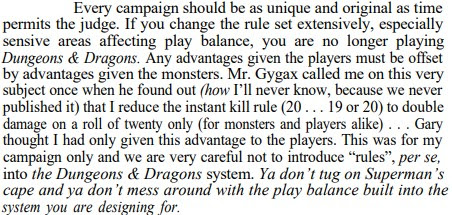
The column that appeared in issue #27 (July 1979) is quite unusual, because Gygax turns it over Bob Bledsaw of Judges Guild. Bledsaw uses the space to offer up a "personal opinion," entitled "What Judges Guild Has Done for Dungeons & Dragons." It's a fairly interesting read in its own right, but there's a short section toward the end of the piece that I want to highlight in this post.

I find it remarkable that, while Bledsaw praises uniqueness and originality in one's own campaign, he also suggests that rules changes, especially those relating to "play balance," run the risk of changing the game so much that one is no longer playing D&D. This is the position Gary Gygax himself advanced in many of his "From the Sorcerer's Scroll" columns and elsewhere. Agree or disagree, there's a logic to it and I suspect that Bledsaw, whose company produced official D&D (and, later, AD&D) materials under license from TSR, knew that this was a line he had no choice but to toe.

After that, Bledsaw then gives an example of when Gygax corrected him regarding rules changes he was using in his own campaign. This concerned the "instant kill rule (20 … 19 or 20)." What's he talking about here? No edition of D&D with which I am familiar has an instant kill rule, let alone the one he seems to describe. On the other hand, Empire of the Petal Throne does and the rule Bledsaw mentions seems almost identical to it. Is this the rule Bledsaw meant? Had he imported the EPT rule into his home campaign? If so, why did Gygax care? I understand that Gary strongly disapproved of critical hits, which is fair. However, if Bledsaw was using them in his home campaign, what difference did it make? So long as he wans't importing them into Judges Guild D&D products – and he says he was not – I don't see why Gygax should "call [him] on this very subject."

Have I misread what Bledsaw is saying? 

Monday, April 25, 2022

Supra-Sentinels

Does anyone remember this Judges Guild advertisement? It appeared in issue #80 (December 1983) of Dragon.

A quick search online reveals that the game was never released, owing to the financial troubles of Judges Guild in the mid-1980s. As a connoisseur of unreleased RPGs, I'm genuinely curious what the game would have been like, both rules-wise and in terms of presentation. JG products were always quite cheaply made but they often overcame these physical flaws but packing a lot of creativity into their newsprint pages. Of course, it's one thing to produce supplements or adventures for someone else's roleplaying games and another entirely to publish your own. I suspect Supra-Sentinels wouldn't have got much traction compared to games like Champions or the soon-to-be-released Marvel Superheroes, but who knows?

Tuesday, November 30, 2021

White Dwarf: Issue #18

Issue #18 of White Dwarf (April/May 1980) features an unusual cover image: a color still of the starship Enterprise from Star Trek: The Motion Picture. That's a particularly potent image for me, since I was a huge fan of Star Trek as a kid and, unlike many people my age, I absolutely loved The Motion Picture. I nevertheless find it strange to see this on the cover of WD, which I have long associated with less "mainstream" depictions of fantasy and science fiction subjects. 

All that aside, the cover at least has some relevance to the content of the issue. The very first article, entitled simply "Star Trek: The Motion Picture" is a set of miniatures rules for use with Citadel's officially licensed Star Trek minis. Written by Tony Yates and Steve Jackson (the British one, of course), the rules are brief, focusing largely on combat, though there are mechanical nods to other activities. The article also includes statistics for the named characters of Trek (Kirk, Spock, McCoy, etc.) and a variety of alien species, as well as a scenario with a map. 

"Open Box" reviews three products, only one of which I have any familiarity. The first is Eon's Darkover boardgame based on the novels by Marion Zimmer Bradley. The review is quite lengthy for "Open Box" – slightly over a full page in length – and quite effusive (9 out of 10). The second, for Task Force's Swordquest, a fantasy boardgame, is more middling in its assessment (6 out of 10). The final review is Dra'k'ne Station, a Traveller adventure published by Judges Guild. The reviewer, Bob McWilliams, a name I strongly associate with excellent Traveller articles in White Dwarf, is quite impressed with the product (8 out of 10), which I suppose I can understand, given how comparatively little Traveller product existed by this time. For myself, I'm generally not all that impressed with most of Judges Guild's Traveller materials, including this one.

The centerpiece of the issue is Albie Fiore's The Halls of Tizun Thane about which I wrote a post at the start of this year. I don't have much to add to my comments from January, except to reiterate at how impressive the adventure is in terms of size and scope. The titular halls consist of more than sixty keyed rooms and there are a large number of NPCs (not to mention two new monsters) with which to interact. Adventures like this were a hallmark of White Dwarf as I remember it and I look forward to seeing more of them in the future.

"Treasure Tables" presents a number of different random tables, from a frankly bizarre one for "accurately" determining the handedness of a NPC to ones for generating weather patterns. I love tables as much as the next guy, but it's vital that they be useful and well made. Most of these are, sadly, are not. "The Fiend Factory" includes four new monsters, one of which is the couerl, a variation on the displacer beast, which is itself a ripoff of A.E. van Vogt's original couerl – a classic example of pop cultural recursion. "The Magic Brush" by Shawn Fuller is a lengthy treatment of the basic techniques of painting  miniatures and seems (to a non-painter) to be quite well done. I've long admired those with the skills to paint miniatures attractively, so articles like this hold my attention despite my own lack of direct experience in the area.

All in all, issue #18 of White Dwarf is a fairly mixed bag, as one might expect from almost any periodical. The high point is definitely Albie Fiore's adventure, which I hope heralds similarly excellent content in future issues. 

Tuesday, November 16, 2021

White Dwarf: Issue #17

Issue #17 of White Dwarf (February/March 1980) features a science fictional cover by Angus McKie. In my memory, one of the things that distinguished White Dwarf from, say, Dragon is that the former frequently boasted cover art that drew from SF or that mixed sci-fi with fantasy. As a huge fan of the genre, this always pleased me. 

The issue begins with an interesting editorial by Ian Livingstone, in which he talks about the perceived expense of a roleplaying game versus a more traditional boardgame. "Is this all I get?" he imagines a newcomer to the hobby saying upon opening his D&D Basic Set. Livingstone then suggests that, because RPGs are a niche hobby, they'll always be more expensive than their mainstream counterparts. The only way that will change is if roleplaying games were to appeal to a wide enough audience that mass market factors enter the equation. For that to occur, he opines, RPGs "would have to be modified out of all recognition and lose their appeal." I'm not sure that history has proven Livingstone wrong.

"The Fiend Factory" offers up six more monsters in this issue. Perhaps I am unusual in this respect, but I'm tiring of the "The Fiend Factory." I'd much rather see clever ways to use existing monsters – of which D&D already had an immensity in 1980 – than an endless menagerie of new ones. "Open Box" is mostly given over to Judges Guild product reviews, starting with Under the Storm Giant's Castle (5 out of 10) and Dark Tower (9 out of 10). These are joined by reviews of both Operation Ogre (5 out of 10) and Caverns of Thracia (9 out of 10). This is, I think, a fairly representative sample of JG's output over the years – plenty of forgettable mediocrity but a number of true classics as well. Also reviewed is Yaquinto's game Time War, which receives a score of 8 out of 10.

"My Life as a Werebear" is an unusual article by Lewis Pulsipher. In it, he delves into the question of playing a monster as a character in Dungeons & Dragons. Pulsipher then provides for monster classes for use with the game. They're an odd assortment, consisting of the blink dog, lammasu, stone giant, and titular werebear. While I'm unsure I'd ever allow such characters in my own games, I think the guiding principles behind Pulsipher's designs are solid and the end results are good (though why anyone would want to play a blink dog character is beyond me). Shaun Fuller's "The Magic Brush" is a lengthy article on the finer points of painting miniature figures. Not being a painter myself, I can't speak to its utility, but it is clearly thorough in its treatment of its subject.

"The Sable Rose Affair" by Bob McWilliams is a superb scenario for use with Traveller. The adventure is quite detailed and includes lots of maps and NPCs, all of which contribute to its overall excellence. More noteworthy is its presentation as a series of "modules," which are discrete sections focusing on specific events or locales within the overall scenario. Depending on the approach the PCs take, only certain modules are needed, which offers the referee flexibility in how he adjudicates the course of play. "Treasure Chest" details seven new artifacts and relics, after the fashion of the mighty magic items found toward the end of the Dungeon Masters Guide. They're fine, as far as they go, though none really stand out as memorable.

The issue ends with an interview with Chaosium stalwart, Greg Stafford. It's a truly fascinating interview, one worthy of its own post (which I'll write either later today or tomorrow), in which Stafford talks at length not just about the origins of Glorantha, RuneQuest, and Chaosium but also his general philosophy of roleplaying and related activities. There's some eye-opening stuff in the interview serves as a good reminder – as if we needed one – of why Stafford was truly one of the greats of our hobby.

All in all, this was another fine issue, one that brings the magazine ever closer to the one I remember from just a few years later.

Tuesday, October 26, 2021

White Dwarf: Issue #14

Issue #14 of White Dwarf (August/September 1979) sports an unusual cover by Emmanuel, best known for the iconic cover of the Fiend Folio. Ian Livingstone's editorial compares US and UK game conventions, with particular attention paid to the length (typically three days in the US vs one in the UK) and expense (US conventions cost more) of these gatherings. Not being much of a convention goer myself – even less so in these crazy times – my opinion on the matter probably doesn't much matter. Still, I can't say that the increasingly theme park-like atmosphere of major game conventions holds much appeal to me. I'd much rather attend something smaller and more "restrained," but what do I know?

Part 2 of Andy Slack's excellent "Expanding Universe" article for Traveller appears here. This time, Slack offers rules additions for starships, computers, and all manner of weaponry, including nuclear ones. Like Part 1, this is excellent, full of both good ideas and good sense. There's a reason why Slack was – and is, in my book anyway – one of the stand-out writers for White Dwarf in its early years. "The Fiend Factory" offers up five more monsters for D&D. Interestingly, none of them seems to be among those chosen for inclusion in the Fiend Folio. 

"Open Box" provides three reviews. The first tackles two supplements for GDW's Traveller: Mercenary and 1001 Characters. The reviewer, Don Turnbull, thinks quite highly of the former and less of the latter. I find it fascinating that Turnbull notes that there are some who find perhaps the most inspired part of the Traveller rules – character generation – to be tedious and it's for these misguided souls that 1001 Characters would be most appealing. Turnbull also reviews two Judges Guild products, Dragon Crown and Of Skulls and Scrapfaggot Green. He considers Of Skulls the better of the two, but nevertheless criticizes the quality, both of content and production, of JG's releases when compared to those of TSR. Jim Donohoe gives Chaosium's Balastor's Barracks a very middling review (5 out of 10). He never explains why he rated it thus, but I know from my own experience that it's a dull slog of a dungeon for RuneQuest that gives little indication of the glories that would later appear for that game line.

"Lair of the White Worm" by John Bethell is a "mini-scenario" for RQ. Set in the ruins of a Dragonewt colony that reputedly sheltered a young wyrm, the locale is a two level affair, consisting of 24 chambers. It's not bad for what it is, though it certainly lacks the attention to world building that would come to characterize most Gloranthan materials (both fan-made and published by Chaosium). "Treasure Chest" presents two elaborate traps after the fashion of Grimtooth's Traps and a series of connected rooms filled with tricks and traps called "The Bath-House of the Pharaoh." These are quite clever and remind me that I need to do a better job of creating compelling traps for use in my fantasy games.

The issue ends with a lengthy interview with none other than Gary Gygax himself. The interview contains enough fascinating material that I'm going to save its contents for a second post I'll make later today. Suffice it to say that, as is so often the case, Gygax gives a good interview, the exact content of which depends greatly on when he was interviewed and by whom. In this case, I get the impression that Gygax must have felt well at ease and so was a great deal more frank about several topics than I would have expected. That said, he nevertheless pushes the "AD&D is a completely different game from OD&D" line that he has elsewhere, no doubt in an effort to shore up TSR's legal defense against Dave Arneson's lawsuits. Still, it's a good interview, as you'll see.

Tuesday, August 31, 2021

White Dwarf: Issue #7

Issue #7 of White Dwarf (June/July 1978) represents something of a milestone for the British gaming periodical. Firstly, it marks the start of the second year of its publication. Secondly, it's the first issue to feature a full-color cover (by the ever-amazing John Blanche). In his opening editorial, Ian Livingstone draws the reader's attention to both of these facts – facts he believes serve as "a reminder to traditional wargamers that we (i.e. roleplayers) are a serious part of the hobby and not just a weird, temporary deviation from it." As ever, I find such comments very strange, but then I was never a wargamer (take a drink), nor did I much care about their opinion of what seemed to me to be a related but wholly separate hobby. Mind you, I was a 10 year-old child when I discovered D&D rather than an adult like Livingstone, so I suppose I can be forgiven for not understanding his seemingly interminable concern about the reputation of roleplaying in wargaming circles. If nothing else, it's a reminder that the past truly is another country.

The issue begins with an article written by Ed Simbalist entitled "Feudal Economics in Chivalry & Sorcery." It's an interesting enough piece, especially for those who want to more "realistically" model the economics of the European Middle Ages in their campaign settings. More interesting than its content, though, is the fact that it's penned by one of the creators of C&S. If nothing else, Simbalist's appearance in WD's pages show that, after only a year of publication, it had already begun to attract significant attention on the other side of the Atlantic. "Fiend Factory" offers up nine new monsters for D&D, several of which would later appear in the Fiend Folio. None of those featured could be called "classics," even by the odd standards of the Fiend Folio, though a handful deserve comment. The first is the Rover, based on the bouncing ball from The Prisoner. The second is the Gluey, which was renamed the Adherer in its published FF form. Finally, there's the Squonk, based on the legendary monster of northern Pennsylvania, which the text calls "more of a pet than a monster; perhaps the female D&Ders would take more to this beast than the hard-headed males."

The "Letters" column is notable for one letter, commenting on Roger Musson's article in issue #6. I reproduce it here in its entirety.

One of these days, I'll need to collect together as many Gary Gygax quotes as I can find regarding the matters of "realism" and "heroism" in D&D to see how consistent his position on the matter remained over the years. For now, I'll simply say that, as he often does, Gygax speaks here in such an argumentative and disingenuous fashion that, even if one were inclined to agree with his points (which I mostly do), he makes it hard to do so, lest one be seen as similarly intemperate. I can't help but wonder how different the history of the hobby might have been if the younger Gygax had possessed even a small portion of the equanimity his older self possessed.

John T. Sapienza's "Carrying Capacity" offers a short and relatively simple new encumbrance system that uses a character's Strength to determine what percentage of his body weight he can carry in equipment and treasure. Meanwhile, Brian Asbury provides Part III of his "Asbury System" for experience. This time, he gives readers the means to determine the XP value of magic weapons and armor, based on their types (sword, mace, chain, plate, etc.), bonuses, and other abilities. I can see no obvious problem with his system as such, only that it seems like more trouble than it's worth, especially when the Dungeon Masters Guide already does the work for the referee (though, to be fair, at the time of publication of this issue, the DMG was still more than a year in the future).

"Molten Magic" provides photographs for eight different sets of miniature figures, including those by Ral Partha and Asgard. "Open Box," meanwhile, features reviews for The Warlord Game, The Thieves of Fortress Badabaskor, Bifrost Volume 1, Lords and Wizards, The Sorcerer's Cave, and Cosmic Encounter. There's also another installment of the "Kalgar" comic strip, which continues to do little for me. I find myself looking forward to the future, when other strips more familiar to me will appear, but those won't, I fear, appear for quite some time still.

Don Turnbull's "Lair of the Demon Queen" presents a "difficult but rewarding section" of his Greenlands Dungeon for the delectation of readers. The lair is a fairly small section of said dungeon but it's quite well thought out, with an elaborate trap that requires deciphering a poem (spoken by statues with magic mouths) to overcome. I simply adore rooms like this in dungeons and I'm ashamed when I consider how much more straightforward my own chambers tend to be these days. In my youth, I'd devote much thought to tricks and traps, not to mention riddles, rhymes, and other bits of fantasy nonsense intended to aid and befuddle the players. Reading this article reminded me of how far I've fallen in the years since. Perhaps I shall have to rectify this in my future work.

The issue ends with "Thoughts on the Proliferation of Magic Items in D&D" by none other than Gary Gygax. As one might expect, Gygax is very much opposed to what he calls "magic on the cheap," something he claims is quite common in "hobby publications" at the time. He suggests that, since D&D is "designed for a long period of active play," the referee would be wise to give out magic items sparingly and with an eye toward ensuring that the game remain challenging over time. He then offers many strategies for separating PCs from magic treasure so as to maintain the appropriate balance. Everything he says here comports with his writings on the subject elsewhere, but, as I commented earlier, his tone is condescendingly off-putting at times and I fear it might sometimes get in the way of what he intends to say (Physician, heal thyself).

Issue #7 of White Dwarf was, by and large, enjoyable to me. It's definitely step up in terms of presentation and quality over its immediate predecessors and it gives me hope that the upcoming issues will be equally enjoyable. 

Tuesday, August 3, 2021

White Dwarf: Issue #3

Issue #3 of White Dwarf is dated October/November 1977 and features cover art by Alan Hunter, who did a number of illustrations in the Fiend Folio. Its first article is entitled "Solo Dungeon Mapping" and is credited to Roger Moores – please note the terminal "s." I assume, though do not know for certain, that this is a typographical error and that the author's name is, in fact, Roger Moore, better known as Roger E. Moore, who would later go on to become editor of TSR's Dragon. Moore's byline appeared extensively in the pages of gaming periodicals starting in the late 1970s, so it seems very likely that this is the same person, but I could be mistaken.

In any case, "Solo Dungeon Mapping" is an unusual article. First, though intended for use with Dungeons & Dragons, it makes reference to Empire of the Petal Throne as another game for which it could be useful. Second, the very loose system that Moore presents seems intended to create dungeons with few rooms per level but lots of long corridors and passages up and down between levels. Now, there's nothing wrong with this approach, of course, but it's quite different from the much more cramped style I tend to associate with dungeons.

Fred Hemmings offers another installment of his "Competitive D&D," This time around Hemmings presents more details on the chambers of his competition dungeon, Pandora's Maze, which I welcome, given what he implied about it in his previous two articles. The intention here is to provide examples of the mix of encounters, tricks, and traps he uses in scenarios of this style. Likewise, Don Turnbull continues to plug away at his "The Monstermark System," with a third entry. As before, I found the article long and tedious, with an emphasis on mechanical and mathematical minutiae of little use to me. It's odd because, for years, I had heard people speak so glowingly of the Monstermark and assumed it was easy to use – apparently not!

"Open Box" tackles a large number of Judges Guild D&D products: Ready Ref Sheets, The Judge's Shield, TAC Cards, Tegel Manor, City State of the Invincible Overlord, Character Chronicle Cards, and The First First Fantasy Campaign. By and large, these were all well received by the reviewer, Don Turnbull. For myself, I was struck by how much Judges Guild had already released by this relatively early date. Also reviewed was FGU's Citadel, Fourth Dimension (its original, pre-TSR version), and TSR's Battle of the Five Armies. 

Lewis Pulsipher continues his "D&D Campaigns" series, with a lengthy discussion of his philosophy of refereeing. Early on, Pulsipher describes his vision of the referee as a "friendly computer discretion," who interferes in the course of play as little as possible, because "the referee is neither infallible nor completely impartial." It's an interesting perspective and one with which I am largely in agreement. He then elaborates on just what he means by this, offering many examples of how this philosophy operates in practice. I know that Pulsipher is often regarded as smug and stuffy in his approach to gaming, but I found this article engaging and look forward to future installments.

"Colouring Conan's Thews" by Eddie Jones is an overview of miniatures painting – another reminder of this hobby's roots. "The Loremaster of Avallon" by Andy Holt presents more D&D house rules, most notably his card-based combat system, whose use eluded me somewhat. I shall have to re-read it several more times to get a better sense of how the system, which uses 100 cards, each bearing a symbol on it, actually works. John Rothwell's "The Assassin" is a variant of the class presented in Blackmoor, while Ian Waugh's "New Magic Rooms" presents two chambers for placement in a dungeon whose interiors operate according to unusual rules. 

I have to admit that I was less impressed with this issue than I was with the previous one. Aside from Lewis Pulsipher's article, there was little that stood out to me as being either original or useful to me. That's the nature of periodicals, of course, but I had hoped that White Dwarf, compared to Different Worlds, would hit the ground running. I guess it's still too early to pass judgment on that score.

Tuesday, July 20, 2021

White Dwarf: Issue #1

I've talked about my experiences with White Dwarf before. It's a RPG magazine that I only read intermittently back in the day and so my memories of it are not as vivid as those of Dragon. Likewise, when I did read it more regularly, it wasn't until late 1982, long after White Dwarf was well established and had settled into a comfortable run. Consequently, I have no direct knowledge of the magazine's early days, which I imagine were pretty wild and woolly. That's why, after the cessation of my examination of Different Worlds, I knew that my next series would be dedicated to White Dwarf.

Issue #1 is listed as June/July 1977, which is one year after the first issue of TSR's Dragon appeared. I think that's significant, because it's a useful reminder of just how early it appeared in the history of the hobby. Remember, too, that the AD&D Dungeon Masters Guide explicitly references White Dwarf in a section entitled "Aids to Playing Advanced Dungeons & Dragons," mentioned by side by side with Dragon. The only other third party publications mentioned in that section are those by Judges Guild. This is telling and should be borne in mind as this series goes forward.

The very first article to appear is entitled "Metamorphosis Alpha," written by Ian Livingstone, the magazine's editor and co-founder of Games Workshop. For the most part, the article is simply an overview of the TSR RPG of the same name. However, the article is more than that, offering new rules for gravitation, as well as discussions of stories like Robert Heinlein's Orphans of the Sky and Non-Stop by Brian Aldiss that influenced the game's creation. More interestingly, Livingstone offers some criticisms and suggestions for improvement.

Back to the rules themselves and criticisms. There are not many but just enough to irritate. The initial task of designing the starship and its contents is lengthy – unless your players want to play for the next four years solid, I suggest a smaller starship (same number of decks). 
Don Turnbull's "Monstermark System" presents a complex mathematical system for assessing the relative challenge of a D&D monsters relative to others (and to the level of player characters). Honestly, I have little basis for evaluating the the utility of the system, since I've never used it. Truth be told, I've never seen much use for this kind of evaluation, but I readily concede that I'm probably unusual in not caring about such matters. I know that the Monstermark System has a solid reputation among fans of D&D, so I have little doubt that Turnbull had come up something worthy of consideration.

"Open Box" is a collection of reviews, focusing on two wargames: SPI's Sorcerer and Avalon Hill's Starship Troopers. Meanwhile, "Competitive D&D" by Fred Hemmings tells the tale of one referee's desire to "score" a dungeon expedition, as two competing parties attempt to make their way through it. I've long been curious about this sort of set-up, so I read the article with some interest. "D&D Campaigns" by Lewis Pulsipher is the first part of a series dedicated to exploring how to establish a D&D campaign and adapt the game's rules to particular styles of play. The article is fine as far as it goes, very similar to other articles Pulsipher was publishing in other magazine's at the time. 

"The Warlord" by Steve Jackson – co-founder of Games Workshop, not (confusingly) Steve Jackson Games – is a discussion of the self-published boardgame The Warlord by Mike Hayes. I'd never heard of the game before, which is apparently quite similar to Risk but with nuclear missiles. "What's Wrong with D&D" by Andrew D. Holt offers complaints and suggestions for "fixing" the game's combat and magic systems. Ho-hum. Alan Youde's "Poison" adopts the poison rules in Metamorphosis Alpha for use with D&D. Shrug. There's also a new magic item (helm of vision) by Steven Littlechild.

All in all, the first issue of White Dwarf feels very amateurish – as it should. It's an uneven mix of material, none of which is bad, but very little of which stands out as noteworthy, with the possible exception of "Monstermark System." Nevertheless, it shows clear promise and I know from personal experience that it does improve with time. Much like Different Worlds (or Dragon, for that matter), it takes a while before a roleplaying magazine finds its footing and I have little doubt the same will be true of White Dwarf.  

Wednesday, May 12, 2021

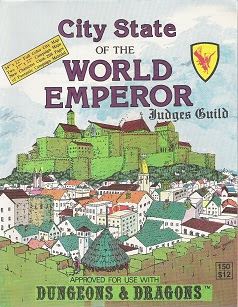
Retrospective: City State of the World Emperor

In the early days of the Old School Renaissance, one would regularly read effusive praise for Judges Guild. I think that's completely understandable. If the point of the OSR is the re-evaluation – and appreciation – of older roleplaying games and their products, it stands to reason there would be a lot of discussion of Judges Guild. Judges Guild was, after all, the earliest official licensee of Dungeons & Dragons and, over the course of the company's existence, it published an immense amount of material. Surely, there must be some, if not many, under-appreciated gems among them.

For the most part, I share this perspective. The Caverns of Thracia, Wilderlands of High Fantasy, Dark Tower, The First Fantasy Campaign, and, of course, City State of the Invincible Overlord are all rightly regarded as classic D&D supplements from the early days of the hobby, as are several others. Unfortunately, the vast majority of Judges Guild's output was, in the words of Patrick Amory, "masses of rubbish, poor art, and typos." No glasses are rose colored enough to turn many JG publications into a forgotten tour de force.

Then there are products like 1980's City State of the World Emperor, which occupy a strange middle ground, being neither pure gold nor completely worthless. Consisting of three books, it details the city-state of Viridistan, ruled by Hautulin Scheitt, the last member of "a once haughty and powerful race." Hautulin is also known as the Green Emperor on account of his skin color, evidence of his descent from the mermen of the Trident Gulf. In addition to ruling the city, he is high priest of the evil water god Armadad Bog, who is reputed to actually dwell beneath the emperor's palace within Viridistan. 

Though the Green Emperor has maintained his rule for 150 years, Viridistan is nevertheless rocked with intrigue. The city-state's monarchy is theoretically hereditary, but most of its emperors have been usurpers, having formerly been part of the local aristocracy before seizing the throne. The infighting between the nobility has slowly weakened the city-state and its hold over the surrounding territories. Consequently, it teeters on the brink of rebellion, civil war, or outright collapse – a terrific set-up for adventures or even a whole campaign.

Unfortunately, the bulk of City State of the World Emperor consists of tedious – and, worse, uninteresting – information about bureaucrats, sanitation, tax collection, and endless army barracks. There are descriptions of local businesses, but most of them are inns, taverns, or similar establishments. Now, obviously, inns are important, even vital, parts of many fantasy settings but how many does one need? Certainly not more than fifty and yet that's exactly what City State of the World Emperor offers. The cumulative effect of all the seemingly endless details of the city-state's civil servants, soldiers, and barkeeps is to undermine the high-level situation established earlier.

More useful are encounter and rumor tables, along with information on the local legal system. There's also an extensive treatment of the oppressed Mycretian religion. About 10% of the population of the city-state belong to this faith, which is peace-loving almost to the point of pacifism. Complementing these details is a new character class intended to represent devotees of the faith, complete with unique powers and abilities. I've always been fond of the Mycretians, in part because of how oddly they sit within the larger Wilderlands setting. 

In the end, City State of the World Emperor holds a lot of unfulfilled potential. The general frame of the city-state is a good one, perfect for intrigue-based adventures and campaigns. I absolutely love the notion of the Green Emperor's being the last of his kind, a throwback to the ancient days when gods walked among men. I likewise love the suggestion that the upper echelons of Viridistan's society are wracked with division and sedition. It's incredibly evocative, which is why it's a shame that so much of the product's three books are filled with pointless, dull minutiae – a wasted opportunity. 

Tuesday, May 11, 2021

Different Worlds: Issue #14

Issue #14 of Different Worlds (September 1981) opens with "Judges Guild and D&D" by Patrick Amory. This is an unusual article, in that it offers an overview of all the Judges Guild D&D/AD&D products, with an eye toward drawing attention to the best ones. This is necessary, in the opinion of the author, because "the Guild has always sacrificed quality for quantity." He hopes to save the reader the need "to wade through masses of rubbish, poor art, and typoes [sic]" before finding a genuinely useful product. That's harsh but fair. The full article is five pages long and singles out those Amory considers especially worth, such as City-State of the Invincible Overlord, City-State of the World Emperor, Tegel Manor, Caverns of Thracia, and First Fantasy Campaign, among a few others. 

"Character Personality Profile" by Mark Lukens presents a system for rating the personality, attitudes, and interests of a character, whether player or non-player. The system is usable with multiple RPGs, since Lukens provides multiple rating scales (2d6, 3d6, d20, d100). The system reminds me a bit of the opposed personality traits system presented in Pendragon, albeit in a less developed form. It's not bad for what it is and I imagine many referees would find some utility in it.

Richard L. Snider offers a preview to the second edition of Adventures in Fantasy. The article is mostly interesting as a historical curiosity, since, unless I am mistaken, this second edition was never published. "Painting Miniature Figures" by Robin Wood is a lengthy but fascinating article, complete with photographs, about the process of painting figurines for use with roleplaying games. Lewis Pulsipher's "Taverns and Inns" provides a system for randomly rolling up drinking establishments – everything from their size to proprietors to patrons. "Familiars" by David F. Nalle provides a handful of short tables for generating familiars, including unique ones. 

"Plausible Geography for Role-Playing Games" by George Hersh is a surprisingly short article, consisting mostly of a recommendation to acquire copies of United States Geological Survey topographical maps to use as the basis for adventure maps. "Come, Clash with the Titans" by Larry DiTillio provides AD&D and RuneQuest stats for the monsters and opponents from the 1981 movie, Clash of the Titans, along with magic items and scenarios employing them. The issue also includes reviews of the Traveller double adventure Argon Gambit/Death Station and Grimtooth's Traps

Gigi D'Arn's gossip column includes quite a few tidbits this issue, starting with rumors that "SPI is losing money rapidly," which is why it is trimming its staff. Gigi also mentions Avalon Hill and Heritage had supposedly made bids on the company. There's also this story:

This is a reference to the module, Palace of the Silver Princess, about which Jean Wells talked a bit in my interview with her some years ago. I find this fascinating, since, at the time, I had absolutely no idea there was any controversy regarding the module. It was only sometime this century that I became aware of and I still sometimes can't believe it actually happened.

Issue #14 is an improvement, in my opinion, over issue #13. There's a great deal more immediately useful gaming material and not a single "theory" article, which is a welcome change. It's worth mentioning that editor Tadashi Ehara began the issue asking readers to send him letters indicating what games they play and which articles they have found most enjoyable. This suggests that Ehara was well aware of the need to better balance in the magazine's content. It will be interesting to see how things unfold in the next few issues.

Tuesday, April 6, 2021

Different Worlds: Issue #9

Issue #9 (August/September 1980) of Different Worlds features a quite striking cover by Luise Perrine that seems to tie into an article appearing later in the issue. If so, that's the first example of this I've seen in Different Worlds. Typically, the covers of gaming magazines seem to bear little connection to the issue's contents, no doubt due to the circumstances under which they're commissioned. Still, I've admired Perrine's artwork ever since I first laid eyes on her illustrations for RuneQuest, so it's a treat to see her given the cover here.

The issue begins with "Flippancy in FRP" by my old nemesis, Greg Costikyan. The article advocates, in a tongue in cheek way, for more "silliness" or "flippancy" in roleplaying game sessions and campaigns. Costikyan covers multiple areas where he thinks a bit more "chaos" would help a game, such as handling alignment, religion, money, and character names. While his overall point is fair enough – we could all do with a little less lightheartedness from time to time – the article is, in my view, delivered with the obnoxiousness typical of a young man who thinks he knows it all (Costikyan would have been 21 years-old at the time of this article). 

"Boardgames to RPGs" by Glenn L. Williams is much more interesting (and certainly less annoying). Williams examines the expectations RPGs and boardgames create in their players and the techniques employed in their design to fulfill those expectations. With that in mind, he suggests that it would be possible to use boardgames as the basis for roleplaying games. To prove his point, he takes Steve Jackson's Ogre and develops from it the outline of a RPG. What's interesting – but also slightly baffling – is that Williams makes the Ogres themselves the focus of he RPG, with the player taking on role of the artificially intelligent war machine rather than, say, a human soldier in the world the Ogres inhabit. 

John T. Sapienza presents an extensive review of the Zargonian Figures produced Bearhug Enterprises. These figures are cardboard stand-ups to be used in place of miniature figures. I'd never heard of these specific figures but I am very familiar with the concept. Sapienza thinks very highly of the figures, both for their quality and their price, which he thinks will make them popular with gamers, Later, he reviews actual metal figurines by McEwan and Citadel. I find it fascinating how lengthy these reviews are. I've said before that I never used miniatures much back in the day (or now), so it's good to be reminded how important they were in many quarters of the hobby.

 "The Imperium – A Traveller Campaign" by Marc Miller and Frank Chadwick is a five-page article, describing what would become the official GDW Traveller setting. Though I am deeply familiar with the Third Imperium as a setting, it was nevertheless a joy to read these. It reminded me of how much fun I had with Traveller and my own early days as a writer, creating adventures and setting material in the pages of Challenge. Anders Swenson reviews Judges Guild's Verbosh, which he considers a good investment for the money. Swenson also positively reviews Chaosium's Gateway Bestiary.

David F. Nalle's "Variable Alignment System" is yet another take on this venerable topic, this time presenting two point scales (Karma and Loyalty) to track a character's progress along the Good/Evil and Law/Chaos axes. It's fine, I suppose, but seems unnecessary for most people. Steve Perrin's "Cult of the Tiger" is another Gloranthan cult for RuneQuest (and the source of the issue's cover, I believe). Lewis Pulsipher's "Place for Adventure" is a short article, outlining nine unusual locations that might serve as adventure locales, such as animal burrows or giant bee hives. 

This month's Gigi D'Arn column includes some intriguing tidbits. There's a lot of talk about movies, such as the shelving of plans for a D&D movie, along with rumors about Dragon Slayer, The Last Unicorn, and Conan the Barbarian. The comments from the latter are somewhat dismissive, though it's fascinating, from a historical perspective, to learn that filming on Conan was delayed due to the death of Josip Broz Tito in Yugoslavia, where the movie was to be shot. There's also talk of a supposed "D&D/AD&D Companion" that will include lots of historical information on weapons and armor. I have no idea what Gigi is referring to here and it makes me wonder if there was ever any basis for the rumor in the first place.

Monday, November 30, 2020

Huge Ruined Piles


Men & Magic, Volume I of original Dungeons & Dragons, in a section entitled "Preparation for the Campaign," rather famously describes a dungeon as a
"huge ruined pile, a vast castle built by generations of mad wizards and insane geniuses".

The quote is a popular one in the OSR and for good reason: it's incredibly evocative. Reading it, I find myself thinking of an immense, crumbling Gothic structure, perched precariously on some mountaintop and sprawling across its slopes. In this, I've likely been influenced by the cover illustration to OD&D's Supplement II: Blackmoor.

What's interesting is that both the Blackmoor and Greyhawk campaigns were centered around – and indeed named after – a castle (as was Rob Kuntz's El Raja Key). Despite that, it was the levels beneath those two castles that served as the focus of player character action rather than the castles proper. Castle Greyhawk did have an "upper works" (as did Castle Zagyg), but they did not occupy much of the player's attention, at least according to one account by James M. Ward. For Castle Blackmoor, we have a map of the surface levels of the castle, presented in Judges Guild's The First Fantasy Campaign, but they're sadly not very interesting – hardly a "huge ruined pile."
Speaking of Judges Guild, the 1977 module, Tegel Manor, is in some ways closer to this ideal, though, at only 250-ish rooms, it's probably too small to be called truly "sprawling" (though moreso than either Castle Amber or my own The Cursed Chateau). 

I've written before about "above ground" dungeons, but, in that case, I was thinking mostly of ruined cities on the model of Glorantha's Big Rubble, which is itself worthy of further discussion. However, my present musings are occasioned more by today's Pulp Fantasy Library entry. I now find myself thinking about immense, haunted castles – an unholy amalgam of Castle Dracula, Neuschwanstein, and the Winchester Mystery House, peopled with all manner of monsters and perhaps even the degenerate descendants of the original inhabitants á la H.P. Lovecraft's The Lurking Fear
It's funny really that "the dungeon," meaning an improbable warren of subterranean tunnels should become the default environment for adventuring in RPGs. On one level, it makes perfect sense, since dungeons, as conceived by roleplaying games, have no real world analog, thus freeing the referee to map them according to his own fancies. Mapping a castle, even an absurdly large and rambling one, might demand at least a little knowledge of the layout of such buildings and that can impede one's creativity. I've experienced a little of this myself, in detailing the surface ruins of Urheim, since it's meant to be a "real" fortified monastery where all of its buildings have a clear and logical purpose. 

That aside, I don't see any reason why a would-be designer of a massive castle "dungeon" need be limited by real world considerations. My references above to Neuschwanstein and the Winchester Mystery House were chosen specifically to highlight the legitimacy of whimsical, irrational, and downright deranged design choices. After all, if your huge ruled piles is the result of "generations of mad wizards and insane geniuses," why should its floorplan be bound by normal logic? 

I remain quite taken with Jason "Philotomy Jurament" Cone's notion of "the dungeon as mythic underworld," which I believe comports almost perfectly with OD&D's presentation of the game's play environment. But we need not be too literal when it comes to adopting this perspective. Properly presented, a sprawling, crumbling castle can be every bit an example of an underworld as any series of monster-infested tunnels. Indeed, if one looks at Gothic fiction from the late 18th through 19th centuries and beyond – fiction that has had a clear influence on fantasy roleplaying – cursed and haunted castles abound and entering them is often metaphorically akin to descending into Hades (consider Jonathan Harker's trip to Transylvania in Dracula, for instance).

Obviously, creating a dungeon of this sort will require some re-thinking of the traditional structure of levels and the difficulty associated thereto. Off the top of my head, I might suggest dividing the castle into wings, with certain certain wings being "low level" and others "high." Alternately – or even in conjunction with wings – one might instead opt for a vertical approach: as one ascends the castle's spires, it becomes more difficult. Another possibility is simply to dispense with such artificial notions and opt for a more "organic" one, where the challenge is independent of location and characters exploring the place must learn to be clever to avoid running into dangers beyond their present abilities. The possibilities are quite large and, were I a better cartographer, I might start work on my own huge ruined pile. Alas, my skills in this area are negligible, so it won't be happening anytime soon. One day ...