Showing posts with label hit points. Show all posts

Thursday, February 13, 2025

sha-Arthan Combat

Mechanically, Secrets of sha-Arthan began as a variant on Moldvay/Cook Dungeons & Dragons, because I'm a big fan of that version of D&D, which is easy to learn and to play. However, as I've worked on it and playtested bits of it, several elements – for example, the magic system – have diverged more and more from B/X, to the point where it's becoming more of its own thing. I'm fine with that, since, at the end of the day, my first priority is to make a game I like. However, I do hope that, when I'm done (whenever that might be), it'll also be something others might enjoy, too.

Lately, I've been experimenting with some ideas related to the combat system. Most significant among these ideas is that player character hit point totals are mostly static and equal to one of the character's ability scores. So, for example, if the character's score in relevant ability is 12, he has 12 hit points. This makes beginning characters quite a bit tougher than a typical 1st-level D&D character, who might have half that many hit points to start. However, I don't envisage those 12 hit points ever really increasing with experience, except perhaps in small ways here and there.

This is a big change from D&D and its derivatives, though very much in line with games like RuneQuest and other members of the Basic Role-Playing family. Having played many BRP games over the years, I do appreciate the benefits of non-inflationary hit points. For one thing, combats are generally much more dangerous, since a single lucky hit is capable of knocking a character out of a fight, if not outright killing him. That means players have to think twice about rushing into battle and, when they do so, they have to rely on planning and superior skill, not simply bags of hit points, to achieve victory. 

On the other hand, precisely because of combat's deadliness, BRP games include a lot of ways to potentially mitigate that deadliness. For example, the combat rules include active defense maneuvers, like dodging and parrying. The rules also include ablative armor that lessens any damage that makes it through those defenses. These are welcome aspects of the combat rules, but there's no question that their inclusion slows down play in a way that D&D's relatively simple and abstract combat rules do not. As a guy who usually finds combat the least interesting aspect of most RPGs, fast and simple better suits my preferences.

Yet, I'm still playing around with ways to keep hit point totals low and combats quick and deadly in Secrets of sha-Arthan. It's proving to be harder than I thought it would, for some of the reasons I've already mentioned. Though BRP-style combat historically grew out of early attempts to regularize OD&D combat and make it more "realistic," it did so at the cost of speed. Finding a way to thread the needle between the elegance of D&D's combat system and the perilous nature of BRP's equivalent is tough, or at least I'm finding it so. 

Consequently, I'd love to hear more from people who have long experience with BRP in any of its forms. Is there a way to have your cake and eat it too? Can I get the best of both worlds? Fast, simple combat that nevertheless has some tactical depth, with lower hit points and active defense? Or is this a fool's errand and I should just abandon the attempt? I'd love to know your thoughts. 

Tuesday, March 19, 2024

Dice for Accumulative Hits

Recently, an acquaintance of mine asked a question about original, pre-Greyhawk OD&D (1974) for which I had no immediate answer: how are hit points determined when a character gains a level? That may seem like a very simple question, but consider the following chart from Men & Magic:

If you look at the second column, you'll see there's an uneven progression of "dice for accumulative hits" – 1+1, 2, 3, 4, 5+1, etc. Though the chart above is for the fighting man, both the magic-user and cleric charts are quite similar in this regard, which is why I was asked the question about how hit points are determined upon gaining a level.

If the player of a first-level fighting man rolls 1d6+1 to determine his character's hit points, what does he do when his character acquires the 2000 experience points necessary to gain level 2? How many dice does he roll and add to the total? OD&D's rules are not especially clear on this point, as we can see:

The example in the text is rather unhelpful as it does not describe the process of rolling additional hit points upon gaining a level. Instead, it simply presents how to roll the hit points of Level 8 fighting man divorced from any other context. 

Empire of the Petal Throne was first published in 1975 and its rules are clearly a variant of pre-Greyhawk OD&D. Consequently, when I have some question about how the rules of OD&D are to be interpreted, I often take a look at EPT. There's no guarantee that EPT's presentation is necessarily representative of the original intention (if any) of OD&D's rules, but, if nothing else, they usually offer some insight into how one person chose to interpret those rules, which is better than nothing. 

In this case, EPT suggests that, upon gaining a level, the player rolls the number of dice prescribed by the rules and totals the result. If the total is higher than his character's previous hit point total, the new total is used. If it's lower, then the previous total is retained. This approach makes a lot of sense to me, since, among other things, it helps to ameliorate bad rolls for hit points over time (provided the character survives, of course). It also provides a simple way to deal with the uneven progression of hit dice. Whether this approach is what was intended in OD&D, I simply have no idea.

Of course, it's possible I'm simply missing something very obvious or that this topic has been well explained elsewhere. If so, I'd love to be corrected, since it's a question that really stumped me when I was asked about it. Back when I was playing OD&D in my Dwimmermount campaign, I had already come under the sway of the EPT interpretation and made ready use of it. Later, we adopted Greyhawk's one additional hit die per level approach, so I never had to grapple with this area of ambiguity. 

Thinking about it now, I can't help but assume it's a topic that's been examined thoroughly by better exegetes than myself, but perhaps not. Please let me know what, if anything, I've been missing in the comments.

Tuesday, August 1, 2023

Polyhedron: Issue #3

Issue #3 of the technically-still-unnamed Polyhedron newsletter (Winter 1981–82) is notable for numerous reasons, starting with the absolutely gorgeous piece of Erol Otus Gamma World art that graces its cover. It's yet another glimpse of an alternate reality where TSR better supported its post-apocalyptic science fantasy game. Of course, the issue is filled with remarkable – and original – illustrations by TSR's stable of artists, so many, in fact, that I'll probably make another post highlighting some of them. 

The issue is double the size of the previous two issues (32 pages), though editor Frank Mentzer mentions that it will return to 16 pages with issue #4. The reason for that is, starting with that issue, the newsletter will appear bimonthly rather than quarterly. Mentzer also announces the establishment of a $1000 RPGA Scholarship Fund to the college-bound RPGA member "with the highest College Entrance Examination Board scores or equivalent thereof." Though I didn't subscribe to Polyhedron until a few issues later, I do remember the announcement of the winner of the scholarship each year.

Issue #3 sees the inauguration of Mentzer's "Where I'm Coming From" column, which he calls "my podium." This first installment isn't all that insightful. It's mostly a paean to the RPGA Network and thanks to readers for the warm response to the newsletter. "Dispel Confusion" continues, though it's no longer credited to a single TSR but simply to "The Game Wizards." As ever, it's an interesting look into the minds of the more rules-obsessed gamers of the early '80s. There's a question about surprise, for example, that brought to light the fact that, in by-the-book AD&D, each segment a character is surprised, he is subject to a full round's worth of attacks – up to five. I can honestly say I have never played the game this way nor have I ever seen anyone else do so, but then it's been long established on this blog that I frequently do it wrong. Oh well!

There is a massive – 7-page – interview with James Ward that is well worth discussing in its own right. Naturally, Ward has a lot to say about Gamma World, among other topics, which is what most interests me, given my lifelong fondness for the game. Dawn Patrol gets two articles devoted to it, the first of which is a report about the results of a tournament at the most recent GenCon. The article includes a turn-by-turn recap of a dogfight between five German and three American planes that ended in a German victory. The second article is another Dawn Patrol by Mike Carr, this time focusing on medals and commendations. Like Gamma World, Dawn Patrol is another game for which I have great fondness, but, unlike GW, I have not played it in decades. One of these years, I may have to fix that.

Don Turnbull's "Turnbull Talking" returns. He devotes himself to the question of just what hit points actually represent, a perennial topic of debate in the old days (and perhaps even nowadays, come to think of it). Michael W. Brunton's "Figure Painting" is just that, a three-page article about the ins and outs of painting figures for use with roleplaying games. Sadly, unlike similar articles in the pages of White Dwarf, no photographs accompany it, which makes the piece a lot less appealing to a painting-impaired reader like myself. Then we get three more pages of "Convention Wrapup," in which the events of GenCon XIV and GenCon East are reported. The focus is naturally on the results of the RPGA AD&D tournaments, as one might expect.

Merle Rasmussen announces a "Top Secret™ Gadget Contest." I'll be curious to see the results of the contest when they're revealed in a later issue. More immediately interesting is the piece of Erol Otus artwork that accompanies the article.

The uncredited "Codebook" is a brief meditation on the use of codes and cyphers in RPGs, followed by four coded messages that are presented as part of a contest for readers to decipher. Later, there's also a Gamma World art contest – there sure are a lot of contests in this issue – in which readers are called upon to illustrate the monsters presented in issue #2 and in this issue. "Mutants: A Continued Sampling of the Weak Ones" by James Ward gives us four more opponents for use with the game. I was (and am) a sucker for stuff like this, so I was happy to see more of it here.

There are more reader-created tricks and traps in "Notes for the Dungeon Master," alongside "Notes from Overseas" by Don Turnbull. Also present is an uncredited full-page article "Spelling Bee" that looks at the use and abuse of the invisibility spell. "Saga of Marnie" by Marnie Bosch is a firsthand account of someone's experiences at GenCon East in July 1981. "Incomplete Convention Schedule '82" is simply a listing of gaming cons for the coming year. I was interested to see that Origins 82 was held in my old hometown of Baltimore that year. I never actually attended Origins until 1991, even though it was often held in and around Baltimore. What can I say? Cons were not a big part of my formative experiences in the hobby (and still aren't, though I should make a stronger effort to change that).

As I said at the beginning, issue #3 of Polyhedron is a significant one, demonstrating that it's already growing and changing in response to its increased readership. Having no direct experience with the RPGA itself, I can't help but wonder how successful it was during the first part of the 1980s. Certainly TSR seems to have placed great stock in it, if Polyhedron is any indication. 

Friday, March 11, 2022

Taking the Sting Out of Poison

During the time when I was subscriber to Dragon, there was an article entitled "Taking the Sting Out of Poison." Written by Chris Landsea, it appeared in issue #84 (January 1984) and was itself something of a follow-up to a previous article "Poison: From AA to XX" by Charles Sagui. Sagui's article appeared in issue #32 (December 1979), which was before I was even aware of the existence of Dragon, let alone a regular reader. However, I was nevertheless familiar with it, because it had been reprinted in Best of Dragon Vol. II. As I mentioned recently, I was a huge fan of Best of Dragon and can still remember many of the articles included in these volumes, including Sagui's.

I bring this up as a bit of background to an inchoate thought I've been having lately regarding poison in Dungeons & Dragons. Now, I've never really had a problem with save or die mechanics and have, in fact, defended them in the past. I'm still not opposed to them in principle, but I've been thinking a lot about hit points and what they're supposed to represent in D&D. If we are supposed to believe, as Gary Gygax suggests in the AD&D Dungeon Masters Guide, that only a small portion of a character's hit point total represents his "actual ability to withstand physical punishment" with the rest being a measure of his "skill in combat ... "sixth sense" ... sheer luck, and the fantastic provisions of magical protections and/or divine protection," why does the character's ability to survive most poisons come down to a single roll of the dice? Would it not, in keeping with the Gygaxian understanding of hit points, make more sense if poison dealt damage and a saving throw, if used at all, served to mitigate the amount of the damage?

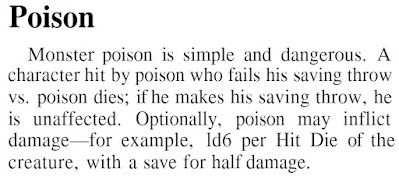
As I thought about this more, I dimly remembered that the the much-beloved D&D Rules Cyclopedia included the following optional way of dealing with poison:

Admittedly, I haven't thought much about the implications of this approach. On first blush, though, I must admit to finding it appealing. Poison is still very deadly. Consider, for example, a giant spider, whose poison under this scheme would dealing 4d6 damage on a failed saving throw and even 2d6 on a successful one. That's not nothing by any reasonable definition, but it introduces a little more variability in the result, as well as being more consonant with the what hit points seem to represent.

I don't know; I'm still pondering this. No doubt some will think I'm going soft in my old age and perhaps that's true. I can only say that I've been spending more time reading other RPGs roughly contemporaneous with D&D and AD&D, like Gamma World and RuneQuest, among others, and looking at how they handle deadly effects like poison. There's quite a range of approaches and some of them strike me as worthy of serious consideration. That's in addition to my aforementioned questions about the interface between such effects, hit points, and saving throws. As always, I appreciate hearing others' thoughts on this matter.

Monday, February 7, 2022

A Radical Proposal

I've lately been thinking about ability scores – the actual numbers associated with any given ability – and how they might be made to serve a more direct purpose in OD&D and games derivative of it. This has led me down some strange paths, some of which I'll probably start sharing over the coming weeks. For the moment, though, I want to present one of the more radical of them, pertaining to Constitution and the generation of hit points.

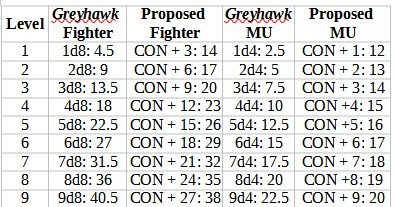
My idea, partly inspired by Basic Role-Playing, is that a newly generated character starts the campaign with a number of hit points equal to his Constitution score plus a fixed amount based on his class (the fixed amount is gained at every level, including first). This is obviously a huge change, since it would make 1st-level characters vastly more durable (even with a below average CON score) than standard OD&D characters. Over time, though, the numbers would even out, so that, by 6th or 7th level, the totals would be quite similar on average. To see what I mean, let's compare the average hit points of a Supplement I fighter and magic-user with 11 Constitution to their equivalents under this new system I've imagined.
This obviously represents a huge shift in thinking, not simply because of the increased durability of low to mid-level characters, but also because hit point increases are now fixed (+3 per level for formerly d8 hit dice, +2 per level for d6, and +1 per level for d4). This makes a high Constitution an extremely valuable asset, particularly at 1st level. On the other hand, hit points are kept much lower overall. Under Supplement I, a fighter with 18 Constitution and maximum rolls could have almost 100 hit points at 9th level, whereas, under this proposal, a fighter with the same CON would have less than half that. 

Naturally, for the proposal to work, there'd have to be a similar shift in the way that monster hit points were calculated, as well as possibly the damage ranges of weapons. Not having tested this, I don't yet have any way of knowing how this would play out or what sorts of unforeseen consequences might emerge from its adoption. At the moment, it's just an idle thought stemming from my desire to see the numerical scores of abilities in OD&D have more meaning beyond being an index on a chart.