Showing posts with label kuttner. Show all posts

Monday, October 6, 2025

Pulp Fantasy Library: The Graveyard Rats

The so-called Golden Age of the pulps is today remembered primarily for the works of H.P. Lovecraft, Robert E. Howard, and Clark Ashton Smith. That’s understandable. Together, the three formed a kind of triumvirate within Weird Tales and beyond, shaping much of what readers still think of when they imagine “pulp fantasy” or “weird fiction.” Their influence looms large not only over their own era but over nearly a century of horror and fantasy writing since.

Still, this focus has a downside. Many other pulp authors, while less visionary or distinctive, nonetheless produced work that remains both entertaining and effective. Their stories remind us that the pulps were not just breeding grounds for a few singular talents but entire ecosystems of imagination that, while crowded and uneven, was undeniably fertile. Among these lesser-remembered figures stands Henry Kuttner, a writer whose early solo work deserves far more attention than it now generally receives.

Today, Kuttner is probably remembered – if he’s remembered at all – in connection with his more famous wife and collaborator, C.L. Moore. Together, the two wrote numerous tales of science fiction and fantasy under various pseudonyms. Yet, before that partnership, Kuttner had already made a name for himself in Weird Tales, contributing stories in a grimmer, more immediate vein than the cosmic mythologizing of Lovecraft. His early horror fiction was leaner, less ornate, and more preoccupied with human frailty than with the vast indifference of the universe.

A prime example is “The Graveyard Rats,” which appeared in the March 1936 issue of Weird Tales. Barely a few pages long, the story has nevertheless become one of Kuttner’s most reprinted works, appearing in anthologies for nearly ninety years. Its endurance is no accident. “The Graveyard Rats” distills horror to its most basic elements of darkness, confinement, corruption, and fear without pretense or embellishment.

The story takes place in Salem, Massachusetts, where Old Masson, the caretaker of a cemetery, has discovered that fresh corpses are being disturbed by unnaturally large rats. These creatures, clever and relentless, drag the dead into their tunnels beneath the graveyard. Masson is less horrified than enraged, not out of respect for the dead but because the rats are stealing valuables he considers his by right. He’s long supplemented his meager income by rifling through the pockets of the newly buried and he resents the competition. Determined to reclaim his spoils, he descends into the tunnels after the vermin – and into a nightmare.

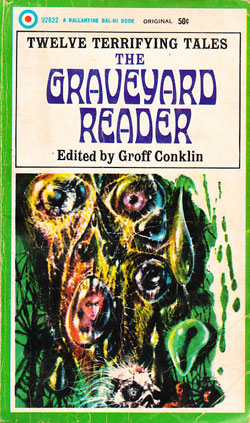
What follows is a relentless sequence of claustrophobic terror. Kuttner’s prose is stripped down but effective, evoking the choking darkness and shifting earth with dreadful precision. As Masson crawls deeper underground, his greed and fear fuse into panic until, finally, he becomes trapped in a tomb, unable to move forward or back, as the rats swarm closer. The ending is swift and merciless, a perfect punchline of pulp horror. I first encountered the tale in an old anthology called The Graveyard Reader, which I remember for its bizarre cover art and, even more, for the shock this short story delivered.

“The Graveyard Rats” is almost a model of what Weird Tales specialized in: concise, lurid, and designed to deliver a visceral jolt. It lacks Lovecraft’s cosmic scope and Smith’s luxuriant prose, but that simplicity is its strength. The story’s imagery touches on primal fears of the dark, the grave, the sensation of the earth closing in around you. It’s a morality play as well, reminding readers that greed and desecration invite their own form of damnation. Its lesson is as blunt as its prose, suggesting that there are worse fates than poverty and some appetites lead only to hell, if only metaphorically.

That bluntness is also what has kept "The Graveyard Rats" alive. Unlike many pulp horror stories, it doesn’t drown in adjectives or rely on elaborate mythologies. It is immediate, physical, and timeless. The same anxieties that drove readers in 1936 still have power today. Kuttner would go on to write more sophisticated stories, especially after joining forces with Moore, but “The Graveyard Rats” endures as a near-perfect exemplar of the pulp ethos. It’s a reminder that the pulps, for all their excesses, sometimes captured something essential about horror, namely, we are afraid of the dark and always will be.

Monday, July 12, 2021

Pulp Fantasy Library: Hydra

Like his friend, Robert Bloch, about one of whose stories I wrote last week, Henry Kuttner was one of the younger members of the so-called "Lovecraft Circle." Kuttner began a lengthy correspondence with HPL in 1936, an exchange that would inadvertently introduce him to C.L. Moore, whom he would marry in 1940. He and his wife formed a durable and prolific writing partnership that lasted almost two decades, until his untimely death at the age of 42 in 1958. Most of Kuttner's output during that time was science fiction, but he got his start as a writer of cosmic horror after the fashion of Lovecraft.

"Hydra," first published in the April 1939 issue of Weird Tales, is an example of Kuttner's early horror work. It's a solid effort, filled some genuinely clever ideas, hampered primarily by its somewhat pedestrian presentation, which relies heavily on a kind of faux journalistic style that, while not wholly ineffective, distances the reader from the events Kuttner describes, thereby lessening their impact. 

"Hyrdra" begins strongly.

Two men died; possibly three. So much is known. The tabloids ran flaming headlines of the mysterious mutilation of Kenneth Scott, noted Baltimore author and occultist, and later, they capitalized similarly on the disappearance of Robert Ludwig, whose correspondence with Scott was well known in literary circles. The equally strange and even more ghastly death of Paul Edmond, while separated from the scene of the Scott horror by the width of a continent, was clearly connected with it.

Among Edmond's effects was a diary that referenced a "privately printed pamphlet, On the Sending Out of the Soul," a pamphlet that "none of the local booksellers had heard of." Despite this, the diary states that it was this pamphlet that had caused Ludwig and Edmond "to undertake the disastrous experiment." The two men, we are told,

were deeply interested in the occult. They had dabbled in witchcraft and demonology as a result of their acquaintance with Scott, who possessed one of the best occult libraries in America.

We further learn that Scott "was a strange man" whose "knowledge of esoteric matters was little short of phenomenal." Together, Ludwig and Edmond hoped to use the knowledge contained in the aforementioned pamphlet to sneak into Scott's library through mystical means. 

The general process was familiar to both students. Their researches had informed them that the soul – or in modern occult language, "astral body" – is supposed to be an ethereal double or ghost, capable of projection to a distance. 

Making use of an odd "mixture of drugs and chemicals," including cannabis indica, the pair experiments with astral projection – to some success, it seems, for Edmond "seemed to be outside Scott's window," where he sees "the crumpled body of the man himself lying on the carpet … with his head doubled at an impossible angle out of sight beneath the torso, or else he was headless." Ludwig reveals that "his vision had been identical with Edmond's," which occasions him to admit that he had actually written to Kenneth Scott beforehand, asking his advice on how to perform the ritual properly. 

Not long thereafter, the pair receive a telegram from Scott, which reads:

ATTEMPT NO EXPERIEMENTS WITH PAMPHLET YOU MENTION STOP TREMENDOUSLY DANGEROUS AND MAY MEAN MY DEATH STOP AM WRITING YOU TODAY BY AIR MAIL FULL DETAILS STOP ADVISE YOU BURN PAMPHLET

A few days later, they read a story in the Los Angeles Times that reveals that Scott has been mysteriously murdered. According to the story, "there were no clues to indicate the identity of the assailant" and that "the victim's head had been severed from his body and was inexplicably missing. The remainder of "Hydra" sketchily details – remember that all this information is reported through the medium of pieced-together bits from diary entries and similar notes – what happens to Edmonds and Ludwig over the next few days, as the true consequences of their astral projection become clear. As the opening paragraph of the story makes clear, it does not end well. 

"Hydra" is not a wholly successful story. On a purely surface level, it's unremarkable and some might deem it little more than pulp hack work of a rather pedestrian sort. I don't share that assessment of the tale, but I don't think it's wholly unfair. However, Kuttner's descriptions of nightmarish alien dimensions and their frightening inhabitants are genuinely imaginative and well worth reading. You can tell he's trying hard to convey in words "the Ultimate Chaos" that rests at the center of the universe and I enjoyed his efforts.

Monday, February 15, 2021

Pulp Fantasy Library: Cursed be the City

Nowadays, Henry Kuttner is not very well known. His wife, C(atherine) L(ucille) Moore, is much more celebrated, despite the fact that she and Kuttner regularly collaborated on fiction during the 1940s and '50s. A likely reason for this is that Kuttner, like many pulp writers, had more than a dozen known pseudonyms under which his stories appeared. For example, many of his most famous tales appear under the name of Lewis Padgett, a pen name he and Moore used jointly. Consequently, a lot of Kuttner's work gets lost in the shuffle, aside from his contributions to the Cthulhu Mythos (which, I believe, Chaosium once collected into a single volume during the 1990s). 

That's too bad, because Kuttner produced a number of interesting pulp fantasy stories that are worthy of one's attention. I'm not talking his "Elak of Atlantis" yarns, one of which formed the basis for a previous entry in this series. Though fun (and funny), I remain unsure whether or not they were intended to be read as anything other than parodies of the nascent genre of sword and sorcery. On the other hand, his two tales of Prince Raynor are more serious efforts in the vein of Robert E. Howard, as we shall see. Both appeared in the pages of Strange Stories, a would-be competitor to Weird Tales that lasted only thirteen issues before folding. During its short run, it nevertheless managed to attract the talents of many notable pulp writers, such as Kuttner, Moore, August Derleth, Robert Bloch, and Seabury Quinn, among others. Its editor was Mort Weisinger, who would later achieve fame for his work at DC Comics during its Golden and Silver Ages.

"Cursed be the City" appeared in the April 1939 issue of the magazine and begins in what would seem to be an imitation of Howard's quotation from the inaugural Conan story, "The Phoenix on the Sword." Kuttner's version, from "the tale of Sakhmet the Damned," reads thus:

This is the tale they tell, O King: That era the royal banners were lifted upon the tall towers of Chaldean Ur, before the Winged Pharaohs reigned in secret Aegyptus, there were mighty empires far to the east. There in that vast desert known as the Cradle of Mankind – aye, even in the heart of the measureless Gobi – great wars were fought and high palaces thrust their minarets up to the purple Asian sky. But this, O King, was long ago, beyond the memory of the oldest sage; the splendor of Imperial Gobi lives now only in the dreams of minstrels and poets....

The Nemedian Chronicles it is not, but, even so, it establishes that "Cursed be the City" is a story set in the mythical past of Earth, before either Ur or Pharaonic Egypt flourished, a common convention of early sword and sorcery tales. The mighty city of Sardopolis, "Jewel of the Gobi," is under siege by the armies of King Cyaxares. During the siege, a white-bearded old man – a prophet, we are told – predicts the fall of Sardopolis to its enemies. He also predicts a bad end for the invaders as well:

"Ye shall ride through the streets of the city in triumph. And your king shall mount the silver throne. Yet from the forest shall come your doom; an old doom shall come down upon you, and none shall escape. He shall return – He – the mighty one who dwelt here once...."

With that, the prophet leaps from the walls onto the spears of the invaders, who taunt him from below, and dies. Not a bad start to the story!

As predicted, King Cyaxares seizes the throne of Sardopolis, killing its ruler, King Chalem, and throwing his body to the vultures. Not long afterwards, he captures Chalem's son, Raynor, and sends him off to be tortured. With this, Cyaxares speaks to his aide, a mysterious dark-haired youth known as Necho, whom the conqueror seems not to like.

"... It was an evil day when we met, Necho."

Low laughter came. "Yet you summoned me, as I remember. I was content enough in my own place, till you sent your summons."

Involuntarily the king shuddered. "I would Ishtar had sent down her lightning upon me that night."

"Ishtar? You worship another god now."

As the pair bicker, it becomes apparent that Necho is in fact a demon of some sort and that Cyaxares has entered into a Faustian bargain with him for "all power on earth, fair women and treasure beyond imagination" in exchange for serving Necho after his death. The king regrets being "the first to bring shame upon our royal blood" by his actions, but he can see no way out. Like it or not, he is bound by his pact with Necho.

Meanwhile, Raynor is rescued from torture by his servant Eblik and the duo flee the palace, bent on revenge against Cyaxares and his invading army. They make their way to the temple of Ahmon, where they meet a nameless priest who gives them sanctuary and provides them with a talisman that, if used properly, will summon the ancient forest god, banished long ago from the city. Raynor vows to make use of the talisman to unleash divine Chaos upon the enemies who slew his father and brought Sardopolis low.

"Cursed be the City" is fast-paced and tells a compelling story with a great ending. Kuttner's prose is spare and his dialog to the point. He does not luxuriate in descriptions the way that Howard might and his focus is far more on "the big picture" than one the characters themselves, who are only briefly sketched. At the same time, I enjoyed the tale he was telling, even if I did wonder why his prehistoric world, before Ur and Egypt, made reference to so many gods, places, and things associated with recorded history. The story would, in my opinion, been improved by the creation of wholly new references. That criticism aside, "Cursed be the City" is fun pulp fantasy that amply demonstrates why more people should know the name of Henry Kuttner.

Monday, August 20, 2012

Pulp Fantasy Library: Quest of the Starstone

While C.L. Moore created numerous characters over the course of her decades-long writing career, her two most popular creations are the medieval French warrior Jirel of Joiry and the futuristic ne'er-do-well Northwest Smith. I've written about both of them before in this space and with good reason. I consider both Jirel and N.W. to be among the most memorable characters of pulp fantasy, right up there with John Carter and Conan. These characters are not only interesting in their own rights, but very influential to boot, becoming prototypes for later fantasy and science fiction characters (It's pretty clear, for example, that Northwest Smith served as a significant inspiration for George Lucas's Han Solo).

Given their popularity with Weird Tales readers, where both Jirel and Smith first appeared, it's little surprise that the two characters would eventually appear side by side in a single story. "Quest of the Starstone" was that story, published in the November 1937 issue of The Unique Magazine. This story was not written solely by Moore, but was a collaboration with Henry Kuttner, whom Moore would marry in 1940. Consequently, the story isn't, in my opinion, as good as the others about these characters, nor as good as later collaborations between Moore and Kuttner. That might be because the pair hadn't quite worked out the best way to combine their distinct talents, which gives "Quest for the Starstone" a "choppy," uneven feel. Moore's stories are usually brooding and introspective and, "Quest for the Starstone" is more of a straightforward romp and evinces a lot more humor than is typical in Moore's singular works.

What makes the story interesting, though, is its story, which I think nicely demonstrates how much our conceptions of "fantasy" and "science fiction" have changed over the last three-quarters of a century. As the story begins, Jirel is pursuing the warlock Franga in medieval France. Among his many magical artifacts is reputed to be the Starstone, which grants its possessor uncanny luck. Jirel succeeds in wresting it from Franga in a memorable exchange:
"Ha, behold it!" she screamed to the unanswering stone. "Son of a fiend, behold it! The luck of the Starstone is mine, now a better man has wrested it from you! Confess Joiry your master, you devil-deluder! Dare you show your face? Dare you?"
Over that empty corner the shadow swept again, awesomely from nowhere. Out of the sudden darkness creaked a door's hinges, and the wizard's voice called in a choke of fury,
"Bel's curse on you, Joiry! Never think you've triumphed over me! I'll have it back if I—if I—"
"If you—what? D'ye think I fear you, you hell-spawned warlock? If you—what?"
"Me you may not fear, Joiry," the wizard's voice quavered with fury, "but by Set and Bubastis, I'll find one who'll tame you if I must go to the ends of space to find him—to the ends of time itself! And then—beware!"
Since I've already revealed that this short story details the meeting of Jirel and Northwest Smith, one need not guess whom Franga will choose as his champion. Using his sorcery, the warlock travels to the future and finds Smith and his Venusian sidekick Yarol in a seedy tavern on Mars. It's in this section that Moore's melancholy writing comes to the fore, as she describes Smith's dissatisfaction with his life as an interplanetary smuggler. She also has him sing a few stanzas of the song "The Green Hills of Earth," a song whose title Robert Heinlein would borrow a decade later. Just then, Franga appears and makes Smith an intriguing offer:
"Are your services for hire, stranger?" quavered a cracked voice speaking in a tongue that despite himself sent Smith's pulses quickening in recognition. French, Earth's French, archaic and scarcely intelligible, but unquestionably a voice from home.
"For a price," he admitted, his fingers closing definitely on his gun. "Who are you and why do you ask? And how in the name of—"
"It will reward you to ask no questions," said the cracked quaver. "I seek a fighting-man of a temper strong enough for my purpose, and I think you are he. Look, does this tempt you?"
A claw-like hand extended itself out of the shadow, dangling a double rope of such blue-white pearls as Smith had never dreamed of. "Worth a king's ransom," croaked the voice. "And all for the taking. Will you come with me?"
"Come where?"
"To the planet Earth—to the land of France—to the year of 1500."
 So far as I know, this is the only time that the date of Jirel's time is ever explicitly mentioned in any of Moore's writings, which seem to make it canonical, but I must admit that the date doesn't sit well with me, mostly because Jirel's adventures seem to occur in earlier time. Regardless, Smith agrees to Franga's offer, mostly out of boredom, and he's instructed by the magician to steal the Starstone back from Jirel if he wants his reward and his way back to the future. The remainder of the story deals with what happens once Smith meets Jirel of Joiry and discovers that the situation into which he's been thrust is not quite as simple as he'd been led to believe.

As I said above, "Quest of the Starstone" isn't a great work, even by the standards of pulp fantasy. I like it nonetheless, since it reveals the much higher degree of permeability between literary genres in the past. Perhaps more precisely it reveals that, once upon a time, "fantasy" was a very broad genre, one that encompassed much more than wizards and dragons and included Martians and spaceships, too. Out of that broader conception of fantasy did games like Dungeons & Dragons grow, with its many references to Barsoom and robots alongside its reference to Conan and Balrogs. I won't say that I think nothing has been gained by stricter conceptions of genre, but I will say that I think some things have been lost.

Monday, August 8, 2011

Pulp Fantasy Library: Thunder in the Dawn

Assuming the name "Henry Kuttner" occasions any recognition whatsoever, it's likely in relation to his wife, C.L. Moore, who created such memorable pulp fantasy characters as Jirel of Joiry and Northwest Smith. Of course, it's also possible one might recognize Kuttner's name from his stories inspired by the work of H.P. Lovecraft, though these are not as well known, let alone read, as the Mythos tales of some of his contemporaries. It's far less likely that one knows Kuttner for his sword-and-sorcery tales set in a pre-sunken Atlantis, four of which appeared in Weird Tales between 1938 and 1940.

The first of these stories is a novella called "Thunder in the Dawn," which was long enough to split into two parts and published in the May and June 1938 issues. This story introduces us to the swordsman Elak and his sidekick Lycon. Not long after he appears in a tavern in the seaside city of Poseidonia, an assassin sets upon Elak, using both magic and blade in his task. Elak escapes death because of the unexpected arrival of yet another man, a druid by the name of Dalan, whose own command of fire magic defeats the assassin. Together, they interrogate the would-be killer and learn that he was sent by a warlock (unimaginatively) named Elf.

Lycon, like the reader, is left confused by this turn of events. Why does Elf wish to slay Elak?
Elak shook his head. "Tell him, Dalan."

"Cyrena? The northernmost kingdom of Atlantis?" Lycon asked. "I know Orander rules it, but that's all."

"A dozen years ago Norian ruled Cyrena," the Druid said. "He had two stepsons, Orander and Zeulas. Zeulas killed him."

Elak moved uneasily.

"Zeulas killed him," Dalan repeated, "in a fair fight, and both men had provocation. Because of this Zeulas, though he was the elder, did not assume the crown. He left Cyrena to wander, a homeless vagabond, through Atlantis."

Lycon turned to stare at Elak. "By Ishtar! You don't mean--"

"He is Zeulas," the Druid said. "His brother, Orander, rules in Cyrena. Or -- did rule."
With Elak's true identity revealed, the trio set off on a quest to save Orander and defeat the warlock Elf. Along the way, they are joined by Lady Velia, Elak's one-time lover whom they free from her abusive husband. There are giant spiders, humanoid monsters, elementals, and more. The result is something that feels remarkably like a D&D adventure. There are even frequent references to the Nine Hells and the fiendish entities that dwell there.

"Thunder in the Dawn" is a quick, fun read, but, beyond escapism, it lacks much in the way of lasting value. Compared to, say, many of Howard's Conan yarns, it's amazingly shallow and "fluffy." Indeed, there are times when it feels like an attempt at a pastiche of Howard, with its evocation of a pseudo-historical past age and its appropriation of names of real-world places and cultures (the Vikings and the Picts) to lend verisimilitude to its narrative. Kuttner isn't much of a stylist either; his descriptions are often cursory and his plotting simple. However, his dialog can be quite effective, especially in its use of humor and irony. He's no Clark Ashton Smith or Jack Vance, but I think he is superior to Howard in this regard. It's largely for this reason that I found myself enjoying "Thunder in the Dawn" despite its many inadequacies. There were even times when I was reminded of Fritz Leiber in the interactions between Elak and Lycon -- and that's never a bad thing.