Showing posts with label swords-and-sorcery. Show all posts

Monday, July 10, 2023

Pulp Fantasy Library: The Thief of Forthe

The death of Robert E. Howard on June 11, 1936 was a huge blow, not simply to his many friends and admirers, but also to the incipient genre of sword-and-sorcery. While it would be an exaggeration to claim that REH is solely responsible for its creation and popularization, there can be little question that his tales of Conan the Cimmerian played an outsize role in popularizing them among the readers of Weird Tales in the 1930s. 

Consequently, as news of Howard's death spread, several authors stepped forward in an attempt to fill the void he left in the Unique Magazine's pages. One of these was Clifford Nankivell Ball, who, by his own admission, had been "a constant reader" of Weird Tales since 1925. A huge fan of Conan's adventures, he mourned the demise of REH in the magazine's letters column, the Eyrie, in early 1937. However, rather than simply mourn, Ball wrote six original short stories of his own, three in the sword-and-sorcery genre, all of which were published in WT between May 1937 and November 1941.

Though Ball's first published story was "Duar the Accursed," far more interesting to me is his second effort, "The Thief of Forthe," which appeared two months later, in July 1937. Apparently, editor Farnsworth Wright must have also thought well of the story, since he gave it the cover illustration for the issue – and by Virgil Finlay no less! The titular thief is Rald, "prince among thieves," who, at the start of the tale, has been summoned into the presence of the magician Karlk.
The magician was of slender frame, of small features, and delicate hands and feet. He had never appeared in any other costume than the one he now wore – a long robe of ebon silk almost touching the ground as he walked, held by a twisted cord at the waist. A black cowl covered his head; the heavy beard and hirsute growth bear the ears left only the flashing malignant eyes and the thin nostrils visible. There were many whispers to the effect that Karlk was not really of the race of men and that if anyone would have the unthinkable courage to uncover this person, he would discover, not a human form, butn some monstrosity impossible for the mind of mankind to imagine.

Rald, meanwhile, wore only a "breech-clout ... and the sandals on his feet," as well as a "slender sword dangling by his side." He is "clean-shaven, his hair bound in the back by a gold chain," with "great scars" across his body to indicate that "he had known the clash of steel in combat." Most importantly, his "well-shaped skull gave proof that brain backed his brawn." This is an important detail, since Rald demonstrates again and again throughout the story that he became "prince among thieves" as much by the use of his wits as by his sword. 

He asks the magician why he has summoned him, to which Karlk replies simply, "I wish you to steal something for me." 

Of course you want me to steal! For what other purpose would you summon Rald? What seek you, wizard, that your magic cannot obtain? Some of [King] Thrall's jewels? – a stone or two from the Inner Temple? No women, mind you! I don't deal in them. What is the bargain and what is my reward?

Rald expanded his chest; he was proud with the pride of an expert in his profession.

Karlk laughed shortly, wickedly. "Jewels? The prizes of the temples? Ha! From the playgrounds for children unlearnt in the mysteries of the skies! I see a great prize, something so earthly my unearthly hands cannot touch it without the aid of your nimble fingers, oh Rald! I seek the kingdom of Forthe!"

Shocked, the notorious thief started upright in the stone chair. Bewilderment strained his countenance; incredulity stamped horror on his features as he sought to comprehend blasphemy.

"Forthe!" he exclaimed. "Forthe! Why – none but the Seven Gods could steal Forthe from King Thrall of the Ebon Dynasty!"

"Except Karlk," amended the magician.

What Ball might lack in polish, he makes up for in enthusiasm – and intriguing ideas. I must confess that, before I began "The Thief of Forthe," I was unsure what to expect. The fact that Ball was a self-professed fanboy of Robert E. Howard who'd never written a word of fiction before 1937 didn't fill me with much hope. Likewise, the start of the tale, with its ponderous descriptions and portentous dialog, led me to expect very little of value. Yet, as I reached the section above, in which Karlk explains to an unbelieving Rald his intentions, I can't deny that my interest was piqued.

"Steal Forthe!" muttered Rald. "Rebellion – treachery – millions to bribe – for what? A powerful kingdom – aye! But who shall rule it, granting you gain it? You with the blood of its peoples on your hands and the terror of yourself in their hearts?"

The magician's voice became a whisper. "King Rald!" he said.

Mine is not the only interest that was piqued. Karlk's bargain is that, in exchange for his assistance in helping Rald steal the kingdom of Forthe from its current ruler, he would be granted a "voice behind the throne," as well as "just a little more freedom for – experiments." Rald is not keen on this bargain, but he "dreamed a dream of empire, as many powerful men had done before" and so agreed to enter palace to steal "the legendary Necklace of the Ebon Dynasty."

The Necklace was composed of a string of fifty diamonds, each one itself worthy of the ransom of a king, and the lot, in their magnificent entirety, of fabulous value. But the chief virtue of the heirloom lay not in its marketable worth, but in the legendary credits supposedly bestowed upon it by the multiple blessings of the Seven Gods when, eons ago, they granted the rights of kingship to the Ancient One who had been the first King of Forthe and the subsequent founder of the dynasty.

 Naturally, Karlk imagines that, once Rald is acclaimed king by virtue of his possession of the Necklace of the Ebon Dynasty, he would have no trouble bending the thief to his will, "pull[ing] strings to make the puppet dance." 

"The Thief of Forthe" is clearly the work of a novice writer, imitating the style and subject matter of a more accomplished author whom he admired. Despite this, the plot is genuinely interesting and the twists and turns it takes unexpected but fairly satisfying. The story, though rough, holds a lot of promise. I can't help but wonder what might have become of Ball had he continued writing after 1941. With more experience, I suspect he might well have honed his craft and come closer to achieving his goal of filling the void left by Robert E. Howard. As it is, he is mostly an intriguing "what if" in the annals of pulp fantasy. A pity!

Friday, October 29, 2021

REVIEW: The Spine of Night

One of the many oddities of contemporary popular culture is that, while fantasy, in the broad sense, has never been more popular, the sword-and-sorcery tales that were once the standard bearers of the genre in the 1960s and '70s don't get quite as much play. With the exception of the disappointing 2011 Conan the Barbarian, I can't think of a single sword-and-sorcery movie released in the last decade. Beyond that, I'd have to reach back to the early years of this century or even into the 1990s to think of films that could reasonably be called by that name. That's a shame, because I think many of sword-and-sorcery's signature elements and themes, most notably its meditations on the ambiguity of barbarism, civilization, and magic, might resonate well with viewers at this moment in history.

Writer-directors Philip Gelatt and Morgan Galen King would seem to agree. Their film, The Spine of Night, which was released today in theaters and through a number of video on demand services, is an engaging attempt to tell a sword-and-sorcery tale in an original setting. It's presented as a rotoscoped animated movie, after the fashion of Ralph Bakshi's Wizards, The Lord of the Rings, and Fire and Ice, and, of course, Gerald Potterton's Heavy Metal. If you're at all familiar with any of these previous works, particularly Heavy Metal and Fire and Ice, you'll have a better sense of what you're in for. The Spine of Night is an unambiguously adult film, with heavy doses of graphic violence and nudity (two of its main characters appear wholly or partially unclothed throughout). There's little gratuitous or prurient about this, however; their inclusion serves to establish the world and the story Gelatt and King wish to tell. 

That story is a complex one, told through a series of vignettes tied together by a larger framing device. True to its sword-and-sorcery literary inspirations, The Spine of Night proceeds briskly and with little time spent to luxuriate in exposition. Combined with its shifting perspective and occasional use of unique words and names, the viewer must pay close attention to the unfolding narrative to understand it fully. That said, the movie rarely fails to offer up compelling characters and intriguing situations, making this task a little easier, especially if you are already a fan of sword-and-sorcery yarns.

The Spine of Night begins with the ascent of the swamp witch Tzod (voiced by Lucy Lawless) to the top of a mountain during a snowstorm. About her neck she wears a necklace on which hangs a bone and a blue flower – exactly like the one she finds withering at the top of the mountain. Before she can reach this second flower, she finds that it protected by a masked warrior (Richard E. Grant), who threatens her for what he sees as her attempt to steal "the last light of the gods." The Guardian is startled to learn Tzod already possesses a flower of her own asks how she came to possess it. She explains that a single seed of the flower blew down the mountain, took root, and grew. That flower then spread and is the cause of much of the trouble that has occurred in the world beyond. The Guardian knows nothing of this; he has kept watch over the single dying flower on the mountaintop for untold eons.

What then follows is Tzod's recounting to the Guardian of what she knows of events since the fateful day when she and her people were defeated by outsiders seeking to expand their empire. At that time, Tzod's necklace was made up of many flowers, whose power she used to heal and to protect. Captured, she is taken to the fortress of Lord Pyrantin (Patton Oswalt), the petulant son of the the empire's unnamed leader. There, she also meets a timid scholar named Ghal-Sur (Jordan Douglas Smith). He's a member of a not-quite-religious order who scours the world for lost knowledge. He's been summoned here to record the acts of Pyrantin. However, when he sees the power the blue flowers hold, he schemes to steal them away from Tzod and thereby set into motion a series of events that unfold over the course of an indeterminate but apparently long period of time. 

The blue flowers are thus a major through-line in the The Spine of Night. Over the course of its vignettes, we learn more about them and their origins. Each vignette set in a different place and largely involves different characters. For example, one vignette is set in the city from which Ghal-Sur's order comes, while another takes place in a city besieged by enemy forces. Each story provides the viewer with a piece of a large picture, detailing not just the unfolding events Tzod is describing to the Guardian but also the world in which The Spine of Night is set. The vignettes vary in length but all add something to the overall narrative of the film. The same is true of the characters who appear in them. It's an interesting approach to storytelling for a film. Gelatt and King clearly want to show us as much of the world they've created as they can while still telling a coherent story and I think they largely succeed in doing so.

The voice cast is good. All three principal characters are well acted, with Richard E. Grant's Guardian being a standout. It's from him that some of the film's best moments come, such as when he reveals the origins of both the world and the blue flowers. He conveys the right balance between menace, genuine concern for mankind, and weariness of his long vigil. This is a credit to the movie's script, which is uniformly excellent. It's neither inappropriately contemporary in its dialog nor does it stray into the forced "ye olde timey" verbiage all too common in fantasy. If the film has any weaknesses, it's that it might be a bit too short for the story it is trying to tell. On the other hand, as I noted earlier, this may be a deliberate choice in homage to the spare prose of many sword-and-sorcery tales of the past. I should also add that, while the animation is solid – assuming one appreciates rotoscoping – it's not quite up to the level of its visual inspirations. That's probably a consequence of its budget more than anything else and I find it difficult to fault the film for it.

Those small criticisms aside, The Spine of Night thoroughly engaged me. I enjoyed the movie's look and feel, the story it told, and the world in which it was set. In fact, I found myself frequently wishing that more time had been spent with several of the locales and characters introduced in the various vignettes. A great deal was implied in these small stories and I'd love see some of those implications elaborated upon in greater detail. The conclusion of the movie suggests that Gelatt and King might have more to say about their setting and I devoutly hope that that is so. The Spine of Night is an intriguing, imaginative fantasy of the kind I'd like to see more often. Here's hoping that we do!

Wednesday, November 11, 2020

Spinner Rack Memories

The most magical place I've ever visited was the Middle River Public Library in suburban Baltimore, Maryland. As a child, I must have gone to the library every couple of days, looking for new books on dinosaurs and planets and frogs, three subjects very near and dear to my heart. I learned to write my name – no mean feat! – specifically so that I could get my very own library card. Though small, the Middle River Library had a surprisingly good collection of books that appealed to me. It was here, for example, that I first came across EC Comics and H.P. Lovecraft and these early experiences left me with a lifelong love of horror in all its forms.

Because the library was small and thus had limited space for shelves, there were spinner racks all over the place. Generally, the racks were used for small and light volumes, like magazines, comics, and paperback books. In the 1970s, when I was a child, fantasy and science fiction were much more likely to be published as paperbacks than as hardcovers. Consequently, these spinner racks abounded in books of this sort, a significant portion of which were originally printed in the 1960s, during the explosion in interest in these genres. I spent a great deal of time at those spinner racks, turning them slowly to admire their covers and sometimes grabbing a few books to take home with me.

Even now, more than four decades later, I can remember vividly the covers of some of the books I saw there, so long ago. Perhaps the most memorable were the Lancer/Ace Conan collections edited by L. Sprague de Camp and Lin Carter. With one exception, these collections were all published between 1967 and 1971 and contained a mix of Robert E. Howard's original stories – mostly in altered form, unfortunately – and pastiches by other authors intended to fill in the "gaps" in the chronology of Conan's life. Frank Frazetta provided the cover illustrations for most of these collections, some of which are forever burned into my memory.

I know I grabbed a few of them, like Conan of Cimmeria and Conan the Adventurer, solely on the strength of their covers alone. I have only dim recollections of the actual contents of these collections; I must confess that it took me several more years before I developed a fondness for Conan or REH. Even so, it was a beginning, a first foray into the world of sword-and-sorcery, and it probably contributed to my eventual deep dive into the genre during my teen years. There's a lot to criticize about the Lancer collections on the editorial side – my feelings about De Camp in particular are not positive – but there's no denying that, along with Marvel's comics, they introduced a lot of people, myself included, to the Hyborian Age. I'm very grateful for that introduction

Monday, October 19, 2020

Death Dealer

If I had to choose a single piece of artwork that summed up the feel of "fantasy" around the time I discovered Dungeons & Dragons (1979), it'd be this one.

Painted by Frank Frazetta in 1973, Death Dealer has got to be one of the most iconic – and imitated – pieces of sword-and-sorcery artwork ever created. I'm not sure when or where I first saw it. If I had to guess, I'd imagine I saw it as a poster somewhere, perhaps in a hobby shop, though it's also possible I encountered it in a record store, since Molly Hatchet's debut album used this image as its cover. Wherever I first saw it, the painting is unforgettable. 

A friend of mine growing up was so taken with Death Dealer that it was a regular point of reference for his descriptions of his D&D characters – "He has a horned helmet like the Death Dealer," etc. I also seem to recall that he purchased a Ral Partha miniature that had clearly used Death Dealer for "inspiration" and insisted that it be used for his character.  Who could blame him? It's a remarkable painiting.

Monday, October 12, 2020

The Warlord

Of all the sword-and-sorcery comics that DC Comics introduced in the 1970s, by far the most successful was The Warlord. Introduced in issue #8 of 1st Issue Special (November 1975) before getting his own title in February 1976, the Warlord appeared in 133 issues before the comic concluded in 1988. That's a respectable run for any comic, let alone a fantasy comic. 

Mike Grell created, wrote, and drew The Warlord after having worked at DC Comics for a couple of years on titles as varied as Aquaman, Batman, and Green Arrow. He would later produce a newspaper comic chronicling the adventures of Edgar Rice Burroughs's Tarzan. I find this intriguing, given how much The Warlord mines from the rich veins of one of the seminal works of pulp fantasy, At the Earth's Core. Perhaps this explains the comics' longevity compared to DC's other fantasy efforts – or perhaps I'm letting my own preferences get in the way of an objective analysis again.

Regardless, The Warlord tells the story US Air Force pilot, Travis Morgan who, while flying a covert reconnaissance mission over the Soviet Union, is attacked by missiles. He escapes but his plane is damaged and leaking fuel. To make it back to base safely, he has to plot a new course, one that takes him straight over the North Pole. His hasty course correction proves flawed and Morgan has no option to parachute, despite the inhospitable nature of the Arctic. 

Instead, of snow and ice, he lands in a jungle – as well as a larger, warmer sun in the wrong position for the time of day and a strange horizon. Confused, Morgan tries to gain a better sense of where he is and what has befallen him. What he soon sees is stranger than he had expected.
Red-blooded American soldier that he is, Morgan attempts to save the woman, only to discover that she is well in command of the situation on her own. Not long after she slays the dinosaur, Morgan and the woman are captured and taken to the city of Thera, for an audience with its king. The king's advisor is a sinister man named Deimos, who immediately recognizes Morgan as a threat to his position. Deimos starts to use a magical globe to try to kill Morgan, but he pulls out his sidearm and shatters it with his last bullet. 

The king is suitably impressed and treats Morgan as an honored guest. Needless to say, Deimos doesn't feel quite the same way, nor does the young woman, whose name we learn is Tara. 
Time passes, during which Morgan learns the local language, grows a beard, and begins to understand more of what has happened to him and where he is
Tara stays with Morgan and, together, they begin a series of adventures that last for more than a decade, during which time Morgan rises to a position of prominence within the world of Skartaris (as does Tara). The Warlord is enjoyable, if you're a fan of hollow earth pulp fantasies after the fashion of Burroughs. Clearly, DC's readership must have included a fair number of such fans, since, as I said above, the comic continued until 1988. I was never a regular reader, but I caught an issue here or there over the years, thanks to a friend who had an immense collection of these and other comics, and always enjoyed it. It's my understanding that, like many "lesser" DC characters, Travis Morgan has made cameos in other comics in the years since The Warlord ended. If anyone knows more about his subsequent history, I'd loved to know.

Saturday, October 3, 2020

REVIEW: Planet Eris Gazetteer

I have a complicated relationship with published Dungeons & Dragons campaign settings. On the one hand, there are settings, like the Wilderlands of High Fantasy or the World of Greyhawk, for which I have a great deal of affection. On the other hand, I feel very strongly that the best campaign settings are the ones referees create themselves. That's why it's been close to fifteen years since I made use of someone else's setting rather than simply making my own. Neverthelesss, I remain an ardent admirer of interesting and well made settings for D&D and, when I find one, I like to let others know about it.

The Planet Eris Gazetteer is both interesting and very well made. Written by Jimm Johnson, this 64-page, digest-sized booklet describes the titular planet, its history, peoples, and lands. Eris is "the 10th planet of a yellow sun known as Sol," inhabited by several different humanoid races, ranging from Earthmen who fled their dying world at the dawn of the 33rd Æon; to Barsoomians, elves, dwarves, halflings, and other staples of fantasy. That might sound like a chaotic jumble, but it's not – or at least it's no more of a chaotic jumble than is D&D generally. If anything, the Gazetteer leverages the game's mélange of fantasy and science fiction literary sources to good effect, presenting a setting that is both immediately accessible and ready-made for the kinds of fantasy gaming that Dungeons & Dragons (and its derivatives) do so well: rollicking sword-and-sorcery with a healthy dose of science fantasy. 

The book provides brief overviews of the planet's climate, seasons, history and calendar systems, races and languages before launching into the gazetteer proper. The first (and largest) entry describes the Empire of Sparn and its capital city. The Empire is a Lawful, authoritarian realm akin to the Roman Empire of old Earth – if the Romans had had magic. Sparn's subject realms also get their own entries, as do the lands outside the reach of the Imperator Sparnorum. Every geographical feature on the map receives short descriptions, generally a sentence or two – enough to fire the imagination but not limit it. This is a good time to show off said map, which is absolutely beautiful and available as both a PDF (provided with the purchase of the Gazetteer) or as a 24" × 36" poster map. Gaze upon its glory!

The book also describes the gods and demons of Eris, starting with the pantheon of Law worshiped by the Sparnians. Other deities, some of them having come from old Earth, appear, as do creatures of Chaos and the elemental powers. Again, it's a hodgepodge, but a well chosen one that buttresses the Howard-by-way-Burroughs feel of the setting. 

Though clearly intended for use with OD&D, the Gazetteer is largely rules-free. The only exceptions treat overland travel, random encounters, and seafaring and none of are mechanically complex; even calling them "rules" might be a stretch. Instead, the emphasis is on presenting an engaging setting full of adventure possibilities. The book's OD&D heritage is even more clear when you look at its layout and overall presentation, which is broadly reminiscent of that of Eldritch Wizardry. With a cover by old school favorite Peter Mullen and interior artwork by Rich Longmore and Luigi Castellani, the booklet does a very good job of evoking its clever take on sword-and-sorcery.
In short, the Planet Eris Gazetteer is fun and inspiring, particularly if you're a fan of the pulp fantasies that inspired Gygax and Arneson. It's the kind of setting in which I'd love to play, as well as being a great example of what a single individual or small group of people who share a vision can achieve. I would be very happy indeed to see more RPG books of this sort produced: concise, focused, and inspiring. Whether or not you're in the market for a new campaign setting, I still recommend the Planet Eris Gazetteer most highly. You can buy it as a PDF or in print from Lulu or from DriveThruRPG 

Monday, September 21, 2020

Stalker the Soulless

The 1970s were a time of both great instability and great creativity at DC Comics, with new characters being created at a rapid pace and then discarded just as swiftly. This was particularly true of those characters created to capitalize on the growing popularity of sword-and-sorcery themes and concepts, few of whom lasted more than a handful of issues.

A very good example of this is Stalker, premiering in June 1975. Created by Paul Levitz (perhaps best known for his work on The Legion of Super-Heroes) and Steve Ditko (of Spider-Man and Dr Strange fame), Stalker only lasted four issues before being unceremoniously canceled. It's a pity, because there are some clever ideas in the comic that, given time, might have developed into something of lasting interest. As it is, Stalker is, at best, a curiosity for those of us chronicling the history of fantasy themes in pop culture.

Stalker takes its title from its protagonist, who begins as a nameless urchin from the streets of Geranth near the Cold Wastes. Dreaming of one day becoming a great warrior, he seeks out the temple of the god of evil and war, Dgrth – try pronouncing that – and offers the deity his soul in exchange for his martial blessing. Dgrth not only agrees but appears before the young man to give him the power and skills he desires – as well as the moniker of Stalker.

Dgrth is true to his word: Stalker is now a potent warrior of unmatched skill. Unfortunately, he soon finds that he takes no pleasure in his blessing. Dgrth, it seems, has already taken his soul and, with it, his emotions and everything that made him a human being. 

Enraged, Stalker decides to storm Dgrth's hell to force another audience with the god and there to demand his soul be returned to him. After many trials, he succeeds in facing the god of war once more, who explains to him that what he seeks is impossible, for Stalker's soul has already been absorbed into his very being. So long as evil and war existed, he was invincible and there was thus no way for Stalker to reclaim his soul. Rather give up, Stalker instead takes Dgrth's words as a challenge.
It's actually a pretty good setup for a sword-and-sorcery comic, as Stalker travels across the world, attempting to find a way to stop wars and defeat evil without in the process strengthening them – quite a task for a soulless man whose only powers are of a violent nature. The whole thing has a vaguely Moorcockian vibe, which is helped somewhat by Ditko's signature style. Stalker the Soulless is no Elric, to be sure, but, as heroic anti-heroes go, he's much more interesting than Kane

Like many of these discarded fantasy heroes from the 1970s, Stalker has apparently made small appearances in DC comics over the years, though I know little of their contents. If anyone knows more about the subsequent history of the character, I'd be interested in knowing about it.

Monday, August 31, 2020

The Coming of Red Sonja

In today's Pulp Fantasy Library entry, I mentioned that Robert E. Howard's "The Shadow of the Vulture" served as the inspiration for Red Sonja, who was based on the character of Red Sonya of Rogatino. Whereas Sonya was a character of the 16th century, Sonja was a re-imagined by Roy Thomas and Barry Windsor-Smith as a woman of the Hyborian Age. She made her debut in the pages of issue #23 (February 1973) of Conan the Barbarian, before appearing a second time in issue #24 the following month.

Issue #23 very loosely adapts "The Shadow of the Vulture," changing not only its setting but also several details of the plot. Conan takes the place of Gottfried von Kalmbach in the narrative, while Prince Yezdigerd takes the place of Suleyman. Red Sonja fairly closely approximates Red Sonya, though, as we shall see, her motivations are not identical. On the other hand the titular Vulture, is quite similar to his counterpart in the original Howard yarn, right down to his winged armor and description as "the most noted slayer in a nation of slayers."

In the telling of Roy Thomas, Yezdigerd bears a grudge against Conan for having scarred his face. He now seeks revenge on him, with the help of his agent, Oglu, whose name is unchanged from the original story.
Oglu tracks Conan down to a rural village, just as his namesake had done to Gottfried, except that Conan is in the company of a young woman, because of course he is. Awakened by the attack, Conan escapes to the city of Makkalet, which is being besieged by Turanian forces. The Cimmerian only makes it to the city's gates thanks to the intervention of a mysterious red-headed woman.
The woman eventually introduces herself as Red Sonja and Conan is shown several times pronouncing her name aloud as "Son-ya" as if to stress to the comic's readers how the "j" in the name is to be pronounced. Silly as this was, it probably was necessary; I remember well how many people I knew who insisted the character's name was pronounced "Son-ja," with the "j" sounding like the one in my own name. 

Conan tries to thank Sonja, but she brushes off his gratitude, claiming, as a mercenary in the employ of the king of Pah-Dishan, she "merely did what [she is] paid well to do." Though attracted to her because her skill with a sword and her ability to drink "the strongest man under the table," he concludes that "she's all men's delight – and no man's love" and heads off alone. Of course, that's not the last we see of Red Sonja, as she returns later to save Conan a second time, just as Sonya of Rogatino did for Gottfried von Kalmbach. The adaptation ends in a similar fashion too.

As a Conan story, "The Shadow of the Vulture" works well enough. The character of Red Sonja differs from her 16th century counterpart in having no motivation for her involvement in the battle against the Turanians – Hyborian Age stand-ins for the Turks – except money. There is no personal motive, as there is in Howard's original story. 

Equally noteworthy, I think, is that Sonja dresses somewhat reasonably. Though she has bare legs, she does wear a full chain shirt rather than the bikini normally associated with her character. The bikini wouldn't make an appearance until August 1974, when Red Sonja returned in the pages of Savage Sword of Conan drawn by John Buscema. The story behind the change in her attire is an interesting one in its own right, resulting from the confluence of the growing popularity of fantasy, the emergence of a powerful and influential fan culture, and changes in what was deemed acceptable for portrayal in comics. Perhaps I'll talk about these in a future post. For now, what's important is that Red Sonja did not become the character we all know today overnight; there were several steps in her evolution from Red Sonya of Rogatino to the She-Devil with a Sword.

Pulp Fantasy Library: The Shadow of the Vulture

No doubt you've heard of Red Sonja, the chainmail bikini-clad heroine created by Roy Thomas and Barry Windsor-Smith for Marvel Comics in 1973. For nearly a half-century, she's been an icon of sword-and-sorcery literature and the world's most prominent poster girl for unreasonable armor. She first appeared in issue #23 of Conan the Barbarian (February 1973), which adapted a story by Robert E, Howard entitled "The Shadow of the Vulture." But did you know that the original story neither featured Conan nor took place in the Hyborian Age but was rather a historical yarn set in Austria in the 16th century?

The short story appeared in the January 1934 issue of The Magic Carpet Magazine. The Magic Carpet was the very short-lived successor to Oriental Stories, a companion magazine to the much more well known and successful Weird Tales. Farnsworth Wright was editor of both magazines, which no doubt explains the presence of so many Weird Tales stalwarts in its pages (e.g. Robert E. Howard, Otis Adelbert Kline, Clark Ashton Smith). The January 1934, as it turns out, was the final issue of the pulp and it is now largely forgotten but for the handful of memorable stories published in its pages.

By my lights, "The Shadow of the Vulture" is among those memorable stories. The story starts sometime after the Battle of Mohács (which Howard spells Mohacz), as the Ottoman sultan, Suleyman, is preparing to release a collection of Austrian envoys "pallid from months of imprisonment." As he is doing so, he recognizes one of the envoys, but does not immediately remember where, and so lets him return to his homeland. Later, as he is talking with his grand vizier, Ibrahim, he recalls that the Austrian, named Gottfried von Kalmbach, had wounded him at the aforementioned battle. "I could not mistake those blue eyes," he explains. For the crime of having "with impunity spill[ed] [Suleyman's blood] on the ground for the dogs to lap up," the sultan demands Gottfried's head. 

Eager to gain Suleyman's favor, Ibrahim enlists the aid of a Tatar named Yaruk Khan to stop Gottfried from leaving Turkey; when that fails, he turns to his agent Mikhal Oglu.

The Grand Vizier brooded on his silken cushions until the shadow of a pair of vulture wings fell across the marble-tiled floor, and the lean figure he had summoned bowed before him. The man whose very name was a shuddering watchword of horror to all western Asia was soft-spoken and moved with the mincing ease of a cat, but the stark evil of his soul showed in his dark countenance, gleamed in his narrow slit eyes. He was the chief of the Akinji, those wild riders whose raids spread fear and desolation throughout all lands beyond the Grand Turk's borders He stood in full armor, a jeweled helmet on his narrow head, the wide vulture wings made fast to the shoulders of his gilded chain-mail hauberk. Those wings spread wide in the wind when he rode, and under their pinions lay the shadows of death and destruction. It was Suleyman's scimitar-tip, the most noted slayer of a nation of slayers, who stood before the Grand Vizier.

I suspect that Oglu's unique armor is inspired by that of the famed Polish winged hussars, which are contemporary with the time period of the story.

Oglu and his men, after some time, track Gottfried von Kalmbach to a village along the Danube but he manages to escape their clutches, riding to Vienna. When he arrives there, the city is already preparing for a siege by Ottoman forces led by Suleyman himself. Gottfried joins the Viennese in fighting the Turks and, while doing so, finds himself under the guns of advancing Janissaries. Deciding to make a break for a nearby cannon, he turns, only to be greeted by a strange sight.

It was a woman, dressed as von Kalmbacj had not seen even the dandies of France dressed. She was tall, splendidly shaped, but lithe. From under a steel cap escaped rebellious tresses that rippled red gold in the sun over her compact shoulders. High boots of Cordovan leather came to her mid-thighs, which were cased in baggy breeches. She wore a shirt of fine Turkish mesh-mail tucked into her breeches. Her supple waist was confined by a flowing sash of green silk, into which were thrust a brace of pistols and a dagger, and from which depended a long Hungarian saber. Over all was a carelessly thrown scarlet cloak.

This surprising figure was bending over the cannon, sighting it, in a manner betokening more than a passing familiarity, at a group of Tirks who were wheeling a carriage-gun just within range.

"Eh, Red Sonya!" shouted a man-at-arms, waving his pike. "Give 'em hell, my lass!"

This woman, who hails from Ruthenia, saves Gottfried's life for the first time (the second will occur later in the story). We learn that she bears a grudge against not just the Turks generally but against her sister, Roxelana, who has become Suleyman's chief consort. Over the course of the story, we learn more about Sonya and watch her prowess in battle on numerous occasions. Though Gottfried von Kalmbach is ostensibly the main character of this tale, it is Red Sonya of Rogatino who is by far its most memorable character.

"The Shadow of the Vulture" is, I think, a good example of Howard's historical fiction. He tells an engaging story that takes place against real historical events, in this case the 1529 Siege of Vienna, populated by a mix of fictional (Gottfried and Sonya) and real characters (such as Suleyman and Roxelana). It's told in a fast moving "blood and thunder" style that I found delightful, but it is likely not to everyone's taste. If nothing else, as the literary origin of one of the most enduring female characters of sword-and-sorcery literature, it's well worth looking at.  

Monday, November 26, 2012

Pulp Fantasy Library: On Thud and Blunder

I'm firmly of the opinion that it's no mistake Dungeons & Dragons was published when it was. The late '60s saw a huge literary revival of pulp fantasy, thanks in no small part to the Ballantine Adult Fantasy series edited by Lin Carter, which kicked off in 1969. And one cannot deny the influence that the first authorized paperback editions of Tolkien's works (also published by Ballantine) had, when they appeared in 1965. This foundation having been laid down, the 1970s proved to be an extraordinarily fruitful period for fantasy literature of all sorts, much of it quite excellent. Of course, given the sheer volume of new fantasies being written during the '70s, it was inevitable that a significant portion of them would be, at best, mediocre and, at worst, execrable. This was particularly the case with regards to "heroic fantasy," the term then used to refer to what we nowadays call sword-and-sorcery tales -- the genre Robert E. Howard pioneered in the 1930s.

It's against this backdrop that Poul Anderson penned his famous essay "On Thud and Blunder," which first appeared in Andrew Offutt's anthology, Swords Against Darkness III, published in 1978. Anderson's essay is both a clear-headed skewering of the worst excesses of then-contemporary sword-and-sorcery stories and a call to arms to writers to do better in their own efforts. Anderson begins his essay with the following "excerpt" from the adventures of Gnorts the Barbarian:
With one stroke of his fifty-pound sword, Gnorts the Barbarian lopped off the head of Nialliv the Wizard. It flew through the air, still sneering, while Gnorts clove two royal guardsmen from vizor through breasplate to steel jockstrap. As he whirled to escape, an arrow glanced off his own chainmail. Then he was gone from the room, into the midnight city. Easily outrunning pursuit, he took a few sentries at the gate by surprise. For a moment, arms and legs hailed around him through showers of blood; then he had opened the gate and was free. A caravan of merchants, waiting to enter at dawn, was camped nearby. Seeing a magnificent stallion tethered, Gnorts released it, twisted the rope into a bridle, and rode it off bareback. After galloping several miles, he encountered a mounted patrol that challenged him. Immediately he plunged into the thick of the cavalrymen, swinging his blade right and left with deadly effect, rearing up his steed to bring its forefeet against one knight who dared to confront him directly. Then it was only to gallop onward. Winter winds lashed his body, attired in nothing more than a bearskin kilt, but he ignored the cold. Sunrise revealed the shore and his waiting longship. He knew the swift-sailing craft could bring him across five hundred leagues of monster-infested ocean in time for him to snatch the maiden princess Elamef away from evil Baron Rehcel while she remained a maiden — not that he intended to leave her in that condition … .
As Anderson immediately admits, the above is "exaggerated" for effect "but, unfortunately, not much." Before moving on to the meat of his essay, he defends heroic fantasy literature as not "inherently inferior" to other kinds of literature, while at the same time recognizing that
every kind of writing is prone to special faults. For example, while no one expects heroic fantasy (hf) to be of ultimate psychological profundity, it is often simple to the point of being simplistic.
The purpose of "On Thud and Blunder," then, is to point out these "special faults" so that writers can avoid them in the future and thus ensure that fantasy literature lives up to its fullest potential. That's an admirable thing in my opinion, but it Anderson's essay is loaded with assumptions that don't always apply -- which is inevitable when you're dealing with fantasy. Anderson takes the tack that heroic fantasy takes place in a pre-industrial society based on historical Europe. That's often the case, but it isn't universally so (look at Tékumel, to cite just one obvious example), making some of his comments and suggestions less broadly pertinent than he might have assumed.

That said, he brings up a large number of good points, such as:
People who have experienced blackouts will tell you that a nighted city without the modern invention of lights is black. With walls shutting off most of the sky — especially along narrow medieval streets — it is far gloomier that any open field. You’d grope your way, unless you had a torch or lantern (and then you’d better have an armed guard). Furthermore, those lanes were open sewers; in many places, stepping stones went down the middle because of that. Despite sanitary measures, metropolitan streets as late as about 1900 were often uncrossable simply because of horse droppings. Graveyards stank too: one reason why incense was used in church services.
And:
The Church raises the subject of religion in general, which is little used in our field. Oh, yes, we may get a hero swearing by his particular gods and perhaps carrying through a small rite, equivalent to stroking a rabbit’s foot. We certainly got plenty of obscene ceremonies in honor of assorted toad-like beings. Both of these do have their historical counterparts. Nevertheless, it would be interesting to see an imaginary society which was pervaded by its faith, as many real ones have been.
These are but two small but valuable thoughts Anderson brings to bear in imagining an "improved" heroic fantasy genre, where verisimilitude is given a higher priority than it often is by writers of the genre. No doubt some will see in this essay a schoolmarmish attitude seeking to "take the fun out of" pulp fantasy by making it conform to a narrowly-conceived "reality," but I don't think that's what Anderson was attempting to do at all. Rather, he wanted writers to avoid sloppiness and to ground their stories of fantastical heroism in something more closely approximating a believable world, so as to make both the fantasy and the heroism shine all the brighter. Even if one disagrees with him and his observations, "On Thud and Blunder" is nevertheless and intriguing document from the second flowering of sword-and-sorcery literature and is worth reading for anyone interested in its history.

Comments on this post can be made here.

Wednesday, June 6, 2012

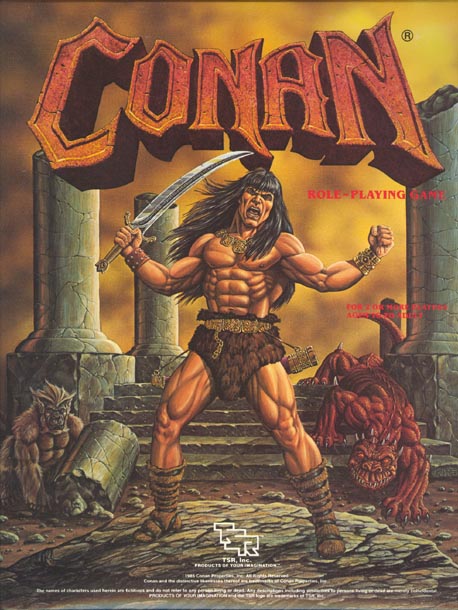
Retrospective: Conan Role-Playing Game

In my opinion, one of the things TSR did right during its existence was produce a wide variety of roleplaying games rather than endlessly churning out material for Dungeons & Dragons. There are several reasons why I think this is so, the most important of which is that these new games provided an outlet for players and game designers alike to try new things without feeling the need to inflict their desire for novelty on D&D. By this I meant that a great many of the slings and arrows D&D suffered over the years have been the result of people getting bored of its ways of doing things and then trying to change it to suit different tastes. Far better in my opinion is to play or to create new games specifically that speak to those tastes.

In my early years in the hobby, my friends and I regularly stopped playing Dungeons & Dragons when we felt the call of a different genre or even style. TSR happily provided us with plenty of other games from which to choose -- Gamma World, Gangbusters, Star Frontiers, Top Secret -- as did other game companies. We rarely stayed away from D&D for long, but I think our regular "sabbaticals" from it helped keep us interested in it over the long term. I still think that way today, which is why I see it as a good thing for a group to play many different RPGs (so long as it doesn't give way to the dreaded "gamer ADD").

I bring this up because one of the last non-D&D TSR roleplaying games I remember buying was 1985's Conan Role-Playing Game. Designed by David "Zeb" Cook, it's a complete game in a single box, consisting of a 32-page rulebook, a 16-page reference guide, and a 48-page guide to the Hyborian Age. I remain amazed at how often TSR produced RPGs whose rulebooks were 64 pages or under; it's frankly a thing of beauty -- all the moreso because, in most cases, these games didn't need to be any longer. Conan was a fairly "light" game, using a series of six "talent pools" to adjudicate every action a character takes in the game. The pools are broad in nature (Prowess, Fighting, Endurance, Knowledge, Perception, and Insight), under which are more specific talents that represent areas of unusual skill, like Brawling for Fighting or Reading/Writing for Knowledge. Talent checks are resolved using percentile dice and compared to a color-coded result chart, as was the style at the time. In cases where a character is attempting to do something an NPC is opposing (combat, for instance), two talents are compared, with the opposing talent subtracted from the active one to determine what line on the chart to read. Though the rulebook didn't do a particularly good job of explaining all this, in practice, the system was quite easy to use.

For my friends and I, though, what made Conan such a fascinating game, aside from its source material, was its character creation system, which encouraged players to think about who their character was and how he fit into the Hyborian Age. The "character folio" (i.e. record sheet) included a section entitled "story" with a series of blanks for the player to fill in, like Mad Libs. So, it would say "(Character Name), (Sex) of (Father) and (Mother), was born in the land of (Homeland). (Character Name) grew (Appearance). As a youth, (Character Name) learned (Talents)." And so on. The idea is to frame one's character abilities into something that is coherent, interesting, and fitting for an adventurer in a Robert E. Howard yarn. It's a simple thing really, but I can't stress how revelatory this approach was to my friends and I. We found it so much easier to get into the spirit of things this way.

Of course, it probably helped that Conan Role-Playing Game was clearly a labor of love on the part of David Cook. His fondness for the stories of Conan is well known and this game is like a love letter to the tales of the Cimmerian. For example, the game's magic system is mechanically loose and difficult for characters to master, with many opportunities for both disaster and long-term consequences. This is, of course, as it should be, for magic in the Hyborian Age is usually a dark affair not to be trifled with. This didn't stop one of my friends from creating a sorcerer character, named Talon after the twisted bird-like claw he had on one hand -- a reminder of his playing with things Man Was Not Meant to Know. Just as well presented is the game's setting, which is presented in the form of a faux notebook written by an archeologist named Ervin H. Roberts who was convinced that there was "an age undreamed of" in prehistory. It's a little silly, of course, but in a good way that I think encourages fun rather than hinders it.

I vaguely recall that TSR produced a handful of modules of to support Conan Role-Playing Game (in addition to those produced for AD&D), but I may be misremembering. Regardless, I don't believe the game did very well for the company, or at least it didn't do well enough, because it wasn't on store shelves for long. I think that's a shame, because Conan was well-presented, straightforward, and fun. It could never replace Dungeons & Dragons in the eyes of my friends and I, but that's hardly the benchmark by which a game ought to be judged. Unfortunately, I think that's exactly the benchmark TSR used, which is why most of their non-D&D RPGs had extremely short lives. A pity.

Monday, November 7, 2011

Crom the Barbarian!

Numbered amongst Gardner Fox's many comic writings is a sword-and-sorcery tale called "Crom the Barbarian!," which appeared in the June 1950 issue of Out of This World. The story borrows heavily (and shamelessly) from Robert E. Howard's Hyborian Age for ideas and names, so it's not exactly a work of art. Still, it's one of the earliest S&S comics in existence and I thought others might get a kick out of it. Here's the first page:
You can see scans of the whole story here, in this thread at the official Conan forums, where poster Theaganes made them available. "Crom the Barbarian!" is in the public domain, too, so if anyone out there is looking for a hot property to base their next old school RPG on, feel free to make use of this one.

Saturday, September 3, 2011

REVIEW: Song of the Beast-Gods

As regular readers of this blog ought to know, I haven't counted myself a fan, let alone a player, of D&D III for many years now. Indeed, it was my dissatisfaction with that game that brought me back to the games I played in my youth and that I'm playing today. Consequently, I haven't been keeping a close eye on events in the D20 world; it's generally only when someone brings one of its products to my attention that I take notice. It's rare still that I find myself enjoying a D20 product enough that I wish there were some way I could work it into my OD&D campaign -- but that's exactly how I felt after I read Morten Braten's adventure, Song of the Beast-Gods.

This should come as no surprise, since I'd already read and enjoyed Braten's previous adventure The Spider-God's Bride, which, like the present one, is written for the D20 system and set in a fantasy world called Xoth. Xoth is a fascinating setting, calling to mind both Howard's Hyborian Age and Clark Ashton Smith's Zothique, suffused with hints of eldritch horror. It's almost tailor-made for the kinds of pulp fantasy adventures I most enjoy. This fact probably goes a long way toward explaining why I found it easy to overlook the D20 stat blocks and related mechanics and see Song of the Beast-Gods for what it is: a fun sword-and-sorcery adventure for characters of 2nd to 3rd levels.

Before discussing the contents of this adventure, allow me to briefly discuss its appearance and presentation. Like its predecessor, Song of the Beast-Gods uses a two-column layout for its dense text. I occasionally found it slightly hard to read, but that probably says more about my aging eyes than the layout itself. Maps, important details, and notes to the referee are highlighted through the use of boxes. Titles and headers use evocative -- but legible -- fonts that contribute greatly to the pulp fantasy feel of the adventure, as does the artwork, which is a mix of original pieces and public domain engravings. All in all, Song of the Beast-Gods is attractive and well put together, something I find particularly impressive because it's the product of a one-man operation, with Braten acting as writer, cartographer, and graphic designer.

The adventure itself concerns events in the city of Khadis, where, until two decades ago, the Great Red Sphinx "was placated every year with offerings of treasure and blood." That all changed, when the High King of Yar-Ammon instituted a religious revolution that overthrew the old gods, such as the Great Red Sphinx, and replaced them with a previously unknown deity, the First One. To cement this reformation, the petty king of Khadis sacrificed his eldest daughter, who was being groomed as a priestess in the old faith, to the First One, an act that reverberates even unto the present day, when the player characters make their appearance ...

It's difficult to say more about the adventure without spoiling its secrets. Suffice it to say that events two decades ago did not go quite the way that history records them. This provides an opening for the PCs to become enmeshed in several plots within the city of Khadis that have far-ranging repercussions. What I most liked about Song of the Beast-Gods was that it is, at its heart, a location-based adventure. Certainly, there are plots, but these plots are the plans of various people seeking to take advantage of the situation in Khadis rather than a foreordained sequence of events the referee is expected to follow. Thus, there are no pre-arranged "scenes" or lengthy sections of boxed text to be read as long-winded NPCs try to involve the PCs in their schemes. Instead, what we get are situations, along with detailed descriptions of adventuring locales -- the city, the royal palace, dungeons -- and it's up to the players and referee to use those things to craft an adventure of their own.

For this reason, I think it'd be quite easy to ignore even the situations described in the adventure and simply use its maps, locales, and new monsters on their own. Of course, doing so would deprive one of what I think is a terrific scenario filled with both exuberant sword-and-sorcery excitement and the potential for further developing the fallout from the events the PCs set in motion. Song of the Beast-Gods is the kind of adventure that could easily kick off an entire campaign and a pretty interesting one at that. That alone makes it worth the $5 cost of the PDF ($12 for print). My only real qualm in recommending this adventure is that it's not specifically written for older versions of D&D and thus using it will require a certain amount of conversion but nothing too onerous. In the end, it's Morten Braten's ideas that are this product's main selling point and they're very compelling if, like me, you prefer your fantasy with a healthy dose of pulp.

Presentation: 8 out of 10
Creativity: 8 out of 10
Utility: 8 out of 10

Buy This If: You're looking for a well-done, low-level sword-and-sorcery adventure and don't mind doing a little conversion work.
Don't Buy This If: You either have no interest in sword-and-sorcery or are unwilling to convert D20 mechanics to your preferred system.

Monday, August 8, 2011

Brief Gaming Thoughts on Re-Reading The Lord of the Rings

I've previously mentioned that I'm reading The Lord of the Rings aloud to my daughter, which has proven a very eye-opening experience. Doing so has occasioned two gaming-related thoughts in me, one of broader interest and one with regard to my own Dwimmermount campaign.

I'll start with the more specific one first. Right now, in our reading, we're at the point where the Company has entered Moria and are attempting to find their way out. Moria's frankly an amazing creation -- a vast mountain fortress fallen into ruin and now home to numerous fell monsters. Reading it I found myself realizing just how much Moria must have unconsciously influenced my conception of my Dwimmermount megadungeon. I suppose that shouldn't be a surprise. Moria's one of the better examples of something approximating a megadungeon in fantasy literature and I doubt there are very many old school gamers who aren't familiar with it. Still, when I began my campaign, I made an effort to keep it as Tolkien-free as possible. Looks like I failed.

That brings me to my broader thought. One of the "themes," if you will, of a goodly percentage of the old school renaissance is the embracing of early pulp fantasy and the downplaying, if not rejection, of both later fantasy more generally and Tolkien in particular. I still think immersing oneself in the books and authors of earlier eras is an important part of understanding where D&D came from. It's also a useful corrective to the popular notion that D&D is a game about playing "heroes" on an "epic quest." But I have to admit that, in recent days, I've started to fall in love again with Middle-earth and that's made me reconsider the hard line I've taken against including certain Tolkien-derived elements in my Dwimmermount campaign.

It'll be interesting to see what, if any, effect this has on the campaign as it further evolves through play.

Pulp Fantasy Library: Thunder in the Dawn

Assuming the name "Henry Kuttner" occasions any recognition whatsoever, it's likely in relation to his wife, C.L. Moore, who created such memorable pulp fantasy characters as Jirel of Joiry and Northwest Smith. Of course, it's also possible one might recognize Kuttner's name from his stories inspired by the work of H.P. Lovecraft, though these are not as well known, let alone read, as the Mythos tales of some of his contemporaries. It's far less likely that one knows Kuttner for his sword-and-sorcery tales set in a pre-sunken Atlantis, four of which appeared in Weird Tales between 1938 and 1940.

The first of these stories is a novella called "Thunder in the Dawn," which was long enough to split into two parts and published in the May and June 1938 issues. This story introduces us to the swordsman Elak and his sidekick Lycon. Not long after he appears in a tavern in the seaside city of Poseidonia, an assassin sets upon Elak, using both magic and blade in his task. Elak escapes death because of the unexpected arrival of yet another man, a druid by the name of Dalan, whose own command of fire magic defeats the assassin. Together, they interrogate the would-be killer and learn that he was sent by a warlock (unimaginatively) named Elf.

Lycon, like the reader, is left confused by this turn of events. Why does Elf wish to slay Elak?
Elak shook his head. "Tell him, Dalan."

"Cyrena? The northernmost kingdom of Atlantis?" Lycon asked. "I know Orander rules it, but that's all."

"A dozen years ago Norian ruled Cyrena," the Druid said. "He had two stepsons, Orander and Zeulas. Zeulas killed him."

Elak moved uneasily.

"Zeulas killed him," Dalan repeated, "in a fair fight, and both men had provocation. Because of this Zeulas, though he was the elder, did not assume the crown. He left Cyrena to wander, a homeless vagabond, through Atlantis."

Lycon turned to stare at Elak. "By Ishtar! You don't mean--"

"He is Zeulas," the Druid said. "His brother, Orander, rules in Cyrena. Or -- did rule."
With Elak's true identity revealed, the trio set off on a quest to save Orander and defeat the warlock Elf. Along the way, they are joined by Lady Velia, Elak's one-time lover whom they free from her abusive husband. There are giant spiders, humanoid monsters, elementals, and more. The result is something that feels remarkably like a D&D adventure. There are even frequent references to the Nine Hells and the fiendish entities that dwell there.

"Thunder in the Dawn" is a quick, fun read, but, beyond escapism, it lacks much in the way of lasting value. Compared to, say, many of Howard's Conan yarns, it's amazingly shallow and "fluffy." Indeed, there are times when it feels like an attempt at a pastiche of Howard, with its evocation of a pseudo-historical past age and its appropriation of names of real-world places and cultures (the Vikings and the Picts) to lend verisimilitude to its narrative. Kuttner isn't much of a stylist either; his descriptions are often cursory and his plotting simple. However, his dialog can be quite effective, especially in its use of humor and irony. He's no Clark Ashton Smith or Jack Vance, but I think he is superior to Howard in this regard. It's largely for this reason that I found myself enjoying "Thunder in the Dawn" despite its many inadequacies. There were even times when I was reminded of Fritz Leiber in the interactions between Elak and Lycon -- and that's never a bad thing.

Monday, February 28, 2011

Pulp Fantasy Library: The Ring of Set

Written in 1960 but not published until 1977 (in the anthology Swords Against Darkness), "The Ring of Set" is Richard L. Tierney's first tale of Simon of Gitta, the Samaritan gladiator-turned-sorcerer who lived during the 1st century A.D. Simon of Gitta is a fictionalized version of the Biblical personage Simon Magus, who appears as Saint Peter's antagonist in the Acts of the Apostles and after whom the sin of simony (the buying and selling of Church offices) is named. Tierney, however, portrays Simon is a largely positive light, turning him into a magical adept doing battle against the Cthulhu Mythos as reinterpreted through the lens of Gnosticism, with Yog-Sothoth standing in for the Demiurge.

Tierney is a fascinating writer. He has a long association with the writings of both Robert E. Howard and H.P. Lovecraft, an association that comes through quite clearly in "The Ring of Set." Much of Tierney's fictional output was devoted to several novels (in collaboration with David C. Smith) about Roy Thomas's Red Sonja, a character Tierney and Smith tried to portray as someone more genuinely "Howardian" than her original conception. Whether they succeeded or not remains a matter of debate. Tierney also wrote a Bran Mak Morn pastiche (again with David C. Smith), as well as editing two collections of Howard's historical yarns. He's notable too for having been one of the earliest Lovecraft commentators to suggest that August Derleth had distorted the meaning and themes of HPL's stories, a position that was controversial in the early 1970s but has since become widely accepted.

What's interesting is that, while critical of Derleth's presentation of the Mythos, Tierney nevertheless makes some use of it, albeit from a skewed perspective. Tierney's Gnostic-tinged vision accepts that the Great Old Ones are in rebellion against the Elder Gods, but Tierney portrays the Elder Gods as distant and uncaring about humanity and the myriad other creatures that have arisen in the universe they have created. In this environment, humanity can expect no celestial aid against the Great Old Ones and must instead use whatever resources are at hand to preserve itself in a cold, unfeeling universe. Given that, Simon of Gitta's sorcerous adventures make a great deal of sense. As a "true spirit," who understands the nature of reality, he seeks out spells and ancient artifacts to aid him in his quest for transcendence.

"The Ring of Set" is thus a fun sword-and-sandal tale about Simon's efforts, on behalf of his current mentor, Ka-nephru, highest priest of Ptah in Thebes, to obtain a cursed ring -- the eponymous Ring of Set -- that has been stolen and put up for auction in Rome, where its eventual buyer is none other than the emperor Tiberius. Simon attempts to warn Tiberius of the ring's danger:
"The ring is old, older than all the nations of the earth. It was owned by Thoth-Amon, a sorcerer who lived ten thousand years ago in the land which is now called Egypt. The ring was old even then, but Thoth-Amon learned of its powers and used them to call up demons to do his bidding. His enemies died with the marks of fangs and claws on their bodies, and for a time none could resist his power.

"Yet the ring was not all-powerful: Once, Thoth-Amon invoked its power to destroy a king -- but the king had an ally who a greater sorcerer than even Thoth-Amon, and the ring's power was turned aside The king lived, and later Thoth-Amon died, but the curse was still on the ring and has never been lifted. Since then several kings have tried to wear the ring, but each died a terrible death, so that at last the priests of Egypt hid the thing beneath one of their altars -- and there it lay for nearly ten thousand years, until Diomed's curiosity brought it to light once more."
Tierney is here referencing the very first Conan story, "The Phoenix on the Sword," where Thoth-Amon makes his only canonical appearance in the Hyborian Age. It's also worth noting that Howard himself used the Ring of Set outside of "The Phoenix on the Sword," placing it in the Lovecraft-inspired John Kirowan story, "The Haunter of the Ring."

Tiberius doesn't heed Simon's warning, instead arresting him and throwing him into prison. Soon, though, Tiberius' nephew and heir, Gaius, comes to Simon with a proposition:
"I do not mock you, Simon of Gitta," said Gaius, bending forward and speaking in a low, intense voice. There was a strange gleam in his deep-set eyes. "Tiberius pretends to scoff at the hidden powers of magic, but I am not such a fool. Do you know that the Emperor has fallen ill? Aye, it happened but an hour after he had left the auction-place, and though he vows it is but a passing sickness I can see death approaching in his eyes. The ring is responsible, Simon -- I know it is the ring!"

"What do you want of me, then?"

"The ring, Simon -- and the power to wear it. Old Tiberius has named me his heir, and when he dies I will be Emperor of Rome. Yet an emperor has many enemies -- his throne is never secure. With the power of this ring at my command I would never need fear their plots; my enemies would fall to the fangs of demons, and none could ever dare hope to dispute my rule!"
How Simon responds to Gaius' proposition and the events that follow make up the bulk of the story and an enjoyable one it is.

Tierney clearly has some axes to grind, both historical and religious. Indeed, some of them come across to me as somewhat puerile, the kind of thing an adolescent would do to tweak his elders' sensibilities, though little of this is evident in this story. That said, there's no denying that the mixture is Howardian swords-and-sorcery, Lovecraftian entities, Gnostic nonsense, and the ancient Roman setting is a heady one. Despite my dislike of Simon, who's arrogant and self-absorbed, Tierney has created something very compelling in "The Ring of Set" -- so compelling that I eventually read as many of his Simon of Gitta's tales as I could. Though, as I said, I didn't find Simon particularly sympathetic as a protagonist, the world he inhabits is a terrific one and great inspiration for anyone looking to find a way to blend Howard and Lovecraft or to create a dark historical fantasy (or both). Consequently, I recommend the story most highly, if you can find a copy.

Tuesday, October 26, 2010

Holmes's Appendix N

Dr. Holmes, of course, didn't have an actual Appendix N, but he did digress briefly in his Fantasy Role Playing Games to give the reader his thoughts on the literary inspirations of both D&D in general and his own campaigns. This digression, I think, ought to viewed side by side with the even briefer comments made on the subject in the Blue Book, where he lists Tolkien, Leiber, Howard, Fox, and Greco-Roman mythology as the game's main inspirations.
Literary inspiration for the worlds of fantasy role playing games comes from many sources. The fantasy worlds of Dungeons & Dragons and Chivalry & Sorcery are based on myth and fairy tale. The field of literature is dominated by the work of one man in this century: J.R.R. Tolkien. Without the popularity of The Hobbit and The Lord of the Rings, fantasy role playing would not have found the wide public it now enjoys. Despite this, most fantasy games are closer to the wild, bloodthirsty worlds of Fritz Leiber, Robert E. Howard, and L. Sprague de Camp. The magic system of Dungeons & Dragons is partly derived from the books of Jack Vance. De Camp's The Compleat Enchanter discusses magic as a separate kind of reality with its own rules of logic. As a Dungeon Master, I have drawn extensively from the works of A. Merritt, Andre Norton, Clark Ashton Smith, Lord Dunsany, Edgar Rice Burroughs, and H. Rider Haggard.
As he so often does, I think Holmes strikes the right balance here, pointing out that, while D&D really has more in common with swords-and-sorcery literature in the vein of Howard and Leiber, it was the wide popularity of Tolkien's works that laid the groundwork for the fantasy roleplaying fad in the late 70s and early 80s. I think this squares well with Gygax's contention from 1974 on that the direct influence of Tolkien on D&D was superficial, while its influence on many gamers was significant.

Monday, June 21, 2010

Pulp Fantasy Library: The Shadow Kingdom

August 1929 marked the first appearance of Robert E. Howard's original barbarian hero, Kull of Atlantis, when the story "The Shadow Kingdom" appeared in the pages of Weird Tales. Considered by some to be the first true swords-and-sorcery story as we now understand the genre, "The Shadow Kingdom" shows us Kull after he has already ascended the throne of decadent Valusia, the greatest of the Seven Empires of the pre-cataclysmic Thurian Age, which precedes Howard's more well known Hyborian Age.
Not on the Topaz Throne at the front of the regal Tower of Splendor sat Kull, but in the saddle, mounted on a great stallion, a true warrior king. His mighty arm swung up in reply to the salutes as the hosts passed. His fierce eyes passed the gorgeous trumpeters with a casual glance, rest longer on the following soldiery; they blazed with a ferocious light as the Red Slayers halted in front of him with a clang of arms and a rearing of steeds, and tendered him the crown salute.
Despite the exultant shouts that greet Kull and his soldiers as they return home from war victorious, not everyone in Valusia is pleased:
"Kull! Ha, accursed usurper from the pagan isles." -- "Aye, shame to Valusia that a barbarian sits on the Throne of Kings."

Little did Kull heed. Heavy-handed had he seized the decaying throne of ancient Valusia and with a heavier hand did he hold it, a man against a nation.
More worrisome than such sinister whispers against him is the news that Ka-nu, an advisor to the king of the Picts, the traditional enemies of Kull's own Atlantean people, has requested a private audience with Valusia's barbarian ruler. Though suspicious, Kull puts aside his prejudices against the Picts and agrees to this meeting, going alone to meet with Ka-nu, a "soft and paunchy" old man seemingly "fit for nothing except to guzzle wine and kiss wenches!" After the two men feel one another out, Ka-nu comes to the point:
I see a world of peace and prosperity -- man loving his fellow man -- the good supreme. All this can you accomplish -- if you live!"
Ka-nu warns Kull of a plot against his life, fomented with the help of Baron Kaanuub of Blaal, a former rival of Kull who still seeks the throne of Valusia for himself and his shadowy allies. To ensure that Kull does not die -- and a glorious future along with him -- Ka-nu promises to send along a bodyguard, a Pictish warrior named Brule the Spear-slayer, who will stand with Kull against the secret enemies who seek his death. As a show of good faith, he entrusts Kull with a green gem stolen from the Temple of the Serpent, possession of which means execution. If what he has said is untrue or if he in any way betrays him, Kull need only accuse Ka-nu of the theft of the gem and be rid of him. This gesture on the part of a Pict intrigues Kull and agrees to his plan, even though there is much the barbarian king still does not understand.

What follows is a superb fantasy tale that includes equal parts palace intrigue, feats of derring-do, and eldritch horror. It's a heady combination that, while sharing many similarities with Howard's later work on Conan, nevertheless strikes a different tone, one that is more melancholy and thoughtful about the inevitable decline of civilization than many might expect.
"You are young," said the palaces and the temples and the shrines, "but we are old. The world was wild with youth when we were reared. You and your tribe shall pass, but we are invincible, indestructible. We towered above a strange world, ere Atlantis and Lemuria rose from the sea; we still shall reign when the green waters sigh for many a restless fathom above the spires of Lemuria and the green hills of Atlantis and when the isles of the Western Men are the mountains of a strange land.

"How many kings have we watched ride down these streets before Kull of Atlantis was even a dream in the mind of Ka, the bird of Creation? Ride on, Kull of Atlantis; greater shall follow you; greater came before you. They are dust; they are forgotten; we stand; we know; we are. Ride, ride on, Kull of Atlantis; Kull the king, Kull the fool!"
Kull himself is similarly melancholy and thoughtful despite his rough heritage. He cares about Valusia and her people and acts accordingly. His willingness to believe Ka-nu and accept Brule as his companion is motivated as much by a desire to see that his kingdom does not fall into the hands of evil men -- or worse -- as by his desire to save his own life. Kull is thus a sympathetic figure and one with whom I found it easy to identify. He's also a subtle counterpoint to Conan, another barbarian turned king of a civilized but decadent people. Though both are unmatched warriors, Kull lacks Conan's bombast and bluster. Kull also seems less interested in the pleasures of this world, being more focused on ideals and a sense of duty to others. No one could mistake the two characters, despite some surface similarities between them.

I've seen it said, with some merit, that a writer's earliest works are often his best, even if they lack the polish and sophistication of his later efforts. I think this holds true for "The Shadow Kingdom," which I like a very great deal. The writing is a bit more stiff and formulaic in it than in, say, most of the Conan stories, but I think its characters and ideas are very strong and possess a kind of inchoate energy to them that I sometimes find lacking in the lesser Conan tales. Perhaps I'm biased because I find Kull more like myself than I find Conan, I don't know, but I genuinely love this story, which, regardless of its position in Howard's overall literary corpus, is a great story in its own right and well worth a read.

Monday, May 17, 2010

A Small Regret

If I had it to do over again, I'd probably not have included dwarves or elves in my Dwimmermount campaign. It's not that I really object to their presence -- this is a D&D campaign, after all -- but, as the sessions add up, I find that certain elements of the setting would probably have worked better if humans were the only playable races. For example, death, dying, and the quest for immortality have all become important elements of the campaign, with the the appeal of the cult of Turms Termax being at least partly based on its promise of eternal life to its elite members. But the lengthy lifespans of demihuman races undercut the cult's appeal somewhat, even if neither dwarves nor elves are truly immortal.

Now, as I always do, I've begun thinking about ways to address this within the campaign setting and the result might, in the end, be more satisfying than the straightforward approach I could have adopted in a human-only setting. Still, there's little question that it would have been simpler (and truer to my inspirations) if I'd ditched demihumans at the start. On the other hand, part of what makes D&D the game that it is is its selection of playable demihuman races. You can get rid of them or replace them with others, of course, but, the more you change that "starting lineup," the farther you drift away from the peculiar kind of fantasy D&D evokes. So, there's a balance to be struck, I guess, between leaving too much unchanged for tradition's sake and changing so much that the result is unrecognizable.

More food for thought, I guess.