Showing posts with label marsh. Show all posts

Wednesday, October 2, 2024

Retrospective: The Complete Psionics Handbook

The Complete series of rules supplements for Advanced Dungeons & Dragons Second Edition was, at the time of its inception at the tail end of the 1980s, a genuine innovation – supplements specifically focused on a particular character class or race and providing new ideas, rules, and options for use with them. Later, thanks in large part to White Wolf's "World of Darkness" games, this type of book would become commonplace in the hobby, but, when the Complete series first appeared, there were few prior examples of these "splatbooks," as they'd become known in the gamer argot.

Despite my TSR fanboy proclivities, I never embraced the Complete books. I liked them in principle but was never impressed with their actual content. I also recognized quite early on that their mere existence would likely place a lot of pressure on Dungeon Masters to adopt them, since many players would want access to new options for their characters. Furthermore, I anticipated an inevitable power creep in these options, as each new book in the series tried to outdo its predecessors.

Because of this, I didn't consider the Complete books must-buys and, after the first two, intended to avoid them entirely. However, early in 1991, TSR released the fifth book in the series, The Complete Psionics Handbook, and I was sufficiently intrigued that I bought it as soon as I saw a copy. Written by Steve Winter, this 128-page book presents a completely new system for introducing "extraordinary psychic powers" – psionics – into AD&D, with an eye toward making their use clearer and easier to use for both players and DMs. Psionics had been a part of Dungeons & Dragons since the publication of Eldritch Wizardry in 1976. That original version, created in part by Steve Marsh, served as the foundation upon which the AD&D Players Handbook would later build its own expanded version of psionics. Neither version was, in the opinions of many, clear or easy to use, so a revision was definitely needed.

Winter's psionics system took a lot of inspiration from the earlier versions but was nevertheless its own thing. He carried over a lot of the names and concepts found in Eldritch Wizardry and the Players Handbook, like ego whip and tower of iron will, for example, and placed them within a large, better conceived mechanical framework. One of the biggest problems with the earlier systems was that they felt very ad hoc and unbalanced. There was scarcely any attention given to how psionics would work in relation to other aspects of the AD&D rules. By contrast, these concerns seem to have been at the forefront of Winter's mind as he wrote The Complete Psionics Handbook and it shows.

First and foremost, psionics in this book are primarily the purview of a single character class: the psionicist. While it's still possible for members of other classes to possess a "wild talent," that's unusual. By taking this approach, Winter analogizes psionics with spellcasting and indeed could be said to have reimagined psionics as an alternate magic system – the points-based system that so many D&D players had been desiring almost since the game's beginning. One of the advantages of this approach is that it enabled psionicists to operate as just another character class alongside all the "standard" ones rather than being these weird – and potentially overpowered – outliers whose presence was likely to upset a campaign.

Reimagined as members of a new class, psionic characters' powers and abilities are now tied to level, just like all the classes. As a psionicist advances, he gains new psionic disciplines, devotions, sciences, and defense modes, as well as more psionic strength points (PSPs) in pretty much the same way a cleric or a magic-user gains new spells with experience. This is a simple and frankly obvious change that turns psionics into something that's workable even at low levels of play, something that was often not true in previous versions. In additional, all psionic powers are better detailed and described, giving players and DMs a better handle on what they can and cannot do within the game. It's all very well done.

At the time of its release, I had nothing but praise for The Complete Psionics Handbook. It had managed to take a strange edge case within the rules of First Edition AD&D (and OD&D before it) and convert it into a system that I could actually imagine myself using and enjoying. Not only that but I found myself actively thinking of ways I could do so. Winter's version of psionics felt fresh and fun and, above all, playable, a word I'd never have used to describe any previous version of psionics. That's no small feat and one of many reasons why I am ever more convinced that, despite the distaste many show for it in this corner of the hobby, I can't bring myself to say that Second Edition was an unmitigated disaster. If it was capable of fixing psionics, how bad could it be?

Monday, June 10, 2024

The Adventure is Yours

Throughout 1982 and into 1983, I regularly saw this full-page advertisement for the Moldvay/Cook/Marsh Dungeons & Dragons boxed sets in the pages of Dragon.


The ad is interesting to me for a couple of reasons. First, the image at the bottom left, showing five people sitting at a table playing D&D (with the cover of Keep on the Borderlands clearly standing up in front of the DM) seems to depict the same group of people who appear in a TV commercial from around the same time. That suggests that this print ad was part of a larger, multi-prong effort to introduce "the world's most talked about role-playing adventure" to a wider potential audience. 

Second, the ad features artwork in a style quite distinct from that of any artist I associate with D&D of that era. Since there's no obvious artist's signature, identifying its origin is difficult. It's possible that this question has already been resolved. If so, I'd love to know the identity of the artist. Beyond that, it's also noteworthy, I think, that the illustration depicts three characters (who appear to be a thief, a magic-user, and perhaps an elf) walking/riding at night through the streets of a fantasy setting rather than something more obvious, like a party fighting a dragon or some other monster. Perhaps the marketing people felt this was redundant in light of the inset pictures of the two boxed sets, one of which shows that very scene.

I have no idea how effective this advertisement was in its intended purpose, but I've always liked it.

Wednesday, December 20, 2023

Hidden Details

Because of my post about the limited pop cultural footprint of Dungeons & Dragons as a game, several readers pointed me toward the image below, which I've enlarged as much as I could. It's a still from the 1986 Jim Henson-directed, George Lucas-produced, and Terry Jones-penned fantasy movie, Labyrinth. 

In case it's not clear from the image above, there's a copy – seemingly still in shrinkwrap – of the 1981 David Cook/Steve Marsh Expert Set on a bookshelf in the film. I've admittedly not seen the movie recently, but I suspect this is a blink-and-you'll-miss-it moment rather than something that's given any prominence. Certainly, no one in the movie plays D&D or even references it in any way, so I'm not at all convinced that it's particularly relevant to the point of my earlier post. I imagine it's more likely a case that someone on Labyrinth's production team thought the box "looked cool" and then placed it on the set. I doubt anyone before the advent of high-resolution home video even noticed it; I certainly didn't.

I wouldn't be surprised to discover that there are other movies and TV shows from the 1980s that feature, as background details, Dungeons & Dragons and RPG-related paraphernalia. However, I don't believe their number would be very large, or else they'd be better known. I know that, when I was a kid, I made a big deal out of even the flimsiest connections to my beloved hobby. If there are more instances like this out there, they must be very well hidden indeed.

Monday, February 6, 2023

Hex Help

Much as I adore the incomparable map of the Flanaess from the World of Greyhawk – perhaps the best RPG map ever – over the last few years I've really come to appreciate the style of hex map that appeared during the Moldvay/Cook/Marsh era of Dungeons & Dragons. Though nowhere as artful in their presentation as Darlene's gorgeous work, the B/X hex maps do nevertheless have a beauty all their own, one born of clarity and utility. They are very easy to read and to use in play, especially if, like me, you are saddled with eyesight that's nowhere near as sharp as it once was. This fact alone counts for a great deal nowadays.

That's why I'd like to prevail upon the collective knowledge of my readers. Are there any programs out there that might enable an incompetent Luddite such as myself to make rough approximations of these maps? Once upon a time, there was a program called Hexographer that came close to doing so, but its current iteration looks much too complex for some of my limited skills to use effectively. Are there any alternatives readily available or must I buckle under and learn how to use this new version of Hexographer?

Monday, December 27, 2021

My Top 10 D&D Illustrations of the Golden Age (Part I)

Ever since I started doing these Top 10 lists earlier this month, I've received a lot of positive feedback, including email suggestions of other lists I could present. One of the most requested of these other lists concerns the art of Dungeons & Dragons, namely my favorite pieces. There's no question that this is a good topic for a list and will generate a lot of discussion, but I must admit to some hesitation nonetheless. Judging art is often subjective, especially gaming art, appreciation of whose qualities can depend on numerous factors beyond the specific piece of art under discussion. It's also been my experience that there's something of a difference in tastes between age cohorts of D&D players, with those encountering the game in the mid to late 1980s having a different notion of what makes good D&D art than those, like myself, coming from just a slightly earlier era.

Nevertheless, I do think there's something to be gained by proposing a list of my Top 10 D&D illustrations. As before, I am limiting myself to the Golden Age of the game, since it's the era when I first encountered it. The imagery of that era made a strong impression on me and, as a result, most of what I think of as the best illustrations for the game were created during its first decade of publication. Also as before, I make no claims to objectivity or universal appeal. The ten illustrations that will appear here and in its follow-up post later in the week are those that I like, for reasons I will explain. Naturally, some will disagree, perhaps vehemently with my choices and that's fine. My only hope is that, in offering my list, I might encourage conversation rather than mere argument.

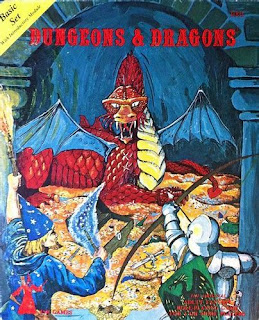
10. Dungeons & Dragons Basic Set (1977)

This painting, by David C. Sutherland, is perhaps the very first piece of D&D art I ever saw and is, therefore, forever linked with the game in my imagination. There was simply no way I could justify excluding it, despite its clear technical deficiencies. Of course, if I were to exclude illustrations on such a basis, I'd have to rule out almost all of those on this list. Even so, there's a lot to like in this particular piece, starting with the fact that it clearly shows a knight in historical armor standing beside a traditional-looking wizard as they face off against a dragon resting atop a vast treasure hoard. For a game called Dungeons & Dragons, this is nearly ideal in conveying what the game is about. I can't tell you how many hours I probably spent staring at this image in late 1979 and early 1980. The illustration reached out and seized me in a way I still cannot adequately explain. In my mind's eye, this is what D&D looks like. 

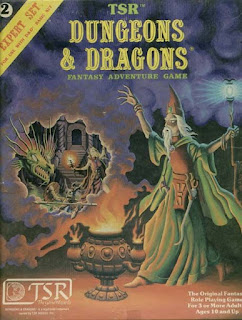
9. Dungeons & Dragons Expert Set (1981)

This is a slight cheat, in that the cover for the Expert Set by Erol Otus also incorporates a portion of his Basic Set cover as well. That said, I actually like the Expert Set illustration a bit more, since it highlights one of Otus's funky wizards, whom I found equally fascinating and unsettling as a youth. More to the point, since I already owned the Holmes-edited Basic Set (see above), I didn't see any immediate need to buy the 1981 Moldvay set, opting for the Expert Set alone (a situation I would later rectify). In fact, I often stuffed the Expert rulebook inside my Holmes box when I took it with me to friends' homes to play. Together, they formed the basis of my foundational D&D experiences and I find it hard to separate the two. However, I rate this illustration slightly higher solely on the basis of the greater skills of Erol Otus. His illustrations were always weird and evocative and did a lot to broaden my conception of what fantasy was and could be.

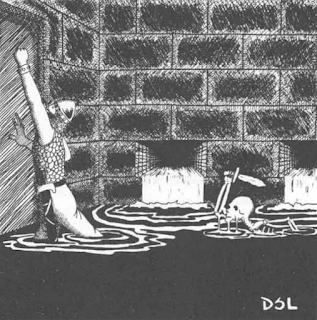
8. "Skeleton Trap" (1979)

This illustration, by David S. LaForce, appears in the AD&D Dungeon Masters Guide. In terms of its composition, it's nothing special, but it's a piece that's fascinated me for decades nonetheless. What I think elevates it above so many other "better" illustrations is the sense of inexorable doom it conveys – a key feature of many early D&D sessions. The room is filling with water; the only means of obvious escape is barred. And there's also an animated skeleton in the room, emerging from beneath the water. Does the hapless fighter on the left know he's about to be attacked from behind? Is he simply more concerned about the rising water level in the room? I pondered these questions a lot when I was younger. Consequently, t's an illustration that's stuck with me over the years.

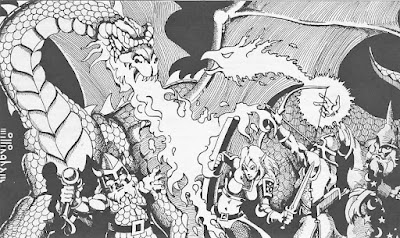
7. "Dragon Attack" (1981)

Unlike many of my peers, I've never been a huge fan of Bill Willingham's artwork. That's not a knock against Willingham's work, which is quite good but a little too "comic book-y" for my tastes. Nevertheless, I consider the frontispiece of the 1981 D&D Basic Set pictured above to be one of my favorite illustrations of the Golden Age. Much like the Sutherland cover to the Holmes Basic Set, it scores a lot of points simply for the fact that it depicts a confrontation with a dragon. Where it is superior to Sutherland's piece – and why it is higher on my list – is that it comes closer to depicting a proper party of adventurers, in this case a dwarf, an elf, a fighter, and a magic-user. The composition is a little odd, in that the adventurers are practically right on top of the dragon, but I can overlook that, because of how dynamic and exciting the scene is. 

6. "Treasure Hunters" (1977)


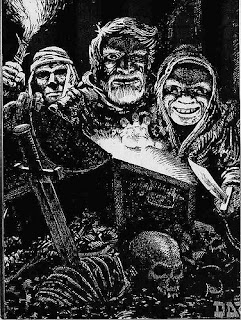
This Dave Trampier illustration, from the AD&D Monster Manual is favorite of mine for a number of reasons. For one, I think it's among Tramp's best pieces of work. The use of light and shadow is quite effective. For another, I love the faces of the three adventurers. They palpably evince greed, with the one on the far right unable to prevent his hand from reaching into the chest and grabbing what's within. Also, these aren't Hollywood handsome protagonists posing heroically for the cameras. They're rough and tumble rogues of the sort Robert E. Howard, Clark Ashton Smith, or Fritz Leiber might have created. They're perfect exemplars of the pulp fantasy literary inspirations of D&D that was largely discarded by later editions of the game. We need to see more dubious characters like this in D&D artwork, if you ask me.

Tuesday, December 7, 2021

White Dwarf: Issue #19

Issue #19 of White Dwarf (June/July 1980) features a wonderfully creepy cover illustration by Les Edwards, which I am certain I have seen before – perhaps several times. Unfortunately, my memory isn't what it used to be and I can't quite recall where else I might have gazed upon its magnificence. If any reader's brain is less addled than mine, I'd appreciate a helpful reminder. 

Ian Livingstone's opening editorial suggests that White Dwarf is doing well and so firmly established in the UK gaming scene that newcomers to it are seeking out back issues. However, he notes that many of these early issues are no longer in print and that, "due to recent increased printing costs," it is not economically feasible to reprint them. Instead, Games Workshop would soon be releasing two compendiums of material derived from early issues, one focusing on articles and one on scenarios. Relatedly, the same increased costs had necessitated a rise in the price of WD – 75p instead of 60p – though four more pages had been added in compensation.

The issue kicks off with Trevor Graver's "Criminals" for Traveller, which presents alternate careers for use with GDW's science fiction RPG. It's a good article in my opinion, though its career format is closer to that of Mercenary than the three little black books of 1977. That's not a damning criticism by any means, but I retain a preference for "basic" character generation over the "advanced" ones presented in later books. More interesting is its approach to ranks, which here are reimagined as "reputation" and map onto the criminal character's notoriety in the galactic underworld (and his worth as a bounty). 

"The Fiend Factory" continues, this time under the editorship of Albie Fiore. Don Turnbull, who originated the column, recently left White Dwarf to take up his duties as head of the new TSR UK. Fiore presents five new monsters, including two varieties of undead horses (one skeletal and one zombie-like). Elsewhere, Stephen Marsh and John Sapienza are the authors of a RuneQuest mini-scenario entitled "Jorthan's Rescue." The scenario concerns a wealthy noble, the titular Jorthan, who has been kidnapped by trollkin and whose wife hires the characters to bring him back alive. Intriguingly, the scenario includes two different versions of the map of the trollkin's lair, one more complex than the other, depending on the needs of the referee. I can't recall ever seeing a scenario that did something like this before, though, as I said at the start of this post, my memory isn't what it used to be.

Roger E. Moore, who would one day go on to be editor-in-chief of TSR's own Dragon magazine, has written "Berserker," a new character class for use with Dungeons & Dragons. The class is very similar in broad outline to the barbarian class we'd later see in D&D's Third Edition, with a focus on "battle lust," which empowers the berserkers attacks. Also included is an option for "berserker clerics" dedicated to appropriate gods of war or physical prowess. Intriguingly, there's a brief discussion of lycanthropic berserkers, no doubt due to the influence of the "bear-shirts" of Norse legend. Over the years, I've vacillated wildly in my feelings about additional and alternate character classes. These days, I'm much more well inclined toward them, which no doubt colors my generally positive opinion of this article.

"Ogre Hunt" by Tom Keenes is a mini-scenario for use with Chivalry & Sorcery. It's a pretty straightforward adventure, consisting of a brief wilderness journey to find the ruined tower where Moribund the Ogre dwells. Said ogre is terrorizing the countryside and so Lady Cynthia is offering a reward to anyone who can slay him. There adventure is nothing special in itself, but I appreciate seeing something written for C&S, a game for which I have an odd fondness, despite never having played it. "Open Box" presents five reviews, starting with Task Force's Starfire (8 out of 10) and Avalon Hill's Magic Realm (7 out of 10). Also reviewed are High Fantasy and Fortress Ellendar (4 and 7 out of 10 respectively). as well as Kinunir for Traveller (9 out of 10).

"Wards" by Lewis Pulsipher is a short article on magical barriers erected by magic-users to protect valuable locations and objects. Pulsipher offers four examples of such wards, including the spells needed to create them. Though brief, it's a clever idea and the kind of thing I appreciate seeing, namely an addition to D&D that doesn't require any new rules, only a repurposing of existing ones. "Treasure Chest" takes an unusual turn by presenting ten different NPCs for use with D&D. Most of them aren't all that special to my mind, but a few, like Fred, Bill, and Charly, a trio of troublesome and reckless fighting men rise above the pack. The issue closes with Chris Harvey's look at the computer moderated postal wargame, Starweb. Articles like this are time capsules of a very specific era, when the computer was a strange new technology and no one quite new what to make of them. 

Issue #19 was a fine one. White Dwarf has truly begun to hit its stride. Bring on issue #20!

Tuesday, May 4, 2021

Different Worlds: Issue #13

Issue #13 of Different Worlds (August 1981) opens with an article entitled "The Land of Faerie" by Scott R. Turner. It's an odd piece, in that it contains no game statistics whatsoever. Instead, it's an overview of a variety of  myths and legends about fairies – mostly from the British Isles – strung together as a semi-coherent whole. There's even a bestiary of sorts, which provides brief descriptions of many fairy creatures. Articles like these baffle me somewhat. They're usually too short to present information that most players of fantasy RPGs don't already know. Likewise, the lack of game-specific information limits their utility.

Strangely enough, Iain Delaney's "The Travellers' Aid Society" follows a similar pattern, being both very short and almost entirely lacking in game statistics. Rather, what Delaney offers is a limited and particular interpretation of the iconic organization from GDW's Traveller game. Even more so than "The Land of Faerie," it's too short to present anything a Traveller fan didn't already know, as well as lacking in game rules that might otherwise make it useful.

 The oddly titled "Role-Playing in the Land of Xanth" by Leonard Kanterman is, for the most part, a book review of first three volumes of Piers Anthony's series of fantasy novels. The review also provides cursory suggestions on how to use Xanth as a setting for a RPG campaign. At the risk of repeating myself, I found the article mostly useless, owing to its short length and lack of game rules. but I suppose it's possible that it might serve as an introduction to the setting to the uninitiated (assuming one considers that a good thing).

Jane Woodward's "The Cult of Erlin the Harper" is a gateway cult for RuneQuest. It's a very welcome counterpoint to the previous three articles, in that it contains a great deal of game-specific information that's useful even in RQ campaigns set on Glorantha. There are not only new music-based rune spells but also details of musical instruments and how they can used in the game. Steven Marsh's "Samurai Swords" follows a similar path, offering lots of details on the schools of Japanese sword-making and the weapons they made. Rather than simply being historical in nature, the article also provides rules for each type of sword, including possible magical powers associated with the weapons. It's more detailed than I expect most people need, but I couldn't help but appreciate the detail nonetheless.

John T. Sapienza reviews "Samurai Figures," focusing on those available from Ral Partha, Archive, and Stan Johansen. The accompanying photographs are quite nice. Lee Gold's Land of the Rising Sun and Dave Hargrave's Arduin Adventure are both reviewed positively, though with a few caveats in the case of the Arduin Adventure. Larry DiTillio's "Sword of Hollywood" looks at two movies, one I've heard of and one I have not. The first is Dragonslayer, which DiTillio liked a great deal. The second is The Archer: Fugitive from the Empire, which he also liked – indeed, he liked it well enough that he wants it to become a weekly television series. Gigi D'Arn's column talks a fair bit about a supposed scramble by various publishers to secure the righs to Conan the Barbarian-related game products, as well as hints of trouble at SPI. 

All in all, issue #13 is something of a disappointment to me. My guess is that the shift from bimonthly to monthly left Chaosium with less quality material to choose from for each issue and it shows. I hope that, as 1981 wears on, things will improve.

Wednesday, April 28, 2021

Retrospective: Thieves' World

I've long had a fondness for Chaosium's boxed sets, starting with Call of Cthulhu, the first RPG from the company I ever owned. From there, it was all downhill: with the exception of RuneQuest, I soon became a dedicated collector of Chaosium's boxed sets. Among those I treasured the most was Thieves' World, based on the fantasy anthology series of the same name edited by Robert Lynn Asprin. 

The boxed set, first published in 1981, consisted of three books and a collection of maps depicting the city of Sanctuary. The first book, Players' Guide to Sanctuary, serves as an introduction to not just the whole set but also its setting. Kicking off the book are two essays by contributors to the literary anthology, starting with Asprin's "Full Circle," which was simultaneously published in issue #12 of Different Worlds. Following it is "Thud and Blunder," Poul Anderson's essay skewering the excesses of sword-and-sorcery literature and a call to produce better entries in the genre. Rounding out the first book are discussions of the city, its inhabitants, history, and gods, as well as an extensive glossary of names and terms unique to Sanctuary.

The Game Master's Guide to Sanctuary presents a variety of articles on how to use the boxed set in one's campaign. These articles discuss bribery and graft, law and order, and the gods (in greater detail). More immediately useful are the extensive encounter tables, each tied to one of the city's districts. Each district gets its own article, including a map that describes the most important locales. In some cases, there are also maps of individual buildings. Wrapping up this book is a map of the city's sewers.

Personalities of Sanctuary is the third and perhaps most interesting book in the set. Each of its chapters describes the most important inhabitants of Sanctuary in terms of a different roleplaying game's rules – Advanced Dungeons & Dragons (by Lawrence Schick), Adventures in Fantasy (by Dave Arneson and Richard Snider), Chivalry & Sorcery (by Wes Ives), DragonQuest (by Eric Goldberg), Dungeons & Dragons (by Steve Marsh), The Fantasy Trip (by Rudy Kraft), RuneQuest (by Steve Perrin), Tunnels & Trolls (by Ken St. Andre), and Traveller (by Marc Miller). The last one is notable, as Miller offers three different ways to integrate Thieves' World into Traveller's science fiction setting. The most interesting of these options is one that postulates that Sanctuary is a computer simulation created for entertainment – a kind of MMORPG for the citizens of the Third Imperium. Concluding the third book is a collection of scenario ideas.

There are three large maps included in Thieves' World: one depicting the whole city, another the Maze district, and the last one the underground areas of the same district. The maps are lovely, as is typical for Chaosium products from this era. 

Thieves' World is an impressive boxed set and I deeply regret that I long ago got rid of mine in a moment of stupidity. I absolutely adore the idea of fantasy cities, particularly those of a shady, crime-ridden sort like Lankhmar or Sanctuary. That said, I can't deny that the set nevertheless has flaws, chief among them being the amount of space devoted to describing all the characters in so many different RPG systems. I'd much rather that the book had provided statistics for only two or three rules sets – D&D, RQ, and T&T maybe? – and then used the freed space to flesh out the city further or expand the scenario ideas instead. Of course, I'd have been even happier if this product had been a complete Thieves' World fantasy roleplaying game using Basic Role-Playing, but I can't really complain in the end. If  only I'd kept my copy … 

Tuesday, February 23, 2021

Different Worlds: Issue #3

Issue #3 of Different Worlds (June/July 1979) features a positively delightful cover by Tom Clark. It's exactly the kind of weird, "out there" art, neither clearly fantasy nor sci-fi, that I associate with the 1970s. Beautiful! The issue begins with a review of Bushido by Steven Lortz. The review is quite positive, praising the game for providing players with more to do than "kill and pillage." Immediately afterward come the next two articles in the "My Life and Role-Playing" series, this time offering up articles by two truly heavy hitters: Dave Arneson and Steve Perrin.

Arneson's contribution is both long and filled with details, most of which are probably well known nowadays. He states early on that "Blackmoor was not the first RPG that I was in. Not by a long shot." He then goes on to relate tales from earlier campaigns, such as the Napoleonic one set in the town of Brownstein [sic] and his adventures stirring up trouble in South America, two events discussed at greater length in the Secrets of Blackmoor film. The rest of the article is filled with biographical details, insights into Arneson's personal perspective on RPGs as an activity, and additional bits of history. Steve Perrin's article is similar, though the details differ, of course. Of particular interest to me is Perrin's reminiscences about the foundation of the Society of Creative Anachronism in 1966 and his involvement in it – involvement, I might add, that played a role in his development of both the Perrin Conventions for OD&D and the rules behind RuneQuest. 

"Research and Rules" is a short article by Steve Marsh, offering five steps for the creation of good RPG rules: Define the Thing to be Written About, Define the User/Situation, Get Acquainted with the Material, Simulate the Rules in Your Present Situation, and Understand the Whys. The article is brief, so none of these steps gets much attention, leaving the end result less satisfying than it might have been. Mike Ginderloy's "Specialty Mages" variant for Dungeons & Dragons gets a third part, this time presenting lightning, crystal, acid, and wind mages. 

"Role-Playing: How to Do It (An Immodest Proposal)" is a lengthy article by Clint Bigglestone, in which he offers his thoughts on both playing and GMing, with an emphasis on the former. Bigglestone is very interested in the creation of plausible characters based on all the factors that describe him, from his physical and mental game stats to cultural background. He also reminds readers that a RPG is a game and one should never lose sight of that fact, no matter how attached one becomes to a character. Dennis Sustare's "Druid's Valley" is an overview of his Bunnies & Burrows campaign setting. I found it incredibly fascinating, because he not only details the setting and its characters but also talks about events from his campaign and his reasoning as a referee. I love this kind of stuff and continue to find these articles some of the best material in Different Worlds.

"The Three Feathered Rivals Cult" by Ray Turney is, of course, a new cult for use with RuneQuest. "A Letter from Gigi" includes numerous bits of then-current gaming gossip, such as the ongoing lawsuit between Arneson and Gygax. Speaking of Gygax, the column comments on the advertisement from White Dwarf featuring Elise Gygax. Also mentioned is the appearance of "yet another article on pole arms" in the pages of Dragon. Apparently people were making fun of Gary's obsession even back in the day. "Different Views" is a collection of letters from readers, one of whom, John T. Sapienza, provides the issue's last article, "A New Cleric Cure System." A variant for D&D, Sapienza effectively rewrites the cleric class, turning it into more of a flexible healer class than a warrior-priest with some healing ability. I'm not sure I like it, but it's an intriguing take on the subject.

Issue #3 of Different Worlds is another good one, particularly in those articles were writers and designers of the hobby let us peak in on their own gaming. That's a topic of which I never tire and hope that future issues will bring more of this. Though I do appreciate rules options and variants, those can be found anywhere. What Different Worlds offers that I've rarely seen elsewhere is a glimpse of what it was like to play in the early days of the hobby and that is worth a great deal to me.

Friday, February 12, 2021

Age of Heroes

Along with Revolt on Antares, another of TSR's minigames that I played regularly was Saga: Age of Heroes, designed by Steve Marsh. It's a fun little game about Norse mythology, in which the players play heroes seeking to earn sufficient glory to be welcomed into Valhalla after death. Like all the minigames, it's fairly simple in its design but nevertheless manages to pack a number of fun little wrinkles into it, like runes, magic items, and divine intervention. 

The game is also notable for its artwork, such as these counters, depicting the game's heroes.

There's also this amazing piece by Erol Otus, which demonstrates, as if there were any doubt, that he was capable of far more than nightmare-inducing slime monsters.
The game's map is quite remarkable too, featuring artwork by (I think) Jim Roslof, though I'm unsure whether Roslof is also responsible for the map proper. Regardless, it's a very striking bit of cartography and I can still remember its areas to this day.
There's something incredibly appealing about minigames, not just TSR's but also those designed by Steve Jackson and others: compact, straightforward rules with a minimum of components whose design is still deep enough to hold one's attention for more than a single game. I've thought about designing games like this on numerous occasions and maybe one day I'll get around to it. For now, I'm content to remember how much fun I had with these little games. They deserve more attention than I think they got back in the early '80s when they originally appeared.

Wednesday, January 20, 2021

Retrospective: Hexagonal Mapping Booklet

"The past is a foreign country" is a saying of which I am fond. I am reminded of it often as I look back on my early experiences in the hobby, which are replete with things that scarcely make sense from the vantage point of the present. Living as we do in a world relatively inexpensive personal computers and desktop printers, as well as Internet connectivity, the idea that anyone would pay for something like character sheets (or non-player character sheets) probably seems a little bizarre and understandably so. Yet, I can say, with complete sincerity, that products such as those were much appreciated, even coveted, though we nevertheless balked at their price – not to mention complained that they were difficult to photocopy, thanks to the colored paper on which they were printed.

When I think back to this time, I am also reminded of the 128-page Hexagonal Mapping Booklet that was originally released in 1981, with a cover illustration by Bill Willingham. This is a book I desperately wanted, since, unlike graph paper, which was readily available from any office supply store, hex paper was hard to come by. I had up until that time been making do with hex pages photocopied from a sheet included at the back of Gamma World, which were merely adequate to the task. It always frustrated me that the D&D Expert Set, which includes a section on designing a wilderness for use with one's campaign, did not include a sample hex sheet (nor did The Isle of Dread, a module whose impact on my sense of what a hexcrawl is cannot be overstated). 

It's funny: I consider hex paper to be as much a marker of roleplaying games as polyhedral dice. Since I was never a wargamer, RPGs were the first place I encountered the idea of hex maps and their oddity left a strong impression on me. I was already familiar with graph paper from school, so that, when I first picked up Dungeons & Dragons, there was nothing the slightest bit strange about it. As I recall, I already had graph paper in my home when I cracked open my copy of the Holmes Basic Set on that fateful day in December 1979. But hex paper? I'd never seen it before and I was thoroughly enthralled by it. Being able to own an entire book filled with it was a proud moment and I treasured that book for years afterward.

My original Hexagonal Mapping Booklet is long gone and it's now easier than ever to find hex sheets of any size without incredible ease. Nevertheless, I can't help but look back fondly on those early days, when I would spend untold hours mapping out enchanted forests, perilous mountains, and pestiferous swamps for the players in my games to explore. I eventually graduated to even bigger and more ambitious maps (though, oddly, I used graph paper for my Emaindor setting) and remain, like most gamers in my experience, a devoted fan of maps of all types. The Hexagonal Mapping Booklet wasn't the source of my devotion, but it certainly encouraged it and for that I'll always be grateful.

Monday, January 18, 2021

The Enduring Appeal of Basic D&D

If I'd been asked, back in, say, 1981, the name of my favorite roleplaying game, I'd have answered, without hesitation, Advanced Dungeons & Dragons. There are multiple reasons why I'd have replied this way, perhaps the greatest of which being that AD&D presents a very eclectic but nevertheless compelling fantasy vision informed by the literary tastes of Gary Gygax. Decades later, I still find that my imagination remains thoroughly colonized by ideas and concepts whose origins lie in AD&D. That's not a criticism by any means; if anything, it's evidence of just how powerful a thing Gygax wrought.

Despite this, purely as a game, I don't think I'm speaking uncharitably in calling AD&D a convoluted mess. I don't believe I've ever met a gamer who played AD&D strictly by the book – assuming such a thing is even possible. AD&D's combat rules, for example, are nigh unintelligible and I'd be amazed to learn that anyone who'd bothered to fathom their mysteries gained anything of lasting consequence by doing so. I say this as someone who's on record as liking "rough edges" in games. 

I don't think I'm alone in this doublethink regarding AD&D: simultaneously adoring its ideas and esthetics while feeling its rules are awful. In fact, I suspect this attitude is quite widespread, at least among gamers of a certain age. Equally widespread, I think, is effusive love for Tom Moldvay's Basic Rules. Indeed, if I had to hazard a guess, I imagine that, among gamers who call themselves "old school," Basic D&D (or one of its retro-clones, like Labyrinth Lord or Old School Essentials) is being played much more often than AD&D. Why would this be?

It's an interesting question and one for which there are probably as many answers. Speaking only for myself, I would say that Basic D&D's strengths are its flexibility and open-endedness, the very things that Gygax would later claim made it a "non-game," a topic to which he returned on other occasions. Basic D&D (and, by extension, Expert D&D) is intentionally written in a way that is easy to understand (compared to the little brown books of OD&D from which it derives) and encourages individual creativity.
While the material in this booklet is referred to as rules, that is not really correct. Anything in this booklet (and other D&D booklets) should be thought of as changeable – anything, that is, that the Dungeon Master or referee thinks should be changed. This is not to say that everything in this booklet should be discarded! All of this material has been carefully thought out and playtested. However, if, after playing the rules as written for a while, you and your referee (the Dungeon Master) think that something should be changed, first think about how the changes will affect the game, and then go ahead. The purpose of these "rules" is to provide guidelines that enable you to play and have fun, so don't feel absolutely bound to them.

It's precisely this attitude, stated boldly and upfront, that, when combined with its generally simpler and more straightforward rules, makes Tom Moldvay's version of Dungeons & Dragons my go-to version of the game these days. This is true, even when I wish to introduce ideas or elements from AD&D (which is often). 

Obviously, other players and referees will have their own reasons for choosing Basic D&D – and if you're one of them, I'd like to hear why – but the larger point remains: Basic/Expert D&D has become the preferred version of the game for those interested in its earliest editions. I find this fascinating, given how much more common it was, back in the day, to dismiss it as "kiddie D&D." I regret being so contemptuous of it when I was younger and am grateful that I've come around to recognize it for the masterpiece of clarity, concision, and creativity that it is.

Wednesday, November 25, 2020

36

Volume I of original Dungeons & Dragons says the following about levels:

There is no theoretical limit to how high a character may progress, i.e. 20th level Lord, 20th level Wizard, etc.

Shortly thereafter, there's a section entitled "Levels Above those Listed," which details the progressions for hit dice, fighting ability, and spells for levels above those provided in the "Statistics Regarding Classes" charts. Supplement I: Greyhawk spells these out much more explicitly, expanding those charts for magic-users to level 22 and clerics to level 20. Neither Supplements II or III touch upon this topic again, but Supplement IV: Gods, Demi-Gods & Heroes alludes to the matter briefly in Tim Kask's foreword, where he comments on "the absurdity of 40+ level characters." Precisely why characters of that level are absurd is never explained.

Advanced Dungeons & Dragons does not, so far as I can determine, touch specifically on this topic. A perusal of the Players Handbook shows that the "Spells Usable by Class and Level" charts for both the cleric and magic-user go all the way to level 29 (and illusionists to level 26). Unearthed Arcana increases the maximum level for druids to 23, but druids have always had a clear level cap, as have assassins and monks. Meanwhile, Deities & Demigods, the expanded successor to Supplement IV, seems to cap divine beings at level 25 in their respective classes (though, it should be noted, many of them have levels in multiple classes). 

The Cook/Marsh Expert Set, in a section entitled "Levels Beyond Those Listed" – an obvious allusion to the aforementioned section in 1974's OD&D – states that

Several character classes (cleric, fighter, magic-user and thief) are allowed to advance to 36th level.

To my knowledge, this is the first time in a published D&D ruleset where there is both an unambiguous statement about the existence of a maximum level for character classes (aside from the demihuman ones) and a specific number attached to that maximum level, namely 36. When I first read that section, back in 1981, I remember thinking, "Why 36?" Nearly forty years later, I'm no closer to answering that question than I was then. The idea of a maximum level is not, in itself, absurd, but, once you've committed yourself to that idea, why not stop at, say, 20 or 30 or even 40, since they're nice, round numbers? What's the logic behind 36? What am I missing?

Saturday, August 27, 2011

American Gothic

Reader Ronald Copley pointed me toward an old post over at Yog-Sothoth, where you can download a PDF copy of the original manuscript pages of the RPG, American Gothic, typed up by Steve Marsh. American Gothic is of interest, because it is, in the words of Sandy Petersen, "the alpha version" of Call of Cthulhu, one of the classics of our hobby.

According to Sandy Petersen:
Steve is an old friend of mine, and he did in fact help germinate the American Gothic idea (the name was his idea, for instance). Another pal of mine, Marc Hutchison, was involved from the start. Steve wrote up a treatment basing it largely on D&D...
The PDF document, which you can download here, is short but fascinating, particularly since it was written in May 1977 and uses OD&D/Chainmail terminology in places (such as the fighting capability of the "Mycenean Thought Crafters" class). Reading through it, you can see a number of things that call to mind the lost version of psionics that Steve Marsh created that was later reworked for inclusion into Eldritch Wizardry. It's well worth taking a look at this if you have any interest in the development of the games and ideas of the hobby.

Thursday, February 10, 2011

Retainers in Moldvay/Cook/Marsh

I am used to getting emails from people asking me questions about various topics and I don't mind receiving them, though I am often rather slow in responding. My apologies for that. Anyway, when I get several -- or, in this case, three -- on the same day and all about the same topic, I begin to wonder what's going on.

Today, the topic in question was henchmen and hirelings and their use in old school D&D. In the past, I've said that I think OD&D (and, to a lesser extent, AD&D) assumes that PCs will employ hirelings and acquire henchmen to accompany them on their adventures. That's why Charisma isn't a "dump stat" in OD&D: you want a good score in order to be able to secure (and retain) the services of hirelings. (Of course, it's worth noting that, unless a character's score is very high, he's only going to be able to employ 4 or 5 hirelings at most) In my Dwimmermount game, hirelings and henchmen have been important from the start, with several of these NPCs, such as Gaztea. Angrboda, and Hap, having become every bit as important as the PCs who employ them. When I was a kid, it was pretty common for our adventuring parties to include porters and torch bearers and men-at-arms, in addition to the occasional "specialist" of one sort or another. That's what we saw the older guys doing and we followed suit. Plus, it sure did help to have those extra guys along!

Because of these three emails, I went back to look at various older editions of D&D to see what they said about hirelings and henchmen. Maybe later I'll post some thoughts based on what I saw in the LBBs and AD&D, but, for the moment, I'm going to stick to the Moldvay Basic and Cook/Marsh Expert rulebooks, because I was actually quite surprised by what I found there. For example, Moldvay begins his discussion of "Party Size and Composition" by saying,
It is not wise to adventure alone, for the monsters which may be encountered are numerous. It is much safe to go adventuring with a group of people who can help and protect each other. The best size of an adventure party is 6-8 characters, enough to handle the challenges which will be faced, but not too many to become disorganized or to ruin chances to surprise the monsters.
Later on, in a follow-up paragraph, Moldvay states that "The DM may allow a player character to hire companions to add to the size of a party." May. That's an important word, as we'll see in a bit.

A few pages on, Moldvay devotes nearly an entire page to explaining the rules surrounding retainers (as he calls hirelings), including how they may be hired and their loyalty to their employer. One noteworthy element of this section is that the hiring of retainers is presented as at least in part a roleplaying challenge, with the PCs expected to conduct interviews of prospective employees. Likewise, Moldvay stresses that, even if the PCs are generous in their terms, there may simply not be enough NPCs interested in signing on with the PCs, meaning that the hiring of retainers is not simply a function of a character's having a requisite Charisma score and cash to spare. He also notes that
Retainers are often used to strengthen a party which is attempting extremely dangerous adventures. It is recommended that the DM not allow beginning characters to hire retainers. New players tend to use retainers as a crutch, letting them take all the risks. If a dungeon is very difficult, the DM should let the players have more than one character apiece before using retainers, at least until players are more experienced. Hirelings are experts which can be hired by the characters. They are more suited to higher level campaigns and are explained in the D&D EXPERT SET.
There's lots to to chew on in that paragraph, such as the distinction between a "retainer" and a "hireling" (the latter term being one that the Expert Rules do not employ, opting for "specialist" instead), but what I found most intriguing was the admonition against allowing beginning characters to hire retainers, for fear they'd become "a crutch." That's quite the reversal from the received wisdom in the old school world these days, where it's generally claimed that beginning characters have the greatest cause to employ retainers and that their employment shows that the players are being thoughtful and cautious.

Turning to the Expert rulebook, there are a handful of interesting points to consider. First, in a section entitled "Organizing the Party," there's a sample party presented, consisting of four PCs and two retainers -- quite a small number! Later, in discussing "Specialists and Mercenaries," the rulebook states that
During the game, characters may need to hire NPCs with training or special skills in a certain area. These people are known as specialists. Specialists are not retainers and they will not go on adventures.
Examples of specialists are alchemists, armorers, and engineers. In discussing mercenaries, it's not that
Like specialists, they will usually not go on dungeon adventures and will only participate in wilderness adventures such as fighting other armies, clearing land of monsters around the castle, and defending the castle.
And that's the extent of information on retainers in Moldvay/Cook/Marsh that I could find easily. What's interesting to me is how much this information differs both from my recollection of it and the assumptions of a lot of old school fans these days. When I was a kid, I distinctly recall using the rules for specialists and mercenaries in the Expert book to round out the party when going on dungeon expeditions. Likewise, my reading of both the LBBs and AD&D is that there's an assumption (often implicit) that most PCs will have one or more hirelings in their employ who will accompany them wherever they go, provided they are paid, outfitted, and treated well.

Clearly, though, that's not what Moldvay/Cook/Marsh actually say and I have to wonder what had happened by 1981 that it was deemed necessary to out and out state that many hirelings do not venture into dungeons and that low-level PCs ought not to have hirelings, lest they become a crutch. It's not something I'd ever really given much thought to, but I must admit that, knowing what I know now, we might well have stumbled on an explanation for why so many gamers have an aversion to the very idea of retainers: they picked up their attitude from the B/X rulebooks.

(As an aside, it's worth noting that the Rules Cyclopedia is a little softer in its stance on retainers. While sharing the insistence that mercenaries "do not normally go on dungeon adventures," it does allow that other non-specialist retainers might be allowed in games "with only a few players or with weak and inexperienced characters," if the referee wishes to allow them)

Monday, October 4, 2010

REVIEW: B/X Companion

These days, I'm more than a little swamped with things to keep me busy. Between posting to the blog, working on Thousand Suns, keeping up correspondence, and the responsibilities of parenthood, a lot of stuff gets pushed aside on to the "do it later" pile, including, I am embarrassed to confess, a lot of the books and PDFs people kindly send me for review. I was steadily working my way through them, hoping to have a couple more (at least) done this week, when a friend of mine stopped by this weekend and asked if I'd bought a copy of Jonathan Becker's B/X Companion. I admitted that I hadn't yet, for various reasons, but that I hoped to get a copy sometime soon, perhaps later in the month as a birthday present to myself. My friend told me I could read his copy and so I did -- in a single sitting, into the early hours of the morning.

It's rare that a gaming product, even a very good one, holds my attention long enough that I read it cover to cover in a single session but the B/X Companion did just that. For those of you who don't know, this book is an attempt to produce one of the "lost" products of the hobby, the fabled D&D Companion mentioned in the Cook/Marsh Expert Rules. As described there, the D&D Companion would have dealt with characters of levels 15-36, providing new spells, magic items, monsters, and other material intended to extend a campaign into higher-level play. The D&D Companion, alas, was never written, although a boxed set calling itself Companion Rules did appear as part of Frank Mentzer's re-write of the game line in the mid-80s. But, good as that boxed set was in some respects, it wasn't the D&D Companion we'd been promised in 1981, a feeling Jonathan Becker obviously shared, leading to his writing of the book under review.

The B/X Companion is thus written as if it were an add-on to the 1981 edition of Dungeons & Dragons (Moldvay/Cook/Marsh or "B/X"). It is thus not a complete game in its own right but rather presumes the reader also owns the original B/X volumes or, as a substitute, Labyrinth Lord from Goblinoid Games. Its compatibility with Labyrinth Lord is close but not perfect. The B/X Companion cleaves very closely to the original rules, so certain tables in LL, such as combat or saving throw matrices, to cite but two, don't match up with those in this book. It's not a huge issue, but it is worth noting. Likewise, the B/X Companion doesn't appear to have been written under the OGL, which is odd, given how much material it uses from D&D. I honestly don't know on what basis it was released at all, since every retro-clone I've seen to date, including some that stray quite far from the source material, make use of the OGL as a legal bulwark, if nothing else.

Purely as an artifact, the B/X Companion is an amazing piece of work. Though its beautiful cover art is by Brian DeClercq rather than Erol Otus, it nevertheless manages to capture the look and feel of the B/X ruleset. The same is true of the interior artwork by Michael Cote, Kelvin Green, David Larkins, and Amos Orion Sterns, all of whom have produced some excellent pieces here. I was particularly taken with Green's work, whose homage to a piece from the LBBs is very nicely done (and it reminds me that I really must procure his services in the future). The layout and presentation of the book is a very good match for its illustrious predecessors, as is the voice in which it is written. The B/X Companion can therefore be called a nearly pitch-perfect evocation of that 1981 D&D rules.

Of course, what really matters most of all are the rules and it's here that the book shines. Though I could enumerate literally dozens of areas where I disagreed with Becker's choices or would have done something differently, the fact remains that the overall approach of the B/X Companion is one with which I heartily agree. The whole book is only 64 pages in length and adopts the same lean elegance as Moldvay/Cook/Marsh. Spell and monster descriptions, for example, are rarely more than a couple of paragraphs in length, with each paragraph being only a sentence or two. Magic items are even more spare in their presentation. Despite that, Becker packs a lot of punch into his descriptions and the new material he presents should serve as excellent spurs to the imagination of referees and players alike.

What's particularly interesting to me, though, is that the B/X Companion contains a lot of genuinely new material. Yes, there are the requisite nods to OD&D's Supplements and to AD&D staples, but what I immediately noticed was how many new spells, monsters, and magic items were included in this product, thereby increasing its utility even to players of other versions of D&D. Likewise, the simple but effective mass combat and domain management rules ought to be easily portable into other rulesets. Truth be told, there's a lot here that could be transported elsewhere with only a minimum of work and, believe me, I am sorely considering doing so.

Taken as a whole, the B/X Companion is nothing less than an alternate take on what high-level play means in Dungeons & Dragons, a take that eschews the absurdities of both Mentzer's quest for immortality and WotC's vision "epic level" campaigns. In its place is a lower key but nonetheless heroic style that has a much more "human" scale, if that makes any sense, one that is a plausible outgrowth of the world implicit in the B/X rules. About the only place where I think Becker strays from this vision is his cop-out regarding demihuman characters, who, while they can no longer gain levels, can still accrue experience and thus improve their combat and saving throw chances. It was an approach I didn't much care for in Mentzer and find even less agreeable in the context of Moldvay/Cook/Marsh, but it's easily ignored.

All in all, the B/X Companion is a triumph, both as a physical product and as a work of the imagination. It's probably one of the best things to come out of the old school renaissance this year and I can't wait to snag my own copy to sit proudly on my shelf alongside my dog-eared copies of the B and X rulebooks.

Presentation: 8 out of 10
Creativity: 10 out of 10
Utility: 7 out of 10

Get This If:
You're a fan of the B/X rulebooks or are looking for an alternate approach to play above 14th level.
Don't Get This If: You don't have any interest in the B/X rules or prefer high-level characters to be more over the top in their power and ambitions.

Tuesday, July 13, 2010

B/X Companion on the Horizon

That on the right is Brian DeClercq's cover to JB's soon-to-be-released B/X Companion. I have to admit I'm pretty excited by this. I've been following the blog posts about the supplement's development for a long time and I've been mightily impressed with JB's understanding of the Moldvay/Cook/Marsh rules and his desire to hold true to their design principles. So, I have every expectation that I'll be impressed by what he done in the B/X Companion.

Plus, that cover is really well done -- attractive and evocative in its own right but also paying homage to Erol Otus's classic illustrations. I can't wait.

Sunday, August 23, 2009

Interview: Steve Marsh

Steve Marsh is a name long associated with Dungeons & Dragons, having worked on two supplements to OD&D and the Expert Rulebook published in 1981. He's also a friend of Sandy Petersen, creator of Call of Cthulhu, with whom he shares a longtime fascination with the works of H.P. Lovecraft. I had the opportunity to ask Mr Marsh a few brief questions about his involvement in both the hobby and the industry and he was kind enough to reply with the answers below.

1. How did you become involved in the hobby of roleplaying?

I had tried to come up with my own system, working from boardgames and The Golden Bough and did not get very far. One day I sat down next to Sandy Petersen in a class at BYU, saw his D&D rule books, and started asking questions.

2. It's interesting that you tried to construct your own roleplaying game before you'd actually seen the D&D rulebooks. Do you recall why you tried to do this? Had you heard of D&D beforehand?

It was 1969 or so, I was just starting High School, had never played miniatures, but I had encountered some Avalon Hill/SPI boardgames (and subscribed to Strategy & Tactics for years). D&D wouldn't come out until 1974, and I wanted to play a game. I had a mythos. I wanted a game, but did not get very far (I was trying to make unit counters work in the place of miniatures, which I had never seen).

3. You were given special thanks in Supplements II and III to OD&D. What were your contributions to those two books?

I did the underwater encounters, monsters and some other material in Blackmoor and a character class I designed was taken apart and turned into the psionic powers in Eldritch Wizardry.

4. So the introduction of psionics into D&D is your fault then?

Kind of, I wanted a character class, but the editor decided that the abilities belonged available to everyone, except for elves (I was 5'2" at the time and built like a wrestler, because I was a wrestler, and had more sympathy with dwarves than elves, in case you are curious).

5. How did you come to be hired at TSR and what were your responsibilities at the company?

Gary wanted me to visit, so I worked a summer. I did Judges Guild product reviews, wrote the Expert Rulebook and did the minigame Saga.

6. So how did you meet Gary Gygax in the first place?

Correspondence. Then face to face years later when I spent a summer working at TSR. We got together at Dragoncon in Fort Worth and introduced each other to our wives even later.

7. Speaking of the Expert Rulebook, what was your role in bringing that particular product to publication?

They had already decided to do it and Tom Moldvay had finished the book that went before it. I was supposed to pull things together and get it written.

8. Were you more of a developer/editor than a designer then or did you and David Cook work together closely in the writing of the rulebook?

We were in the same room at TSR, but it wasn't seen as that difficult, though everyone felt free to kibitz and make comments, even the artist (no one liked the idea of hairy rhinos being intelligent) ...

9. You contributed to Monsters of Myth, showing us a little of your campaign world's unique characteristics, including its take on Chaos, which had a distinctly Lovecraftian quality to it. Would you consider yourself a big fan of Lovecraft and, if so, how have his writings influenced your gaming?

I like Cthulhloid menaces, though I'm not always a believer in their not being able to be beaten. My home brew game was the originator for Call of Cthulhu according to Sandy [Petersen --JDM], but it provided as much to that game as a pair of dice would have, Sandy did everything of significance from his own work.

10. Speaking of Lovecraft, is there any chance you're related to Captain Obed Marsh of Innsmouth, Massachusetts?

All the Marsh families in the United States before WWII are related to each other as descendants of John Marsh of the William and Mary Company (he was a bondservant with that group).

11. Do you still roleplay and, if so, what games do you play nowadays?

I play over at Sandy Petersen's from time to time, not as often as I would like.

Tuesday, July 28, 2009

Unknown Thieves

I was looking at the guidelines given in the Expert Rulebook for "levels beyond those listed," which offers some advices to referees looking to expand the rules to cover levels 15 and up. In the section describing thieves, it says:
It will be noted that thieves have high chances of success in their special abilities when conditions are favorable for that action. Thieves will therefore gain new abilities requiring greater skill and danger. These will include the ability to climb overhangs, upside down, ventriloquism, powers of distraction, and the ability to mimic voices.
Somehow, I never noticed that passage before or, if I did, I don't remember reading it. I'm not sure what I think about their possible inclusion or how their inclusion might have affected my estimation of the thief's place in D&D. Still, this is the first time I've seen a suggestion to expand the thief's skills in old school D&D beyond the thief-acrobat in Unearthed Arcana, but I do find it very intriguing, if only because it reveals avenues for further developing the class that are consonant with its origins rather than pushing it toward the ninja death commando of later editions.