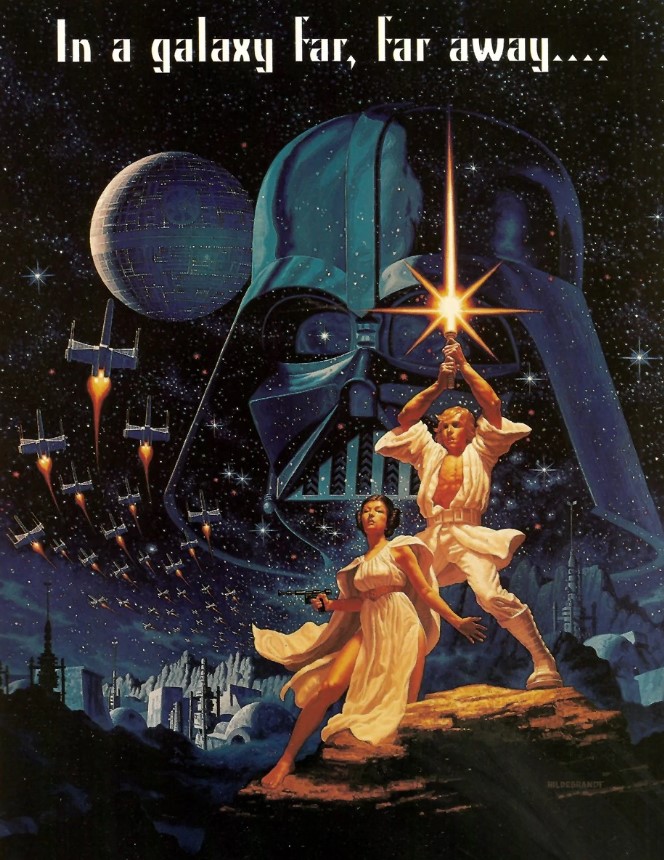
If you were into fantasy during the 1970s, you were almost certainly familiar with the artwork of Greg and Tim Hildebrandt, generally known as the Brothers Hildebrandt. Today, they're probably most remembered for their various Lord of the Rings calendars (the first of which appeared in 1976) and the covers to the Shannara novels of Terry Brooks, but I suspect the first of their paintings I ever saw was this one:
Monday, September 19, 2022
Terrifyingly Beautiful
Pulp Science Fiction Library: Hunters of the Sky Cave
Recently, one of the players in my House of Worms campaign offered to referee Traveller for myself and several others. Since Traveller likely remains my favorite roleplaying game of all time, I jumped at the chance to participate. This will be the first time I've ever used the Mongoose Traveller rules, so I'm looking forward to seeing how they differ from the classic GDW rules I've nearly always used in the past (the exception being GURPS Traveller, which I last played more than twenty years ago – my goodness, how time flies!).
Anytime I start thinking about Traveller and its Third Imperium setting, my mind inevitably drifts toward the science fiction authors and stories that inspired them. Standing alongside the Dumarest of Terra series by E.C. Tubb is the Flandry saga of Poul Anderson, the earliest stories of which first appeared in the 1950s, but were collected and anthologized throughout the '60s, '70s, and '80s. That's how I first encountered them and I retain an inordinate fondness for the collections published by Ace with covers by the great Michael Whelan, like the one that accompanies this post.
The third of the Ace volumes, entitled Agent of the Terran Empire, included the story "Hunters of the Sky Cave," which was itself an expansion of an earlier short story originally published in 1959 under the title "A Handful of Stars" (and occasionally reprinted under yet another title, "We Claim These Stars!:). In terms of its writing, it's one of the earliest of Anderson's Flandry tales, though it takes place during the middle of the character's career as an agent of the faltering Terran Empire. Captain Sir Dominic Flandry is commonly described as a "science fiction James Bond" in that he's a debonair spy with an eye for the finer things in life, though his fans are quick to point out that he predates the first appearance of Bond by two years.
At the start of "Hunters of the Sky Cave," Flandry is attending a feast and a ball thrown by Ruethen of the Long Hand, the Merseian ambassador to the Terran Empire. The Merseians are an alien species whose own expanding empire is a rival to that of the Terrans. The ball is thus an occasion for Flandry to gather intelligence on the Merseians – and attempt to seduce Diana Vinogradoff, Right Lady Guardian of the Mare Crisium, as part of "a thousand-credit bet with his friend," Ivar del Bruno, who insisted that the noblewoman "would never bestow her favors upon anyone under the rank of earl." This sort of behavior is typical of Flandry and is at least in part a consequence of his vocation, as he remarks to himself:
Terra has been rich for too long; we've grown old and content, no more high hazards for us. Whereas the Merseian Empire is fresh, vigorous, disciplined, dedicated, et tedious cetera. Personally, I enjoy decadence; but somebody has to hold off the Long Night for my own lifetime, and it looks as if I'm elected.
The eyebrows of Traveller aficionados should immediately arch at the reference to the Long Night, the collapse of interstellar civilization against which Flandry struggles vainly across his long career in service to the Empire. Marc Miller borrowed the name for the future history of the game's official setting to describe the period between the fall of the Second Imperium and the rise of the Third.
In any case, Flandry never gets the chance to enjoy the company of Lady Diana. Instead, he's summoned to the office of Vice Admiral Fenross, his superior in Naval Intelligence, who tasks him with a mission to the planet Vixen. "A space fleet appeared several weeks ago and demanded that it yield to occupation," Fenross explained. The ships of the fleet "were of exotic type, and the race crewing them can't be identified." Fenross worries the unknown aliens occupying Vixen were secretly in alliance with the Merseians – which is why he intends to send Flandry to Vixen to find out what is actually going on and deal with it in any way he can.
To prepare for his mission, Fenross puts Flandry in touch with a Vixenite named Catherine Kittredge, who escaped the planet and headed for Terra with information about the invaders.
"They call themselves the Ardazirho, an' we gathered the ho was collective endin'. So we figure their planet is named Ardazir. Though I can't come near to pronouncin' it right."
Flandry took a stereopic from the pocket of his iridescent shirt. It had been snapped from hiding, during the ground battle. Against a background of ruined human homes crouched a single enemy soldier. Warrior? Acolyte? Unit? Armed, at least, and a killer of men.
Preconceptions always got in the way. Flandry's first thought had been Wolf! Now he realized that of course the Ardazirho was not lupine, didn't even look notably wolfish. Yet the impression lingered. He was not surprised when Catherin Kittredge said the aliens had gone into battle howling.
They were described as man-size bipeds, but digitigrade, which gave their feet almost the appearance of a dog's walking on its hind legs. The shoulders and arms were very humanoid, except that the thumbs were on the opposite side of the hands from mankind's. The head, arrogantly held on a powerful neck, was long and narrow for an intelligent animal, with a low forehead, most of the brain space behind the pointed ears. A black-nosed muzzle, not as sharp as a wolf's and yet somehow like it, jutted out of the face. Its lips were pulled back in a snarl, showing bluntly pointed fangs which suggested a flesh-eater turned omnivore. The eyes were oval, close set, and gray as sleet. Short thick fur covered the entire body, turning to a ruff at the throat; it was rusty red.
"Is this a uniform?" asked Flandry.
The girl leaned in close to see. The pictured Ardazirho wore a sort of kilt, in checkerboard squares of various hues. Flandry winced at the combinations: rose next to scarlet, a glaring crimson offensively between two delicate yellows. "Barbarians indeed," he muttered.
Once again, the connection to Traveller should be obvious, as the game's official setting includes a species of wolflike aliens known as the Vargr and whose fashion sense tends toward the garish by human standards.
Of course, "Hunters of the Sky Cave" is much more interesting than as the source of inspiration for Traveller. Once Flandry gets to Vixen, he quickly discovers that there's more going on than anyone suspected and that, despite his own initial doubts, the invasion of the planet likely plays a role in the Merseians' ongoing attempts to undermine the stability of the Terran Empire. What follows then is a fast-paced and clever bit of space opera, filled with equal parts intrigue, derring-do, and, above all, interesting characters. Anderson excels at the latter, bringing surprising depth and complexity even to Flandry's antagonists, who are more than mere "barbarians." It's a great science fiction short story and well worth your time.
Friday, September 16, 2022
A Bugaboo in the Hobby
Wednesday, September 14, 2022
Retrospective: Greyhawk Adventures
Thursday, September 8, 2022
The Eternal Paradox
Random Lonely Nerd: "I wish more people were interested in [comic books/Star Trek/Dungeons & Dragons/etc.]."
Random Annoyed Nerd: "It was better before more people became interested in [comic books/Star Trek/Dungeons & Dragons/etc.]."Tuesday, September 6, 2022
I Slay, and Am Content
A mighty-thewed barbarian, courtesy of the incomparable Russ Nicholson (White Dwarf #49).
White Dwarf: Issue #49
Issue #49 of White Dwarf, with its cover by Angus McKie, is dated January 1984. Editor Ian Livingstone uses this (in)auspicious date to muse briefly about George Orwell's influential novel and the role RPGs might play in fending off Big Brother. He suggests that "role-playing games allow their players freedom of expression as no others have done before them." Even given the context in which he said it, the comment strikes me as naïve. Like Michael Moorcock, I'm not as certain as Livingstone that Big Brother would necessarily oppose the escapism of RPGs, since it might help to distract one from the shackles of everyday life under an oppressive regime. On the other hand, I suspect Livingstone didn't mean the comment seriously and so I won't dwell on it further here.
"Shuttle Scuttle" by Thomas M. Price is a great example of two things White Dwarf regularly published: scenarios involving two or more groups of players and scenarios with game stats for two or more different game systems. In this case, it's a science fiction adventure for two groups of Traveller, Space Opera, or Laserburn players. One group consists of terrorists who've hijacked a shuttle – and the pilot of the shuttle; the other are government representatives trying to deal with the situation. Each group is supposed to convene in a separate room, with the referee moving between them, in order to represent the inability of each side to know fully what the other is saying or doing. That's interesting enough, but even more interesting is that the shuttle pilot in the first group is actually antagonistic to the terrorists in his "group" and must work to aid the government representatives in the other group without endangering the lives of any hostages aboard the shuttle. It's a compelling set-up for an adventure and, having done similar things in other RPGs to some success, I'm intensely curious how well it'd work in this case.
"Open Box" begins with a review of Monster Manual II, which receives 7 out of 10 – an entirely fair rating, despite my own personal fondness for the book. Two new Fighting Fantasy books are also reviewed, Starship Traveller (9 out of 10) and City of Thieves (8 out of 10). As I happened, I owned both of these and thought very highly of them, particularly the former, since I have always been more of a science fiction fan than a fantasy one. Also reviewed are three Traveller products: Supplement 12 – Forms and Charts (2 out of 10), Supplement 13 – Veterans (3 out of 10), and Adventure 9 – Nomads of the World Ocean ( 9 out of 10). Although I think the scores of the two supplements are a little harsh, I can understand why they were rated so poorly. On the other hand, Nomads of the World Ocean is a true classic and wholly deserving of its high score. Finally, there are reviews of Mercenaries. Spies, and Private Eyes (4 out of 10) and The Adventure of the Jade Jaguar (3 out of 10). This is probably the most negative installment of "Open Box" I've seen in some time. I wonder if it represents a course correction from the more usually glowing reviews of past issues.
Dave Langford's "Critical Mass" features reviews of multiple fantasy and science fiction novels, most notably Michael Ende's The Neverending Story. I'm honestly quite surprised Langford enjoyed the book (though not without a few of his usual jabs). "Clay to Marble" by Chris Felton is an expansion of sorts to the rules for construction in the Dungeon Masters Guide. Felton fleshes out things like costs, man-weeks, maintenance, and mishaps. Articles like this are a godsend to referees who care deeply about their subject matter but an awful bore to those who could care less. That's not a knock against the article itself, which is well done, only a comment on just how hard it must have been to find content for publication in a gaming magazine that might appeal to a wide audience.
"Runes in the Dungeon" by Dave Morris is a collection of variant rules for RuneQuest in which he presents "classes" for use with the game. These classes are fighters, magic-users, thieves, and witches and each includes special rules for generating ability scores and starting skills. The intent here is not so much to abandon RQ's traditional rules structure as to scaffold an occupation-based approach to creating a character. This is especially helpful, I'd imagine, to players accustomed to D&D's approach to character generation, as well as those who simply need the spark of creativity in creating a new character. I think it's a great little article. Meanwhile, "Rune Questions" by Oliver Dickinson is simply a collection of questions and answers about the rules of RuneQuest and the world of Glorantha.
"A Fleeting Encounter" by Andy Slack is a great Traveller article that offers advice on expanding the simpler starship rules of Book 2 so that the referee isn't required to delve into the complexities of the High Guard supplement. This is something of which I approve, since I always found High Guard too much of a muchness for my taste. We also get new strips for "Thrud the Barbarian," "The Travellers," and "Gobbledigook," with "The Travellers" being my favorite, of course. As I believe I've explained before, what makes "The Travellers" stand out for me is the way it amusingly presents what it's like to have played in a Traveller campaign in the 1980s, right down to the shameless ripping off of plots and situations from SF books, TV shows, and movies.
"The Key of Tirandor" by Mike Polling is the first part of a two-part AD&D adventure for characters of levels 6–9. What makes it especially notable is that the adventure – though the text calls it a "campaign" – takes place in its own unique setting, one that is low in magic and where there are no real gods (and thus no clerics), though peasants and the ignorant believe in their existence. The setting also has its own unique monsters, which are described at the end of this part of the adventure. It's very fascinating stuff and, from the vantage point of the present day, quite compelling, since I've lately found myself wishing more fantasy RPG settings were similarly original in their presentation.
"The Goblin Cult of Kernu" by Ian Bailey is a follow-up to his presentation of goblins for use with RuneQuest in issue #46. Here, as the article's title suggests, Bailey gives readers an example of a goblin cult for use in the game, along with sub-cults and a spirit associated with them. "Insect World" collects five new creepy crawlies for use with D&D or AD&D, while "Detect Illusion" does the same for new spells and magic items associated with the illusionist class. There's also a strangely uninteresting installment of "Super Mole," White Dwarf's games gossip column. Most of the rumors presented aren't at all intriguing, with the exception of the story of Will Niebling's attempt to exercise a stock option for 500 shares that was rejected by Brian Blume and might result in a lawsuit. I know nothing more about this supposed dispute, but I imagine it reflects the chaos and decline that characterized mid-1980s TSR.
Issue #49 is a very good issue and I greatly enjoyed its contents, as the length of this post attests. Next week, we reach the half-century mark in the history of White Dwarf and, if my middle-aged memory is correct, it's another pretty decent issue.
Wednesday, August 31, 2022
Retrospective: Dragonlance Adventures

Tuesday, August 30, 2022
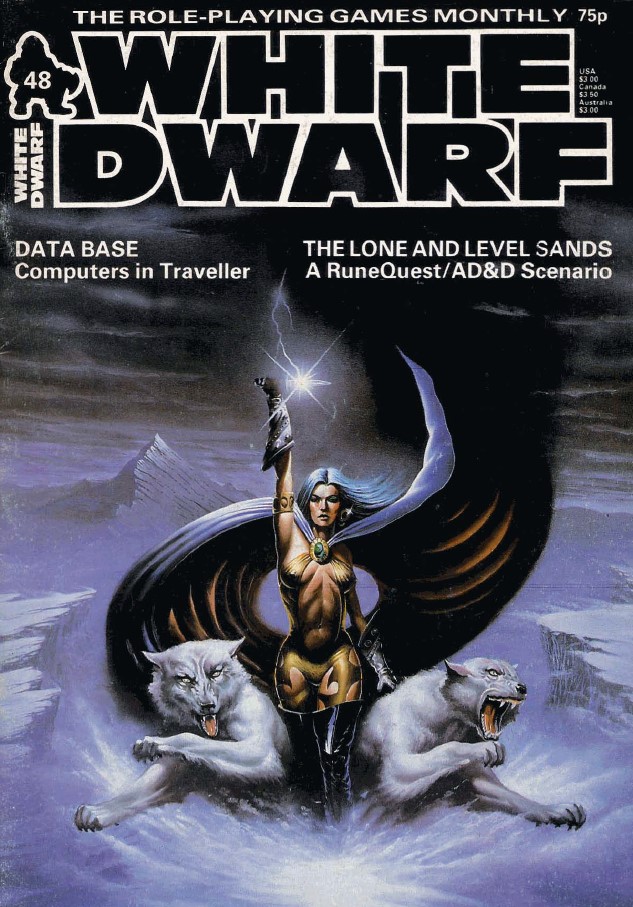
White Dwarf: Issue #48
Dave Langford's "Critical Mass" brief tackles a number of different books this month, including novels by Robert Silverberg, Tanith Lee, and Brian Aldiss. One of the things I always liked about Langford's reviews was the coolness of his praise, while his criticisms frequently ran very hot indeed. Nowadays, I find his reviews a bit more mean-spirited than I did in my youth, but that probably says more about my middle-aged softness than it does about Langford, many of whose reviews are still fun to read.
"By the Gods!" is a short article by Lewis Pulsipher – did he write something for every issue of White Dwarf? – in which he touches on the questions of the extent to which the gods might involve themselves in the outcome of mortal battles. Pulsipher marshals several arguments, based largely on Earth mythology, that the gods won't interfere much, but I'm not convinced myself. After all, why should the gods of a fantasy world follow the pattern laid down in The Iliad or Norse sagas rather than a logic all their own? That said, I understand why he offered this answer and am somewhat sympathetic to it. On the other hand, divine intervention is a possibility in many fantasy RPGs and it seems a shame not to consider it.
"Stomp!" is a fun little article by Rick Priestley, in which he presents rules for adding giants into Warhammer Fantasy Battles. Of particular amusement is the section entitled "Giants and Alcohol," which explains that "giants have a very irresponsible attitude towards alcohol" and then notes that elves believe this is due to "'environmental factors' and 'widespread social and economic deprivation'." Because giants are likely to be drunk when encountered, the article provides procedures for simulating their staggered movement. As I said, it's great fun and a pleasant reminder of when fantasy gaming put greater stock in whimsy and humor.
"The Dark Brotherhood" by Chris Felton is a collection of advice on better integrating assassins into an ongoing AD&D campaign, along with sketches of a few scenarios involving this deadly character class. The article is nothing special, but not everything in an issue is going to be gold, is it? "The Game of the Book …" by Charles Vasey touches on the extent to which various wargames accurately reflect the books that inspired them. This is a topic of some interest to me, though my lack of direct familiarity with many of the games Vasey cites limits it utility to me.
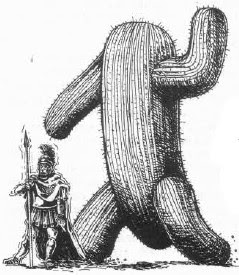
"Database" by Marcus L. Rowland is a sensible expansion of the computer rules in Traveller, something that nearly everyone who played the game felt was necessary. Even in the early 1980s, before personal computers were ubiquitous, gamers found Traveller's approach to the topic inadequate, leading to a plethora of articles like this one. "Ice, Desert, and Swamp" presents three new monsters for use with RuneQuest, including the Cactus Devil, show here:
Monday, August 29, 2022
Pulp Fantasy Library: The Sunken Land
"The Sunken Land" begins with Fafhrd and the Mouser aboard a "cranky sloop," as it makes its way across the "huge, salty Outer Sea" en route to Lankhmar. While the Mouser is unhappy about their maritime journey – something about the "uniformly stormless weather and favorable winds disturbed him" – Fafhrd is having the time of his life. His people are renowned sailors and he enjoyed being once more aboard the deck of a ship. More than that, his bow-fishing had brought him an unexpected boon. The belly of one of the fish he's reeled in contains a prize.
The object did not seem very small even on Fafhrd's broad palm, and although slimed-over a little, was indubitably gold. It was both a ring and a key, the key part set at a right angle, so that it would lie along the finger when worn, There were carvings of some sort. Instinctively the Gray Mouser did not like the object. It somehow focused the vague unease he had felt for several days now.
Naturally, Fafhrd does not share his friend's pessimistic view. Indeed, he proclaims that he "was born with luck as a twin" and proudly displays the ring on his hand. Despite this, something about the ring roused "strange memories" in Fafhrd, perhaps due to the fact that the carving on the ring "represented a sea monster dragging down a ship."
"I think they called the land Simorgya. It sank under the sea ages ago. Yet even then my people had gone raiding against it, though it was a long sail out and a weary beat homeward. My memory is uncertain. I only heard scraps of talk about it when I was a little child. But I did see a few trinkets carved somewhat like the ring, just a very few. The legends, I think, told that the men of far Simorgya were mighty magicians, claiming power over wind and waves and the creatures below. Yet the sea gulped them down for all that."
The Mouser takes an interest in these legends and suggests that perhaps they now sail over top the sunken land of Simorgya. If so, would it not be better if Fafhrd threw the ring overboard? Who knows what curse might be laid upon it? Later, as if to prove the Mouser right, a strange storm blows up and he once again urges his friend to get rid of the ring. Even stranger, Fafhrd sees something appear out of the storm – "the dragon-headed prow of a galley."
Needless to say, neither expected to see another ship come upon theirs in the middle of such a terrible storm, especially not a ship that resembled that of Fafhrd's own people. The sight of it so catches the big barbarian off-guard that, for once, he fails to pay attention to his surroundings aboard the deck and is knocked overboard. Adrift on the stormy sea at night, Fafhrd loses sight of the sloop on which he was traveling – and the Mouser. In time, he is rescued by the crew of the galley, who were "Northerners akin to himself. Big raw-boned fellows, so blond they seemed to lack eyebrows."
The Northerners did not save him out of any kindness. They need an oarsman to replace one of their own who had been swept into the sea during the storm. Like Fafhrd's discovery of the ring in the fish's belly, he himself has become an unexpected gift to his rescuers. Put to work, Fafhrd learns from another oarsman that the leader of the Northerners, Lavas Laerk, had "sworn to raid far Simorgya," the exact same legendary land about which Fafhrd has spoken to the Mouser earlier. Quite a coincidence! Even more remarkable is the fact that, sometime thereafter, the ship's steersman cries out, "Land ho! Simorgya! Simorgya!" Somehow, against all odds – against all reason – the Northerners had found Simorgya, a magical land supposedly sunk beneath the waves ages ago …
"The Sunken Land" is a terrific bit of economical but nevertheless engaging storytelling. It's more of a ghost story than a typical sword-and-sorcery tale of rollicking adventure but that doesn't take away from my pleasure in reading it. Leiber is a master of mood and creeping horror and he puts that mastery to good use in "The Sunken Land." It's a great reminder that horror is a species of fantasy and it ought not be neglected, either in literature or fantasy roleplaying games.