Showing posts with label leiber. Show all posts

Monday, January 5, 2026

Pulp Fantasy Library: The Tale of Satampra Zeiros

With The Ensorcellment of January now underway, I’m taking a brief hiatus from H. P. Lovecraft’s Dreamlands tales to share my thoughts on four Clark Ashton Smith stories I consider particularly worthy of attention. The first of these is a story of which I am especially fond, “The Tale of Satampra Zeiros,” which appeared in the November 1931 issue of Weird Tales. Whatever its other virtues – and they are many – it stands as one of the clearest early expressions of sword-and-sorcery literature. More broadly, it encapsulates many of the qualities that define what I think of as pulp fantasy at its most effective: immediacy, moral ambiguity, horror, and a palpable sense that the world is not merely indifferent to human ambition but actively hostile to it.

The tale opens with one of my favorite first sentences ever to appear in a fantasy story:

I, Satampra Zeiros of Uzuldaroum, shall write with my left hand, since I have no longer any other, the tale of everything that befell Tirouv Ompallios and myself in the shrine of the god Tsathoggua, which lies neglected by the worship of man in the jungle-taken suburbs of Commoriom, that long-deserted capital of the Hyperborean rulers.

The story that follows fully earns that opening. It is a first-person account by a professional thief explaining not only how he came to lose his right hand, but how his most recent heist ended in catastrophe. Not a bad beginning! Together with his companion, Tirouv Ompallios, Zeiros ventures into Commoriom, the long-abandoned capital of Hyperborea, a place shunned even by other robbers. Rumored to be cursed and haunted by strange gods, Commoriom nonetheless promises fabulous wealth to anyone bold (or foolish) enough to plunder it. For Zeiros, that promise is irresistible.

The two thieves break into an ancient, seemingly intact temple of the elder god Tsathoggua – the toad-god’s first appearance in Smith’s fiction – where they find no jewels or gold, but instead disturb a foul, viscous substance resting within a vast bronze basin. This substance rises and assumes the form of a monstrous, many-limbed creature that hunts them through the ruins all night long. At dawn, the thieves realize they have come full circle and have returned to the temple itself. Barricading themselves inside proves useless. The creature oozes through a damaged lintel, consuming Ompallios in silence and nearly claiming Zeiros as well. He escapes only by sacrificing his right hand, surviving to record the tale as a warning.

Smith wrote “The Tale of Satampra Zeiros” early in his career as a prose writer, when he was still finding his footing in the pages of Weird Tales and the story bears the clear imprint of his literary influences. Poe’s fascination with doom, confession, and inevitable consequence is evident in the framing, while the French Decadents inform the luxuriant prose and preoccupation with corruption, blasphemy, and decay. At the same time, Smith is also clearly engaging with the raw material of adventure fiction – thieves, lost cities, fabulous treasure, and sudden violence. The fusion of these elements gives the story its remarkable staying power. Even decades after first reading it, I can still vividly recall the experience.

A great deal of the story’s success lies in Smith’s choice of protagonist. Zeiros is no hero. He is greedy, cynical, and ultimately self-preserving, surviving only at the expense of his partner in crime. This perspective strips the tale of any romantic gloss and reinforces a central truth of Smith’s Hyperborea, namely, that audacity is not rewarded, only punished. For that reason, “The Tale of Satampra Zeiros” is more than merely a foundational sword-and-sorcery text (though it certainly is that). It represents a decisive shift away from quests, kingdoms, and moral uplift toward immediate danger and personal survival. The stakes are not cosmic salvation or political destiny, but simply whether the protagonist lives to see another day. In that respect, it is a near-perfect encapsulation of the pulp fantasy ethos.

Though he never, to my knowledge, confirmed it, I have long suspected that “The Tale of Satampra Zeiros” exerted some influence on Fritz Leiber’s conception of Fafhrd and the Gray Mouser. These roguish protagonists, with their ill-conceived schemes and narrow escapes, feel like natural descendants of Zeiros and Ompallios. Likewise, the relationship between Smith’s two thieves – transactional, greedy, and ultimately fragile – anticipates later depictions of adventuring partnerships defined more by convenience than by trust.

For similar reasons, I strongly associate this story with old school Dungeons & Dragons. The abandoned city of Commoriom, its forbidden temple, and its inhuman guardian are all immediately recognizable elements of dungeon-based play. More importantly, the story embodies an ethos in which exploration is genuinely dangerous and curiosity often carries a terrible price. Nearly a century after its publication, “The Tale of Satampra Zeiros” remains a sharp and unsettling work of pulp fantasy. It reminds us that an abandoned ruin may be a trap, filled with inimical gods and lethal consequences. In doing so, the story helped establish a tradition of fantasy that values peril over heroism and survival over glory, a tradition that continues to shape the genre today.

Saturday, August 30, 2025

Interview: Jeff Talanian

1. How did you first discover the works of H.P. Lovecraft and what was it about his writing that captivated you?

Greetings, James, and thank you for the opportunity to chat about one of my favorite authors, H.P. Lovecraft. So, when I was a young teenager in the early- to mid-1980s, I was playing in a local AD&D group that was run by a childhood friend by the name of Andrew. One week, my friend Bob, whom I am still friends with to this day, wanted to run something different for the group as a one-shot. It was Call of Cthulhu, by Chaosium. I played a scientist armed with a pistol, and my guy either died or went mad – I don't recall the specifics. But I loved the content, and it led me to looking up the story "The Call of Cthulhu," by Mr. Lovecraft, and it's since been a lifelong fascination. So, I discovered HPL through gaming. I think it was about 1983 or 1984.

2. Lovecraft’s influence on Hyperborea is unmistakable. What elements of his cosmic horror do you think best lend themselves to tabletop roleplaying?

The crushing sense of futility in which mankind must come to terms that he is an insignificant ant in comparison with the Great Old Ones; that no matter how much he achieves, whatever lofty heights he attains, there is something larger out there that views man with indifference, if even at all. It is a different mindset than some previous presentations in which player characters can actually achieve a god-like status or even become immortals with all the benefits derived therefrom. In a true cosmic horror campaign, for no matter how much power and glory you achieve, you are still no more than the aforementioned ant in the grand scheme of things.

3. Lovecraft is often associated with "modern" horror, but Hyperborea is firmly sword-and-sorcery. How do you blend the alien terrors of the Mythos with the more grounded violence and heroism of pulp fantasy?

I drew a lot of inspiration from HPL's brothers-in-arms, as it were – Clark Ashton Smith, Robert E. Howard, and no small amount of inspiration from other authors such as Abraham Merritt and Fritz Leiber. As Howard and Lovecraft became closer friends, as evidenced by the letters they exchanged, we started to see the influences of cosmic horror played out in Howard's fiction, which was a subtle shift away from some of his earlier themes of more heroic, action-oriented yarns. This also applies to Smith's work, which borrows from Lovecraft's work, but in a lot of cases, HPL was borrowing from CAS (see Tsathoggua). So, even though HPL was writing a lot of his works from a modern (for his time) perspective, and other authors have since done the same, I think it should be recognized that authors such as REH and CAS were taking these same concepts and themes and applying them to other worlds and other times of a more fantastic bent.

4. What’s your favorite Lovecraft story, and why? Has it ever directly influenced an adventure or mechanic in Hyperborea?

"The Shadow Out of Time" is not only a personal favorite, but also one that I have derived a great amount of inspiration from for the entire Hyperborea adventure game itself. In 2008, in the aftermath of Gary Gygax's passing, whom I'd been working for three years as a writer, I found myself back to square one. I decided to make my own game that I would enjoy playing with my beer-drinking buddies, and if other gamers liked it – great! If they didn't, then to hell with them! I wanted my game to be built out from and inspired by earlier systems by Gygax and Arneson, and I wanted its setting to have a Bran Mak Morn, Conan, and Kull feel to it, but with a heavy dose of the weird fiction produced by Howard's friends, H.P.L. and C.A.S. At the time, I was rereading all of Lovecraft's works, and when I read "The Shadow Out of Time," I had an epiphany. It was inspired by the following passages:

I learned—even before my waking self had studied the parallel cases or the old myths from which the dreams doubtless sprang—that the entities around me were of the world’s greatest race, which had conquered time and had sent exploring minds into every age. I knew, too, that I had been snatched from my age while another used my body in that age, and that a few of the other strange forms housed similarly captured minds. I seemed to talk, in some odd language of claw-clickings, with exiled intellects from every corner of the solar system.

There was a mind from the planet we know as Venus, which would live incalculable epochs to come, and one from an outer moon of Jupiter six million years in the past. Of earthly minds there were some from the winged, star-headed, half-vegetable race of palaeogean Antarctica; one from the reptile people of fabled Valusia; three from the furry pre-human Hyperborean worshippers of Tsathoggua; one from the wholly abominable Tcho-Tchos; two from the arachnid denizens of earth’s last age; five from the hardy coleopterous species immediately following mankind, to which the Great Race was some day to transfer its keenest minds en masse in the face of horrible peril; and several from different branches of humanity.

Here was a story showing me exactly what I needed to do with my setting and how I could pull it all together – whether you are talking about Kull's Valusia, the Elder Things of Antarctica, or Tsathoggua worshipers of Hyperborea – it was all there! I then began to conceive of an idea of an adventure game setting in which all these elements could be pulled together, and more!

5. You’ve cited not just Lovecraft but also Howard, Smith, and Merritt as inspirations. What do you think the shared thread is among these authors and how does Hyperborea pay homage to that tradition?

I think that each and all they were incredibly imaginative writers who dared to write for a genre that was largely shunned, and they were excelling at it. I believe they wrote "up" to their readers, and never catered to a lowest common denominator to increase sale. Their themes were complex, thoughtful, and induced a range of emotions from curiosity to dread to fear. Sure, I have tried to pay homage to this in my works and the works I'm overseeing, and I hope that my stuff has honored the great pulp tradition (at least in gaming form).

6. What does pulp fantasy offer that contemporary fantasy often neglects or downplays?

Contemporary fantasy has largely been stuck in Tolkien's back yard for many years. It's not a bad backyard to be trapped in, because the good professor was one of the greatest practitioners of literature to ever do it, and there have been some wonderful homages to his works. Pulp fantasy is different. It often features a single viewpoint protagonist, it's usually not about saving the world, and it has a more immediate, realistic feel to it, even if the things experienced are beyond the mundane. They often feature an unexpected twist at the end that results in the death of the protagonist or worse, so you are almost always at the edge of your seat when reading these fantastic tales.

7. You've continued to refine and expand Hyperborea across its editions. Has your approach to incorporating Lovecraftian elements evolved over time?

I think conceptualizing a world setting in which Lovecraftian elements are real and present is something that I am always trying to see improved or evolved, as you put it. For example, a ranger in Hyperborea is not a specialist versus humanoids and giants; rather, he is a specialist against otherworldly creatures whose objectives do not accord with the welfare of mankind. So, rangers in Hyperborea hunt Mi-Go, the Great Race, Night Gaunts, and so forth. The content we produce touches on this, in a world that has seen mankind nearly wiped out by a star-borne contagion and now clings to a meager existence in which these many horrors abound.

8. Do you think there's such a thing as too much Mythos in an RPG? Can it become over-familiar or even cliché?

I think if it is done well, with purpose and a vision that is worked hard for, it can never be too much. Imagine, if you will, how many people in the last two millennia have studied the classics, reading and rereading The Odyssey and The Iliad. So, I don't think the Mythos will ever get old, but as readers become more savvy, they will discern between quality pastiche and silly pastiche.

9. As a game designer and worldbuilder, what lessons have you learned from Lovecraft’s approach to mythmaking and the unknown?

I learned that we, as designers and world builders, should not feel bound to the religions and myths of the ancients when conceptualizing and exploring antemundane concepts. Anyone can create a world or a setting that draws inspiration from known works but also has the audaciousness to explore and develop strange new worlds and realities. You just have to have the stubbornness to do it, dismissing naysayers and detractors. Do what thou wilt, my friends.

Thank you for having me, James. Cheers!

Friday, August 29, 2025

What If Lovecraft Had Lived into the '60s?

In our reality, H.P. Lovecraft died on March 15, 1937 at the age of 46. While it would be a stretch to say that he died "young," he certainly died younger than most men of his era. For example, Clark Ashton Smith, who was born less than three years after Lovecraft, died in 1961 at the age of 68. With a better diet and better access to medical care, it's not at all improbable to imagine HPL living into his 60s or even 70s – long enough for him to see World War II, the end of the Great Depression, and the monumental technological and social changes of the ensuing decades. If he had lived, what might Lovecraft have written and what impact might it have had?

I have no answers of my own to this question, but, back in 1978, at the 38th World Science Fiction Convention in Phoenix, Arizona, several notable science fiction and fantasy writers and commentators held a panel on the very topic. Led by Dirk W. Mosig, the panel also included Donald R. Burleson, J. Vernon Shea, Fritz Leiber, and S.T. Joshi. If you're interested and have the time, you can listen to the panel, which consists of six half-hour audio files. 

The files are surprisingly clear, given how old they are, and the discussion is interesting. Fritz Leiber's comments are, in my opinion, among the most notable, especially in light of the fact that Lovecraft read an early draft of the Fafhrd and the Gray Mouser story, "The Adept's Gambit," As I said, if you have the time, it's well worth your time.

Thursday, June 6, 2024

Criticism and Commentary

I think it's fair to say that Gary Gygax had a very thin skin when it came to criticisms of the Advanced Dungeons & Dragons game line, even when the criticisms weren't aimed at a book or module in which he had a hand. A good example of what I'm talking about can found in the "From the Sorceror's [sic] Scroll" column he penned for issue #66 of Dragon (October 1982). There, Gygax responds to criticism of Deities & Demigods.

Before getting into the substance of what Gygax says here, a little background. The "critical piece" referenced in the paragraph above appeared in issue #19 of Different Worlds (March 1982). It's a review written by Patrick Amory that ends by stating "Deities & Demigods [is] fit only for the trashcan." Gygax claims that he only heard about Amory's piece after "reading a letter of agreement" written by a "disgruntled ex-TSR game designer." This second letter appeared in issue #22 of Different Worlds (July 1982) and its author is Lawrence Schick, who served as the editor of Deities & Demigods. 

If you follow the link to Schick's "letter of agreement," you'll see that it's both lengthy and thoughtful in its criticisms. Though he clearly disagreed with the direction James M. Ward took the book, he does not seem to bear any ill will toward the man he calls "a real nice guy." Likewise, that he "really liked the AD&D system and wanted the AD&D products to be the best possible." Schick's criticisms, for the most part, boil down wanting DDG to have closer to Cults of Prax in its approach. That's an absolutely fair criticism in my book, but I'd of course say that, since it's pretty close to my own opinion on the matter. Regardless, I don't think anything Schick wrote is worthy of the intemperate and petty response Gygax offers.

Sadly, Gygax doesn't stop there. He continues his verbal assault against "this capable and knowledgeable individual" in a very bizarre fashion.
Given Gygax's frequent and vociferous disavowals of the influence of Tolkien over his vision of AD&D, I think it's pretty rich of him to turn around and try to use the (admittedly true) lack of religion in Middle-earth as evidence that the kind of book Schick would have preferred is somehow inappropriate for the game line. His references to the works of Howard, Leiber, and De Camp and Pratt seems less disingenuous (and more in keeping with his pulp fantasy preferences), but I'm not sure it serves his original point. If anything, in his flailing attempt to deflect Schick's fair criticisms of Deities & Demigods, he comes close to suggesting a book about gods and religion is unnecessary for AD&D.

This line of attack is all the odder, because Gygax's own articles about the deities and demigods of his World of Greyhawk setting were all quite good and included many of the details that Schick wished to see. He even acknowledges this later in his response, adding that this is appropriate "because they are part of an actual campaign," while DDG was never intended as anything more than "raw material upon which to build a campaign." He then suggests that expecting Deities & Demigods to be more than that is tantamount to "want[ing] someone else to do all your creative thinking for you." What an odd – and condescending – thing to say!

In the end, I think Gygax would have been better off not saying anything at all. I can only assume the fact that Schick, a former TSR employee, publicly offered his own firsthand thoughts about the shortcomings of an AD&D volume stung. I can certainly understand his feelings and might well have felt similarly were I in his shoes. Nonetheless, his response seems disproportionate and, worse, small-minded. Compared to Dragon, Different Worlds had a very small circulation and I doubt that many people were unduly influenced by its negative review, assuming they even saw it. If anything, an immoderate tirade like this one might well have had a greater negative effect on potential buyers.

Saturday, July 22, 2023

REVIEW: Black Sword Hack

During the nearly eight years this blog was inactive, I wasn't paying nearly as much attention to the wider old school roleplaying scene as I previously had been. Consequently, quite a number of releases, trends, and fads within this sphere completely passed me by. One of these was The Black Hack, a streamlined class-and-level RPG by David Black, whose first edition appeared in 2016. For a time, I am given to understand, The Black Hack and its design principles were much favored, leading to a proliferation of "Hacks" – Bluehack (for Holmes D&D), The Rad-Hack (Gamma World, etc.), Cthulhu Hack (Call of Cthulhu), even The Petal Hack (Empire of the Petal Throne), among many, many more.

Now, there's nothing inherently wrong with any of this. Gamers are as prone to enthusiasms as the next person and I try not to begrudge anyone else their preferences, even if I don't share them. Still, I can't deny that the intensity of the ardor for The Black Hack put me off looking into it for some time. What can I say: I'm prone to contrariness. When I finally did read The Black Hack for myself, I found it more agreeable than I expected, despite my dislike of certain aspects of its design. That's not knock against it, of course; I generally dislike certain aspects of most games' designs. That's more or less the nature of the beast.

That's why Black Sword Hack took me by surprise. I didn't even know it existed until it showed up in my mailbox one day as a complimentary copy sent to me by its publisher, The Merry Mushmen (best known for Knock!). Written by Alexandre "Kobayashi" Jeanette, Black Sword Hack is, in his words, "a dark fantasy roleplaying game inspired (but not limited to) the works of R.E. Howard, Michael Moorcock, Karl Edward Wagner's Kane series, Fritz Leiber's Lankhmar and Jack Vance's Dying Earth books." Being a fan of all those writers and their pulp fantasies, that description certainly got my attention, as did the eye-catching artwork by Goran Gligović, which can be found throughout the full-color, 112-page, A5-sized, hardcover book.

The core rules of Black Sword Hack are simple. A turn is an abstract measure of time, during which time a player character may act. During a time, a character can typically take two actions, such as movement and combat. All actions are resolved by making an attribute test. The goal of a test is to roll under a character's appropriate attribute score with a d20. A roll of 1 is always a critical success, while a roll of 20 is always a critical failure. I must admit that the lower-is-better d20 roll takes some getting used to, since it runs counter to decades of experience as a player of roleplaying games, but otherwise the rules of Black Sword Hack are straightforward.

The game retains the "Usage die" from The Black Hack, but with a twist. For those unfamiliar with it, the Usage die is a way to keep track of resources that have limited quantities, like rations or arrows. Whenever a resource is used, the die is rolled and, if the result is 1 or 2, the die "degrades" to the next die type (e.g. d8 becomes d6) until d4 is reached and 1 or 2 is rolled, at which point the resource is completely depleted. Black Sword Hack does not employ the Usage die for concrete resources, but only for abstract ones, like influence, debts, etc. Further, there is the Doom die, a type of Usage die that represents "the attention of Law and Chaos" on the characters. It's rolled whenever the character critically fails and under certain other specific conditions. Once the Doom die is depleted, the character makes all his tests and damage rolls with Disadvantage (i.e. rolling two dice and taking the lowest result).

While the D&D pedigree of Black Sword Hack (and The Black Hack on which it is based) is readily apparent (STR, DEX, CON, etc.), the game is class-less, placing greater emphasis on a character's origin (barbarian, civilized, or decadent) and background (berserker, diplomat, assassin, etc.). This provides a looser mechanical framework for characters, in keeping with the wide range of possible dark fantasy settings the referee might create (more on this in a bit). Characters can also acquire "gifts" – powers of Balance, Chaos, or Law – in addition to sorcery, faerie ties, twisted science, and runic weapons. As characters gain experience, they accrue more abilities and hit points, but a high-level Black Sword Hack character is much less robust than a D&D character of similar level. Consequently, combat is much more fraught with danger, which makes sense, given its literary inspirations.

Where Black Sword Hack really shines, though, is its world building tools. Approximately half the book is devoted to the referee – more if you include its sample bestiary. The game assumes the referee will create his own setting, one dominated by the struggle between Law and Chaos, as in Moorcock and Anderson's fantasies. There are tables and examples to aid him in deciding on the nature of the struggle and how it manifests in the setting, along numerous adventure seeds, two adventure, and the sketch of an entire city. There's even a sketch of a setting, complete with a map, to show one way to make use of the world building tools.

A conceit of the referee section is that any setting the referee designs will inevitably include certain stock locales – Forbidden City, Amber Enclave, Merchant League, Northern Raiders, etc. These are not just tropes from dark fantasy fiction but perhaps also eternal archetypes that reappear throughout the multiverse. Creating a setting for Black Sword Hack involves drawing a map and placing all these locales onto it somewhere and then fleshing out the details through play and the judicious use of random tables provided in the book. It's a clever approach and one that genuinely helps guide the referee in a useful way. The same goes, I think, with the bestiary, which includes plenty of archetypal enemies – demons, cannibals, serpent people – to spark the imagination, while still providing the tools needed to create unique and original antagonists.

If Black Sword Hack has a flaw, it's its looseness. Some players and referees may find its relative lack of concern for considering every possibility, whether in the rules or its myriad settings, disappointing. If you prefer something more defined, even concrete, you're better off with other options. Black Sword Hack revels in its light, almost freeform, rules and malleable setting elements and that won't be to everyone's taste. But as someone who's come to realize that my own preferences tend toward simple, flexible rules with lots of room for filling in the details as I go, this is right up my alley. When I get around to running that Stormbringer campaign of my dreams, there's no question in my mind that I'll be using Black Sword Hack. Perhaps others will like it too.

Black Sword Hack is available directly from the Merry Mushmen website in either print or PDF form.

Monday, May 29, 2023

By the Guts of the Green God

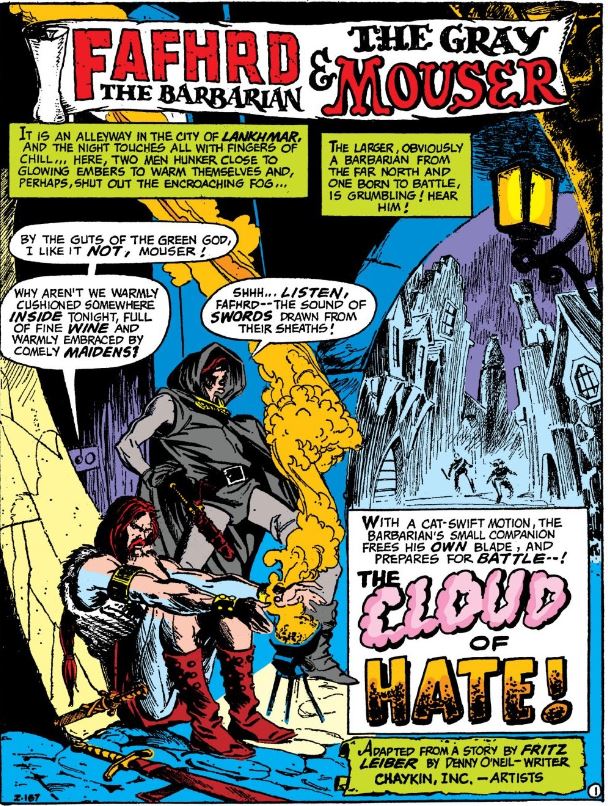
I've talked about the Sword of Sorcery comic before. It's a remarkable example of DC's multiple forays into the fantasy genre throughout the 1970s. Like most of the other fantasy comics DC published during that time – Arak, Son of ThunderBeowulf, Dragon Slayer; Claw the UnconqueredStalkerThe Warlord, and more – Sword of Sorcery didn't last long. However, it has the distinction of having adapted several Fritz Leiber stories to the comics medium, including "Cloud of Hate," which appeared in its fourth issue from October 1973. 

As is often the case, the adaptation isn't a straight one, though most of its alterations concern the tale's order of events than their actual content. Likewise, the dialog is not directly taken from Leiber's text, though it's clearly inspired by it. For me, though, the main joy of the comic is its artwork by Howard Chaykin, which is excellent. (In a twist of fate, Chaykin would later return to comics based on Leiber's Lankhmar stories in 2007, only this time as a writer rather than artist.)

DDG Hate

TSR's 1980 AD&D book, Deities & Demigods, includes a chapter devoted to what it calls the "Nehwon Mythos" – characters, monsters, and deities derived from the works of Fritz Leiber's stories of Fafhrd and the Gray Mouser. In light of today's installment of Pulp Fantasy Library, I thought it might be fun to post that chapter's write-up of the malevolent entity, Hate.


Pulp Fantasy Library: The Cloud of Hate

One of the reasons I find pulp fantasies so congenial is that their preferred format, the short story, actively works against tales that are unnecessarily complex and overwrought. Indeed, many of my favorite fantasy stories are little more than situations, in which characters I like encounter a problem and then use their wits in order to overcome it. The stakes are straightforward and largely personal – nothing epic or world-changing, just a simple yarn in which cleverness and swordplay win the day for the protagonist (I don't say "hero," because the best pulp fantasy characters would probably blanch at being called such).

Of course, the truly great writers of pulp fantasy were capable of threading the needle, so to speak, by doing everything I just described above and nevertheless finding a way to invest it with greater significance. Fritz Leiber was such a writer and his stories of Fafhrd and the Gray Mouser demonstrate this again and again. Take, for example, "The Cloud of Hate," which first appeared in the May 1963 issue of Fantastic Stories of Imagination. On the one hand, it's just another story of the Twain on the make, but, on another, there are intimations of their adventures having a larger significance, even if they do not realize it.

"The Cloud of Hate" opens, not with the protagonists, but beneath the streets of Lankhmar, in the subterranean Temple of Hates, "where five thousand worshipers knelt and abased themselves and ecstatically pressed foreheads against the cold and gritty cobbles as the trance took hold and the human venom rose in them." 

The drumbeat was low. And save for snarls and mewlings, the inner pulsing was inaudible. Yet together they made a hellish vibration which threatened to shake the city and land of Lankhmar and the whole world of Nehwon.

Lankhmar had been at peace for many moons, and so the hates were greater. Tonight, furthermore, at a spot halfway across the city, Lankhmar's black-togaed nobility celebrated in merriment and feasting and twinkling dance the betrothal of their Overlord's daughter to the Prince of Ilthmar, and so the hates were redoubled.

This ritual within the Temple of Hates – what a wonderfully evocative name! – has a purpose beyond mere worship. Led by the Archpriest of the Hates, the worshipers have called forth "tendrils, which in another world might have been described as ectoplasmic" which "quickly multiplied, thickened, lengthened, and then coalesced into questing white serpentine shapes" and then billowed out of the temple to the streets above. Once there, this "billowing white" fog "in which a redness lurked" began to seek out victims among Lankhmar's populace.

It's at this point that the reader is introduced to Fafhrd and the Mouser, who are employed as watchmen during the aforementioned festivities in honor of the Overlord's daughter. The northerner states that "There'll be fog tonight. I smell it coming from the Hlal." His smaller companion is dubious of his prognostication, but Fafhrd insists "There's a taint in the fog tonight." Meanwhile, the fog summoned at the Temple of Hates makes its way into the Rats' Nest tavern, where it finds "the famed bravo Gnarlag." Touching him with a "fog-finger,"

Gnarlag's sneering look turned to one of pure hate, and the muscles of his forearm seemed to double in thickness as he rotated it more than a half turn.

Elsewhere, Mouser asks his friend about their lot in life, specifically why they are not dukes or emperors or demigods. Fafhrd explains that it's because they're "no man's man ... We go our own way, choosing our own adventures – and our own follies! Better freedom and a chilly road than a warm hearth and servitude." Mouser is skeptical of these explanations, pointing out how often they've chosen to serve others, but their philosophizing is interrupted by Fafhrd once again stating that something ill is afoot. His sword, he says, "hums a warning! ... The steel twangs softly in its sheath!" And once again, Mouser expresses disbelief.

The fog continues to make its way through Lankhmar, seeking out first "Gis the cutthroat" and then "the twin brothers Kreshmar and Skel, assassins and alleybashers by trade." In each case, the fog 

intoxicated them as surely as if it were a clouded white wine of murder and destruction, zestfully sluicing away all natural cautions and fears, promising an infinitude of thrilling and most profitable victims.

The "hate-enslaved" marched together in the fog "toward the quarter of the nobles and Glipkerio's rainbow-lanterned palace above the breakwater of the Inner Sea." Unfortunately for them, the Twain stand guard this night.

"The Cloud of Hate" is one of Leiber's shorter stories of Nehwon, but that works to its advantage in my opinion. Its brevity enables it to focus on what most matters, namely the inexorable movement of the otherworldly fog across the city of Lankhmar and the point when Fafhrd and the Mouser come into contact with it. This meeting is compelling first because the Mouser is initially so dismissive of the idea that there is anything odd happening and second because the reader has no idea what effect the fog might have on these comrades-in-arms. Would they, like all the others before them, become "hate-enslaved" or might they somehow escape this horrible fate? Leiber's answer to this and other questions is clever and offers insights into two of the most fascinating characters in fantasy – highly recommended.

Monday, January 30, 2023

Pulp Fantasy Gallery: Swords and Deviltry

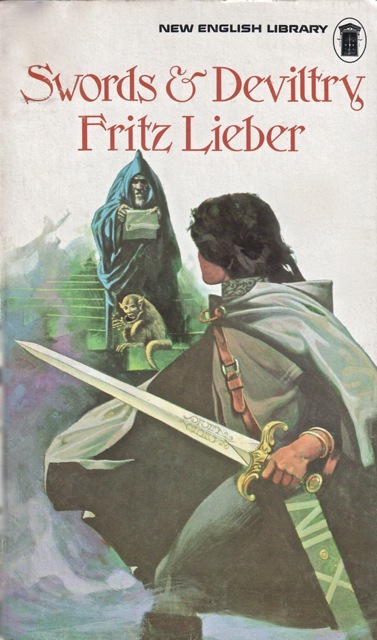
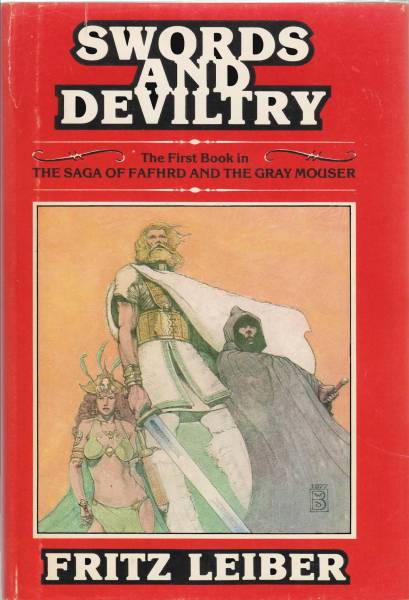
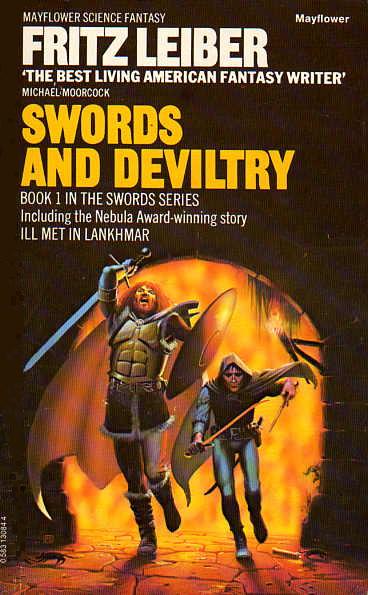
On September 1, 2008fifteen years ago, if you can believe it – I inaugurated a new series for the blog that I called Pulp Fantasy Gallery. I intended the series to be a regular look at the evolution of not just fantasy art over the decades but of specific fantasy characters and settings over time. The series didn't last long, in large part because it very quickly evolved into the more literary-focused Pulp Fantasy Library series, which continues to this day (and is my second longest-running series, after Retrospective). 

On some level that's a shame, because I continue to think the evolution of fantasy art is a fascinating subject, especially for those of us who favor the esthetics of earlier times. Because of this – and because I've found myself unexpectedly busy over the last week and thus unable to devote myself properly to Pulp Fantasy Library – I've decided to pen a new entry in Pulp Fantasy Gallery today. Whether I'll continue to do so on a regular basis, I don't know. 

For now, let's take a look at five different cover illustrations created for the various English editions of Fritz Leiber's Swords and Deviltry. The first of these was published by Ace in May 1970 and featured artwork by Jeff Jones. Ace continued to use variations on this cover for more than fifteen years on its US editions of the book.
Not long thereafter, in December 1971, the New English Library released a UK edition of the book. The cover (by an unknown artist) bears a clear similarity to the Ace cover above.
A second UK edition appeared in December 1977 from George Prior Publishers, with artwork by Wayne Barlowe.
Just two years later, a third UK edition appeared from Mayflower, illustrated by Peter Elson.
Continuing a theme, we have a fourth UK edition, this time from Grafton in July 1986, with Geoff Taylor doing the cover.

Monday, January 2, 2023

Pulp Fantasy Library: Under the Thumbs of the Gods

I've regularly remarked on this blog that Dungeons & Dragons (and, by extension, most fantasy roleplaying games, with a few notable exceptions) doesn't take the matter of religion very seriously. By "seriously," I mean only that very little thought seems to have been given to the nature of the gods, their relationship to mortals, and the consequences that follow from that. To some extent, that's understandable, since comparatively few of the pulp fantasies that inspired D&D deal directly with the gods (though, of course, ancient mythologies do). Even so, it's long been disappointing to me, because I think there's a rich vein of ideas to be mined when it comes to faith, religion, and the gods.

Perhaps unsurprisingly, Fritz Leiber was already well ahead of me when he wrote "Under the Thumbs of the Gods." Appearing for the first time in the April 1975 issue of Fantastic, the story finds Fafhrd and the Gray Mouser "drinking strong drink one night at the Silver Eel," when they become "complacently, even luxuriously, nostalgic about their past loves and amorous exploits." This is, of course, very much in character for the Twain, whose adventures are filled with all manner of love affairs, including the tragic.

What Fafhrd and the Mouser don't know is that their boasts "about their most recent erotic solacings" have been overheard – but not by men.
In the Land of the Gods, in short in Godsland and near Nehwon's Life Pole there, which lies in the southron hemisphere at the antipodes from the Shadowland (the abode of Death), three gods sitting together cross-legged in a circle picked out Fafhrd and the Mouser's voices from the general mutter of their worshippers, both loyal and lapsed, which resounds eternally in any god's ear, as if he held a seashell to it.
The three gods in question are Issek, who "had the appearance of a delicate youth with wrists and ankles broken;" Kos, "a squat, brawny god bundled up in furs, with a grim, not to say surly, heavily bearded visage;" and Mog, "who resembled a four-limbed spider with a quite handsome, though not entirely human face." 

These three deities had taken an interest in these particular mortals because they had, at one time or another, been – or feigned to be – one of their devotees. Fafhrd had revered Kos during his youth in the Cold Waste and had become an acolyte of Issek during a low point in his life. while the Mouser "made a game for several weeks of firmly believing in Mog," because his lover, Ivrian, "had taken a fancy to a jet statuette of Mog." More than that,

the three gods singled out their voices ... because they were the most noteworthy worshippers these three gods had ever had and because they were boasting. For the gods have very sharp ears for boasts, or for declarations of happiness and self-satisfaction, or for assertions of a firm intention to do this or that, or for statements that this or that must surely happen, or any other words hinting that a man is in the slightest control of his destiny. And the gods are jealous, easily angered, perverse, and swift to thwart.

This is delightful stuff, in my opinion, full of both the wit and cynicism that are hallmarks of the tales of the Nehwon. In the span of just a couple of paragraphs, Leiber has painted a striking portrait of the gods of his fantasy setting. He goes on:

"It's them, alright – the haughty bastards!" Kos grunted, sweating under his furs – for Godsland is paradisal.

"They haven't called on me for years – the ingrates!" Issek with a toss of his delicate chin. "We'd be dead for all they care, except we've our other worshippers. But they don't know that – they're heartless."

"They have not even taken our names in vain," said Mog. "I believe, gentlemen, it is time they suffered divine displeasure. Agreed?"

Nehwon's gods, you can see, are petty and vain, not unlike the gods of ancient Greece or Clark Ashton Smith's Hyperborea. They bristle at being ignored – and are more than prepared to smite their wayward followers to assuage their feelings of abandonment. In this case, the three gods decide to make use of the Twain's plan to seek excitement in Lankhmar: "We will hunt girls – ourselves the bait!" in the words of the Mouser. 

Mog said, smiling lopsidedly because of his partially arachnid jaw structure, "They seem to have chosen their punishment."

"The torture of hope!" Issek smiled eagerly, catching on. "We grant them their wishes –"

"– and then leave the rest to the girls," Mog finished.

"You can't trust women," Kos asserted darkly.

"On the contrary, my dear fellow," Mog said, "when a god's in good form, he can safely trust worshippers, female and male alike, to do all the work."

"Under the Thumbs of the Gods" is a fast-moving yarn that might, on first reading, seem fun but fairly insubstantial. In fact, I think it one of Leiber's most fascinating later stories. Not only do we learn a lot more about the gods of Nehwon, but we also learn a thing or two about Fafhrd and the Gray Mouser themselves, which is always worthwhile. 

Tuesday, September 27, 2022

My Top 10 Favorite Imaginary Settings (Part II)

As I prepared the second part of this list, what struck me is that three of the top five entries are roleplaying game settings. Thinking on it, I suppose that only makes sense. I spend a lot more time exploring imaginative settings through roleplaying than I do through simply reading stories set in them. In any case, this was a useful exercise for me, since it helped me to understand better the things I find most attractive in imaginary settings. Readers will notice certain commonalities between my favorites, though I think there's also a fair degree of diversity too.

Part I can be found here.

5. Zothique

Of all the settings created by Clark Ashton Smith, Zothique is by far my favorite. I was first introduced to Zothique through his short story, "The Empire of the Necromancers" and it very rapidly became one of my favorite imaginary settings. Evoking melancholy and ennui, as well as making ample use of mordant humor, one might call it the Clark Ashton Smith-iest of all his imaginary settings. I've derived a great deal of pleasure from reading stories that take place on the Last Continent; several of them are regular reads that I return to year after year.

In some respects, Zothique is quite similar to Vance's Dying Earth, in that it's really our Earth in the impossibly far future, when sorcery and congress with extra-terrene entities are now facets of everyday existence. However, it lacks the technology-as-magic (or is that magic-as-technology?) conceit of the Dying Earth, focusing instead on the return of black magic and alien gods as a consequence of mankind's enervating boredom as it awaits the end of all things. Zothique drips with a decadence that is equal parts repulsive and enchanting – heady stuff, especially for someone whose life is as staid as mine.

4. Lankhmar
You can be forgiven for thinking I meant Nehwon, but I can assure you that I mean Lankhmar, the City of the Black Toga and home base of Fritz Leiber's Fafhrd and the Gray Mouser. The truth is that, for the most part, I don't find the world of Nehwon all that interesting. Indeed, I'm not even certain that Leiber found it all that interesting himself. Lankhmar, on the other hand, is endlessly fascinating and is practically a world in itself, with its dark, winding streets, remarkable locales, and even more remarkable inhabitants. It's not for nothing that Leiber's best stories all take place within the city's walls.

Lankhmar is the setting that first taught me the potential a single well-described place could hold. Leiber ably demonstrated that there's absolutely no need to create an exhaustive fantasy world to tell amazing stories. Bring a single city to life and you have everything you need to present many tales of adventure. Lankhmar is also probably why I've long had a fascination with cities and city-states in fantasy, as well as why I hope one day to referee a campaign set entirely within a city. I haven't done it yet, but, if I do, you can be sure there will be more than a little Lankhmar in the proceedings.

3. Glorantha

Even a few years ago, I doubt Greg Stafford's Glorantha would have made it onto my top 10 favorite imaginary settings, never mind my top 5. For a long time, my early experiences with the setting made it difficult for me to recognize its brilliance. Recently, though, Glorantha has risen considerably in my estimation, thanks in no small part to my having had the chance to play in a couple of RuneQuest campaigns that allowed me to experience the setting on its own terms. The result was a re-evaluation of both the setting itself and what Stafford was attempting to do with it.

If D&D's default idiom is pulp fantasy, then RuneQuest's is mythology. Glorantha has a mythic feel, like the world of Greco-Roman myth but with numerous unique and, dare I say, modern twists on them that make it feel genuinely unique. Stafford was a keen student of myth, religion, and spirituality of all kinds and that shows in the cultures, societies, and beliefs of Glorantha. It's a thoroughly engaging place, all the more so, I think, because that seems to have been the intention. Through their characters, players are supposed to grapple with the meaning of myth and legend, even to the point of potentially rewriting them through their characters' actions. And to think I once dismissed it as too "Californian."

2. Tékumel

Some of you will no doubt have expected that Tékumel would take the top spot on this list and I can't blame you for thinking so (though those who know me well will not be surprised by my actual top choice). I was a relative latecomer to Tékumel, only really discovering it in the early '90s, through a Usenet newsgroup dedicated to the setting of Empire of the Petal Throne. Once I discovered, I was hooked and became a lifelong devotee. Recent revelations have not dimmed my love for the setting nor weakened the enthusiasm of myself or the players of my ongoing House of Worms campaign, which barrels on toward its eighth year of continuous play.

My fondness for Tékumel is based on several factors, the chief being that it's not a vanilla setting. Instead, it's a complex, detailed world whose main inspirations are a variety of non-European historical cultures. Despite this, it's not nearly as difficult to understand as some have claimed and can, in fact, be enjoyed by roleplayers of all stripes. I also love Tékumel for its blending of science fiction and fantasy, something that you'll see in many of the settings on this list. And despite the claim that the setting is so detailed that there is no room for individual creativity, I have found just the opposite. Rather than being an impediment to my own creativity, the detail has served to inspire me, often in unexpected ways. I've had more fun refereeing my Tékumel campaigns than I have almost any other – high praise from a gamer who's been playing for more than four decades.

1. Third Imperium
If you correctly guessed that the Third Imperium would be at the top of this list, congratulations, you know me and my tastes well. I regularly tell people that, when it comes to RPGs, "D&D is my first love, but Traveller is my true love." A big part of the reason why I feel that way is because of the game's "official" setting. Players older than I remember a time when Traveller, like Dungeons & Dragons, was simply a rules set without a setting of its own. For them, Traveller remained a game of "science fiction adventure in the far future," while, for me, it's always been "science fiction adventure in the Third Imperium."

My fondness for the setting is born of several factors. The first is the deft way that Miller and his colleagues at GDW borrowed and riffed off elements of the great sci-fi writers of the '40s through '70s to create a setting that was simultaneously familiar and original. The second is that I've spent more time playing and refereeing in the Third Imperium than I have in any other imaginary setting. In many ways, the Third Imperium is home and I know it like the back of my hand. Finally, my first professional writing credits were for Traveller in the 1990s, which, in turn, introduced me to a number of others who subsequently became some of my oldest and dearest friends. I can think of no better marker of excellence than that.

Monday, August 29, 2022

Pulp Fantasy Library: The Sunken Land

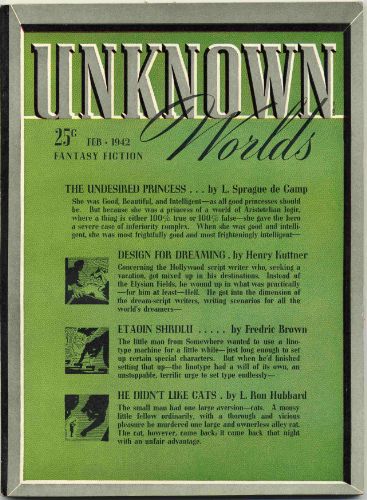
Originally published in the February 1942 issue of Unknown Worlds, "The Sunken Land" is an early adventure of Fafhrd and the Gray Mouser (the fourth in terms of publication). Consequently, it's somewhat shorter than many of his later and more famous tales of the Twain. I don't mind this in the least, as my patience with the ever-increasing length of fantasy and science fiction literature grows thinner with each passing year. The plot of "The Sunken Land" also seems somewhat derivative of other earlier works, such as Lovecraft's "Dagon" and Smith's "The Vaults of Yoh-Vombis." Again, I don't mind this, as I think "originality" is over-valued when it comes to fiction. In addition, both of the aforementioned stories are fine evocations of supernatural horror, which I consider an important part of what makes a good sword-and-sorcery yarn (as opposed to mere "fantasy"). 

"The Sunken Land" begins with Fafhrd and the Mouser aboard a "cranky sloop," as it makes its way across the "huge, salty Outer Sea" en route to Lankhmar. While the Mouser is unhappy about their maritime journey – something about the "uniformly stormless weather and favorable winds disturbed him" – Fafhrd is having the time of his life. His people are renowned sailors and he enjoyed being once more aboard the deck of a ship. More than that, his bow-fishing had brought him an unexpected boon. The belly of one of the fish he's reeled in contains a prize.

The object did not seem very small even on Fafhrd's broad palm, and although slimed-over a little, was indubitably gold. It was both a ring and a key, the key part set at a right angle, so that it would lie along the finger when worn, There were carvings of some sort. Instinctively the Gray Mouser did not like the object. It somehow focused the vague unease he had felt for several days now.

Naturally, Fafhrd does not share his friend's pessimistic view. Indeed, he proclaims that he "was born with luck as a twin" and proudly displays the ring on his hand. Despite this, something about the ring roused "strange memories" in Fafhrd, perhaps due to the fact that the carving on the ring "represented a sea monster dragging down a ship."

"I think they called the land Simorgya. It sank under the sea ages ago. Yet even then my people had gone raiding against it, though it was a long sail out and a weary beat homeward. My memory is uncertain. I only heard scraps of talk about it when I was a little child. But I did see a few trinkets carved somewhat like the ring, just a very few. The legends, I think, told that the men of far Simorgya were mighty magicians, claiming power over wind and waves and the creatures below. Yet the sea gulped them down for all that."  

The Mouser takes an interest in these legends and suggests that perhaps they now sail over top the sunken land of Simorgya. If so, would it not be better if Fafhrd threw the ring overboard? Who knows what curse might be laid upon it? Later, as if to prove the Mouser right, a strange storm blows up and he once again urges his friend to get rid of the ring. Even stranger, Fafhrd sees something appear out of the storm – "the dragon-headed prow of a galley."

Needless to say, neither expected to see another ship come upon theirs in the middle of such a terrible storm, especially not a ship that resembled that of Fafhrd's own people. The sight of it so catches the big barbarian off-guard that, for once, he fails to pay attention to his surroundings aboard the deck and is knocked overboard. Adrift on the stormy sea at night, Fafhrd loses sight of the sloop on which he was traveling – and the Mouser. In time, he is rescued by the crew of the galley, who were "Northerners akin to himself. Big raw-boned fellows, so blond they seemed to lack eyebrows." 

The Northerners did not save him out of any kindness. They need an oarsman to replace one of their own who had been swept into the sea during the storm. Like Fafhrd's discovery of the ring in the fish's belly, he himself has become an unexpected gift to his rescuers. Put to work, Fafhrd learns from another oarsman that the leader of the Northerners, Lavas Laerk, had "sworn to raid far Simorgya," the exact same legendary land about which Fafhrd has spoken to the Mouser earlier. Quite a coincidence! Even more remarkable is the fact that, sometime thereafter, the ship's steersman cries out, "Land ho! Simorgya! Simorgya!" Somehow, against all odds – against all reason – the Northerners had found Simorgya, a magical land supposedly sunk beneath the waves ages ago …

"The Sunken Land" is a terrific bit of economical but nevertheless engaging storytelling. It's more of a ghost story than a typical sword-and-sorcery tale of rollicking adventure but that doesn't take away from my pleasure in reading it. Leiber is a master of mood and creeping horror and he puts that mastery to good use in "The Sunken Land." It's a great reminder that horror is a species of fantasy and it ought not be neglected, either in literature or fantasy roleplaying games. 

Wednesday, April 27, 2022

Retrospective: Lankhmar: City of Adventure

I'm a sucker for fantasy cities. I'm not entirely sure of the precise origin of my fascination with them, but I have little doubt that Fritz Leiber's Lankhmar played a role in cultivating it. I was – and am – a huge fan of the tales of Fafhrd and the Gray Mouser. Consequently, their home base, the City of the Black Toga, the City of Sevenscore Thousand Smokes, is forever lodged in my imagination as the fantasy city par excellence.  

When TSR published Lankhmar: City of Adventure in 1985, there was no question about whether I'd buy it. Though I'd already seen both The Free City of Haven and Thieves' World (and likely a few other similar products), neither of them had the same kind of immediate appeal for me as did Lankhmar. I remember first seriously thinking about the possibilities of playing D&D in Nehwon after I got my copy of Deities & Demigods, but I never actually did so. With the release of this 96-page softcover book, however, I thought the time might have come to take the plunge at last.

Written by the trio of Bruce Nesmith, Douglas Niles, and Ken Rolston, Lankhmar: City of Adventure aims to do two things: describe the titular city as a roleplaying locale and provide rules and guidelines for playing Advanced Dungeons & Dragons in Nehwon. Of these two goals, the least interesting is the former, in large part because the implied setting of Gygaxian D&D is already very similar to that of Leiber's fiction. Most of what's needed is a different selection of monsters and deities – both of which this book provides in their own chapters – and a reduction in the prevalence of magic and you're most of the way there. With regard to magic, Lankhmar reduces it to two kinds, black and white, with most magic in Nehwon being black and, therefore, out of the hands of player characters. While perhaps a bit simplistic, it's not a terrible approach and I'm sympathetic to the designers who opted for it rather than creating an entirely unique magic system for Nehwon.

The description of the city is quite good and generally hews quite closely to Leiber's stories (all of which get summaries at the start of the book). The city is divided up into "districts," each of which has its own section where their most important locations are described. Each district has its own map, which fits onto the larger map of the entire city. Because even these district maps encompass a large amount of real estate, it'd be impossible to detail them entirely. To deal with this, there are portions of each map that are left blank and that are intended to be filled through the use of geomorphs presented in a little booklet found inside the back cover of Lankhmar. The referee can then fill in these blanks as he sees fit, in the process creating his own version of Lankhmar.

As impressive as the rest of Lankhmar: City of Adventure was – and it genuinely was well done – I soon found that all thoughts of running a campaign set in Leiber's world faded once I realized just how broadly useful that booklet of geomorphs was. I saw that TSR had given me the tools I needed to create my own large fantasy cities with relative ease. All I needed to do was photocopy the geomorphs I wanted from among the large selection Lankhmar provided and then fit them together as I wished. I must tell you I spent a lot of time at my local public library, making use of the Xerox machine to produce enough maps so that I could piece together a larger map of the cities of Emaindor. What fun!

In the end, it's difficult for me to disentangle my positive feelings toward Lankhmar from my memories of making use of those geomorphs. Though I do think the book does what it sets out to do quite well, what sticks with me now, decades later, is the way it inspired me to make my own cities in my own setting rather than using those that someone else had made. That's probably the highest compliment I can pay to any RPG product: it sparked my own creativity. By that measure, Lankhmar: City of Adventure is a very fine product indeed. 

Monday, March 21, 2022

Pulp Fantasy Library: Smoke Ghost

Fritz Leiber is an author who gets a lot of love on this blog and deservedly so. His tales of Fafhrd and the Gray Mouser are, I think, among only a handful of stories that can credibly be claimed as feeling like playing Dungeons & Dragons and other fantasy roleplaying games. This is implicitly acknowledged by Gary Gygax himself, who not only included Leiber in Appendix N of the AD&D Dungeon Masters Guide, but called him, along with a small number of other authors, one of "the most immediate influences" upon the game. 

Leiber was a very prolific writer and his contributions to the canon of pulp fantasy are not limited to the adventures of the Twain. Indeed, one of his earliest published stories is set in 20th century Chicago and features a subject that some might consider horror. Nevertheless, I think it's an important and compelling tale that takes a staple of the fantastical literary tradition – the ghost story – and updates it for the modern era while also making it genuinely timeless.

"Smoke Ghost" appeared in the October 1941 issue of Unknown Worlds and tells the story of advertising executive Catesby Wran. One day, while dictating to his secretary, he asks the young man a very strange question.

"Have you ever seen a ghost, Miss Millick?" And she had tittered nervously and replied, "When I was a girl there was a thing in white that used out of the closet in the attic bedroom when you slept there, and moan. Of course it was just my imagination. I was frightened of lots of things." And he just said, "I don't mean that traditional kind of ghost. I mean a ghost from the world of today, with the soot of the factories in its face and the pounding of machinery in its soul. The kind that would haunt coal yards and slip around at night through deserted office buildings like this one. A real ghost. Not something out of books."

Miss Millick is confused by Wran's line of questioning, thinking that "he'd never been like this before." Nevertheless, he continued to ponder this topic.

"Have you ever thought what a ghost of our times would look like, Miss Hallick? Just picture it. A smoky composite face with the hungry anxiety of the unemployed, the neurotic restlessness of the person without purpose, the jerky tension of the high-pressure metropolitan worker, the sullen resentment of the striker, the callous viciousness of the strike-breaker, the aggressive whine of panhandler, the inhibited terror of the bombed civilian, and a thousand other twisted emotional patterns. Each overlying and yet blending with the other, like a pile of semi-transparent masks?"

I can't speak for anyone else, but I found this a powerful passage that remained in my mind for some time after reading it. It's little wonder that Miss Millick called it "an awful thing to think of." Undeterred by his discomfort, Wran keeps musing aloud about this topic.

"Yet, that's just what such a ghost or vitalized projection would look like, Miss Millick," he continued, smiling in a tight way. "It would grow out of the real world. It would reflect all the tangled, sordid, vicious things. All the loose ends. And it would be very grimy. I don't think it would seem white or wispy or favor graveyards. It wouldn't moan. But it would mutter unintelligibly, and twitch at your sleeve. Like a sick, surly ape. What would such a thing want from a person, Miss Millick? Sacrifice? Worship? Or just fear? What could you do to stop it from troubling you?"
Wran continues in this vein for some time, adding more and more details to his sketch of what a modern day ghost might be like. Leiber is at the absolute top of his game here. As the details pile up, we're left not just with a frightening picture of a 20th century specter but also of a mind slowly deteriorating under the weight of the terrifying thoughts it bears, the conclusion to them being this:

"It's a rotten world, Miss Millick," said Mr. Wran, talking at the window. "Fit for another morbid growth of superstition. It's time the ghosts, or whatever you call them, took over and began a rule of fear. They'd be no worse than men."
We soon learn that Wran's musings have a cause: he's been seeing a black figure wherever he goes, following him. Wran hopes that the figure is a manifestation of a psychosis, because the alternative – that it is real – is too awful to contemplate. "Good thing I'm seeing the psychiatrist tonight," Wran thinks to himself. Surely, if anyone can help rid him of this dreadful vision, it's Dr. Trevethick – or so he hopes. 

"Smoke Ghost" is not in the public domain, like many of the stories I discuss here, so I can't point readers to a place online where you can read it. The story is, however, included in many anthologies not just those specifically devoted to Fritz Leiber's short fiction. If anything I've written above intrigues you, I highly recommend you make an effort to find the story and read it. It is, in my opinion, one of the best ghost stories I've ever read, one that gets to the heart of why ghosts continue to haunt us, even in this age of materialism, science, and psychology. 

One of the accompanying illustrations by Edd Cartier

Monday, February 21, 2022

A Tale of Two Adaptations

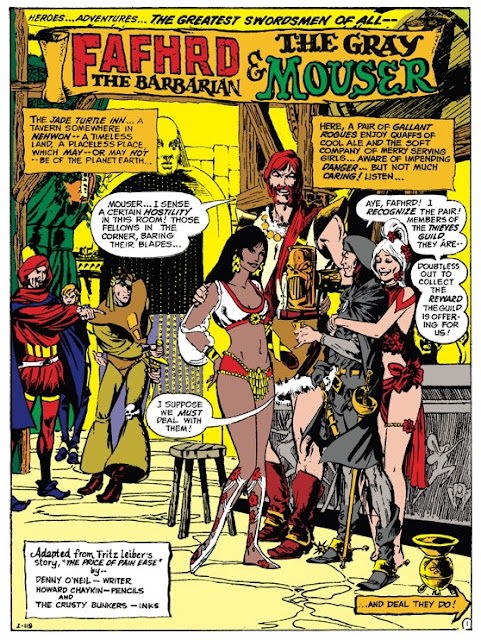
Interestingly, "The Price of Pain-Ease" was adapted twice in comics form. The first one appeared in the first issue of DC's Sword of Sorcery series (March 1973). Veteran Denny O'Neil is listed as writer, while newcomer Howard Chaykin is the artist. This was, in fact, Chaykin's first significant assignment for DC, so the adaptation has a certain historical importance.

As an adaptation of the story, though, it's awful. O'Neil truncated the story, eliminating the ghosts of Ivrian and Vlana, thereby eliminating much of the tale's melancholy tone, not to mention the central motivation of the Twain. I honestly can't fathom what O'Neil was thinking here, as his excisions undercut everything that make "The Price of Pain-Ease" memorable.

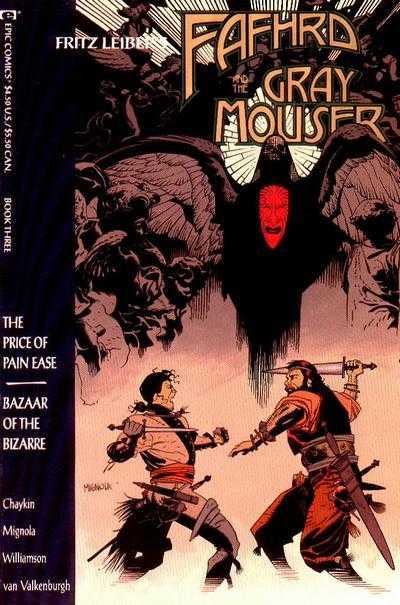
Fortunately, Chaykin at least had a chance to redeem himself, though this time as a writer rather than illustrator. At the start of the 1990s, Marvel's Epic imprint published Fritz Leiber's Fafhrd and the Gray Mouser, a four-issue series that adapted many of the stories featuring the titular pair, including "The Price of Pain-Ease," which appeared in issue #3 (January 1991). 

Chaykin's adaptation is vastly more faithful to the story than was O'Neil's, which would be enough to set it apart from its predecessor. Almost as remarkable is its artwork, provided by a pre-Hellboy Mike Mignola, with the inking done by the legendary Al Williamson. The Epic adaptations are universally excellent, both in terms of their fidelity and the imagery. Mignola's moody, expressionist style is well suited to Nehwon and especially suits the tone of "The Price of Pain-Ease." All the Epic comics were eventually collected in a single volume by Dark Horse in 2007. It's still in print, so far as I know, and I greatly recommend picking it up, if you've never seen it before.

Pulp Fantasy Library: The Price of Pain-Ease

Starting in 1968, Ace Books began collecting Fritz Leiber's stories of Fafhrd and the Gray Mouser, many of which had previously been published in various periodicals starting in the late 1930s, into a series of paperbacks. In addition, Leiber penned several new short stories intended to fill in the gaps in the chronology of the Twain's lives, two of which appear in the collection Swords Against Death (1970)

Perhaps unsurprisingly, given the captious nature of fantasy fans – or indeed fans of any sort – not all of these new tales have been well received. Some of the complaints focus on the content of the additions, which is a little less rollicking than earlier entries in the series, while others focus on their style, which is wordier. Both these complaints have merit, I think, which is why I can't wholly dismiss them as just the cantankerous grumblings of dyspeptic nerds. 

Yet, at least in the case of "The Price of Pain-Ease," these complaints sell the story short. Certainly, this story feels different from its predecessors, but, rather than detract from its place within the canon of Nehwon, I think that its differences strengthen it. Take, for example, the opening of the story:

The big barbarian Fafhrd, outcast of the World of Nehwon's Cold Waste and forever a foreigner in the land and city of Lankhmar, Nehwon's most notable area, and the small but deadly swordsman the Gray Mouser, a state-less person even in careless, unbureaucratic Nehwon, and man without a country (that he knew of), were fast friends and comrades from the moment they met in Lankhmar City near the intersection of Gold and Cash Streets. But they never shared a home. 

Overly fastidious devotees of Leiber's prose might deem the above in stark contrast with the fast-moving, buoyant tenor of his earlier works. There's no doubt that his style has changed between the publication of "Two Sought Adventure" in 1939 and 1970, but I don't see that as in any way diminishing the yarn he is about to spin, which is every bit as delightfully idiosyncratic – and, above all, human – as any other in the annals of Lankhmar. 

The Twain are still mourning the deaths of "their first and only true loves – Fafhrd's Vlana and the Mouser's Ivrian." who had been "foully murdered" in "Ill Met in Lankhmar" and this dark fact hangs like a cloud over the entire story. Drunk after an evening's revels at the Golden Lamprey inn, the friends stumble upon the little estate of Duke Danius, a local aristocrat presently away from the city.

It rested on six short cedar posts which in turn rested on flat rock. Nothing then would do but rush to Wall Street and the Marsh Gate, hire a brawny two-score of the inevitable nightlong idlers there with a silver coin and a big drink apiece and promise of a gold coin and bigger drink to come, lead them to Danius's dark abode, pick the iron gate-lock, lead them warily in, order them to heave up the garden house and carry it out – providentially without any great creakings and with no guards or watchmen appearing.

That's right: Fafhrd and the Gray Mouser, with the help of forty men, steal an entire house and transport it to an empty lot behind the Silver Eel tavern. It's a remarkable feat of thievery, even for the greatest thieves in all of Lankhmar, but it's only the beginning of the story. The pair then settle down to living in the Duke's garden home, which turns out to have been the nobleman's love nest, filled as it is with two thick-carpeted bedrooms and whose walls are festooned with erotic murals. It also holds a library of similarly "stimulating" books, which attracts Fafhrd's attention.

The theft was highly successful, they had no trouble from Lankhmar's brown-cuirassed and generally lazy guardsmen, no trouble from Duke Danius – if he hired house-spies, they botched their too-easy job. And for several days the Gray Mouser and Fafhrd were happy in their new domicile, eating and drinking up Danius's fine provender, making a quick run to the Eel for extra wine, the Mouser taking two or three perfumed, soapy, oily, slow baths a day, Fafhrd going every two days to the nearest steam-bath and putting in a lot of time on the books, sharpening his already considerable knowledge of High Lankhmarese, Ilthmarish, and Quarmallian.

Later, Fafhrd discovers a second library, whose books dealt "with nothing but death … at complete variance with the other supremely erotic volumes." The northerner then devotes himself as fervently to these tomes as he had to the more prurient ones he'd found earlier. The two comrades try to enjoy themselves and their stolen home.

However, they didn't invite any girls to their charming new home and perhaps for a very good reason, because after half a moon or so the ghost of slim Ivrian began to appear to the Mouser and the ghost of tall Vlana to Fafhrd, both spirits perhaps raised from their remaining mineral dust around-about, and even plastered on the outer walls. The girl-ghosts never spoke, even in the faintest whisper, they never touched, even so much as by the brush of a single hair; Fafhrd never spoke to Vlana to the Mouser, nor the Mouser to Fafhrd of Ivrian. The two girls were invariably invisible, inaudible, intangible, yet they were there.

After just a few days of these apparitions, both Fafhrd and the Mouser "were rapidly going mad" This compels the pair to seek out – secretly and separately from one another – the aid of "witches, witch doctors, astrologers, wizards, necromancers, fortune tellers, reputable physicians, priests even, seeking a cure for their ills … yet finding none." The apparitions continue and, one night, the Mouser flees from the wraith of Ivrian and into Fafhrd's room, which he finds empty. 

Worried, the Mouser heads over to the Silver Eel, where he asks the houseboy there if he'd seen his friend. "Yes," he replies. "He rode off at dawn on a big white horse." But Fafhrd doesn't own a horse. "It was the biggest horse I've ever seen. It had a brown saddle and harness, studded with gold." It's then that the thief notices "a huge jet-black horse with black saddle and harness, studded with silver." Throwing caution to the wind, he approaches the horses, mounts it, allowing it to carry him into the unknown, in the belief that it would lead him to Fafhrd – and perhaps an end to the apparitions that so trouble his sleep and his spirit.

I'm a sucker for moody, melancholic tales and "The Price of Pain-Ease" is very much that sort of story, dealing as it does with the Twain's attempts to get over the deaths of their lovers, deaths for which they blame themselves. The tale's moodiness unquestionably sets it apart from earlier entries in the series and that might not make it to everyone's taste. At the same time, there is plenty of humor – some of it dark – action, and camaraderie, all of which I strongly associate with Leiber's Nehwon works. This very much is a Fafhrd and the Gray Mouser story, but it's one written by an older, more experienced Leiber and both in content and style it shows – not that I mind in the slightest.