Tuesday, June 7, 2022

White Dwarf: Issue #37

Issue #37 of White Dwarf (January 1983) features a cover by Emmanuel that I assume is inspired by an article within entitled "Faeries," about which I'll speak presently. Like all of Emmanuel's previous covers (including that of the Fiend Folio), it's quite striking and very different than the kind of artwork I instinctively associate with RPG magazines. That may say more about my own narrow perspectives, I don't know. Regardless, it's a strangely compelling piece and is a good reminder that "fantasy" artwork isn't limited to the technically proficient but soulless style seen too often on this side of the Atlantic Ocean.

Ian Livingstone's editorial begins by focusing on the relative decline in the British pound compared to the US dollar and its adverse effect on the pricing of imported goods, like RPGs. This, in turn, leads him to wonder why, seven years after the arrival of Dungeons & Dragons, there is still no commercially viable British competitor. Games Workshop would, of course, rectify this matter in time, starting with (I believe) Golden Heroes in 1984, followed by Judge Dredd in 1985, and, of course, Warhammer Fantasy Role-Play in 1986. 

"Faeries" by Alan E. Paul discusses, as its subtitle explains, "AD&D and the Land of Faerie." The article is basically an overview of British and Celtic folkloric notions about fairies, fairy creatures, and the otherworldly realm whence they come, with an eye toward incorporating these things into an AD&D game. It's a good effort and genuinely interesting, though I am generally well inclined toward attempts to introduce some authenticity into D&D's deracinated monster roster. However, "Faerie" is very light on specifics and contains no rules or rules modifications to aid the referee in this goal. Consequently, I found myself wanting more.

Andy Slack continues his "Introduction to Traveller," this time offering advice to referees. Like its predecessor, it's well done for what it is, though, as I perpetually say when approaching articles like this one, it's difficult to judge it properly decades after so many of its insights have passed into conventional wisdom. On the other hand, "Bloodsuckers" by Marcus L. Rowland is an unambiguously excellent article. As its title implies, it's about vampires, specifically for use with Dungeons & Dragons. What Rowland does is present referees with a "vampire construction kit" filled with lots of ideas and options. They're presented in the form of random tables, but the referee could just as easily choose those options he prefers. The end result is a much more varied – and unpredictable – kind of undead monster.

"Open Box" reviews three products this month, starting with Chaosium's SoloQuest for use with RuneQuest, which the reviewer judged excellent, giving it a 9 out of 10. Slightly less well received (7 out of 10) was TSR's Star Frontiers. Reviewer Andy Slack it less "realistic" and more "action adventure" oriented than Traveller, which is a fair, if common, knock against the game. Finally, there's Crasimoff's World, a play-by-mail fantasy RPG of which I've never heard. The reviewer likes it well enough (8 out of 10), though it's hard to understand fully what the game was like to play. Mind you, PBM gaming is a huge black hole in my own experience of the hobby, so I must admit to having a general difficulty in comprehending how they worked in practice.

"The City in the Swamp" by Graeme Davis is a remarkable AD&D scenario for characters of levels 5–7. The premise is that a gray slaad had been sent to spread some chaos on the Prime Material Plane and failed. Rather than return to Limbo in disgrace, he instead fled into a swamp to hide among the toad-like gralthi (a new monster race). A death slaad was sent to do the job the gray slaad failed to do and then, shapechanged into human form, he hires a group of player characters to go into the swamp and deal with his wayward kin. It's a very unusual set-up but a clever one that reminds me of a little of a lost story of Fafhrd and the Gray Mouser or even Elric. My only real complaint is that it's difficult to read, as many White Dwarf articles were, thanks to both its small font size and its being printed on silhouetted pages.

"D&D Scenarios" by Lewis Pulsipher is a collection of brief adventure ideas for Dungeons & Dragons. 
 When I say "brief," I mean it. None of the ideas is fully fleshed out and most are only a paragraph or two long. Like the "Introduction to Traveller" piece earlier, it's hard to judge articles like this in retrospect. I can only say that I wasn't inspired, let alone blown away, by any of the ideas presented here. How much of that reflects my current vantage point is hard to say. Much more compelling was this month's installment of the "Fiend Factory," which presents four new monster species, the standout being the weed-delvers, a race of ancient cephalopods that ruled the seas eons ago. Also called the Wet Ones, the weed-delvers come in three varieties and are Chaotic Neutral in alignment, meaning the referee can use them in a multitude of ways, not simply as straight up antagonists.

"Magic Quest" offers up three new spells and one magic item for RuneQuest, while "Starbase" provides a prospecting vehicle for Traveller (complete with a schematic diagram). Finally, "Encumbrance without Tears" is an optional, simpler encumbrance system for use with AD&D. There's no question that this system is better than the standard version, but it's still too number-heavy for my present tastes. Mind you, I've never been a stickler about encumbrance, so I'm probably not the intended audience for articles like this.

This is a very good issue, buoyed in large part because of the excellent vampire article and the terrific AD&D scenario. Both heavily remind of the things I liked best about White Dwarf when I was a reader of the magazine in the early to mid-1980s. Both also encapsulate a certain intangible quality that I strongly associate with "British fantasy." They're both excellent palate cleansers for gamers like myself whose earliest experiences of fantasy are limited primarily to created by Americans (and American game companies). Good stuff!

Monday, June 6, 2022

Create Exciting Color Pictures with Light!

I'm a well-known meanie when it comes to the brandification (and kiddie-fication) of Dungeons & Dragons by TSR in the mid-1980s. For that reason, I apologize in advance for my instinctive disdain of products like the Dungeons & Dragons Lite-Brite Picture Refill. Bear in mind that, in 1984, when this was released, I was almost 15 years old and at the height of my adolescent snobbery. That 15 year-old still slumbers within my middle-aged shell. When I look at images like this one, it's hard to keep him in check.

On first glance, I wondered why Bozo the Clown was pictured on the front of this thing. As I looked closer, I realized that the kids were in fact creating an image of Strongheart the Paladin, but I can't be the only one who had to squint to recognize him, can I?

There were apparently a dozen Lite-Brite patterns included in this refill set, all of which are depicted below, though they're admittedly hard to discern. Most of them look to depict characters and monsters from the LJN D&D toyline, like the aforementioned Strongheart. More interesting, I think, is that Hasbro now owns Lite-Brite, alongside Dungeons & Dragons (and just about everything else I remember from my childhood).

Are Character Advancement Rules Necessary?

I've never made any secret of the fact that GDW's Traveller is my favorite roleplaying game. Over the years, I've played it a lot – perhaps not as often as Dungeons & Dragons but that's to be expected, I think. Fantasy RPGs have always been more popular than science fiction ones and D&D was (and is) the proverbial 800-lb. gorilla of fantasy roleplaying games. Even so, Traveller has had a profound influence on the way I look at – and play – RPGs. Indeed, it might well have had a greater influence on me than even Dungeons & Dragons.

I mention this because twice in recent weeks I've been asked about how I handle character advancement in my ongoing House of Worms Empire of the Petal Throne campaign. Though obviously derived from OD&D, EPT includes a number of unique mechanical features, including reduced experience points as characters rise in level. The practical effect of these reductions is that, unless one's campaign is focused very heavily on underworld exploration and the acquisition of huge amounts of treasure, character progression stalls out at about level 6 or 7. That's what has happened in House of Worms.

In Traveller, once you've generated your character, his characteristics or skill levels will probably never improve (though characteristics can decrease, due to the effects of aging). As the game explains,

Characters already know their basic physical and mental parameters; their basic educational and physical development have already occurred, and further improvement can only take place through dedicated endeavor. Experience gained as the character travels and adventures is, in a very real sense, an increased ability to play the role which he or she has assumed.

This is a dramatic counterpoint to the approach of D&D or indeed almost any other roleplaying game, where regular mechanical improvement is, if not the entire point of the game, a major feature of it. Traveller, by contrast, largely eschews this; the "reward" of playing Traveller over time is "increased ability to play the role" the player has adopted. In other words, the player becomes more experienced rather than his character.

Note the distinction I made: regular mechanical improvement, by which I meant things like increased hit points, combat ability, saving throws, etc. Traveller provides little scope for that after character generation and yet, despite their absence, I can't recall a single complaint from anyone with whom I've played the game over the years. Certainly no one in my Riphaeus Sector campaign was aggrieved by this state of affairs. Of course, a lack of regular mechanical improvements is not the same thing as a lack of all improvements. Whenever I've played Traveller, the characters have improved, through the acquisition of better gear, greater knowledge, and more far-reaching influence. None of this is insignificant and, in fact, I would argue that most of these non-mechanical improvements ultimately have longer-lasting consequences (particularly in long campaigns).

This is certainly what I have observed in the House of Worms campaign. Though no player character has acquired any new hit points or spells in a very long time, I don't think anyone involved in the campaign would attempt to make the claim that his character hasn't improved with time. For example, the characters began, seven years ago, as minor scions of the mid-ranked House of Worms clan in the city of Sokátis. Through a combination of skill, cleverness, and dumb luck, they're now in positions of some power and influence within Tsolyánu. In addition, they've learned more about the world of Tékumel, knowledge that has served them well as they attempt to unravel the mysteries of Achgé Peninsula. As in my Traveller campaigns of old, not a single player has ever complained about his character's "lack of improvement."

Perhaps unsurprisingly, as I continue to work – albeit more slowly than I'd hoped – on The Secrets of sha-Arthan, the question of the mechanical improvement of characters is something I'm pondering. Are character advancement rules even necessary? Do we simply include them in nearly every RPG simply because D&D did so in 1974? I haven't made up my mind on this matter, but, between a lifetime of playing Traveller and the last seven years of my House of Worms campaign, I'm seriously beginning to wonder about their presumed necessity. At the very least, I'm looking more closely at experience and advancement than I have until now, with an eye toward understanding their purpose and effect on gameplay. What can we learn from Traveller and might its approach not be a better one than the never-ending mechanical escalation of Dungeons & Dragons

Dungeon Dragon Battle

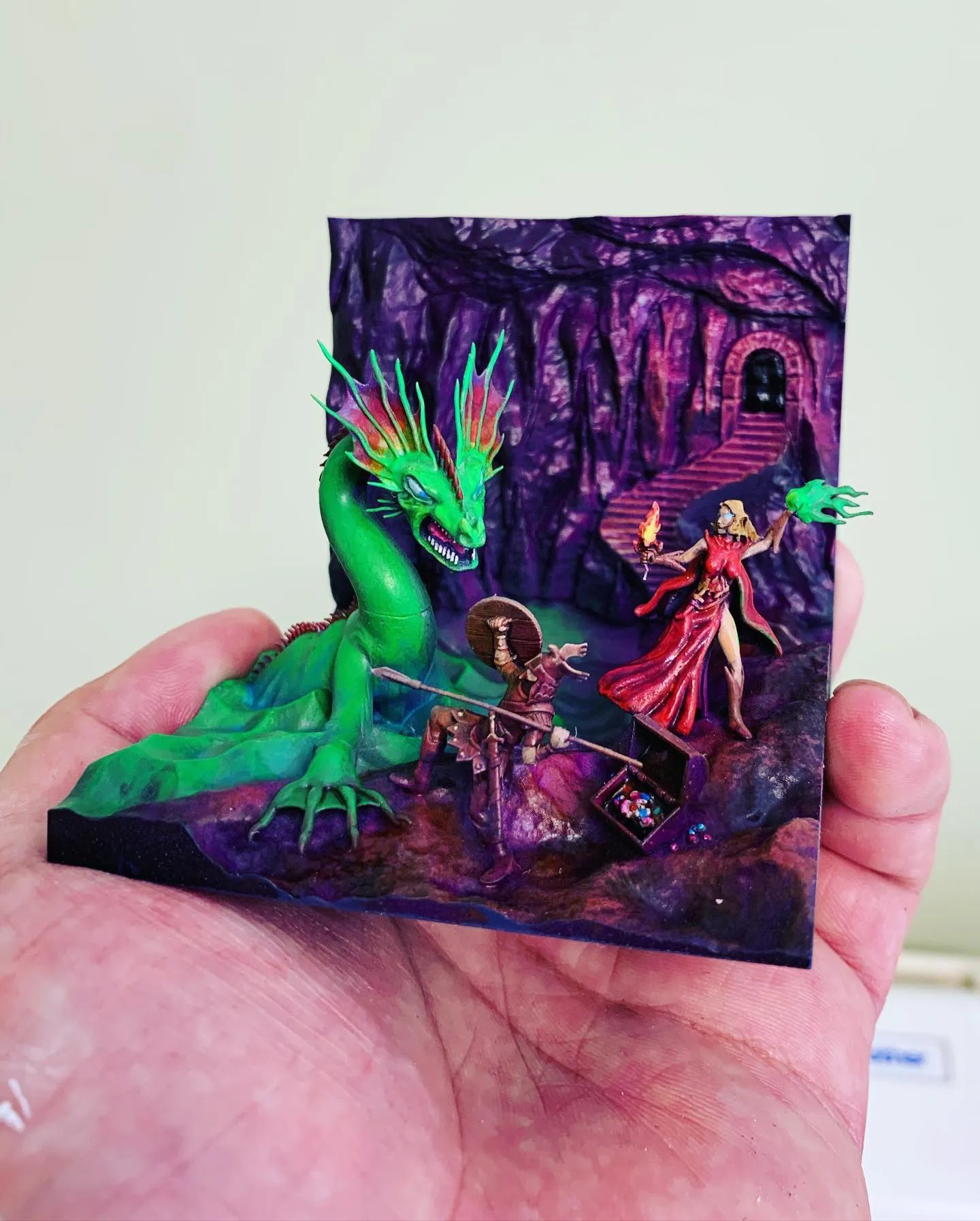
For those of you into 3D printing, you might find this reproduction of the iconic Erol Otus cover to the 1981 Dungeons & Dragons Basic Set interesting. I know next to nothing about 3D printing – or painting for that matter – but it's hard not to be impressed by this!

Pulp Fantasy Library: Enchantress of Venus

The distinctions separating the literary genres of fantasy and science fiction are fine ones, especially when dealing with early examples of the latter. For example, is A Princess of Mars a work of science fiction because its story takes place on the very real planet of Mars or is it a mere fantasy because so many of its setting details are incompatible with what we now know about the Red Planet? Over the decades, it's been a frequently contentious issue, hence the proliferation of even finer literary genres – planetary romance, science fantasy, and sword-and-planet, to name but a few – intended to put an end to such questions. As I've gotten older, I've simultaneously become less interested in these matters and more accepting of an expansive definition of "fantasy" that includes all types of imaginative fiction.

In the case of Leigh Brackett's tales of Eric John Stark, many of which appeared in the pages of Planet Stories in the 1940s and '50s, this primal concern nevertheless resurfaces. Even in 1949, when Brackett wrote her first story of Stark, enough was known about the other worlds of our solar system that there was little plausibility to their being habitable by mankind without significant technological aid, let alone having intelligent natives of their own. Was Brackett then writing fantasy or did her stories still qualify as science fiction, albeit of an old fashioned sort – or is this, as I increasingly feel, a distinction without a difference? 

Of course, little of this matters, as Stark's adventures are engaging yarns told with great enthusiasm. "The Enchantress of Venus," which first appeared in the Fall 1949 issue of Planet Stories, amply demonstrates what I mean. Second in the chronology of the tales of Stark, the novella takes place, as its title suggests, on the planet Venus, renowned for its "seas" of buoyant, phosphorescent gas. This detail is important because, as the story begins, Stark is aboard a ship making its way across one such Red Sea toward the town of Shuruun. 

Shuruun is, to borrow a phrase, a wretched hive of scum and villainy. Stark is no stranger to such places and thus has no fear of the town. However, he only sought it out to find his friend, Helvi, "the tall son of a barbarian kinglet," who had gone into the town previously and never returned. Stark feels an obligation to locate Helvi and, if necessary, rescue him from whatever peril awaited him in Shuruun. Like so many pulp fantasy protagonists, Stark lives by his own code of honor, one that places great value in friends.

Malthor, the captain of the ship on which he is traveling, repeatedly suggests that Stark, whom he recognizes as a stranger, due to his black Mercurian skin, would do well to lodge with him when they reach Shuruun. Each time, Stark declines. As it turns out, he has good reason to do so: Malthor's true intentions are wholly sinister. Just as the ship gets within sight of the "squat and ugly town" that "crouch[ed] witch-like on the rocky shore, her ragged skirts dipped in blood," Malthor and some of his crew attack Stark in an attempt to take him prisoner, though for what precise purpose he did not know (and would not until later in the story). Rather than suffer this fate, Stark dives overboard into the Red Sea.
The surface of the Red Sea closed without a ripple over Stark. There was a burst of crimson sparks, a momentary trail of flame going down like a drowned comet, and then—nothing.

Stark dropped slowly downward through a strange world. There was no difficulty about breathing, as in a sea of water. The gases of the Red Sea support life quite well, and the creatures that dwell in it have almost normal lungs.

Stark did not pay much attention at first, except to keep his balance automatically. He was still dazed from the blow, and he was raging with anger and pain.

Properly scientific or not, this is evocative stuff and a reminder of why Brackett made such a splash (no pun intended) in the world of pulp fantasy during the 1940s and '50s. 

Emerging from the sea, Stark makes his way to Shuruun in search of Helvi. He is almost immediately recognized as a stranger by the locals, who confront him and appear ready to attack. Before this can occur, a white-haired Earthman named Larrabee calls out and invites him to drink with him. Larrabee, we soon learn, is a notorious thief who "got half a million credits out of the strong room of the Royal Venus." In the nine years since, he has holed up in Shuruun to avoid being found by the authorities. When Stark introduces himself, Larrabee mentions that he knows his name from a wanted poster as "some idiot that had led a native revolt somewhere in the Jovian Colonies—a big cold-eyed brute they referred to colorfully as the wild man from Mercury." 

Stark is amused by this description of himself but soon shifts the conversation to local matters, in particular the whereabouts of Helvi. Larrabee claims not to have seen him and instead speaks of the Lhari, "the Lords of Shuruun," who are "always glad to meet strangers." Hearing this, Stark decides he to call on the Lhari to see if they might know something about Helvi. Along the way, he meets Zareth, the teenage daughter of Malthor, who'd been sent into Shuruun to find him and then lure him into an ambush outside the city. Then, he'd be handed over to "the Lost Ones," who dwell in the interior of the swamp and have an interest in strangers like Stark. Zareth doesn't follow through on her father's plans, though, because he beats her and she hates him. However, she has no interest in joining Stark in visiting the Lhari, who frighten her as much as her father.

If you're having difficulty keeping all these narrative threads – Malthor, the Lhari, the Lost Ones – straight in your head, that's understandable. Brackett throws a lot at her readers at the beginning of "The Enchantress of Venus" and its can be confusing at times. Fortunately, she's a very skilled writer and repays the patience and forbearance shown to her. By the time Stark enters the castle of the Lhari and meets them, in all their decadent glory, for the first time, that things begin to make a great deal more sense. In some ways, that's the real beginning of the novella and the action barrels along from that point until it reaches its ultimate, satisfying conclusion. It's a lot of fun to read and reminds me, in some ways, like many of Robert E. Howard's tales of Conan the Cimmerian: a "wild" outsider finds himself caught up in the machinations of several sinister factions and must find a way to extricate himself from their clutches. What's not to love?

Sunday, May 15, 2022

Wandering DMs

Dan Collins and Paul Siegel have once again asked me to appear on their Wandering DMs channel this afternoon at 1pm EDT. This time, I'll be talking about the ups and downs of refereeing a RPG campaign for the last seven years. Though obviously some of what I have to say will be specific to my ongoing House of Worms campaign, much of it – most of it, I hope – will have more general applicability to any long-running RPG campaign.

Tuesday, May 10, 2022

White Dwarf: Issue #36

Issue #36 of White Dwarf (December 1982) features a cover by Brian Bolland, one of the comics artists most closely associated with Judge Dredd. At the time this issue appeared, I was only dimly aware of the existence of Dredd as a character. What little I did know was gleaned from the pages of White Dwarf, as I'll soon discuss.

Appropriately, the issue kicks off with an article by Ian Livingstone, in which he talks about the creation and history of the Judge Dredd comic. He then uses that as a springboard to talk about the design of the Judge Dredd boardgame reviewed in the previous issue. This is an article I remember quite well, since it was likely my first serious introduction to Dredd, Mega-City One, and the bizarre rogues gallery of perps that inhabit it. It'd still be several more years, I think, before I laid hands on a copy of the Judge Dredd comic, but I nevertheless has fond memories of this issue and Livingstone's article.

The "Fiend Factory" serves up but a single new monster for use with Dungeons & Dragons this month – "The Loculi" by Eric Hall. The titular creatures are intelligent reptilians with a wide range of abilities, including spells and psionic abilities. In addition, their combat effectiveness, not to mention their likelihood to own and employ magic items, increases with age, as demonstrated on an accompanying table. The loculi are thus flexible opponents, equally suitable for characters of any level. Sadly, beyond their combat abilities, there's not much more to the loculi. We learn very little of their society or culture, which is a shame, because I think there's potential here.

Part 1 of Andy Slack's "An Introduction to Traveller" focuses on both players and characters. As presented, it's remarkably basic in its approach, with lots of attention given to explaining the meanings of character ability scores, dice rolling, even hexadecimal notation. As with those "intro to D&D" articles that appeared in the pages of Imagine, I find myself wondering once again the purpose of articles like this or the target audience. I can only presume that it's for readers of White Dwarf who are as ignorant of Traveller as I was at the time of Judge Dredd. If so, I would guess they'd find the article useful, though it's tough going for anyone with much familiarity with the game beforehand. 

Another Traveller article is "Sector and Starburst" by Marcus L. Rowland, which presents the code for two ZX81 programs. Both programs generate sector for the game, with the latter doing so in a more minimalist fashion. Obviously, this article las almost no use today except as a museum piece – I'm completely unfamiliar with the ZX81 computer – but I got a kick out of it nonetheless. The early days of consumer computers coincided with my entry into the hobby of roleplaying and will thus be forever linked in my memory. Seeing articles like this triggered a powerful wave of nostalgia.

"The Druid's Grove" by Mark Byng is a fascinating and fun little aid for use with AD&D. Its purpose is to provide a map and ancillary rules for adjudicating the trials by combat needed for druids to advance beyond 11th level, since members of the class must beat their superiors to do so. This isn't something every campaign will need, but I appreciate its inclusion nonetheless, not least because it makes it any effort to liven up the combat with hazardous terrain and flora and fauna that could prove beneficial or detrimental. This is the kind of article that White Dwarf would do from time to time that really captured my imagination, even if I never had an opportunity to use it.

"Open Box" reviews several new items, starting with The Warlock of Firetop Mountain (10 out of 10), followed by Trollpak, which somehow only rates a 9 out of 10. Yaquinto's Pirates and Plunder RPG also rates a 10 out of 10, which only adds to my sense that WD's reviews were often wildly out of a sync with my own perceptions. Finally, there are reviews of several FASA Traveller products: Merchant Class Ships (8 out of 10), Aslan Mercenary Ships (7 out of 10), and the FCI Consumer Guide (9 out of 10) – again, all very positive reviews. I'm not one who relishes negative reviews and indeed sometimes feels that too many reviews are unduly negative. However, neither do I see much value in overly effusive reviews. Perhaps it's the numerical rating system that's distorting things.

"Rules Additions" by Simon Early is a strangely titled introductory scenario for RuneQuest that is written in a way to challenge a wide variety of the characters' skills to succeed. The main "rules additions" handle one character assisting another in their tasks. "More Necromantic Abilities" by Graeme Davis is a follow-up to the previous issue's "The Necromancer." Here, Davis provides thirteen new powers for use by the class.

Finally, Lewis Pulsipher's "A Guide to Dungeon Mastering" series concludes with Part III. He talks a bit about the importance of keeping a campaign difficult enough to hold the players' interests, lest they reach high level too easily. He goes further in suggesting that D&D doesn't handle high-level play very well from a mechanical perspective and that, as a result, there will be a host of issues a referee must contend with. Finally, he emphasizes the need for each referee to pursue his role in a fashion that gives him the most enjoyment. Though I disagree with some of his observations, I nevertheless found this installment of the series my favorite. I generally enjoy reading about the philosophy of refereeing and this article is no different in this regard.

As I say repeatedly, periodicals are almost always a mixed bag, though I find that White Dwarf, perhaps due to its smaller pool of talent, tends to be much more wild in its variability, with some issues being profoundly mediocre and others being transcendent. Issue #36 tends more toward the former, though I retain a personal affection for the issue, because of my memories of having read it at the tender age of thirteen. 

Monday, May 9, 2022

"The Playable One"

An unexpected joy of re-reading White Dwarf is coming across advertisements like this one for Star Frontiers, which, so far as I know, was unique to the UK market. The ad is interesting for several reasons, starting with the original artwork that accompanies it. Equally interesting, I think, is the inclusion of a cartoonish looking wizard as a kind of corporate mascot. Again, this seems unique to the UK market, though a similar wizard character does appear on the box of the 1982 TSR children's boardgame, Fantasy Forest. Both, I imagine, are callbacks to the old TSR wizard logo from the late 1970's to very early 1980s.

Most interesting of all, at least to me, is that the advertisement emphasizes the supposed playability of Star Frontiers over its competitors in the SF RPG market. At the time this ad appeared (1982), Traveller was likely the most popular and successful science fiction roleplaying game on the market, followed by Space Opera. I can certainly believe that Space Opera was widely seen as complex, but was Traveller viewed in the same way? My no doubt rose-colored memories don't include that perception at all, but that doesn't say much. Even given the sorts of hyperbole to which advertising is prone, I can't help but wonder about the claim that Star Frontiers "will change your opinion of science fiction role playing games."

Pulp Fantasy Library: The Right Hand of Doom

There can be denying that, during his lifetime, Robert E. Howard was an extremely successful – and popular – writer. Consequently, illustrations depicting his stories appeared on the cover of Weird Tales thirteen times, since the advertisement of a yarn by Howard served as a powerful enticement at the newsstand. Yet, like all writers for the pulps, he regularly encountered disinterest and rejection by his editors, most notably the mercurial editor of the Unique Magazine, Farnsworth Wright. Sometimes, REH would rework these rejected stories for resubmission elsewhere (or even again to Weird Tales). At other times, he simply abandoned these stories and it would not be until decades after his death that anyone even became aware of their existence, let alone had a chance to read them.

Such is the case with "The Right Hand of Doom," a very early story of Puritan adventurer, Solomon Kane. The story was likely written and rejected sometime in the late 1920s or early 1930s, but its first publication didn't occur until 1968, when it appeared in Red Shadows, an anthology named after the Kane story of the same name. Produced by Donald M. Grant, Red Shadows was a limited run book, with fewer than 900 copies in its first printing. However, the book sold out quickly, thanks in part to the growing interest in Howard's original texts, unadulterated by the "revisions" of L. Sprague de Camp and Lin Carter. The inclusion of previously unknown tales like "The Right Hand of Doom" no doubt played a role as well.

The story begins in a tavern, where a drunken man with "a high-pitched grating voice" boasts of the fact that a man is to hang out dawn.
"Roger Simeon, the necromancer!" sneered the grating voice. "A dealer in diabolic arts and  worker of black magic! My word, all his foul power could not save him when the king's soldiers surrounded his cave and took him prisoner. He fled when the people began to fling cobble stones at his windows, and thought to hide himself and escape to France. Ho! Ho! His escape shall be at the end of a noose. A good day's work, say I."

But not everyone in the tavern is impressed by the boasts of the man, whose name we learn is John Redly. Seated near the fireplace is "a tall silent man" who was "gaunt, powerful and somberly dressed." 

"I say," said he in a low powerful voice, "that you have this day done a damnable deed. Yon necromancer was worthy of death, belike, but he trusted you, naming you his one friend, and you betrayed him for a few filthy coins. Methinks you will meet him in hell, some day." 

Redly is offended by such an accusation but chooses not to tangle with the man by the fireplace, whom the others in the tavern call "dangerouser than a wolf" – Solomon Kane. Redly likewise thinks little of the vengeance the necromancer swore to take on him. Now that Simeon was in the hands of the authorities, he could enjoy the wages of his betrayal in safety. Naturally, Redly is mistaken in this and, by the morning, he is dead in his bed and Kane is there to determine just how this happened.

"The Right Hand of Doom" is a very short story, just a few pages in length and it wastes few words on unnecessary dialog or description. If I have a complaint about the story, it's that there's very little action in it. Kane is almost passive in the story, which unfolds without his involvement. He is there to witness Simeon's revenge upon the man who betrayed him and then react to it. He rights no wrongs, as he usually does, nor is he ever in any danger. Instead, Kane is simply present, though Howard does a good job, I think, in depicting his resolute demeanor and upright character. 

"The Right Hand of Doom" is thus a very different kind of pulp fantasy. It's essentially a ghost story of a sort, one you might tell around the campfire at night rather than a tale of heroic derring-do in the early 17th century like Howard's more well known stories of Solomon Kane. Perhaps that explains why "The Right Hand of Doom" was never published during Howard's lifetime: it's something of a departure from his usual style and subject matter. Personally, I'm fine with that and think it's a fun little tale of supernatural revenge well worth reading if you can find a copy.

Friday, May 6, 2022

Cross Pollination

Briefly: I am fine. Thank you to everyone who reached out to check in on me, concerned that my having not written a post in the last week portended something unpleasant. The truth is I simply wanted to take a break. Spring is here; the weather is warmer and now seemed a good time to start working on my garden, among other vernal chores. Regular posting will resume in due course.

In the meantime, here's another question to keep you occupied: have you ever imported a rule from one RPG into another? That is, have you ever come across a rule (or rules interpretation) in one game that you liked so much that you thought a different game would benefit from its adoption? In my own case, I found the way that Empire of the Petal Throne handles the rolling of hit points upon gaining a new level so clever that I've made use of it in every level-based RPG with increasing hit points that I referee. For those unaware, EPT says that, once a new level is gained, the player rolls all his character's hit dice and adds up the total. If the sum is less than his character's current hit points, he gains no new hit points; if the sum is greater, it becomes the character's new hit point total. I like the rule because it evens out a PC's hit points over time while still respecting the inherent randomness of using dice.

What are your favorite rules you've borrowed from another game?