Showing posts with label imagine magazine. Show all posts

Tuesday, April 4, 2023

White Dwarf: Issue #70

Issue #70 of White Dwarf (October 1985) has a very striking cover by Brian Williams. Though the idol in the back recalls gaming's best cover ever, I find myself drawn to the blindfolded barbarian in the foreground. Why is he blindfolded? What is the significance of the runes written on that blindfold? What is that glowing device in his left hand? It's a very evocative piece and all these unanswered questions only makes it more compelling.

Ian Livingstone's editorial mourns the loss of Imagine magazine, which ceased publication with its thirtieth issue. His words seem genuinely heartfelt, especially when he notes "the good relationship between the White Dwarf staff and their opposite numbers." At the same time, Livingstone uses this occasion to downplay any suggestion that there is a decline in interest in the hobby of roleplaying. He likewise crows that "White Dwarf's circulation continues to increase," which, while undoubtedly true, seems – to me anyway – to be in slightly poor taste, given the circumstances. 

"Tongue Tied" by Graeme Davis deals with the questions of languages and literacy in AD&D. Davis offers a simple but "realistic" system for handling fluency and the learning of new tongues. It's probably more than is needed by most players of AD&D, but it looks to do a good job at emulating "the polyglot flavour of Howard's Hyborian Age or Moorcock's Young Kingdoms." I may look at it more closely as I ponder similar issues in The Secrets of sha-Arthan.

As usual, we get new installments of "Thrud the Barbarian," "Gobbledigook," and "The Travellers." The latter concludes its series of presenting Traveller statistics for the comic's many characters by giving us a look at "the galaxy's most repugnant pervoid," Jason Dinalt – no, not that one – and Felix the Dawlri, an "albino koala bear/tribble." We also get several superhero-related features, starting with Paul Ryder's "The Coven," a cabal of villainous magicians for use with Golden Heroes. There's also "Reunion" by Simon Burley, an adventure dual statted for both Golden Heroes and Champions. The scenario is a follow-up to the introductory one included with Golden Heroes, so I suspect it would hold much less appeal to a Champions referee (unless he happens to own GH as well).

"Open Box" looks at a lot of D&D-related items, starting with three Expert-level modules: Quagmire!, The War Rafts of Kron, and Drums on Fire Mountain, all of which receive scores of 8 out of 10. Dragons of Mystery for the Dragolance series does not fare nearly as well, receiving only 6 out of 10, which is frankly a much higher score than its text would suggest. The reviewer says that "its actual use and value is questionable" along with many other harsh truths. Battle System, meanwhile, gets a better hearing (8 out of 10). I was surprised by this, given that Battle System was something of a rival to GW's own Warhammer rules. Finally, there's The Lost Shrine of Khasar-Khan, the second entry in "The Complete Dungeon Master" series (8 out of 10).

"The Price is Right" by Marcus Rowland is a follow-up of sorts to last month's "The Surrey Enigma." The article describes in full the pre-decimal UK monetary system, along with a price list of common items. I'm a sucker for articles like this, so I found it quite useful. Dave Langford's "Critical Mass" is here once more and, as usual, I couldn't muster the interest to do more than skim its three columns. Oh well. "Dead or Alive" by Diane and Richard John presents a new career for Traveller: the bounty hunter. Along with the usual information on terms of service and skills, there's also a nice variant of the classic type-S scout ship – with deckplans!

The third part of Peter Blanchard's "Beneath the Waves" series focuses on "creatures from the depths." This includes not just the usual underwater menaces, like cephalopods and sharks, but also sentient species, such as aquatic elves, mermen, and sahuagin. As with earlier installments, this is a solid article but much too short; it only scratches the surface of its subject. "In Too Deep," also by Blanchard, is an AD&D adventure for 4th–5th level characters. The scenario concerns a maritime expedition for spices, the politics of the merchants guild, renegade mermen, and other submarine shenanigans. There are plenty of twists and turns in the adventure and I think it does an effective job of showing how to integrate underwater threats into an AD&D campaign.

"Monstrous NPCs" by Paul Ormston offers up three fully fleshed-out monster NPCs, each a unique individual with his own personality, history, and goals. There's a lizard man prince, a jovial stone giant, and an intellect devourer masquerading as a human. Though each description is short, they're all interesting. They also nicely demonstrate that even monsters can benefit from characterization. "Chop and Change" is Joe Dever's article on modifying miniature figures by adding or subtracting elements from the original molds. He includes several photos of conversion techniques in action, including one of a dinosaur playing a saxophone that I found rather amusing for some reason.
All in all, I mostly enjoyed reading this issue of White Dwarf, though I continue to see signs that the magazine is in the midst of its transformation into the Games Workshop house organ it will one day become.

Tuesday, June 28, 2022

"The Thinking Magazine for Adventure Gamers"

Issue #40 of White Dwarf (April 1983) featured an advertisement for the first issue of TSR UK's Imagine, which premiered the very same month. 

In addition to the usual hyperbole, the ad is also notable for making use of the term "adventure gaming" to describe the hobby it services. In certain quarters, "adventure game" was preferred to "roleplaying game," in part, I think, because "roleplaying" was at the time more strongly associated with the field of psychology. I don't recall ever encountering the term often back in my youth. To my American ears, it sounds very British, but that might just be confirmation bias on my part. Regardless, it doesn't appear to have been widespread in its use, even within the United Kingdom, as evidenced by the title of Games Workshop's own foray into the field.

Tuesday, February 2, 2021

Imagine Magazine: Issue #30

And so we come to the final regular issue of Imagine magazine, issue #30, which appeared in September 1985 (there is also a Pelinore-focused special edition dated October 1985, which I do not own). The issue is another special one, dedicated to the subject of Vikings, with a cover by Richard Clifton-Dey. There is a brief editorial by Keith Thorrson, commending the issue's contents but no indication that the periodical would be ending, which suggests the decision to kill Imagine was a surprise to its staff. Back in the USA at the time, TSR was in a state of chaos, with the power struggle between Gary Gygax, the Blume Brothers, and, later, Lorraine Williams in high gear. This struggle had financial implications too, with layoffs and the shedding of assets to deal with debts. It's quite likely that Imagine was collateral damage of all of this, but I can't say that for certain.

"Viking!" by Graeme Davis is a lengthy (6-page) article providing aid to referees and players on how to integrate various aspects of Norse society, culture, and myth into D&D and AD&D. It's a fine article but necessarily more of an outline than a detailed plan of how to bring these RPGs more in accord with the world of the Vikings. David Hill's "Rune Magic" is similar, though much shorter and narrower in its scope. "None for mortal men doomed to die …" by Carole Morris is an overview of the Volsüng saga, with some very brief notes on how it provides inspiration for Norse-themed RPG campaigns. 

Venetia Lee and Reif Dormann offer "Icelanders," which briefly describes the history and legends of medieval Iceland. It's fine as far as it goes but, like most of the content in this issue, is very light on game material and much more heavily focused on "real world" information – not bad by any means but less than I'd have hoped in a roleplaying games magazine. "Ragnarok!" – lots of exclamation points in this issue! – is a Battlesystem scenario based on the mythical Norse battle between the Aesir and the Giants. I have no idea how well it would play but the concept is an excellent one. "The Norse Planes of Gladsheim" by Rod Stevenson provides details on the home of the Norse gods, according to the cosmology of AD&D. Again, it's fine, given its limited scope, but it doesn't compare to the Roger E. Moore's treatment of the same subject in the pages of Dragon. 

This month's Pelinore piece is actually a collection of three entries, the Asylum, the Deathcart, and the Waxworks (the first two by Brian Garrod and the other by Linda Moore), each of which includes NPC descriptions and ideas for scenarios involving them. The tone and content of these entries reminds me quite a bit of early Warhammer Fantasy Role Play and points toward many of the things I tend to associate with 1980s British fantasy: black humor and general grottiness. Carl Sargent's "Dispel Confusion Special" continues what was begun last issue by tackling cleric and druid spells. Reviews cover a large selection of TSR products for AD&D, D&D, Marvel Super Heroes, and Indiana Jones, along with products for Twilight: 2000, MERP, and TOON. Neil Gaiman's "Fantasy Media" looks at the movies Legend and A View to a Kill (both of which he disliked) and Ttrancers (which he enjoyed), in addition to The Wishsong of Shannara, which he calls "a must for those who like fantasy trilogies with silly names." "Fanscene" continues with more letters and opinion pieces about the state of the hobby, while Roger Musson's "Stirge Corner" the oddities of AD&D's hit point and armor class systems – still contentious topics today.

As I expected, I find myself feeling slightly saddened by conclusion of Imagine's run. The final issue, like so many of its predecessors, is a mixed bag that points toward the potential the periodical had even as it also highlights its flaws. I've been attempting to reach out to some of the principals involved in Imagine, with the hope that I might be able to arrange interviews with them to talk about their memories and experiences of those day. So far I've met only limited success but I'll keep trying, because I'd love to know more about those days. The mid-80s were a fascinating time of transition in the hobby on both sides of the Atlantic and I'd love to learn more about it from people directly involved in it. Until then, I'll be moving on to a new magazine next week, Chaosium's Different Worlds, which ran for forty-seven issues between 1979 and 1987.

Tuesday, January 26, 2021

Imagine Magazine: Issue #29

And so we come to the penultimate issue of Imagine, number 29 (August 1985), featuring a cover by Angus McKie (best known for his work on Iron Crown Enterprise's SpaceMaster). The issue kicks off with a very interesting article by Chris Barlow, entitled "For Monsters, Treasure and … other things." Its topic is experience points and the activities for which they are awarded, from the perspective of AD&D. I call it interesting, because Barlow is not simply dismissive of the standard means of acquiring XP but rather open to other approaches, including ones that award "class-based" activities. In this, he anticipates some of the options presented in Second Edition (and echoes those presented in earlier products, such as Arduin). I'm of multiple minds on this question, which is why articles like these command my attention, even if I've never reached a firm opinion on the matter.

This month's Pelinore article by Brian Garrod presents the Monument Square section of the City League, complete with maps, NPCs, and adventure seeds. Meanwhile, the issue's central feature is an interview with the science fiction author Bob Shaw, whom I must confess I've never heard of. This is followed by a short story by Shaw, "Executioner's Moon," its first appearance in print. Following both of these pieces is a science fiction RPG article, "The Sarafand File," by Paul Vernon and Sean Masterson, intended for use with either Traveller or Star Frontiers. The article is based on elements of Shaw's fiction, specifically the Cartographic Service from the novel Ship of Strangers. Never having read the novel, I can't comment on the article's fidelity to it, but it does contain some useful maps of a starship and a survey vehicle, along with multiple adventure ideas.

"The Taumet Codex" by Andrew Swift is a short adventure for AD&D that introduces a new monster, the eponymous Taumet, a magically constructed dragon of great power. Much more interesting is the "Dispel Confusion Special" (with thanks given to Carl Sargent), which discusses unusual aspects of magic-user and illusionist spells. For example, it's noted that the spell dig does damage against clay golems and that the clone spell cannot be used on non-humanoid creatures. As is often the case with Imagine articles of this sort, it's nothing earth-shattering but it's solid, practical material that highlights details of the game that might otherwise be overlooked. This month's reviews include lots of TSR products for D&D, AD&D, Marvel Super Heroes, and Indiana Jones. I was most intrigued by a review of a Traveller product I'd never heard of, Deneb Sector, written by Graham Staplehurst and David Hulks as a charity product for the Save the Children Fund. From what I have subsequently gathered, the supplement is exceedingly rare and its contents superseded by later published Traveller materials, even though it was officially sanctioned by GDW at the time.

Neil Gaiman's "Fantasy Media" reviews a number of films (Return to Oz, Cat's Eye, Night of the Comet) I'd long forgotten about, showing just how far we now are from the mid-1980s. He also review a mountain of books, the most notable of which is L. Ron Hubbard's Battlefield Earth, which Gaiman deems "un-put-downable." I guess there's no accounting for taste. This issue also marks the premier of "The FanScene," a section devoted to short articles on a variety of topics by readers (as opposed to staff writers) on a variety of topics, such as fanzines. Reading through it is quite fascinating, since it reveals  fanzines were apparently alive and well in the United Kingdom at the time, something of which I was only dimly aware. Roger Musson's "Stirge Corner" counsels against "letting fighters dominate the game," which is, at first glance, an odd thing to say. What Musson means, however, is that adventures should not focus too much on combat to the exclusion of tricks, puzzles, and social encounters – hard to disagree with that!

With that, we come to the end of another issue and, soon, the end of Imagine itself. I must admit, for all my grousing about the up-and-down quality of the magazine, I'm saddened that I'll soon be reaching the end of my reading of it. I'll have more thoughts on this topic in my post next week, but, for now, I'll simply say that I strangely feel a sense of impending loss, which is odd, given that I was utterly unaware of the existence of Imagine during its original run. Can you have nostalgia for something you never experienced?

Tuesday, January 19, 2021

Imagine Magazine: Issue #28

Issue #28 of Imagine (July 1985) is another "special" issue, in this case "pulps." I try not to be too judgmental on this particular topic, since I understand what is meant by "pulps," namely broad, over-the-top action, as exemplified by many of the stories that appeared in the pages of pulp magazines during the 1920s, '30, and '40s. Yet, as I regularly point out, "pulp" is no more a genre than is anime (another term frequently misused by those unfamiliar with it); the pulps were filled with stories of many different genres, from fantasy to crime stories to historical fiction, with many more besides, most of which shared only the paper on which they were printed and nothing more. 

Paul Mason's "The Masked Avengers" presents itself as "an introduction to pulp rolegames," which in this case means Daredevils, Justice Inc., Gangbusters, Chill, and Call of Cthulhu. According to Mason, pulp stories were "stirring tales of two-fisted action" featuring "rugged individuals fighting for truth, justice, and the American way against the forces of evil in a variety of exotic locations." He's correct that that's the way "pulps" are popularly understood, though the pedant in me recoils at the narrow understanding of the contents of these magazines. Oh well.

".... And Action!" by Mark Davies and Derrick Norton is, in a bit of serendipity, an article that demonstrates well just how much of a mess AD&D's combat rules were. The article takes five pages to elucidate the game's initiative system, something that Moldvay Basic handles succinctly in a few short paragraphs. Chris Felton's "Lycanthropy," on the other hand, is a four-page discussion of lycanthropes in D&D and AD&D, fleshing them out for use as opponents, NPCs, and even player characters. As is often the case, it's not a topic that matters much to me personally, but the article is nicely done and engaging – exactly what I want out of gaming articles. Felton returns, along with Paul Cockburn, in "The Gods of the Domains," this issue's Pelinore article. The piece fleshes out a few of the gods, providing them with mythology and relationships to one another. Accompanying the article is "Carraway Keep and the White Order" by Graeme Drysdale, which describes an organization for magic-users and elves.

David Hill's "A Look at the Cthulhu Mythos" is an overview of its (literary) history, detailing all the authors who have contributed to it and the ways in which their contributions changed it. Short but interesting, I was glad to see an article like this in a gaming magazine. Marcus Rowland's "A Nice Night for Screaming" is a murder mystery scenario intended for use with a variety of "pulp" RPGs, including the Adventures of Indiana Jones. It's a tight, well written adventure, as one would expect of Rowland. Chris Felton has yet another article in this issue, "The English Daredevil," which examines this pulp archetype from the perspective of England in the 1930s, with suggestions for modifying the rules of various games to make them a little less USA-centric. It's a good article; my only complaint is that it's too short and narrow. I'd love to have seen a longer treatment of the subject.

Hilary Robinson's "Time for the Little People" is a science fiction short story dealing with interactions between Terrans and an alien race. Sadly, this month's review focus entirely on TSR products, for AD&D and Marvel Super Heroes. Roger Musson's "Stirge Corner" discusses the potential pitfalls of a campaign less focused on dungeon delving and defeating monsters and more on politics and other social interactions. In particular, he ponders how to award experience points in D&D campaigns of this sort. As always, there's lots of food for thought. 

This month's "Fantasy Media" is written by Neil Gaiman, which is interesting from a historical perspective, if nothing else. Gaiman reviews a movie I've never heard of, Titan Find, which he dubs an "Alien rip-off," as well as Runaway (starring Tom Selleck, which he likes well enough), Repo Man (which he also liked), and Cloak and Dagger (another positive review). What struck me reading this column was how many movies whose existence I had forgotten; it was quite a trip down memory lane being reminded of these. And, as always, there are comics I didn't bother to read.

Imagine continues to intrigue me, partly because I'd never seen it back in the day and partly because its content is noticeably different from what I'd read in Dragon or even White Dwarf (to which I had more regular but nevertheless intermittent access). Articles are fairly hit or miss, it's true, but they also tend to be longer and off the beaten path in terms of content. There's quite a lot of good material here, along with some forgettable stuff too. The good material, though, is of very high quality and it's a shame that the magazine didn't last longer. As the conclusion of this series draws closer, I find myself slightly saddened.

Tuesday, January 12, 2021

Imagine Magazine: Issue #27

Issue #27 (June 1985) of Imagine features a very striking cover by Pete Young. As with most of the past issues, this one is devoted to a theme, in this case magic and magic-users. It kicks off with "Magic: Miracle or Menace?" by Mike Lewis, which discusses the place of the magic-user in a fantasy society, with special attention given to the ways that the presence of magic might lead to social and political upheaval. The article is brief and its points are fairly elementary, especially to old hands, but Imagine seems to have been focused on beginning roleplayers, so the presence of pieces like this make sense. 

Next up is "New Magic User Spells" by none other than Gary Gygax. The article is a reprint of Gygax's earlier (November 1982) article from Dragon, presenting spells that would later be included in the pages of Unearthed Arcana. I remember enjoying the original article – and others like it – but somehow, when UA was finally published, much of the material didn't seem quite as attractive anymore. One thing this reprint has going for it, though, are some delightful illustrations, like this one, depicting the spell stoneskin.

"Rhyme nor Reason?" by J.A. Robertson is an attempt to provide a rationale for D&D's magic system by postulating the existence of True Speech, a primal language, knowledge of which grants the speaker varying degrees of command over reality. It's an intriguing idea and the author is quick to point out that it's not meant to be a definitive rationale, only a possible one that he's used successful in his own campaigns. "A Familiar Liability" by Mark Davies tackles the subject of familiars, looking at the advantages and disadvantages of the spell as presented in AD&D, along with suggestions on how to improve it. While I have never cared much about this topic, I must confess Davies made me more interested in it, which is the sign of a good article in my opinion.

Chris Felton's Pelinore article describes the town of Burghalter, another small settlement in the County of Cerwyn. Burghalter is notable for having a secret cult whose members worship rakshasas, monsters that may or may not actually exist in the town. "One Fine Day in the Middle of the Night" by Paul Emsley is a level-agnostic AD&D adventure set in Pelinore and takes the form of a murder mystery. Its level agnosticism is unusual, at least in published adventures, but it makes a great deal of sense in the case of scenarios like this one, which consists almost entirely of investigation. Good stuff!

Kevin Smith's "Alcain and the Swamp Demons" is an amusing fantasy short story about a barbarian chieftain, the titular Alcain, and his interactions with a high priestess called the most beautiful of all women. It's a fun, clever little story and I enjoyed reading it. This issue's reviews cover adventures for AD&D, Middle-earth Role Playing, and Chivalry & Sorcery, along with Twilight: 2000. The review of the last product is overall positive (with a few caveats) and notes
this is a good game, well worth clubbing together for, if you belong to a group of experienced players who like free-running games and whose referee can run a scenario from minimal notes. If your referee has no experience of 'winging it' and needs all the details worked out in advance, this is not the game for you. Unfortunately, there are far too many of these around, so the game will probably sink into oblivion within the year.

 Ouch!

Colin Greenland's "Fantasy Media" offers reviews of several movies and books, starting with John Carpenter's Starman, which he dislikes a great deal. He is much more taken with The Return of Captain Invincible!, a movie I'd never heard of till now and that, based on what I've read about it, sounds awful. I guess there's no accounting for taste. Roger Musson's "Stirge Corner" discusses the matter of character beliefs and how they affect playing them. Musson uses the example of Norse culture to illustrate his point. As usual, it's a good article that provides some excellent food for thought. Musson is by far my favorite author in the pages of Imagine. I wonder whatever became of him.

Tuesday, January 5, 2021

Timescape

Issue #26 of TSR UK's Imagine magazine contained the advertisement above, which awakened some long-forgotten memories of reading an article about Treasure Trap, an early LARP that took place in an English castle. Though I can't be certain, it's likely the article in question appeared in the pages of White Dwarf, my main source for gaming news outside North America. In any case, I was enthralled by the idea of fantasy roleplaying "for real" and hoped one day to participate in such an event. 

I was an exchange student in London for a few months in 1987 and had hopes that I might be able to visit Treasure Trap, but never did so for various logistical reasons. In the years since, my interest in this sort of activity has waned considerably (I have, in fact, never LARPed), though I retain an academic interest in historical reenactment and related hobbies. I've had a few friends who were casual participants in SCA events, but, again, have never attended one myself. The SCA is another huge lacuna in my knowledge of the history of our hobby. Its influence on roleplaying isn't huge but it's there, particularly on the west coast scene. I am led to understand that the Perrin Conventions, a set of OD&D house rules and the ultimate origin of Chaosium's influential Basic Role-Playing, owe a lot to Steve Perrin's experience in the SCA, for example.

It's frankly amazing to me that, even after all these years, there are still plenty of nooks and crannies in the history of the hobby that are poorly explored and documented. Had I the resources to do so, I'd love to look into some of these more seriously.

Imagine Magazine: Issue #26

Alan Craddock provides the cover to issue #26 of Imagine (May 1985), which also very prominently features a starburst proclaiming that the magazine is "For players of the Dungeons & Dragons role-playing game." A banner at the bottom left also proclaims that the issue will include "(almost) live" coverage of Gamesfair '85. From a purely historical point of view, the three-page article devoted to that game convention is by far the most interesting one in the whole issue, if for no other reason than its being a window on the hobby of yesteryear. For that reason, I'm going to save my comments on it till the end of this post. 

"The Adventurers' Guild" by Chris Felton takes the form of a faux lecture delivered by a veteran adventurer to his colleagues about novel uses for magic spells. For example, by casting continual light on marbles, one can determine the depth of a shaft or the contents of an alcove. Likewise, one could cast wall of iron above a target, which then drops on his head. As articles go, it's fine but nothing I haven't seen before in other similar articles. Roger Musson's "Monstermark Revisited" is a revision of the author's famous system for measuring the lethality of a monster that appeared in the pages of White Dwarf. Again, it's fine for what it is, but I've never had any need for such a system (though I understand the Monstermark was well regarded in its day). 

This month's Pelinore material consists of descriptions of the setting's gods and the village of Tellhalter, neither of which grabbed me the way previous entries in this series have – perhaps I'm becoming jaded. "Fellow Travellers" by Paul Vernon treats what it calls "wayfarers" one might encounter on the road for use as random encounters in D&D or AD&D. Wayfarers are divided into groups, such as commoners, dignitaries, or officials and then further sub-divides them, offering descriptions, game stats, and ideas on how to use them in a game. It's a clever little article with genuine utility, which is just what I like to see. "The Great Paladin Hunt" by Mike Brunton is an AD&D adventure, in which the characters are all paladins who have escaped from the clutches of a band of gnolls who were preparing to eat them as part of a celebration. The scenario is basically a wilderness hexcrawl, with multiple keyed encounters, as the paladins attempt to flee to safety while the gnolls pursue them. As a tournament adventure for Gamesfair, it seems like it'd be fun to play.

"Mindmeld" is "a game of psionic warfare" for two players (though suitable for solitaire play), written by Alan E. Paull. Since I didn't have the chance to play it myself in preparation for this post, I unfortunately can't speak to its quality. "Rock Touch" by Sharon Clark is a short story about a geologist and her assistant who encounter something strange while on a survey. This issue's reviews focus on Dragonlance (both its modules and first novel), all of which are reviewed with charity though without much love, if that makes sense. The reviewers are certainly fairer to the series than I have been in the past. Meanwhile, Colin Greenland's "Fantasy Media" takes on Ladyhawke and Brazil (among other things), both of which he liked a great deal. In "Stirge Corner," Roger Musson continues to talk about the uses of fantasy maps and tackles the issue of whether they ought to "make geological sense" or whether it's more important they serve the ends of the referee's campaign – as always, thought provoking stuff. There are comics too, but …

Which brings us to the coverage of Gamesfair, complete with photos. Here's an example of one that, though taken in another country, nevertheless reminds me of my own early experiences of game conventions.

These young lads could have been my friends and I around the same time, a thought that fills me with equal parts wistfulness and embarrassment.

The coverage also provides details of a seminar  to be led by Gary Gygax, described as "the highlight of the weekend." However, Gary was not able to make the event and TSR UK head, Don Turnbull, took his place. Despite this disappointment, Turnbull offered up a number of interesting tidbits and controversial statements, some of which really struck me. First, he mentions that the long-awaited module T2 was nearly complete but had been so greatly expanded that it would probably be released as a hardback book. Turnbull also stated that the D&D toys "have nothing to do with our hobby" and had "harsh words … about some other recent trends in the industry." Sounds like a man after my own heart! The article also notes that the crowd "were concerned about the Dragonlance modules and the direction that modules seem to be taking." Sadly, there was no elaboration of what this direction was, but it definitely piqued my interest, given my own well-known feelings about Dragonlance and its baleful influence on Dungeons & Dragons.

In sum, issue #26 was a fairly middling one, with only the coverage of Gamesfair being a stand out for me personally and, even then, primarily for the nostalgia factor of peering into the world of nerdery circa 1985. Those were the days!

Tuesday, December 29, 2020

Imagine Magazine: Issue #25

 Issue #25 of Imagine (April 1985) is the "Far Eastern Special," presenting numerous articles whose content derives from myths, legends, and cultures of Asia. Without context, I'd have assumed that the issue's contents had been chosen to complement the release of Oriental Adventures, but I'd have been wrong. That AD&D hardcover, the last to bear the byline of Gary Gygax, wasn't published until late 1985 (Gary's preface is dated September of that year). Indeed, there's nary a mention of Oriental Adventures in this issue, which suggests there's no connection between the two whatsoever or, if there is, it's an unacknowledged one. 

Graeme Davis opens the special with "Monsters from Folklore of the Philippines," a collection of seven new creatures for use with Advanced Dungeons & Dragons (as well as notes on local versions of standard AD&D monsters). Davis also penned ""Japanese Bujutsu in the AD&D Game." The article presents more than a dozen new weapons of Japanese origin, in addition to brief disarming, archery, and judo. Though brief, the article is one I'd have enjoyed at the time, during a period when I was very interested in Japanese history and legendry. David Knowles, meanwhile, offers "Ogre Magi," an examination of these Asian-inspired monsters with an eye toward fleshing them out both as monsters and as a playable, if evil, character race. What's most interesting to me is that Knowles presents Ogre Magi as Dai-Bakemono rather than a kind of Oni, as would eventually become standard in AD&D. The distinction between the two classes of supernatural beings is a subtle one and I don't claim to understand all the nuances involved but I note it nonetheless.

"Dragonlore of China and Japan" by Carole Morris is a three-page overview of how dragons were viewed in these two Asian cultures. There are no game stats provided anywhere in the article; it's simply a discussion of the topic from the perspective of Chinese and Japanese myths and it's quite good for what it is. "The Words of Go-Guji" is a mini-module by Mike Brunton that's intended for use with both AD&D and Bushido, though it seems to have been intended for the latter. I say this because the text of the adventure provides Bushido stats while an accompanying article, "Using The Words of Go-Guji with the AD&D Game," offers conversion notes for the former. The scenario involves a cursed village terrorized by deathless samurai and I imagine it could serve as a fun kick-off to a Japanese fantasy campaign. "Moshigawa's Homecoming" by Gordon Linzner is a piece of short fantasy fiction inspired by Japanese culture – nothing special but unobjectionable. Graeme Davis provides yet another article, this time "Pentjak Silat: The Martial Arts of Indonesia," which, despite its title, is mostly a list of Indonesian weapons for use with both AD&D and Bushido. 

This month's reviews include Timemaster from Pacesetter, Halls of the Dwarven Kings, and Mordenkainen's Fantastic Adventure. I find it notable that the latter gets a fair amount of criticism for the inexplicable oddities of the dungeon (such as "traps with no real explanation"). Agree or disagree with those criticisms, I nevertheless find it laudable that Imagine, though a house organ of TSR UK, had sufficient editorial integrity that they published reviews of TSR products such as these. Colin Greenland's "Fantasy Media" tackles The Terminator (which he loved) and 2010 (which he also liked, though he sarcastically notes that the film is "for everyone who was mystified by 2001"). Roger Musson's "Stirge Corner" talks about maps and the difference between modern maps, with their high level of detail and precision, and historical maps that are more vague and situational in their presentation and how these differences can be put to good use in RPGs – good stuff.

This month's Pelinore article treats "The Cornucopia," a gambling den owned and operated by the nefarious Cottonwood family. More interesting is the gazetteer of the County of Cerwyn, location of eth City League. Included along with the gazetteer is a map of the town of Darkmoor, a trading settlement of a few thousand people. The gazetteer is a useful little article, since it fleshes out the wider world beyond the City League, something I find very useful when starting a new campaign.

Issue #25 is a good one, filled with some excellent, if very specific, articles and ideas. As I've noted before, special issues like these are hit or miss with me, as I suspect they are with most readers. If you happen to be interested in the subject matter of the issue, they're amazing; if you're not, they're tedious. Consequently, how much one might appreciate this issue depends, I suspect, on how much you like Asian-flavored fantasy.

Tuesday, December 22, 2020

Imagine Magazine: Issue #24

Issue #24 of Imagine (March 1985) features a cover by Ken Kelly and marks the second anniversary of the TSR UK magazine. As its cover proclaims, this issue is dedicated to thieves and, unlike several previous themed issues, almost the entirety of its contents do in fact deal with thieves and related matters. The thief content kicks off with "Criminal Negligence" by Kerry Bateman, which examines the class from an unexpected perspective. Bateman suggests that thieves are misunderstood and maligned in AD&D. The article then talks about what makes the class unique and valuable, as well as addressing common questions and concerns about the class. There's very little world shaking here, but it's not a bad introduction to both the class and this issue's overall theme.

Venetia Lee's "Thieves' Den," meanwhile, is a lengthy and imaginative discussion of thieves' guild, with an eye toward using them in D&D campaigns. I've long had an interest in running an all-thief campaign and this article approaches that subject, along with guidelines for doing so. The Pelinore installment presents the Old Bastion, a safehouse used by the City League's thieves. The installment also provides an overview of the thieves' guilds of Pelinore and how they operate. Chris Felton's "All That Glistens …" discusses scams and illegal activities in which thieves can participate beyond outright theft. 

"How to Sell the Ponti Bridge" is a larcenous short story written by none other than Neil Gaiman, long before he was a world famous, best-selling author. While I'm no fan of Gaiman's work – heresy, I know – I'm nonetheless tickled to see his byline in the pages of a RPG magazine. It's a reminder of just how important roleplaying games, particularly D&D, has been in promoting and popularizing the fantasy genre through which many new writers have come to prominence. "Guilty if Caught" is a mini-adventure intended for an all-thief group, written by Mike Brunton. Actually, it's more accurate to call it three mini-adventures, each one a job offered to the characters by the thieves' guild to which they belong. Chris Barlow's "An Open and Shut Case" examines locks from historical, technological, and game mechanical perspectives. It's a very narrow topic but well done and surprisingly interesting.

"Microreviews" looks at two early computer games, Runes of Zendos and The Wrath of Magra, neither of which ring a bell with me. This month's RPG reviews cover modules for Dragonlance, Marvel Super Heroes, and AD&D. Most fascinating to them, though, is the review of Golden Heroes, Games Workshop's superhero roleplaying game. I owned Golden Heroes based on the relentless advertising of it in the pages of White Dwarf and rather liked elements of its design. The review in this issue speaks well of it, suggesting that it's more complex and detailed than the TSR game, making it better suited for older and more sophisticated players. I'm not sure I'd agree with that, but it's been decades since I last looked at Golden Heroes. Maybe it's time I correct that?

Brian Creese's "Chainmail" looks at playing auto racing games, like Formula One and Speed Circuit, by mail. I continue to be intrigued by Imagine's regular coverage of postal games; it's a window on another age. Colin Greenland reviews Dune (which he liked, particularly its costumes and sets – who can argue with him?), Gremlins (which he didn't like), and The Black Hole (which he openly mocks). He also takes a look at Raymond Feist's Magician, a book that's very contentious in the world of Tékumel fandom, since the invading Tsurani Empire clearly owes a lot to M.A.R. Barker's fantasy setting. I've never read a word of Feist's books, but, from the descriptions, here and elsewhere, it's little wonder that the matter is fraught with acrimony.

"Stirge Corner" by Roger Musson continues to tackle the matter of wilderness travel. In this issue, his interest is on the conflicting demands of what I'd call Gygaxian naturalism – creating a plausible wilderness that follows predictable rules – and one that's at least somewhat "balanced" toward the levels of the characters traversing it. Usually, I find Musson's thoughts congenial with my own. Here, I disagree strenuously with the idea that even wilderness encounters ought to be scaled to the characters' power. I like my wilderness wild and dangerous – and capable of slaying unwary characters who travel through it unprepared. This issue also includes new episodes of all its comics, but, since I never read them anyway, I have little to say on this score.

Issue #24 was a very good one. Its focus on thieves, despite my well known ambivalence toward them as a class, was a true highlight and I found many of its articles genuinely of interest to me. I hope that the coming issues are equally good.

Tuesday, December 15, 2020

Imagine Magazine: Issue #23

Issue #23 of Imagine (February 1985) features a cover by Carl Critchlow of Thrud the Barbarian fame. As if that weren't enough to endear it to me, it also features Crusader great helm, something for which I've long had an inexplicable affection. The cover also boasts that this issue will highlight ghosts and so it does in an article by Chris Barlow entitled, naturally enough, "Ghosts." Much like last issue's article on vampires, this one seeks to expand the possibilities for ghosts. Unlike its predecessor, "Ghosts" includes no new mechanical options for these insubstantial undead, but instead devotes its three pages entirely to other options, such as appearance, actions, and origins, with an eye toward individualizing ghosts in this manner. I approve of this approach, which is buttressed with a follow-up AD&D scenario, "The Curse of Arivale," also by Barlow, dealing with an aristocrat's hall haunted by a variety of ghosts, including two new types – good stuff in my opinion.

This month's Pelinore article "The Big Wide World" expands beyond the City League to give readers an overview of the entire setting. A large scale map of the whole world is provided, along with information on geography and timekeeping. As described here, Pelinore is "a symbol of the central struggle of Opposites: Law and Chaos, Good and Evil, Beauty and Ugliness, Happiness and Misery." While most people in the setting are unaware of this cosmic struggle, it nevertheless colors everything that happens in it, though, as the article notes, "Harmony is the route to peace." I'm fascinated by this, since I've long felt that works best in Dungeons & Dragons when tied to a metaphysical battle á la Moorcock or Anderson. I'm curious to see if this idea is developed more in future articles. Accompanying this article is a single-page one by Venetia Lee describing the Basilisks, a criminal gang in the City League.

Paul Vernon's "Languages in AD&D Campaigns" is a fine, if broad, article on this subject. Its most interesting sections concern how languages can be used to establish facts about a campaign setting, as well as its musings on alignment languages. (I find it fascinating that so many Imagine articles take up the question of alignment and take it seriously, of which I approve. Makes me wonder why this was so.) "A Knight to Be King" by Chris Felton discusses the various ways a player character might acquire a royal title, including seizing it from an existing monarch. It's an interesting mix of advice and history, with some vague mechanical guidelines on how to handle the military conflicts that would inevitably follow any such seizure of power. Meanwhile, Carl Sargent's "The Multi-Character Campaign" discusses the pros and cons of a campaign where each player controls a "stable" of PCs of various classes and levels. I personally like this model of campaigning and have found that, if a campaign lasts long enough, it's almost inevitable that each player will have multiple characters. This has happened in my House of Worms Empire of the Petal Throne campaign, for example.

"The Shedu's Hall" by Matthew Parker is a D&D adventure set in Pelinore, which also centers around a hall haunted by a unique ghost. Roger Musson gives us "An Introduction to Board Wargaming," which is a very good sketch of this rather large subject. Most interesting, I think, is Musson's note toward the end that "wargames" need not be about wars or even military conflicts at all, which is absolutely true in my experience and probably explains why many contemporary wargames call themselves "historical simulations" or some variant thereof. "Getting In" by Paul Mason concerns itself with how one much become involved in the hobby of roleplaying, with an emphasis on the types of activities outside of playing at the table on might pursue, from fanzines to convention attendance.

This month's game reviews focus heavily on adventures "suitable for use with AD&D," such as those produced by Role Aids and Grenadier. There's also a very positive review of Chill and some Traveller supplements by FASA. "Fantasy Media" by Colin Greenland includes reviews of the movies Metropolis and Romancing the Stone, the latter film being one I'd completely forgotten existed until now. Roger Musson's "Stirge Corner" focuses on wilderness travel and its pitfalls, a topic in which I have a great deal of interest, having run several sandbox campaigns over the last decade. There are also new installments of "Rubic of Moggedon" and "The Phalanx" comics, though, as I repeatedly say, I've done little more than glance at them.

There's some good material in this month's issue, particularly the overview of Pelinore, but, overall, it's a much more middling issue than I had hoped. Mind you, as someone who's put out twelve issues of a fanzine, I understand very well how hard it can be to ensure that every issue is as good as, if not better than, the last. Still, I'm finding Imagine a good read overall and I look forward to future issues.

Tuesday, December 8, 2020

Imagine Magazine: Issue #22

 Issue #22 of Imagine (January 1985) fittingly features a cover by Rodney Matthews entitled "Earl Aubec." I say fittingly, as this issue's "theme" is Michael Moorcock and his works.  That alone made me sit up and take notice, since I have long had a love/hate relationship with Moorcock as a writer and creator. I'm always interested in hearing what he has to say, even if I frequently disagree with it. Seeing the blazon on the cover announcing several Moorcock-related features immediately increased my enthusiasm to read the magazine's contents. 

"The Vampire Revamped" by Derrick Norton is the issue's first article. It's an extensive examination of the undead monster, with an eye toward expanding its powers and abilities for use with AD&D. I have no objection to this and in fact think it's a good idea. The vampires of Dungeons & Dragons have always been a bit bland in my opinion (hence my own variant of them) and Norton does a good job of presenting multiple alternatives, even if some of them are bit more potent than I'd prefer myself.

"Gibbet Street" is the latest installment in the series describing the City League of Pellinore. As its name suggests, Gibbet Street gets its name from the gallows that stands there – a reminder to the inhabitants of this shady part of the city that criminal behavior can have dire consequences. Also nearby is Beggars Alley. As usual, there are plenty of quirky NPCs detailed, along with examples of the city's guilds. Also presented is information on capturing and selling monsters for use as opponents in the arena (described in last issue). As I have said several times before, I find Pellinore quite charming in its content and terrific in its presentation. It's a good model, I think, for building up a fantasy setting from the ground up and has undoubtedly influenced my posts on Urheim.

Michael Moorcock's "The Last Enchantment" is a Elric short story originally published in 1978. It concerns the Melnibonéan's journey into a realm of Chaos and his efforts to escape it. The story, which I had read before, is not an action packed one. Rather, it's somewhat philosophical and gives Moorcock the chance to muse about the nature of Chaos. Not one of Moorcock's great tales but it's worth a read nonetheless. Much more interesting, I think, is his interview in which he touches upon a very wide range of topics, from Deities & Demigods to Mervyn Peake to why the Eternal Champion always has a companion at his side. If you've read interviews with Moorcock before, none of it is particularly revelatory (or new), but I enjoyed reading it nonetheless. Another article, "The Theatre of Michael Moorcock" by David Hill, is an overview of the three main Eternal Champions series (Elric, Hawkmoon, and Corum), presented as if it were notes from an imaginary stage production.

"Earl Aubec and the Iron Galleon" is an adventure for Advanced Dungeons & Dragons written by Michael Brunton based on an outline by Moorcock. It's an unusual adventure in that it's intended for a single player, who takes the role of Aubec, Earl of Malador. Aubec is a great hero of the Young Kingdoms from before the time of Elric, as well as a previous incarnation of the Eternal Champion. A second character, Jhary-a-Conel, is provided in the event that a second player is included. It's an intriguing scenario, involving a sea voyage that results in a fogbound collision with the titular Iron Galleon. The adventure also includes rules for luck points that remind me of those in Conan Unchained!

Graeme Davis and Colin Greenland take a long look at gamebooks in "Solo Voyages." They cover a lot of ground in this piece, from Fighting Fantasy to Lone Wolf to Tunnels & Trolls and The Fantasy Trip. I find the concept of solo fantasy gaming fascinating, even though I have fairly limited experience with it myself, so this article held my attention. There are plenty of reviews this month, such as Lords of Creation, Middle Earth Roleplaying, and Star Trek the Roleplaying Game, in addition to supplements for Marvel Super Heroes, Indiana Jones, and Traveller. I enjoy reading old reviews, both for the perspective on how things were viewed in the past and for how things are viewed in different contexts. Overall, I'd say Imagine tends to be a bit harsher in its reviews than was Dragon, though, in the case of this issue, that wasn't quite so clear.

Brian Creese's "Chainmail" continues to discuss postal gaming, something with which I have no experience and still find it hard to imagine was once sufficiently popular to command a monthly column devoted to it. Colin Greenland's "Fantasy Media" reviews The Last Starfighter, which he praises for its computer effects, and The Dune Encyclopedia, one of my favorite bits of para-fiction ever published. I should write a post about it someday, because it's a remarkable piece of work that too few people have ever seen, let alone read. Rounding out the issue is Roger Musson's "Stirge Corner," which tackles languages – a topic dear to my heart – and new installments of "Rubic of Moggedon" and "Phalanx."

This is another strong issue, aided no doubt by the presence of all the Michael Moorcock-related material. I've lamented many times before the decoupling of roleplaying games and the literature that inspired them. Seeing the work of a genuine literary superstar like Moorcock in a magazine devoted to RPGs is thus a big thrill for me, as well as a reminder of the lost world I grew up in, when being a D&D player meant that of course you had read Elric (and Conan and John Carter and Middle-earth and …), a situation that seems far less true today than it was in my youth. Ah well.

Tuesday, December 1, 2020

Imagine Magazine: Issue #21

Issue #21 of Imagine (December 1984) is another themed issue, this time devoted to superheroes. The cover illustration by Steven Kyte depicts Captain Arrow, a character with whom I am unfamiliar, which means he's either a lesser British superhero or original to Imagine. If anyone reading this can provide some insight into the matter, I'd appreciate it. Regardless, it's a fun cover piece and very much in the style of art I remember from the days when I actually read comic books. 

The issue kicks off with "To Save the World," an overview of superheroes and superhero roleplaying by Nige Squires. Taking the form of a compendious history of the genre, Squires uses that history to illustrate how to create adventures and characters for a RPG campaign. It's an interesting approach and enjoyable to read, especially when you consider the time it was written. The comics world was still vaguely intelligible to an outsider in 1985, though mega-crossover events like Secret Wars and Crisis on Infinite Earths were just starting become an unavoidable trend. In any case, I liked the article and think it succeeded in what it set out to do.

Paul Cockburn provides us with "Kiss of Death," a mammoth 12-page adventure for Marvel Super Heroes that includes several detachable pages of battle maps and stand-up figures, as well as stats for Captain Britain (by Pete Tamlyn). Martin Lock writes "Harrier Comics," which is both a discussion of comics publishing in the UK as well as an advertisement for the titular comic company (of which Lock was founder). Again, my lack of knowledge of the British comics scene, aside from 2000AD, limits my perspective and I'd be happy to learn more from readers who know more. Game reviews continue the comics theme, with reviews of Marvel Super Heroes, several Champions supplements, and TOON. There are also reviews of Justice Inc., The Adventures of Indiana Jones (which the reviewer felt was a good idea badly executed) and Psi World, among others. I was struck by just how many products were discussed – more than fourteen in all – and wondered if I'd ever seen so many reviews in a single issue of any gaming magazine before.

Roger Musson pens two articles in this issue. The first is his regular "Stirge Corner" column, which continues to tackle alignment. This time, though, it's Neutrality that catches his attention. Like the others in the series, it's a solid article with some genuine insight. His conclusion, which serves as the conclusion to the whole series, is worth reproducing here:

Altogether, the morals of the average adventurer are somewhat open to suspicion. Of the players I have seen, few have demonstrated a true alignment in any positive sense. The rest have concerned themselves almost exclusively with staying alive, gathering treasure, and gaining experience levels. 

Musson's other piece, "The Curse of the Purple Potion," is a pun-filled story of the sort I adored when I was in high school but that now seems far less funny.

Chris Felton's Pellinore article, "The Arena," presents the City League's gladiatorial and chariot racing arena, along with maps and NPCs associated with it. There's also a simple set of rules to adjudicate chariot racing that includes a hex map of the race track and counters to represent the chariots. John McKeown's "Monsters, Magic & Menageries" is a very unusual article. It covers the process of breeding – and cross-breeding – monsters, a topic I don't believe I've ever seen in a RPG article before. I can't see using it in any games I'd run, but I'm always intrigued by unusual options like this nonetheless.

"For Whom the Bell Jingles" is a "not terribly serious" AD&D adventure by P. Howard, G. Baker, and L. King. The adventure takes place at Christmas and involves the characters rescuing Santa Claus from a demon called Nurk. I'm not a fan of such scenarios, but I know many people like them. Colin Greenland's "Fantasy Media" reviews several movies, including Red Dawn (which he, quite reasonably, pans) and Ghostbusters (which he likes). He also reviews the second Thieves' World novel, Tales from the Vulgar Unicorn and treats it favorably, despite disliking the stories by Philip Jose Farmer and A.E. van Vogt, whom he calls "two burnt-out stars if ever there were." Mike Lewis, in his "Soapbox," compares RPG rulesets to computer hardware and software, a somewhat odd analogy but one that probably seemed very relevant at the time, as affordable personal computers were just starting to appear. Finally, "Rubic of Moggedon" and "The Phalanx" comics return and I continue not to care.

Issue #21 is fine but, for me anyway, not as enjoyable as issue #20. That's not slight against Imagine itself but more of a testament to my own relative lack of interest in superheroes compared to other subjects. I hope that next issue will be more to my liking.

Tuesday, November 24, 2020

Imagine Magazine: Issue #20

Alan Craddock provides the cover to issue #20 of Imagine (November 1984), which is dedicated, as its cover proclaims, to "Clerics in the Dungeons & Dragons game." Themed issues like this are always a risk, since, if you're not interested in the theme, it tends to damper your enthusiasm for reading the issue. Fortunately for me, this issue's theme piqued my interest greatly, since clerics might well be my favorite class in D&D. I've always felt that clerics weren't given the love and attention they deserve, being reduced to armored medics respected only for their ability to heal and nothing else. Needless to say, I was curious to see what the writers of Imagine had to say on the subject.

Things kick off with Paul Vernon's "Clerics are People Too." The article rightly notes that, whereas fighters, magic-users, and thieves all have clear literary inspirations, the cleric does not. While I can certainly come up with examples to counter Vernon's specific claim, his larger point remains, namely, that D&D clerics lack fantasy role models and that this contributes to their being played badly and banally. What Vernon suggests is developing fantasy religions better so that players of clerics understand what their character should believe and its impact on their behavior. Nowadays, it's an obvious point – though how often it's actually employed is an open question – but, in 1984, I think it was fairly unusual.

Lewis Pulsipher offers "Alignment, Personality & Philosophy-Religion," an extensive examination of all these factors with regards to playing a cleric. Pulsipher is particularly interested in the subject of alignment, which, as we all know, remains a contentious one even today. He argues for making alignment more important, even to the point of suggesting, for example, that Lawful clerics not roll for their hit points but instead get the average amount per level, while Chaotic ones roll as normal. It's an intriguing notion, though not one I expect to catch on, even if it does succeed bringing alignment front and center rather than leaving it a philosophical abstraction at best.

"As God is My Witness" by Graeme Davis examines the judicium Dei, the various types of trials used during the Middle Ages to determine guilt or innocence. This is a purely historical article but a worthwhile one, full of ideas for use in a campaign. "The Necklace of Lilith" by Phil Gallagher is an AD&D adventure intended for a party consisting only of clerics, which is certainly a novel idea. The scenario concerns the recovery a divine item, the titular Necklace of Lilith, long believed lost. Accompanying the article is another, "New Clerical Spells," which is a reprint of an article from Dragon #58 (February 1982) by Gary Gygax and Len Lakofka. The adventure makes some use of these spells and is, in fact, intended as a means of introducing them into an existing campaign.

"New Flail Types" by Graeme Davis does exactly what its title suggests, providing more weapons for use by clerics (along with stats for these weapons in other game systems, like DragonQuest, Traveller, and Bushido). Carl Sargent's "Looking for an Edge" examines the ban on the use of edged weapons by clerics and argues, as others have done, that the ban should not apply to clerics of every god. In the traditional polytheistic set-up of Dungeons & Dragons, I am sympathetic to this perspective, though I also think the prohibition exists for reasons beyond a hamfisted attempted to introduce a Christian worldview into the game.

This issue's reviews include Grenadier's Disappearance on Aramat, which the reviewer, Stephen Nutt, liked even less than I did. There are also a number of reviews of adventures for Star Frontiers, Space Opera, and The Morrow Project, continuing Imagine's commitment to greater coverage of science fiction RPGs. There's also a very positive review of the revised, boxed version of The World of Greyhawk, for which I have many fond memories. "Chain Mail" discusses the postal version of En Garde!, while Colin Greenland gives a strangely positive review of Conan the Destroyer, a movie most people intensely dislike. Conversely, he gives a negative review to the animated Fire and Ice, which, while no masterpiece, I recall being more enjoyable than Schwarzenegger's second outing as the Cimmerian. 

The comics "Rubic of Moggedon" and "The Phalanx" continue in this issue. Roger Musson's "Stirge Corner" continues the discussion of alignment begun in the previous issue. He rightly points out that Law does not equal Good and Chaos does not equal Evil and riffs off of these matters to good effect. Richard W. Lee's short fiction, "Prince of Thieves," is fine for what it is but nothing special. Much more compelling is the Pellinore installment, "Pablo Fanquay's Fair," which details a group of traveling performers, along with ideas for using them in a game. The Cock o' th' Walk tavern gets a similar treatment, including a map by Paul Ruiz. There are also rules for making a living by street performance – including by breakdancing. Yes, you read that right. Forgive them: it was 1984.

This is another fine issue of Imagine, with much to recommend it. I am particularly fond of the Pellinore setting articles. They evince a terrific combination of creativity, utility, and humor that sets them apart from most other TSR offerings at the time. Seeing as many of those who worked on Pellinore would eventually contribute to Games Workshop's Warhammer Fantasy Role Play, this should come as no surprise. 

Tuesday, November 17, 2020

If Adventure Has a Game ...

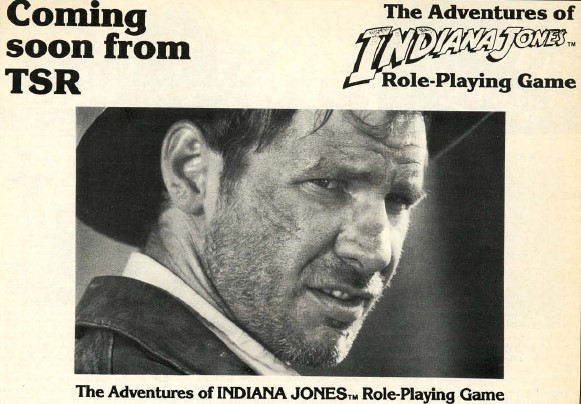
Presented without comment, an advertisement appearing in issue #19 of Imagine, heralding the imminent release of TSR's The Adventures of Indiana Jones Role-Playing Game.  

Imagine Magazine: Issue #19

Chris Collingwood provides the cover for issue #19 of Imagine (October 1984). Its first article is "The Art of Animation" by Mark Davies, which deals extensively with the topic of golems and other magically animated beings. I've always had a fondness for golems, influenced perhaps by the presence of the magens in Castle Amber. The article itself is solid, looking not just at existing golems and golem-like creations but providing several new ones. Meanwhile, "Geas" by Venetia Lee presents several geased magical items. These items are powerful but they also impose restrictions on the behavior of the person possessing them, such as the sword of Bast, which prevents its wielder from ever willingly harming any cat or cat-like creature. It's a simple idea but a good one. 

"The Private Lives of NPCs, Part II" is a follow-up to an article that appeared in issue #11. Like that previous article, which I enjoyed, this one is very good, focusing on a half-dozen basic questions a referee should ask himself when creating non-player characters. It's not a radical or revelatory article, but it's the sort of grounded, commonsensical piece that I still find helpful, even after four decades of gaming. This month's game reviews caught my attention, purely for historical reasons. The first Dragonlance adventure, Dragons of Despair, is given a positive review, unlike the Top Secret scenario, Ace of Clubs. Never let it be said that Imagine was a mere house organ, despite being published by TSR UK. The review of Avalon Hill's Powers & Perils is encouraging, noting that, while it was unlikely that such a complex game would develop a huge following, it was nonetheless worthy of continued support. I have a weird fascination with P&P myself, so I appreciated seeing this review.

"Sinvel's Peril" by Doug Cowie is a Dungeons & Dragons adventure for levels 12-15, intended, it seems, to promote the newly released Companion Rules. The scenario concerns the defense of the town of Sinvel against a horde of barbarians – a trite set-up that's been done numerous times and better, but it does include some terrific maps by Paul Ruiz (about which more below). "Role Playing for Remedials" by Alan Heaven is another look into the past. The article is a counter to suggestions that RPGs are "addictive escapism." How strange to consider that this was once a serious charge against the hobby! Pete Tamlyn offers "Towards Systemless Scenarios," which is a brief overview of the question of how to present adventures intended to be used by many rules systems. The answer? Be as vague as possible, as demonstrated in the companion article (also by Tamlyn), "The Stolen Herd." I'm being flippant, of course, but it is  true the case that what Tamlyn is suggesting is not so much scenario writing as establishing a broad "plot" and then letting each referee decide how things play out. On the other hand, "Games without Frontiers" by Graeme Davis is extremely practical – maybe too practical – as delves into mathematical comparisons of various rules systems.

Paul Vernon's "Uncharted Stars" is a rare example of a Traveller article in the page of Imagine (leaving aside the previous issue), something that was very common in White Dwarf.  It provides rules for spectral classes for stars, as well as an Amber Zone (scenario). Colin Greenwood's "Fantasy Media" tackles a pair of movies (The Last Battle and Supergirl) and a pair of novels (Tanith Lee's The Castle in the Dark and James P, Hogan's Voyage from Yesteryear). "Rubic of Moggedon" and "The Phalanx" comics are here once more, along with Roger Musson's "Stirge Corner." Musson talks about the two ways alignment can be interpreted: as ethics or allegiance. Though short, it's a fine meditation on this contentious topic and does a good job of offering some solutions.

The real heart of the issue is "Pellinore: Law and Order" by Paul Cockburn, which describes the legal system of the City League. There are discussions of police forces, courts, and crimes, in addition to tables devoted to adjudicating all of the above. There's also a gazetteer of those sections of the city where the Courts can be found, along with NPC write-ups of various magistrates. It's terrific bit of worldbuilding by small steps, one that I now realize I have been subconsciously imitating in my own Urheim posts – great minds and all that! The article is accompanied by the maps of Paul Ruiz, whose style I absolutely adore. It's unlike any other cartographer I've seen before or since and I find myself wishing he were still active in the scene.
Imagine has definitely hit its stride. This is a great issue, probably my favorite so far. I look forward to the next one.

Tuesday, November 10, 2020

Imagine Magazine: Issue #18

The cover to issue #18 of Imagine (September 1984) depicts a group of Star Frontiers adventurers, painted by Jim Burns. This is the science fiction issue announced in the previous one. As a long time fan of the genre, I was curious to see what the editors might have cooked up and was generally not disappointed. Nevertheless, the kick-off article is Derrick Norton's "Malevolent Engineering," which examines the creation of monsters for AD&D. At four pages, it's quite extensive and is a good mix of practical and theoretical topics. I found it surprisingly good, despite the fact that I haven't played AD&D in some time. This month's Pellinore installment presents "The Wynd," a section of the City League that's home to the Magic-Users' School. There are a number of small maps of the area and its buildings, as well as descriptions of important NPCs. There is a short story by Colin Greenland, "A House of Straw and Paper," which features characters from Greenland's then-new novel, Daybreak on a Different Mountain. 

Marcus L. Rowland's "The Highest Wisdom" provides a version of the scientist career for Traveller that differs from the one in Citizens of the Imperium. There are also three related scenarios and brief conversion notes for use with other SF RPGs. "On the Rocks" is a Star Frontiers adventure by Mike Brunton. The adventure is a salvage mission, which offers a good excuse to include deck plans and stats for an entirely new class of starship – something of which I greatly approve, being a huge fan of starship deck plans. Graeme Davis's article, "Games Without Frontiers," looks at ways of comparing the game statistics of different games, with an eye toward converting between them. I found it a peculiar article in some respects, but Imagine seems to have had a strange fascination with providing conversion notes for their articles and adventures. It's possible, I suppose, that it was seen as a necessary means to attracting a large audience.

Nearly the entirety of the game reviews in this issue are science fiction related, including my beloved The Traveller Adventure. The reviewer, Stephen Nutt, raves – correctly – "I rate The Traveller Adventure in the top five best role-playing products that have ever been placed on the market. In the context of Traveller, it is the best thing GDW have ever produced, simply a must for anybody running a Traveller campaign." Also reviewed other Traveller products, including three by Gamelords, and Mutiny on the Eleanor Moraes for use with Star Frontiers, which Nutt does not rate nearly as highly (though he acknowledges that it could be a terrific adventure, if all goes well). The preview of the Companion Rules begun in issue #17 concludes here and does a good job, I think, of selling the boxed set, for which I still have positive feelings, despite not generally being a fan of BECMI version of D&D.

Colin Greenland's "Fantasy Media" reviews Star Trek III: The Search for Spock and The Last Unicorn, both positively, along with the video release of the Tom Baker Doctor Who episode, The Brain of Morbius. There are also reviews of a pair of books: Philip K. Dick's Time Out of Joint and Hilbert Schenck's A Rose for Armageddon. Roger Musson's "Stirge Corner" delves into the differences between D&D's three-point alignment system versus AD&D's nine-point one. Given its brief length, it's quite good and raises several points worth considering. "'Zine & the Art of Editing" continues to discuss the finer points of producing fan publications, while "Chainmail" looks at commercial PBM games (like Tribes of Crane, which I saw advertised endlessly in the pages of Dragon). Rounding out the issue are new installments of "Rubic of Moggedon" and "The Phalanx" comics.

All in all, this is a solid issue, though not quite as science fiction-oriented as I had hoped it would be. Nevertheless, there's some excellent material here and it's becoming increasingly clear that the editors of Imagine have a good handle on things now. I very much look forward to next issue.

Tuesday, November 3, 2020

Imagine Magazine: Issue #17

Issue #17 (August 1984) of Imagine features a cover by Pete Young. Its kick-off article, "What to Do With a Dragon's Treasure," by Chris Barlow is a fascinating one. It starts as an examination of the XP for treasure system of Dungeons & Dragons and then proposes an alternative. Barlow's point is that, under the system as presented, treasure gets counted twice: first as money and second as XP. To avoid this, he proposes that, to be counted as XP, the treasure must be spent. This is a common house rule in old school circles and, reading this article, I wonder if perhaps it is the ultimate source of it. However, Barlow expands upon the idea to create a system by which a character can use his treasure to buy training, which is to say, the abilities of other classes. It's an interesting idea, but it does a lot of violence to D&D's traditional class structure, which will limit its appeal.

David R. Knowles presents "The Drow," which is an expansion of the information on the Dark Elves available at the time. "Pelinore: The City League" presents a home base for characters in the setting. Included with the article are seven locales within the City, each of which gets a map and NPC descriptions. "Magic & Mayhem in Celtic History and Literature" is an overview of this topic by Graeme Davis. It's paired with "Lore, Lay & Legend" by Carole Morris, presents brief summaries of important stories from Celtic myth. "Tir Nan Og" by Chris Barlow is an AD&D scenario that involves an expedition to an island people by fairies and fairy creatures.

"'Zine & the Art of Editing" by Mike Lewis is an intriguing article from a historical perspective. Imagine has always covered fanzines, which is a notable way that it differentiated itself from Dragon. This article, though, is about the process of producing, and printing a 'zine, according to the technology of the time. It's short and not deep in its coverage, but it's a window on a bygone world. Game reviews focus on new TSR releases, as they usually do. There are, however, a number of early Games Workshop releases, too, one of which – Battlebikes – brought back memories of the time for me. Frank Mentzer's D&D Companion Set receives a three-page preview that had a similar effect, as I am quite fond of that boxed set, despite its flaws. 

Colin Greenland's "Fantasy Media" is the usual mix of movie and book reviews. Interestingly, he reviews the movie Splash very favorably while he has only harsh words – very harsh words – for Indiana Jones and the Temple of Doom. While Temple of Doom is an awful follow-up to Raiders of the Lost Ark (which is practically irreproachable), it's not as bad as Greenland makes it out to be. Plus, it's opening sequence in the amusingly named Club Obi Wan is terrific. On the other hand, Greenland is contemptuous of the third volume of the interminable Belgariad and loves Thieves' World, so he can't be all bad. 

Roger Musson's "Stirge Corner" provides some tips to the novice DM in preparing a dungeon and Derick Norton's "Identity Crisis" speaks true about characters. Aimed beginners, Norton says a number of things worthy of repeating, chief among them being

In part the desire for good [ability] scores is caused by a clouded view of what a character represents. For some players a character is basically a vehicle with which to propagate their own ego.

Ouch! "The Sword of Alabron" comic is gone, replaced by "Phalanx," a new series. "Rubic of Moggedon," unfortunately, continues.

Taken together, this issue was something of a disappointment to me, particularly after the highs of last issue. There are a handful of worthy articles, but, overall, it feels lackluster. I hope issue #18 will be more enjoyable.