Showing posts sorted by relevance for query pool of the. Sort by date Show all posts

Wednesday, October 19, 2022

Retrospective: Pool of Radiance

My late childhood and early teen years coincided not just with the ascent of fantasy and science fiction in popular media but with the (likely related) ascents of RPGs and video/computer games. By the time I first encountered roleplaying games, there were already serious efforts to combine these two hobbies – and my friends and I were very interested in seeing what they had to offer. That's why we greedily snapped up Wizardry and Telengard and Adventure and many more, all of which we enjoyed but none of which fulfilled our dreams of an electronic entertainment that truly brought the fun of a fantasy RPG to a console or desktop.

There were many reasons why we felt this way, most of them related to the technical limitations of computers in the early to mid-1980s. Another reason was that none of the computer or video games at the time made use of a rules system as complex as that of most pen-and-paper RPGs, which had a negative impact on their depth of play. Wizardry was a solid step in this direction, which is why I loved it, but it was still sufficiently primitive in the scope of its rules that it couldn't hold a candle to Dungeons & Dragons or any other tabletop roleplaying game.

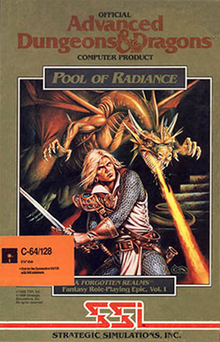
This largely remained the state of affairs until the late 1980s, when advances in both computer technology and program design saw the rise of increasingly sophisticated offerings. By this time, I was away at college and, while I didn't have a desktop computer of my own, many of my friends did so. It was through one of them that, in the Fall of 1988, I was first laid eyes on Pool of Radiance. Produced by Strategic Simulations, Inc. (SSI), Pool of Radiance was the first official Advanced Dungeons & Dragons computer game. Unlike the AD&D-branded Intellivision games of earlier in the decade, this one made use of the actual AD&D rules available at the time. This was a huge selling point to me, since all previous fantasy computer games used their own rules systems, which, as I noted above, were much less robust. 

The other thing that caught my attention was that Pool of Radiance was not a generic fantasy game. Instead, it made use of the then-new official AD&D setting of the Forgotten Realms. I'd been a fan of the Realms since I first encountered Ed Greenwood's articles in the pages of Dragon, so the use of the setting in Pool of Radiance was also a point in its favor. Further, the overall scenario of the game was designed not by the staff of SSI but by a team of RPG designers working at TSR, among them James Ward, David Cook, and Steve Winter. TSR fanboy that I was, this last fact assured me that, with Pool of Radiance, we were finally getting the goods: an honest to Crom digital adaptation of Dungeons & Dragons rather than a knock-off.

As one might expect, the centerpiece of Pool of Radiance was its character generator. The player is given the ability to generate up to six characters for use as his party of adventurers in the game. Ability scores are generated randomly, though the player possesses some capacity to alter them according to his preferences. Characters can belong to any of six races (human, dwarf, elf, gnome, half-elf, and halfling) and any of four classes (cleric, fighter, magic-user, thief, with demihumans given the opportunity to multiclass). Though representing only a portion of AD&D's full possibilities – there are no sub-classes or half-orcs, for instance – everything included in Pool of Radiance works the way it ought to in the tabletop version of the game. This was not a version of the game simplified for computers but the Real Deal™.

The game assumes the characters have come to the city of New Phlan and entered into the service of its council to reclaim the Old City, which has fallen into ruin and is now inhabited by a variety of monsters and evil humanoids. As the characters venture into these ruins, they gain experience and treasure, which enables them to explore ever more dangerous – and lucrative – areas. In time, they become sufficiently powerful and accomplished to move beyond Phlan and explore other locales that likewise would benefit from their presence. In short, Pool of Radiance is a good translation of the structure of most D&D campaigns into computerized form. 

The game's scenario is not groundbreaking or revolutionary in any real way, but it is nonetheless quite enjoyable, precisely because it is so similar to many people's experiences of playing AD&D. This similarity is buttressed by the inclusion of myriads of little rules and game elements, like saving throws, spell selection, magic items, and even demihuman level limits. To play Pool of Radiance is to play AD&D, albeit one that lacks the social interactivity that is, in my opinion, the foundation of why roleplaying is such a fun hobby. Even so, the game had a lot to offer and my friends and I spent far more time playing it than we probably ought to have.

In the decades since its release, computer RPGs have become vastly more sophisticated and immersive than was Pool of Radiance. Everything from their graphics, scenario design, and rules implementation have advanced by leaps and bounds, strengthened by improvements in technology and years of experience. Because of this, I doubt I could go back and play Pool of Radiance (or any of the many SSI AD&D computer games that followed in its wake) with any enjoyment. Yet, there's no question that this game was an important milestone in the development of the CRPG genre and for introducing a wider audience to Dungeons & Dragons – quite the legacy, if you ask me.

Monday, March 28, 2022

Pulp Fantasy Library: The Pool of the Black One

If much of contemporary discussion of pulp fantasy literature is to be believed, there are only two kinds of these tales: ground-breaking stories that transcend their origins or worthless hackwork without any enduring value. Now, I have no difficulty in acknowledging the existence of these two categories and could easily cite examples of stories I've read that fall into each of them. For me, the problem lies not so much in the categories themselves as in the seeming inability of some to admit any middle ground between them. As with so many things, there are shades of gray.

I mention this because of the story I wish to bring to your attention today, Robert E. Howard's "The Pool of the Black One," which first appeared in the October 1933 issue of Weird Tales. No one, I think, considers this one of Howard's best Conan yarns, especially when compared to, say, "The Tower of the Elephant," which appeared earlier in the same year. At the same time, comparing "The Pool of the Black One" to Howard's unarguably best efforts is not only unfair but misses a larger point about the purpose of pulp fantasy literature (or any pulp literature, come to think of it), namely, escapism. 

Don't misunderstand me: I'd much rather that every Conan story were "Red Nails" rather than "The Devil in Iron." That this is not the case says little about the quality of "The Devil in Iron" than it does about our own expectation that every pulp fantasy tale be one that we can read again and again, finding something new in it each time. There's nothing wrong with ephemeral, unexceptional stories so long as we find them diverting while we're reading them. Put another way: not every work of literature must have enduring value to be worthy of our time. Sometimes – often even – it's enough that we enjoy it.

"The Pool of the Black One" begins memorably, with Conan climbing onto the deck of a pirate vessel, where the captain's mistress, Sancha, is sunning herself garbed only in a "short silk kirtle [that] veiled little of her voluptuous contours." 

But at that instant a sound reached her ears unlike the creaking of timbers, thrum of cordage and lap of waves. She sat up, her gaze fixed on the rail, over which, to her amazement, a dripping figure clambered. Her dark eyes opened wide, her red lips parted in an O of surprise. The intruder was a stranger to her. Water ran in rivulets from his great shoulders and down his heavy arms. His single garment—a pair of bright crimson silk breeks—was soaking wet, as was his broad gold-buckled girdle and the sheathed sword it supported. As he stood at the rail, the rising sun etched him like a great bronze statue. He ran his fingers through his streaming black mane, and his blue eyes lit as they rested on the girl.

"Who are you?" she demanded. "Whence did you come?"
Say what you will, but Conan can make quite an entrance. His arrival causes quite a stir on the vessel, a pirate ship whose name is the Wastrel we soon learn. Its captain, a Zingaran named Zaporavo, confronts the Cimmerian and asks him first his name and then "how did you get aboard my ship?" Conan replies in a delightfully laconic way, "I swam."

Zaporavo asks Conan,

"Why should I burden myself with every nameless vagabond that the sea casts up?" snarled Zaporavo, his look and manner more insulting than his words.

"A ship can always use another good sailor," answered the other without resentment. Zaporavo scowled, knowing the truth of that assertion. He hesitated, and doing so, lost his ship, his command, his girl, and his life. But of course he could not see into the future, and to him Conan was only another wastrel, cast up, as he put it, by the sea. He did not like the man; yet the fellow had given him no provocation. His manner was not insolent, though rather more confident than Zaporavo liked to see.

"You'll work for your keep," snarled the Hawk. "Get off the poop. And remember, the only law here is my will."

One might uncharitably call "The Pool of the Black One" formulaic. In the span of a couple of pages, Howard tells the reader exactly where he's taking this story. Zaporavo is a dead man walking and soon Conan will not only take his place as captain of this band of pirates but also his woman. Is it a bad story because of this? From a certain high-minded point of view, perhaps it is, but I think this perspective overlooks the pleasure to be found in seeing how a particular instance of a well-worn formula unfolds.

Conan soon wins the respect and admiration of the crew (and Sancha), much to Zaporavo's dismay. 

He mixed with the crew, lived and made merry as they did. He proved himself a skilled sailor, and by far the strongest man any of them had seen. He did the work of three men, and was always first to spring to any heavy or dangerous task. His mates began to rely upon him. He did not quarrel with them, and they were careful not to quarrel with him. He gambled with them, putting up his girdle and sheath for a stake, won their money and weapons, and gave them back with a laugh. The crew instinctively looked toward him as the leader of the forecastle.
In time, the Wastrel drops anchor off a mysterious island, where "the wind brought scents of fresh vegetation and spices." Zaporavo orders everyone ashore, except for Sancha, whom he commands to stay behind. She's understandably angered by this but nevertheless obeys. From her vantage point aboard the ship, she watches the pirates as they climb the trees along the beach and take the fruits from their branches. She also observes Zaporavo head into the jungle alone, followed not long after by Conan. This strange turn of events piques her interest and she decides to swim secretly to the island to find out what these two men are doing away from prying eyes.

Zaporavo, we're told, 

desired to learn if this island were indeed that mentioned in the mysterious Book of Skelos, whereon, nameless sages aver, strange monsters guard crupts filled with hieroglyph-carven gold. Nor, for murky reasons of his own, did he wish to share his knowledge, if it were true, with any one, much less his own crew.
For his part, Conan follows the captain solely for the purpose of killing him without any witnesses, which he succeeds in doing, as Howard already stated he would. Elsewhere, the crew fall fast asleep, seemingly as a result of the golden fruits they've eaten. This enables Sancha to make her way across the beach without anyone seeing her and then into the jungle, where she stumbles upon Zaporavo's dead body with a "gaping wound in his breast." 

The young woman is not shocked to see this and "did not weep or feel any need for weeping." Instead, she looks for Conan, assuming he would be nearby. Instead, she finds someone else.

Unbelieving horror dilated her brown eyes. Her red lips parted to an inarticulate scream. Paralysis gripped her limbs; where she had such desperate need of swift flight, she could not move. She could only shriek wordlessly.
As it turns out, the late Zaporavo was more right about the nature of this island than he would ever know. The remainder of the tale is spent chronicling Conan's exploration of the island and his discovery of just who dwells here and what their plans are for the hapless pirate crew and, of course, the beauteous Sancha.

"The Pool of the Black One" is a by-the-numbers Conan story, written because Howard needed money and he knew the kind of story that would be quickly accepted by Weird Tales. In that sense, it's nothing special and there are few surprises in its narrative. Nevertheless, I found it fun. It's simply a fast-paced, adventuresome yarn in which the reader gets to see Conan be Conan and all that that entails. Sometimes, that's enough.

Thursday, May 13, 2010

The Moon Pool

I'm a big proponent of including locations of special interest in my dungeons. Generally, these are mysterious and/or beneficial places that hold something that brings the characters back to it again and again. An oft-mentioned example of this from the Dwimmermount campaign is "the Cleric Tree," a weird, azoth-warped subterranean growth that, if properly tended to, yields "fruits" that function as potions of healing. Early on in the history of the campaign, the party discovered this growth, unlocked its secrets, and regularly returned to it in order to take advantage of its boons. In practical terms, this meant that, even as the characters delve deeper into Dwimmermount, they still have reason to return to earlier levels, which in turn gives me the opportunity to present the place as a living environment rather than a static one that can be "cleared" with enough effort. To my mind, this presentation is one of the key differences between a "megadungeon" (or campaign dungeon) and a mere "dungeon" (or lair).

Another special interest location is the Moon Pool, a shallow pool in a series of caves inhabited by a tribe of mutant kobolds. The cave in which the Pool is located has a small opening in its roof through which moonlight can shine, reflecting in the Pool. The Pool itself holds what alchemists refer to as "true water," a primordial liquid untainted by physical contaminants and that cannot be destroyed or have its state altered. Thus, it does not evaporate and cannot be frozen with even the mightiest of spells. On the other hand, true water is a supernatural solvent (which is why alchemists prize it), dissolving magical energies within itself.

In the case of the Moon Pool, the magical energies it dissolves are moon rays, called "lunar emanations" by sages. These moon rays may then be imbibed by living beings who partake of the Pool's contents, boosting -- or diminishing -- their magical potency, in accordance with the phases of the moon, whose power over magic is well-known. Drinking from the Moon Pool has the following effects:

Random Roll (1D20)

Lunar Phase

Effect

1-3

New Moon

-1 caster level, -1 spell (lowest and highest levels)

4-5

Waxing Crescent

+1 caster level

6-8

First Quarter

+1 spell (lowest level)

9-10

Waxing Gibbous

+1 spell (highest level)

11-13

Full Moon

+1 caster level, +1 spell (lowest and highest levels)

14-15

Waning Gibbous

-1 caster level

16-18

Last Quarter

-1 spell (lowest level)

19-20

Waning Crescent

-1 spell (highest level)


"+1 caster level" means that, for spells that have variable effects based on level (e.g. fireball), the caster is treated as one level higher than he actually is. "+1 spell" means that the character gains an additional spell of the type indicated (lowest/highest level) for the duration the Moon Pool's infused water is in effect. Obviously, effects stated as a penalty (e.g. "-1 caster level") function in reverse.

A character who drinks from the Moon Pool must make a saving throw against Spells or Radiation. Success indicates that the effect listed above is operative, according to the current phase of the moon. The effect lasts for a number of days equal to 1 plus the difference between the saving throw number and the number rolled by the player for his character. For example, a 6th-level magic-user requires a 12 to save against Spells or Radiation. If his player rolls 14, the appropriate effect lasts for 3 days. Failure means that the appropriate effect is not operative and no subsequent drinks from the Moon Pool will have any effect whatsoever for a number of days equal to the amount by which the character failed his saving throw. For that matter, while one effect is operative, subsequent drinks provide no additional effect, good or bad. Finally, Moon Pool effects cannot be dispelled by any known means; a character who has drunk from its waters must wait until the appropriate number of days has passed before its effects will fade.

I keep pretty good track of time in my campaign, using the guidelines given in Volume 3 of the LBBs. Consequently, I know roughly what phase the moon is in if it ever becomes pertinent to play. However, not all referees are as fastidious about timekeeping and so the table above can also be used to randomly determine the current phase.

Monday, January 30, 2012

Pulp Fantasy Library: The Metal Monster

I've talked recently about how the name Abraham Merritt is not as well known among fantasy enthusiast as it ought to be and I stand by that assertion. In the early part of the 20th century, Merritt, along with Edgar Rice Burroughs, was fantasy. His stories were widely read and influential, none moreso than his The Moon Pool, which was a particular favorite of Gary Gygax. The Moon Pool had a sequel of sorts called The Metal Monster, which first appeared in the pages of Argosy All-Story Weekly in serial form during the weeks of August 7 to September 25, 1920. H.P. Lovecraft thought very highly of the story, remarking in a letter written in 1934 that
the book contains the most remarkable presentation of the utterly alien and non-human that I have ever seen.  I don’t wonder that Merrittt calls it his “best and worst” production.  The human characters are commonplace and wooden — just pulp hokum — but the scenes and phaenomena… oh, boy!
I think that's a fair assessment, not just of The Metal Monster but of Merritt's work in general. His characters are rarely noteworthy but his ideas are often top-notch and inspiring. This is certainly the case in The Metal Monster, which concerns an expedition by Dr. Walter Goodwin of the International Association of Science to Himalayas in search of rare plants. Goodwin also makes an appearance in The Moon Pool, which is why I call The Metal Monster "a sequel of sorts" to the former book, even though The Metal Monster stands perfectly well on its own.

The story is framed, as was The Moon Pool, as a real account of an adventure that Dr. Goodwin related to Merritt. In this respect, it's very much in keeping with the conventions of Burroughs, who does the same in his Barsoom tales. Where Merritt differs is in the ominousness with which he infuses his novel. Before he sets off on his expedition, Dr. Goodwin has an extended soliloquy that espouses a Lovecraftian worldview before the fact.
In this great crucible of life we call the world—in the vaster one we call the universe—the mysteries lie close packed, uncountable as grains of sand on ocean's shores. They thread gigantic, the star-flung spaces; they creep, atomic, beneath the microscope's peering eye. They walk beside us, unseen and unheard, calling out to us, asking why we are deaf to their crying, blind to their wonder.
Sometimes the veils drop from a man's eyes, and he sees—and speaks of his vision. Then those who have not seen pass him by with the lifted brows of disbelief, or they mock him, or if his vision has been great enough they fall upon and destroy him.
For the greater the mystery, the more bitterly is its verity assailed; upon what seem the lesser a man may give testimony and at least gain for himself a hearing.
There is reason for this. Life is a ferment, and upon and about it, shifting and changing, adding to or taking away, beat over legions of forces, seen and unseen, known and unknown. And man, an atom in the ferment, clings desperately to what to him seems stable; nor greets with joy him who hazards that what he grips may be but a broken staff, and, so saying, fails to hold forth a sturdier one.
Earth is a ship, plowing her way through uncharted oceans of space wherein are strange currents, hidden shoals and reefs, and where blow the unknown winds of Cosmos.
If to the voyagers, painfully plotting their course, comes one who cries that their charts must be remade, nor can tell WHY they must be—that man is not welcome—no!
Therefore it is that men have grown chary of giving testimony upon mysteries. Yet knowing each in his own heart the truth of that vision he has himself beheld, lo, it is that in whose reality he most believes.
This speech is intended to prepare the reader for the many oddities that Merritt describes once Dr. Goodwin reaches the Himalayas. There, the protagonist quickly makes the acquaintances of several other researchers and explorers -- Dick Drake and the brother and sister team of Martin and Ruth Ventnor -- who join him in his activities. As they press onward, they see strange lights, what appears to be a giant set of footprints, and a civilization of vicious men who look to their eyes to be ancient Persians unchanged since the time of Darius and Xerxes. These Persians pose a grave threat to Goodwin and his compatriots, until they are rescued by a mysterious woman who appears from nowhere.

Within the black background of the fissure stood a shape, an apparition, a woman—beautiful, awesome, incredible!
She was tall, standing there swathed from chin to feet in clinging veils of pale amber, she seemed taller even than tall Drake. Yet it was not her height that sent through me the thrill of awe, of half incredulous terror which, relaxing my grip, let my smoking rifle drop to earth; nor was it that about her proud head a cloud of shining tresses swirled and pennoned like a misty banner of woven copper flames—no, nor that through her veils her body gleamed faint radiance.
It was her eyes—her great, wide eyes whose clear depths were like pools of living star fires. They shone from her white face—not phosphorescent, not merely lucent and light reflecting, but as though they themselves were SOURCES of the cold white flames of far stars—and as calm as those stars themselves.
And in that face, although as yet I could distinguish nothing but the eyes, I sensed something unearthly.
The woman reveals herself as Norhala and commands remarkable powers in her battle against the Persians.

"To the crevice," I shouted to Drake. He paid no heed to me, nor did Ruth—their gaze fastened upon the swathed woman.
Ventnor's hand shot out, gripped my shoulder, halted me. She had thrown up her head. The cloudy METALLIC hair billowed as though wind had blown it.
From the lifted throat came a low, a vibrant cry; harmonious, weirdly disquieting, golden and sweet—and laden with the eery, minor wailings of the blue valley's night, the dragoned chamber.
Before the cry had ceased there poured with incredible swiftness out of the crevice score upon score of the metal things. The fissures vomited them!

Globes and cubes and pyramids—not small like those of the ruins, but shapes all of four feet high, dully lustrous, and deep within that luster the myriads of tiny points of light like unwinking, staring eyes.
They swirled, eddied and formed a barricade between us and the armored men.
Down upon them poured a shower of arrows from the soldiers. I heard the shouts of their captains; they rushed. They had courage—those men—yes!
Again came the woman's cry—golden, peremptory.
Sphere and block and pyramid ran together, seemed to seethe. I had again that sense of a quicksilver melting. Up from them thrust a thick rectangular column. Eight feet in width and twenty feet high, it shaped itself. Out from its left side, from right side, sprang arms—fearful arms that grew and grew as globe and cube and angle raced up the column's side and clicked into place each upon, each after, the other. With magical quickness the arms lengthened.
Before us stood a monstrous shape; a geometric prodigy. A shining angled pillar that, though rigid, immobile, seemed to crouch, be instinct with living force striving to be unleashed.
Two great globes surmounted it—like the heads of some two-faced Janus of an alien world.
At the left and right the knobbed arms, now fully fifty feet in length, writhed, twisted, straightened; flexing themselves in grotesque imitation of a boxer. And at the end of each of the six arms the spheres were clustered thick, studded with the pyramids—again in gigantic, awful, parody of the spiked gloves of those ancient gladiators who fought for imperial Nero.
For an instant it stood here, preening, testing itself like an athlete—a chimera, amorphous yet weirdly symmetric—under the darkening sky, in the green of the hollow, the armored hosts frozen before it—
And then—it struck!
This is the metal monster of the title and its origins and purpose, along with the origins of all the other mysteries the protagonists encounter, most especially Norhala, form the bulk of the story. The Metal Monster is a great deal of fun if you can get past Merritt's somewhat archaic diction and thin characterization. As I said before, it's his ideas that are so compelling and are what made him such a popular and influential author in his day. Despite the weaknesses of his prose, I think him worth reading for his ideas alone; he's the wellspring of so many of the concepts that would eventually become commonplace, even trite, in later pulp fantasies. Anyone with even the slightest interest in the history of genre literature should seek this one out and read it.

Wednesday, June 14, 2023

Retrospective: The Throne of Bloodstone

While I unqualifiedly count myself as a fan of the articles Ed Greenwood wrote about his home campaign, the Forgotten Realms, in the pages of Dragon, my feelings about TSR's version of it are decidedly more mixed. For the most part, the original boxed campaign setting developed by Jeff Grubb and published in 1987 is quite good, retaining most of the elements that, I think, made the Realms unique, or at least distinct from previous TSR AD&D settings, like The World of Greyhawk or Krynn. However, a lot of the products later released under the Forgotten Realms banner did not, in my opinion, jibe well with Greenwood's vision for his setting, no doubt because TSR saw the Realms as a "kitchen sink" setting where anything that was possible under the AD&D could be found somewhere. 

This desire to reshape the Forgotten Realms into something more generic (or perhaps utilitarian) was obvious from the very beginning, even in the '87 boxed set. In his introduction from that set, Jeff Grubb points out the various ways Greenwood's Realms were changed to accommodate the ideas of others, such as the fact that "the land that is now Vaasa and Damara was only recently (in game design terms) covered by an unnatural glacier." Vaasa and Damara, you may recall, made their first appearance before the publication of the Forgotten Realms boxed set, in 1985's Bloodstone Pass. That module, written by Douglas Niles and Michael Dobson, was itself intended to support the Battle System miniatures rules, as were its two immediate sequels, The Mines of Bloodstone (1986) and The Bloodstone Wars (1987). 

By design, the setting presented in Bloodstone Pass is vanilla fantasy that could easily be dropped into any campaign setting. That's not a criticism and, from a sales point of view, was probably a point in its favor, broadening its pool of potential customers. With the publication of the Forgotten Realms in 1987, though, TSR found a way to cram a lot of stuff into it, in the process diluting its uniqueness. That's why the campaign box set pushes back the Great Glacier and plops Vaasa and Damara into the ice-free real estate so revealed. This change struck me then, as it does now, as utterly unnecessary, since there was nothing about the Bloodstone Lands that felt as if they could be part of the Realms. But commerce pays no heed to esthetics and I doubt anyone at TSR at the time worried about such trivial concerns.

Which brings us to the fourth and final module in the H-series: The Throne of Bloodstone. Written, like all its predecessors, by Niles and Dobson, and published in 1988, module H4 was, then and now, notorious among AD&D fans, for its stated level range – 18–100. You read that correctly; this adventure was explicitly presented as a challenge for 100th-level characters. There are even sample characters of this level provided at the end of the book, in addition to a few pages of advice to the Dungeon Master on running characters of such stratospheric levels of experience.

Why, you might ask, did the module do this? What sort of challenge could possibly justify the need for such potent characters? To start, the characters are tasked with defeating the Witch-King Zhengyi of Vaasa, a 30th-level magic-using lich who, it is revealed, is a devotee of the demon lord Orcus. In the course of this task, the characters discover a gate that leads to the Abyss, the outer planar home not only of the Lord of the Undead but of all the demon lords and princes. Traveling there to do battle with the forces of Chaotic Evil might well be a task worthy of 100th-level characters, but why go there at all, especially if the threat of Zhengyi were already eliminated?

That's where Throne of Bloodstone takes a very odd turn. Not long after discovering the gate, "a short, stocky little man with huge angel's wings wearing white robes" appears. Did I mention he also "calmly puffs on a cigar?" This is St. Sollars, a minor deity introduced all the way back in Bloodstone Pass. He speaks to the characters – in a strange Bugs Bunny-style Brooklyn accent – and explains that "the big boss, ol' Bahamut, don't much like Orcus," whom he calls "the meanest dude this side o' the Pecos." The Platinum Dragon would like the characters to help him deal with Orcus by "corral[ing] that big skull stick o' his," which is to say, he wants them to steal the wand of Orcus. 

The whole thing is beyond bizarre – especially St. Sollars, who feels like he's walked in from a completely different roleplaying game (or maybe Dave Trampier's Wormy). I honestly have no idea how to take all of this. Is it meant tongue in cheek, a kind of verbal winking at the players and the DM, since the very idea of 100th-level adventure is already somewhat absurd? Is this some sort of cryptic allusion that simply escapes me? I just don't know, but then my sense of humor is notoriously lacking. Whatever it means, the task St. Sollars offers the characters sets up the remainder of the module, which is vast in its scope.

The characters pass through the gate and arrive in Pazunia, the first layer of the Abyss. From there, they must make their way – somehow – to the layer ruled by Orcus. Doing so is, naturally, a very dangerous endeavor, since they must pass through many, many other layers to reach their final destination. The result is a kind of tour of the Abyss, with stops at the realms of Demogorgon, Yeenoghu, Lolth, Juiblex, Baphomet, Graz'zt, and so many more. What's interesting is that, while the characters can do battle with many of these fiendish AD&D luminaries, they can also parley with some of them, perhaps even ally with them, since they, too, have bones to pick with Orcus. 

As I said, Throne of Bloodstone is vast in scope. The characters, even 100th-level ones, could spend an immense amount of time traveling, exploring, fighting, and negotiating on the various levels of the Abyss that are lightly detailed in this module. It's practically a campaign in itself – and it all happens before the characters even reach the plane of Orcus. Once there, the challenges are immense, with undead beings everywhere, in addition to the requisite demons and, of course, Orcus himself. It's genuinely awe-inspiring, the kind of thing that many an AD&D no doubt dreamed of one day doing with his high-level character. 

The problems with Throne of Bloodstone are many, starting most obviously with whether it's even possible to run a game at this level. I'm not saying it isn't, only that I do not know and I suspect that neither do Douglas Niles or Michael Dobson – or indeed anyone else. That's one of the other problems: was this ever playtested? Does that even matter? Sometimes, the strength of a module's ideas are what matter and there's certainly a lot of interesting, or at least inspiring, ideas in this one. Of course, most of those ideas are barely detailed. Throne of Bloodstone is more of a sketch of a lengthy, high-level mini-campaign than an adventure module in the traditional sense.

That's why it's well nigh impossible to judge this thing. I have never played it and, for years, I scoffed at it, citing it as an example of just how much AD&D had lost its way by the late '80s. Nowadays, I am not so sure. Throne of Bloodstone is such a strange, wonderful, contradictory mess. Everything about it, from its premise to its contents is, on first blush, quite laughable and yet, having re-read it in preparation for this post, I can't simply dismiss it out of hand. Certainly, it'd require a lot work on the part of the DM to use effectively and, even then, I am not sure it could ever work in practice as well as I imagine it could – but it might be worth a try ... ?

Monday, February 1, 2010

Dwimmermount, Session 29

Whatever dissatisfaction I had about Session 28 was not in evidence in our most recent one, which nicely shook off the last vestiges of the holiday-derived lethargy I'd been feeling about the campaign. The characters continued their explorations of the catacombs within Dwimmermount dedicated to the Iron God, finding many chambers filled with mummified remains and grave goods (which they assiduously avoided taking, lest they rouse the wrath of the Iron God, as had the Termaxians). They also encountered weak undead -- skeleton, zombies, ghouls -- who were easily turned by Brother Canor or dispatched with magic. I keep forgetting just how potent clerics are against the undead in OD&D (and AD&D, for that matter), where a successful turn affects 2D6 undead rather than 2D6 hit dice of undead is affected, as it is in Moldvay, for example. Consequently, very few of the inhabitants of the catacombs proved much of a threat to the PCs.

It was then that Fate offered up one of its ironies. While checking for wandering monsters, I rolled up six shadows to attack the PCs. Now, in OD&D, as many of you no doubt know, shadows are not undead beings, as they are in AD&D. Thus, they can't be turned. Combine that with the ability to surprise on 1-5 on 1D6 and they have the potential to get a serious jump on unsuspecting PCs -- which is exactly what they did. The shadows surprised the party and seized the first round of initiative. Taken together, they did some serious damage to the adventurers, including some Strength drain. They also managed to slay poor Henga, Dordagdonar's shield-maiden, who'd died once before. This time, though, the elf opted not to raise her, feeling that two deaths proved her too weak as a henchmen, so she needed to be replaced. Once the PCs left Dwimmermount, they gave Henga a proper Norse burial and then headed to Adamas to re-supply and look for additional henchmen.

Because of the circumstances under which they last left Adamas, the characters decided not to pay a visit to many of the regular contacts in the city, especially Saidon, as the temple of Typhon wound up looking rather foolish for having been caught off-guard during the "zombie invasion" of several months previous. Nevertheless, the characters did seek out an alchemist to analyze some substances and objects they'd uncovered in Dwimmermount. In doing so, they discovered they had a jar of "ointment of gentle repose," which rendered a corpse incapable of being animated as one of the undead. They also possessed two large, circular plates made of a silvery -- but not actually silver -- metal on which there were many fine grooves. The alchemist could not ascertain the nature of the plates or the type of metal from which it was made, but he could say that it was not made of azoth, which has a more silvery-black color and a different density.

Because there are so few broadly useful 2nd level cleric spells, Brother Candor has been memorizing speak with animals recently, in order to speak with Dusty, the cat they found within Dwimmermount. When he spoke with him in Adamas, he learned that the city-state was the seat of the King of the Cats, whom Dusty suggested might know some useful information. Intrigued, Brother Candor and Dordagdonar set off for the King's home, carrying with them tribute in the form of fine cuts of fish and soft pillows. The King, as it turns out, lives in the attic of a flophouse run by an elderly couple, who allow cats to roam freely throughout the building. These cats are in fact courtiers and supplicants of the King's court.

Brother Candor rented a room in the flophouse in order to climb up into the attic, which was festooned with yarn, twine, and bits of cloth and filled with cages in which mice, rats, and birds could be seen, many of them begging to be released by the human visitors. The King accepted Brother Candor's gifts and heard his petition for information about "weird goings-on," particularly of "one called Cyrus." As it turned out, Dusty knew of Cyrus but had not mentioned it to the PCs because no one had explicitly asked him for such knowledge. The Thulian vampire was last seen in Dwimmermount, descending into the caves where the "silvery oil" pooled. The characters then promised to return and asked the King of the Cats if he might be willing to share any information of interest to them in the future. The King consented and implied that he might have more information very soon.

Meanwhile, Gaztea was seeking out a new shield maiden for Dordagdonar, who insisted on having another human female as his henchmen. She succeeded in locating a promising warrior-woman, whose ability scores I rolled in the open, in front of the players. Her Strength of 13 a promising start -- above average on 3D6 -- but it proved to be one of her lowest stats: Int 12, Wis 14, Dex 15, Con 16, Cha 17. A truly remarkable series of rolls! Seeing this, we dubbed her Angrboda and decided she was a statuesque nigh-Valkyrie, possibly with some giant blood in her. Dordagdonar was suitably impressed and took her into his service. Gaztea continued her studies of ancient Thulian -- Brother Candor wants her to be able to translate documents for him -- and there was talk of her learning alchemy as well, although no steps were made to undertake that.

Before leaving the city, Brother Candor paid his respects -- and his tithe -- to Morna, high priestess of Tyche in the city-state. From her, he learned that an inquisitor of Typhon was due to visit Adamas soon, looking into the zombie plague affair and (most likely) pinning the blame on someone within the temple for having been caught off-guard by the whole affair. Brother Candor also availed himself of the temple's extensive library, looking into the Iron God, whom he discovered to be an ancient Thulian psychopomp, revered for protection of souls against necromancy and similar violations of the natural order. His enemy was a being, possibly a demon, called "The Eater of Souls," who was so weakened by the clerics of the Iron God that he was imprisoned on earth, possibly within Dwimmermount itself.

With that, the party returned to the dungeon and continued their explorations of the catacombs, eventually discovering a roughly-hewn room in which there was a large pool of bubbling azoth, albeit an impure one, as the liquid seemed more "watery" and less viscous than it usually is. Dordagdonar took a sample of it and the session ended for the night.

Monday, April 8, 2024

Can You Go Home Again?

Despite my preference for playing RPGs with a group of friends, I've long enjoyed video and computer games. In fact, over the past Christmas holiday season, I finally completed Legend of Grimrock, a computer game I bought more than a decade ago and never finished. The premise of Legend of Grimrock is that the your party of four characters have been accused of crimes they (probably) didn't commit and must serve their sentence within the dungeons of Mount Grimrock. If they somehow survive its dangers, they will be absolved of their crimes. Of course, no one has ever escaped Mount Grimrock, so the odds of their doing so are not good.

I had a lot of fun with Legend of Grimrock (and, earlier this year, its sequel). It's a tough, occasionally frustrating dungeon whose challenges are a mix of puzzles, traps, resource management, and, of course, combat. In fact, I had such a good time playing it that I experienced a little bit of sadness when I finished the game. I wanted there to be more and there wasn't, so I naturally set out to find other games that might scratch the same itch. Surprisingly, there weren't a lot of computer or video games out there that had quite what I was looking for – at least not current video games (by which I mean, games released within the last decade or so). 

Fortunately, fondness for and appreciation of the products of earlier eras is not limited to the realm of tabletop roleplaying games. Indeed, I suspect there is probably even more nostalgia for old video and computer games, if only because of their greater popularity and reach. In recent years, quite a few publishers have made their older games available once again, after making small updates so that they'll run on modern hardware. That's when the idea struck me: why don't I play one of those older games – go right back to "the source," so to speak? Surely that would help me over my feeling of letdown after completing Legend of Grimrock.

So, I picked up a copy of Pool of Radiance, a computer game for which I have fond memories. Not only was this the first computer game to make use of the Dungeons & Dragons rules, it came out during my time away at college. I never owned the game myself – I didn't yet have a computer, this being 1988 – but a friend of mine did. He kindly let me play it when he was in class and I recall enjoying myself. I never completed the game, so buying it now would give me the opportunity to do so, albeit thirty-six years after the fact.

Regrettably, it looks like I'll probably never finish Pool of Radiance.

The truth is that, for me, the game is too old, both in terms of its content and presentation, for me to enjoy. I suspected this might be the case, since, when I wrote my Retrospective piece back in October 2022, I had the chance to look at lots of screenshots and even the original manual. They reminded me that just how primitive the game is. Now, as an enjoyer of OD&D, there's nothing inherently wrong with primitive and, in fact, there can often be something very enjoyable about it. When it comes to technology, though, the matter is a bit more complicated, since it can be difficult to unlearn what you have already learned.

In the case of Pool of Radiance, its user interface is awkward and clunky, designed for use with computer hardware that no longer exists. Likewise, the graphics are often difficult to read/recognize on a modern computer monitor. That made doing almost anything in the game slow and unintuitive, thereby detracting from my enjoyment. Further, the game design is very tedious and grindy – almost as if the stereotype of old school tabletop RPGs were true! Rather than challenging my wits, the game challenged my patience and I soon found I was unable to play it with any pleasure.

It's a great shame, because I was looking forward to playing Pool of Radiance to its conclusion, after all these years. I wonder if the problems are really with the game itself or with me. It may simply be the case that I've grown so accustomed to the way modern games work that I can't get myself back into the headspace to appreciate older ones. If so, that makes me wonder if something similar might be going on with people who claim they can no longer play older tabletop RPGs. Is this a case where "technology," broadly defined, so alters our mental frames that it inhibits or even impedes our ability to make use of earlier versions of itself? I don't know if this is true, but it's a fascinating thought.

Regardless, I still don't have a good replacement for Legend of Grimrock. Any suggestions?

Tuesday, March 26, 2024

Polyhedron: Issue #19

Issue #19 of Polyhedron (September 1984), like the previous issue, features a cover illustration promoting one of TSR's licensed RPGs, in this case The Adventures of Indiana Jones. The reputation of the Indiana Jones game has long – and somewhat understandably – suffered as a result of the game's narrow focus and presentation, squandering its real potential as a vehicle for pulp adventure. The scenario included in this issue, "The Temple of the Chachopoyan Warriors "(written by Doug Niles), does little to correct this. The adventure reframes the opening scenes of Raiders of the Lost Ark as a means of introducing the game and its rules to newcomers. While adequate to that specific task, it also reinforces the sense that the RPG would never really rise above its limited source material and that's a pity.

This issue's "Two Cents" is a rebuttal to last issue's rebuttal to another article, appearing in issue #14 – yikes! If nothing else, it's a reminder that roleplayers have always liked to argue with another about almost anything. It's also a reminder that my patience is very limited when it comes to such things, then or now. That said, this issue's installment, by Christopher Gandy, at least makes a few solid points, most importantly that, for many players, roleplaying is an escape and an opportunity to do and experience things they'd never be able – or want – to do in real life. There's nothing wrong with this and it can, in fact, serve a useful purpose.

"Lost Ships, Madmen, and Pirate Gold" by Antonio "Crazy Tony" O'Malley is a fun article intended for use with Gangbusters, Call of Cthulhu, Daredevils, or any other roleplaying game set in the 1930s (interestingly, Indiana Jones is not mentioned). The general thrust of the three-page piece concerns the care and feeding of pulp adventure campaigns. O'Malley covers a wide range of topics – legendary treasures, historical mysteries, gangsters, and ghosts, among others – with an eye toward offering advice on how best to make best use of them in play. The article is both creative and practical and I remember enjoying it when I first read it long ago, an opinion that didn't much alter upon re-reading it.

"... And the Gods Will Have Their Way" by Bob Blake concludes the "Prophecy of Brie" series of adventures begun back in issue #16. The adventure takes up the interior twelve pages of this issue and is designed to be removeable by bending back the staples that hold it together. Though I never mad direct use of it, I appreciated its attempt to provide a consistent cultural backdrop for the scenario, in this case, pseudo-Celtic, rather than the usual vague mishmash found in most Dungeons & Dragons modules at the time. On the other hand, the fact that this "mini-module" took up half of the issue's page count was a bit of an annoyance. As always, I suspect that the editors of Polyhedron were struggling with figuring just what the 'zine was supposed to be and how it differentiated itself from TSR's other gaming periodical, Dragon.

Frank Mentzer presents the results of the RPGA Network Item Design Contest, consisting of six winners selected from a pool of "almost a hundred." The items were judged in the categories of "usefulness," "originality," and "rules compliance." The grand prize winner, whose creator received a lifetime membership to the RPGA, is the talisman of the beast. Written for AD&D, the talisman enables its wearer to shapechange into the animal associated with it, as well as to speak with animals of the same type. Usable seven times a week, any attempt at an eighth use traps the wearer in anima form until the curse is dispelled by the Great Druid. With the exception of the taser rifle, intended for use with Star Frontiers, all the other winners are for AD&D – a reminder, I suppose, of just how much more popular it was than any of TSR's other offerings.

Tim Kilpin's "If Adventure Has a Game ... er, Name, It Must Be Indiana Jones!" is a two-page overview of The Adventures of Indiana Jones Role-Playing Game. It's essentially an advertisement masquerading as an article, though I do appreciate that there are some quotes from David Cook, in which he explains his intentions while designing the game. Alas, his intentions included not just a desire for "fast action" but also hewing as closely as possible to the characters and events of the two movies released at the time. Not to sound like a broken record, but it's a real shame that TSR either didn't (or couldn't – I've seen claims that it was Lucasfilm that dictated this) open up the world of Indiana Jones a little more, so as to include original characters and situations. Ah, well!

James M. Ward's "Cryptic Alliance of the Bi-Month" looks at The Created, a group of sentient androids and robots that believe themselves superior to the human beings who created them. The Created make for a great antagonistic cryptic alliance in Gamma World campaigns, which is why I like them. Compared to earlier articles in this series, this one doesn't add much to our knowledge beyond making The Created even more explicitly villainous than we already suspected (their leader is android/robot hybrid called V.A.D.E.R. X and, no, there's no explanation for that acronym). 

"The Laser Pod" by Jon Pickens is a nice – and very useful – addition to the Star Frontiers starship combat system found in Knight Hawks. One of the oddities of baseline Knight Hawks is that fighter craft are too small to carry any type of laser weapons. Instead, they're armed exclusively with rockets. While this makes sense within the context of the starship construction rules, it nevertheless felt a little disappointing to those of who'd grown up imagining fighters dogfighting with lasers. Pickens presents a clever little option that simultaneously stays true to the original rules while also giving us laser fanatics what we've wanted all along. Bravo.

Finally, there's "Dispel Confusion" with more questions and answers about TSR's various RPGs. While reading this issue's sampling, a few thoughts occurred to me. First, the AD&D questions are overwhelmingly technical in nature, which is to say, they're about how to interpret the text of the rules as written, whereas the questions for most of the other games are much more in the realm of advice on how to handle situations the rules don't explicitly cover. This might simply be a consequence of AD&D having more rules than other TSR games, but I suspect it may speak to the culture surrounding AD&D as well. Second, there are no questions in this issue about Boot Hill. I can't help but wonder if this is reflective of its relatively small fanbase at the time.

As always, Polyhedron continues to be something of a moving target. Every issue offers a different mix of content, coverage, and quality, which, I suppose, is fairly typical of a zine that is increasingly relying on outside submissions for its content. Still, I find the inconsistency a little bit frustrating, making my enjoyment of this series similarly inconsistent.

Wednesday, September 25, 2024

Retrospective: Ultima

Regular readers will recall that, growing up, I did not have a personal computer. That's why I spent so much time at the homes of friends who did. Indeed, it was only because of those friends that I was able to play such foundational computer roleplaying games as Telengard, Wizardry, and Temple of Apshai. Even in college, I didn't own a computer, so I continued the practice of using others' computers until the dawn of the 1990s, when I finally entered the modern world and at last got one of my own. 

During my college years, there were two CRPGs I remember playing with great enthusiasm: Pool of Radiance and Ultima – or Ultima I as it had been rebranded in 1986. Ultima first came out in 1981, but I don't believe I was aware of it at the time. In any case, I never had the chance to play it until several years later, well after it had spawned a series of sequels. Consequently, everything I'll say in this post pertains to the 1986 version, published by Origin Systems. If there are any significant differences between it and the earlier version(s) of the game, please let me know in the comments.

Like so many early computer games, Ultima had an interesting instruction manual with some impressive artwork. The manual laid out the premise of the game as well as the parameters under which it operates. It does so almost entirely as if it were a document being read by the player's character. Consequently, the information contained within (mostly) lacks any reference to game mechanics or things that the character would not know. Some of it is even written as if an unnamed person is speaking directly to the character, who is addressed as "Noble One" and assumed to be the hero who will save the realm of Sosaria from the depredations of necromancer, Mondain.

Like most computer RPGs, then or now, Ultima owes a lot to Dungeons & Dragons in its overall conception and gameplay. However, unlike, say, Wizardry, it does not include the possibility of controlling an entire party of adventurers, which is something that was added in its sequels. Instead, the player controls a single character, whom he creates before starting his adventure. A character has six attributes that are nearly identical to those in D&D. Likewise, the races available are familiar ones – human, elf, dwarf, and bobbit (halfling). The same is true for the professions, consisting of fighter, cleric, wizard, and thief. In short, it's all pretty standard stuff and nothing that someone who'd been playing pen-and-paper RPGs would have found the slightest bit unusual.

In addition to being a foul necromancer, the aforementioned Mondain is also invulnerable to attack, thanks to his possession of a powerful artifact, the Gem of Immortality. Finding a way to circumvent the effects of the gem is thus the character's main quest throughout Ultima. To succeed in this quest, the character must travel throughout the realm, interact with NPCs, and explore dungeons and other locales. In the process, the character will acquire wealth, better gear, and experience points, allowing him to become more powerful. Again, it's all pretty standard stuff that we've seen many times before.

The "standard" nature of all this was simultaneously an asset and a drawback to Ultima, at least from my perspective at the time. I appreciated that it was pretty easy to pick up and play. Having played D&D for some time beforehand, there was very little in Ultima that surprised me. On the other hand, there weren't really any elements of the game that wowed me. I might have thought differently, if I had encountered it upon its original release in 1981. By the time I discovered it, in 1988, I'd already seen a number of other games that did what it did, often better. For example, Pool of Radiance seemed to me to be a much better implementation of the core concepts of tabletop RPGs in digital form – and it used the official AD&D rules to boot!

Of course, I still played Ultima and enjoyed myself. Even in the midst of my college studies, I still had a lot of spare time to waste on computer games. Consequently, I don't rate Ultima quite as highly as it probably deserves. Certainly, the game went on to become a very successful and influential CRPG series. To this day, I still know lots of people with very fond memories of the game and its sequels. Meanwhile, its spin-off, Ultima Online, released in 1997, was one of the first truly successful massive multiplayer online roleplaying games (or MMORPGs – a term coined by Richard "Lord British" Garriott, the creator of Ultima). For that reason alone, its place in the history of computer RPGs is assured.

Thursday, May 23, 2024

Retrospective: Greyhawk Wars

I've never been much of a wargamer (take a drink). Despite that, I've always been interested in wargaming, particularly the hex-and-chit variety epitomized by Avalon Hill. Over the years, I've dabbled in wargames, such as my recent flirtation with the COIN series published by GMT, but I've never really committed to them in the way that many of my friends have done. I thus have a minor inferiority complex about this, feeling that my gaming "education" is somehow deficient because I haven't played wargames as often or as widely as my peers.

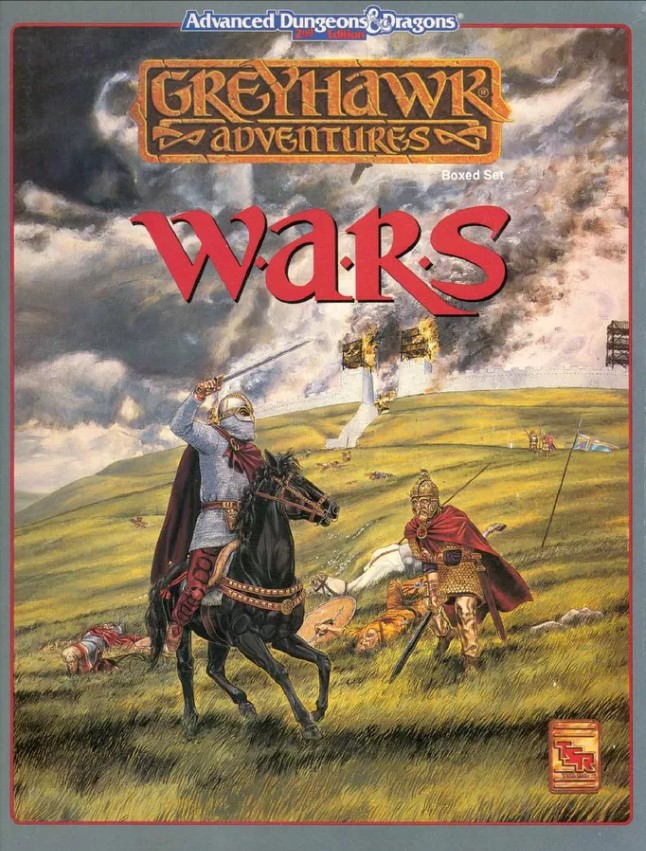
So, when TSR released a board wargame set in Gary Gygax's World of Greyhawk setting in 1991, I took immediate notice of it. This was my chance to get in some much needed wargaming experience. Alas, things didn't quite go as planned on this score, but I'll get to that soon enough. For the moment, let's focus on the matter of the game's title. According to the box cover, one could be forgiven for thinking it's called Greyhawk Adventures: Wars. However, the text of the rulebook repeatedly calls it simply Greyhawk Wars, which is how I've always referred to it, though some online spaces (like BoardGameGeek) favors the longer, more ponderous title.

In addition to the possible confusion over the title, it's also worth noting that, despite being a wargame, Greyhawk Wars was released under the Advanced Dungeons & Dragons 2nd Edition banner. This is in spite of the fact that it contains no roleplaying content whatsoever, not even the thin gruel provided by Dragons of Glory, another TSR strategic-level wargame set within a D&D campaign world. Of course, TSR had long been notorious about slapping the (A)D&D logo on just about everything, in an effort to build and expand its "brand." Compared to, say, wind-up toys or sunglasses, this particular bit of brand building was pretty innocuous and indeed could be justified in that it was intended to be the lead-in to a relaunch of the World of Greyhawk setting.

Though Gygax departed TSR for good by 1986, the company retained control of Greyhawk. Throughout the late 1980s, there were a handful of Greyhawk products released, most notably Greyhawk Adventures, but none of them, in my opinion, did a good job of carrying on the flavor and tone set by Gygax's original. If anything, they blandified the setting, reducing it to the worst kind of vanilla fantasy. Unsurprisingly, the setting's popularity – and, therefore, sales – declined, especially when compared to TSR's other two AD&D settings: Krynn and the Forgotten Realms

TSR probably recognized this fact, which is why, starting in the early '90s, the company attempted to better differentiate the World of Greyhawk in the hopes that it'd be more appealing to AD&D players. The first step in doing so was Greyhawk Wars. The wargame, designed by David "Zeb" Cook, concerns a massive war that engulfs the peoples and kingdoms of the Flanaess, one whose results upend the status quo presented in previous World of Greyhawk products. Whatever my personal feelings about the end result, it's hard not to admire the boldness of this approach. For years beforehand, Gary Gygax, in periodic Greyhawk updates published in Dragon, had been hinting at the possibility of such a large-scale "world war," but he never pulled the trigger on the idea, probably because he intended Oerth to be an open-ended "steady state" setting each Dungeon Master could customize according to his own desires.

Greyhawk Wars takes a very different approach. Instead of leaving the World of Greyhawk perpetually teetering on the edge of grand events, Cook opts to topple the whole structure, throwing long established peoples, places, and situations into chaos. At the end of the battles depicted in the wargame, a new order is established across the Flanaess, one where the forces of Good are battered, beaten, and on the defensive, while Evil, as represented by the Empire of Iuz, the Scarlet Brotherhood, and the successor states of the Great Kingdom is on the rise. The result is something that's definitely different from the original World of Greyhawk. Whether it's better is another matter.

As tabletop wargames go, Greyhawk Wars occupies a middle ground between being simple enough a newcomer can easily pick it up and so complex that only a hardened veteran of Third Reich could ever play it. The game rules are relatively short – only 8 pages – and straightforward. While there are lots of counters (representing military units), there are no hexes. Instead, the map of the Flanaess into movement "areas" of varying size, based to some extent on terrain. Also included in the game are a number of cards, some of which represent random events and treasures that can be used to augment the abilities of military units. Named NPCs (called "Heroes") play a role in the game, too, which lends it a slight roleplaying flair, though, for the most part, this is still very much a standard wargame. 

Greyhawk Wars is intended for 2 to 6 players, depending on the scenario, each with its own victory conditions. These conditions, though, are solely for gaming purposes and have no bearing on the canonical versions of these events, much in the way that a Confederate player in a wargame about the American Civil War can emerge victorious, contrary to history. The 32-page Adventurer's Book lays out the "true" conclusion of the Greyhawk Wars, the one I described above, with Evil ascendant and Good on the defensive. This is in contrast to the earlier Red Arrow, Black Shield module, which, while assuming a particular outcome for its world war, nevertheless considers the possibility of other outcomes and how they might affect ongoing campaigns. Greyhawk Wars allows for no such possibility and all subsequent Greyhawk products would follow the canonical version of history detailed in the Adventurer's Book.

As I alluded to at the start of this post, my own experiences with Greyhawk Wars weren't great. That's not a fault of the game, which is fine, if unexceptional. Rather, I had difficulty in finding others interested in taking the time to play any of its scenarios. Between setting up and playing, most took 3 hours or more – a short time compared to many wargames, I know – and that limited my pool of potential players. As a result, I don't think I ever played Greyhawk Wars more than a half-dozen times and rarely to conclusion. My perpetual quest for more wargaming knowledge and experience was thwarted once again.

All that said, I can't help but find Greyhawk Wars a fascinating window into the last decade of TSR's existence. The mere fact that the company published something approximating a classic hex-and-chit wargame set in Greyhawk is remarkable in its own right. That it was also the first part of a larger plan to reboot Gary Gygax's campaign setting into something they hoped would be more attractive to fantasy roleplayers in the 1990s is just as remarkable. I can't speak much about the success of the former, since, as I said, I didn't get the chance to play it much. As to the latter, that's the subject of next week's Retrospective post, so stay tuned.

Wednesday, October 5, 2022

9 Months and 18 Days

Earlier this year, I wrote a brief post about the Twilight: 2000 campaign I began in December of 2021. This campaign is in addition to my House of Worms Empire of the Petal Throne campaign, which is still ongoing. There's some overlap between the players of the two campaigns, but the majority of the Barrett's Raiders players don't participate in House of Worms. I should also note that we make use of the new edition of T2K published by Free League rather than either of the old GDW editions. (One of these days I should write a full review of the new edition, since, after nine months of play, I think I have a decent handle on its strengths and weaknesses,)

The title of this post is a reference to the fact that, while the campaign has been up and running for nine months of real time, only a few weeks of game time have passed – an average of about two game days for every month we've been playing. That may seem like an unduly slow pace, but a lot has happened in those few weeks of game time, as the characters have made their way from Kalisz toward the Free City of Kraków. Along the way they've scrounged for supplies, aided Polish civilians in the town of Krzepice, avoided dealing with some rogue US soldiers who'd established a base in Dobrodzień, dodged elements of the Soviet Third Tank Army, and more. It's been a very enjoyable ride for me as the referee and, I assume, the players, since they keep showing up each week.

Twilight: 2000 has always included a very strong hexcrawl element to its gameplay. The characters, after all, are the survivors of a US mechanized infantry division smashed by a Warsaw Pact offensive and now are left to their own devices. Whatever their goals, whether short-term or long-term, they have no choice but to travel overland through the terrain of war-torn Poland. Much of what happens in a given session is the result of random encounters that occur along the way. The Free League edition of the game is very good in this regard, providing lots of useful tables, not to mention maps, from which the referee can cobble together situations with which the characters can deal. Of course, there are also set encounters, too, scattered throughout the countryside, such as the aforementioned Free City of Kraków.

The characters' ostensible plan is to find other NATO forces so that they can get back to (relative) safety and eventually the USA. That's what led them to Kraków in the first place. As a free city independent of all sides in the ongoing war, they figured it'd be a good place to hole up for a while and get a better lay of the land. Unfortunately, Kraków proved almost as fraught with danger as the countryside, albeit of a different sort. The Free City is wracked with factions, several of whom attempted to recruit the characters to their cause. It quickly became clear that the place was a powder keg about to blow and they'd be better off leaving on their own terms while they still could do so.

While in the city, the characters did succeed in making contact with other NATO (and NATO-friendly) personnel. This not only increased their numbers – providing a pool of secondary and replacement characters – but also opened up more options to them, as they plan their next move, From what they have learned, the remaining NATO forces in Poland have retreated to the northwest of the country, where Free (aka non-Communist) Polish forces have established themselves. That's more or less on the other side of the country from their current location, which is why they're currently considering the use of a boat (or several) to move north more quickly.

As I said at the beginning of this post, the campaign has been very enjoyable so far, though not without its challenges. The wide range of possible avenues for character action has sometimes led to analysis paralysis on the part of the players. This, in turn, has sometimes made it difficult for me to anticipate what they might do and keep even five minutes ahead of them, which is what I prefer in campaigns like this. Consequently, I feel as if I've been thrown back on my heels more often than I like. This isn't something that happens often in, say, my House of Worms campaign, where I feel like I have a good handle on things most of the time. With this, I feel much less confident, but that's probably a good thing. I now have to exercise "muscles" I haven't in a while, not to mention re-learn certain refereeing skills I'd apparently let atrophy. 

Onward!

Wednesday, May 3, 2023

Retrospective: Ghostbusters

Roleplaying games based on officially licensed properties started appearing quite early in the history of the hobby. FGU's Flash Gordon & the Warriors of Mongo is the first that I can recall, unless you wish to count TSR's Warriors of Mars, which is, in my opinion, something of an edge case – and it wasn't officially licensed at any rate). Others soon followed, like Heritage's Star Trek (and FASA's too!), SPI's Dallas, Chaosium's Call of Cthulhu and Stormbringer, ICE's Middle-earth Role Playing, and many, many more. 

I mention all of this because I think it's sometimes easy to forget, especially on the old school side of the hobby, that gamers have long been quite keen on playing around in fictional worlds originally created for mass media. Much as I valorize the inventive and often idiosyncratic settings unique to RPGs, I'm also a big fan of a couple of games that make use of licensed settings and think the hobby would be diminished without them. If nothing else, licensed roleplaying games can serve as a useful entrée to newcomers.

Though I suspect that Star Wars: The Roleplaying Game, released by West End Games in 1987, is the most well-known (and successful?) licensed RPG ever, at least some of its success depends on another West End RPG, released the year before: Ghostbusters. Subtitled, "A Frightfully Cheerful Roleplaying Game," Ghostbusters is an unexpectedly good game, boasting not just a good sense of humor, as you'd expect, but also a solid and easy to use set of rules. Looking at its designers – Sandy Petersen, Greg Stafford, and Lynn Willis – this should come as little surprise. What still surprises me, though, even after all these years, is that it was Ghostbusters that gave the world not just the core of the system later used to excellent effect in the aforementioned Star Wars RPG, but also gave it the now-ubiquitous dice pool method of resolving in-game actions.

Characters in Ghostbusters have four ability scores, called traits – Brains, Muscle, Moves, and Cool – that are each given a numerical rating representing the number of six-sided dice rolled when making use of that trait. Players can associate a talent with each trait. Talents are more or less skills, like brawl, convince, or parapsychology. When a character makes use of a talent, he gets an additional three dice to add to those already provided by his trait. Other things, like equipment, can add to the pool of dice a player rolls as well. The sum of any roll is then compared to a target number assigned by the referee (called the Ghostmaster), based on its difficulty, success equated with meeting or exceeding the assigned target number.

If you understood the foregoing description of Ghostbusters' game mechanics without any trouble, that's because they're now well-established and commonplace, but that wasn't the case in 1986, when the idea of dice pool was somewhat exotic, at least in the circles in which I moved. As I already mentioned, Star Wars borrowed and further developed this system, which is no surprise, given that the two games were both West End products. What's more remarkable, I think, is that games like Ars Magica, Vampire: The Masquerade (and its sequels), and Shadowrun all evince the direct or indirect influence of Ghostbusters, making its mechanics, along with those of Dungeons & Dragons and Basic Role-Playing, among the most enduring in the history of the hobby.

Ghostbusters included or popularized several other mechanical innovations, such as the use of "brownie points" with which a player could influence the result of dice rolls, potentially blunting some of their negative consequences. "Hero points" of this sort were nothing new by this point. However, Ghostbusters enabled a player to gain more brownie points for his character through good roleplaying and achieving his character's stated goals. I can't say for certain that nothing like this had ever been done before – I'm pretty sure it had been – but, at the time, I found it revelatory. At the opposite end of the scale, the game included the "ghost die," a special six-sider where the 6 was replaced with the Ghostbusters logo. The ghost die is used in every roll and any roll showing the logo indicates a negative consequence of some sort, even if the roll is otherwise successful. Again, it's old hat now; in 1986, though, this was genuinely innovative.

Another aspect of Ghostbusters that I think deserves special praise is its basic premise. Unlike some licensed RPGs, which assume the players will take on the roles of existing characters within the media property, Ghostbusters assumes the players will create their own Ghostbusters, who are franchisees of the original, New York-based Ghostbusters of the 1984 movie. The idea is that the player characters are the local Ghostbusters of their hometown and their adventures should reflect that fact. I think it's a great set-up and, even at the time, I felt that it was a good basis for making more Ghostbusters movies, with each one taking place in a new city with a new cast of characters. 

I really enjoyed playing Ghostbusters when it was first released and still look back fondly on it. Sadly, I no longer have my copy and trying to replace it is prohibitively expensive. It's a very underrated RPG for one that is so well designed, influential, and fun. I wish it were more widely known and appreciated today.

Monday, April 25, 2011

On Being a Mutant (Part I)

I can only assume that, unlike my youthful self, most gamers interested in old school RPGs today realize that Gamma World sprang out of the earlier Metamorphosis Alpha. Given that, it only makes sense to compare the two games to see how they handle common rules elements. A particularly intriguing comparison is the generation of physical and mental mutations for PC mutants.

Everyone knows that Gamma World demanded the random rolling of mutations through the use of a percentile table, but what about Metamorphosis Alpha. Here's what its rulebook says on the topic:
A player character choosing to be a mutation, whether humanoid or monster-like, has ... physical and mental mutations. These last two abilities are determined by rolling a four-sided die once for physical mutations and once for mental mutations and allowing the player to pick from one to four powers, with the only limiting factor being the number of powers given by the die roll.
Now, that passage alone is quite interesting, but it gets better:
The referee must make sure that the monster mutations taken by players when choosing are consistent. Thus, if a player chooses to have wings, then he or she cannot also expect to be taller (and thus heavier). The referee should, as always, use his judgment and discretion in such matters. 
I should briefly note here that each character has one or more defects as well and these are randomly determined by the referee in secret beforehand, but, otherwise, Metamorphosis Alpha provides no mechanism for randomly rolling mutations. In fact, there are no tables of mutations in the book at all, only a list. It's also worth noting that the descriptions of some mutations include "limitations." For example, a mutant who is "gills" cannot have any sonic abilities, while one who has "wings" cannot be taller or have a total carapace. Of course, the rulebook goes on to explain that. although PC mutants may not have such forbidden combinations of mutations, NPC species may. No explanation for why this should be the case is offered beyond the obvious inference.

As noted already, everyone knows that, in Gamma World, mutations are rolled randomly. But here's what the text of the first edition rulebook actually says:
After determining the relative strengths of all characters’ basic attributes, players electing to play humanoid or mutated animal characters must determine their characters’ mutations. This process can be done in one of two ways. The first way is for the character to roll a single four-sided die twice to determine the number of physical and mental mutations (one roll for each). The number of mutations having been determined, the player then rolls a pair of percentile dice for each mutation, consulting the appropriate chart for results. Using this method, the character may or may not have mutational defects, depending upon the dice roll. The second method of determining a character's mutations is to determine the number of mutations in the same manner as described above, but then to allow the player to pick the mutations he wishes his character to receive. After the player has selected the proper number of mutations, the referee then selects one or more mutational defects in the following manner: a roll of three or four when determining the number of mutations (either physical or mental) indicates one physical or mental mutational defect, as the case may be (or both, if both dice rolls were either three or four). Two rolls of two indicate either one physical or one mental mutational defect (referee’s discretion). Rolls totaling three or less mutations receive no mutational defects. Mutational defects may be found on the same chart as "normal" mutations, and are indicated by the letter “D”.
As you can see, even Gamma World retains the possibility of the player's choosing his character's mutations rather than rolling for them by a percentile roll on a table. Granted, that option is listed second in the above paragraph and was not one I think I ever encountered in actual play back in the day, but it's a perfectly legal, by the book option.

The similarities and differences between Metamorphosis Alpha and the first edition of Gamma World got me to thinking about how subsequent editions of Gamma World handled the generation of mutations. The 1983 second edition continues to give each mutant character 1d4 physical and 1d4 mental mutations, determined randomly from a table. However, the rolls on the table are weighted, with the player being able to add his character's Constitution and Intelligence scores respectively to his d100 result for physical and mental mutations respectively. Naturally, defects are at the lower range of results while the best -- such as "Pick Any Good Mutation" -- are at the higher end of the table. Second edition does suggest allowing a player to pick his character's mutations as a safeguard against "hopeless characters," but this suggestion is not presented as a default one, unlike in either Metamorphosis Alpha or first edition.

Gamma World's third edition in 1986 states that all mutants have 1-4 physical and 1-4 mental mutations. Each mutation is rolled randomly on a percentile table, with low scores being less good (and particularly low scores requiring a second roll on the defects table) and high scores being the best (including "Pick Any Mutation"). What's interesting to me is that the third edition specifically states that "In some cases, a character may gain mutations with conflicting results." This possibility is largely (and explicitly) impossible in Metamorphosis Alpha and not discussed in either the first or the second edition of Gamma World.

The 1992 fourth edition gives all mutants 5 mutations to start, the exact ratio of physical to mental determined by rolling 1d6 and comparing it to a table. Players are given the option of having fewer than the rolled number of mutations, if desired. Mutations are themselves generated on a percentile table, where there is no relationship between the number rolled and whether it's a beneficial mutation or a defect (just as in first edition).

The fifth edition in 2000 was a supplement for Alternity. Alternity largely eschewed random rolls for anything pertaining to character creation. However, this version of Gamma World does provide an option for "pure" randomization of physical and mental mutations, as well as defects (here called "drawbacks"). However, the default assumption is that mutations are chosen. Fifth edition introduces the concept of weighted values for each mutation, with some mutations costing more of a character's pool of "mutation points" than others. Defects provide addition points to the pool.

The fifth edition was the last edition to carry a TSR product number (even though it was published by Wizards of the Coast), so it seems a convenient cut-off point for the present discussion. However, I will, in future discussions of Gamma World, talk at greater length about the infamous sixth edition published in 2003 by White Wolf's "Swords & Sorcery" D20 imprint, both for completeness and because I had a small hand in the line and so can offer some insights into it and relationship to what went before. I do not own the seventh edition of the game, published in 2010 and have no intention to purchase it, so I'm afraid I won't have anything to say about it in future posts.