Showing posts with label mentzer. Show all posts

Tuesday, December 2, 2025

The Articles of Dragon: "Ay pronunseeAYshun gyd"

I am nothing if not a horrible nerd about too many of the things that matter to me. And one of the things that matters a great deal to me is language

When I was in school, I enjoyed diagramming sentences and making proper use of the subjunctive mood. Spelling was one of my favorite subjects and I used to proudly tell anyone who would listen that I only ever spelled one word wrong on a spelling test during my entire elementary school career (Tuesday, if you can believe it). I was (am?) that annoying kid who corrected other people's grammar – and pronunciation.

Consequently, I absolutely adored Frank Mentzer's article, "Ay pronunseeAYshun gyd," which appeared in issue #93 of Dragon (January 1985). Over the course of five pages, Mentzer sets out to present the correct pronunciations for some of the weirder and more obscure words and names found in Dungeons & Dragons and AD&D materials. Of course, Mentzer is quick to note that he personally doesn't believe there is such a thing as a "right" or a "wrong" pronunciation (or spelling). Thus, the pronunciations he offers in the article are simply the "preferred" or even "most common" rather than the correct ones. Such descriptivist nonsense didn't hold any water with me when I was fifteen and it holds even less now, but I feel it's important to mention Mentzer's comment nonetheless, since I'm sure someone will bring it up in the comments in order to defend the rectitude of his idiosyncratic pronunciation of lich or drow or whatever.

As I said, I really enjoyed this article, since it gave me a weapon with which to bludgeon my less verbally adept friends. Thus equipped, I was ready to defend “proper” pronunciation with the zeal of a paladin guarding a sacred relic. My friends humored me (mostly). After all, I'd been doing this sort of thing for years before this article ever appeared. Fortunately, I’ve mellowed somewhat over the years – at least, that’s what I tell myself – but the truth is that I still sometimes look at Mentzer's article just to be sure that I wasn't mistaken in how to say certain words and names. 
Apropos of nothing, I assure you.

Tuesday, April 29, 2025

REPOST: The Articles of Dragon: "A New Game with a Familiar Name"

If the results of my poll back in October are any indication, nearly two-thirds of my regular readership entered the hobby within the first ten years of its existence, with a sizable portion of them doing so between the years 1980 and 1984. During that five year span, two different Basic Sets appeared, the first in 1981 and the second in 1983. Being a Holmes man who'd "upgraded" to AD&D sometime in 1980, I had no need for either of the Basic Sets released subsequently, but, TSR fan boy that I was, I nevertheless dutifully purchased both when they were released. That, of the two, I still have Tom Moldvay's 1981 version still sitting on my shelf today probably tells you all you need to know about my opinions of them.

But, back in issue #77 (September 1983) of Dragon, the reviser of the 1983 version, Frank Mentzer, made his case for why we needed a new Basic Set. It's a really fascinating article, both because it suggests that TSR obviously felt some need to justify the release of yet another Basic Set and because of the things that Mentzer says in his piece. It is, I think, a fascinating snapshot of the end of the Golden Age, making it well worth a read if you're at all interested in the history of this hobby and how it changed over the years.

The very first thing Mentzer mentions in his criticism of previous editions is that "you had to find someone to show you how to play." He notes that, in fact, learning from others who had figured out how to play on their own was the norm previously. That's because the game had "a devoted following, people who taught newcomers the ways of roleplaying." Mentzer is absolutely correct about this, as I've noted before. In those bygone days, you entered the hobby by initiation, aided by someone who'd done so before you. In my case, it was via a friend's teenaged brother; I, in turn, taught others how to play. That was the order of things in the late '70s and very early '80s. The 1983 edition is thus an attempt to correct this "flaw" of expecting that you'd learn to play from others.

Mentzer then notes that
the previous editions were not revisions. They were new attempts at using the same methods of organization applied to the original data plus evolution. They were not "revised," merely "reorganized." This one is different.
That's an interesting statement. I regularly point out that Holmes isn't really an introduction to AD&D at all, despite the claims inserted clumsily by TSR, but rather a new edition of OD&D that retains much of the original text of the LBBs. Moldvay is, I think, more of a revision than Mentzer gives it credit for. That said, it's also largely consonant with the LBBs, again retaining verbiage to be found in the 1974 game. The 1983, on the other hand, is even more than a revision; it's a rewriting of the game, using new language to express many of the same ideas. There's nothing wrong with that, of course, but the language is very simple and clearly geared toward children, which wasn't the case with the Blue Book I first encountered in 1979. Consequently, I recoiled upon reading it and it only further solidified my notion that the D&D line was for kids.

The 1983 set's focus on self-teaching and simple language probably made sense from a marketing standpoint. Given how well the set supposedly sold, I can't really fault TSR for going in this direction. At the same time, though, there was clearly a shift happening, away from adults and teenagers as the target audience and away from initiation as the means of entering the hobby. Likewise, the adoption of a unified esthetic (all Elmore and Easley artwork) that, while attractive, seemed to narrow rather than broaden the scope of the game. In short, the 1983 Basic Set marked a definite change from what had gone before.

I'll be honest: I was somewhat reluctant to write this particular post. I've gotten a surprisingly large number of requests from readers asking me to touch on the issue of the differences in philosophy between the 1981 and 1983 Basic Sets. But I also know the fondness with which many remember the Red Box and the profound influence it had on them as younger people. So, I hope no one takes this as a knock against the '83 boxed set, even if it's not to my cup of tea. I'm sure there were guys who started with the LBBs who looked at the Holmes set with disappointment, too; that's the way these things go. At the same time, I don't think it can be denied that 1983 marks another change in the history of both D&D and the hobby.

Tuesday, December 24, 2024

REPOST: The Articles of Dragon: "Falling Damage"

And so it begins.

Issue #70 of Dragon (February 1983) saw the appearance of "Falling Damage" by Frank Mentzer, the first of what would turn into several articles discussing this strangely contentious subject. I say strangely contentious because, until this article appeared, I don't think the "right" way to adjudicate falling damage was ever a topic of serious conversation, at least not among the gamers I knew. The LBBs provide rules for falling damage hidden away in the section on aerial combat in Volume 3, where it's stated simply that
for every 1" of height a rider must throw one six-sided die for damage occurring from the crash, i.e. a crash from 12" means twelve dice must be rolled and their total scored as points of damage
That passage is the basis for what was the standard interpretation of falling damage in every form of D&D -- 1d6 damage per 10' fallen. That is, until this article, where Mentzer claims that the rules in AD&D were hastily written by Gary Gygax and were, as such, unclear as to his actual intent. Instead of 1d6 damage per 10' fallen, the claim is advanced that Gary actually meant 1d6 damage per 10', with the dice being cumulative in effect. That is,
1d6 for the first 10' feet, 2d6 for the second 10' (total 3d6 for a 20' fall), 3d6 for the third 10', and so on, cumulative. The falling body reaches that 20d6 maximum shortly before passing the 60' mark.
According to Mentzer, this new system -- which in fact Gygax had "always used" -- is "definitely more realistic." (emphasis mine) There's that dreaded word, the hallmark of the Silver Age. It's something that, at the time, meant a lot to me, but that, as the years have worn on, I find myself caring less and less about. In a game where people can throw balls of fire from their hands and adventurers become tougher to kill as the result of slaying monsters and looting treasure, fretting over whether a 60' fall or a 200' fall deals 20d6 damage seems bizarre. More to the point, after nearly a decade of "doing it wrong" (Mentzer's words), did the difference matter enough to make the change?

Regardless, the claim that Gygax had "always used a geometrically increasing system for damage in AD&D games" strikes me as somewhat suspect. I suppose it's possible that, sometime after the LBBs were published, Gary changed the way he dealt with falling damage in his home campaign. But, if so, I find it surprising that he never noticed that in every other D&D product published after 1974, the 1d6 per 10' rule is the norm. Indeed, I'd hazard a guess that, if one were to look through the various modules and articles Gygax penned between 1974 and 1983, we'd find instances where the 1d6 damage per 10' rule was in fact used. There's a fun project for an enterprising soul out there!

Monday, July 15, 2024

A (Very) Brief Pictorial History of Halflings

For today's look at the art of TSR era Dungeons & Dragons, I've decided to step away from monsters and instead focus on something a little different: halflings. Halflings, as everyone knows, originate in the works of J.R.R. Tolkien and have little or no antecedents in real world myth or legend. Despite Gary Gygax's well-known dislike of The Lord of the Rings, he was, however, a fan of The Hobbit, which introduced halflings – or, rather, hobbits – to the world. Both books were very popular among fantasy aficionados during the early 1970s, when D&D was born, so it's not at all surprising that Tolkien's diminutive creations should find their way into the game (along with several of his monsters). Of course, this usage was completely unauthorized and legally dubious. Saul Zaentz's Middle-earth Enterprises threatened legal actions against TSR for its usage of "hobbit" (and "ent" and "Nazgûl," I believe) in OD&D. Subsequent printings of the game, such as the one I own, changed "hobbit" to "halfling" and that term then became the common one in Dungeons & Dragons. 

There are no clearly identified illustrations of halflings in OD&D. However, there is this piece of Greg Bell artwork that I think is supposed to be a halfling:

As you can see, the illustration is crude and looks more like the common depiction of a leprechaun – note the hat – than what we now expect of a hobbit or halfling. However, there are no leprechauns in OD&D, playable or otherwise. Further, if you look carefully, you can see the figure above is using a sling in his right hand, a signature weapon of halflings in both OD&D and the Fantasy Supplement to Chainmail. 

The earliest unambiguous illustration of a halfling comes in the AD&D Monster Manual by David Sutherland. Sutherland's depiction is broadly consonant with Tolkien's descriptions of hobbits, including their hairy feet.
The next year, in 1978, Sutherland illustrated module B1, In Search of the Unknown. One such illustration shows a short figure I assume is meant to be a halfling. Because he has no beard, I don't think he's supposed to be a dwarf, but there's no way of knowing for certain.
Next up is Bill Willingham's take on a halfling from the 1980 reprint of White Plume Mountain – even though it actually depicts a polymorphed efreeti masquerading as a halfling. Once again, furry feet à la Tolkien are visible.
1980 also saw the release of Slave Pits of the Undercity, whose cover features this towheaded halfling by Jeff Dee.
The Tom Moldvay D&D Basic Set (1981) includes this depiction of several different character classes by Dave LaForce. In the bottom right-hand corner, you can see a halfling, armed with a bow. 
The Cook-Marsh Expert Set (1981) includes one of my favorite depictions of a D&D halfling (by Jeff Dee). 
Frank Mentzer's 1983 revisions of the Basic and Expert Sets include many illustrations of halflings, probably the most of any TSR edition of Dungeons & Dragons. For the purposes of space, I'm including only a single example (by Larry Elmore), though there are many other excellent options to choose from.
The same year saw the release of The Shady Dragon Inn, a supplement filled with artistic renderings of every conceivable D&D character type, including halflings. It also features portraits of characters based on the LJN D&D toy line, such as Figgen the Halfling Thief (whose toy, ironically, was never actually produced as far as I know). This is Timothy Truman's version of Figgen:
In the third episode of the first season of the Dungeons & Dragons cartoon series (also 1983), we're introduced to a character called Hector the Halfling (who's actually bad guy Venger disguised by magic). He's the only halfling to appear in the series of looks quite different than all previous depictions of the race. He lacks hairy feet, but he wears peculiar pants that cover half of his oversized feet, leaving the toes visible. He also has pointed ears, an inconsistently portrayed aspect of D&D halflings.
The Forgotten Realms Campaign Set (1987) presents us with another slightly anomalous vision of halflings. Jeff Easley's halflings are skinny, goofy-looking little people with mildly larcenous demeanors. They still have big, slightly hairy feet, but otherwise strike me as quite unique.
Jim Holloway's version of halflings from 1989's Monstrous Compendium is, in my opinion, a little creepy, with his heavy eyebrows, half-lidded eyes, and languorous pose. He also boasts a veritable mane of hair that starts at his ankles and then drapes over the tops of his feet. To my eyes, the overall effect is suggestive of a satyr rather than a hobbit and I can't say I'm keen on it.
Tony DiTerlizzi's piece from the 1993 Monstrous Manual is better, exuding a kind of scrappy heroism that works well for halflings. 
As you can see from just this small sampling of illustrations, there's never been a fully consistent conception of halflings. I wouldn't be surprised if this was driven, at least in part, by a desire to legally distinguish D&D's diminutive race from Tolkien's hobbits. At the same time, there can be no question that, at base, halflings are hobbits in all but name. The presence of hairy feet – a characteristic derived from Tolkien – in nearly all of the above pieces of artwork demonstrates that. If the intention were to avoid comparisons to the denizens of Middle-earth, you'd think removing that feature would have been at the top of the art director's list. (Interestingly, the kender of Dragonlance pointedly wear shoes – take that, Saul Zaentz!).

There's a lot more to be said on this topic, I think, but I'll leave that to another day. For now, I'm interested in your thoughts about both the art and the place of halflings in your own D&D campaigns. Do you use them? Do you, like me, replace them with another race? Or you omit them entirely? 

Tuesday, June 18, 2024

Polyhedron: Issue #30

With issue #30 of Polyhedron (July 1986), we reach the final issue I ever owned or read. My subscription ended that summer and, with my final year of high school approaching, I was so preoccupied with other matters that I elected not to continue reading. To be fair, I let my subscription to Dragon lapse around the same time, but I'd still pick up stray copies of the magazine to keep abreast of the latest news about D&D and other RPGs. Consequently, this will be last post in which I do a recap of Polyhedron's contents. I'll do a summation of my feelings about the RPGA newszine next week before moving on to a new regular feature the following week.

As has often been the case, this month's cover is drawn by Roger Raupp. It depicts the six characters from Christopher S. Jones's "Nienna & Friends," the first installment in "The New Rogues Gallery," which is "a continuing feature ... through which members may share their most interesting characters and NPCs." In truth, this is just an outgrowth of the "Encounters" column that began all the way back in issue #8, which had already morphed into something akin to this. In any case, "Nienna & Friends" presents write-ups (including AD&D stats) for the half-Drow fighter/magic-user Nienna, her human cleric mother, Rhodara Larith, and their protector, the Grey Elf magic-user Zered Camaron. Zered's son, Elerion, along with Nienna's evil Drow father, Tray-Dor, and his drider companion, Day-Ron, complete the group. In general, I like articles like this, if only because they give me some sense of what happens in other people's campaigns. I know "let me tell you about my character" is supposed to be cringeworthy, but I genuinely do enjoy this sort of thing (and occasionally indulge in it myself).

"In Search of the 12th Level Mage" by Roger E. Moore is a good article on the much-vexed question of demographics in Dungeons & Dragons. Moore takes a look at the population information provided in the revised World of Greyhawk boxed set and plugs it into the information found in the AD&D Dungeon Masters Guide regarding the makeup of NPC adventuring parties to arrive at a possible answer. His conclusion is that high level characters of any class are quite rare, especially so for magic-users, who number only about 200 out of every 1000 people (who are themselves only one-tenth of every 10,000 people). Of those 200, only 1 is 8th-level, meaning that the mage of the title would be a special NPC created and placed by the referee. Of course, the question of how many NPCs have classes/levels is itself an interesting one without a definitive answer. Even so, speculations like this are fun and an important part of worldbuilding in my opinion.

Brian Leikam's "In Defense of the Lowly Fighter" is, as its title suggests, a look at the fighter class in Dungeons & Dragons and how to make it more appealing to players. I wrote a post about this article three and a half years ago, so I won't say much more here. However, I largely agree with Leikam that fighters should be more common and better appreciated in D&D, especially nowadays, where the human fighter has more or less become synonymous with "boring." 

"Ravager" is the first part of an AD&D adventure by Jeff Grubb. Though it doesn't mention it anywhere, I assume this was a RPGA tournament scenario at some point, since most of the adventures that appear in Polyhedron began life that way. Its premise is that a bandit-king, the eponymous Ravager, has arisen and, thanks to ancient magic, has made himself effectively immortal. The goal of the characters is to raid a tomb in the Grey Desert that might contain information on how to reverse this magic and render the Ravager mortal again. The tomb is small and filled with traps, tricks, and puzzles, in addition to monsters. I expect it would be a challenge to navigate it successfully. Included with the adventure are six pregenerated PCs whose names could well be Asterix characters: Necromantix, Logistix, Goldbrix, etc.

"The Treasure Chest" returns in limited form, offering just back issues of Polyhedron and four RPGA adventures written by Frank Mentzer, like To the Aid of Falx. There's also a similarly abbreviated "Fletcher's Corner" by Michael Przytarski, in which he muses about crossbreeds among the various D&D races, another much-vexed topic in gaming circles. Przytarski offers no new insights or answers here. Slightly more useful is Jeffrey A, Martin's "Beware the New Golems," which offers up four new golem types: copper, oak, brass, and shadow. The last one is notable, because it's a golem that can only be made by illusionists, something you don't see very often in AD&D, where the illusionist was, in my opinion, and underused and under-appreciated class.

Preston Shah's "Little Miss Sure Shot" was unexpected. It's not just a Boot Hill article, but a history lesson as well, providing historical details and game information on using Annie Oakley in your games. I like articles of this sort, but then I'm also a fan of historical gaming, so I'm probably not a good gauge of how well received articles like this would have been received. "New and Old" by James M. Ward is a one-page preview of some aspects of the upcoming new (third) edition of Gamma World. He also reiterates the oft-repeated promise that TSR planned to do a new edition of Metamorphosis Alpha to tie into it as well. That didn't happen, of course, but I don't doubt that it was planned. 

"Dispel Confusion" is reduced to one page and tackles only AD&D questions, nearly all of which are highly technical in nature. With hindsight, this is one of those aspects of the TSR era of D&D that seems baffling. At the time, though, a fair number of gamers, myself included, really did care about "official" answers to rules questions. Finally, there's Errol Farstad's review of Timemaster, which he thought had "potential to be very enjoyable," even though it still had a few "rough spots." That's a fair assessment, I think.

And that's all folks – the end of my re-reads of Polyhedron. Next week, as I stated at the beginning of this post, I'll share some final thoughts about the more than 20 issues I read during my time as a subscriber. There's frankly a lot to say on the subject and I think it's deserving of its own post.

Monday, June 17, 2024

A (Very) Partial Pictorial History of Goblins

During the course of looking into the pictorial history of kobolds last week, I noticed that, starting in the late First Edition AD&D era and extending into early Second Edition, kobolds started looking more goblin-like in illustrations. This was particularly striking in light of Dave Sutherland's original depiction of them as short, horned, scaly dog-men, a depiction unique to old school Dungeons & Dragons. Thinking further on the matter, I began to ponder just what I meant by "goblin-like." Had my notion of a goblin in D&D been similarly influenced by the depictions of them to which I'd been first exposed during my entrance into the hobby of roleplaying? Given the popularity of my kobold post last week, I thought this a question worth investigating.

So far as I can tell, the very first depiction of a goblin in any Dungeons & Dragons product is this one from the original 1974 release of the game. Drawn by Greg Bell, this early goblin looks to me more like a deranged dwarf than a monster in the usual sense of the term:

Dave Trampier provided the illustration for goblins in the AD&D Monster Manual (1977) and I suspect this is the ultimate source for my own imagining of what they look like:
In the same year, Minifigs in the UK produced a series of Dungeons & Dragons miniatures that included goblins among them. Here's one that looks to be quite similar to Trampier's art, right down to the little horned helmet:
In 1980, Grenadier Models produced its own take on goblins, which, again, are broadly consonant with Trampier's depiction, though, to my eyes anyway, they seem slightly more feral. 

1981 is the year Tom Moldvay's D&D Basic Set is released. Though the rulebook does not include artwork for any of the game's traditional humanoid enemies, it does include this Dave LaForce – were all of TSR's early artists named Dave – piece from the alignment section in which there's a bound and gagged figure whom my childhood friends and I assumed was a goblin. He certainly matches many of the characteristics associated with goblins, though he seems to be taller and less stocky than previous depictions.
Like the Moldvay Basic Set, Frank Mentzer's 1983 revision does not include any illustrations of its monstrous humanoids. However, in its solo adventure, there is the following piece of artwork (by Jeff Easley) that, from context, would seem to depict goblins. Once again, they wear horned helmets.
The same year, the Doug Niles D&D Basic adventure, Horror on the Hill, was published. The adventure's primary antagonists are goblins and hobgoblins. Jim Holloway provides numerous illustrations throughout the module, but, aside from a couple of contextual clues, it's not at all clear (to me anyway) when he's depicting a goblin and when he's depicting a hobgoblin. A big of why that's the case is that the two races look very similar to one another. Are these two goblins or hobgoblins? Regardless, I think they're representative of Holloway's broader take on these humanoids.
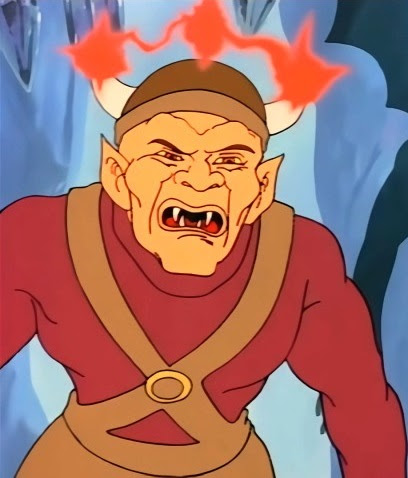
In the third and final season of the D&D cartoon, there's an episode entitled "The Dungeon at the Heart of Dawn" that features a character who looks very much like Dave Trampier's original Monster Manual illustration of a goblin, though he's not explicitly called a goblin. He even has – yet again – a horned helmet, although, in this story, the horns serve to focus a magical blast that he shoots from his helmet. 
Second Edition's Monstrous Monstrous Compendium (1989) gives us a different Jim Holloway take on goblins. You can definitely see in this piece an evolution of Trampier's original, right down to his pose. He still wears a small helmet, albeit one without horns. This goblin is a bit more wizened in appearance than his 1e counterpart, which, strangely, calls to mind Greg Bell's dwarf-like OD&D version.
Finally, there's this goblin image from the 2e Monstrous Manual (1993) by an artist I can't quite identify. He's vaguely reminiscent of Holloway's goblins from Horror on the Hill, but also seems vaguely "fairy tale-ish" in his attire, particularly the oversized shoes. 

As the title of this post implies, this is an incomplete examination of the evolution of goblins in TSR era Dungeons & Dragons. I am sure there are other illustrations depicting this classic evil humanoid to be found during the period between 1974 and 2000, but I've presented here only those with which I am most familiar. If there are other examples from this period you think are particularly relevant to this discussion, please feel free to post them in the comments. This is especially true if the depiction differs radically from what we see above. My own take on goblins from the Dwimmermount and Urheim setting of Telluria owe a lot, I think, to the illustrations I saw in the TSR products of my youth, which just goes to show how important evocative artwork is in bringing a game and/or setting to life.

Tuesday, June 11, 2024

Polyhedron: Issue #29

Issue #29 of Polyhedron is another April Fool's Day issue, though it actually appeared in May of 1986. The issue features a cover by Tom Wham, which is always a delight. I wish the same could be said of its content. I readily admit that I'm not an ideal audience for issues like this, but that's not because I lack a sense of humor. Rather, I simply dislike forced humor and this issue is full of it. Needless to say, I didn't enjoy re-reading this one. Apologies in advance if my frustration gets the better of me.

"Notes from HQ" is typically ephemeral and focused on RPGA matters. The only genuinely interesting thing in it is the announcement of the Gamers' Choice Awards. "Unlike other gaming industry awards, for which the winners are chosen by manufacturers and special panels, these awards are given to those companies whose products are judged the best by the most qualified judges of all – the gamers themselves." I must be old, because I don't recall ever hearing of these awards before. On the other hand, I was never much of a con goer, so that might explain my ignorance. 

Skip Williams gives us "The Lighter Side of Encounters II," a sequel to his article in the previous year's April Fool's Day issue. Like its predecessor, what makes the article interesting is not so much its content as the origin of the content, namely AD&D campaigns run by the Lake Geneva staff of TSR, in this case Williams himself and Frank Mentzer. Williams presents two different encounters, one involving a mad dash through a dungeon and another about trying to prevent a pit fiend from regenerating, that aren't exactly humorous in context, but that seem so when presented in isolation. They're the kinds of things that happen in any RPG campaign played with friends and I love them for that reason. This article is probably the best in the issue and it's because it's the most "serious."

"The Camel's Nose" by Mike Selinker is an AD&D adventure that takes up 16 pages – half of the issue. It's a humorous scenario for six pregenerated player characters, all of whom are valley elves with ridiculous names like "Tattieboggle Spauldrocky" or "Arglebargle Collieshangle." These characters are tasked with protecting a talking camel (a cleric of the Camel Lord, Camelopardus), on his journey across the Burning Desert to a shrine of his deity. He brings with him a sacred rock called the Camel's Nose and ... well, I think you can probably guess where this is going. The adventure is filled with puns and humorous allusions and general silliness, like the Camels Oasis shopping center. I'm sure someone might find it funny, but that someone is not me.

Selinker returns with "The Ecology of Tiamat," which is a rambling dialog between Feargall the All-Noxious and Greenhorn the dim as they "humorously" discuss Feargall's many encounters with Tiamat. It's strange, self-referential, and fourth wall-breaking and, again, I just found it tedious. Your mileage may vary. "Fractured Spells" by Rick Reid is a collection of goofy spells for all magic-using classes, from neutralize person to detect chum to continual lice and more. As you can see, they're all based on puns or misreadings of pre-existing spells. I'll give the author points for cleverness, but not much else.

"The Gods of the Gamma World Game" by James M. Ward is a very strange article. Ward presents five larger-than-life characters from the setting of Gamma World, each of which represents "a different ideal." For example, Ren – there's that name again – is the archetypal scientist, while Tobor the Unstoppable is the archetypal robot. If I squint, I can sort of see what Ward's getting at with these characters. They're more akin to "tall tales" like Paul Bunyan or Pecos Bill than "gods" in the usual sense. That's kind of interesting. However, Ward saddles them all with absurd Gamma World game stats akin to what you'd find in Deities & Demigods and serendipitously provide additional insight for my recent post about that very book and the drawbacks of its presentation.

The issue ends with Roger E. Moore's "Savage Sword of Lugnut the Barbarian," another "humorous" story, this time about a mighty-thewed barbarian and his quest to save a princess from Skuzzdrool the Ultra-Necromancer. It's not very funny, even as a parody of Conan, but's thankfully short, which is more than can be said of "The Camel's Nose." I still cannot understand why half the issue was devoted to that adventure ...

Oh well. One more issue to go before this series ends, which is probably for the best. My patience is wearing thin, especially after this issue.

Tuesday, May 28, 2024

Polyhedron: Issue #28

Issue #28 of Polyhedron (March 1986) features yet another cover by Roger Raupp, who, as I've remarked previously, seems to have been TSR's go-to guy for on-demand artwork in the mid to late 1980s. I never minded, because I liked his style, which I felt struck a nice balance between the cleanliness of Larry Elmore and the grubbiness of Jim Holloway while still remaining firmly within the realm of "fantastic realism." Given how often his illustrations appear during this period, I suspect Raupp must have worked quickly – a great virtue for an artist employed in the gaming industry.

"Notes from HQ" contains an update on "the City Project" first announced in issue #25. Editor Penny Petticord mentions that "the legal aspects of the project have not yet been completely resolved," but does not elaborate on precisely what this means. She might be alluding to the assignment of copyrights, given that this project will include submissions from many outside sources, though there are other possible explanations. Interestingly, Petticord makes no mention of the placement of the setting within the World of Greyhawk or any other setting. Gary Gygax's imminent departure from TSR might explain this omission. In any event, the project would eventually be shifted to the Forgotten Realms when Ed Greenwood's campaign setting became the default setting of AD&D in 1987.

"Adventure Among the Clouds" by Jeff Martin is an AD&D article that tackles the subject of cloud islands – floating "land" masses that can serve as adventure locales. The existence of such islands was first confirmed in the Monster Manual's description of cloud giants and elaborated upon further in module UK7, Dark Clouds Gather. In this article, Martin describes the origin, composition, and inhabitants of cloud islands, along with notes on how these magical places affect spells and magic items. His overall approach reminds me a lot of a condensed version of what Roger E. Moore pioneered with his "The Astral Plane" article in Dragon #67 (November 1982), though, sadly, less interesting. Cloud islands are potentially fascinating places and very much in keeping with AD&D-style fantasy, but Martin, in my opinion, treats them in a rather mundane way. It's a shame.

Back in the day, Frank Mentzer was a machine when it came to penning RPGA AD&D tournament adventures. This issue includes another one, "The Great Bugbear Hunt," intended for characters of levels 5–7. The set-up is that, while out in the wilderness, a passing band of bugbears slew the horses of a party of adventurers and stole all the items in the saddlebags. Among them is a magic-user's spellbook. Naturally horrified by this turn of events, he enlists the aid of others to venture back into the wilderness in an attempt to find the bugbears and retrieve it. The scenario is, in effect, a scavenger hunt in a wilderness filled with monsters and other obstacles. This one looks like a lot of fun, with plenty of varied and challenging encounters.

"The Specialist Mage" by Jon Pickens introduces a new idea for use in AD&D games: the specialist mage. Bear in mind, this is 1986, three years before the release of Second Edition, which formalized specialist mages as an option for player character magic-users. Here, the idea is presented as being for NPCs only – a common dodge employed in the pages of Dragon to justify its articles on new classes without running afoul of TSR dicta about "no new character classes." Pickens's version of the specialist mage receives XP bonuses if he employs more spells of his chosen specialty, in addition to having access to unique spells unavailable to non-specialists. In this issue, he presents numerous new necromancy spells, though they were intended only for use by "an NPC villain." Where have I heard that before?

Michael Przytarski's "Fletcher's Corner" is focused on the creation and judging of tournament scenarios, a topic that I must confess holds little interest for me. That he is given three pages to elucidate his thoughts on the topic makes it even less compelling somehow. Of course, this is the official newszine of the Role Playing Game Association, which sponsored innumerable tournaments at GenCon and elsewhere, so this is exactly the kind of content that should be here. That it holds no interest for me says more about my weirdness than it does about the article. Alas, I'm the one writing this post.

In terms of the number of articles, issue #28 has among the fewest in some time. That's probably due to the fact that "The Great Bugbear Hunt" adventure takes up half of the issue's 32 pages. Likewise, all the remaining articles, with the exception of "Notes from HQ," are at least three pages long. I probably wouldn't have even commented on this if any of them had any of them stood out as notable in some way. Instead, they're mostly fine if unexceptional, so I took greater note of how few there were than I otherwise might have.

Sadly, the next issue is the April Fool's Day issue, so I don't think it'll prove much better ...

Tuesday, May 14, 2024

Polyhedron: Issue #26

Issue #26 of Polyhedron (November 1985) is another one that I recall very vividly, almost entirely because of its Roger Raupp cover, depicting a reptilian alien superimposed over what looks to be photograph from one of the Viking landers sent to Mars in the mid-70s. The cover was inspired by Roger E. Moore's article, "Gamma Mars," on which I've briefly commented before. I have lots to say about it but will hold off on doing so until later in this post. 

"Notes from HQ" is, as usual, mostly filled with RPGA ephemera of minimal lasting value. There is, however, a brief section worthy of mention. The "City Project" announced in the previous issue is moving forward, though Penny Petticord asks RPGA members to "hold your actual submissions until specific procedures are announced next issue." Furthermore, she explains HQ "will be finalizing details with Gary Gygax" regarding the placement of the city within the World of Greyhawk setting. Of course, Gygax would depart TSR less than a year later and the City Project would, in turn, head in a different direction.

Next up is "Squeaky Wheels," a guest editorial by Frank Mentzer, in which he tackles criticisms of roleplaying games in the mass media. Mentzer isn't talking solely about the religiously-inflected Satanic Panic – though he does have rebuttals to offer on that score – but also to more general worries about RPGs, such as the suggestion that playing these games inclines one to suicide. I must admit that, despite having lived through these times, I encountered almost no resistance to my involvement in roleplaying. If anything, my parents and the parents of my friends were incredibly supportive of our hobby. Perhaps we were just lucky, I don't know. In any case, I'll never cease to be baffled when I come across articles like this one. They're yet more evidence that the past really is a foreign country.

"Con-Fusion" by Fas Eddie Carmien is a brief collection of thank yous to the volunteers at GenCon 18 – nothing special. "Where Chaos Reigns" by Sonny Scott is more amusing, being a fictionalized account of his time working telephone assistance on behalf of the RPGA at GenCon. Though hardly an article for the ages, it's fun and, as someone who's worked at a phone bank a few times over the course of my life, the inanity of the calls Scott recounts seems very true to life. Michael D. Selinker's "A View of GenCon 18 Game Fair from RPGA Network HQ" is a day-by-day recounting of the con from the perspective of someone involved in its operation. I've never been involved in running a con, so I found this article more interesting than I expected. It's helped by the fact that Selinker can spin a good yarn and has a decent sense of humor.

The third and final part of Frank Mentzer's AD&D tournament adventure, Needle, appears in this issue. Part I focused on the location of the titular obelisk, while Part II was about the process of retrieving it for transport it across the sea. Part III concerns what happens after it's been installed in the palace square of the king who wanted it in the first place. In case you're wondering: a magical door to the Moon opens in its base and the characters must journey through it to see its wonders. As premises for an adventure go, it's not a bad one and Mentzer does a solid job of presenting intriguing and challenging encounters. 

"Dispel Confusion" is short this month, tackling only AD&D and Gamma World questions, none of which are especially memorable. For me, what's most fascinating is how increasingly truncated this column has become. In early issues of Polyhedron, "Dispel Confusion" covered two or three pages and covered all of TSR's RPGs. As time went on, its page length shortened and its focus contracted, with only AD&D and Gamma World being consistently covered. The former is understandably, as it was always TSR's most popular and best selling game. Gamma World's continued presence strikes me as stranger, as I never got the impression it was very successful, despite its having no fewer than four editions during TSR's time. 

Speaking of Gamma World, we come at last to Roger E. Moore's "Gamma Mars," which, as its title suggests, presents information on the state of the planet Mars in the post-apocalyptic 25th century of the game. In this timeline, Mars was first visited by human beings in 2002, with a stable colony growing there over the course of the 21st century. By 2076, the colony became independent of Earth. The colonists would eventually discover evidence of alien habitation on the planet – the reptilian Luntarians – but these beings are not natives to Mars but visitors from another planet outside our solar system. A small number of Luntarians placed themselves into suspended animation in the past and were subsequently revived just in time for the Social Wars to engulf Earth and cut Mars off from the mother planet.

I was a big fan of the articles from Dragon that described the state of the Moon in Gamma World, so I was understandably excited to learn more about the wider solar system of the game's setting. As described by Moore, Mars has only been partially terraformed. Its atmosphere, for example, remains too thin for humans to breathe unaided. In addition, pure strain humans predominate, since Mars largely sat out the conflict that devastated Earth. The result is a very different take on Gamma World, one where rival cities jockey with one another for power and rumors of alien ruins and technology form the basis for adventure. At the time, I found it compelling stuff; even now, I think there's something remarkable about it.

Jon Pickens provides "Unofficial Illusionist Spells" that are actually fairly interesting, at least when compared to the cleric and magic-user spells from previous issues. I think that's because, in AD&D, there are comparatively few illusionist magic items and thus the spells here don't exist primarily to act as means of explaining how such items exist. Michael Przytarski's "Fletcher's Corner" also deals with magic, in this case magic items, which he first divides into the categories of "mundane, powerful, deadly, and ridiculous" with the goal of suggesting how common each type should be in a good campaign. He also addresses the question of "magic shops," something I get the impression was becoming increasingly common in mid-80s AD&D (based on how often it was criticized in official TSR publications). The issue ends with Errol Farstad's positive review of Twilight: 2000.

Twenty-six issues in, Polyhedron continues to lack a solid, consistent foundation on which to build. As I have repeatedly said in this series, you never know what to expect from an issue, with some having numerous useful and excellent articles and others ... less so. While I completely understand why this was the case, it's disappointing and played a big part in why I'd eventually let my subscription lapse, even as I continued to read Dragon for many more years to come. 

Tuesday, May 7, 2024

Polyhedron: Issue #25

Issue #25 of Polyhedron (September 1985) features eye-catching artwork by the Marvel Bullpen, depicting the Hulk and long-time foe, the Abomination, bursting through the cover. Both characters appear in the issue's Marvel Super Heroes article – a first for the newszine. At the time, I was quite pleased by this expansion of Polyhedron's coverage, because I was a big fan of MSH and was always on the look-out for new material (particularly write-ups of Marvel characters that hadn't yet appeared elsewhere).

Normally, "Notes from HQ" is filled with RPGA-related ephemera and thus doesn't command my attention for long. This time, though, part of it is of greater interest, specifically the call for Dungeon Masters to submit "a store, tavern, house, city block, NPC, street encounter, guild" for inclusion in a fantasy setting to be used by the RPGA as a "home base" and possible locale for adventures. Robert Asprin's Thieves' World is referenced as an inspiration and it's stated that Gary Gygax has agreed to allow this city to be placed in his World of Greyhawk setting. If any of this sounds familiar, that's because I suspect the project was eventually retooled for use with the Forgotten Realms, becoming Ravens Bluff, the Living City, an RPGA staple for years to come.

Jon Pickens offers up a second part of his "Unofficial Magic-User Spells" series, again looking to existing magic items as source of new spells (like the ring of spell turning and ring of x-ray vision). It's fine, if a bit unimaginative, though I cannot forgive the consistent misspelling of "absorption" as "absorbtion" throughout, especially when the magic item that inspired it, the rod of absorption, spells it correctly. The "RPGA Network Player and Judge Standings" is hardly worth mentioning, since it's little more than three pages' worth of names. Looking through them, I spotted the usual assortment of TSR employees and freelancers, along with a few others whose names I recognized from Dragon and elsewhere. I wonder if any readers of this blog had earned enough tournament XP to make it onto the list?

Part II of Frank Mentzer's AD&D adventure, Needle, also appears in this issue. Having found the titular needle – a magical obelisk – in Part I, the characters are now tasked with removing it for transport back to their homeland while dealing with hostile bullywugs and pirates. The adventure is quite fascinating, in that it's mostly a matter of resource management and logistics. The characters command a team of workers and mercenaries over the course of the several weeks needed to achieve their goal. How well they manage their resources, as well as how they respond to various threats, determine whether or not their mission is successful. I have no idea how it would be to play, the idea behind this scenario sounds compelling.

Michael Przytarski's "Fletcher's Corner" returns, talking about high-level adventures this time. That's a topic of great interest to me, since there aren't a lot of good examples of them in my opinion and I'd love to read some good advice on how to create my own. Sadly, there's not much meat to this article. It's mostly brief nuggets ("Try not to be bring the gods into it") intended to keep things somewhat grounded and avoiding boredom ("Three red dragons are fun, but they can become tiresome"). Perhaps the article's brevity (one page) prevents Przytarski from getting into the weeds of this topic, I don't know. Regardless, I didn't find what I was looking for here, which is a shame. My quest continues.

"Rampage" by Roger E. Moore is a straightforward Marvel Super Heroes scenario, in which four different super-strong characters – the Hulk, Hercules, the Abomination, and Titania – in the streets of New York. It's not deep, but it's fun. I also appreciate the way that Moore presents different Karma award charts for each character as a way to highlight their differences. That's something I always liked about Marvel Super Heroes and that's harder to implement in a game where the characters are all original creations of the players rather than established personalities. 

With apologies to Rembert N. Parker, I'm going to pass over his "How to Succeed at Judging an RPGA Network Event," because it's of minimal interest to me. "Dispel Confusion" consists of two full pages of AD&D questions, with no other RPGs represented. By and large, the questions this issue concern ambiguities in the rules and, as such, aren't that interesting to discuss here. The most notable question concerned psionics and its use, with the answer noting that psionics will be revised "in the future." Rounding out the issue is a positive review of Paranoia, an old fave of mine, though it's been years since I've attempted to play it. Maybe I should change that.

As always, Polyhedron is so much more of a mixed bag than is Dragon and it's frustrating. Most issues contain good material, but very few are consistently good. That probably explains why I eventually stopped reading it, while I continued with Dragon well into the 1990s. I suspect this is because Polyhedron always had a much more "amateur" quality, which limited both its audience and its submissions. It's a real pity.

Tuesday, April 30, 2024

Polyhedron: Issue #24

Issue #24 of Polyhedron (July 1985), with its cover illustration by Roger Raupp, is another one I remember very clearly from my youth – and the cover is a big part of the reason why. When I first saw this odd collection of characters, I honestly had no idea what I was looking at. Were they supposed to be orcs or half-orcs or something else entirely? As I turned out, my guess wasn't far from the truth, but that initial perplexity compelled me to read the issue with great interest. Nearly forty years later, I still remember it.

"Notes from HQ" can be quickly dispensed with, since most of it concerns RPGA matters of little lasting interest. The main thing worth discussing is a note indicating that, in response to pleas from the editor in previous issues, there have been a number of submissions from RPGA members. Indeed, Penny Petticord states that "we have not rejected a single article." She quickly adds, though, that submissions are still very few in number and that "only a fraction of the so-called active membership has contributed." At the time there were supposedly "over 8000" RPGA members worldwide, so I can sympathize with Petticord's lament about the small number of submissions. 

"Letters" is quite interesting this issue. First, there's a letter in which a reader complains about the heavy D&D focus of Polyhedron, as well as the lack of support for Marvel Super Heroes. In response to the first part, the editors explain that Polyhedron can only publish those articles that are submitted to it, so, if anyone wants to see more non-D&D content, they'll need to make it happen themselves. As I think I said before, I wish I'd paid more attention to this sort of stuff when I was a subscriber, because I probably would have had better luck getting published in Polyhedron than I ever did in Dragon. In answer to the second part, the editors point out that, because MSH is a licensed game, Marvel itself must review and approve everything it publishes for the game. This makes it harder for any writer, especially those outside the TSR staff, to produce new articles to support it. Also among the letters published are a couple discussing the bad publicity Dungeons & Dragons is getting in their area, a consequence of the ongoing Satanic Panic. If I hadn't lived through those times, I'd hardly believed such things happened!

"Secrets of Success" by Steve Null offers tips on playing in RPGA tournaments. Never having participated in RPGA events, I must say I only briefly skimmed this article and saw nothing worthy of comment here. "Unofficial New Magic-User Spells" by Jon Pickens continues what he began in issue #22. The selection of new spells continues to focus replicating the effects of AD&D magic items, which is fine, but I'd have liked a little more variety myself. More notable, I feel, is that, like its predecessor, it includes the word "unofficial" in its title – a reminder that nothing that appears in Polyhedron carries the official TSR seal of approval. 

Part I of Frank Mentzer's AD&D adventure, "Needle," appears in this issue. Designed for characters of levels 8–10, this is another tournament adventure offered for the delectation of readers of Polyhedron, like most of the adventures published in its pages previously. The adventure concerns an expedition to locate and examine a powerful magic item – the titular Needle – that is found in a ruined city located in a far-off land. The characters are all members of an adventuring guild called SMART, which stands for Syndicate of Master Adventurers for the Recovery of Treasure. All the pregenerated characters have what I assume (hope?) are merely nicknames, like Slim, Smiley, Blondy, and Blaze. To be honest, I found this nomenclature detracted from my enjoyment of scenario, which is otherwise decent, filled with lots of challenges and puzzles. Maybe it's just me, but I prefer a slightly more serious tone when it comes to things like names.

Errol Farstad's "How Reviews are Done" is an overview of how RPGs and RPG products will be reviewed in Polyhedron, since such reviews are a new future in the newszine. All games are given a Difficulty rating from 1 to 4, with 1 being the easiest to learn for a newcomer and 4 being the hardest. Then, the product is rated on a scale of 1 to 10 in three other categories: Packaging, Rules and Explanations, and Miscellaneous. Taken together, these four ratings contribute to its Overall score, rated from 0 to 4 Stars. With the explanations out of the way, Farstad reviews Star Trek the Role Playing Game, to which he gives an overall rating of 3 Stars out of a possible 4. He had some minor (and frankly nitpicky) complaints about the game, which did not detract from his otherwise very positive opinion of it. Being a big fan of the old FASA game, I could not disagree with his assessment.

"The Grond Family & Friends" by Roger E. Moore is the first installment in a new series called "The New Rogues Gallery." Like the book after which its named, this series is intended to present write-ups and illustrations of characters from people's home campaigns – basically "Let me tell you about my character(s)" in written form. The eponymous John Grond is a half-ogre and it's his friends and family whom Roger Raupp depicted on the cover of this issue. Half-ogres were briefly described as a possible player character race by Gary Gygax in issue #29 of Dragon (September 1979). Moore apparently liked the idea enough to adopt and adapt for his own use. The article presents six characters, ranging from Grond himself (a 16th-level fighter) to his wife (a 4th-level half-ogre cleric) and followers, like Boron the Moron, a full ogre of limited intelligence.

"Fletcher's Corner" by Michael Przytarski – and people say my name is hard to spell – is the start of a new column devoted to "solving the everyday problems faced by anyone who judges role playing games." In short, it's another referee's advice column. Consequently, I expect it'll be filled with lots of good insights and advice that will be genuinely useful to someone who's sitting behind the screen for the first time but rather dull to the veterans among us. That's OK: there are always newcomers in need of advice and that's good for the hobby. For his inaugural column, Przytarski takes up the topic of introducing new characters (and, by extension, new players) to a campaign. It's a good topic and his advice is solid, though nothing I haven't heard before (or come to understand through years of play). It'll be interesting to see what he tackles next and whether I find it useful.

Concluding the issue is "Dispel Confusion," with answers to questions about D&D, AD&D, and Marvel Super Heroes. Sadly, none of the questions piqued my interest, because they were all very banal. Most pertained to discrepancies between two sections of the rules or details that had been inadvertently left out of the text – in short, the kinds of rules questions about which you can't say very much else. Personally, I've always enjoyed questions that afford the responder to pontificate a little about a philosophy of play or game design, but that's just me. Maybe next issue!

Tuesday, April 23, 2024

Polyhedron: Issue #23

April Fool's issues were a staple of my youth, but they're very difficult to pull off. Partly, that's because humor can be very subjective and, partly, that's because most attempts at humor, especially in writing, are simply not very good. Consequently, I greeted the arrival of issue #23 of Polyhedron (April 1985) with some trepidation, despite its delightful cover by Tom Wham (take note of the bolotomus and snits in the bottom lefthand corner). However, I'm happy to say that this particular April Fool's Day issue is (mostly) pretty good. In fact, there are a couple of articles that I still find rather amusing even now – not laugh-out-loud funny, but intellectually droll, if that distinction means anything.

The issue begins with another installment of "News from HQ" that explains the nature of this issue: 

If this is your first issue of the POLYHEDRON Newszine, I'd like to take this opportunity to welcome you to the RPGA Network, and let you in on the gag. Five out of the six issues you will receive with each year of membership will bring you club news, informative articles on your favorite game systems, and a chance to make a serious contribution to the hobby by sharing your ideas with other members. This is not one of those five.
That's the kind of humor I'm talking about. The editorial goes on to explain that this issue was "conceived in madness and dedicated to the proposition that there is room for levity in gaming." I wholeheartedly agree, as anyone who's ever played in one of my campaigns will tell you. Yes, even the ones occasionally featuring unpleasant stuff. Games are supposed to be fun, after all, and it's important not to lose sight of that.

Much less funny is "An Official Policy Statement," whose entire shtick is using $64 words to say silly things about, in this case, "the sex lives of monsters." As I said above, humor writing isn't easy.

Fortunately, Gary Gygax gifts us with "Ultimists," a new character class for AD&D. Described as "fighting wizard-priests," Ultimists combine the abilities of clerics, magic-users, and monks. While their ability scores are rolled using only 3d6, the result of that roll is made by recourse to a chart, with most rolls resulting in scores of 15 or higher. This section of the class description pokes fun, as Gygax makes clear, those "enthusiasts" who objected to his system for rolling up the abilities of the then-new barbarian class. Ultimists also make use of spell points, because "memorizing spells is tedious, and the selection requires reasoning and intelligence applied to the game." Ouch. I can't really blame Gygax for using the article as an opportunity to vent about critics of AD&D. I imagine he was quite fed up with them by this point in his life.

"Why Gargoyles Don't Have Wings (But Should) (An Alternative Viewpoint) by David Collins is an attempt to explain away Gary Gygax's concerns about the illustration of the gargoyle in the Monster Manual through a variety of vaguely humorous means. It's fine for what it is, but nothing special. A bit more interesting is Skip Williams's "The Lighter Side of Encounters" in which he presents a couple of humorous encounters from Frank Mentzer's Aquaria campaign as a way of demonstrating how humor sometimes finds its way into otherwise "serious" RPG campaigns. The encounters are all based on things that actually happened in Menzter's campaign, which is fascinating in its own right. Speaking of Mentzer – or, rather, Knarf Reztnem – his "Punishments to Fit the Crime" offer a pair of humorous stories whose conclusions depend on puns. They're basically Dad jokes in written form. Make of that what you will.

Frank Mentzer reappears with "New Magic Items," which offers up some fun (and funny) magic items from his Aquaria campaign, like the canister of condiments and the sweet tooth. Then, he reappears yet again – the man was a machine back in the day – with "Excerpts from the Book of Mischievous Magic," a spoof of his The Book of Marvelous Magic. This second article many amusing magical items like the awl of the above, cool hand lute, stocking of elf summoning, and practical yoke. It's all very silly, of course, but done with some real cleverness and an understanding that a good joke magic item isn't just a joke, but should also have some potential utility in a game. Mentzer clearly understood this.

Part 2 of David Cook's "In the Black Hours" AD&D adventure (Part 1 appeared in the previous issue) is the sole piece of "serious" material in the entire issue and thus feels very much out of place. Like its predecessor, it looks fun, reminding me a bit of something in which Fafhrd and the Gray Mouser or Conan, while working as a thief, might have become involved. "Dungeonsongs" is back to form, with a trio of humorous, RPG-themed songs set to well-known tunes, like "I'll Be a Wererat in the Morning" and "Green Slime." "Dispel Confusion" answers numerous important questions for D&D, AD&D, and Top Secret, like this one:
Bruce Heard pens "Zee Chef," another new character class for use with AD&D. A chef is designed specifically for NPCs "devoted to the culinary arts and learning more about native delicacies." It's a spellcasting class, with a host of new spells, including my favorite, edible glamour. Concluding the issue is "The Male of the Species" by – you guessed it – Frank Mentzer, which describes "emezons," the male counterparts to the amazons presented by Gary Gygax in issue #22. Some emezons are members of the new chef NPC class, while others are "exceptionally skilled at child raising, interior decorating, and hair styling." Hey, it was a different time.

All in all, not bad. Even someone as humor-impaired as myself chuckled a couple of times, which is quite a feat in itself. I'd still rather have had a "normal" issue of Polyhedron, but I can't deny the staff did a good job with their assignment. Well done!