Showing posts with label magic-user. Show all posts

Friday, August 16, 2024

Level Titles: Clerics and Magic-Users

Yesterday, we looked at the level titles of fighters and thieves, so today we'll turn to the level titles of clerics and magic-users. These are a bit more interesting, in that there's more variability between the different editions of Dungeons & Dragons. In OD&D (1974), clerics have the following level titles:

In the AD&D Players Handbook (1978), we get a similar but not identical list. Levels 1 and 2 are the same, while level 3 is simply "priest" rather than "village priest." The title of "curate" becomes a level 4 title and "vicar" disappears entirely, replaced by "perfect," which may or may not be a misspelling of "prefect." "Bishop" is replaced with "canon" and there's a title above patriarch – high priest.

The 1981 Expert Rules has yet another set of level titles, one that is fairly close to that of OD&D and yet still distinct. There's a new title, elder, that's placed in between curate and bishop, making the latter a 7th-level title rather than a 6th-level one in OD&D.

The strangest thing about all the lists of clerical level titles is how, for the most part, they're all derived from the names of Christian clergy, which says a lot about the origins of the cleric class. The anomalous titles are "adept," which strikes me as being more appropriate to a magic-user of some kind and "lama," which, while religious in character, has nothing to do with Christianity. Why these were both included in the list, I have no idea.

Turning to magic-users, we get this list in OD&D:

AD&D has a similar list, starting at level 3. The first two AD&D level titles are quite different and the titles that were replaced appear nowhere else on the list. They're simply removed. 

The Expert Rules give us yet another list. "Medium" and "seer" are restored to level 1 and 2, while "theurgist" and "thaumaturgist" are both removed entirely, much as "medium" and "seer" were in AD&D. The OD&D level titles that followed, starting with "magician" simply drop down several levels, perhaps so that "wizard" can now be the 9th-level rather than 11th-level title, since the 1981 edition places a great emphasis on level 9 being "name" level for the four human classes. Also of note is that the 1981 rules spell "conjurer" and "sorcerer" as "conjuror" and "sorceror," despite neither OD&D nor AD&D spelling them that way.

Normally, the 1983 Frank Mentzer-edited edition of D&D follows its 1981 predecessor quite closely, but there are some differences worthy of note. In the case of magic-user level titles, it's worth noting that '83 restores the "–er" endings of both "conjurer" and "sorcerer," while everything else remains the same.

I find these changes quite fascinating, but I wish I knew precisely why they were made. I have theories but no proof and I suspect, even if I were to hunt down the people responsible for doing so, they would not remember after so many decades. 

Tuesday, August 13, 2024

The Articles of Dragon: "Cantrips: Minor Magics for Would-Be Wizards"

You would think I'd remember issue #59 of Dragon (March 1982) for its 20+ pages of science fiction content, but, at the time I first read it, I was much more interested in Gary Gygax's latest "From the Sorceror's Scroll" column. Entitled "Cantrips: Minor Magics for Would-Be Wizards," this column is what first introduced 0-level spells into Advanced Dungeons & Dragons. Gygax offers these up as the first preview of the AD&D "expansion volume" he was working on at the time and that he hoped would be released "next year" (i.e. 1983). He explains that this volume "will be for both players and DMs, with several new character classes, new weapons, scores of new spells, new magic items, etc." 

Needless to say, this was irresistible to my youthful, Gygax-loving, TSR fanboy self. I'd been playing AD&D – or, at least, using AD&D books to play a game we called "AD&D" – since sometime in 1980 and had, during that time, had dutifully acquired all its available volumes. The prospect of a new volume and one penned by Gygax himself filled us with excitement. That he was now sharing monthly glimpses into what this volume might contain in the pages of Dragon more or less assure that I'd be paying careful attention to the magazine from now on.

Of course, this first article in the series of previews didn't really interest me all that much. For whatever reason, my friends and I weren't all that keen on magic-users. It's not that we never played magic-users – well, I didn't, but that's another story – but that our favorite classes tended to be fighters, thieves, and clerics. With one exception, I can't recall a single player character who was a single-classed MU. All of the magic-users amongst our characters were multi-classed elves and even these were pretty uncommon. Consequently, I couldn't get too excited about cantrips, since I knew they wouldn't see much use at our table.

And I was correct in thinking this. Early on, shortly after the article was published, I suggested that we give these new minor spells a whirl to see if they'd actually be useful. As Gygax presents them, a magic-user can memorize four cantrips for every first-level spell he's willing to forgo. At that very favorable exchange rate, a couple of players thought it worth a try, selecting cantrips like exterminate, knot, tangle, and wilt in place of a single detect magic or light. The consensus, as I recall, was that some cantrips had value in certain limited situations, but that, by and large, few magic-users would ever willingly give up a spell slot for them. After that, I don't think we ever thought much about cantrips.

Nevertheless, this remains a memorable and important article for me even now – because it was the first article that suggested to me that the AD&D game's rules might change or evolve in any significant way. You must remember that, by the time I started playing, all three of AD&D's rulebooks had already been released. While both Deities & Demigods and the Fiend Folio came out after my introduction to the hobby, I didn't pay either of them much heed and indeed made comparatively little use of either of them. More to the point, neither one changed much of anything about the AD&D rules, so they could be safely ignored. However, this Gygax column from issue #59 heralded the dawn of a new era, one in which AD&D would, at last, change through the introduction of new character classes, spells, magic items, etc. That was a very big deal to me at the time, hence why I can recall reading this article for the first time, even more than forty years later.

Saturday, June 22, 2024

Dousing the Fireball

With the possible exception of magic missile – which, ironically, didn't appear until a year after the original game's release – I can think of no more iconic spell in Dungeons & Dragons than fireball. As most of you will no doubt already know, fireball (or fire ball, as it's rendered in OD&D and the 1981 and '83 D&D Expert Sets) first appeared in Chainmail, where it's one of two types of missiles a wizard can throw, the other being lightning bolt. In Chainmail, a wizard can seemingly throw a fireball at will and its function is as a form of battlefield artillery that immediately destroys any target within its area of effect weaker than a Hero. Even if you've never played Chainmail, I hope my brief summary makes clear just how potent a fireball is – and that's the problem. 

When the abilities and spells of Chainmail's wizards were translated into the terms of OD&D, there were inevitably going to changes and alterations, big and small. In the case of fireball, these changes included a slightly larger burst radius and damage that increases with the level of its caster or, as Men & Magic explains it, "A 6th level Magic-User throws a 6-die missile, a 7th a 7-die missile, and so on." These changes explain, I suspect, why fireball became the iconic D&D spell and the one that nearly every magic-user hoped to learn as soon as they were of sufficient level to do so. Taken together, the fireball of OD&D and all subsequent TSR versions of the game is one of only a handful of spells whose damage-dealing potential has no upper limit. Coupled with its large area of effect and easy reach for most characters – a magic-user only needs to be 5th-level (20,000 XP) to potentially acquire it – fireball is a must-have spell when it comes to damage-dealing.

Spend enough time in online D&D circles and the subject of the relative power of fighters versus magic-users will inevitably come up. This is one of those perennial topics that simply will not die, because, unlike many such topics, I think there's some substance to it. Fighters, even when equipped with potent magic weaponry, can never dish out as much damage as can even a fairly low-level magic-user. Over the years, various solutions have been proposed, such as weapon specialization in AD&D, but none of them has met with universal acceptance – quite the opposite, in fact. 

That's why I've lately been thinking about either eliminating or modifying spells whose damage-dealing effects increase with the level of their caster. If you look at the original spell list from Volume 1 of OD&D, both fireball and lightning bolt are odd men out, mechanically speaking. Most of the game's "offensive" spells, like sleep, cloudkill, or disintegrate do not become more effective as the caster rises in level. Any variability they have in terms of damage or overall effectiveness is usually independent of level (there are exceptions). That feels right to me somehow and offers a better model to emulate in rethinking spells in OD&D and similar games.

On the other hand, simply removing fireball, lightning bolt, and comparable spells might be simpler. This is what Lamentations of the Flame Princess did long ago. Many of that retroclone's deviations from OD&D were introduced specifically to strengthen the fighter's role as the most potent combatant and damage-dealer, which is a worthy goal. Furthermore, by eliminating and/or weakening the number and scope of magical damage dealing, this approach carves out a different role for the magic-user, that of a seeker after knowledge and controller of the environment. It's a far cry from the role people now tend to associate with D&D magic-users, but is that necessarily a bad thing? It's closer to the pulp fantasy conception of sorcerers and wizards than to the cartoonish, video game-y vision of them flinging fireballs and hurling lightning bolts.

I don't know. I'm still thinking about this, especially in light of my evolving thinking about magic in Secrets of sha-Arthan. I'd love to hear readers' thoughts on the subject, especially from those of you have regularly play fighters and/or magic-users. How do you perceive their relative strengths when it comes to damage-dealing or do you make changes to rebalance things?

Tuesday, May 28, 2024

Polyhedron: Issue #28

Issue #28 of Polyhedron (March 1986) features yet another cover by Roger Raupp, who, as I've remarked previously, seems to have been TSR's go-to guy for on-demand artwork in the mid to late 1980s. I never minded, because I liked his style, which I felt struck a nice balance between the cleanliness of Larry Elmore and the grubbiness of Jim Holloway while still remaining firmly within the realm of "fantastic realism." Given how often his illustrations appear during this period, I suspect Raupp must have worked quickly – a great virtue for an artist employed in the gaming industry.

"Notes from HQ" contains an update on "the City Project" first announced in issue #25. Editor Penny Petticord mentions that "the legal aspects of the project have not yet been completely resolved," but does not elaborate on precisely what this means. She might be alluding to the assignment of copyrights, given that this project will include submissions from many outside sources, though there are other possible explanations. Interestingly, Petticord makes no mention of the placement of the setting within the World of Greyhawk or any other setting. Gary Gygax's imminent departure from TSR might explain this omission. In any event, the project would eventually be shifted to the Forgotten Realms when Ed Greenwood's campaign setting became the default setting of AD&D in 1987.

"Adventure Among the Clouds" by Jeff Martin is an AD&D article that tackles the subject of cloud islands – floating "land" masses that can serve as adventure locales. The existence of such islands was first confirmed in the Monster Manual's description of cloud giants and elaborated upon further in module UK7, Dark Clouds Gather. In this article, Martin describes the origin, composition, and inhabitants of cloud islands, along with notes on how these magical places affect spells and magic items. His overall approach reminds me a lot of a condensed version of what Roger E. Moore pioneered with his "The Astral Plane" article in Dragon #67 (November 1982), though, sadly, less interesting. Cloud islands are potentially fascinating places and very much in keeping with AD&D-style fantasy, but Martin, in my opinion, treats them in a rather mundane way. It's a shame.

Back in the day, Frank Mentzer was a machine when it came to penning RPGA AD&D tournament adventures. This issue includes another one, "The Great Bugbear Hunt," intended for characters of levels 5–7. The set-up is that, while out in the wilderness, a passing band of bugbears slew the horses of a party of adventurers and stole all the items in the saddlebags. Among them is a magic-user's spellbook. Naturally horrified by this turn of events, he enlists the aid of others to venture back into the wilderness in an attempt to find the bugbears and retrieve it. The scenario is, in effect, a scavenger hunt in a wilderness filled with monsters and other obstacles. This one looks like a lot of fun, with plenty of varied and challenging encounters.

"The Specialist Mage" by Jon Pickens introduces a new idea for use in AD&D games: the specialist mage. Bear in mind, this is 1986, three years before the release of Second Edition, which formalized specialist mages as an option for player character magic-users. Here, the idea is presented as being for NPCs only – a common dodge employed in the pages of Dragon to justify its articles on new classes without running afoul of TSR dicta about "no new character classes." Pickens's version of the specialist mage receives XP bonuses if he employs more spells of his chosen specialty, in addition to having access to unique spells unavailable to non-specialists. In this issue, he presents numerous new necromancy spells, though they were intended only for use by "an NPC villain." Where have I heard that before?

Michael Przytarski's "Fletcher's Corner" is focused on the creation and judging of tournament scenarios, a topic that I must confess holds little interest for me. That he is given three pages to elucidate his thoughts on the topic makes it even less compelling somehow. Of course, this is the official newszine of the Role Playing Game Association, which sponsored innumerable tournaments at GenCon and elsewhere, so this is exactly the kind of content that should be here. That it holds no interest for me says more about my weirdness than it does about the article. Alas, I'm the one writing this post.

In terms of the number of articles, issue #28 has among the fewest in some time. That's probably due to the fact that "The Great Bugbear Hunt" adventure takes up half of the issue's 32 pages. Likewise, all the remaining articles, with the exception of "Notes from HQ," are at least three pages long. I probably wouldn't have even commented on this if any of them had any of them stood out as notable in some way. Instead, they're mostly fine if unexceptional, so I took greater note of how few there were than I otherwise might have.

Sadly, the next issue is the April Fool's Day issue, so I don't think it'll prove much better ...

Tuesday, May 21, 2024

Polyhedron: Issue #27

Issue #27 of Polyhedron (January 1986) features yet another cover by Roger Raupp, this time depicting a clan of dwarves. Raupp was a very prominent artist in the pages of both Polyhedron and Dragon during the second half of the 1980s – so prominent that, for me at least, his illustrations strongly define the look of that era. I also remember Raupp's work on many of the later Avalon Hill RuneQuest books, which, as I understand it, are very well regarded among Glorantha fans. 

Leaving aside the forgettable "Notes from HQ," the issue properly kicks off with "Dominion" by Jon Pickens, which introduces a new type of spell for use by AD&D magic-users. Unlike previous collections of new spells by Pickens, this one looks not to magic items for inspiration but rather psionics. All of the dominion spells concern "controlling the victim's voluntary muscles and sensory linkages." This is not mind control but rather bodily control of another being (with the senses being considered part of the body). It's an interesting approach and ultimately, I think, a better one than AD&D's psionics system, which, in addition to being mechanically dubious, didn't really mesh with the overall feel of the game.

"The Thorinson Clan" by Skip Olsen presents five dwarves, related by blood and marriage, from his Norse mythology-inspired AD&D campaign. These are the characters Roger Raupp portrayed on the cover. They're an interesting bunch and I must confess I appreciate the fact that Olsen's campaign is multi-generational, a style of play I think is under-appreciated (and one of the reasons I think so highly of Pendragon). Almost certainly coincidentally, this issue's installment of Errol Farstad's "The Critical Hit" offers a very positive review of Pendragon, which he calls "the stuff of which legends are made." Needless to say, I agree with his assessment.

Next up is "She-Rampage" by Susan Lawson and Tom Robertson, a scenario for use with Marvel Super Heroes. As you might guess based on its title, the scenario involved She-Hulk but also a number of other female Marvel characters, like Valkyrie, Spider-Woman, Thundra, and Tigra. There's also an original character, Lucky Penny, who's based on the Polyhedron's editor, Penny Petticord. The background to the adventure is rather convoluted and involves alternate Earths where one sex dominates the others. The male-dominated Earth, Machus, has learned of the existence of our Earth and sees the existence of super-powered women as a potential threat to be eliminated. This they attempt to do by traveling to our world and then – I am not making this up – releasing doctored photos and scurrilous stories in the pages of "a girlie magazine known as Pander." Naturally, the superheroines take exception to this and it's clobberin' time. I have no words.

Michael Przytarski's "Fletcher's Corner" looks at "problem players." More specifically, he's interested in two different types of players who can cause problems for the referee. The first is the "Sierra Club Player," who's memorized all the rulebooks and uses his knowledge to overcome every obstacle the referee sets before him. The second is the "Multi-Class Player," whose experience is so wide that he tells other players the best way to play their class. In each case, Pryztarski offers some advice on how best to handle these players. Like most articles of this sort, it's hard to judge how good his advice would have been at the time, because most of what he says is now commonsense and has been for a long time. 

"Alignment Theory" by Robert B. DesJardins is yet another attempt to make sense of AD&D's alignment. Like all such attempts, it's fine to the extent that you're willing to accept its premises. DesJardins argues that "law versus chaos" is a question of politics, while "good versus evil" is a question of heart (or morality). He makes this distinction in order to fight against the supposed notion that some players believe Lawful Good is more good than Chaotic Good – in short equating "law" with "good" and "chaos" with "evil." Was this a common belief then or now? I suppose it's possible players who entered the hobby through Dungeons & Dragons might have carried with them echoes of its threefold alignment system, but, even so, how common was it? I guess I long ago tired of alignment discussion, so it's difficult for me to care much about articles like this.

This month, "Dispel Confusion" focuses solely on rules and other questions about Star Frontiers, which surprised me. Meanwhile, "Gamma Mars: The Attack" by James M. Ward offers up a dozen new mutants to be used in conjunction with the "Gamma Mars" article from last issue. Most of these mutants are mutated Earth insects, but one represents the original Martian race, whose members have been lying beneath the planet's surface in wait for the right moment to strike against human colonists to the Red Planet. I find it notable that Ward was long interested in introducing extra-terrestrial beings into his post-apocalyptic settings, whether Gamma World or Metamorphosis Alpha. I wonder why it was an idea to which he returned so often?

As you can probably tell by this post, my enthusiasm for re-reading Polyhedron is waning. I'm very close to the end of the issues I owned in my youth, so I may simply be anticipating the conclusion of this series. On the other hand, I also think there's a certain tiredness to the newszine itself. The content has never been as uniformly good as that of Dragon and it's become even more variable as it has depended more and more on submissions by RPGA members, few of which are as polished or imaginative as those to be found elsewhere. The end result is a 'zine that's sometimes a bit of a chore to read, never mind comment about intelligently. 

Ah well. I'll soldier on.

Tuesday, May 7, 2024

Polyhedron: Issue #25

Issue #25 of Polyhedron (September 1985) features eye-catching artwork by the Marvel Bullpen, depicting the Hulk and long-time foe, the Abomination, bursting through the cover. Both characters appear in the issue's Marvel Super Heroes article – a first for the newszine. At the time, I was quite pleased by this expansion of Polyhedron's coverage, because I was a big fan of MSH and was always on the look-out for new material (particularly write-ups of Marvel characters that hadn't yet appeared elsewhere).

Normally, "Notes from HQ" is filled with RPGA-related ephemera and thus doesn't command my attention for long. This time, though, part of it is of greater interest, specifically the call for Dungeon Masters to submit "a store, tavern, house, city block, NPC, street encounter, guild" for inclusion in a fantasy setting to be used by the RPGA as a "home base" and possible locale for adventures. Robert Asprin's Thieves' World is referenced as an inspiration and it's stated that Gary Gygax has agreed to allow this city to be placed in his World of Greyhawk setting. If any of this sounds familiar, that's because I suspect the project was eventually retooled for use with the Forgotten Realms, becoming Ravens Bluff, the Living City, an RPGA staple for years to come.

Jon Pickens offers up a second part of his "Unofficial Magic-User Spells" series, again looking to existing magic items as source of new spells (like the ring of spell turning and ring of x-ray vision). It's fine, if a bit unimaginative, though I cannot forgive the consistent misspelling of "absorption" as "absorbtion" throughout, especially when the magic item that inspired it, the rod of absorption, spells it correctly. The "RPGA Network Player and Judge Standings" is hardly worth mentioning, since it's little more than three pages' worth of names. Looking through them, I spotted the usual assortment of TSR employees and freelancers, along with a few others whose names I recognized from Dragon and elsewhere. I wonder if any readers of this blog had earned enough tournament XP to make it onto the list?

Part II of Frank Mentzer's AD&D adventure, Needle, also appears in this issue. Having found the titular needle – a magical obelisk – in Part I, the characters are now tasked with removing it for transport back to their homeland while dealing with hostile bullywugs and pirates. The adventure is quite fascinating, in that it's mostly a matter of resource management and logistics. The characters command a team of workers and mercenaries over the course of the several weeks needed to achieve their goal. How well they manage their resources, as well as how they respond to various threats, determine whether or not their mission is successful. I have no idea how it would be to play, the idea behind this scenario sounds compelling.

Michael Przytarski's "Fletcher's Corner" returns, talking about high-level adventures this time. That's a topic of great interest to me, since there aren't a lot of good examples of them in my opinion and I'd love to read some good advice on how to create my own. Sadly, there's not much meat to this article. It's mostly brief nuggets ("Try not to be bring the gods into it") intended to keep things somewhat grounded and avoiding boredom ("Three red dragons are fun, but they can become tiresome"). Perhaps the article's brevity (one page) prevents Przytarski from getting into the weeds of this topic, I don't know. Regardless, I didn't find what I was looking for here, which is a shame. My quest continues.

"Rampage" by Roger E. Moore is a straightforward Marvel Super Heroes scenario, in which four different super-strong characters – the Hulk, Hercules, the Abomination, and Titania – in the streets of New York. It's not deep, but it's fun. I also appreciate the way that Moore presents different Karma award charts for each character as a way to highlight their differences. That's something I always liked about Marvel Super Heroes and that's harder to implement in a game where the characters are all original creations of the players rather than established personalities. 

With apologies to Rembert N. Parker, I'm going to pass over his "How to Succeed at Judging an RPGA Network Event," because it's of minimal interest to me. "Dispel Confusion" consists of two full pages of AD&D questions, with no other RPGs represented. By and large, the questions this issue concern ambiguities in the rules and, as such, aren't that interesting to discuss here. The most notable question concerned psionics and its use, with the answer noting that psionics will be revised "in the future." Rounding out the issue is a positive review of Paranoia, an old fave of mine, though it's been years since I've attempted to play it. Maybe I should change that.

As always, Polyhedron is so much more of a mixed bag than is Dragon and it's frustrating. Most issues contain good material, but very few are consistently good. That probably explains why I eventually stopped reading it, while I continued with Dragon well into the 1990s. I suspect this is because Polyhedron always had a much more "amateur" quality, which limited both its audience and its submissions. It's a real pity.

Tuesday, April 30, 2024

Polyhedron: Issue #24

Issue #24 of Polyhedron (July 1985), with its cover illustration by Roger Raupp, is another one I remember very clearly from my youth – and the cover is a big part of the reason why. When I first saw this odd collection of characters, I honestly had no idea what I was looking at. Were they supposed to be orcs or half-orcs or something else entirely? As I turned out, my guess wasn't far from the truth, but that initial perplexity compelled me to read the issue with great interest. Nearly forty years later, I still remember it.

"Notes from HQ" can be quickly dispensed with, since most of it concerns RPGA matters of little lasting interest. The main thing worth discussing is a note indicating that, in response to pleas from the editor in previous issues, there have been a number of submissions from RPGA members. Indeed, Penny Petticord states that "we have not rejected a single article." She quickly adds, though, that submissions are still very few in number and that "only a fraction of the so-called active membership has contributed." At the time there were supposedly "over 8000" RPGA members worldwide, so I can sympathize with Petticord's lament about the small number of submissions. 

"Letters" is quite interesting this issue. First, there's a letter in which a reader complains about the heavy D&D focus of Polyhedron, as well as the lack of support for Marvel Super Heroes. In response to the first part, the editors explain that Polyhedron can only publish those articles that are submitted to it, so, if anyone wants to see more non-D&D content, they'll need to make it happen themselves. As I think I said before, I wish I'd paid more attention to this sort of stuff when I was a subscriber, because I probably would have had better luck getting published in Polyhedron than I ever did in Dragon. In answer to the second part, the editors point out that, because MSH is a licensed game, Marvel itself must review and approve everything it publishes for the game. This makes it harder for any writer, especially those outside the TSR staff, to produce new articles to support it. Also among the letters published are a couple discussing the bad publicity Dungeons & Dragons is getting in their area, a consequence of the ongoing Satanic Panic. If I hadn't lived through those times, I'd hardly believed such things happened!

"Secrets of Success" by Steve Null offers tips on playing in RPGA tournaments. Never having participated in RPGA events, I must say I only briefly skimmed this article and saw nothing worthy of comment here. "Unofficial New Magic-User Spells" by Jon Pickens continues what he began in issue #22. The selection of new spells continues to focus replicating the effects of AD&D magic items, which is fine, but I'd have liked a little more variety myself. More notable, I feel, is that, like its predecessor, it includes the word "unofficial" in its title – a reminder that nothing that appears in Polyhedron carries the official TSR seal of approval. 

Part I of Frank Mentzer's AD&D adventure, "Needle," appears in this issue. Designed for characters of levels 8–10, this is another tournament adventure offered for the delectation of readers of Polyhedron, like most of the adventures published in its pages previously. The adventure concerns an expedition to locate and examine a powerful magic item – the titular Needle – that is found in a ruined city located in a far-off land. The characters are all members of an adventuring guild called SMART, which stands for Syndicate of Master Adventurers for the Recovery of Treasure. All the pregenerated characters have what I assume (hope?) are merely nicknames, like Slim, Smiley, Blondy, and Blaze. To be honest, I found this nomenclature detracted from my enjoyment of scenario, which is otherwise decent, filled with lots of challenges and puzzles. Maybe it's just me, but I prefer a slightly more serious tone when it comes to things like names.

Errol Farstad's "How Reviews are Done" is an overview of how RPGs and RPG products will be reviewed in Polyhedron, since such reviews are a new future in the newszine. All games are given a Difficulty rating from 1 to 4, with 1 being the easiest to learn for a newcomer and 4 being the hardest. Then, the product is rated on a scale of 1 to 10 in three other categories: Packaging, Rules and Explanations, and Miscellaneous. Taken together, these four ratings contribute to its Overall score, rated from 0 to 4 Stars. With the explanations out of the way, Farstad reviews Star Trek the Role Playing Game, to which he gives an overall rating of 3 Stars out of a possible 4. He had some minor (and frankly nitpicky) complaints about the game, which did not detract from his otherwise very positive opinion of it. Being a big fan of the old FASA game, I could not disagree with his assessment.

"The Grond Family & Friends" by Roger E. Moore is the first installment in a new series called "The New Rogues Gallery." Like the book after which its named, this series is intended to present write-ups and illustrations of characters from people's home campaigns – basically "Let me tell you about my character(s)" in written form. The eponymous John Grond is a half-ogre and it's his friends and family whom Roger Raupp depicted on the cover of this issue. Half-ogres were briefly described as a possible player character race by Gary Gygax in issue #29 of Dragon (September 1979). Moore apparently liked the idea enough to adopt and adapt for his own use. The article presents six characters, ranging from Grond himself (a 16th-level fighter) to his wife (a 4th-level half-ogre cleric) and followers, like Boron the Moron, a full ogre of limited intelligence.

"Fletcher's Corner" by Michael Przytarski – and people say my name is hard to spell – is the start of a new column devoted to "solving the everyday problems faced by anyone who judges role playing games." In short, it's another referee's advice column. Consequently, I expect it'll be filled with lots of good insights and advice that will be genuinely useful to someone who's sitting behind the screen for the first time but rather dull to the veterans among us. That's OK: there are always newcomers in need of advice and that's good for the hobby. For his inaugural column, Przytarski takes up the topic of introducing new characters (and, by extension, new players) to a campaign. It's a good topic and his advice is solid, though nothing I haven't heard before (or come to understand through years of play). It'll be interesting to see what he tackles next and whether I find it useful.

Concluding the issue is "Dispel Confusion," with answers to questions about D&D, AD&D, and Marvel Super Heroes. Sadly, none of the questions piqued my interest, because they were all very banal. Most pertained to discrepancies between two sections of the rules or details that had been inadvertently left out of the text – in short, the kinds of rules questions about which you can't say very much else. Personally, I've always enjoyed questions that afford the responder to pontificate a little about a philosophy of play or game design, but that's just me. Maybe next issue!

Tuesday, March 19, 2024

Polyhedron: Issue #18

Serendipity is a funny thing. No sooner did I mention my childhood affection for Spider-Man than I find that issue #18 of Polyhedron (July 1984) features everyone's favorite web-slinger facing off against the Scorpion on its cover. This only makes sense, of course, since TSR's Marvel Super Heroes debuted around this time and was a big hit for the company. In fairly short order, it seemed as if there were nearly as many adventures being released for MSH as there were for Dungeons & Dragons, though my memory might well be faulty.

Spidey and the Scorpion form the basis for this issue's "Encounters" article, written by none other than Jeff Grubb, the designer of Marvel Super Heroes. Like all previous "Encounters" articles, this one is brief, but Grubb nevertheless makes the most of the limited space, presenting a scenario in which Spider-Man must rescue J. Jonah Jameson from a subway car that's been commandeered by Scorpion. It's straightforward and simple but does a good job, I think, of presenting the kind of situation in which the Web-head often found himself.

James M. Ward's "Cryptic Alliance of the Bi-Month" focuses on the mutant mirror image of the Knights of Genetic Purity, the Iron Society. Also known as the Mutationists, the Iron Society seeks to rid the post-apocalyptic Earth of all non-mutated life, with pure strain humans being the primary target of their ire. Needless to say, this makes the Society an object of fear in Gamma World and I always felt that they'd be used primarily as antagonists in most campaigns. Compared to the Knights, who might excellent villains in my opinion, the Iron Society somehow feels a bit more one-note and the article does little to change my mind on this, alas.

"Remarkable, Incredible, Amazing" by Steve Winter. As you might guess from its title, it's an overview of the then-newly released Marvel Super Heroes RPG. It's basically an advertisement intended to entice gamers into buying TSR's latest product and, in that respect, it does a fair job. Much more interesting is Roger E. Moore's "Kobolds and Robots and Mutants with Wings." Over the course of three pages. Moore talks first about the joys of "hybrid" games that mix and match rules and setting elements, something that even the AD&D Dungeon Masters Guide discusses briefly. He then moves on to talk about various hybrid games he's run, such as when AD&D adventurers made use of a well of many worlds to travel to the universe of Bunnies & Burrows to fight rats in thrall with agents of the Cthulhu Mythos. Finally, he presents a lengthy discussion of kobalts – kobolds who traveled to Gamma World's setting, were mutated by radiation, and then bred true as a distinct species. Moore stats them up for both GW and AD&D and presents lots of information on how they could be used in both games. As I said, it's a very interesting article and a reminder of just how imaginative a writer Moore was.

"The Magic-User" by James M. Ward presents yet another "archetypical" [sic] example of a Dungeons & Dragons class, including her personality, skills, possessions, and holdings. In this case, that's Delsenora, an older woman who uses potions of longevity to retain her youth, who has a particular hatred for powerful undead, like vampires and liches. She also has a passion for flying through the use of magic. Consequently, she's built her castle high in the mountains, in a place otherwise inaccessible to those without flight. Appended to the end of Delsenora's description are two more magic-users, one by Ward (named Lidabmob – Bombadil spelled backwards) and another by Susan Lawson, presumably a RPGA member.

"Two Cents" by Joseph Wichman is a rambling opinion piece in which the author, another RPGA member, covers a number of vaguely related topics under the header of "roleplaying." He begins by arguing, contra the "Two Cents" column in issue #14, that roleplaying is not the same as acting and that any referee who expects his players to immerse themselves deeply in their roles is being unreasonable. He also touches on "troublesome" players, evil characters, and player vs character knowledge – all perennial topics in the gaming magazines of my youth. While I don't disagree with anything the author writes here, the article is somewhat frustrating to read, since it bounces around from one subject to the next.

"Layover at Lossend" by Russ Horn, yet another RPGA member, is a short Star Frontiers scenario set on the titular planet of Lossend. The format of the single-page scenario reminds me a bit of the "Encounters" feature, in that it includes of player characters to be used in conjunction with it. The adventure itself isn't particularly worthy of comment, since it's very short and sketchy, leaving most details to the referee to work out. What is interesting is that Horn refers to the referee – the official term for the Game Master in the game – as "the DM."  This is obviously just a small slip-up, both on the part of the writer and the Polyhedron editorial staff. However, I think points to the extent to which the terminology of Dungeons & Dragons had become the defaults in RPG discussions, even discussions about other games.

"Money Makes the World Go Round" by Art Dutra – again, an RPGA member – is a thoughtful little piece about the role of money and treasure in an ongoing D&D campaign. Dutra's focus is primarily from the side of the referee, highlighting the ways that money can be used to both motivate and impede player characters. He points out all the costs that PCs can incur during a campaign, especially those that are overlooked, like training and converting gems into coins, among many others. Dutra is absolutely correct, in my opinion, that referees often fail to take into account the, if you'll forgive the pun, value of money as a driver of a campaign. My only criticism is that focusing on taxes, exchanges rates, hidden costs, and other expenses can very quickly become tedious, or at least that's been my experience. Finding a way to keep money in mind without degenerating into an exercise in bookkeeping would be truly worthwhile topic for an article or essay.

Speaking of tedious, this issue's "Dispel Confusion" is largely filled with very persnickety rules questions of the sort that bore to tears. Whether because of laziness or a lack of intelligence, I've always been much more of a rulings guy rather than a rules guy, so this stuff frequently baffles me. I'm especially baffled by questions that begin "Can I ...?" as if the sender felt he needed TSR's permission to introduce something into his own campaign. I suppose these are the inevitable fruits of the company's attempts to maintain tight control over all of its games and to discourage its customers from buying or making use of "inferior" supplementary materials.

Issue #18 of Polyhedron shows the continued evolution of the 'zine. Perhaps the biggest change is the inclusion of many more articles submitted by RPGA members. That's a welcome change, though the quality of those submissions seems to vary quite a bit. Over time, I suspect that, too, will change, but, for the moment, it gives the issue a much more uneven feel than some of its immediate predecessors. Nevertheless, I look forward to seeing what future issues have in store. 

Tuesday, February 1, 2022

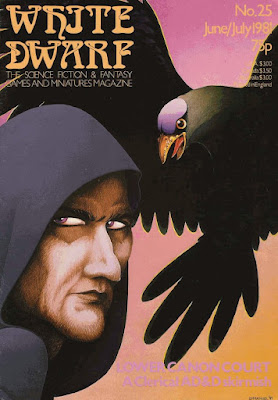
White Dwarf: Issue #25

Issue #25 of White Dwarf (June/July 1981) features a cover by Fiend Folio cover artist, Emmanuel. In addition, Emmanuel provides all of the issue's interior art, except for graphical elements and headers that first appeared in previous issues. Having a single artist handle all the artwork of a single periodical issue is quite unusual in my experience, which is why it's all the more striking in this instance. Mind you, compared to, say, Dragon of the same era, White Dwarf had a lot less artwork per issue. Still, I couldn't help but take note of it. Also worthy of note is that this issue marks the fifth anniversary of White Dwarf's publication.

Part III of Lewis Pulsipher's "An Introduction to Dungeons & Dragons" focuses on playing "the spell-using classes," as he calls them – but not all of them. Druids, for example, are specifically excluded as being very different from magic-users or clerics. Illusionists are not discussed either, but I am assume that's because this article is geared more toward original Dungeons & Dragons rather than AD&D and illusionists do not appear in any OD&D rulebooks or supplements, having debuted in The Strategic Review. In any case, Pulsipher's advice on playing these two classes is fairly straightforward and sensible. He emphasizes their distinct roles and the spells and abilities they possess that best support those roles. There's not much new here to longtime players of D&D and much of what he says has passed into widely accepted conventional wisdom. However, he does make one point worthy of mention, namely that clerics are, in fact, potent warriors in their own right and ought to be played as such rather than as magic-users with a less spectacular selection of spells. To that end, he counsels that "rough 20% of a party" should be clerics, as their hybrid nature makes them very valuable to any dungeon expedition.

Trevor Graver's "The Self-Made Traveller" is a set of optional skill acquisition rules for Traveller. The purpose behind the rules is to eliminate the randomness of Traveller character generation by giving players points to spend on selecting skills of their choice for their characters. I can't say I see much appeal in this, as Traveller's random character generation system is one of its strongest – and most fun – elements, but I have no doubt there are those who disagree. "Open Box" reviews Space Opera (8 out of 10), Plunder and RuneMasters for RuneQuest (5 out 10 and 9 out of 10 respectively), and Double Adventure 2 for Traveller. Of these reviews, I think the one for Space Opera is the most fascinating, as it's written by Andy Slack. Slack praises the game as "complicated" but nevertheless full of "rewarding and entertaining" detail that some might find more enjoyable than other SF RPG offerings.

"The Dungeon Architect" by Roger Musson is one of the more celebrated series of articles from the early days of White Dwarf. Part I, entitled "The Dungeon Interesting" kicks it off with an overview of the concept of dungeons, followed by thoughts on why a dungeon might exist, what manner of beings might exist within its labyrinths, and who or what might dwell nearby on the surface world. In and of themselves, these questions are not particularly interesting and most referees have probably given them some thought before creating their own dungeons. What makes this article valuable, though, is the way that Musson presents each question and then methodically lays out a series of possible answers to each one, along with ideas to spark the reader's creativity. It's an excellent kick-off to a series that will continue in the issues to come.

"Lower Canon Court" by Tony Chamberlain and Paul Skidmore is an odd little mini-game to be used with AD&D. It's intended to represent a clerical court for the trying of those who've gone against the dictates of their alignment and/or religious beliefs, but it's presented as a skirmish complete with a map, two dozen NPCs, and crypts filled with undead beneath the court. At first, I thought this was intended as a kind of trial-by-combat affair, but that doesn't seem to be the case at all. Instead, players are given control of the various NPCs, each of whom has notes about how he views the court and will judge potential defendants. There's a chance the undead might escape the crypts and disrupt the judicial proceedings, but that's an extra feature of the situation rather than its purpose. I suppose this might fun as a one-off scenario.

"Treasure Chest" presents four new miscellaneous magic items and some quick rules on character handedness. The byline of Roger E. Moore once again figures prominently in this section, as it has in several recent issues. "Blowout!" by Andy Slack is a set of expanded rules for vacuum suits in Traveller and is quite well done. I'd recommend making use of it, if your campaign features the regular use of vacc suits and you'd benefit from the added detail. "The Fiend Factory" presents a series of five "themed" monsters, all of which can be found in The Black Manse, the cursed dwelling of a benevolent baron whose son is not so well-intentioned. This is a good structure for presenting new D&D monsters and I think it sets this installment of "The Fiend Factory" apart from most other collections of new monsters.

"The Ship's Library" by Bob McWilliams discusses books, both fiction and non-fiction, that every Traveller referee ought to read to help in setting up a campaign. "What Makes a Good AD&D Character Class" by Lewis Pulsipher concludes the issue with his thoughts on the subject at hand. Most of those thoughts are common sense, such as "don't make the class too powerful," but what is commonsensical now might not have been so in 1981. Consequently, I doubt many reading it today would derive much benefit from it.

Issue #25 is a very good one, filled with numerous interesting articles. These articles also seem to be getting longer, which I appreciate, but this comes at a cost. Since the magazine's page count hasn't increased noticeably, the size of the text is getting smaller. That probably would have been fine when I was a teenager, but nowadays, I find it vexing. Oh, to be young again!

Tuesday, May 18, 2021

Different Worlds: Issue #15

Issue #15 of Different Worlds (October 1981) features a cover by Rick Becker, who had previously done the covers for issues #6 and #10, as well as The Gateway Bestiary. Paul Montgomery Crabaugh's "More Citizens" kicks things off by presenting six new professions for use with GDW's Traveller: cavalry, artillery, technician, engineer, reporter, and civilian, along with three new skills. In my youth, when I was playing Traveller regularly, I used to adore articles like this, so reading this one was a nice blast of nostalgia for me.

"Tournament Role-Playing" by Ken Rolston is a lengthy, 10-page piece that covers a great many topics relating to the refereeing a adventure scenarios at gaming conventions. The topics range from styles of play to the creation of characters to judging players. He provides a lengthy example of a RuneQuest scenario he has designed that nicely demonstrates the principles he puts forward. Of particular interest to me was his assertion that one's "best bet" is "basing your tournament scenarios in the campaign you are currently running." As someone who's long felt that too many game writers aren't even playing the games for which they are writing, I couldn't agree more.

"Calandra and Aurelion" by Charles Huber is a Gloranthan cult for use with RuneQuest. Even though I don't play RQ regularly, I nevertheless enjoy these cult write-ups. Religion is a topic that's near and dear to me; I find its treatment in most fiction (including RPGs) to be laughably simplistic. RuneQuest makes a much better effort to take religion seriously and many of these cult articles demonstrate that quite well. David F. Nalle's "Favorites of the Gods" is another article treating religion, specifically the ability of characters to gain the favor of deities through sacrifices and quests. Nalle's treatment is simple and mechanical in its approach, but I nevertheless appreciate his attempt to grapple with the topic of divine intervention.

"A Modest Proposal for The Fantasy Trip" by David R. Dunham is a short article suggesting the splitting of the game's attribute scores into related pairs to deal with both the over-importance of certain attributes and the "unrealistic" nature of combing, say, one's physical strength and endurance into one score. This is a long-standing complaint about not just TFT but also its descendant GURPS. "Man Bites Dog" is Ken St. Andre's rather peculiar article that's ostensibly about "role-playing in the future." Instead of a prognostication of how the then-new technology of computers might change the face of the hobby, St. Andre instead offers a half-serious, half-parodic account of what roleplaying might be like in a post-apocalyptic world when only the aged remember "the good old days back in the 1980s." 

Lewis Pulsipher's "Making Life Hard for Magic-Users" is another entry in the ancient genre of "cutting magic-users down to size," the belief that magic-users in Dungeons & Dragons are too powerful compared to other character classes. To correct this supposed imbalance, Pulsipher offers numerous possible fixes, such as spell points, spell failure, spell interruption, and more. I appreciate the range of options he suggests, even if I've never been of the opinion that magic-users needed fixing to make them less potent and flexible.

This issue's reviews are lengthy and mostly critical of the products reviewed, starting with SPI's Universe. Actually, the review of Universe is quite measured and fair. The review of Aftermath is similarly fair, but notes that the complexity of the rules militates against wading through its rules to get to the genuinely good material in the game. The poor Fiend Folio gets the most abuse, such as the following passage that mocks the monsters contained therein.

Harsh but not wholly incorrect.

Gigi D'Arn's column is shorter, owing to the fact that it's now monthly, a fact Gigi draws attention to at the start of her piece. Nevertheless, there are a few notable tidbits, such as further rumors about the insolvency of SPI and that Chaosium is working on a King Arthur RPG (though it's rumored that Ken St. Andre is working on it with Greg Stafford). Gigi also says the following, which I found amusing.
Ouch! Equally amusing, I think, is that not everyone who read Different Worlds liked Gigi's column, as this letter to the editor makes clear.
I guess there's no accounting for taste.

Friday, April 16, 2021

Random Roll: DMG, p. 59

The ability of several demihuman races to see in the dark is firmly established in Dungeons & Dragons. My first encounter with the game was through the Holmes-edited Basic Set and its rulebook calls this ability "infravision" without any explanation. The AD&D Dungeon Masters Guide, though, goes to some length explaining the nature of infravision.

As explained in PLAYERS HANDBOOK, infravision is the ability to see light waves in the infrared spectrum.

To say that I have disliked this definition for decades is an understatement. While I am on record as not being opposed in principle to the mixing of science fiction and fantasy, Gygax's explanation of infravision leans a little too heavily, in my opinion, on real world science, with infelicitous consequences, as we shall see.

Gygax elaborates with the following:

Characters and various creatures with infravisual capability out to 60' (standard) are basically picking up radiation from their surroundings. Therefore, they note differences in thermal radiation, hot or cold. They do not "see" things which are the same temperature as their surroundings. Thus, a room in a dungeon might look completely blank, as walls, floor, ceiling, and possibly even some wooden furniture are all of the same temperature. Openings in the walls should show up rather plainly, as space anywhere else will, and if you are generous, you can allow different substances to radiate differently even if at the same temperature, i.e. the wood in the example above would be discernible if care was used in scanning the room infravisually.

Leaving aside the not insignificant matter of what this does to the "magic" of D&D, the conception of infravision Gygax advances here seems intended to limit its utility. If an elf's ability to see in the dark is akin to 1970s era IR goggles, it's a rather narrow ability, almost to the point of uselessness. I imagine that's the point, though. He continues:

Except where very warm or very cold objects are concerned, vision of this sort is roughly equivalent to human norm on a dark or cloudy night at best. Note also that monsters of a very cold or very warm sort (such as a human) can be tracked infravisually by their footprints. Such tracking must occur within two rounds of their passing, or the temperature difference where they had trodden will dissipate. 

The ability to track via infravision is certainly handy, though, as one might expect, Gygax places limitations on it, which given his explanation of how the ability works, is not unrealistic. Of course, what he gives with one hand, he takes with the other.

Light sources which give off heat also absolutely prevent infravision from functioning within their sphere of illumination. (Explain this as the effect of trying to see into the dark when the observer is in a brightly lot area.) It requires not less than two segments to accustom the eyes to infravision after use of normal vision. 

Again, this makes sense, given his conception of infravision, but it's a potentially serious drawback when one notes that it takes two segments to shift between normal and infravision. A lot can happen during those 12 seconds of temporary blindness.

The section ends by noting that creatures with infravision with a range of 90' or more – the sort possessed by "most monsters inhabiting underground areas" – see much more clearly than those with standard infravision. 

Such creatures can easily distinguish floor, ceiling, wall, and other areas, as well as furnishings within the area.

Talk about stacking the deck in the monsters favor!

This whole section makes me unhappy, or at least disappointed. I much prefer granting certain creatures, like dwarves, elves, and many monsters, the magical ability to see in the dark without restriction. This is more or less what's implied in OD&D and the way I've always handled infravision (a term I now reject, owing to the scientific associations Gygax foists on it here). Chainmail, I believe, grants magic-users the power to see in the dark too and it's something I've long considered giving player characters of that class as a basic ability. 

My point, ultimately, is that I think this whole section reeks of an attempt by Gygax to rein in an ability he thought too useful. Since I neither share his likely concern nor like his reframing of infravision as thermal vision, there's not much here I would use. 

Tuesday, February 9, 2021

Different Worlds: Issue #1

Different Worlds premiered in February 1979 with Tadashi Ehara as its editor, a position he held for the entirety of the magazine's run. Ehara states, in his inaugural editorial, that Chaosium wanted to produce "a magazine to cover all aspects of role-playing, from Dungeons and Dragons to Bunnies and Burrows, from Traveller to En Garde! Even SPI's Commando." Thus, Different Worlds was intended to cover the entirety of the hobby rather than focusing on a specific game or even group of games. In this, Different Worlds was no different than Dragon, White Dwarf, or Imagine, though I have little doubt that its origins on the west coast of the United States colored its content in ways both subtle and obvious.

The issue kicks off with Charlie Krank's "Beginner's Brew," the subtitle of which is "What is all this stuff?" Krank then explains what an RPG is and what its various elements (referee, players, dice, etc.) are and how they all relate to one another. The article is basic, as one might expect, but what interests me most is that such an article was deemed necessary at all. Yes, it was written in early 1979, barely five years after the invention of the hobby, but how many readers of Different Worlds wouldn't know what a roleplaying game was? Of course, Imagine regularly included such articles, too; perhaps it was simply considered a requirement at the time, much like examples of play in RPG rulebooks.

Next up is the first part of Mike Gunderloy's D&D variant, "Specialty Mages." Specialty mages, as opposed to "True Mages," (i.e. OD&D magic-users) are somewhat more robust (d6 hit dice) and have a wider range of weapons (swords and spear) but have a narrower, more focused list of available spells. The first part focuses on the Mages of Earth, providing lists for spell levels 1–10 – yes, 10. This is not explained, simply presented as if it were a fact, which I suspect reflects early house rules of an additional level above 9. I myself remember encountering such things in the early '80s, which suggests it was a widespread notion. I'm curious to see what Gunderloy might do in the second part of the article.

"My Life and Role-Playing" is a collection of articles of varying lengths by notable game designers and writers of the period, in which they talk about their early experiences with the hobby – how they discovered it, what led to their creating a game of their own, etc. – and, in several cases, give us insight into their home campaigns. The range of writers is indeed vast, consisting of (among many others) Ken St. Andre, Marc Miller, Greg Costikyan, Dennis Sustare, Lee Gold, and Dave Hargrave. I could devote a post or more to each of these articles, since nearly all of them contain historical tidbits that were otherwise unknown to me. For example, Marc Miller not only mentions his unpublished fantasy RPG, Companions of the Road but also Frank Chadwick's If I Were King … (which might be an earlier version of Liege Lord). Equally interesting is reading about Dave Hargrave's disappointment with OD&D and how it fueled his desire to come up with his own design. It's terrific stuff and I'm so very glad I read it.

Ed Simbalist, one of the creators of Chivalry & Sorcery and Space Opera, presents "Archaeron," his home fantasy campaign setting, along with a hand drawn map of its main area. What's most appealing about the article is not so much its content, which, if I am honest, isn't all that remarkable, but Simbalist's own comments on why he designed the setting in the way he did. I adore articles of this sort and wish more game designers – or indeed just gamers – would do something like this. Greg Stafford provides "The Cult of Geo," a new cult for use with RuneQuest, the first bit of content in the issue specifically geared toward a Chaosium game. 

Steve Lortz's "What is a Role-Playing Game?" is an odd article, not quite in the same genre of Charlie Krank's earlier piece from the same issue. Rather than being a discussion of RPGs from the perspective of a neophyte, it is rather an examination "rule organization," with a focus on things like time, scale, and sequences, among related topics. He demonstrates his point of view more fully by outlining the rules structure of an imaginary game, Cannibals and Castaways, in which the player characters attempt to survive on a desert island inhabited by cannibals. There's even an example of play, followed by yet more analysis of RPG rules, this time with an eye on "move structure in RPGs," "move" here being a synonym for "action." As I said, it's an odd article and I must confess I found it tedious and generally uninteresting to me (but my disinterest in rules discussion is legendary). The issue concludes with an article by P.E.I. Bonewits and Larry Press to support Authentic Thaumaturgy

My overall impression of Different Worlds is immensely positive after only a single issue. Unlike Imagine, which seemed to take a while to find its footing, it's pretty clear that Different Worlds already has a good sense of what it's about. Since I only ever read a single issue of the magazine back in the day and one fairly late in its run – I can't recall the issue number but I will remember it when I get to re-reading it – this is all new to me. I anticipate that there will be many moments of discovery and pleasure along the way; I cannot wait to read more.

Friday, January 29, 2021

Random Roll: DMG, p. 40

This is the first post in what I intend to be an ongoing series. I've said on several occasions that the brilliance of Gary Gygax's Dungeon Masters Guide stems, at least in part, to its strange and often inexplicable mix of contents. Flip the book open to almost any page and odds are good your eyes will soon alight upon a sentence, paragraph, or whole section devoted to an intriguing topic or two. Furthermore, they often treat topics in a way that's found nowhere in the entirety of AD&D. For that reason, "Random Roll," as I'm calling this series, will consist of my simply opening my copy of the DMG to a random page and commenting on what I see there.

Today's post focuses on a section entitled "Spell Casting" found on page 40. In it, Gygax explains how spells work in AD&D and it's good reading, if only for the insight it gives into how one of D&D's creators saw the "mechanics" of spell casting. Gygax begins by noting that

All magic and cleric spells are similar in that the word sounds, when combined into whatever patterns are applicable, are charged with energy from the Positive or Negative Material Plane. When uttered, these sounds cause the release of this energy, which in turns triggers a set reaction. The release of the energy contained in these words is what causes the spell to be forgotten or the writing to disappear from the surface upon which it is written.
There's a lot packed into those three sentences, but the most important one, I think, is the last one, as it provides an explanation for why a memorized spell is forgotten upon casting. Almost as interesting is that Gygax suggests a connection between uttering "word sounds" with infusing a spell with positive or negative energy. In the Players Handbook, the components of spells are divided into verbal, somatic, and material components. If I'm understanding Gygax in this section, the verbal component is essential, something a quick scan of the spells in the PHB more or less confirms this. With the exception of only the 1st-level druid spell, invisibility to animals, all spells have a verbal component (which suggests to me that the druid spell listing may well be in error). 

Gygax elaborates on this in the next paragraph:

The triggering action draws power from some plane of existence of the multiverse. Whether the spell is an abjuration, conjuration, alteration, enchantment, or whatever, there is a flow of energy – first from the spell caster, then from some plane to the area magicked or enspelled by the caster. The energy flow is not from the caster per se, it is from the utterance of the sounds, each of which is charged with energy which is loosed when proper formula and/or ritual is completed with their utterance.

The emphasis on the importance of speaking words is fascinating and comports with the fact that the spell silence 15' radius and similar effects are effective attacks against spell casters. Gygax makes an analogy to explain the way spells function.

It is much like plugging in a heater; the electrical outlet does not hold all of the electrical energy to cause the heater to function, but the wires leading from it, ultimately to the power station, bring the electricity to the desired location.

From there, Gygax explains the purpose of somatic and material components.

the hand movements are required in order to control and specify the direction, target, area, etc. of the spell effects. When spell energy is released, it usually flows to the Prime Material from the Positive or Negative Material Plane. To replace it, something must flow back in reverse. The dissolution and destruction of material components provides the energy that balances the flow, through the principle of similarity.

Agree of disagree with the specific details of Gygax's explanation, I nevertheless find it admirable that he made clear the logic behind the AD&D spell system. He adds that

(For background reading you can direct your campaign participants to Vance's THE EYES OF THE OVERWORLD and THE DYING EARTH as well as to Bellair's [sic] THE FACE IN THE FROST.)

If ever proof were needed of the importance of the books listed in Appendix N, here's a good example. Once again, we see that Gygax drew heavily from the books in that list, using them not just as airy inspiration for his own conceptions but, in many cases, as in this one, as the very foundations on which he built the edifice of Advanced Dungeons & Dragons. It's good to be reminded of this from time to time, since it's fashionable in some quarters to downplay the significance of Gygax's appendix of inspirational and educational reading. Doing so would, I continue to contend, make it harder to understand how some aspects of the game setting function, as this section of the Dungeon Masters Guide illustrates.

Tuesday, August 25, 2020

REVIEW: Folk Magic of the Haven Lands

Since 2017, Monkeyblood Design has been detailing the Midderlands, "a twisted version of central England" as viewed "through grime-smeared spectacles." Though ostensibly written for use with Swords & Wizardry, all Midderlands products are easily adapted to your favorite OSR rules system. The latest release for the Midderlands is no different. 

Folk Magic of the Haven Isles (available in hardcover, softcover, and PDF) is a concise 60-page volume offering a collection of new options for magic-users, inspired by the folklore of the actual British Isles (called the Haven Isles in the Midderlands setting). Written by Richard Marpole and with full color illustrations by Glynn Seal, Folk Magic is delightful, filled with not only intriguing takes on magic but the same quirky charm found in all the Midderlands books – a twisted (semi)historical fantasy with bits of absurd, Pythonesque humor.

More importantly, this is a book suffused with a refreshing specificity. Nearly everything in Folk Magic is inspired by real world myths and legends while still being accessible to those unfamiliar with them. In this way, the book avoids being generic and deracinated like so much fantasy these days. There's a groundedness to it all that, for me anyway, is a huge part of its appeal.

The meat of Folk Magic is the eleven new magical sub-classes it introduces. Each one is tied to the traditions of the Haven Isles, providing unique abilities and drawbacks, including spell options and casting styles. Fortunately, each sub-class generally takes up only one or two pages of text, ensuring that any new rules associated with them are straightforward and simple to employ. In most cases, the descriptions focus as much on flavor as on rules, which I think offers a great model to referees looking for ways to customize the magic-users of their own settings. 

The new sub-classes are:

  • Appel Queen or King: Supernaturally inspired brewers (an option for beer making is provided)
  • Bog Chanter: Knowers of the secrets of bogs and marshes.
  • Braag: Magical tricksters who can change into donkeys
  • Demon Slaves: Sorcerers who have aligned themselves with devilry in exchange for great power
  • Faerie Bride or Bridegroom: Individuals who spent time in the realm of the Faeries
  • Green Child: Children raised in the subterranean Middergloom and make their way to the surface
  • Hermetic Magician: Learned scholars of the occult
  • Masked Dancer: Magicians who draw power from the masks and costumes they don
  • Peller: Cunning-folk steeped in the lore of their rural homes
  • Sin Eater: Religious folk who acquire magical abilities by atoning for the sins of magicians
  • Spae Wife: Prophets and weather diviners
  • Stitch Witch: Magicians who demonstrate their powers through magical attire
  • Toadman: Poisoners, gamblers, and con men with batrachian powers
  • Wizard of the Cage: Sorcerers who tend to the sleeping knights fated to help the Haven Isles in its hour of greatest need
As you can see, there is a great deal of variety in the sub-classes. The one thing that unites them is their connection to the folklore of the Midderlands setting. For example, the Braag is more common among the playable goblin race and is reflective of their ways, while the Green Child maintains a connection to the weird green radiation that manifests in physical deformities that can be passed on to others. In every case, there are small tweaks or additions to the basic magic-user class, such as the demon slave's demonic familiar or the spae wife's divinations, that set them apart. It's all so simple and yet evocative, demonstrating that you don't need to deviate too much from the core classes of the D&D tradition in order to create a PC or NPC who is genuinely distinctive.

Folk Magic of the Haven Isles also includes new backgrounds (non-mechanical bits of inspiration), magical tomes (spellbooks with histories of their own), new spells (some limited to specific sub-classes), and oddities, like the mandrake and robin jade-breast. Taken together, it's a neat little package of ideas to inspire referees and players alike, whether they're using the Midderlands setting or not. If nothing else, I hope that we'll see more books like this, not just from Monkeyblood Design, but from other publishers too: charming and idiosyncratic takes on the well worn elements of old school fantasy. There's a surprising amount of life left in these hoary standards. Folk Magic of the Haven Isles brilliantly demonstrates shows this to be the case; others should take note and emulate it.