Showing posts with label bledsaw. Show all posts

Friday, March 6, 2026

Interview: Rudy Kraft (Part II)

4. Were you ever formally an employee of Chaosium or were you simply a freelance writer and designer for the company?

I was never an employee of Chaosium. All the work I did for them was as a freelance writer and designer. I was, for four months, an employee of Judges Guild. I was never an employee of any other game company although I was flown to Las Vegas to interview with Coleco for a job as a game designer in Connecticut. I was recommended for this job by Jennell Jaquays, with whom I had worked on several projects. I ended up turning the job down because at that time, Coleco only had a handheld gaming device with which I was not impressed. To be fair, I have never used a handheld gaming device or controller other than for the original Pong. All my electronic gaming has been on computers, so my judgment in this area might have been flawed.

Also, the pay being offered by Coleco was not significantly above what I was making as a combination freelance game designer, book seller, and legal secretary for my mother. And after spending four winters in Ithaca, New York and one winter in Decatur, Illinois, I preferred to live in the Bay Area to avoid snow. Other than my four months with Judges Guild, I was never a formal employee of a game company. Even my work as editor of Gryphon was done as a freelancer where I got paid a certain amount of money for gathering the articles and editing them for each issue of the magazine.  

5. You also wrote a number of products published by Judges Guild. How did that come about and what do you recall about it?

My involvement with Judges Guild came about when Greg decided to exclude the Broken Tree content from Snake Pipe Hollow.  As best I can tell, he did so for reasons of space not quality. Greg told me that they had signed an agreement with Judges Guild to produce licensed RuneQuest products. He suggested that I expand the material and submit it to them. I did so. I do not have any detailed memories of my work on that project, but it did lead to a job offer. Unlike the job offer from Coleco, which occurred several years later, I accepted this job offer and moved to Decatur, Illinois in January 1980. I remained there for 4 months during which time I designed and worked on several projects for the Judges Guild.  

I attended the Origins game conventions in Philadelphia in June of 1979 and again in 1980. I wanted to make contacts and look for work in the gaming industry. The job with Judges Guild partially arose out of the 1979 trip. My work on Frontiers of Alusia with SPI arose out of the 1980 trip.

I remember many things about my involvement with Judges Guild quite clearly and some not at all.  While I was Judges Guild, I injured my back moving heavy boxes. Prior to that time, I had no problems with my back. Since that time, I have had intermittent chronic back pain which requires precautions to avoid ongoing pain. I think it’s likely I would have eventually had back problems anyway, but I didn’t need it to trigger at age 22.  

I left Judges Guild because the owner, Bob Bledsaw, became concerned because there was a burglary in a building somewhat near the Judges Guild offices. He decided to address the burglary by buying a gun and leaving it in the office so whoever was there could protect themselves. This probably seemed like a perfectly sensible plan from the perspective of someone living in downstate Illinois, but it seemed crazy to me as a 22-year-old from Palo Alto, California. As a result, I left the Judges Guild and went home.

However, this was not a hostile breakup. I continued to produce projects for Judges Guild for several years thereafter. I began to represent Judges Guild at San Francisco Bay area game conventions by running a booth in the dealer hall. I don’t remember the specific financial arrangements, but it was financially profitable, albeit not greatly so, for both Judges Guild and myself.  

The RPGGeek website shows that I had been involved in 26 projects as a designer. Some of them are duplicate entries or things where I only contributed a short element. However, 10 of them were separate Judges Guild products. 

My contributions to the Book of Treasure Maps II, Book of Treasure Maps III, Legendary Duck Tower, Duck Pond, and Portals of Torsh were done as a Judges Guild employee. Treasure Maps II involved me completing work that someone else had already started. I started Treasure Maps III but Edward Mortimer completed it after I left. Legendary Duck Tower had been started by Jaquays while she was a Judges Guild employee. I finished it while I was working there. Its title was a pun on her Dark Tower D&D adventure. Obviously, Duck Pond took the punning title sequence one step further.

The other five products were items that I designed freelance after I left Judges Guild. Wondrous Relics was inspired by my RuneQuest product, Plunder. I thought it would be fun to make a bunch of new magic items for Dungeons & Dragons. I should pull out a copy and see if there is anything worth using in my current campaign.

The three portal products were designed to create an interconnected series of worlds where each product would provide a background for a world which Dungeon Masters could add to their campaign, if they wanted to have multi-planet campaign.  

I don’t remember much about design process of each of these items except that in September of 1980, I bought an Apple 2+ computer. From that point on I was typing my work, and my mother’s legal work, on that computer. At the time, there wasn’t any standardized word processing program, so I still submitted everything on paper, and it had to be retyped by the game publisher. I don’t remember the specific word processing program I used, but it was nowhere near as user friendly as the current ones.  So, for example, if I accidentally deleted something, there was no control Z to bring it right back. I had to retype it. Thus, there were number of occasions where work was lost because of accidental deletions or a failure to save combined with a computer crash, which also occurred much more often than it does now. In addition, there was no internal hard drive, so everything had to be saved onto a separate floppy disk.

I stopped representing Judges Guild at Bay area conventions in 1983 or 1984 after I got a part-time job at a local bookstore which became a full-time job that lasted until 1985 when I left to go to law school. 

Monday, August 22, 2022

"Ya Don't Tug on Superman's Cape"

As I'm sure readers of this blog already know, "From the Sorcerer's Scroll" was the name of Gary Gygax's regular column in the pages of Dragon. It was here that he would share previews of upcoming AD&D rules additions and changes, as well as offer his opinions on various topics of the day. Those opinions were often controversial, particularly when they pertained to the "right" way to play Dungeons & Dragons and generated a lot of pushback in the letters pages to Dragon. In retrospect, I wonder if that wasn't part of their point.

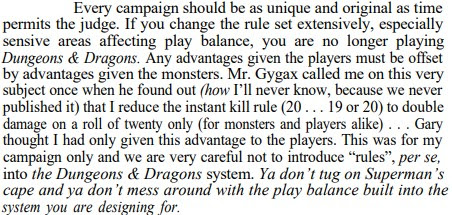
The column that appeared in issue #27 (July 1979) is quite unusual, because Gygax turns it over Bob Bledsaw of Judges Guild. Bledsaw uses the space to offer up a "personal opinion," entitled "What Judges Guild Has Done for Dungeons & Dragons." It's a fairly interesting read in its own right, but there's a short section toward the end of the piece that I want to highlight in this post.

I find it remarkable that, while Bledsaw praises uniqueness and originality in one's own campaign, he also suggests that rules changes, especially those relating to "play balance," run the risk of changing the game so much that one is no longer playing D&D. This is the position Gary Gygax himself advanced in many of his "From the Sorcerer's Scroll" columns and elsewhere. Agree or disagree, there's a logic to it and I suspect that Bledsaw, whose company produced official D&D (and, later, AD&D) materials under license from TSR, knew that this was a line he had no choice but to toe.

After that, Bledsaw then gives an example of when Gygax corrected him regarding rules changes he was using in his own campaign. This concerned the "instant kill rule (20 … 19 or 20)." What's he talking about here? No edition of D&D with which I am familiar has an instant kill rule, let alone the one he seems to describe. On the other hand, Empire of the Petal Throne does and the rule Bledsaw mentions seems almost identical to it. Is this the rule Bledsaw meant? Had he imported the EPT rule into his home campaign? If so, why did Gygax care? I understand that Gary strongly disapproved of critical hits, which is fair. However, if Bledsaw was using them in his home campaign, what difference did it make? So long as he wans't importing them into Judges Guild D&D products – and he says he was not – I don't see why Gygax should "call [him] on this very subject."

Have I misread what Bledsaw is saying? 

Wednesday, August 31, 2011

Retrospective: Wilderlands of High Fantasy

I think it's fair to say that two of the lasting effects of the old school renaissance are the popularization of the term "sandbox" to refer to an open-ended campaign setting and the holding up of Judges Guild's The Wilderlands of High Fantasy as the premier example of a sandbox setting. The term "sandbox" is one I'd never heard, let alone used, in a tabletop RPG context until a few years ago, being, ironically, borrowed from the world of video games. And, while I knew of The Wilderlands of High Fantasy and even used it (briefly) back in the day, I never held it up as a model I wanted other campaign settings to emulate. How things change!

Originally released in 1977, The Wilderlands of High Fantasy is one of oldest published settings for use with Dungeons & Dragons. Nowadays, the release of a new campaign setting is often met with disinterest and even eye rolls, in part, I suspect, because campaign settings have become a very common product in the years since this was released. In 1977, though, this wasn't the case and one sometimes gets the impression that there was some skepticism among even their creators that gamers would have any interest in such a thing. Consider, for example, that the credits to The Wilderlands includes the following disclaimer:
All within are merely inspiration for the active and pontifical judges of the guild. Please alter, illuminate, expand, modify, extrapolate, interpolate, shrink, and further manipulate all contained to suit the tenor of your campaign.
I really like that quote and it nicely highlights one of the continually fascinating things about the Wilderlands setting: it's very flexible, even protean. Every time I have ever encountered or heard of a referee using it for their home campaign, I've been struck by just how different his home campaign is, not only from the "official" Wilderlands as published by Judges Guild but also from every other Wilderlands campaign run by other referees.

A big part of why this is the case is that The Wilderlands of High Fantasy, despite focusing on five of the sixteen regions of the overall Wilderlands setting, nevertheless devotes a lot of its 32 pages to collections of random tables and new rules. Thus, there are tables for ruins, caves, and lairs, in addition to rules for hirelings, prospecting, and income, among other topics. These tables and rules are clearly designed to facilitate campaigns where the characters wander about the world, exploring it hex by 1056-foot hex, in search of fame and fortune according to their own lights rather than any overarching plan concocted by the referee beforehand.

Another big part of why Wilderlands campaigns differ so much from one another is the sketchy nature of the setting information The Wilderlands of High Fantasy presents. A typical settlement is given a name, a population, a racial "type," general alignment, the name and characteristics of its ruler, and its primary resource. Hexes containing features of interest get a single line of description, such as "The crystallized skeleton of a dragon turtle is buried on the sandy beach. The skull houses a giant leech." There are no game stats or explanation here, just a very basic idea for the referee to read and, it is hoped, to be inspired by.

As a younger person, the Wilderlands didn't thrill me much and the presentation of the setting in products like The Wilderlands of High Fantasy was the main reason why. From my youthful perspective, I felt that authors Bob Bledsaw and Bill Owen hadn't done "enough work" for me. Sure there were maps, including player's maps that didn't have complete information about settlements and geographic features, but what I really wanted was a lengthy historical overview of the setting and more detailed information about its peoples and locales. The Wilderlands of High Fantasy gave me none of that, instead expecting that I'd fill in those blanks myself, using the vague details, random tables, and new rules as raw materials from which to craft my own setting. After all, that's what being a referee is all about, isn't it?

Monday, April 19, 2010

Two Years Gone


Robert E. Bledsaw (May 18, 1942 - April 19, 2008)

Wednesday, March 25, 2009

Retrospective: City State of the Invincible Overlord

When one thinks of the greatest city in the history of pulp fantasy, one immediately thinks of the City of the Black Toga, Lankhmar. And when one thinks of the greatest city in the history of fantasy roleplaying, one immediately thinks of Judges Guild's City State of the Invincible Overlord. First published in 1977, CSIO made a huge splash at the time of its release and it remains, in my opinion, the gold standard for urban sourcebooks over 30 years later.

One reason for that was its huge 34" x 44" map (in four sections), detailing over 300 individual locations, along the NPCs who inhabited them. This opened urban adventuring to sandbox-style play with great ease. Players could send their characters to wander aimlessly through the City State, checking out its various shops and sights without the referee having to worry about the daunting task of creating it all himself. Of course, in typical Judges Guild fashion, these details were sparse and open-ended. This let each referee tailor the City State to his own campaign, making this product very much a "playing aid," just as it bills itself.

CSIO really was a very flexible and easy to use product. I have filed off the serial numbers and re-tooled it for use in many campaigns, most memorably my Greyhawk campaign of old, where it stood in for the City of Greyhawk itself (there being no official alternative at the time). The City State is also the basis for Adamas in my current Dwimmermount campaign. Oddly, I've never actually used it in a genuine Wilderlands campaign. My few Wilderlands campaigns were all set far away from the City State, which makes me a bit unusual, I suspect.

I don't think it's an understatement to say that Judges Guild played a bigger part in establishing most of what I consider the essential elements of old school play than any company outside of TSR. Beyond that I'd say that JG did even more than TSR when it came to developing certain elements, most notably wilderness/sandbox and urban play. CSIO shaped many people's perceptions of what a D&D city ought to be and, as I said, I've yet to see a more immediately useful urban environment for gaming than this one. Like the Wilderlands of which it's a part, the City State is a terrific pulp fantasy goulash that borrows gleefully from many sources of inspiration, creating a city that's not only a great place to adventure in its own right but one that feels as like a D&D city should -- boisterous, somewhat incoherent, but brimming with possibilities.

You can still find copies of this great game aid on eBay and from used game sellers, but they're often very pricey. Necromancer Games produced a 3e version of it several years ago and, like all their JG stuff, it's excellent. It really is a pity that they're not continuing to produce new Wilderlands material, but that leaves an opening for guys like James Mishler, so I can't really complain. In any event, City State of the Invincible Overlord remains one of my favorite RPG products of all time and, in terms of its influence, it certainly ranks highly indeed.

Thursday, January 8, 2009

Retrospective: Tegel Manor

Tegel Manor vexes me.

First published in 1977 and revised in 1980 (and expanded in 1989) by Judges Guild, Tegel Manor is without a doubt one of Bob Bledsaw's masterpieces. Describing a sprawling 240-room haunted castle, the module is a textbook example of a funhouse dungeon, utterly lacking in anything resembling an ecology and filled with many encounters for which the adjective "whimsical" is charitable at best. The contents and/or inhabitants of each room are random -- in some cases literally -- meaning that, here you might find nothing more threatening than some giant beetles but next door you might find a Type III demon polymorphed as a kindly old beggar.

Now, I've come clean on the fact that I'm not a huge fan of funhouse dungeons, with a few exceptions. At the same time, I recognize their importance in the history of D&D and see them as an important antidote to post-Hickman tendency to treat adventure modules primarily as a vehicle for "story." But, even within that context, Tegel Manor irks me. I'm not entirely sure how to take it. Is it intended as a joke, a Castle Greyhawk before its time? With its random encounter charts containing 100 members of the cursed and unfortunately named Rump family (all of whose names start with the letter R) and its goofy encounters ("Four Zombies ... bowing to a Giant White Rat ... in a pink cape and red plumed hat"), it certainly seems that way. It's one thing to sidestep naturalism, but Tegel Manor goes above and beyond the call of duty when it comes to "gonzo."

But the map is a think of beauty. Nothing -- and I mean nothing -- has ever beaten it. You can see a bit of it in the image above, but it doesn't do justice to the thing. It's filled with winding passages, secret doors, mazes, empty rooms, weird features, and more. Best of it, the map is completely legible and usable in play, despite its complexity. I think the quality of Judges Guild's maps is often overlooked. Compared to what others produced at the time, JG's output is often unparalleled. Bill Owen, in his reminsicences about the Guild, commented on the difficulties Bob Bledsaw encountered in fnding printers capable of producing maps of the quality he wanted to include in his modules and I can believe it. Even now, with so many advances in technology, very few gaming maps are as multifaceted yet usable as Judges Guild's best work. It's really a testament to the company that they did so much first and best.

Tegel Manor isn't a module I'd ever run as written. There's too much about it that rankles me and, if it rankles me, you can be sure that it'd get even less warm a reception by today's gamers. Yet, despite that, there's something very compelling about it. Perhaps it is because it's so different from my own tastes that it elicits a frisson in me whenever I read it. Perhaps I can't shake the feeling that I've yet to reach the zen state where, suddenly, the whole thing will make sense to me. Or perhaps it's simply that the maps are so damned cool. Whatever it is, I find it hard to dismiss Tegel Manor outright, even though I want to. It's simply not the kind of module I'd ever run, let alone write, but that may be the point. One of the joys of my exploration into the history of the hobby is encountering stuff that is so different from my own preferences. Even when I don't change my mind, I still come away enriched by the encounter.

Thursday, November 20, 2008

REVIEW: Judges Guild's Bob & Bill: A Cautionary Tale

Bill Owen was the co-founder of the legendary Judges Guild, along with the late Bob Bledsaw. Together, the two friends blazed a trail in the RPG industry that still shines brightly over thirty years later. Judges Guild was the first third party company ever licensed by TSR to produce support products for Dungeons & Dragons, which it did from 1976 to 1982. During that time, JG published over 200 different products, many of which are rightly regarded even today as the best ever written. Mr Owen has now written a 36-page "memoir" of his time with Judges Guild and of his friendship with Bob Bledsaw. Available directly from him, this little book is a treasure trove of information for those interested in the history of the hobby, particularly its wild and wooly early days.

Mr Owen's reminsicences begin in 1965, when he first played the Avalon Hill wargame Afrika Korps with his older brother and embarked on a lifelong love of such games. His story is probably not too different from that of many kids growing up in the late 60s, who would eventually go on to become the core of the hobby. These are the original grognards, the guys who earned the right to that noble moniker far more than I. I was never a wargamer myself, but I knew many of them as a younger person. Nevertheless, there's a huge gap in my knowledge of the prehistory of RPGs and Mr Owen's stories go some way toward filling it in. That's not say that the information presented here is exhaustive, because it occupies only a few pages of a fairly short work. Still, what impressed me was the way that Mr Owen provided context to the environment out of which OD&D would grow.

Of course, it's the information about the early days of D&D and Mr Owen's involvement with Judges Guild from 1976-1978 that is the main attraction here; he doesn't disappoint. I could probably list dozens of marvelous anecdotes Mr Owen relates about the foundation of the Guild, his interactions with fans, and more, but I doubt I'd do them justice. They simply must be read in his own conversational style to be apreciated. Two of the things that quickly come through the text are Mr Owen's love of gaming and his abiding affection for Bob Bledsaw. It's these twin sentiments that make this more than a simple memoir and something to be savored. I found myself going back and rereading many sections after the fact, such as his recollections of GenCon 1977 -- held at the Playboy Club in Lake Geneva, if you can believe. This isn't an academic tome; it's not a collection of names and dates nor is there a great deal of analysis (there is some). That might not be to everyone's liking, but I found it endearing and one of the primary attractions of this book. It's often too easy to forget that gaming is a social activity enjoyed by friends, a mistake Mr Owen's memoir doesn't make.

You will note that the book has a subtitle -- "A Cautionary Tale." That's because Mr Owen makes digressions throughout in which he discusses the ups and downs of running a small business generally and a gaming business in particular. He offers a number of insights and bits of useful advice that'll be of immediate interest to anyone who's ever considered taking the plunge and entering the games biz. More than that, though, his digressions shed light on the profoundly amateur nature of the hobby in the early days, something more than a few of us in the old school community have commented upon. The do-it-yourself nature of the early days wasn't limited to the gaming table; the early industryhad a similar character.

What really makes this book something special, though, are the old photographs. It's richly illustrated, with multiple color and black and white photographs on every page. I absolutely adore this kind of thing and found myself mesmerized by photos of the original hand-drawn map of Tegel Manor and similar artifacts. If you possess a sensitive stomach, some of the 1970s fashions found in these pictures might be arresting. Even so, it's hard not to wax enthusiastically for those bygone days when the hobby was born. It was an amazing time and, while I am still old enough to remember much of what Mr Owen recounts in this book, I often nevertheless found myself wishing I was older and had entered the hobby sooner.

If Judges Guild's Bob & Bill has a flaw, it's that it's too short and that some of its few pages are taken up by events after Mr Owen left Judges Guild in 1978. Granted, the post-JG information is useful in providing additional context and in fleshing out the continuing friendship between the author and Bob Bledsaw. Still, I would have liked a lengthier treatment of the Judges Guild years. Perhaps it's something Mr Owen could take up in the future; I have a feeling he has a lot of great information to share with us.

Final Score: 4 out of 5 polearms

Sunday, November 2, 2008

Feast of All Souls


Animabus, quaesumus, Domine, famulorum famularumque tuarum oratio proficiat supplicantium: ut eas et a peccatis omnibus exuas, et tuae redemptionis facias esse participes: Qui vivas et regnas.