Being a big fan of the humorous illustrations of Wil McLean, I thought I'd share this fun little comic from issue #20 of Dragon (November 1978).


Being a big fan of the humorous illustrations of Wil McLean, I thought I'd share this fun little comic from issue #20 of Dragon (November 1978).
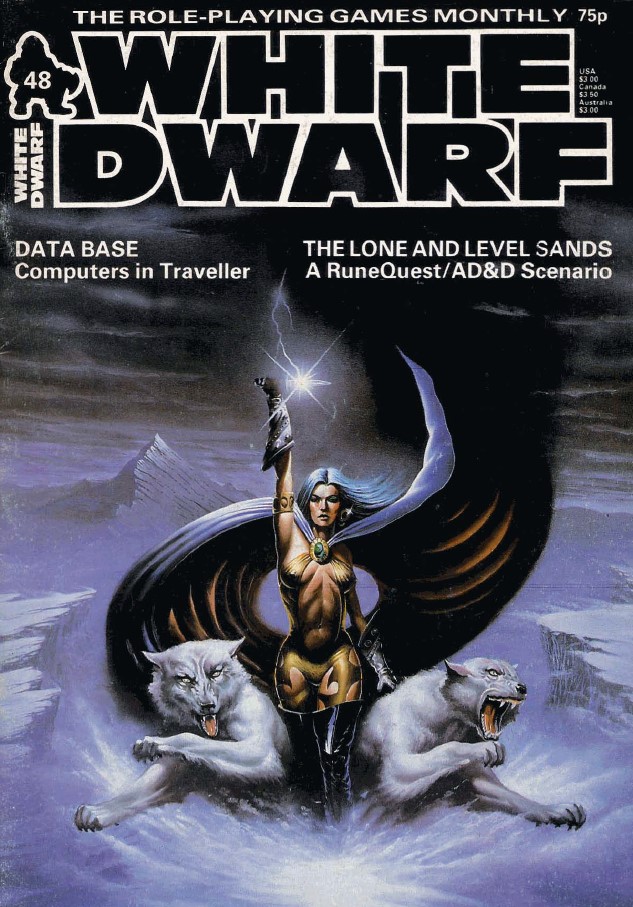
Dave Langford's "Critical Mass" brief tackles a number of different books this month, including novels by Robert Silverberg, Tanith Lee, and Brian Aldiss. One of the things I always liked about Langford's reviews was the coolness of his praise, while his criticisms frequently ran very hot indeed. Nowadays, I find his reviews a bit more mean-spirited than I did in my youth, but that probably says more about my middle-aged softness than it does about Langford, many of whose reviews are still fun to read.
"By the Gods!" is a short article by Lewis Pulsipher – did he write something for every issue of White Dwarf? – in which he touches on the questions of the extent to which the gods might involve themselves in the outcome of mortal battles. Pulsipher marshals several arguments, based largely on Earth mythology, that the gods won't interfere much, but I'm not convinced myself. After all, why should the gods of a fantasy world follow the pattern laid down in The Iliad or Norse sagas rather than a logic all their own? That said, I understand why he offered this answer and am somewhat sympathetic to it. On the other hand, divine intervention is a possibility in many fantasy RPGs and it seems a shame not to consider it.
"Stomp!" is a fun little article by Rick Priestley, in which he presents rules for adding giants into Warhammer Fantasy Battles. Of particular amusement is the section entitled "Giants and Alcohol," which explains that "giants have a very irresponsible attitude towards alcohol" and then notes that elves believe this is due to "'environmental factors' and 'widespread social and economic deprivation'." Because giants are likely to be drunk when encountered, the article provides procedures for simulating their staggered movement. As I said, it's great fun and a pleasant reminder of when fantasy gaming put greater stock in whimsy and humor.
"The Dark Brotherhood" by Chris Felton is a collection of advice on better integrating assassins into an ongoing AD&D campaign, along with sketches of a few scenarios involving this deadly character class. The article is nothing special, but not everything in an issue is going to be gold, is it? "The Game of the Book …" by Charles Vasey touches on the extent to which various wargames accurately reflect the books that inspired them. This is a topic of some interest to me, though my lack of direct familiarity with many of the games Vasey cites limits it utility to me.
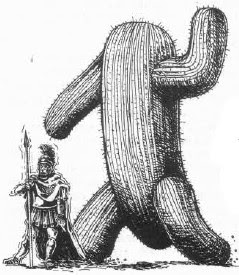
"Database" by Marcus L. Rowland is a sensible expansion of the computer rules in Traveller, something that nearly everyone who played the game felt was necessary. Even in the early 1980s, before personal computers were ubiquitous, gamers found Traveller's approach to the topic inadequate, leading to a plethora of articles like this one. "Ice, Desert, and Swamp" presents three new monsters for use with RuneQuest, including the Cactus Devil, show here:

"The Demonist" by Phil Masters is a new character class for use with AD&D, following in the footsteps of the demon summoning rules for RuneQuest presented in the previous three issues. The class is basically a variant (evil only) cleric, with a unique spell list, including some original spells, like soul shield and summon imps. New character classes – or "NPC classes," if it's published in the pages of Dragon – have been a staple of the hobby since 1974. Most of them aren't especially interesting, so Masters deserves some credit for creating one that's not dull. That said, I'm not sure there's much need for the demonist as a distinct class, when simply creating new spells for evil clerics would suffice.
"Open Box" reviews four products this month, starting with FGU's Privateers and Gentlemen, which earns 9 out of 10 – much higher than I would have expected. The Asylum and Other Tales also receives 9 out of 10, while Starfleet Battles Supplement #1 is rated 7 out of 10. Big Rubble, on the other hand, gets a fairly nuanced rating: 10 at best, much 8–9, some scenarios 5–6. Nuanced ratings is nothing new to White Dwarf. Many ratings are divided between presentation, rules, playability, and complexity, with a single overall rating for the entire package. This is the first time, though, that I can recall seeing the "overall" rating (which is what I usually report in my posts) broken up in this way.
Dave Langford's "Critical Mass" reviews Asimov on Science Fiction, a nonfiction book in which Isaac Asimov offers his thoughts and opinions about the genre and its practitioners. Langford's opinion of the book is mixed. Much of it is clear, lucid, and sensible. However, Asimov's own prejudices and his incessant self-promotion mar what might have otherwise been a solid tome. Fond though I am of much of Asimov's oeuvre, I find it difficult to disagree with Langford's assessment. "Zine Scene" by Mike Lewis is the inaugural column devoted to gaming fanzines. Lewis introduces himself to the reader, along with a handful of 'zines he thinks worthy of mention.
"Extracts from the Travels of Tralk True-Eye" by Ian Bailey presents details and game stats for several types of goblins for use with RuneQuest. The goblins are imaginative and varied, which is nice, though I'm not sure how well they'd fit into Glorantha. Mind you, I often forget that White Dwarf regularly published "generic" RQ articles that were not tied to Glorantha and this appears to be another of them. I suppose it's a testament of how ingrained Glorantha is to my own conception of RuneQuest that I even think to ponder questions like this. "Aliens" by Phil Masters presents two new non-human species for use with Traveller: the crustacean-like Phulgk'k'k'k and the small ape-like Ghashruan.
The conclusion to Daniel Collerton's "Irilian" gives readers a two-page color map of the entire city. Irilian's main buildings are keyed but, to make full use of it, one must possess the previous five issues of White Dwarf. Accompanying the map is the final part of the six-part adventure, "The Rising of the Dark," which takes place within the city's walls, along with random encounter tables and information on civil and religious law. It's a terrific end to a terrific series of articles. "Irilian" was what finally convinced me to subscribe to White Dwarf after picking up single copies of it for years. That likely explains the fondness I have for the whole series and the city it depicts.
"Rune Rites" presents two very short articles for use with RuneQuest. The first, "Daily Health" by Paddy Barrow is a very odd one. It's a set of random tables to determine "how a player character feels on a certain day." Sub-tables are used if a character feels particularly good or bad, with game mechanical effects coming into play. Perhaps this might be useful on occasion, but it strikes me as a perfect example of the randomness fetishism that frequently afflicts long-time gamers. Much better is Dave Morris's "Force of Will," which codifies a system for measuring a character's ability to resist debilitating/demoralizing effects. The system is simple and easy to use; it makes a for a consistent alternative to the haphazard way RQ used to handle this sort of thing.
"Kwaidan" by Oliver Johnson and Dave Morris is a nifty little adventure scenario for Bushido. As its title suggests, it presents a ghost story set in feudal Japan. It's quite well done, with detailed NPCs, maps of a village, a monastery, and a manor house, and of course the ghosts wreaking havoc in the region. I haven't had the chance to play Bushido in years; reading "Kwaidan" makes me wish I were. "Treasure Chest" presents a mini-scenario based around a couple of weird magic items, including the "Dorianic Portrait," while "Mini-Monsters" offers five small monsters for use with D&D. The issue concludes with the latest installments of "Thrud the Barbarian" and "The Travellers," the former of which is especially amusing.
As I alluded to earlier, this issue comes from the period when I was reading White Dwarf religiously, as a companion and counterpoint to Dragon, to which I was also subscribing. Consequently, I have a lot of affection for these issues. At the same time, it's obvious in retrospect that White Dwarf was changing – becoming slicker, more professional, and diversifying its content. In addition, Game Workshop was itself changing and those changes would soon enough impact White Dwarf itself. This knowledge doesn't adversely affect my delight in re-reading issues like this one, but it does remind that Golden Ages rarely last long, no matter how great their glory.
While issues 44, 45, and 46 of White Dwarf offered up rules for demon summoning in RuneQuest, issue 20 of Dragon (November 1978) did the same for Dungeons & Dragons, with an article entitled "Demonology Made Easy: How to Deal with Orcus for Fun and Profit" by Gregory Rihn. The article is quite interesting in its own right, but what immediately stands out about it is the following illustration that accompanies it:

That's Orcus, the Demon Prince of Undead, as drawn by Dave Trampier. So far as I can recall, this is the first (and only?) time Trampier ever drew Orcus. The rendering doesn't completely match the demon prince's description in either Eldritch Wizardry or the Monster Manual – his ram's horns, for example, are absent – but I like it nonetheless. Along with Dave Sutherland, Tramp is one of the artists whose work defines D&D for me, so it's always a joy when I discover a new piece of his that I'd previously not seen.

The issue kicks off with "Open Box," which reviews Avalon Hill's Wizards. This is a game I regularly saw in game stores but never owned or played. The reviewer, Alan E. Paull, found its presentation somewhat frustration, but liked its gameplay enough to give it 7 out of 10. Meanwhile, Oliver Dickinson gives Pavis 9 out of 10, which is, I think, a little stingy. The older I get, the more I have come to appreciate the output of Chaosium in the late '70s and early '80s, with Pavis and Big Rubble among its masterpieces. Also reviewed are three modules for AD&D and one for D&D: Tomb of the Lizard King (9 out of 10), Pharaoh (10 out of 10), Oasis of the White Palm (10 out of 10), and Blizzard Pass (6 out of 10) respectively. With the exception of Blizzard Pass, I think these ratings are a bit generous, but tastes differ, of course, and I recall thinking much better of the "Desert of Desolation" series at the time than I do now.
Dave Langford's "Critical Mass" spends most of its space on a lengthy review of C.J. Cherryh's Downbelow Station, which was the winner of the previous year's Hugo Award for best novel (for what it's worth). Langford seems genuinely well disposed toward Cherryh as a writer, but doesn't think this is her best effort. He also does quick reviews of three other books, including Italo Calvino's If On a Winter's Night a Traveler, which is an admittedly strange book to review in White Dwarf, though "Critical Mass" frequently devoted itself to books other than those that could easily be called fantasy or science fiction.
Part 2 of Dave Morris's "Dealing with Demons" focuses on lesser demons, describing them and their abilities for use with RuneQuest. The article's main attraction, in my opinion, is that these demons are (mostly) original rather than drawing on real world myths and legends. It's a clever approach to the topic, I think, though they're a good fit for RQ's Glorantha setting is another matter (assuming that was the intention, since the article is silent on the matter). "Gateway to Adventure" by Bob McWilliams is a "cameo" adventure, which is a coinage of McWilliams for "small scenes or themes that could be fitted into an ongoing campaign." In this case, the cameo is about researching an interplanetary transport device – the titular Gateway – that leads somewhere else. McWilliams doesn't provide any information on what's beyond the gate, leaving that to the referee to decide, which is admittedly a little unsatisfying. On the other hand, the set-up is fairly good and it's an unusual one for Traveller, which is a plus.
"Stop, Thief!!" by Marcus L. Rowland is a short article detailing the contents, along with individual weight and costs, of the items in a typical thieves' kit. I personally don't care for this level of detail, but I can appreciate its utility in certain circumstances. Part 4 of Daniel Collerton's "Irilian" is as good as its predecessors. In addition to the usual mix of local businesses, this installment describes the town's guards, bureaucracy, and ruling council. It's packed with the kind of detail that a referee needs if he intends to use a town as regular locale for his campaign. There's also an adventure set in the town relating to religious corruption and false relics – good stuff!
As I mentioned earlier, this issue marks the debuts of two new comic strips. The first is Thrud the Barbarian by Carl Critchlow. Thrud is a delightful parody of Conan and his mighty-thewed knock-offs. Most of Thrud's adventures involve random mayhem and destruction as a result of his penchant for attacking first and then thinking later, if at all. I'm especially fond of his encounter with an Elric clone, but most of his stories are great. Also premiering in this issue is Mark Harrison's The Travellers, which is a similarly broad parody of science fiction, filtered through the lens of GDW's Traveller. If anything, it's even more delightful than Thrud and I simply adored it back in the day (and still do).
"Divinations" by Oliver Dickinson is largely a collection of errata and clarifications to RuneQuest and RQ products. As such, it's only of interest to diehard fans. "Thistlewood" is a Warhammer Fantasy Battles scenario intended for two, four, or six players, plus an umpire. The scenario is a fairly typical "defend a sleepy little village against invaders" kind of thing, but it's filled with lots of charming details and information from the early days of Warhammer, before it became the behemoth of later years, so I find it strangely compelling nonetheless. Of particular note is the fact that the scenario is written by Joe Dever, best known for his work on the Lone Wolf series of gamebooks.
"Fiend Factory" offers up four new elemental monsters for use with D&D and AD&D. The somewhat misnamed "Elemental Items" by Daniel Hooke is actually a collection of eight new magic items that pertain to the para-elemental planes. Finally, "Super Mole" is a gossip column about the RPG industry, written by an anonymous author, after the fashion of Gigi D'Arne of Different Worlds but without the bitchiness. Most of the gossip is ephemeral stuff that has little lasting value, but I did find the section relating to Chaosium and its licensing of RuneQuest to Avalon Hill fascinating. According to Super Mole, Greg Stafford stated that the Chaosium crew simply wanted to design games and had no interest in "printing, selling, credit control," and the more tedious, business-related aspects of producing RPG materials. This is something I've long suspected to be the case (and indeed may have read somewhere else), but it's fascinating to see it stated here so baldly.
Issue #45 is another solid one. White Dwarf has really hit its stride in my opinion, though I am undoubtedly biased, since I'm now well into the run of issues with which I am most familiar. We're not quite yet at the point when I was a regular subscriber, though that will come soon and I'm rather excited to revisit those particular issues. In the meantime, though, I continue to enjoy these revisits to one of the truly great magazine's of our hobby.
 Gary Gygax's Appendix N serves two very useful purposes in my opinion. First, and most obviously, the list reveals the authors and works that "were of particular inspiration" to Gygax in creating his particular version of Dungeons & Dragons. Second, and just as important in my opinion, the list introduces younger readers – or those simply new to the genres of fantasy and science fiction – to the significant writers of earlier generations with whom they might otherwise be unfamiliar. I know I learned a great deal, not just about the literary origins of Gygaxian D&D, but also about literary history more generally by seeking out the names Gygax cited at my local library.
In a few cases, it was difficult, because, by even the early 1980s, these writers, who had been so prominent and influential in their day, had faded into obscurity. Such was the case of Fredric Brown, an author whose name meant nothing to me when I first came across it in Appendix N – though it should have. The eighteenth episode of the first season of the original Star Trek series is "Arena," written by Gene L. Coon, and it might have been inspired by Brown's 1944 short story, also entitled "Arena," leading to his being given a story credit and payment. The episode memorably features the reptilian Gorn and was a favorite of mine as a child, so it's quite likely I saw Brown's name in the credits many times and yet it would be years before I made the connection between him and Gygax's Appendix N.
Eventually, I was able to locate a collection of Brown's fiction called Honeymoon in Hell and devoured it. Though Brown did write several mystery and science fiction novels, his preferred medium was the short story – and by "short," I mean really short. Brown was the master of what was known at the time as "short short fiction" and is now often called "flash fiction." Many of his yarns are no more than three pages long, with a significant number being even shorter. This short format enabled Brown to refine his characters and ideas into their purest form, which led to fiction with remarkable bite. That his stories, regardless of their length, also included wry or black humor only added to the overall effect. It's little wonder, then, that Gygax regarded Brown so highly that he simply recommended him as an author in Appendix N rather than as an author of a particular work or works.
"Naturally" is a perfect example of Brown's skills as a writer. Originally appearing in the September 1954 issue of Beyond Fantasy Fiction, it tells the tale of Henry Blodgett, a college student who is so anxious over his upcoming geometry test that he is unable to sleep. Henry is terrible at all types of mathematics, including, it seems, geometry and fears failing the test. If he doesn't pass, the college will expel him and his dreams will turn to ashes. In desperation, Henry turns to magic as a solution.
The occult had always interested him. He had books on it and he’d often read the simple instructions on how to conjure up a demon and make it obey his will. Up to now, he’d always figured that it was a bit risky and so had never actually tried it. But this was an emergency and might be worth the slight risk. Only through black magic could he suddenly become an expert in a subject that had always been difficult for him.
From the shelf he quickly took out his best book on black magic, found the right page and refreshed his memory on the few simple things he had to do.
"Naturally" being a fantasy story, Henry's incantation works, summoning a demon into his dorm room, but things don't quite work out the way he had hoped. I won't say any more about the conclusion of this story consisting of only nine short paragraphs except that I laughed out loud, something I rarely do when reading, upon reaching its penultimate paragraph. It's a great story and I urge everyone who's never read it to seek it out. For that matter, seek out any of Brown's fiction you can find. He was an imaginative writer, with a keen sense of humor and it's a crime he's not more well known and celebrated today. In a world overrun with phonebooks masquerading as fantasy novels, we could use more of Brown's short short stories.
 |
| Vephar by Jason Sholtis |
Bael (Old School Essentials)
 |
| Bael by Jason Sholtis |
Bael is a great demon king, arguably the most powerful of his kind. From his citadel on the dark side of Aido in the Sixth Shell, he commands 66 legions. Though capable of assuming many guises, his preferred form is that of an eight-legged creature with three heads—his right one looking like a cat, his left like a toad, and his central one like a cadaverous human king wearing a two-tiered crown. When Bael speaks, it is through the mouth of his human head, which possesses a harsh and haughty voice.
Bael may only be struck by +3 or better weapons. His human head has a charm gaze (no saving throw) that affects creatures within 300' for 1 turn. The number of creatures affected is determined by their hit dice, as follows: 3 HD or fewer, 1d10×10; 4–6 HD, 5d8; 7–9 HD, 3d8; 10–12 HD, 2d6; and 13+ HD, 1d4. Creatures possessing 15 or more hit dice are entitled to a saving throw versus spells. His toad head has a breath attack identical to the effects of a wand of cold. His cat head causes fear as a wand of fear. These two attacks are usable at will. Both the toad and cat heads may also bite, but Bael rarely stoops to such attacks, deeming it beneath him.
Bael may use the following spell-like abilities at will: clairvoyance, continual darkness, detect invisible, detect magic, dispel magic, ESP, invisibility, levitate, polymorph self, read languages, read magic, telekinesis (5000 coins per head), wall of ice, water breathing, web, and summon (with an 85% chance of success) any demon of the first through sixth shells. Once per day, he can use feeblemind or projected image.
All spiders do Bael homage, as do Chaotic felines and batrachians. The Grimoire Major (which designates Bael 06-02 Red) claims there is a rivalry between the King of the East and Duke Vephar (q.v.) regarding the Ranine (q.v.), with both demon lords asserting dominion over them. On Telluria, cultists and witches make pacts with Bael to gain the powers of subtlety and invisibility.
 |
| A phlogerus by Jason Sholtis |
The phlogerus wields two swords +1 in battle, but is equally fond of employing its teeth and tail in battle. An opponent grabbed by the tail is constricted and drawn toward its body, so as to expose him to the heat emanating from its hide (dealing 3d6 damage). It is immune to ordinary weapons, like all demons of the sixth shell. At will, it can use the following spell-like abilities: cause fear, detect invisible, detect magic, dispel magic, feeblemind, mirror image, read languages, and read magic. Also, it can summon (70% chance of success) a demon from the first five shells.
Like the amenus (q.v.), the phlogerus is rarely found on Telluria. It is more common in the upper air and even in astral space. It is claimed (in the Kenomicon, among other volumes) that phlogeri existed in vast numbers during the time of the Great Ancients, when travel between the Four Worlds was commonplace.
Amenus (Demon of the Fifth Shell) (Old School Essentials)
 |
| An amenus by Jason Sholtis |
The amenus is a frightening demon sporting bristly fur and four wings. It is rarely seen on Telluria, except when summoned by foolhardy magicians or on an errand for its lord, the mighty president Camio (q.v.). Its coming is preceded by a powerful blast of cold air that extinguishes all unprotected flames within 80' of itself.
The amenus prefers to fight while flying, so that it can use all four of its claws as well as its powerful bite. Being a demon of the fifth shell, it is immune to ordinary weapons. All of the following spell-like abilities are available to it, usable at will: cause fear, control weather, continual darkness, detect invisible, and projected image. An amenus can summon (75% chance of success) a single demon from the first five shells (determined randomly).
Aegaeus (Demon of the Fourth Shell) (Old School Essentials)
 |
| An aegaeus by Jason Sholtis |
AC –1 [20], HD 11*** (49hp), Att 2 × claw (1d6), 1 × bite (2d4), 1 × tail slap (1d4), THAC0 11 [+8], MV 90' (30'), SV D6 W7 P8 B8 S10, ML 10, AL Chaotic, XP 3500, NA 1d3 (1d6), TT E
The aegaeus is a blasphemous hybrid of fish and frog, standing only slightly taller than a Man. Its skin is scaled and slimy and radiates a noisome stench whose effect is similar to that of a troglodyte (q.v.), except that it is more potent (–2 saving throw). The aegaeus prefers to haunt watery locales both above and below the surface of the world, but is little impeded by dry land. Wherever it goes, the aegaeus remains wet and drips fetid water.
A demon of the Fourth Shell, the aegaeus is immune to ordinary weapons. It can employ all of the following spell-like powers at will: cause fear, continual darkness, detect invisible, detect magic, dispel magic, and read languages. Likewise, an aegaeus may summon (65% chance of success) a single demon from the first four shells (determined randomly).
Aegaei serve the demonic duke Vephar and often act as his emissaries and generals. It is therefore not uncommon to find an aegaeus leading a group of ranine (q.v.) or troglodytes, to name but two terrestrial races who serve the Lord of the Sail Road.
 |
| A talpus by Jason Sholtis |
Chthonius (Demon of the Second Shell) (Old School Essentials)
 |
| A chthonius by Jason Sholtis |
AC –2 [21], HD 9*** (40hp), Att 2 × fist (1d12), THAC0 12 [+7], MV 60' (20'), SV D8 W9 P10 B10 S12, ML 11, AL Chaotic, XP 3000, NA 1d3 (1d6), TT C
The chthonius is a lumbering, 10-foot tall pile of rock shaped into the mockery of a man. Although it can be found almost anywhere underground, it prefers magmatic regions, which resemble the Demon Worlds from which it comes. Its ambitions elsewhere are obscure and few magicians bind chthonii into service, though there are tales that these demons played a role in the fall of the the monastery of St. Gaxyg-at-Urheim.
As a demon of the Second Shell, a chthonius is susceptible to ordinary weapons. In combat, it fights with its powerful fists. Its mouth froths and exudes a mephitic vapor that causes violent choking to all living creatures within a 10-foot radius who fail a saving throw versus poison. The effect lasts 2–5 rounds and a new saving throw is required every time an opponent leaves the range of the vapor and re-enters it. A chthonius can use the following spell-like abilities at will: cause fear, continual darkness, and detect invisibile. It may also summon another chthonius with a 25% chance of success.

Lucifugus (Demon of the First Shell) (Old School Essentials)
 |
| A lucifugus by Jason Sholtis |
AC 0 [19], HD 8** (36hp), Att 2 × claw (1d8), 1 × bite (1d10), THAC0 12 [+7], MV 120' (180'), SV D8 W9 P10 B10 S12, ML 12, AL Chaotic, XP 1750, NA 1d3 (1d6), TT B
Looking like an unholy amalgam of man and bat, the lucifugus is one of the weakest demons of the Great Void. Barely sentient, it acts purely on the twin instincts to flee the light and to destroy any Lawful beings it encounters. Consequently, the lucifugus cannot be reasoned with or bribed, though magicians and cultists who know the appropriate black rites (such as those contained in the Book of the Void) may press a lucifugus into temporary service.
Like all demons of the First Shell, a lucifugus is susceptible to damage from ordinary weapons. It possesses the following spell-like abilities, usable at will: continual darkness and detect invisible. Additionally, a lucifugus may summon another demon of its kind with a 10% chance of success.
The Tome of Avowal claims that small numbers of lucifugi descend every new moon, fleeing into the dark places of the earth to set up lairs from which to attack the unwary. True or not, the lucifugus is unquestionably the commonest terrestrial demon, to the point that there are orders of fighting men who dedicate themselves solely to their eradication.


 "Demon" is a term used to describe a wide variety of intelligent, Chaotic beings native to the otherworldly dimension generally called "the Void" or "the Abyss." Unlike most other beings, who are believed by Men to have been created by one or more gods, demons have no such divine origin, although their exact relationship to the gods and to Creation itself is a matter of debate among sages and priests. One popular theory holds that demons are spontaneously generated by Chaos itself, while another suggests that demons are the inadvertent consequence of the gods' attempts to bring order out of Chaos. For their part, demons explicitly deny both such theories, for they also deny the existence of the gods themselves, claiming them to be merely the fancies of Men.
 As I'm sure I've mentioned before, there are no Chaotic gods in the Dwimmermount campaign. For that matter, there are no Neutral ones either. All deities are Lawful, being strongly connected to human civilization (no other races have gods of their own, though some occasionally adopt human ones for various reasons). Now, "Lawful" does not equate to "Good." Quite a few of the gods couldn't be called "Good" by most moral standards, Typhon, protector of the city-state of Adamas, being a good example.
 Has anyone out there ever seen these? Were they ever in fact produced?

