
Showing posts with label religion. Show all posts
Showing posts with label religion. Show all posts
Friday, November 28, 2025
The Threefold Faith of the Living Balance
Over at Grognardia Games Direct, I've indulged my enthusiasm for worldbuilding by presenting an overview of the beliefs and religious practices of the Empire of Inba Iro. This is pure setting creation without any direct game mechanical application for Secrets of sha-Arthan, but I enjoy this kind of thing and thought some of my readers might too.


Tuesday, July 22, 2025
The Articles of Dragon: "Presenting the Suel Pantheon"

No one should mistake my many misgivings about Deities & Demigods for a disdain for its subject matter. On the contrary, I've long been fascinated by the treatment of gods and religion in roleplaying games. In fact, it's precisely because of that deep interest that I find Deities & Demigods so lacking. It simply isn't a very compelling or thoughtful exploration of these topics, especially when compared to works like Cults of Prax or Cults of Terror.
That said, I was nonetheless an avid reader of Gary Gygax’s “Deities & Demigods of the World of Greyhawk” series in the pages of Dragon magazine. My appreciation for it was twofold. First, I enjoyed learning more about Gygax’s setting than was revealed in the original folio edition. Second and more importantly, the series made a greater effort than Deities & Demigods to describe the beliefs and practices of the worshipers of these divine beings. It wasn’t perfect, of course; these weren’t theological treatises. Still, they went farther than most in offering a sense of the gods’ societal roles within the Flanaess, rather than simply listing their hit points and powers.
Gygax's "Deities & Demigods of the World of Greyhawk" ran for only five installments, the last appearing in issue #71 (March 1983). At the time, I had the impression that there were many more gods yet to be detailed, but that Gygax was simply too busy with other projects to continue the series himself. That’s why, when issue #86 (June 1984) introduced a new series of Greyhawk-related deities, I was pleased. This time, the articles were penned not by Gygax but by Lenard "Len" Lakofka, and they focused exclusively on the gods of a single human ethnic group in the setting: the Suel (or Suloise). The first installment covered just two gods, Lendor and Norebo.
There was much to admire in this second series. Lakofka had a distinct voice, quite different from Gygax’s, and that difference came through clearly in his descriptions of the Suel deities. One of the things I appreciated most was his greater inclusion of snippets of mythology, like hints at familial and other relationships among the gods. That gave the pantheon a sense of internal coherence and realism often missing from Gygax’s portrayals (a few notable exceptions notwithstanding). Instead of presenting the gods as a collection of isolated and artificially constructed figures, Lakofka tied them together, both to each other and to the world they inhabited. They felt more like a genuine pantheon than anything in the original Gygaxian series.
Another strength of the series was the way it framed these deities as being venerated by a particular culture and ethnic group. That felt more authentic to me. Historically, religions are usually deeply rooted in specific peoples and regions rather than being universally applicable or interchangeable, a tendency too often seen in fantasy settings. Of course, there are many historical examples of syncretism and interpretatio graeca – phenomena I both admire and have incorporated into my Secrets of sha-Arthan setting – but these are rarely explored in RPGs, where religion is typically presented in a dull, mechanical fashion. Lakofka’s articles didn’t completely avoid those pitfalls, but they were a marked improvement over most of their contemporaries. That’s why I still hold them in high regard today.
Tuesday, June 24, 2025
REPOST: The Articles of Dragon: "Special Skills, Special Thrills"

For that reason, there were growing cries among some gamers to "fix" the cleric. In this context "fix" means change to make it less tied to a particular religion, in this case a particular religion the game itself had eschewed. The first time I recall seeing an "official" answer to these cries was in Deities & Demigods, where it's noted that the clerics of certain deities had different armor and/or weapon restrictions than "standard" clerics. A few even got special abilities reflective of their divine patron. This idea was later expanded upon by Gary Gygax himself in his "Deities & Demigods of The World of Greyhawk" series of articles, which I credit with giving widespread attention to this idea. I know that, after those articles appeared, lots of my fellow gamers wanted to follow Gary's lead and tailor their cleric characters to the deities they served, an idea that AD&D more formally adopted with 2e in 1989.
In issue #85 (May 1984) of Dragon, Roger E. Moore wrote an article entitled "Special Skills, Special Thrills" that also addressed this topic. Moore specifically cites Gary's articles as his inspiration and sets about providing unique abilities for clerics of several major pantheons. These pantheons are Egyptian, Elven, Norse, Ogrish, and Orcish – a rather strange mix! Of course, Moore intends these to be used only as examples to inspire individual referees. Likewise, he leaves open the question of just how to balance these additional abilities with a cleric's default ones. He notes that Gygax assessed a 5-15% XP penalty to such clerics, but does not wholeheartedly endorse that method himself, suggesting that other more roleplaying-oriented solutions (ritual demands, quests, etc.) might work just as well.
Like a lot of gamers at the time, I was very enamored of the idea of granting unique abilities to clerics based on their patron deity. Nowadays, I'm not so keen on the idea, in part because I think the desire for such only underlines the "odd man out" quality of the cleric class. Moreover, nearly every example of a "specialty cleric" (or priest, as D&D II called them) still retains too much of the baseline cleric to be coherent. Why, for example, would a god of war be able to turn the undead? Why should almost any cleric wear heavy armor and be the second-best combatant of all the classes? The cleric class, even with tweaks, is so tied to a medieval Christian society and worldview that it seems bizarre to me to use it as the basis for a "generic" priest class. Far better, I think, would be to have individual classes for priests of each religion or, in keeping with swords-and-sorcery, jettison the class entirely.
Tuesday, May 13, 2025
REPOST: The Articles of Dragon: "Setting Saintly Standards"

That's where "Setting Saintly Standards" steps in. Bennie proposes that saints are special servants of the gods who've achieved immortality and some measure of divine power. He makes them on par with Greyhawk's "quasi-deities" like Murlynd or Keoghtom, but explicitly tied to a specific deity, whom they serve and whose cause they promote. The article lays out their spell-like abilities and offers four examples of saints from his own campaign to give the referee some idea of how to create saints of his own. He likewise suggests that some saints -- "patron saints" -- may have shrines dedicated to them and, over time, achieve sufficient power to become demigods in their own right. Exactly what this means for relations between the saint, his followers, and the deity he ostensibly serves is never discussed.
I'm on record as intensely disliking the reduction of gods and semi-divine beings to game stats. It's not for nothing that I dislike both Gods, Demigods & Heroes and Deities & Demigods. One of D&D's worst failings is its reductionism, its voracious appetite to turn everything into either a monster to be killed or a piece of magical technology to be wielded. Saints, as Bennie imagines them, are just big monsters -- or little gods -- to be confronted rather than anything more sublime. Maybe I'd be less bothered by this if he'd have adopted another term for what he's presenting; I don't think the idea of fighting gods is necessarily out of bounds. For certain styles of fantasy, it's even highly appropriate. But saint has a very specific meaning and Gygax's mention of them is almost certainly tied up in the implicit Christianity of early gaming.
Late 1983, though, was a long distance away from 1974, though, and the culture of the hobby had changed. What to Gygax had seemed obvious was now in need of explication and not just explication but expansion. That's why Bennie broadens the use of the term "saint" to include the servants of any god, not just Lawful Good ones. Thus we have St. Kargoth, a fallen paladin, among the four examples he provides us. To say that the idea of an "anti-saint" or "dark saint" is bizarre to me is an understatement. Mind you, I find the idea of non-Lawful Good paladins similarly bizarre, so clearly I'm out of step with a lot of gamers, no that this is any surprise.
Tuesday, November 29, 2022
The Light of Kulvu
Kulvu is a word in the ancient Onha language with many meanings: balance, harmony, law, nature, order, and reason. Some three centuries before the commencement of the First Cycle, the sage Urkuten used the word to describe the underlying principle of reality. Urkuten taught that happiness consists in understanding and conforming oneself to that reality, which is rationally organized and thus evidence of the Divine. Urkuten sometimes used “the gods” as a synonym for the Divine but he is otherwise silent on the matter of what, if any, deities exist. It is precisely for this reason that his doctrines, called in later ages the Light of Kulvu, achieved such wide acceptance, as they were metaphysically flexible and, therefore, compatible with many pre-existing religious practices.
The Light of Kulvu spread across sha-Arthan along with the empire that would bear its name. Over the course of the empire’s 1229 years of existence, schools dedicated to Urkuten’s teachings were founded on every continent but Alakun-Tenu (where the god, da-Ten, brooks no rivals, even non-dogmatic ones), establishing itself as one of the most widespread and enduring belief systems of the last ten cycles. Though rarely the dominant faith of any land at present, the Light of Kulvu nevertheless exercises great influence over the societies and cultures of many, including several in the Hashaya Peninsula, most importantly the Empire of Inba Iro.
The Mirror of Virtue
Sometime during the administration of the Archon Herekshumal (1:100–120), the text known today as Chunik Choredri ("The Mirror of Truth") first appeared. A product of the Ruketsa philosophical school of Kulvu, the book is a distillation of and commentary on Urkuten’s teachings. Chief among those teachings are eight axioms, collectively known as Unquestionable Precepts. The Precepts are:
- Reality is ordered.
- Order is evidence of reason.
- Only the Divine possesses reason potent enough to order reality.
- Being a product of the Divine, this order is inescapable.
- Virtue consists in understanding order and conforming one’s actions to it.
- Wisdom distinguishes between those actions that are in conformity with order, namely, courage, knowledge, restraint, and justice; and those that are opposed to it, namely, fear, ignorance, lawlessness, and license.
- Therefore, avoid all that is irrational and disordered.
- Accept that illness, pain, and death are no less ordered than health, pleasure, and life.
Thanks to the fervent efforts of generations of sages, the Unquestionable Precepts have achieved wide dissemination, forming the basis of dozens of schools of the Light of Kulvu (the Bejandrai and Kamarjantil schools being notable exceptions), as well as at least one entirely distinct religion (Viruktiyel). Despite their differences, all share the belief that happiness can be achieved by acceptance of the Divine order and one’s place within it, including the duty to understand not only reality itself but one’s fellow creatures, so as to treat them fairly and justly. If there were a single creed one could call central to the diverse peoples of sha-Arthan, the Light of Kulvu probably comes closest to it.
Thursday, November 24, 2022
Computer God

Something I've observed is that, if you look at the totality of a creator's work, you'll sometimes notice patterns in their creations. By "patterns," I mean subject matter or themes that keep cropping up again and again. Sometimes, this is done deliberately, with the creator explicitly embracing this, while at other times, it's done subconsciously. There are plenty of exceptions to this, of course; not every creator is given to this behavior. Indeed, one could make a reasonable case that the best creators are those whose works are genuinely varied in their subject matter or themes.
Yesterday, I posted a story about an "AI agent" that had supposedly become very adept at playing Diplomacy. In reflecting on it, I realized that one of the reasons the story so intrigued me is not simply for its connection to a game I enjoy, but because it connects to a recurring subject within my own creative endeavors: computers as gods. I was suddenly struck by the fact that, without my specifically intending to do so, I'd been playing around with this idea under a variety of different guises. Clearly, it's something that has fired my imagination, hence the prevalence of it in my works to date.
The initial intention behind my Dwimmermount campaign setting was to create a setting for D&D that was outwardly fairly ordinary and traditional but with a secret science fiction background. Part of this background is that the gods of the Great Church were, in fact, artificial beings created by technological advanced Men in the ancient past and whose civilization was ultimately destroyed as a consequence of their hubris. None of this was ever revealed in the course of the campaign, but it provided the intellectual frame by which I understand the setting.
In my House of Worms Tékumel campaign, the characters have spent a long time, both in game and in the real world, interacting with several strange cultures of the mysterious Achgé Peninsula. Among the many ways these cultures differ from those of the characters' homeland of Tsolyánu are the gods they worship. One of the most important is called Eyenál, who is generally depicted as a war god. Some months ago, while interacting with a device of the Ancients, the characters learned of the existence of "ANL/1043," described as being "a 301st generation strategic agent" – in short, Eyenál is some sort of artificial intelligence, possibly charged with Tékumel planetary defenses.
Likewise, in the Secrets of sha-Arthan, I've imagined many different artificial beings created by "the Makers" whose ruins are scattered across the True World. Some of these beings are mere automatons without much in the way of individual will or intelligence, while others are closer to Men. Others still possess vast and alien intelligence utterly unlike that of any other intelligent species. Some of these direct and guide cities or even entire nations, ruling them as gods, though, of course, few on sha-Arthan understand this.
In each case, knowledge of the true nature of the gods as artificial beings is largely unknown within the setting. Naturally, I know the truth and occasionally the players (as opposed to their characters) catch on to what's really going on. The reaction has been universally positive, so far as I can recall. I distinctly remember the revelation about Eyenál being met with pleasure by several of the players, who felt it provided a clever and unexpected re-interpretation of many of the details they'd already collected about the Achgé Peninsula and its history.
I presume regular return to the subject of artificial gods is rooted in my lifelong love of science fiction. Stories of "computer gods" or, at least, computers viewed as gods are commonplace in the genre. I wonder, though, if there's more to it than that and, if so, what it is. Clearly, I'm trying to grapple with something through the vehicle of my imagination, though I'm not yet sure what it is. Regardless, I find it fascinating that I continue to revisit this idea and wonder if others find that they return to the same ideas over and over within their own creations.
Saturday, September 24, 2022
Wrestling with God
How have I never seen this piece of Jack Kirby art before?

Wednesday, February 16, 2022
Retrospective: Gods of Hârn
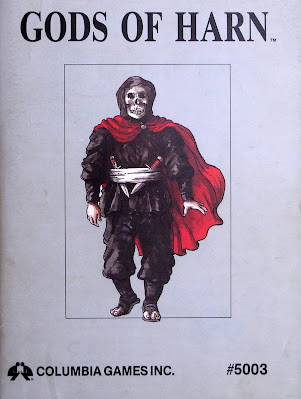
That said, I am a hypocrite on this matter when it comes to Hârn, a fantasy setting I've never used but whose support products I've nevertheless bought in surprising amounts. Everything I've purchased for Hârn is very well done, both in terms of content and presentation. There's an obvious love in these books that's almost infectious and I've often found myself picking them up over the years, despite my avowals not to do so. We all have our weak spots, I suppose, and the richly detailed fantasy world of Hârn is one of mine.
Of all the Hârn products I've bought (and never used) over the years, perhaps my favorite is Gods of Hárn. Originally published in 1985, the book is an overview of the ten gods of the setting's pantheon, along with information about the religions that worship them. For me, this is the most important part of what makes Gods of Hârn so special. There have been plenty of RPG books published about deities and divine beings, but few of them provide much in the way of useful information about the structure and activities of their mortal worshipers. Cults of Prax comes to mind, but, even there, the focus is more on the mythological role of the various gods of Glorantha than on the faiths of their followers.
Each god in Gods of Hârn receives a description of his or her personality and role in the pantheon, but more detail is heaped on their church. The theological and social missions of the churches is discussed, along with information about their holy days, symbols, history, and clerical organization. Each of these categories is fleshed out in sufficient detail that both the player and referee would find them useful in play. Though there's plenty of detail in Gods of Hârn, the book doesn't luxuriate in detail for its own sake; nearly everything here is presented with the goal of enhancing play, which is particularly useful for players of priests or zealous devotees of a particular god. As a fan of Tékumel, believe me when I say that I adore setting detail. At the same time, I also recognize that there can be such as a thing as too much detail. I believe that Gods of Hârn strikes a good balance between leaving everything up to the referee's imagination and overloading him with needless minutiae.
There are no game statistics for the gods of Hârn's pantheon to be found here. The emphasis is more on the mortal side of religion, which is how it should be in my opinion. Throughout history, religions have played an important role, for good and ill, in human events. Often those roles were a direct consequence of the beliefs and structures of the religions themselves, a fact that Gods of Hârn clearly recognizes. The historical sections of the book detail many instances when one or more of the churches influenced events on Hârn and elsewhere. Likewise, the sections detailing their hierarchies and present activities provide plenty of scope for the referee to make religion matter in a way it sometimes doesn't in fantasy settings.
If nothing else, Gods of Hârn is a good model to emulate for creators and referees looking to present gods and religion in their settings and that's why I'm glad I own it, even though I've never played a campaign set on Hârn – at least that's what I keep telling myself.
Monday, July 5, 2021
Deities & Demigods is a Failure
In my weekly summaries of the contents of Chaosium's Different Worlds magazine issues, I rarely comment on the letters column, "Different Views." Occasionally, though, there are entries worthy of commentary and, in such cases, I make a post to highlight them. In issue #22 (July 1982) – about which I'll talk tomorrow – there's a lengthy letter written by Lawrence Schick, a game designer once employed by TSR, perhaps best known for White Plume Mountain. Schick was also editor of Deities & Demigods, an AD&D book about which I have generally negative feelings and it's about that book that he penned the letter that appeared in Different Worlds.
Issue #19 of the magazine featured a scathing review of DDG by Patrick Amory. Amory disliked the book even more than I do, saying it was "fit only for the trash can." One might reasonably have expected Schick to have defended the book he edited, but he does not. Instead, he agrees with Amory's assessment and indeed amplifies them. Schick's letter, which I reproduce in full below is remarkable, not just for what it says about Deities & Demigods but how it says it. I can't help but wonder if Schick's feelings were at least partly colored by his experience of having been recently laid off by TSR at the time this letter appeared. That's not to suggest his feelings about the book aren't sincere – I have no reason to assume otherwise – but I doubt he'd have been so forthcoming were he still a TSR employee at the time.

There is much to ponder here, but what most stands out to me is Schick's recommendation of Cults of Prax over Deities & Demigods even for referees of Advanced Dungeons & Dragons. It's an unusual suggestion, though I understand Schick's point, namely that Cults of Prax treats the subject of religion far more seriously than does DDG – or indeed almost any RPG book whose content touches on gods and their worship. Mind you, I've long felt that there are almost no good treatments of religion in popular entertainment, which probably speaks to the cultural deracination of 21st century Westerners. D&D is far from the only example of this, even if it's one that frequently vexes me. Apparently, Lawrence Schick was similar vexed.
Wednesday, June 2, 2021
Retrospective: Cults of Terror
 If there's an area where I think most roleplaying game settings – and, let's be honest, most other forms of popular media – consistently fail, it's religion. By "fail," I simply mean that most RPGs do a very poor job of presenting one of the foundations on which nearly every human culture has been built. If religion is treated at all, it's either presented very cursorily or, worse yet, reduced to mere game mechanics with little or no consideration of society or culture.
There are probably many reasons why this is so, but I'd guess a big reason is that most roleplaying game writers were born and live in secularized, or at least secularizing, countries where religion as it's been known for untold thousands of years holds comparatively little sway. This makes it far less likely that they understand religion of the sort that makes sense in more traditional societies, like those of the ancient and medieval eras in which so many fantasy RPGs are set. By my lights, there are two main exceptions to this, one of which is Tékumel. The other is RuneQuest's Glorantha.
Years ago, I wrote about Cults of Prax, a RQ supplement that detailed more a dozen religions – called cults in Glorantha – with information about their myths and history, nature, organization, membership, and relationships with other cults. Cults of Terror is a 1981 companion book, detailing nine more cults from Glorantha. In terms of its format, this supplement is quite similar to its predecessor. Where it differs is in its specific content. Whereas Cults of Prax detailed religions suitable for membership by player characters, those in Cults of Terror are, in the words of its introduction, those of "the bad guys of Glorantha, the enemies of creation, the foes against whom every fight must be fought." So awful are the cults presented here that the book includes the following warning in bold type:
IMPORTANT: contributors, editors, and publisher categorically intend that these cults be used for Non-Player Enemy religions. Player Characters should not join these cults. We recommend that Player Characters who join these religions quickly be put to sacrifice by Non-Player-Character priests, to get them out of play.
From the vantage point of the present day, this warning seems mildly absurd, but one must remember that, in the aftermath of the James Dallas Egbert III disappearance just a couple of years prior, roleplaying games were receiving increased – if facile – scrutiny and I suspect that Chaosium, much like TSR, was worried about the possibility of bad publicity. In the case of Cults of Terror, I can understand this, as many of the cults are quite abhorrent, such as that of Thed the Mother of Broos or Vivamort, Lord of the Undead.
Each of the cults in this book get very detailed write-ups, providing plenty of insight not just into the beliefs and activities, but also their place within the setting of Glorantha. It's in this area where Cults of Terror excels. In some ways, it's even superior to Cults of Prax, because much more is revealed about the myths, history, and cosmology of Glorantha. A RuneQuest referee would therefore find this volume quite useful, even if he weren't directly using any of the cults described herein. That said, the cults all make terrific enemies and general antagonists for any campaign set in Glorantha.
At the beginning of this retrospective, I noted that far too many roleplaying games treat religion too lightly or reduce it solely to game mechanics, mistakes that RuneQuest did make. I should make it clear, though, that neither Cults of Terror or its predecessor make the opposite mistake: indulging in fantastical anthropology for its own sake. Cults of Terror contains many details about the titular cults, details that situate them well within the overall setting of Glorantha. Yet, most of these details are also practical, giving the referee what he needs to use them appropriately within his RQ campaign. Cults of Terror is emphatically not an "academic" work whose contents serve no purpose for gaming. To my mind, it strikes just the right balance between being too game-focused and too esoteric – which is why it remains a favorite of mine, even though I have played RuneQuest only infrequently over the years.
Wednesday, April 21, 2021
B.A.D.D. Arguments

Despite this, I experienced almost no significant opposition to my involvement in roleplaying, nor did any of my neighborhood friends. If anything, we were encouraged to play D&D and RPGs, in the belief that it was a thoughtful, creative hobby that fostered good habits like reading, writing, and social engagement. That's why it was something of a shock to me when I learned, through news stories, that, in some places, there were serious – or at least seriously held – questions about the game and its purported effects on young people.
Though I was aware of Patricia Pulling and her organization, Bothered About Dungeons & Dragons (B.A.D.D.), I never gave either much thought until I saw that infamous 60 Minutes segment from 1985 that interviewed her and others who were attempting to lay the blame for teenage suicides on the game. Even after that, I never saw any of the literature B.A.D.D. produced to advance their cause until comparatively recently. When I did, I was (mostly) terribly disappointed. The little booklet depicted above is little more than a collection of quotes and excerpts taken out of context in an effort to paint D&D as dangerous, immoral, and unhealthy. It's riddled with spelling errors and possesses a layout that makes the Little Brown Books of OD&D look professional. Worse yet, they're not even fun to read in the way that Jack Chick's Dark Dungeons is.
Having said that, there's a part of the booklet I find rather interesting. Here's the relevant page:

The text argues that D&D is bad because it "teaches occult forms of religion," specifically witchcraft. According to the booklet, the state of California has recognized covens of witches as "bonified [sic] religions and …[has] given [them] tax exempt status as churches," facts that prepare us for the absolutely amazing bit of rhetorical jiu-jitsu that's to come. The argument goes like this:
- Dungeons & Dragons teaches witchcraft.
- California recognizes witchcraft as a religion.
- The "Supreme Court has ruled that religion is not to be taught in schools."
- Therefore, D&D should not be allowed in schools.
I can't help but admire the chutzpah on display here. The argument is as specious and disingenuous as it is bold. Claiming that D&D is religious in nature and, therefore, disallowed in public schools is patently absurd, but, as a line of argument, it's imaginative. Unfortunately for B.A.D.D., I don't think anyone not already convinced of D&D's supposed danger could possibly have been swayed by it.
Tuesday, November 24, 2020
Imagine Magazine: Issue #20

Things kick off with Paul Vernon's "Clerics are People Too." The article rightly notes that, whereas fighters, magic-users, and thieves all have clear literary inspirations, the cleric does not. While I can certainly come up with examples to counter Vernon's specific claim, his larger point remains, namely, that D&D clerics lack fantasy role models and that this contributes to their being played badly and banally. What Vernon suggests is developing fantasy religions better so that players of clerics understand what their character should believe and its impact on their behavior. Nowadays, it's an obvious point – though how often it's actually employed is an open question – but, in 1984, I think it was fairly unusual.
Lewis Pulsipher offers "Alignment, Personality & Philosophy-Religion," an extensive examination of all these factors with regards to playing a cleric. Pulsipher is particularly interested in the subject of alignment, which, as we all know, remains a contentious one even today. He argues for making alignment more important, even to the point of suggesting, for example, that Lawful clerics not roll for their hit points but instead get the average amount per level, while Chaotic ones roll as normal. It's an intriguing notion, though not one I expect to catch on, even if it does succeed bringing alignment front and center rather than leaving it a philosophical abstraction at best.
"As God is My Witness" by Graeme Davis examines the judicium Dei, the various types of trials used during the Middle Ages to determine guilt or innocence. This is a purely historical article but a worthwhile one, full of ideas for use in a campaign. "The Necklace of Lilith" by Phil Gallagher is an AD&D adventure intended for a party consisting only of clerics, which is certainly a novel idea. The scenario concerns the recovery a divine item, the titular Necklace of Lilith, long believed lost. Accompanying the article is another, "New Clerical Spells," which is a reprint of an article from Dragon #58 (February 1982) by Gary Gygax and Len Lakofka. The adventure makes some use of these spells and is, in fact, intended as a means of introducing them into an existing campaign.
"New Flail Types" by Graeme Davis does exactly what its title suggests, providing more weapons for use by clerics (along with stats for these weapons in other game systems, like DragonQuest, Traveller, and Bushido). Carl Sargent's "Looking for an Edge" examines the ban on the use of edged weapons by clerics and argues, as others have done, that the ban should not apply to clerics of every god. In the traditional polytheistic set-up of Dungeons & Dragons, I am sympathetic to this perspective, though I also think the prohibition exists for reasons beyond a hamfisted attempted to introduce a Christian worldview into the game.
This issue's reviews include Grenadier's Disappearance on Aramat, which the reviewer, Stephen Nutt, liked even less than I did. There are also a number of reviews of adventures for Star Frontiers, Space Opera, and The Morrow Project, continuing Imagine's commitment to greater coverage of science fiction RPGs. There's also a very positive review of the revised, boxed version of The World of Greyhawk, for which I have many fond memories. "Chain Mail" discusses the postal version of En Garde!, while Colin Greenland gives a strangely positive review of Conan the Destroyer, a movie most people intensely dislike. Conversely, he gives a negative review to the animated Fire and Ice, which, while no masterpiece, I recall being more enjoyable than Schwarzenegger's second outing as the Cimmerian.
The comics "Rubic of Moggedon" and "The Phalanx" continue in this issue. Roger Musson's "Stirge Corner" continues the discussion of alignment begun in the previous issue. He rightly points out that Law does not equal Good and Chaos does not equal Evil and riffs off of these matters to good effect. Richard W. Lee's short fiction, "Prince of Thieves," is fine for what it is but nothing special. Much more compelling is the Pellinore installment, "Pablo Fanquay's Fair," which details a group of traveling performers, along with ideas for using them in a game. The Cock o' th' Walk tavern gets a similar treatment, including a map by Paul Ruiz. There are also rules for making a living by street performance – including by breakdancing. Yes, you read that right. Forgive them: it was 1984.
This is another fine issue of Imagine, with much to recommend it. I am particularly fond of the Pellinore setting articles. They evince a terrific combination of creativity, utility, and humor that sets them apart from most other TSR offerings at the time. Seeing as many of those who worked on Pellinore would eventually contribute to Games Workshop's Warhammer Fantasy Role Play, this should come as no surprise.
Monday, November 23, 2020
Saints Alive

Back when I was creating what would eventually become my Telluria setting, I toyed with the idea of making it explicitly monotheistic, but, in the end, went with "secret monotheism" instead. On this model, there are "gods" who are worshipped and around whom religions have grown up, but they are not truly divine. The only true Deity of the setting, know variously as Law, Father God, and the Great Maker, among many sobriquets, is no longer widely known in the main campaign area. Though I like this set-up and have used it to good effect, I find myself wishing I'd gone with my initial idea and dispensed with all the lesser, false gods, if for no other reason than it'd be different.
So, in working on Urheim, I'm playing with this idea a little more obviously. How – or if – this meshes with what I've done before is still an open question. For the moment, I'm developing Urheim as a kind of "parallel" universe in which many of the same elements exist as in the rest of Telluria but that there are also idiosyncrasies unique to it. If nothing else, this gives me a freer hand to create; I don't feel bound by anything I've come up with before and can pick and choose those elements I think fit the overall feel.
In keeping with this approach, I've been mentioning various saints in my Urheim posts, starting with St. Gaxyg the Gray. Being a fan of homages and anagrams, I decided that many, if not most, of the saints would be coded references to noteworthy individuals from the history of the hobby. Thus, Gaxyg the Gray is (obviously) an anagram of Gary Gygax. In a similarly obviously fashion, St. Evad filzArn refers to Dave Arneson. I've also mentioned St. Carmichael, which is a double reference, both to Mike Carr, player of the very first cleric in roleplaying, as well as to Dohram, Servant of Saint Carmichael, a pre-egenerated character from In Search of the Unknown (penned, not coincidentally, by Carr). There's also a mention of St. Richomer the Tailor, whose identity I leave to the astute to undertangle in the comments. (That's in addition to two others, I've not yet mentioned anywhere: St. Iacomus the Warden and St. Andreas the Taker of Fiends)
I've found this exercise of making (I hope) clever homages to the worthies of the gaming pantheon a lot of fun. I'd like to encourage others to take it up too, offering any idea they have in the comments. Should I like any of them enough to make use of them in Urheim, I'll gladly credit your creation and send you a copy of the 'zine or other publication where it appears.
Monday, September 17, 2012
More on Relics
Earlier this year, I did a post about artifacts and relics after having seen an exhibition of a large number of them at my parish. It's a topic about which I have a lifelong fascination, aided in no small part due to the fact that Gary Gygax saw fit to include relics with miraculous powers in both OD&D and AD&D. So, when I read a blog post by the pastor of a parish in Louisville, Kentucky, talking about the reinterment of the relics of two third-century Roman martyrs there, I wanted to share it. Be warned, though, that what follows has nothing directly to do with gaming and I share it out of interest, as I know there are quite a large number of students of ancient and medieval history amongst my readers.
 The saints being reinterred are Magnus and Bonosa, both martyred during the persecution of Septimius Severus in 207. According to tradition, Bonosa was a virgin arrested for her beliefs and Magnus a centurion who attempted to save her life. Both were thrown into Colosseum and met their deaths there. Their bodies were taken to the catacombs beneath Rome and later translated to a monastery in Agnani, Italy, where they remained the turn of the 20th century, when the monastery was confiscated by the Italian government and the order of nuns who resided there forced to leave. A pastor in the United States petitioned the Holy See for the relics and Pope Leo XIII agreed. The skeletons of the two saints were sent to Kentucky in 1901, where they've resided ever since.
Recently, renovations to the church (Saint Martin of Tours) where the relics were displayed provided an opportunity to remove them, examine them further -- there were CT scans done of the remains, for example -- and reinter them with greater solemnity. The photo above is one of many from the reinterment Mass at the church. You can see both saints attired in new clothing and placed on biers before the altar. They have now been placed in glass reliquary cases at the sides of the church.
Again, this has little to do with gaming as such, but it's fascinating stuff I thought worth sharing.

Recently, renovations to the church (Saint Martin of Tours) where the relics were displayed provided an opportunity to remove them, examine them further -- there were CT scans done of the remains, for example -- and reinter them with greater solemnity. The photo above is one of many from the reinterment Mass at the church. You can see both saints attired in new clothing and placed on biers before the altar. They have now been placed in glass reliquary cases at the sides of the church.
Again, this has little to do with gaming as such, but it's fascinating stuff I thought worth sharing.
Sunday, February 19, 2012
Artifacts and Relics
 |
| The skull of St. Wenceslaus of Bohemia |
None of the relics I saw on Friday (there were 168 in all) were as impressive as the one depicted above. Almost all of them were tiny fragments of bone (ex ossibus in Latin) or clothing (ex indumentis) placed in a theca, a small, circular, gold container, which in turn was placed in a standing display. The theca (meaning "receptacle" in Latin) is sealed in a special way, using four strings and a wax seal impressed with the signet of an appropriate authority (a bishop, an abbot, or a postulator), and is always accompanied by a certificate attesting to its authenticity. The lack of any of these things -- the strings, the seal, the certificate -- makes the relic dubious and thus not fit for public veneration. During the Middle Ages, the creation of fake relics was almost an industry, thus necessitating the Church's oversight and regulation of the practice, including the banning of the sale of relics. This prohibition continues to this day.
In regulating relics, the Church distinguishes between three types. First class relics are either items associated with the life of Christ (like a piece of the Cross, for example -- one of which was at my parish's exhibition) or the physical remains of a saint. The vast majority of the relics I saw were first class relics. Second class relics are items worn or frequently used by a saint. Third class relics are items touched to a first or second class relic. Consequently, many people at the exhibition brought rosaries, crucifixes, and similar objects to touch to the relics on display so as to create third class relics from them.
 |
| Theca of a relic of St. Louis de Montfort |
None of D&D's relics seem to be the objects of veneration. Rather they're just powerful magic items -- another example of the game's often reductionist appropriation of religion and mythology. But that didn't stop me from inventing my own more saintly relics in my campaigns of old (like the Sword of St. James) and attaching them to pilgrimage sites rather than throwing them in a dragon's hoard somewhere. The structure of the Dwimmermount campaign's cosmology does not (at present) allow for saintly relics, so I don't have any new ones to share. However, that may change in the future, as more of the setting's ancient past is made known through the actions of the PCs, in which case I may return to this topic in earnest.
 |
| Thecae in display stands |
Tuesday, January 17, 2012
The Articles of Dragon: "Special Skills, Special Thrills"
For that reason, there were growing cries among some gamers to "fix" the cleric. In this context "fix" means change to make it less tied to a particular religion, in this case a particular religion the game itself had eschewed. The first time I recall seeing an "official" answer to these cries was in Deities & Demigods, where it's noted that the clerics of certain deities had different armor and/or weapon restrictions than "standard" clerics. A few even got special abilities reflective of their divine patron. This idea was later expanded upon by Gary Gygax himself in his "Deities & Demigods of The World of Greyhawk" series of articles, which I credit with giving widespread attention to this idea. I know that, after those articles appeared, lots of my fellow gamers wanted to follow Gary's lead and tailor their cleric characters to the deities they served, an idea that AD&D more formally adopted with 2e in 1989.
In issue #85 (May 1984) of Dragon, Roger E. Moore wrote an article entitled "Special Skills, Special Thrills" that also addressed this topic. Moore specifically cites Gary's articles as his inspiration and sets about providing unique abilities for clerics of several major pantheons. These pantheons are Egyptian, Elven, Norse, Ogrish, and Orcish -- a rather strange mix! Of course, Moore intends these to be used only as examples to inspire individual referees. Likewise, he leaves open the question of just how to balance these additional abilities with a cleric's default ones. He notes that Gygax assessed a 5-15% XP penalty to such clerics, but does not wholeheartedly endorse that method himself, suggesting that other more roleplaying-oriented solutions (ritual demands, quests, etc.) might work just as well.
Like a lot of gamers at the time, I was very enamored of the idea of granting unique abilities to clerics based on their patron deity. Nowadays, I'm not so keen on the idea, in part because I think the desire for such only underlines the "odd man out" quality of the cleric class. Moreover, nearly every example of a "specialty cleric" (or priest, as D&D II called them) still retains too much of the baseline cleric to be coherent. Why, for example, would a god of war be able to turn the undead? Why should almost any cleric wear heavy armor and be the second-best combatant of all the classes? The cleric class, even with tweaks, is so tied to a medieval Christian society and worldview that it seems bizarre to me to use it as the basis for a "generic" priest class. Far better, I think, would be to have individual classes for priests of each religion or, in keeping with swords-and-sorcery, jettison the class entirely.
Thursday, December 22, 2011
The Articles of Dragon: "Setting Saintly Standards"
That's where "Setting Saintly Standards" steps in. Bennie proposes that saints are special servants of the gods who've achieved immortality and some measure of divine power. He makes them on par with Greyhawk's "quasi-deities" like Murlynd or Keoghtom, but explicitly tied to a specific deity, whom they serve and whose cause they promote. The article lays out their spell-like abilities and offers four examples of saints from his own campaign to give the referee some idea of how to create saints of his own. He likewise suggests that some saints -- "patron saints" -- may have shrines dedicated to them and, over time, achieve sufficient power to become demigods in their own right. Exactly what this means for relations between the saint, his followers, and the deity he ostensibly serves is never discussed.
I'm on record as intensely disliking the reduction of gods and semi-divine beings to game stats. It's not for nothing that I dislike both Gods, Demigods & Heroes and Deities & Demigods. One of D&D's worst failings is its reductionism, its voracious appetite to turn everything into either a monster to be killed or a piece of magical technology to be wielded. Saints, as Bennie imagines them, are just big monsters -- or little gods -- to be confronted rather than anything more sublime. Maybe I'd be less bothered by this if he'd have adopted another term for what he's presenting; I don't think the idea of fighting gods is necessarily out of bounds. For certain styles of fantasy, it's even highly appropriate. But saint has a very specific meaning and Gygax's mention of them is almost certainly tied up in the implicit Christianity of early gaming.
Late 1983, though, was a long distance away from 1974, though, and the culture of the hobby had changed. What to Gygax had seemed obvious was now in need of explication and not just explication but expansion. That's why Bennie broadens the use of the term "saint" to include the servants of any god, not just Lawful Good ones. Thus we have St. Kargoth, a fallen paladin, among the four examples he provides us. To say that the idea of an "anti-saint" or "dark saint" is bizarre to me is an understatement. Mind you, I find the idea of non-Lawful Good paladins similarly bizarre, so clearly I'm out of step with a lot of gamers, no that this is any surprise.
Thursday, October 20, 2011
That Old School Religion

 The main thing about this topic that I'd say remains of interest to me is that, in the late '80s, when TSR whitewashed D&D in an effort to avoid criticism from some quarters, it was, in some ways, simply extending Gygax's own belief that there were topics he considered inappropriate for inclusion in a mere roleplaying game. Consider that, despite the inclusion of lots of devils and demons in the game, there were never any official stats for Lucifer/Satan. Likewise, when Gary felt the need to balance out the minions of cosmic evil with minions of cosmic good, he didn't call them "angels" but rather "devas," "planetars," and "solars." And, while there are crosses aplenty, there are never any crucifixes. Granted, the motivations behind what Gygax did and what TSR later were quite different but the effect was largely the same: to keep the game's Christian element largely superficial.
None of this is intended to deny that there are undeniably Christian elements in D&D, but I don't think those elements bring with them many doctrinal/theological assumptions -- or at least not many more than, say, the horn of Valhalla or rakshasas do for Norse paganism or Hinduism. And I've never had any problem with that.
Friday, April 8, 2011
G is for Great Church
The Great Church was a religious institution of the Thulian Empire, formed out of the nine most influential faiths among the Thulians. Eight of the original deities honored by the Great Church were:
The Thulians established the Church both in hopes of securing the blessings of all the gods and as an instrument of policy. These former Hyperborean barbarians were a very pious and superstitious people and saw their victory over the Eld as proof of a divine mandate. To ensure they retained that mandate, early Thulian emperors lavished great wealth and power on the priesthoods of the deities that had supported their rebellion against the Red Elves. Those early emperors similarly did not wish the various temples to feud with one another and so created a structure by which they could work together and, when necessary, adjudicate disputes, with the imperial throne serving as the final arbiter of irreconcilable differences.
The Great Church was ultimately undermined by the Termaxian cult, which taught that all the gods were nothing but manifestations of the man-become-god Turms. Only the faiths of Tyche and Typhon offered much opposition to the Termaxians, which is why both deities are now held in much higher esteem than are most of the others revered by the Great Church. The Church itself ceased to exist with the fall of the Thulian Empire, though many of its constituent faiths continue to cooperate with one another. Likewise, the titles employed in most religions today are evidence of the Church's continued influence even after its institutional cessation.
- Anesidora: Goddess of grain, fertility, marriage, and law.
- Asana: Goddess of strategy, heroism, and science.
- Caint: God of medicine, poetry, and music.
- Donn: God of the dead.
- Mavors: God of warfare.
- Tenen: God of travelers, craftsmen, and invention.
- Tyche: Goddess of fortune, prosperity, and destiny.
- Typhon: God of judgment, discipline, and trade.
The Thulians established the Church both in hopes of securing the blessings of all the gods and as an instrument of policy. These former Hyperborean barbarians were a very pious and superstitious people and saw their victory over the Eld as proof of a divine mandate. To ensure they retained that mandate, early Thulian emperors lavished great wealth and power on the priesthoods of the deities that had supported their rebellion against the Red Elves. Those early emperors similarly did not wish the various temples to feud with one another and so created a structure by which they could work together and, when necessary, adjudicate disputes, with the imperial throne serving as the final arbiter of irreconcilable differences.
The Great Church was ultimately undermined by the Termaxian cult, which taught that all the gods were nothing but manifestations of the man-become-god Turms. Only the faiths of Tyche and Typhon offered much opposition to the Termaxians, which is why both deities are now held in much higher esteem than are most of the others revered by the Great Church. The Church itself ceased to exist with the fall of the Thulian Empire, though many of its constituent faiths continue to cooperate with one another. Likewise, the titles employed in most religions today are evidence of the Church's continued influence even after its institutional cessation.
Monday, February 28, 2011
Pulp Fantasy Library: The Ring of Set
 Written in 1960 but not published until 1977 (in the anthology Swords Against Darkness), "The Ring of Set" is Richard L. Tierney's first tale of Simon of Gitta, the Samaritan gladiator-turned-sorcerer who lived during the 1st century A.D. Simon of Gitta is a fictionalized version of the Biblical personage Simon Magus, who appears as Saint Peter's antagonist in the Acts of the Apostles and after whom the sin of simony (the buying and selling of Church offices) is named. Tierney, however, portrays Simon is a largely positive light, turning him into a magical adept doing battle against the Cthulhu Mythos as reinterpreted through the lens of Gnosticism, with Yog-Sothoth standing in for the Demiurge.
Tierney is a fascinating writer. He has a long association with the writings of both Robert E. Howard and H.P. Lovecraft, an association that comes through quite clearly in "The Ring of Set." Much of Tierney's fictional output was devoted to several novels (in collaboration with David C. Smith) about Roy Thomas's Red Sonja, a character Tierney and Smith tried to portray as someone more genuinely "Howardian" than her original conception. Whether they succeeded or not remains a matter of debate. Tierney also wrote a Bran Mak Morn pastiche (again with David C. Smith), as well as editing two collections of Howard's historical yarns. He's notable too for having been one of the earliest Lovecraft commentators to suggest that August Derleth had distorted the meaning and themes of HPL's stories, a position that was controversial in the early 1970s but has since become widely accepted.
What's interesting is that, while critical of Derleth's presentation of the Mythos, Tierney nevertheless makes some use of it, albeit from a skewed perspective. Tierney's Gnostic-tinged vision accepts that the Great Old Ones are in rebellion against the Elder Gods, but Tierney portrays the Elder Gods as distant and uncaring about humanity and the myriad other creatures that have arisen in the universe they have created. In this environment, humanity can expect no celestial aid against the Great Old Ones and must instead use whatever resources are at hand to preserve itself in a cold, unfeeling universe. Given that, Simon of Gitta's sorcerous adventures make a great deal of sense. As a "true spirit," who understands the nature of reality, he seeks out spells and ancient artifacts to aid him in his quest for transcendence.
"The Ring of Set" is thus a fun sword-and-sandal tale about Simon's efforts, on behalf of his current mentor, Ka-nephru, highest priest of Ptah in Thebes, to obtain a cursed ring -- the eponymous Ring of Set -- that has been stolen and put up for auction in Rome, where its eventual buyer is none other than the emperor Tiberius. Simon attempts to warn Tiberius of the ring's danger:
"The ring is old, older than all the nations of the earth. It was owned by Thoth-Amon, a sorcerer who lived ten thousand years ago in the land which is now called Egypt. The ring was old even then, but Thoth-Amon learned of its powers and used them to call up demons to do his bidding. His enemies died with the marks of fangs and claws on their bodies, and for a time none could resist his power.Tierney is here referencing the very first Conan story, "The Phoenix on the Sword," where Thoth-Amon makes his only canonical appearance in the Hyborian Age. It's also worth noting that Howard himself used the Ring of Set outside of "The Phoenix on the Sword," placing it in the Lovecraft-inspired John Kirowan story, "The Haunter of the Ring."
"Yet the ring was not all-powerful: Once, Thoth-Amon invoked its power to destroy a king -- but the king had an ally who a greater sorcerer than even Thoth-Amon, and the ring's power was turned aside The king lived, and later Thoth-Amon died, but the curse was still on the ring and has never been lifted. Since then several kings have tried to wear the ring, but each died a terrible death, so that at last the priests of Egypt hid the thing beneath one of their altars -- and there it lay for nearly ten thousand years, until Diomed's curiosity brought it to light once more."
Tiberius doesn't heed Simon's warning, instead arresting him and throwing him into prison. Soon, though, Tiberius' nephew and heir, Gaius, comes to Simon with a proposition:
"I do not mock you, Simon of Gitta," said Gaius, bending forward and speaking in a low, intense voice. There was a strange gleam in his deep-set eyes. "Tiberius pretends to scoff at the hidden powers of magic, but I am not such a fool. Do you know that the Emperor has fallen ill? Aye, it happened but an hour after he had left the auction-place, and though he vows it is but a passing sickness I can see death approaching in his eyes. The ring is responsible, Simon -- I know it is the ring!"How Simon responds to Gaius' proposition and the events that follow make up the bulk of the story and an enjoyable one it is.
"What do you want of me, then?"
"The ring, Simon -- and the power to wear it. Old Tiberius has named me his heir, and when he dies I will be Emperor of Rome. Yet an emperor has many enemies -- his throne is never secure. With the power of this ring at my command I would never need fear their plots; my enemies would fall to the fangs of demons, and none could ever dare hope to dispute my rule!"
Tierney clearly has some axes to grind, both historical and religious. Indeed, some of them come across to me as somewhat puerile, the kind of thing an adolescent would do to tweak his elders' sensibilities, though little of this is evident in this story. That said, there's no denying that the mixture is Howardian swords-and-sorcery, Lovecraftian entities, Gnostic nonsense, and the ancient Roman setting is a heady one. Despite my dislike of Simon, who's arrogant and self-absorbed, Tierney has created something very compelling in "The Ring of Set" -- so compelling that I eventually read as many of his Simon of Gitta's tales as I could. Though, as I said, I didn't find Simon particularly sympathetic as a protagonist, the world he inhabits is a terrific one and great inspiration for anyone looking to find a way to blend Howard and Lovecraft or to create a dark historical fantasy (or both). Consequently, I recommend the story most highly, if you can find a copy.
Subscribe to:
Posts (Atom)