Monday, May 27, 2024
The Cost of Power
Monday, April 17, 2023
A Delightfully Blank Canvas
William Church's map of Prax from the second edition of Chaosium's RuneQuest remains one of my favorite RPG maps ever. The other day, for reasons that will become clear later, I found myself perusing a different Chaosium RPG, Stormbringer. The game's original 1981 boxed set includes, among its many goodies, a fold-out wall map of the Young Kingdoms that's also the handiwork of Mr Church.
![]() |
| Please enlarge! |
Monday, October 24, 2022
The Least Important Attribute
I was recently poring over a number of different RPGs to see how they defined and handled ability scores. One of the games I examined was Chaosium's 1981 game, Stormbringer, written by Ken St. Andre and Steve Perrin. Section 2.1.7 of its rulebook says the following about the attribute of Charisma:
This is a measure of leadership, charm, and of personality. It is not necessarily a measure of physical beauty, although it may be used as such from time to time. CHA helps your character in dealings with other player and non-player characters. In reality, it is the least important attribute. (italics mine)
Charisma (or its equivalent) is regularly deemed a "dump stat" in many RPGs, but I think this is the first time the text of a game explicitly makes this claim. The irony is that, while Charisma isn't as broadly useful as many other attributes in Stormbringer, it nevertheless plays a role in demon summoning and binding – significant activities in the world of the Young Kingdoms. Still, I find this section of the rulebook fascinating, since it would seem to be a rare instance of the designers speaking directly to the reader about the relative utility of some aspect of the game's rules.
Tuesday, March 1, 2022
White Dwarf: Issue #29
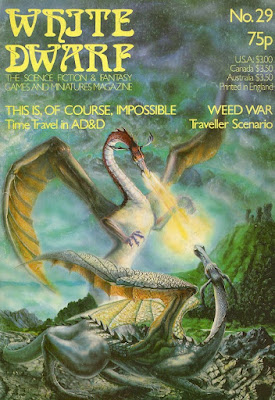
Issue #29 of White Dwarf (February/March 1982) features a cover illustration by Andrew George, depicting two dragons fighting with one another. It's a surprisingly mundane piece of artwork for WD in my opinion, but it's nevertheless well done. Inside, Ian Livingstone explains the origin of the magazine's name and it's as straight forward as one might have guessed. Since the then-nameless periodical was to cover both fantasy and science fiction, any proposed name would have "to reflect both those topics." He then explains that "a dwarf is a well-known fantasy character, and a white dwarf is a small, high density star. And that's all there is to it. Simple really when you think about it."
The issue starts with a bang. Paul Vernon presents the first part of a multi-issue series entitled "Designing a Quasi-Medieval Society for D&D." The inaugural article focuses on "The Economy – Workers and Craftsmen." Over the course of three, densely-packed pages – in the tiny font I so strongly associate with White Dwarf – Vernon covers a wide range of economic topics, from occupations, apprenticeships, wages, quality of goods, and more. In doing so, he attempts to stay true as possible to both history and to the established rules of (A)D&D, hence the use of "quasi-medieval" in the title. All in all, I think he does a good job of what he sets out to do, though at times I found his discussions tedious (as I usually do in works of this sort). On the other hand, the simple fact that he raises questions about the wider societal implications of D&D's rules is worthy of praise.
"Lucky Eddi" by Oliver Dickinson is a work of fiction set in the city of New Pavis in RuneQuest's setting of Glorantha. I'm generally not a fan of "game fiction," but I make an exception for Dickinson's work, which is delightful. His stories, of which this is the first, depict Glorantha from the perspective of the rogues and ne'er-do-wells of New Pavis. The style is reminiscent of the works of Damon Runyon and is a lot of fun, especially if you don't mind your version to be much less self-serious than the setting has become over the years. Reading Dickinson's stories in White Dwarf were one of the reasons I started to re-evaluate my previous prejudices about RuneQuest. Re-reading the first installment in this issue was a joy.
"Open Box" reviews four interesting products, starting with GDW's Fifth Frontier War, which earns a rating of 8 out of 10. The licensed Traveller supplement SORAG (published by Paranoia Press) receives an even higher rating of 9 out of 10. Barbarian Prince by Dwarfstar is a favorite of mine, so I was glad to see that the reviewer thought quite highly of it as well (8 out of 10). The final review was of Chaosium's Stormbringer, which only received a 7 out of 10 – still a solid rating but not as good as I would have expected in the pages of WD. The main complaint of the reviewer, Murray Writtle, is that the game is not suitable for long-term campaign play, as "inglorious death" was all too common. I think that's a fair comment, though I'm not sure I'd consider it a flaw in the game.
Dryden Badenoch's "The Mudskipper" is a 100-ton multi-terrain vehicle for use with Traveller. It's a clever idea and nicely presented, complete with a map of its interior. "This Is, Of Course, Impossible" by Marcus L. Rowland is an article outlining the possibilities for "Time Travel in AD&D." Over the course of three pages, Rowland nicely discusses the topic at hand. He starts off with an overview of various interpretations of time and how each views divergences. He then moves on to methods of time travel, from magical to technological, before discussing the use of time travel in adventures and campaigns. Rowland even includes a bibliography of stories touching on the subject. All in all, it's very well done.
S. McIntyre's "Weed War" is a Ttraveller scenario set on a world in the Spinward Marches. The scenario concerns a struggle between various interests for control of a native species of seaweed that is useful in the production of certain pharmaceuticals. I like the adventure well enough, though the general set-up is a well-worn one in Traveller. Roger E. Moore described "Gray and Sylvan Elves" as a PC race for use with AD&D and Bob Lock does the same for "The Brownie." Fuddy-duddy that I am, neither of these articles thrilled me; I'm generally of the opinion that D&D should have fewer race options, not more. "Fiend Factory" offers up five monsters from "The Light Desert." None of them really grabbed my attention, but the artwork accompanying the article is rather good. Finally, we get a new approach to "Amulets & Talismans" in D&D from Lewis Pulsipher. In his interpretation, the items in question are more disposable and can be made by PC spellcasters to provide limited magical protections and related effects.
Issue #29 is a very good one, filled with all the content I remember from my time reading the magazine. I continue to be pleased by the number of terrific Traveller articles published in White Dwarf, as well as the presence of longer, more detailed pieces about specific (and often unusual) topics. The first appearance of Oliver Dickinson's Pavis stories is simply the icing on the cake.
Tuesday, July 27, 2021
Interview: Rick Meints (Part I)
Rick Meints is the president of the venerable and celebrated RPG publisher, Chaosium – as well as a roleplaying gamer of long standing. Recently, he very kindly agreed to be interviewed, answering some questions about his history in the hobby, the games he's enjoyed playing, and what Chaosium is up to these days. Presented below is the first half of this interview; the second half will appear tomorrow.
1. How did you first become involved in the hobby of roleplaying?
I first played D&D back in late 1978 when I spent my allowance on the D&D Basic boxed set. It opened a whole new world of possibilities. I used graph paper from my math class to sketch out dungeons, and bought a few Ral Partha minis at my local hobby store to move my imagined characters around the map. My parents encouraged reading and told my sister and I that they would buy us any book we wanted. That made it easy to purchase the Players Handbook and Dungeon Masters Guide in 1979. As a kid that took care of my toys, I still have those books close to hand on a nearby gaming shelf in my home office. During summer vacations I played through the entire Giants and Drow (GDQ) series, happily power gaming all the way. The hook was set deep for what was to come when Tim Webster, our GM, showed us the RQ rulebook and Cults of Prax shortly thereafter...
2. What was your initial impression of RuneQuest and, more specifically, of its setting, Glorantha?
My gaming group started dabbling with RQ a few years after the game came out, mostly with some home-brewed scenarios. I devoured every word of Cults of Prax, especially the stories from "The Travels of Biturian Varosh" that were sprinkled throughout the book. I had previously played a cleric, but the religious side of the character was not fleshed out at all. To be honest I can't even remember which god the character was a cleric for. Playing a warrior who worshipped Orlanth and then a merchant who became a priest of Issaries was a very pleasant change. The depth of the game world of Glorantha intrigued me as well. What set the hook deeply was playing through almost all of the possible adventures in the sandbox campaign Griffin Mountain during the summer of 1981. Everything we encountered while working on Joh Mith's caravan was novel and exciting, be it Jack O'Bears, Citadels built by Giants, the occupying Lunar forces, seeking out the Windsword on Griffin Mountain, carving a Windbery tree branch to make a magic staff, or meeting the legendary Gonn Orta at his castle hidden in the mountains. I actually kept a bit of a game journal back then, which was a first for me. I wanted to write these stories down. We only took a break from RQ to try the next Chaosium game Tim brought home, which was Call of Cthulhu.
3. What did you think of Call of Cthulhu? Were you already familiar with Lovecraft at the time?
I had never read any of his books before playing Call of Cthulhu, and only knew a little about him because I saw a few of his books on Tim, our Keeper's bookshelves. I was keen to play, partially because I really like the 1920s era, and also because my character was able to use a Thompson submachine gun with a 50 round drum. Because it basically used the core rules also used for RuneQuest, it was easy to get playing right away, and we were soon battling various cultists. I enjoyed those game sessions, but we were playing it when there weren't that many supplements published for it yet, so I didn't play through many of the classics. We would have kept playing it but Tim went off to college and his brother Tom brought home a 2" boxed set called Stormbringer for us to try next.
4. Stormbringer is a favorite of mine. What did you think of it? Were you a fan of Moorcock's Elric stories?
I was excited to get a chance to play an RPG set in the Young Kingdoms. I had read several of the Elric novels (classic DAW paperbacks) about a year or so prior to Tom opening the Stormbringer box at our game table. I played a sailor from the Isle of Purple Towns who worshipped Strassha. After reading through the rules I noticed "Impressive Scar" on the Major Wounds table and getting one of those became my first in-game goal. That was followed by getting a Melnibonean Gold Wheel. The combat system was a bit more streamlined, which I liked. The magic system was also streamlined, but that appealed to me less. We all loved demon weapons and armor, and as an Agent I got pretty good at summoning water elementals. I don't remember the mission we were given by Strassha, but when we completed it we got the power to breathe water from him, which came in handy on several occasions during our further adventures. Alas, the closest we got to Tanelorn was Nadsokar.
5. A common element to most of the games you've mentioned so far are the rules originating in RuneQuest and later known as Basic Role-Playing. What did you find so appealing about those rules when you first encountered them? What do you still find appealing about them?
I initially liked the rules for a number of reasons. It was great that Chaosium uses the same basic rules in all of their games so if you know how to play RQ, learning Call of Cthulhu or Stormbringer or Ringworld is mainly learning about the game world. I also like the way you don't have a restrictive character class that limits what armor, weapons, skills, or spells you can use. With BRP you get to pick and choose a lot more of those things for yourself. I am happy to not have to chase experience points to improve my level and abilities. Skill use and combat also feel far less abstract. It means crunching more numbers, but I like crunching numbers. Most people immediately understand what having a 75% climb skill means and how much protection they get from two point armor. I've played a lot of game systems since the 80s, and the BRP rules still largely work for how I want to play, unless I am playing in a single shot adventure at a con. For one shots I usually prefer a more rules light storytelling type of system.
6. Are there any other memories you have of your early days of roleplaying, whether they be playing a BRP game or something else?
I bought the Holmes boxed Basic D&D set, but didn't know of anyone who played the game. I mainly just read through all the material and rolled up a character, but didn't really play the game until one of my friends in Junior High said he was willing to GM. He had just bought the Players Handbook and the Giants series of modules and was looking forward to running them. Because I was the only player, I played several characters, each of a different class. It worked for Brian and I. We ended up playing through Steading of the Hill Giant Chief, Glacial Rift of the Frost Giant Jarl, Hall of the Fire Giant King, Descent into the Depths of the Earth, Shrine of the Kuo Toa, and Vault of the Drow over the next year or so. With Tim and Tom Webster, the four of us took turns GMing games of Boot Hill, Top Secret, Gamma World, and Traveller. Our interest in each of those didn't last very long though. Gun fights turned out to be too deadly in Boot Hill, Brian and Tim thought the post-nuclear Gamma World was too preposterous (especially when I played a Hoop), the Imperium seemed boring in Traveller even though we liked rolling up veterans, and in Top Secret I had a hard time GM'ing when the three of them decided to become terrorists instead of playing good guys. We ate a fair bit of pizza and had a lot of laughs at the table along the way though. On Boy Scout trips Tom and I would often play the little black box games by Steve Jackson. Arena duels were popular in Car Wars because lots of us could play. We took long bus trips with the troop and would often play fairly late into the night because we could sleep on the bus during the day. We also played Tunnels & Trolls, but all I remember is getting to cast the "Take that you fiend" spell. Up until I went to college we were always playing something throughout the summer, plus weekends year round.
Tuesday, June 29, 2021
Different Worlds: Issue #21
I realize that technology, education, and shoes have caged me, kept me from a realm too often considered mere fantasy, a world through which I might perceive medieval literature, and all literature, and my entire life from a new and visual standpoint, a beautiful and fantastic world of pure reality.
I really don't know what to make of this article, so I won't even try.
Ken St. Andre's "The Elric Saga: See Battle Near Melniboné" is a solo adventure for use with Stormbringer. It's a fun little scenario based on events from the works of Michael Moorcock. "Creating Jolanti" by Michael Malony and Greg Stafford is a RuneQuest piece describing the constructed race known as the Jolanti. "Making a Magic Staff" by Gerald M. Schmitt is a D&D variant that offers rules and guidelines for making the ubiquitous wizard's staff much more mechanically useful. As is often the case with the articles of Different Worlds, it's not something I'd make use of myself, but I nonetheless appreciate variants of this sort.
This month's reviews highlight Waspwinter and Legend of the Sky Raiders, both for Traveller. The latter is rightly lauded, while the former is not. Also reviewed are Journey to the Center of the Circle (which I do not know) and Descent into the Depths of the Earth. John T. Sapienza's "An Expanded Cleric vs. Undead System" seeks to alter the turning system in order to better take into account the disparity between a cleric's level and that of the undead he's attempting to turn. Gigi D'Arn comments on how hard it is to write a monthly column, with which I can sympathize. Nevertheless, she comments upon the fall-out of the end of SPI, starting with its acquisition by TSR and the establishment of Victory Games. There's also mention of TSR's purchase of Amazing stories and a needlework company, as well as the (unrealized) rumor that Chaosium had obtained the rights to produce a game based on Fritz Leiber's Fafhrd and the Gray Mouser stories.
I continue to enjoy reading Different Worlds and am curious to see where the magazine goes as the 1980s wear on.
Monday, June 4, 2012
My Latest Acquisition
Fortune sometimes smiles on me, though, as it did recently. I was, at long last, able to obtain a terrifically well-preserved 1987 Games Workshop printing of Chaosium's Stormbringer RPG for a song.
For those of you too young to know this, back in the '70s and '80s Games Workshop often produced amazing hardcover editions of American RPGs for the UK market. Besides being hardcovers, they often incorporated supplemental material along with the rulebook, creating a unique "complete" edition that gave you everything you needed under one cover. This Stormbringer volume, for example, also includes The Stormbringer Companion, too, along with full color art plates.
It's easy to forget that, early on, Games Workshop acted as a mail order service for British gamers who wanted to get hold of the latest releases from North America. Later, they produced UK editions of popular games, such as this one and a Call of Cthulhu third edition I also possess. I still consider some of these editions to be the best ever made for their respective games, which is why I like to snag copies of them when I can do so at a reasonable price. This copy of Stormbringer, as you can see from the photo, is in superb condition. It's binding is still strong and the pages are clean. The only flaws are some slight whitening along the spine and the careful removal of four perforated character sheets at the back.
I was incredibly lucky to get hold of this one. I think I'll need to find some way to run it this summer, if only as a one-shot or short campaign.
Thursday, March 3, 2011
Thoughts Occasioned by BRP
I realize this probably puts me in the minority but I'm generally disinterested in ripping out rules systems in a RPG because I don't like them or because they intimidate me. Nowadays, there are so many different games available that, if I dislike large enough sections of a given game's rules, then I can simply discard it and find another game that better suits me. In the ancient days, this wasn't quite as viable and so there was a greater perceived need to "kit bash." Consequently, this talk of "get rid of X" or "ignore Y" doesn't appeal to me as much as it once did.
This is a big part of the reason why I favor OD&D over AD&D at the moment. To me -- and, again, I realize this is likely a minority opinion -- playing AD&D with large segments (no pun intended) of its rules removed, ignored, and/or replaced seems to defeat the point of AD&D. If I'm not using the published initiative rules or weapon vs. AC adjustments or material components or whatever, I might as well be playing OD&D plus whatever bits I like from the Supplements.
And, as I said, I feel similarly about RuneQuest. Ditching strike ranks or hit points by body part or whatever would likely speed up play and make it less intimidating to me, but to do so would be, in my opinion, to change the complexion of RuneQuest enough that I'd wonder why I was bothering to use the rules at all. If I'm going to play RuneQuest, I'd like to play it as close to what the designers intended as I can, house ruling only when absolutely necessary, but then that's my feeling about every RPG I play.
I'll have more to say on this topic in days to come. I've been planning to do reviews of both Mongoose's unfortunately named RuneQuest II and D101 Games's OpenQuest, each of which has points in its favor (and disfavor) and highlight different aspects of what I like (and dislike) about Basic Roleplaying. I'll try to get those up soon so that the discussion we've been having can continue.
Wednesday, March 2, 2011
Why BRP Frightens Me
That's a page from Apple Lane that provides the combat stats for five trollkin -- five. Gamers complain about the stat blocks of 3e monsters and rightly so, but it should be noted that Basic Roleplaying, at least in its RuneQuest and Stormbringer forms pioneered the lengthy stat block by providing ability scores, skill percentages, and hit points for each body part for every NPC the characters might conceive engage in combat against (which, of course, means all of them -- this is old school, after all).Certainly it's true that those stats are still much simpler and more straightforward than those of D&D III, but they're also much more complex and convoluted than those of OD&D (or AD&D). BRP combat isn't as abstract as OD&D's; that's one of its selling points and I can tell you from past experience that, done well, combat in Stormbringer (with which I have the most experience) can be a lot of fun. But it's also a lot more work than that in OD&D: takes more time, requires more dice rolls and more paperwork. I have no doubt that, with time and experience, it can run very smoothly.
Still, the thought of it frightens me. I'm just not sure I have what it takes any more to run a very complicated RPG, which is kind of a shame, because, one of these days, I would like to play Stormbringer or RuneQuest or Chivalry & Sorcery. Ah well.
Saturday, June 19, 2010
Japanese Stormbringer
Anyway, my world traveling friend (and player of Vladimir the dwarf) is in Japan on a business trip and sends along the following image:
It is, as you can see, a Japanese edition of Chaosium's Stormbringer RPG (the 5th edition from the looks of it). I think it looks absolutely awesome.
Tuesday, June 8, 2010
My Latest Haul
Monday, May 31, 2010
The Dramatic Effect
Whom do you really want to win this fight? Yes, a gamemaster is supposed to be neutral, but you know how you want the adventure to go, so make it work out. Simply describe the other fights in glowing terms, with much hewing off of heads and sundered limbs, while running the player-character battles normally.Take note of the sentence I've bolded above. I highly doubt that this is the first time that this sort of sentiment appeared in a RPG product. Indeed, I suspect that some enterprising person could probably cite an example of a similar sentence in a product from the first five years of the hobby. Likewise, I think it's pretty clear that advice presented in The Shattered Isle is not intended to be a manifesto of a new way of roleplaying. It's just reassurance for the referee to trust his instincts in ensuring that things "work out" as they should.
Thus, if the player-characters are losing when you want them to win, simply describe how their allies are defeating their foes with ease, then turning to assist the adventurers.
Similarly, if you want to drive off the adventurers and they are doing well in their own fights, describe the steady attrition of the allies until they find themselves fighting multiple foes, by which time the intelligent adventurers should try to get out of the mess they're in by voting with their feet.
But make no mistake: this does represent a shift in the conception of RPGs and the role of the referee in RPGs and not one for which I have much liking these days. I think it lends more credence to the notion that the mid- to late 1980s are when certain changes in the hobby became not only widespread -- they were probably popular long before this point -- but when gaming companies began not only to acknowledge but to encourage them.
Monday, May 24, 2010
Pulp Fantasy Library: The Dreaming City
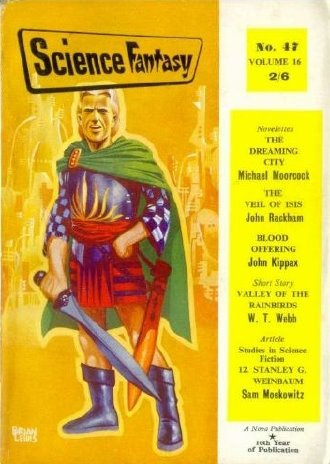
You may well recall the image to the left, as it was one of the earliest installments in what I'd then dubbed "Pulp Fantasy Gallery," a recurring feature intended to highlight the artwork associated with the classics of pulp fantasy on which D&D was founded. It didn't take long for me to rename the feature to what it is today, in part because I'm an even poorer critic of art than I am of literature, but also because, sadly, much of the artwork associated with pulp fantasy is pretty uninteresting to me. I honestly didn't think I could have sustained a weekly series by discussing art alone. Others might be better suited to that task, which is why I've stuck with discussing (largely) written works whose ideas and stories struck a chord with the founders of our shared hobby.Because of the original post cited above, I've never actually tackled an Elric story as part of this series. That's odd, because there's little doubt that the Elric saga had a clear and powerful influence on early D&D (and not just its alignment system). It's odd too given how much I adore Chaosium's Stormbringer RPG. Likewise, the Elric saga is, in my opinion, a textbook example of the dangers of success, a topic near and dear to my heart, as you well know. So, when I woke up this morning and read Dan Collins's excellent post on "Elric and Art," I knew today was the day to write my own post on the first Elric short story, "The Dreaming City," which appeared in the June 1961 issue of Science Fantasy.
The story begins evocatively:
For ten thousand years did the Bright Empire of Melniboné flourish -- ruling the world. Ten thousand years before history was recorded -- or ten thousand years before history had ceased to be chronicled. For that span of time, reckon it how you will, the Bright Empire had thrived. Be hopeful, if you like, and think of the dreadful past the Earth has known, or brood upon the future. But if you believe the unholy truth -- then Time is an agony of Now, and so it will always be.It's a terrific opening and one that really sets the mood for both the setting and the specific story Moorcock is about to tell. Equally terrific is the first description of Elric, which in my opinion matches Howard's justly famed description of Conan (which seems appropriate, given Elric's origin as, at least in part, an "anti-Conan").
Elric, the moody-eyed wanderer -- a lonely man who fought a world, living by his wits and his runesword Stormbringer. Elric, last Lord of Melniboné, last worshiper of its grotesque and beautiful gods -- reckless reaver and cynical slayer -- torn by great griefs and with knowledge locked in his skull which could turn lesser men to babbling idiots. Elric, moulder of madnesses, dabbler in wild delights ...What's most interesting about "The Dreaming City" is that the story it tells, that of Elric's invasion of Imrryr, capital of the Bright Empire, with the aid of sea raiders in order to defeat his cousin Yyrkoon and rescue his lover Cymoril, who's been placed in an enchanted sleep by Yyrkoon, her brother. Thus, Elric's saga begins with the climactic battle between his chief nemesis. Yyrkoon's eventual defeat at Elric's hands is thus the starting off point for what follows rather than the conclusion to it.
This should come as little surprise, given that Moorcock wanted, by his own admission, to turn many of the timeworn convention of swords-and-sorcery fiction on their heads and so he does here. Elric, as presented in "The Dreaming City" is a weak, decadent albino whose power comes as much, if not more, from sorcery and pacts with demonic entities, as it does from his blade. Were he in a Conan tale, he would almost certainly be an antagonist and, even in "The Dreaming City," he comes across as not wholly sympathetic. He is, after all, a man willing to betray his own people, leading others to sack the unconquered city of Imrryr in his personal quest for revenge.
"Imrryr fell, in spirit, five hundred years ago -- she will fall completely soon -- for ever! I have a little debt to settle. This is my sole reason for aiding you. As you know I have made only a few conditions -- that you raze the city to the ground and a certain man and woman are unharmed. I refer to my cousin Yyrkoon and his sister Cymoril ..."Yyrkoon has usurped Elric's throne while the albino sorcerer was away, wandering among the sneeringly named Young Kingdoms, the "lesser" states that have grown up in the shadow of Melniboné and whose powers have waxed while the Bright Empire's have waned. Unlike others of his race, Elric appreciated "the less sophisticated pleasures of the outside world," but he also felt "the pulse of his ancestry beat strongly in his deficient veins," equally appreciating the dark beauties of his own culture.
Speaking for myself, I find Elric a very ambiguous character, as I am sure he was intended to be. Though perhaps less cruel than his kinsmen, he is nevertheless a cruel character, one whose intensely personal drives lead him to the ruin of others, even those he least wishes to harm. It's possible, I think, to be sympathetic with Elric at times, but it's difficult to like him unreservedly. He possesses a powerful, raw appeal nonetheless and it's not hard to understand why he struck a chord with many readers only familiar with the often unimaginative pulp fantasy heroes who rose to prominence during the 40s and the 50s.
There's no question that Elric was different and fantasy readers were ready for different. Unfortunately, he also proved so successful that Moorcock could never abandon him, leading to ever more ridiculous stories featuring the character, the vast majority of which aren't, in my opinion, particularly good. Over time, Elric has become every bit as much a caricature of himself as had Conan under the guidance of L. Sprague de Camp. The much-reviled Drizzt Do'Urden may be laughable to a lot of us, but he would never have been possible without Elric, who firmly established the angsty, good-member-of-an-evil-people as a fantasy archetype.
None of this, though, undermines the genuine goodness of "The Dreaming City," which remains every bit as good as it probably was in 1961. Indeed, if anything, it's probably better now in some respects, since all of us who've suffered through the later Elric stories can return to it and its immediate sequels to remember that, once upon a time, Elric really was an interesting character and Moorcock was a visionary writer whose stories positively crackled with taut prose and amazing ideas.
Sunday, May 16, 2010
Woo-hoo!
I'm still trying to snag a copy of Pavis & Big Rubble, as well as Hawkmoon, though the latter looks to be a lot easier to find than the former.
Tuesday, August 11, 2009
Ken St Andre Explains It All
In section 1.1 of Stormbringer ("What is Roleplaying?"), Ken St Andre includes a very succinct explanation of what a RPG (or FRP game, in his usage) is and what its play consists of, part of which follows:
The FRP game's use of dice makes them partially a game of chance, unlike chess or other mathematically-based games that are purely games of skill. However, skill is definitely involved in the play of an FRP. Players need to develop skill in problem-solving, communication with others, and the ability to make rapid decisions, and when those skills are combined with luck and vicarious adventure, FRP games become far more interesting than any amusement based on only one of these factors.The italics are mine, because I consider them pretty important and key facets of the style of play I most enjoy. These are topics I'll be returning to at a later date, but I was trying to remember this quote earlier today when I wrote my piece on random character generation. Now it's here and I can refer to it later, as needed.
Monday, August 10, 2009
More Stormbringer Awesomeness
The literary genre of swords & sorcery fiction is a particularly gory branch of heroic fantasy, and that is what this game simulates. Inevitably, this means that some players are going to get into situations that they can't get out of, and their characters will have to die. It is important that they realize this before the game ever starts, and that they know that you bear them no personal animosity. Then, when the character's number comes up, kill him without regret. As a GM it is poor form to become so fond of some character that you let him cheat death when his luck finally runs out.
Generally speaking, a character's death should always be traceable to some decision or action that he made. A character who chooses to fight a bear and then gets killed by that bear has no gripe coming. A character who refuses to wear armor and then gets killed by an arrow when all his armored companions are advancing safely deserves his fate. A character who walks into a dragon's den to avoid a certain death outside it really can't complain if the dragon eats him anyway.
On the other hand, if the players comes up with a plausible way to survive a situation, and makes the required skill or POW saving rolls, then you really should let him survive. I once had a character who killed a monster -- a giant combination armadillo-wolf -- and then burrowed into its innards and hid inside the dead monster for hours to avoid innumerable others that were wandering around. It worked, too, and that character survived that particular trap, only to die later when caught out in the open by an aerial attack. He was happy to survive the first time, and I had no gripes when he died later because the GM was absolutely fair about it. If he had been smart enough, he wouldn't have been caught in the open.
Beggars Can't Be Choosers
The rulebook includes a section -- 2.3.10.3, if you're interested in its wargames-style organization -- entitled "Difficulty of Being a Beggar." It reads in part:
Because of their handicaps and very low status in the Young Kingdoms' society, it is not recommended that beginning players attempt to use Beggars for their adventurer characters. If you have randomly determined that your adventurer character is a Beggar, you may roll again on table [2.3.1.1] Class Background if you wish.Maybe it's final, definitive proof that I'm as mentally deranged as some have claimed, but I think that's one of the more awesome bits of text I've read in any gaming rulebook lately. Makes me want to run an all-beggar mini-campaign set in Nadsokor.
However, those players who enjoy a challenge may get a special kick out of attempting to beat the system and win with a character who is blind, deaf, or partially crippled. Any triumphs won with such a character would be correspondingly greater than those won by normal characters. If you do choose to play a Beggar, you have my condolences and best wishes.