Showing posts sorted by date for query castle amber. Sort by relevance Show all posts

Wednesday, January 21, 2026

Retrospective: Trail of Tsathogghua

I continue in my Quixotic quest to find RPG products that show the influence, explicit or otherwise, of Clark Ashton Smith. As I wrote last week, this has proven a surprisingly difficult endeavor, so I hope I can be forgiven for grasping at whatever straws I can find, which is why, this week, I'm taking a look at Trail of Tsathogghua, a scenario pack for Chaosium's Call of Cthulhu, first published in 1984. 

Now, as I've mentioned many times before, the Dungeons & Dragons module, Castle Amber, is probably – probably – what first introduced me to Clark Ashton Smith. I can't say that for certain, especially after forty-five years, in part because Call of Cthulhu was released the very same year, 1981, and it includes a number of references to Smith and his creations, most notably Tsathoggua. Having been a devoted CoC fan since its initial appearance, it's just possible that it was this game rather than Castle Amber that turned me on to CAS, but I think that unlikely.

Speaking of Tsathoggua, perceptive readers will no doubt have noticed that I spell the name of the Hyperborean bat-toad god differently than does the title of this scenario pack. For reasons unknown to me, author Keith Herber inserted an "h" into the deity's name, an addition not attested in Smith's own work nor, for that matter, in Call of Cthulhu itself, whose entry on him spells it as I do. Given that CAS includes a mangled spelling of the name (Zothaqquah) in his Averoigne stories, this isn't a particularly unusual variant, but I nevertheless can't help but wonder why it was used here.

Trail of Tsathoggua is a 64-page book, featuring a terrific cover by Steve Purcell, an artist who, in his later career, would work for LucasArts, Nelvana, and Pixar. The book consists of three adventures, the first two of which are loosely connected to one another, while the third stands on its own and is, by far, the best of the trio – and indeed widely regarded as one of the best Call of Cthulhu scenarios of its early years. 

The first adventure shares its title with the book itself, albeit with the definite article added, "The Trail of Tsathogghua." It concerns an Miskatonic University archeological expedition to Greenland, where a massive stone slab carved with a giant bas-relief and odd hieroglyphs has recently been discovered. As it turns out, the slab is an artifact of ancient Hyperborea, as described by Clark Ashton Smith, providing information not just about the prehistory of the region but also about the location of a temple to Tsathoggua that is strongly implied to be the same one Satampra Zeiros attempted to plunder untold millennia ago.

The second adventure, "The Curse of Tsathogghua," moves to Canada, British Columbia specifically, as characters investigate rumors of the Sasquatch and a connection to the Greenland expedition from the first adventure. Like the first scenario, this one has a connection to Smith's work, albeit a more tangential one, since the Sasquatch are depicted as present-day descendants of the furry Voormis of Hyperborea. The adventure also includes the possibility that, if successful, the investigators might draw the attention and patronage of the Canadian prime minister, William Lyon Mackenzie King (incorrectly called simply William Lyon McKenzie [sic] in the text), who, in real life, was secret Spiritualist with a keen interest in the occult. 

The third and final adventure, "The Haunted House," a title it shares with the classic adventure found at the back of the Call of Cthulhu rulebook, takes place in Grand Rapids, Michigan, and has little to do with the other two. Instead, it focuses on the Van Laaden Mansion, which is plagued by all manner of unusual and possibly supernatural events. The explanation for this is a clever and genuinely spooky one: centuries ago, a druid merged his consciousness into a tree that was later felled and shipped to America as some of the lumber used to build the Van Laaden Mansion. Now, his spirit possesses the place and wreaks havoc.

Taken as a whole, Trail of Tsathogghua is a mixed bag, but there are enough good ideas here to make it useful to almost any Keeper running a Call of Cthulhu campaign. As a fan of Clark Ashton Smith, it's nice to see ideas from his Hyperborea cycle incorporated into the game, even if the incorporation doesn't have a huge overall impact. Too few RPGs look to CAS at all, so I suppose I'm naturally inclined to give bonus points to products like this one that make even a small effort to do so.

Wednesday, January 14, 2026

Retrospective: Mark of Amber

Because I’m focusing this month’s posts on the life, works, and legacy of Clark Ashton Smith, I’ve been trying to find roleplaying game products to discuss in my weekly Retrospective series that connect, even tangentially, to him. I’ve been surprised by how difficult this has proven, a fact that’s probably worthy of a post of its own. Still, while pondering the question, I was reminded that fourteen years after the publication of Castle Amber for the Moldvay/Cook/Marsh edition of Dungeons & Dragons, TSR released a follow-up adventure, albeit a rather unusual one.

Released in 1995, Mark of Amber is a strange product, at once a sequel to 1981’s module X2, an experiment in multimedia presentation, and part of a broader effort by TSR to retrofit its “Known World” setting for use with Advanced Dungeons & Dragons. Consequently, this boxed adventure offers a revealing snapshot of TSR in its final years, as it looked backward for inspiration while simultaneously trying out new gimmicks in the hope of reinvigorating sales.

In the abstract, the core idea behind Mark of Amber is a solid one, namely, a return to the old-school weirdness of Castle Amber and expand upon it in interesting ways. Unfortunately, the published adventure is very much a product of its time, the mid-1990s, and all that entails. The tension between the original module’s unrepentant eccentricity and the narrative design impulses then in vogue results in a product that feels caught between two worlds, neither fish nor fowl.

It’s important to remember that, while Castle Amber has many virtues as an adventure, subtlety was never one of them. Tom Moldvay trapped the characters inside a haunted manor populated by eccentrics modeled on figures from Clark Ashton Smith’s fiction. Once ensnared, the PCs were expected to poke around the castle, encountering all manner of bizarre and often dangerous oddities. Castle Amber was thus a classic funhouse dungeon that, despite its literary inspirations, made no great pretensions about itself. It was simply a module where curiosity was its own reward – and frequently its own punishment.

Mark of Amber presents itself as a sequel, taking place decades after the events of X2. The d’Ambreville family still looms large, but the tone has shifted considerably. Gone is the open-ended exploration of a cursed mansion. In its place is a more structured mystery involving murders, secret identities, and dreamlike visions tied to the immortal Étienne d’Ambreville. This shift, I think, reflects a broader change in adventure design. Where Castle Amber invited players to wander, experiment, and uncover strangeness at their own pace, Mark of Amber asks them to follow a plot. Events are paced. Clues are arranged. The Dungeon Master is given a clear narrative spine to maintain.

This approach is by no means unique to Mark of Amber and isn’t even necessarily a flaw. Mystery scenarios, for example, often benefit from structure. Still, it does highlight just how different TSR’s adventure design priorities had become by the mid-1990s. If Castle Amber feels like a haunted museum for the characters to explore freely, Mark of Amber feels more like a guided tour. There are still plenty of strange sights to see and unhinged NPCs to interact with, but the route to them is far more constrained.

To the extent that Mark of Amber is remembered today at all, I suspect it’s largely because of its inclusion of an audio CD. TSR intended it to be played during the session, with specific tracks keyed to certain locations and encounters. The disc contains ambient soundscapes, musical stings, and even narrated segments designed to heighten immersion. This wasn’t the first time TSR had experimented with audio accompaniments, but it was, so far as I can recall, the only time I encountered it myself.

As ludicrous as this might seem now, in 1995 it was actually a somewhat ambitious idea. Tabletop RPGs were still overwhelmingly analog experiences. I doubt every group even had a CD player available at the table and, even when they did, cueing tracks mid-session would almost certainly disrupt play. As a result, the CD was probably more trouble than it was worth. For me, it stands as a perfect emblem of TSR’s late-era mindset: occasionally bold and genuinely experimental, but often out of step with how most people actually played their games.

An equally interesting aspect of Mark of Amber is its place within the evolution of the setting that would come to be known as Mystara. In its earliest conception, the Known World belonged firmly to the Basic/Expert line. AD&D already had its own distinct stable of settings, like Greyhawk, the Forgotten Realms, and Krynn, each with different assumptions about character power and campaign focus. Nevertheless, beginning in 1994, TSR began adapting Mystara for AD&D and Mark of Amber is part of that effort.

How well this translation worked overall, I can’t really say, since I didn’t purchase any of the other AD&D Mystara products. Even so, I sense a certain contradiction here. Mystara was built as a sandbox setting, with clear geography and room for emergent play, while many AD&D adventures of that time emphasized plotted narratives. Mark of Amber embodies this mismatch, taking place in a setting born in the freewheeling era of the early 1980s now pressed into service for a much more scripted style of play.

All of this leaves Mark of Amber as an uneven adventure. It boasts strong atmosphere, memorable NPCs, and an ambitious presentation, but it’s probably best remembered today for what it reveals about the state of TSR and, by extension, Dungeons & Dragons, just a few years before the company was acquired by Wizards of the Coast.

Bringing this back to Clark Ashton Smith for a moment, Mark of Amber is a curious artifact. Its connection to CAS is almost entirely inherited rather than organic, filtered through Castle Amber rather than drawing directly from the source. Where Moldvay’s original module gleefully embraced the weirdness and excess of Smith’s fiction, Mark of Amber seems to me to approach that inheritance with a more cautious, narratively controlled hand.

In that sense, the adventure neatly encapsulates TSR’s situation in 1995. It looks backward to a beloved classic, tries to dress it up with new technology, and then situates it within a setting undergoing corporate redefinition. The result is neither a pure revival nor a bold reinvention, but something in between. It's a respectful sequel that never quite recaptures the anarchic spirit that made its predecessor memorable.

Castle Amber remains, in my opinion, a monument to Golden Age D&D’s joyful strangeness. Mark of Amber, by contrast, stands as a reminder of how much the game (and its publishers) had changed. For better or worse, it shows us what happens when old school weirdness is filtered through the sensibilities of the 1990s, becoming more polished, more controlled, and ultimately less surprising.

Wednesday, January 7, 2026

Thoughts Occasioned by Castle Amber

This post is not, strictly speaking, a Retrospective, since I've already done one on Tom Moldvay's 1981 module, Castle Amber – two, actually, if you count the repost as well. Nevertheless, in honor of The Ensorcellment of January, I thought it more than appropriate to take another look at the only old school Dungeons & Dragons module to take explicit inspiration from the works of Clark Ashton Smith. While I'll endeavor not to repeat much of what I said in my original Retrospective, there will inevitably be a few points to which I'll return, though I hope I'll offer some additional insights to justify doing so.

Despite my repeatedly thinking otherwise, the name of Clark Ashton Smith does not appear anywhere in Appendix N to Gary Gygax's AD&D Dungeon Masters Guide nor does he appear in the expanded list of "favorite authors [and] inspirational sources" in his 1992 Mythus Magick bonus. On one level, it's a very odd omission, as Gygax was quite well read when it came to fantasy and science fiction literature – including lots of early pulp fantasy authors, like Robert E. Howard and H.P. Lovecraft, both of whom he considered "among the most immediate influences" on his conception of the game he co-created. 

The fact that Gary Gygax, of all people, could seemingly have either not known or not cared about CAS suggests that, compared to many of his literary contemporaries, he has always been, if not necessarily obscure, something of an acquired taste. Speaking even as an avowed devotee of Smith, I can’t really blame anyone who finds his mellifluous prose, sardonic demeanor, and detached misanthropy a bit much, particularly when set beside the more muscular storytelling of Howard or the raw imaginative urgency of Lovecraft. Smith demands patience and a willingness to luxuriate in language for its own sake. His stories often feel less like adventures than like jeweled relics to be contemplated from a respectful distance.

Consequently, Smith’s fiction is not easily mined for gameable elements in the way Conan’s swordplay or Lovecraft’s Mythos can be. Howard offers clear models for heroic action and conflict. Lovecraft provides a cosmology of forbidden knowledge, cults, and monsters that can be lifted almost wholesale into play. Smith, by contrast, traffics in mood, decadence, and fatalism. His stories often lack conventional heroes, hinge on ironic or poetic reversals, and end not with triumph or revelation but with extinction, transformation, or bitter resignation. These qualities make his work harder to translate into D&D and that difficulty is probably at the root of why Gygax took little notice of him. Smith does not easily become a list of monsters, spells, or magic items.

Fortunately for me, Tom Moldvay did notice him. Although I’m still not absolutely certain that it was Castle Amber that first introduced me to Smith – it may well have been Call of Cthulhu, released the same year as module X2 – I can say with certainty that it was this adventure that solidified Smith’s hold over my imagination. Castle Amber suggested that roleplaying games could evoke not just action or terror, but a sense of dreamlike estrangement and baroque melancholy. It suggested that play could feel uncanny rather than merely dangerous, strange rather than merely challenging, and that those feelings could linger long after the dice were put away.

That lingering quality is a large part of why I still love Castle Amber four decades later. It is, above all else, unsettling. On the surface, it is just another dungeon for characters of levels 3 to 6, complete with monsters, traps, and treasure. Dig a little deeper, though, and the dungeon in question reveals itself as a kind of fun house, governed less by internal logic than by a warped, almost oneiric sensibility. Its 70 keyed locations feel less like rooms in a coherent structure and more like fragments of half-remembered stories stitched together by madness and decay.

One chamber hosts a boxing match against magical constructs; another contains the lair of spellcasting spiders imported from The Isle of Dread (itself another Moldvay creation); elsewhere, there is a kennel of hellhounds. None of these elements really belong together, at least not in a naturalistic way and that disjunction might be the point. The titular Castle Amber resists easy categorization. It feels wrong in a way that is difficult to articulate, as if it obeys a set of esthetic or even metaphysical rules that the players can sense but never fully grasp. Layered on top of this is the grotesque parade of the Amber family themselves – decadent, deranged, and occasionally tragic figures who are, unsurprisingly, closer to characters out of Smith’s own stories than to standard fantasy villains.

Castle Amber thus has a very strange vibe, one that I picked up on even as a twelve-year-old. It made me uneasy in a way that very few D&D modules ever have. How much of that vibe is intentional and how much of it is something I've been projecting onto it is difficult to say, especially after so many years of reading and playing it. I assume at least some of it must have been intentional, because Moldvay was adapting elements of Smith's Averoigne stories for use with D&D and those stories have a similar ambience. 

This brings to mind another question that has longed dogged me about this module: why was this particular module was ever released. Though not a close adaptation of the Averoigne tales, it's close enough that special thanks are given to CASiana Literary Enterprises, Inc. (the estate of Smith) "for use of the Averoigne stories as inspirational material." It's unclear whether TSR acquired or sought out a license from CASiana for use of the stories or not, but, even if it didn't do so formally, Castle Amber is an unusual early example of an RPG product published by TSR explicitly derived from a pre-existing intellectual property. 

Regardless, I count Castle Amber as one of my favorite adventure modules for any edition of Dungeons & Dragons. Not only did it play a role in making me a lifelong Clark Ashton Smith fan but it also forever affected my sensibilities when it comes to fantasy and fantasy adventures. It was, for example, one of the primary inspirations behind my own The Cursed Chateau (an adventure that I am, not coincidentally, in the process of revising for re-release). It's a weird, fun, disconcerting scenario and I think it still holds up today.

Monday, July 7, 2025

Dungeons & Dreamscapes

I’ve often said I feel fortunate to have discovered Dungeons & Dragons when I did, before the dead hand of brandification settled over the game and drained it of the wild, untamed esthetic that once made it so visually compelling and culturally strange. In the years before D&D became a polished entertainment “property,” its visual identity was a chaotic collage of influences drawn from unexpected sources: psychedelic counterculture, turn-of-the-century Art Nouveau, underground comix, pulp magazines, and outsider art. Monsters leered with extra eyes and boneless limbs, while dungeons sprawled like fever dreams. There was a visual lawlessness to early D&D (and to roleplaying games more broadly) that mirrored the creative freedom of its rules. That freedom invited players to imagine fantasy worlds that were not simply adventurous, but also surreal, grotesque, and deeply personal.

These thoughts came back to me recently while flipping through some of the Dungeons & Dragons materials I encountered shortly after I took my first tentative steps into the hobby. Looking at them now, decades later, I’m struck not just by their content, but also by their form. Much of the art did not resemble anything I had seen before. It was crude at times, even amateurish by the standards of commercial illustration. Yet, it was also evocative in a way that transcended technique. These images did not so much depict a fantasy world as suggest one, obliquely, symbolically, even irrationally. Many felt like fragments from dreams or relics from some lost visionary tradition and, on some level, they were.

That tradition was a subterranean one, largely outside the orbit of mainstream fantasy art. Psychedelic poster designers, Symbolist painters, and zinesters working on the margins of the counterculture all contributed, consciously or not, to the strange visual DNA of early roleplaying games. Before branding demanded consistency and legibility, Dungeons & Dragons was porous enough to absorb all of it. The result was an esthetic that was both wildly eclectic and, paradoxically, cohesive in its weirdness. It didn’t feel like a mainstream product; it felt like artifacts from another world.

Today, it’s common to point to Tolkien as the primary visual and thematic influence on early D&D. His mark is real and unmistakable (despite what Gary Gygax wanted us to believe). However, when you examine the actual artwork that filled TSR’s products in the late 1970s and early ’80s – the era when I entered the hobby – you find yourself far from Middle-earth. Instead of noble elves and stoic rangers, you see grotesque creatures, warped anatomy, anatomical impossibilities, and alien geometries rendered in flat inks and, later, garish colors. This wasn’t the Shire. This was something older, more primal, and far stranger.

Where did this esthetic come from?

As I’ve already suggested, part of the answer lies in the psychedelic explosion of the 1960s. This was a cultural moment that sought to dissolve the boundaries between consciousness and art. Psychedelic artists like Rick Griffin and Victor Moscoso developed a visual language rooted in abstraction, distortion, and saturated color, a kind of sensory mysticism meant to evoke altered states. Concert posters and album covers became portals to other dimensions. Meanwhile, underground comix, like those of Robert Crumb or Vaughn Bodē, combined sex, satire, fantasy, and absurdism into worlds that gleefully rejected the conventions of good taste or coherent storytelling.

While Gygax and Arneson were not themselves products of this milieu, the audience they attracted often was – college students, sci-fi fans, and other oddballs shaped by the psychedelic visual environment of the late ’60s and early ’70s. I was younger than that cohort, a child in fact, not a teen or adult, but even I absorbed some of its esthetic currents. They filtered into my world through album covers, comics, cartoons, toys, and the hazy, low-fi look of the decade itself. I didn’t yet know what most of these things meant, but I nevertheless felt their strangeness. They stuck with me, shaping my imagination in ways I only later came to understand.

TSR, for its part, didn’t initially reflect these influences. Much of the earliest D&D art was traditional or utilitarian, inherited from the wargaming scene. As the game’s popularity exploded in 1979, TSR began to draw on a new crop of young illustrators, many of them influenced, directly or indirectly, by underground comix, countercultural poster art, and the lingering weirdness of the 1970s. Their work didn’t smooth out the chaos from which early D&D was born – it amplified it.

No one embodied this more than Erol Otus. His illustrations for the Basic and Expert boxed sets are among the most iconic in the history of the hobby, as well as some of the strangest. Otus’s monsters don’t just look dangerous; they look wrong, like something glimpsed in a fever or half-remembered from a dream. His color palettes are lurid, his anatomy grotesquely playful, his compositions uncanny and theatrical. His esthetic doesn’t belong to heroic fantasy. It belongs to a blacklight poster, hung next to a velvet mushroom print and a battered copy of The Teachings of Don Juan.

Otus, whether intentionally or not, brought the visual grammar of psychedelia into the core of D&D. In doing so, he captured something essential about the game: that it wasn’t just a fantastic medieval wargame; it was a tool for exploring the irrational, the liminal, the transformed. Other artists took up different parts of this same sensibility. Dave Trampier’s work, for example, especially his iconic AD&D Players Handbook cover, radiates a stillness and mystery more akin to myth or ritual than heroic adventure. Other similarly restrained pieces of early D&D likewise seem caught between worlds.

The same spirit is evident in third-party publications. Judges Guild modules are packed with crude, surreal illustrations that throb with symbolic weirdness. David Hargrave’s Arduin Grimoire goes even further. It's a deranged collage of cybernetic demons, magical diagrams, flying sharks, and bizarre maps that reads like D&D filtered through Zardoz. It’s no coincidence that Hargrave gave Otus his first professional credit. They were kindred spirits, working not within a genre, but along the outermost fringes of it.

Beyond psychedelia, another artistic thread ran through the background: the ornate, esoteric elegance of Art Nouveau. The flowing lines of Aubrey Beardsley, the sacred geometry of Alphonse Mucha, and the decadent mysticism of Gustav Klimt all haunt the margins of early RPG art. Beardsley’s illustrations for Salome or Le Morte d’Arthur look, at times, like direct ancestors to early D&D's depictions of witches, sorcerers, and demons. These fin de siècle influences were rediscovered during the 1960s counterculture and found their way, through posters, tarot decks, and zines, into the strange visual stew of early roleplaying games.

Even the dungeon itself is shaped by this visionary impulse. Early dungeons aren’t realistic structures. They’re mythic underworlds. They don’t obey architectural logic but symbolic logic, filled with teleporters, talking statues, secret doors, and fountains of infinite snakes. They’re not places so much as thresholds. To descend into a dungeon is to cross into a space where transformation of one kind or another is not only possible but expected.

That’s why so many early modules have such power decades later. Quasqueton, Castle Amber, White Plume Mountain, The Ghost Tower of Inverness – they’re not just combat arenas. They’re almost spiritual landscapes, mythic spaces presented as keyed maps. The artwork used to depict them conjures a mood, a worldview, a sense of mystery, inviting players to see fantasy not as genre convention, but almost as a moment of altered perception.

However, as D&D became a brand, this strangeness was steadily scrubbed away. Style guides were introduced. Idiosyncratic artists gave way to professionals. The game’s visuals became cleaner, more representational, more standardized. With that polish came a flattening of the imagination. D&D no longer looked like a vision; it looked like product.

This, I think, is what so many of us in the early days of the Old School Renaissance were reaching for, even if we couldn’t name it at the time. We were looking for the weirdness again, for the ecstatic, chaotic, sometimes unsettling energy that marked those early years. We remembered when fantasy didn’t have to be safe or heroic or respectable. We remembered when D&D looked like a door to Somewhere Else.

That's because fantasy, properly understood, is not an esthetic. It is a vision of the world tilted just enough to let the impossible shine through. Like the pioneers of science fiction and fantasy, the early artists of Dungeons & Dragons understood this. Otus understood it. Trampier understood it. So did Beardsley, Griffin, and countless anonymous illustrators working on mimeographed zines and early rulebooks in the 1970s. They weren’t just drawing monsters or dungeons. They weren’t just illustrating rules. They were revealing other worlds.

Monday, April 17, 2023

Pulp Fantasy Library: The Mandrakes

Of Clark Ashton Smith's three main cycles of fiction – Zothique, Hyperborea, and Averoigne – I encountered Averoigne first, thanks to the Dungeons & Dragons module, Castle Amber. Consequently, I've retained a great affection for that "sorcery-ridden province" of pre-modern France, even though my estimation of Zothique has since eclipsed it. Averoigne is a place of sinful passions run amok, where pride, envy, wrath, and, above all, lust are given full vent, with frequently horrific results. 

"The Mandrakes," which first appeared in the February 1933 issue of Weird Tales, is a good illustration of prcisely what I mean. The short story tells the tale of a married couple, Gilles Grenier and his wife, Sabine. The pair came "into lower Averoigne from parts unknown or at least unverified" and soon established themselves in a little hut
close to those marshes through which the slackening waters of the river Isoile, after leaving the great fosest, had overflowed in sluggish, reed-clogged channels and sedge-hidden pools mantled with scum like witches' oils. It stood among osiers and alders on a low, mound-shaped elevation; and in front, toward the marshes, there was a loamy meadow-bottom where the short fat stems and tufted leaves of the mandrake grew in lush abundance, being more plentiful and of greater size than elsewhere through all that sorcery-ridden province. The fleshly, bifurcated roots of this plant, held by many to resemble the human body, were used by Gilles and Sabine in the brewing of love-philtres. Their potions, being compounded with much care and cunning, soon acquired a marvelous renown among the peasants and villagers, and were even in request among people of a loftier station, who came privily to the wizard's hut. They would rouse, people said, a kindly warmth in the coldest and most prudent bosom, would melt the armor of the most obdurate virtue. As a result, the demand for these sovereign magistrals became enormous.

Initially, the couple worry that their activities might attract unwelcome attention and, with it, charges of witchcraft. Instead, they find the opposite: they enjoy "a repute by no means ill or unsavory," even among the local clergy, "because of the number of honest marriages promoted by the philtres." 

Ironically, Gilles and Sabine themselves do not seem enjoy such a marriage.

It was rumored by visitors that [Sabine] had oftentimes been overheard in sharp dispute with her husband; and people soon made a jest of this, remarking that the philtres might well be put to a domestic use by those who purveyed them. But aside from such rumors and ribaldries, little was thought of the matter. 

Consequently, when, five years after their arrival in Averoigne, Sabine is no longer seen with her husband, the locals simply accept the explanation of Gilles, namely that " his spouse had departed on a long journey, to visit relatives in a remote province" even though "there had been no eye-witnesses of Sabine's departure." For his part, the sorcerer took to

living tranquilly with his books and cauldrons, and gathering the roots and herbs for his magical medicaments, was well enough pleased to have it taken for granted. He did not believe that Sabine would ever return; and his unbelief, it would seem, was far from irrational. He had killed her one evening in autumn, during a dispute of unbearable acrimony, slitting her soft, pale throat in self-defense with a knife which he had wrested from her fingers when she lifted it against him. Afterward he had buried her by the late rays of a gibbous moon beneath the mandrakes in the meadow-bottom, replacing the leafy sods with much care, so that there was no evidence of their having been disturbed other than by the digging of a few roots in the way of daily business.

Gilles, we soon learn, "was not sorry that he had killed Sabine," as "they had been ill-mated from the beginning" and "it was far pleasanter to be alone." 

The following spring, "there was much demand for his love-philtres among the smitten swains and lasses of the neighborhood" and so Gilles "went forth at midnight beneath the full May moon, to dig the newly grown roots from which he would brew his amatory enchantments." 

Smiling darkly beneath his beard, he began to cull the great, moon-pale plants which flourished on Sabine's grave, digging out the homunculus-like taproots very carefully with a curious trowel made from the femur of a witch.

Though he was well used to the weird and often vaguely human forms assumed by the mandrake, Gilles was somewhat surprized by the appearance of the first root. It seemed inordinately large, unnaturally white; and, eyeing it more closely, he saw that it bore the exact likeness of a woman's body and lower limbs, being cloven to the middle and clearly formed even to the ten toes! These were no arms, however, and the bosom ended in the large tuft of ovate leaves.

Gilles was more than startled by the fashion in which the root seemed to turn and writhe when he lifted it from the ground. He dropped it hastily, and the minikin limbs lay quivering on the grass. But, after a little reflection, he took the prodigy as a possible mark of Satanic favor, and continued his digging. To his amazement, the next root was formed in much the same manner as the first. A half-dozen more, which he proceeded to dig, were shaped in miniature mockery of a woman from breasts to heels; and amid the superstitious awe and wonder with which he regarded them, he became aware of their singularly intimate resemblance to Sabine.

When Gilles digs up another plant "with less than his usual care," he accidentally cuts into "one of the tiny ankles."

At the same instant, a shrill, reproachful cry, like the voice of Sabine herself in mingled pain and anger, seemed to pierce his ears with intolerable acuity, though the volume was strangely lessened, as if the voice had come from a distance. The cry ceased, and was not repeated. Gilles, sorely terrified, found himself staring at the trowel, on which there was a dark, blood-like stain. Trembling, he pulled out the severed root, and saw that it was dripping with a sanguine fluid.

With that, "The Mandrakes" becomes a story of revenge, as the murdered Sabine seemingly seeks satisfaction from beyond the grave. Smith handles this turn effectively in my opinion, as Gilles receives his much deserved comeuppance. "The Mandrakes" is brief and to the point, wasting no verbiage on extraneous details, focusing instead on the crime of Gilles Grenier and the supernatural retribution it brings about. It's an enjoyable little yarn that somewhat reminds me of Poe – a compliment I suspect Smith would have gladly accepted.

Wednesday, December 7, 2022

Retrospective: Creature Catalogue

Like a great many players of fantasy roleplaying games – probably most, come to think of it – I am a collector of monsters. The AD&D Monster Manual was the very first RPG product I ever bought for myself and, ever since then, new collections of monsters are usually an easy sell for me. Contradictorily, I'm also largely of the opinion that Dungeons & Dragons has too many monsters. If pressed, I'd walk back that assertion with a variety of cavils and equivocations, in part to justify my continued interest in new books of monsters – I am nothing if not self-justifyingly hypocritical. 

A good example of my hypocrisy comes in the form of 1986's Creature Catalogue. As an avid AD&D player, I believed myself obligated to ritually denounce "kiddie D&D," the truth is that there was a lot of excellent material published for that game line over the years of its existence. I clearly recognized this fact even at the time, because I'd often buy – and use – its modules, accessories, and even boxed sets in spite of my ostentatious repudiation of them. 

I rationalized my purchase of the Creature Catalogue on the grounds that it was simply a monster book and that I might find some new foes in its pages with which to challenge the characters of my AD&D campaigns. To be fair to my youthful self, there was quite a lot of truth in my rationalization. It was indeed very easy to make use of elements of D&D – particularly its monsters – in AD&D, which is what I sometimes did. I did this to go effect with several of the monsters from Castle Amber, for instance, so the Creature Catalogue seemed like a solid investment.

In the end, though, I wound up being somewhat disappointed by my purchase. While the book presents more than 200 monsters, a little less than half of them were previously published elsewhere, generally in D&D modules. This was admittedly also true of my beloved Monster Manual II, but less so, since fewer appeared elsewhere and, there's no denying it, the overall quality was better. The monsters of the Creature Catalogue are simply not as good as those of the Monster Manual II, being by turns mundane or silly. There are naturally plenty of exceptions – with so many monsters, it would've been odd if there weren't – but my overall feeling remains that the Creature Catalogue is underwhelming.

The book is divided into distinct sections, each one of which is devoted to a type of monster. Thus, we get a section on animals, another on humanoids, and yet another on "lowlife," the term adopted for vermin monsters. The size of each section varies, with animals and, frustratingly, humanoids being quite numerous and undead – a favorite of mine – being comparatively less so. I say "frustratingly" with regards to humanoids, because it's long been my feeling that D&D could use a lot fewer intelligent, bipedal beings, but I realize this is an unpopular opinion.

Another disappointing aspect of the Creature Catalogue is how many "new" monsters it includes that are translations of pre-existing AD&D monsters into D&D terms. There are nightmares, hook horrors, umber hulks, and ropers, to name just a few. This is admittedly a continuation of a trend begun by the later Frank Mentzer-authored Companion, Master, and Immortal boxed sets, so I can't lay any special blame on the compilers of the Creature Catalogue (Graeme Morris, Phil Gallagher, and Jim Bambra) for it. However, I felt even in 1986 and feel more so now that one of the genuine virtues of the separate D&D line is that it had its own unique flavor distinct from that of AD&D. It was precisely this flavor that regularly got me to sheepishly buy D&D products in the first place. By "crossing the streams," so to speak, TSR was diluting what made D&D worthy in its own right.

The Creature Catalogue is not bad, so much as less good than I had hoped it would be. That's probably an unfair assessment born largely out of my own overblown expectation that it might be a Monster Manual III, but there it is. In general, I like monster books, even idiosyncratic ones like the Fiend Folio. Unfortunately, I can't count the Creature Catalogue among those for whom I have much fondness today and that's a shame. For all my adolescent snobbery, the Dungeons & Dragons line, at its best, offered another imaginative perspective on fantasy roleplaying that I found valuable; that's why I kept buying its releases. For the most part, the Creature Catalogue lacks that perspective. Instead, it feels tired and played out – and that's a genuine shame.

Monday, September 19, 2022

Fun and Challenges

One of the things at which the OSR excels is categorization and the creation of jargon to encapsulate these new categories. Though perhaps inevitable in any thoroughgoing examination of ideas, these practices can be somewhat off-putting to newcomers, not to mention conducive to tedious obscurantism. At the same time, categories and verbal shorthand are genuinely useful, despite the confusion they can engender to those not well versed in their intricacies. 

As its title suggests, dungeons are a foundational element of the play of Dungeons & Dragons. It should, therefore, come as no surprise that, since its inception, the OSR had devoted a lot of virtual ink examining and re-examining dungeons from nearly every possible angle. Consequently, there's also been a concomitant amount of jargon invented to describe dungeons and aspects of them, such as megadungeon or the term I want to talk about now, funhouse dungeon.

Take a look at this map:

The image above is small, so please click to enlarge it and examine its details. The map originally appeared here and is entitled "The Quintessential Dungeon." It's a really nice piece of work in my opinion, both in terms of the brief way it presents its information but also – and perhaps more importantly for my present purposes – the way it manages to include so many well-worn components of old school dungeons. There's a bottomless pit, an alignment-reversing mirror, collapsing stairs, and a subterranean river, not to mention such de rigueur monsters like a rust monster, a mimic, and green slime. 

I find "The Quintessential Dungeon" utterly delightful in the way it sincerely and unironically celebrates all the things I so strongly associate with my early experiences of playing Dungeons & Dragons. (It also reminds me a bit of Zarakan's Dungeon from Down in the Dungeon, which may explain its appeal to me.) I think it's a good example of the kind of thing that some might call a funhouse dungeon, in that it contains a weird mélange of tricks, traps, and monsters seemingly lacking in a unifying principle (beyond the suggestion that the place is a wizard's testing ground to recruit adventurers. 

Over the years, I've used the term funhouse dungeon without any qualms. Indeed, I've even use the term in reference to some of my favorite published D&D adventures, like White Plume Mountain and Castle Amber. Though I meant no disrespect to the designs of these modules by my use of the term, I've lately started to think "funhouse dungeon" might be too glib a term for what we're talking about in most cases. The essential feature of dungeons of this sort is not that they're chaotic jumbles devoid of any rhyme or reason but that they include lots of deadly challenges intended to test the mettle and ingenuity of the characters who dare to enter them.

My point – assuming I have one – is that, rather than being silly, what we typically call funhouse dungeons are actually quite serious, in the sense that surviving them requires more than a hack 'n slash approach to its contents. Likewise, the varied nature of those contents should be viewed not as an anarchic mess but as yet another aspect of its challenging nature. Because one room might contain a group of trolls who've captured a halfling and the next a teleportation trap, the players have to keep on their toes in a way they might not in a dungeon that follows more naturalistic principles.

Perhaps I make too much out of what is ultimately little more than a terminological issue. What I most wanted to say in this post is that I think, as I have grown older, I've acquired a much greater respect for dungeons whose primary purpose is to present a gauntlet of clever tricks, cruel traps, and gimmicky monsters for the characters to overcome in pursuit of gold and experience points. I used to think less of dungeons of this sort. Nowadays, I recognize that funhouse dungeons – or whatever better term might replace it – can be every bit as satisfying, not to mention terrifying, as more plausibly built subterranean labyrinths.

Tuesday, April 26, 2022

White Dwarf: Issue #35

Issue #35 of White Dwarf (October 1982) features a wonderfully evocative cover by Les Edwards. Covers like this one highlight one of the most visible differences between WD and Dragon. Dragon's cover artwork was, in general, very good, but much of it felt "game-y" to me, whereas White Dwarf's cover illustrations looked like the kind you might see on fantasy and science fiction novels – no surprise, since many of the pieces originally did appear on novels). 

Ian Livingstone's editorial references an unnamed survey of unit sales of RPGs in the USA. According to this survey, the ten top selling games are, in order: D&D, AD&D, Traveller, The Fantasy Trip, Top Secret, Chivalry & Sorcery, Tunnels & Trolls, RuneQuest, Space Opera, and Arduin Grimoire. Quite the list, isn't it? I'm not at all surprised to see both D&D and AD&D there; the same goes for Traveller. With the exception RuneQuest and perhaps Tunnels & Trolls, I wouldn't have expected any of the others to be on the list at all, never mind in the top ten.

"The Necromancer" is a new AD&D character class by Lewis Pulsipher. The class is interesting in two respects. The first is that it's limited only to evil aligned characters, much like the assassin (or the death master). The second is that it's not, strictly speaking, a sub-class of magic-user but is instead a unique class all its own. Consequently, it doesn't have spells but "abilities," rated according to "grades," ranked from 1 to 5. Many of these reproduce the effects of certain existing spells (e.g. animated dead, feign death, speak with dead, etc.) but the majority of them are original and focus on the creation and control of undead beings. The class is distinctive and well done and would work well as the basis for an antagonist. I'm not so sure I'd allow its use for a player character, but then I long ago lost the taste for evil PCs.

"... We Have a Referee Malfunction" by Bob McWilliams is a short, humorous article about how a Traveller referee should handle situations that don't go as planned in a session. While it's clearly satirical in purpose, McWilliams nevertheless presents some genuinely useful ideas in the article. "Green Horizon" by Marcus L. Rowland is a stand-alone Traveller scenario in which the players take on the roles of alien beings – the Ksiffchi – whose ship misjumps and winds up in orbit around a primitive planet. Due to the misjump, the ship is damaged and the crew of the vessel have no choice but to land on the planet and attempt to find the parts they require to effect the repairs. The twist is that the primitive world is, in fact, Earth and the Ksiffchi have arrived in June 1944. If you've ever wanted to play a sci-fi adventure where marsupial-like aliens face off against Nazis, "Green Horizon" is for you.

"Open Box" starts its reviews with the Games Workshop boardgame of Judge Dredd (9 out of 10). Next up are five different TSR modules for D&D and AD&D: The Sinister Secret of Saltmarsh (9 out of 10), The Secret of Bone Hill (8 out of 10), Against the Giants (10 out of 10), Palace of the Silver Princess (10 out of 10), and Castle Amber (6 out of 10). As you can see, it's both an odd collection of modules and an odd array of ratings. I'm particularly baffled by the high rating of Palace of the Silver Princess, which, while it has much to recommend it, is not even close to being in the same category as the Giants modules. Likewise, I take some offense at the mediocre rating of Castle Amber, but I readily admit my affection for the things probably blinds me to some of its flaws. Finally, there's a review of Chaosium's Borderlands, which receives a 10 out of 10. 

"Lashing Out" by Phil Masters is a surprisingly long article on introducing whips into Dungeons & Dragons. In addition to ordinary whips, Masters also presents multiple magical whips, some of which have unusual effects (like the whip of lightning). "Weapon Quest" by Andrew Brice offers up multiple new weapons for use with RuneQuest. Part II of Lewis Pulsipher's "A Guide to Dungeon Mastering" tackles the subjects of "Monsters & Magic." This encompasses not just the choice and placement of monsters and magic items in a dungeon, but also the use of magic and magic items by monsters. As with its predecessor, the advice is solid for it time, but, from the vantage point of 2022, there's hardly anything here I've not before.

"Lord of Kanuu" by John R. Gordon presents a new monster – the spidron – and a mini-scenario in which to use it. The spidron is a malignant green liquid that can disguise itself under a robe to appear as if it is a humanoid being. Instead of being silly, it's strangely creepy, partly, I think, because of the spidron's use of drugs to create zombie-like minions from ordinary people. The author says that he was inspired by an episode of the television show The Tomorrow People. Never having seen the show (that I can recall), I wonder if any readers who have might be able to identify the story that inspired him.

Aside from "The Necromancer" (about which I nevertheless have some issues), issue #35 doesn't stand out in my opinion. It's not a bad issue by any means, but it doesn't quite rise above the level of "workmanlike." That's no criticism. It's difficult to produce exceptional material on a monthly basis; the fact that it ever happens is, frankly, remarkable.

Monday, December 13, 2021

The Runners-Up

Selecting D&D modules for my Top 10 list was difficult – more difficult than I imagined it would be. Even limiting my choices to those published by TSR during the years between 1974–1983, there were a large number of viable choices. Inevitably, I excluded a few modules that, had I a larger list, I would probably have included. In the interests of clarifying my thought processes, I've decided to reveal five more modules for which I have great fondness but that, for one reason or another, I excluded. Unlike the previous two posts, I'm going to focus here on why I didn't select them for my Top 10. In some ways, this post might be even more illuminating than its predecessors.

These runners-up are ranked according to how close they came to making it onto my Top 10 list. 

5. The Lost Caverns of Tsojcanth

As a kid, I adored this module, though much of my adoration came from the 32-page insert included with it. The insert featured a plethora of new monsters, many of them demons, which would later appear in the pages of the Monster Manual II, along with many new magic items. This sort of thing was like catnip to me at the time. But that insert is not the module itself. I've come to realize that, while the titular caverns are solid enough as an adventuring locale, they're not remarkable enough to warrant inclusion in my Top 10 list. With the benefit of hindsight, I realize now that my fondness for The Lost Caverns of Tsojcanth actually reflects my fondness for the year in which it was published – 1982 – and the possibilities I saw in AD&D's future rather than the content of the module proper. I still think there's a lot to like here, but not enough to have made my final cut.

4. The Secret of Bone Hill

My reasons for eliminating this module from the list was quite simple: it didn't see much use at my table back in the day. I've always regretted that. The Secret of Bone Hill is a very well presented low-level module. It has the potential, I think, to serve as a terrific kick-off to a new campaign. Indeed, I've heard of referees who've done just that and, by all accounts, this module is easily the equal of The Keep on the Borderlands and perhaps even The Village of Hommlet. But, as I said, my appreciation for it is largely academic, based almost entirely on reading its text rather than playing through it with others. As a kid, I swiped some elements of the module – like the skelters and zombires, which really impressed me at the time – for use in my own scenarios. I also repurposed some of its maps in a similar fashion. Beyond that, this was one of those modules I bought largely out of loyalty to TSR rather than because I expected to use it as intended.


3. White Plume Mountain

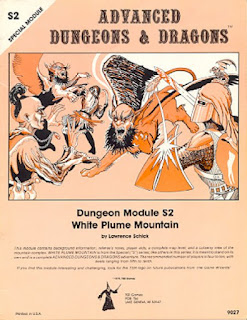
This module is the quintessential "funhouse dungeon," which is why I so wanted to include it on my Top 10 list. Ultimately, it didn't make the final cut, because the list already included Castle Amber, a funhouse dungeon I played extensively and repeatedly back in my youth. Compared to that, White Plume Mountain is very much an also-ran. My friends and I had lots of fun with the module, but I only ever ran it once. In my Top 10 list, I placed a lot of importance of replayability and White Plume Mountain, for all its virtues, is more or less a one-and-done kind of dungeon. The characters go there for a specific reason – to recover the three stolen magic weapons – and, once they've achieved that goal, why go back? That's not a damning criticism, to be sure, but it's enough of one in my mind that I had no choice but to exclude it from my Top 10, despite my fondness for it. 

2. The Sinister Secret of Saltmarsh 

Excluding this one hurts. In many respects, this module is perfect. It's got an excellent premise and is very well presented. That it's intended for use with beginning characters points even more strongly in its favor. On the other hand, its premise – that the supposedly haunted mansion of an alchemist is actually being used as a hideout for rather mundane bandits – works against it somewhat. I say that with some regret, as I quite like this "Scooby-Doo" approach, which I see as the culmination of Gygaxian naturalism in some respects. My experience, though, is that many players are disappointed when they discover that there's nothing actually supernatural going on and that everything happening has a purely rational explanation. Consequently, I have fewer fond memories of refereeing this than any of those included in my Top 10.

1. The Keep on the Borderlands

This should not be a surprise. I have probably played module B2 more than any other D&D module, to the extent that I practically know many sections of it by heart. It's a fun scenario that's a great introduction to the game, so why not include it? Quite simply, I find it a little unimaginative these days. The titular keep feels very generic and underdeveloped (perhaps intentionally). The Caves of Chaos are a bit of a slog. Even the Shrine of Evil Chaos, which was my favorite part as a youth, feels lackluster, especially when compared to the lair of Lareth the Beautiful in The Village of Hommlet. These criticisms probably seem unfair and they might well be. I can only say that, speaking in 2021, I don't like The Keep on the Borderlands as much as I once did and that fact influenced my decision to keep it off the Top 10 list. Even so, I came very close to dropping The Hidden Shrine of the Tamoachan for it.

Thursday, December 9, 2021

My Top 10 D&D Adventures of the Golden Age (Part I)

By far and away, the most popular post I've ever written on this blog is one of its earliest ones. Entitled "30 Greatest D&D Adventures of All Time," the post is a brief commentary on a list published in issue #116 of Dungeon magazine, in which I offered my thoughts on the entries included in this list. The list includes modules from the entire history of Dungeons & Dragons up until that point (2004) and its choices, as I say in my post, are idiosyncratic to say the least. Even so, the list is a good conversation starter and I've had many fruitful discussions of the merits and flaws of various D&D modules over the years.

Recently, a long-time reader of this blog asked me if I'd ever written a post in which I ranked the modules of D&D's golden age. As it turned out, I had not and, with his encouragement, I started thinking about doing so. Unlike my reader, I wasn't prepared to look at all the adventures published for D&D during the period between 1974 and 1983. Instead, I decided to restrict myself solely to those published by TSR during that period. Further, I was only going to rank my top ten. 

Please note the possessive pronoun. What follows is the first part of a list of the ten D&D adventure modules published by TSR during the game's golden age, ranked according to my own tastes. I make no claims that my preferences are, let alone should be, universal. Nevertheless, I will make an effort to explain the reasons I've included every module on this list. I hope that doing so will provide not just some context to my own ranking but also engender wider conversation about the classics of the early days of Dungeons & Dragons.

10. The Hidden Shrine of Tamoachan

Of all the modules in my list, this is the one whose esteem in my eyes has risen the most. That's because, with the benefit of hindsight, I better appreciate the cleverness of its design. While there are a handful of monsters to be found here, such as the first appearance of the gibbering mouther, the real attractions are the shrine's many tricks and traps. Speaking as someone who's often had difficulty coming up with such things, I can't help but admire the imaginations of Harold Johnson and Jeff R. Leason. They succeeded in creating a good mix of challenges for both brain and brawn, which is precisely what a good dungeon requires to be memorable and fun. Couple this with the Mesoamerican vibe of the shrine – used to good effect in the included illustration booklet – and you've got a winner. One of these days, I ought to try running it again to see if I can use it to better effect than I did as a kid. Given the quality of its design, I suspect I can.

9. Expedition to the Barrier Peaks

Published in 1980, this is the first (but not the last) time Gary Gygax's byline is seen on this last. As a kid, I was somewhat ambivalent about this module, given its inclusion of explicitly science fictional elements, but, nowadays, such genre bending appeals to me a lot more. Beyond that, the module features lots of unique encounters, not just with the alien animals living aboard the wrecked spaceship – who can forget the froghemoth? – but with some of the weird denizens of the Monster Manual, like the mind flayer and the intellect devourer. Equally memorable are the striking visual designs of the high technology scattered throughout the ship. Few of them look anything like what players would expect of a futuristic weapon, which very nicely simulates how medieval fantasy characters might look on such things the first time they encounter them. Finally, the design of the ship's decks deserve praise too.

8. The Lost City 

I simply adore this module. The only reason it isn't rated higher is that there are so many excellent candidates for this list and inevitably one of them would have to occupy this rank. Part of what I regularly call Tom Moldvay's "Pulp Fantasy Trilogy," (the other parts to be discussed shortly) The Lost City is a great evocation of, as its name suggests, the "lost city" genre that was a staple of pulp fiction (Howard's "Red Nails" probably being one of the most relevant examples for our purposes.) That Moldvay wrote the adventure for low-level characters is, to my mind, one of its best features. Too often scenarios of this sort are reserved to higher levels, on the assumption that the lost civilization contains mighty wonders and terrors suitable only for potent PCs. Moldvay, on the other hand, offers up the titular city as the starting point for a whole campaign, one that could potentially take those low-level characters to much greater heights of power and importance. That's how it's done.

7. The Isle of Dread

This was the adventure module that first taught me the joys of wilderness exploration, an aspect of D&D with which I still sometimes struggle to this day. Together, David Cook and Tom Moldvay present a delightfully open-ended locale, populated by all manner of monsters and NPC. Though the promise of treasure is what initially draws the characters to the Isle, there's so much more to do there, whether it be fighting prehistoric monsters, negotiating with the natives, or even just filling in every hex on the blank map they're carrying with them. When I first refereed this in my youth, the player characters spent many sessions on the Isle, scouring every hex in search of its mysteries. In the process, they ran afoul of pirates who would eventually become recurring antagonists for a time. The module is also notable for having presented a map and brief gazetteer of the "Known World" fantasy setting.

6. Castle Amber

This module ranks so high for me, because it was my introduction to the fiction of Clark Ashton Smith, thereby initiating a lifelong fascination with the Bard of Auburn and his works. Of course, Castle Amber is a genuinely fun adventure, provided you're in the mood for a funhouse dungeon. What I like about this module is that, while it is a funhouse, filled with bizarre and occasionally silly things, it's not completely inexplicable. There's an underlying logic to the place and its inhabitants. There are reasons why the Amber family behaves as they do and uncovering those reasons play a large role in the fun of this adventure – assuming you survive. I know many aficionados of old school D&D point to Judges Guild's Tegel Manor as the best example of this style of "wild and woolly" module, but, for my money, Castle Amber is better written and presented and overall more fun. It's a true classic and worthy of more praise than it typically gets.

Monday, November 30, 2020

Huge Ruined Piles


Men & Magic, Volume I of original Dungeons & Dragons, in a section entitled "Preparation for the Campaign," rather famously describes a dungeon as a
"huge ruined pile, a vast castle built by generations of mad wizards and insane geniuses".

The quote is a popular one in the OSR and for good reason: it's incredibly evocative. Reading it, I find myself thinking of an immense, crumbling Gothic structure, perched precariously on some mountaintop and sprawling across its slopes. In this, I've likely been influenced by the cover illustration to OD&D's Supplement II: Blackmoor.

What's interesting is that both the Blackmoor and Greyhawk campaigns were centered around – and indeed named after – a castle (as was Rob Kuntz's El Raja Key). Despite that, it was the levels beneath those two castles that served as the focus of player character action rather than the castles proper. Castle Greyhawk did have an "upper works" (as did Castle Zagyg), but they did not occupy much of the player's attention, at least according to one account by James M. Ward. For Castle Blackmoor, we have a map of the surface levels of the castle, presented in Judges Guild's The First Fantasy Campaign, but they're sadly not very interesting – hardly a "huge ruined pile."
Speaking of Judges Guild, the 1977 module, Tegel Manor, is in some ways closer to this ideal, though, at only 250-ish rooms, it's probably too small to be called truly "sprawling" (though moreso than either Castle Amber or my own The Cursed Chateau). 

I've written before about "above ground" dungeons, but, in that case, I was thinking mostly of ruined cities on the model of Glorantha's Big Rubble, which is itself worthy of further discussion. However, my present musings are occasioned more by today's Pulp Fantasy Library entry. I now find myself thinking about immense, haunted castles – an unholy amalgam of Castle Dracula, Neuschwanstein, and the Winchester Mystery House, peopled with all manner of monsters and perhaps even the degenerate descendants of the original inhabitants á la H.P. Lovecraft's The Lurking Fear
It's funny really that "the dungeon," meaning an improbable warren of subterranean tunnels should become the default environment for adventuring in RPGs. On one level, it makes perfect sense, since dungeons, as conceived by roleplaying games, have no real world analog, thus freeing the referee to map them according to his own fancies. Mapping a castle, even an absurdly large and rambling one, might demand at least a little knowledge of the layout of such buildings and that can impede one's creativity. I've experienced a little of this myself, in detailing the surface ruins of Urheim, since it's meant to be a "real" fortified monastery where all of its buildings have a clear and logical purpose. 

That aside, I don't see any reason why a would-be designer of a massive castle "dungeon" need be limited by real world considerations. My references above to Neuschwanstein and the Winchester Mystery House were chosen specifically to highlight the legitimacy of whimsical, irrational, and downright deranged design choices. After all, if your huge ruled piles is the result of "generations of mad wizards and insane geniuses," why should its floorplan be bound by normal logic? 

I remain quite taken with Jason "Philotomy Jurament" Cone's notion of "the dungeon as mythic underworld," which I believe comports almost perfectly with OD&D's presentation of the game's play environment. But we need not be too literal when it comes to adopting this perspective. Properly presented, a sprawling, crumbling castle can be every bit an example of an underworld as any series of monster-infested tunnels. Indeed, if one looks at Gothic fiction from the late 18th through 19th centuries and beyond – fiction that has had a clear influence on fantasy roleplaying – cursed and haunted castles abound and entering them is often metaphorically akin to descending into Hades (consider Jonathan Harker's trip to Transylvania in Dracula, for instance).

Obviously, creating a dungeon of this sort will require some re-thinking of the traditional structure of levels and the difficulty associated thereto. Off the top of my head, I might suggest dividing the castle into wings, with certain certain wings being "low level" and others "high." Alternately – or even in conjunction with wings – one might instead opt for a vertical approach: as one ascends the castle's spires, it becomes more difficult. Another possibility is simply to dispense with such artificial notions and opt for a more "organic" one, where the challenge is independent of location and characters exploring the place must learn to be clever to avoid running into dangers beyond their present abilities. The possibilities are quite large and, were I a better cartographer, I might start work on my own huge ruined pile. Alas, my skills in this area are negligible, so it won't be happening anytime soon. One day ...

Tuesday, November 17, 2020

Imagine Magazine: Issue #19

Chris Collingwood provides the cover for issue #19 of Imagine (October 1984). Its first article is "The Art of Animation" by Mark Davies, which deals extensively with the topic of golems and other magically animated beings. I've always had a fondness for golems, influenced perhaps by the presence of the magens in Castle Amber. The article itself is solid, looking not just at existing golems and golem-like creations but providing several new ones. Meanwhile, "Geas" by Venetia Lee presents several geased magical items. These items are powerful but they also impose restrictions on the behavior of the person possessing them, such as the sword of Bast, which prevents its wielder from ever willingly harming any cat or cat-like creature. It's a simple idea but a good one. 

"The Private Lives of NPCs, Part II" is a follow-up to an article that appeared in issue #11. Like that previous article, which I enjoyed, this one is very good, focusing on a half-dozen basic questions a referee should ask himself when creating non-player characters. It's not a radical or revelatory article, but it's the sort of grounded, commonsensical piece that I still find helpful, even after four decades of gaming. This month's game reviews caught my attention, purely for historical reasons. The first Dragonlance adventure, Dragons of Despair, is given a positive review, unlike the Top Secret scenario, Ace of Clubs. Never let it be said that Imagine was a mere house organ, despite being published by TSR UK. The review of Avalon Hill's Powers & Perils is encouraging, noting that, while it was unlikely that such a complex game would develop a huge following, it was nonetheless worthy of continued support. I have a weird fascination with P&P myself, so I appreciated seeing this review.

"Sinvel's Peril" by Doug Cowie is a Dungeons & Dragons adventure for levels 12-15, intended, it seems, to promote the newly released Companion Rules. The scenario concerns the defense of the town of Sinvel against a horde of barbarians – a trite set-up that's been done numerous times and better, but it does include some terrific maps by Paul Ruiz (about which more below). "Role Playing for Remedials" by Alan Heaven is another look into the past. The article is a counter to suggestions that RPGs are "addictive escapism." How strange to consider that this was once a serious charge against the hobby! Pete Tamlyn offers "Towards Systemless Scenarios," which is a brief overview of the question of how to present adventures intended to be used by many rules systems. The answer? Be as vague as possible, as demonstrated in the companion article (also by Tamlyn), "The Stolen Herd." I'm being flippant, of course, but it is  true the case that what Tamlyn is suggesting is not so much scenario writing as establishing a broad "plot" and then letting each referee decide how things play out. On the other hand, "Games without Frontiers" by Graeme Davis is extremely practical – maybe too practical – as delves into mathematical comparisons of various rules systems.

Paul Vernon's "Uncharted Stars" is a rare example of a Traveller article in the page of Imagine (leaving aside the previous issue), something that was very common in White Dwarf.  It provides rules for spectral classes for stars, as well as an Amber Zone (scenario). Colin Greenwood's "Fantasy Media" tackles a pair of movies (The Last Battle and Supergirl) and a pair of novels (Tanith Lee's The Castle in the Dark and James P, Hogan's Voyage from Yesteryear). "Rubic of Moggedon" and "The Phalanx" comics are here once more, along with Roger Musson's "Stirge Corner." Musson talks about the two ways alignment can be interpreted: as ethics or allegiance. Though short, it's a fine meditation on this contentious topic and does a good job of offering some solutions.

The real heart of the issue is "Pellinore: Law and Order" by Paul Cockburn, which describes the legal system of the City League. There are discussions of police forces, courts, and crimes, in addition to tables devoted to adjudicating all of the above. There's also a gazetteer of those sections of the city where the Courts can be found, along with NPC write-ups of various magistrates. It's terrific bit of worldbuilding by small steps, one that I now realize I have been subconsciously imitating in my own Urheim posts – great minds and all that! The article is accompanied by the maps of Paul Ruiz, whose style I absolutely adore. It's unlike any other cartographer I've seen before or since and I find myself wishing he were still active in the scene.
Imagine has definitely hit its stride. This is a great issue, probably my favorite so far. I look forward to the next one.